
Phase 1 Orthodontics Signs for Kids Ages 6-10 Broward
Your kid's smile matters to you, and you're paying attention to the early signs that might need orthodontic care.
Maybe you've noticed their teeth are crowding, or they're breathing through their mouth more than usual.
Maybe your pediatric dentist mentioned that early evaluation could save you headaches down the road.
The truth is, spotting when your child might need Phase 1 orthodontics doesn't have to be confusing or stressful.
I've walked this path with my own kids in Broward County, and I know the feeling of wondering if you're catching things early enough or if you're overthinking it.
Let me break down what you actually need to know about Phase 1 interceptive treatment for kids ages 6 to 10, what signs matter, and why families across Pembroke Pines, Hollywood, Weston, and Cooper City trust SMILE-FX Orthodontic & Clear Aligner Studio to guide them through this process with honesty and care.
What Is Phase 1 Orthodontics and Why It Matters for Your Child's Growth
Phase 1 orthodontics isn't about slapping braces on your kid's teeth when they're six years old.
It's actually something way different.
We're talking about interceptive orthodontic treatment that works with your child's natural growth and jaw development to guide things in the right direction early on.
The American Association of Orthodontists recommends kids get their first orthodontic check by age 7.
This isn't to scare you into treatment.
It's to catch small issues before they turn into bigger problems that might need more invasive treatment later.
Think of it like this: catching a slight jaw misalignment when your kid is still growing is way easier than trying to fix it after their growth plates close.
When your child's jaw is still developing, Phase 1 early intervention can guide growth patterns, create more space for permanent teeth, and sometimes prevent the need for extractions or major orthodontic work as a teenager.
At SMILE-FX in Miramar, our board-certified orthodontists specialize in this kind of interceptive care for South Florida kids.
We use cutting-edge low-dose CBCT scans for precise evaluations that don't expose your child to unnecessary radiation.
The goal is simple: set your kid up for better long-term outcomes without forcing treatment they don't actually need.
The Key Warning Signs Your Child Might Benefit from Early Evaluation
So what are you actually looking for?
Here are the red flags that show up in kids between 6 and 10 that warrant an orthodontic evaluation.
Crowding or Spacing Issues
You notice their baby teeth are overlapping or there are big gaps between teeth.
This is super common in growing mouths, and it often makes brushing harder.
When permanent teeth start coming in, sometimes there just isn't enough space in the jaw for everything to fit nicely.
Early intervention can guide jaw growth to create more natural space.
Crossbite Problems
This is when the upper front teeth sit inside the lower front teeth instead of overlapping the way they should.
A crossbite can affect how your child's jaw develops if it goes unchecked.
It's one of those things that's easy to fix early but gets more complicated as kids get older.
Mouth Breathing Habits
Kids who breathe through their mouth instead of their nose often have related teeth and jaw positioning issues.
Mouth breathing can stem from allergies, habits, or airway concerns.
We check this gently without alarm and work on addressing the root cause.
Lingering Thumb Sucking or Tongue Thrust
If your kid is still sucking their thumb or has a tongue thrust habit past age five or six, this can push teeth out of alignment and affect bite development.
Catching this early makes a real difference in preventing bigger problems later.
Not every sign means your child needs treatment right now.
Sometimes the smartest move is monitoring their growth and watching how their permanent teeth come in.
This is where honesty matters.
We tell parents straight up: if your kid doesn't need treatment yet, we'll tell you.
We monitor for free and check in regularly.
You can see real examples of Phase 1 cases from Broward families at our treatable cases page.
Why the Age 6 to 10 Window Matters So Much
Your child's jaw is still growing and reshaping during these years.
Their permanent teeth are starting to come in.
Their bite is still developing.
This window is basically a golden opportunity.
If there are issues that need guidance, this is the time when working with their natural growth gives you the best results.
Once kids hit their teens and their growth slows down, some of those corrective opportunities close off.
Phase 1 treatment in this age range often means appliances that guide jaw growth or create space for permanent teeth.
It's not the full braces situation you might be picturing.
It's strategic, it's gentle, and it's designed to work with your kid's development rather than against it.
What to Expect at Your Child's First Orthodontic Evaluation
You're thinking about scheduling a visit, and you want to know what happens.
Fair question.
Here's what a typical first appointment looks like at SMILE-FX:
We start with a warm greeting from our team who know how to talk to kids without being weird about it.
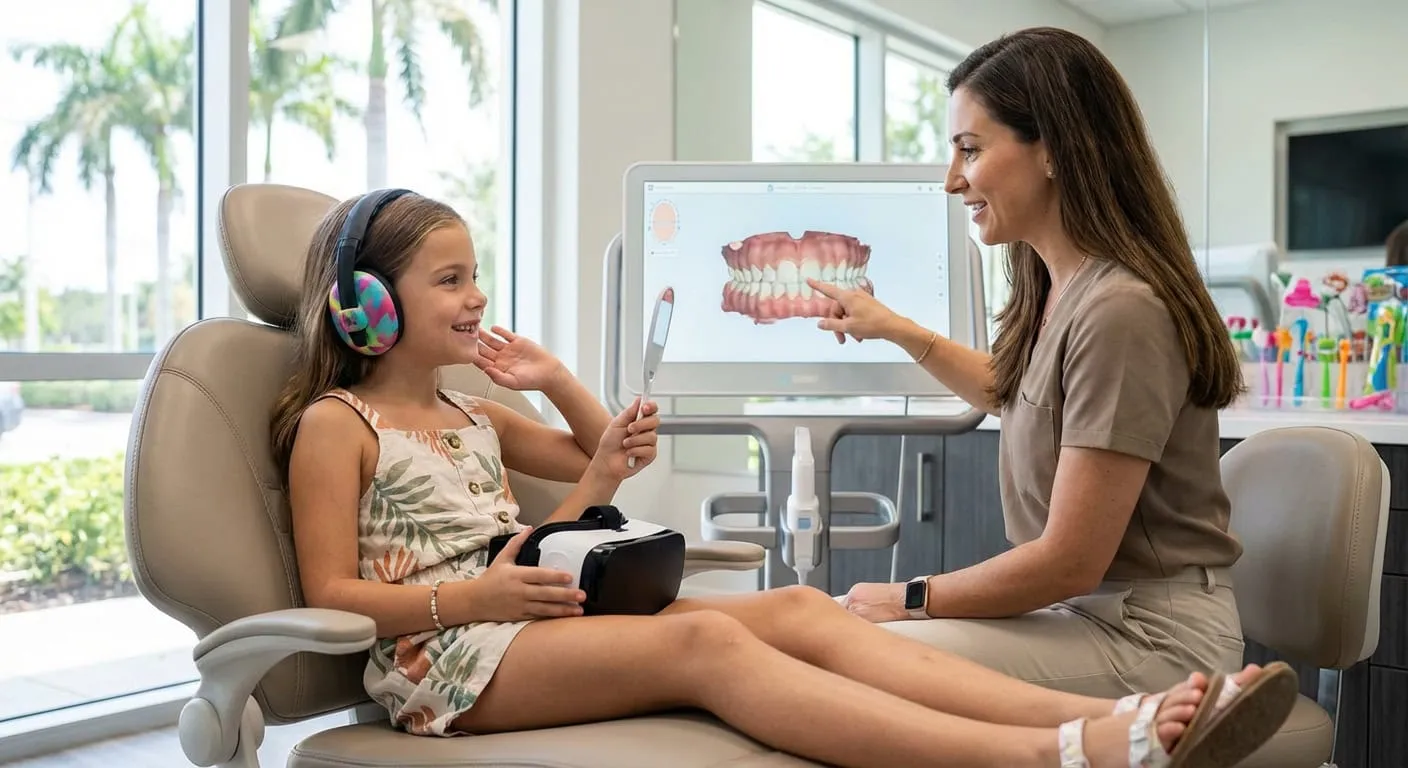
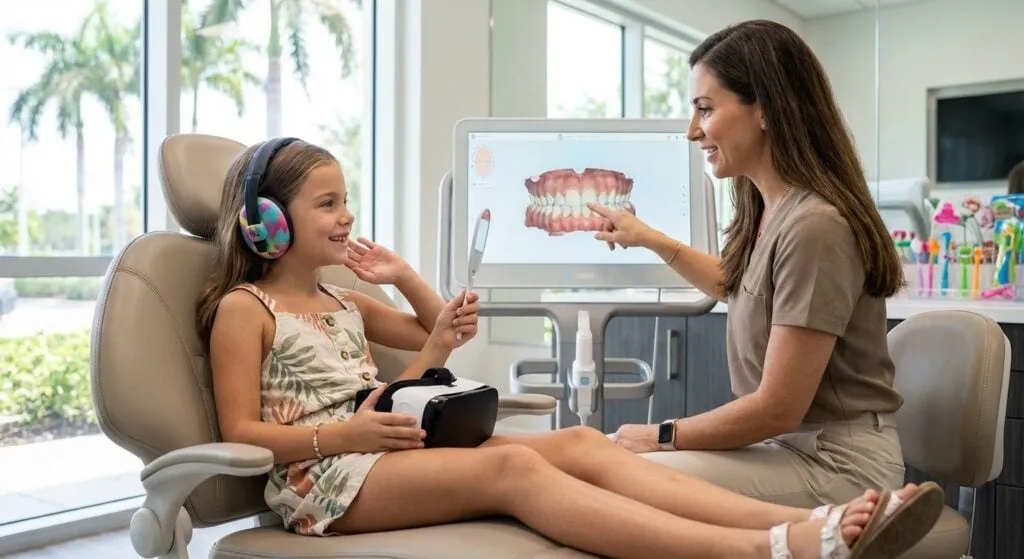
Next, we take photos and quick low-dose X-rays or CBCT scans that we explain simply, like a "smile map" for your kid's mouth.
Your child gets to relax with VR games or shows to keep them comfortable while we work.
The whole thing takes 30 to 45 minutes.
We give your kid snacks and make sure they know this isn't a scary place.
Then we sit down with you and give it to you straight.
If your kid needs Phase 1 treatment, we explain why and what it looks like.
If they don't need treatment yet, we tell you that too.
We're not running a mill where every kid gets braces.
We're actually listening to your child's specific situation and planning accordingly.
You get a clear next-steps plan, and you're not pressured into anything you don't need.
Check out our why choose SMILE-FX page to see what other Broward families are saying about their experiences.
Why Families from Pembroke Pines to Fort Lauderdale Choose SMILE-FX for Phase 1 Orthodontics
We're the trusted partner for pediatric dentists across South Florida for a reason.
Families drive 10 to 30 minutes from all over Broward County because we get Phase 1 orthodontics right.
Our Miramar location is central, easy to reach from Pembroke Pines via I-75, Hollywood via Pine Island Road, Weston, Cooper City, Davie, and Fort Lauderdale.
We offer after-school and weekend appointments so treatment fits your family's schedule without disruption.
What really sets us apart is how we handle kids.
We have VIP suites designed specifically for young patients.
We use noise-canceling headphones, weighted blankets, VR games, kid-friendly shows, and snacks to make sure your child feels comfortable and safe.
Our board-certified orthodontists are specialists, not general dentists trying to do orthodontics on the side.
We know jaw growth.
We know early intervention.
We know how to talk to six-year-olds and ten-year-olds in ways that actually make sense to them.
Parents trust us because we're honest about what their kids need and what they don't.
We use cutting-edge technology like low-dose CBCT scans for safe, precise evaluations.
And we're connected with pediatric dentists across South Florida who know we're going to take great care of their young patients.
Common Questions Parents Ask About Phase 1 Orthodontics
Does my child really need Phase 1 treatment at age 7?
Not automatically.
Per the American Association of Orthodontists, about 80% of kids don't need Phase 1 treatment.
We evaluate each child individually and tell you straight if treatment is actually needed or if monitoring is the better call.
What's the difference between Phase 1 and Phase 2 orthodontics?
Phase 1 happens while your child is still growing, typically between ages 6 and 10.
It focuses on guiding jaw development and creating space for permanent teeth.
Phase 2 usually happens after all permanent teeth have come in, typically in the teen years, and focuses on final tooth positioning and bite alignment.
How do you keep kids comfortable during visits?
We've got it dialed in.
VIP suites, weighted blankets, noise-canceling headphones, VR games, shows, snacks.
We know that a kid who feels comfortable is a kid who cooperates, and cooperation makes everything work better.
When is treatment NOT needed?
If your child's growth is on track and their teeth are coming in reasonably well, sometimes the best move is monitoring.
We'll check in regularly and track their development without starting treatment right away.
These trust-builders are what set us apart.
How does Phase 1 fit with school schedules?
We get it.
School is busy.
Activities are packed.
We offer after-school slots and weekend appointments to make sure orthodontic care doesn't add stress to your family's routine.
Why should I choose a board-certified orthodontist instead of a general dentist?
Orthodontists go through specialized training and certification.
We focus exclusively on teeth and jaw alignment.
We understand growth patterns, jaw development, and interceptive strategies that general dentists simply don't have the depth of training for.
For Phase 1 cases, where timing and guidance are everything, that specialized knowledge matters.
Learn more about our board-certified specialists here.
The Real Impact of Early Orthodontic Care
Here's what we see when Phase 1 treatment works right:
Kids develop better jaw alignment naturally.
They often avoid needing tooth extractions later.
They sometimes skip Phase 2 treatment entirely or need significantly less braces time.
Their confidence grows because their smile develops properly as they grow.
And parents get peace of mind knowing their kid's dental health is being guided by someone who actually knows what they're doing.
This isn't about jumping into treatment for no reason.
It's about being strategic during a window when your child's body is still developing.
Getting your child evaluated by a board-certified orthodontist by age 7 is genuinely smart preventative care.
Next Steps for Your Broward County Family
If you're watching your child for signs of Phase 1 orthodontic needs and you want a professional opinion from someone who actually knows what they're looking for, the move is simple.
Book a FREE 3D scan and VIP smile consultation at SMILE-FX.
We'll evaluate your child's specific situation, explain what we see, and give you an honest recommendation about whether treatment makes sense now, later, or not at all.
No pressure.
No upsell.
Just clear guidance from orthodontists Broward families actually trust.
Book your free consultation here or call us to find a time that works for your family.
If you want a quick sense of what might be going on with your kid's smile first, try our Smile Quiz.
Spots fill up fast for Broward families, so get on the schedule soon.
Your child deserves a confident smile, and Phase 1 orthodontics could be exactly what gets them there.
Beyond Phase 1: What Happens Next with Your Child's Orthodontic Journey
So your kid got evaluated, and maybe Phase 1 treatment is happening right now.
Or maybe the orthodontist said to wait and monitor.
Either way, you're probably wondering what comes after Phase 1 and when you'll actually see the finished result.
The thing is, most parents think orthodontic treatment is just braces for a few years and you're done.
But kids' orthodontics is more like a roadmap with stages.
Phase 1 is the foundation work, but there's a whole next chapter that matters just as much.
Let me walk you through what really happens after those early years, what Phase 2 looks like, and why planning ahead saves you money and stress down the line.
Understanding the Two-Phase Approach to Growing Smiles
When we talk about Phase 2 orthodontic treatment, we're talking about the work that happens after your child's permanent teeth have mostly come in.
This usually lands somewhere in the early teen years, but the timing is different for every kid.
Think of Phase 1 as preparing the foundation.
We're managing jaw growth, creating space, and guiding things in the right direction while your child is still developing.
Phase 2 is finishing the job.
Once all those permanent teeth are settled, we fine-tune their position, perfect the bite, and get that smile camera-ready.
The cool part is that kids who got Phase 1 treatment right often need way less time in Phase 2 braces or clear aligners.
Sometimes they skip it entirely.
Sometimes they need just a few months instead of years.
That's the payoff of catching things early.
The gaps aren't there to fight anymore because we already created the space when their jaw was still growing.
The bite is already close to right because we guided growth patterns early.
At SMILE-FX, we map this out from day one.
Parents know what to expect and when to expect it.
No surprises, no sudden shock when the orthodontist says it's time for Phase 2.
The Time Between Phase 1 and Phase 2 Treatment
Here's what confuses parents the most: there's usually a break between Phase 1 and Phase 2.
Your kid isn't in appliances or braces the whole time.
This rest period is intentional.
We call it the observation phase, and it's actually when a lot of the magic happens.
Your child's permanent teeth are coming in.
Their jaw is still settling from Phase 1 work.
We're watching how everything develops naturally without forcing anything.
This period usually lasts anywhere from six months to a few years, depending on how your child's growth is moving.
During this time, you come in for check-ups.
We take new scans and photos.
We track how their smile is developing.
If something's not tracking right, we catch it early and adjust the plan.
If everything's on track, we just keep watching.
The beauty of Phase 1 planning is that this observation phase is low-stress.
Your kid isn't wearing anything uncomfortable.
They're just living their life while their teeth and jaw sort themselves out.
Parents aren't stressing about what comes next because we already told them what comes next.
It's part of the original plan.
What Phase 2 Treatment Actually Looks Like
When it's time for Phase 2, your options have changed compared to a few years ago.
You're not stuck with just metal braces.
At SMILE-FX, we offer multiple solutions depending on your kid's teeth, their bite, and what works best for their lifestyle.
Traditional Braces
Some kids and parents still prefer braces for Phase 2.
They work incredibly well, and modern braces are way less visible than they used to be.
Smaller brackets, tooth-colored options, even clear ones.
The treatment time is usually predictable, and kids get used to them fast.
A lot of their friends might have braces too, so it's just normal.
Clear Aligners
If your kid is responsible and doesn't mind the discipline of wearing aligners 22 hours a day, Invisalign or other clear aligner systems work great for Phase 2.
They're basically invisible, so your teen doesn't feel self-conscious.
They're removable for eating and brushing, which teenagers actually appreciate.
The trade-off is they need to stay on most of the day, or the treatment won't work as planned.
For Phase 1 kids who did their part in early treatment, aligners are often a solid choice in Phase 2.
The major bite corrections are already handled.
Aligners can handle the fine-tuning beautifully.
Combination Approaches
Some kids benefit from starting Phase 2 with braces for heavy lifting, then switching to aligners for the final months.
It depends on the case.
We assess each situation and recommend what actually makes sense for that specific kid's teeth.
How Long Does Phase 2 Actually Take
This is the question every parent asks.
How long is my kid going to have braces or aligners?
The honest answer is it depends.
But here's the trend we see: kids who did Phase 1 treatment spend way less time in Phase 2.
On average, Phase 2 runs 18 to 24 months for kids who had early intervention.
For kids who skip Phase 1 and jump straight to Phase 2, we're often looking at 24 to 30 months or more.
That's a real difference.
That's sometimes a whole year of extra time in braces.
The reason is simple: the groundwork is already laid.
We're not fighting crowding that started back when they were six.
We're not trying to expand a jaw that's already done growing.
We're just finishing what we already started strategically.
Treatment time also depends on how well your teen cooperates.
If they're wearing their aligners or keeping their braces clean, we're moving faster.
If they're skipping days or not brushing around brackets, things slow down.
This is where teenage responsibility actually matters.
Most kids get it when we explain that following the plan means getting out faster.
The Cost Question: Does Phase 1 Save You Money
Let's be real about money because that's on every parent's mind.
Phase 1 treatment costs something.
It's not free.
But here's what the math actually looks like.
Phase 1 treatment might run $2,500 to $5,000 depending on what's needed.
Phase 2 alone, without Phase 1, typically costs $5,000 to $8,000.
Full treatment without Phase 1, doing everything at once, often runs $7,000 to $10,000 or more.
When you add Phase 1 and Phase 2 together, you're sometimes paying less total than if you'd waited and just done Phase 2.
Plus, you're getting better results and less treatment time overall.
We break down costs upfront at SMILE-FX.
No hidden fees, no surprises.
We also work with most insurance plans and offer payment plans so treatment fits your budget.
Some families choose Phase 1 specifically because spreading the cost across two phases makes it easier to manage.
Other families do Phase 1, then wait a couple years before Phase 2 starts.
The money gets paid down while your kid's at the observation stage.
It's flexible because we understand that orthodontics is an investment.
What Happens When Phase 2 Is Done
Once all the active treatment is finished, your kid moves into retention.
This is the part that actually lasts forever.
Teeth want to shift back to where they came from if you don't hold them in place.
Retention usually means wearing a retainer.
Some kids get a fixed wire bonded to the back of their front teeth.
Some get a removable retainer they wear at night.
Most kids get both for the first year or two.
Then it's usually just the nighttime retainer for years after that.
Your kid needs to understand that retention is not optional.
It's part of the deal.
When they're done with active treatment and they see that perfect smile, they're motivated to keep it that way.
We've never had a teenager who wasn't willing to wear a retainer at night after spending all that time getting their smile right.
Real Talk About Teenager Cooperation During Phase 2
Phase 2 happens when kids are teenagers.
And let me be straight with you: teenager cooperation is unpredictable.
This is where the choice between braces and aligners matters more than the fancy technology.
With braces, they're on.
Your kid can't take them off and forget them.
The treatment moves forward whether they're thrilled about it or not.
With aligners, they control whether they wear them.
If your teenager is solid about following through, aligners are amazing.
If your teenager is scattered, braces keep things on track.
We talk honestly about this with parents before Phase 2 starts.
You know your kid best.
We'll recommend what works for their personality and habits.
Timing Phase 2: When Is Your Kid Actually Ready
Phase 2 doesn't start on a fixed timeline.
It starts when your child is ready, which usually means most of their permanent teeth are in.
For most kids, that's somewhere between ages 12 and 14.
But some kids are ready at 11, and some aren't ready until 15.
Growth is different for every person.
Girls often finish growth earlier than boys.
Late bloomers take longer than early developers.
We monitor this during the observation phase.
When we see that your kid is ready, we tell you.
We schedule Phase 2 to start.
And we give you the full picture of what's coming: timeline, cost, options, everything.
No surprises at appointment time.
Why Choosing the Right Orthodontist From the Start Matters
Here's the thing about two-phase treatment: it only works well if you stick with someone who actually has a plan.
If your child gets Phase 1 treatment from one orthodontist, and then you switch to someone different for Phase 2, that new person is playing catch-up.
They're learning what was done, why it was done, and what was supposed to happen next.
That's not ideal.
At SMILE-FX, we're with you from Phase 1 all the way through Phase 2 and retention.
We know your child's case inside and out.
We have the records, the scans, the original plan.
Phase 2 isn't a guessing game.
It's executing the plan we made years earlier.
Our board-certified specialists stay involved the whole way.
You're not switching doctors or starting over.
That consistency matters more than people think.
What Parents Wish They'd Known About Phase 2
I talk to parents whose kids are deep into Phase 2, and they always say the same things.
They wish they'd done Phase 1 earlier.
They wish they'd known Phase 2 was coming so they could mentally prepare their teenager.
They wish they'd understood the alignment between Phase 1 work and how much faster Phase 2 would be.
The families who are happiest are the ones who knew the full plan from the beginning.
No surprises meant no stress.
Their teenager knew what was coming and why.
They could make informed choices about braces versus aligners because they had time to think about it.
And they spread the cost across years instead of one big bill.
Getting Your Child on the Right Path
If your child is in the 6 to 10 age range and you're wondering about early orthodontic treatment, now's the time to figure out if Phase 1 makes sense.
Not every kid needs it.
But the ones who do benefit enormously from catching things early.
Better results.
Less time in braces later.
Lower total cost sometimes.
More predictable outcomes.
And honestly, fewer headaches for you and your kid.
The best part is that we'll tell you straight if Phase 1 is needed or if monitoring is the smarter move.
No pressure.
Just honest guidance based on what your individual child actually needs.
Book a FREE 3D scan and VIP smile consultation at SMILE-FX here to get started.
We'll assess your child's smile, explain what we see, and give you the full picture of what Phase 1 might look like and what Phase 2 could be down the road.
You'll walk out knowing exactly what to expect and whether early treatment makes sense for your situation.
Families across Broward, Miramar, Pembroke Pines, Weston, Hollywood, Cooper City, Davie, and Fort Lauderdale trust SMILE-FX to guide them through complete orthodontic care for kids and teens.
We offer traditional braces, clear aligners, and Invisalign treatment tailored to what works for each patient's age, lifestyle, and goals.
Let's build your child's confident smile from the ground up with the right orthodontic plan and expert care every step of the way.
Finding the Best Orthodontist for Your Family's Unique Needs in South Florida
You're sitting at your kitchen table scrolling through Google Maps looking for an orthodontist, and you see fifty options pop up.
Half of them have five-star ratings.
The reviews all sound the same.
Prices are all over the place.
One place says they're the best, another says they use cutting-edge tech, someone else talks about their team being friendly.
So how do you actually know which one is right for your kid or yourself?
This is where most people get stuck, and I get it.
Finding a board-certified orthodontist South Florida that you can trust with your family's smile isn't something you want to guess on.
Let me break down what actually matters when you're picking an orthodontist, what separates the real deal from the marketing hype, and why thousands of families from Miami to Palm Beach keep coming back to the same practices year after year.
What Actually Makes an Orthodontist the Best Fit for Your Family
Here's the thing nobody tells you: the best orthodontist near me isn't necessarily the one with the fanciest office or the cheapest price.
It's the one who listens to what you actually need.
Every family walks in with different priorities.
Some parents want the fastest treatment.
Some want invisible options because their teenager cares about appearance.
Some need affordable braces South Florida with flexible payment plans.
Some are dealing with complex bite issues and need someone who specializes in tough cases.
A real orthodontist doesn't try to sell you the same treatment plan that everyone else gets.
They ask questions.
They listen to your concerns.
They explain options, not just tell you what you're getting.
That's the baseline for any top-rated orthodontist Fort Lauderdale or top-rated orthodontist Miramar worth your time.
Board Certified Versus Just Having a Dental License
This matters way more than people realize.
There's a huge difference between a dentist who does some orthodontics on the side and a board-certified orthodontist South Florida.
A board-certified orthodontist went through extra specialized training beyond dental school.
Two to three years of focused learning on how teeth move, how jaws grow, how to handle complex cases.
They pass rigorous exams.
They stay current with continuing education.
A regular dentist might have taken a weekend course or read some books about braces.
Not the same thing.
When you're looking at best orthodontist for complex cases, you absolutely need someone with real credentials.
Check if they're certified by the American Board of Orthodontics.
Look for abbreviations like ABO or AAO after their name.
Ask straight up: are you board-certified?
A real orthodontist won't hesitate to answer that.
If they dodge the question, that's your answer.
Technology Actually Matters but Not for the Reasons You Think
You're going to hear a lot about technology.
3D scans, digital treatment planning, AI-assisted design, all of it.
Some of it's real game-changers.
Some of it's just fancy marketing.
What actually counts is whether the technology helps your orthodontist see your case more clearly and plan treatment more accurately.
For example, cutting-edge technology like CBCT scans lets an orthodontist see your jaw structure in 3D instead of guessing from flat X-rays.
That means better diagnosis.
Better diagnosis means better treatment plans.
Better treatment plans means faster results and fewer surprises.
That's real.
But if an orthodontist has fancy equipment and doesn't know how to use it well, that's just expensive tools in the wrong hands.
A top tech driven orthodontist Miramar uses technology to serve you better, not to impress you.
Ask what technology they use and why.
Listen to how they explain it.
If they're geeking out about the actual clinical benefits, they get it.
If they're just name-dropping equipment brands, that's different.
The Real Deal on Clear Aligners Versus Traditional Braces
This is the question everyone asks: which is better, Invisalign or braces?
The honest answer: they're both good, just different.
Clear aligners like Invisalign are nearly invisible and removable, which teenagers love.
They work great for mild to moderate spacing and crowding issues.
But they need compliance.
Your kid has to wear them 22 hours a day, or they won't work.
Some teenagers are all in.
Some aren't.
Traditional braces are fixed and always working.
They handle more complex bite issues.
Modern braces are way more discreet than they used to be.
Smaller brackets, tooth-colored wires, less noticeable.
A good orthodontist looks at your actual case and recommends what works best, not just what makes the most money.
If you need braces but the office is pushing aligners, that's a red flag.
If your case could work with either option, a real orthodontist lays out both and lets you decide what fits your life.
How Much Should You Actually Spend on Orthodontics
Look, cost matters.
I know budgets are real.
Standard orthodontic treatment runs anywhere from $3,000 to $8,000 depending on complexity, location, and whether you're doing one phase or two.
There are ways to make it work financially.
Affordable braces Broward and $0 down braces financing South Florida options exist at legit offices.
The key is asking about payment plans upfront, not discovering them after you've committed.
Good offices offer multiple financing options because they know not everyone has $5,000 sitting around.
What you don't want is the cheapest option, period.
Dirt-cheap orthodontics often means cutting corners on planning, materials, or follow-up care.
You want to pay fairly for quality work, not gamble on a discount that might cost you more later in redoing cases or dealing with complications.
Insurance might help.
Most dental insurance plans cover about 50 percent of orthodontic costs, capped at a lifetime max of $1,500 to $2,000.
That's helpful but usually not the whole picture.
Ask any office whether they take your insurance and what the coverage looks like before you start.
No surprises.
Kids, Teens, and Adults All Need Different Things
A best pediatric orthodontist South Florida knows how to talk to a six-year-old without scaring them.
They have VIP suites with weighted blankets and noise-canceling headphones.
Snacks afterward.
They make kids feel safe because they get that children aren't just tiny adults.
Teenagers need something different.
They care about what their friends think.
They want treatment options that don't look like braces if possible.
They're developing their own sense of responsibility but aren't always reliable.
A good orthodontist for teens walks that line between giving them autonomy and keeping them accountable.
Adults have their own deal entirely.
Orthodontics for adults Miami and adult orthodontics Aventura have become huge because people want their smile fixed regardless of age.
Adult cases often involve working with other specialists like periodontists or prosthodontists.
Gums might be different.
Bone density might be lower.
Treatment times might be longer.
An orthodontist who handles adults well knows all this and adjusts their approach.
When you're looking for an orthodontist, ask how much experience they have with your specific age group.
Location and Convenience Actually Do Matter
You're going to visit this office once a month for a couple of years minimum.
That adds up fast.
An office that's 45 minutes away sounds fine until you're making your tenth trip out there and the traffic is killing your schedule.
Look for a best orthodontist near me that's actually close to your home or work, not just close on the map.
Also check their hours.
Do they have after-school appointments?
Weekend slots?
Early morning options?
These things matter when you've got a full family schedule.
An office that only does 9 to 5 Monday through Friday is going to make your life harder, not easier.
Ask about virtual consultation options too.
Some follow-ups can happen over video, which saves you time.
The First Consultation Should Be Free or Nearly Free
Any office charging you $200 to $500 just to look at your teeth is setting the wrong tone.
A real orthodontist offers free or low-cost consultations because they want to talk to you about your case, not just extract money upfront.
During that first visit, you're checking them out as much as they're checking out your teeth.
Are they listening or just talking?
Do they answer your questions or rush you out?
Do they explain things in ways you understand or hide behind jargon?
Do they respect your concerns or dismiss them?
A good first consultation gives you a 3D scan or digital images, a real assessment of what you need, and clear talk about cost and timeline.
You leave knowing your options, not feeling pressured to decide on the spot.
Reviews Tell You Something but Not Everything
Google reviews help, but they're not the whole story.
Happy people leave reviews.
Sometimes unhappy people do too.
What you're really looking for is consistency.
If fifty reviews all say the same thing like "friendly staff" and "great results," that's real.
If a few reviews complain about bad communication or rushed appointments, pay attention to that.
Look for mentions of specific things: did they explain the plan clearly, did treatment take the time they said it would, did the final result match what was promised.
Reviews on the orthodontist's own website are more curated, so look at independent platforms too.
Ask friends and family who've done orthodontics locally.
Word of mouth from people you actually know beats algorithm-driven reviews.
Why Staying with One Orthodontist Matters
If your kid needs Phase 1 treatment as a six-year-old and Phase 2 at age thirteen, the best move is sticking with the same orthodontist the whole time.
They have the full history.
They know what was done and why.
They understand the long-term plan.
If you jump around to different offices, each new doctor is starting from scratch.
That costs you time and money and usually delivers worse results.
Look for an office where you feel like you could stay for the long haul.
That's a sign they're the right fit.
The Bottom Line on Finding Your Orthodontist
Picking the right board-certified orthodontist South Florida or #1 orthodontist Miami to Palm Beach comes down to a few non-negotiable things.
Board certification matters.
Honest communication matters.
Technology that serves you matters.
Location and convenience matter.
Payment flexibility matters.
Experience with your age group matters.
And feeling like they actually care about your specific situation, not just getting you in the chair, matters most of all.
If you're in South Florida and you want to find out whether orthodontic treatment makes sense for you or your family, book a FREE 3D scan and VIP smile consultation at SMILE-FX here.
We'll give you honest answers about what you need, what your options are, and what it actually costs.
No pressure, no hidden fees, no trying to sell you something you don't need.
Families across Broward, Miramar, Pembroke Pines, Weston, Hollywood, Cooper City, Davie, and Fort Lauderdale trust SMILE-FX because we're a 5-star rated orthodontist Florida that actually listens.
We handle best orthodontist for kids South Florida, adult orthodontics, best orthodontist for complex cases, and everything in between.
Check out what real patients say about us and see why we're the top-rated orthodontist near me for families ready to build their best smile.