
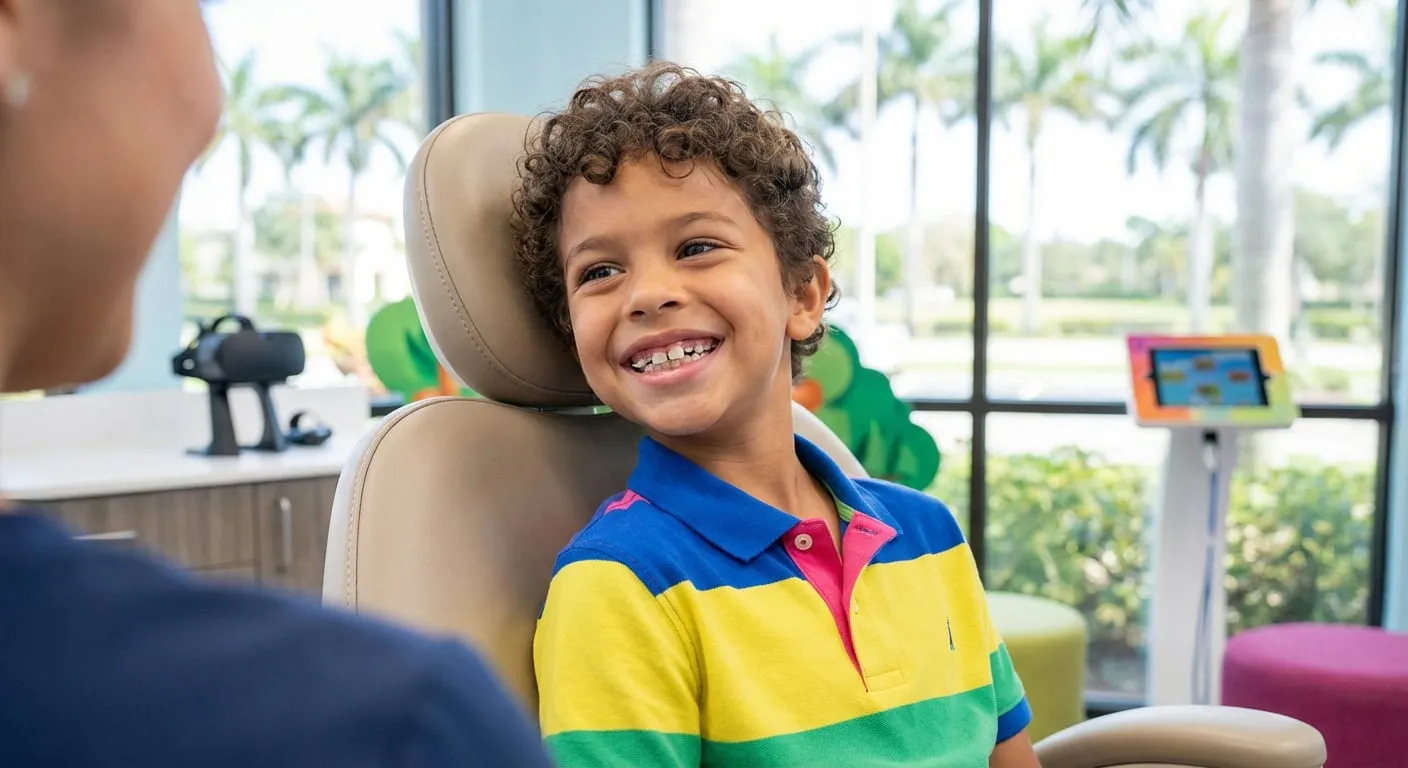
Early Orthodontics for Kids Ages 6-10 in Pembroke Pines
Your kid's smile is one of those things that keeps you up at night, right?
You notice the crowded teeth.
You see the way their jaw sits funny when they chew.
You wonder if it's going to be a problem down the road.
That's exactly where I was when my 7-year-old came home from Silver Lakes Elementary with overlapping front teeth that made them self-conscious about smiling in photos.
I started asking around, talking to other parents at Tequesta Trace Park, and everyone kept pointing me toward one thing: Phase 1 orthodontics.
Not full braces.
Not waiting until their teen years.
Something called Phase 1 treatment that worked with their growth instead of against it.
So I did what any parent does and started researching.
And here's what I found out: early intervention at the right time changes everything.
The American Association of Orthodontists recommends that kids get checked by age 7.
Not because they all need braces.
But because that's when their jaws are still growing and you can guide that growth in the right direction.
It's like catching a problem before it becomes a bigger problem.
Let me walk you through what I learned about Phase 1 orthodontic treatment for kids in our area and why it matters.
What Phase 1 Orthodontics Actually Is and Why It Works
Phase 1 isn't about strapping your kid into a full set of braces at age 7.
It's way more strategic than that.
Think of it as preventative orthodontics.
Your kid's baby teeth are still there, but their adult teeth are coming in.
Phase 1 treatment uses gentle appliances to guide that growth.
It creates space for adult teeth to come in straight.
It corrects jaw alignment problems early.
It can prevent the need for extractions later.
When I first heard about this, I asked the same question you're probably asking: "How is that different from just waiting?"
The difference is timing.
Your kid's jaw is still developing between ages 6 and 10.
You can guide that development.
You can't do that once their growth plates close in their teens.
So Phase 1 is about working with nature, not against it.
It's about making the job easier on them later.
Most kids who get Phase 1 treatment end up needing shorter Phase 2 treatment (if they need it at all), which means less time in braces overall, less pain, and better results.
The Real Signs Your Pembroke Pines Kid Might Need Phase 1
Not every kid needs Phase 1 treatment.
That's the honest truth.
But there are some signs you should watch for.
Crowding or gaps between baby teeth. If you're seeing teeth that are pushed sideways or gaps that look weird, that's often a sign there's not enough room for the adult teeth coming in. Early expansion can create that room naturally.
Crossbite. This is when the upper teeth bite inside the lower teeth instead of outside. Sounds minor, but a crossbite can cause jaw problems, uneven wear on teeth, and eventually TMJ issues. Catching it at 7 or 8? You can fix it before it becomes a real problem.
Mouth breathing. If your kid is constantly breathing through their mouth instead of their nose, that's tied to narrow jaws and underdeveloped airways. This affects sleep, focus at school, and how their face develops. Phase 1 can guide the jaws wider and help them breathe better.
Thumb sucking that won't stop. Most kids stop by age 5. If your kid is still doing it at 7 or 8, it's pushing their teeth and jaw into weird positions. Gentle appliances can redirect the habit without shame or stress.
Severe overjet (buck teeth). When the upper front teeth stick way out in front of the lower teeth, it's not just a look thing. Those teeth are at higher risk for getting knocked out or broken.
Underbite. Lower teeth sticking out past the upper teeth. This gets worse as they grow, so catching it early matters.
Why Pembroke Pines Families Are Choosing SMILE-FX for Phase 1 Care
Let me be real with you.
There are a lot of options out there.
There are general dentists offering braces.
There are chain orthodontic offices.
There are Invisalign mills that treat everyone the same way.
When I started looking around for my kid, I kept hearing the same name from other parents: SMILE-FX Orthodontics.
So I checked them out.
They're in Miramar, which is only 15 to 20 minutes from Pembroke Pines down Flamingo Road.
Close enough that it doesn't feel like a production to get there.
But here's what really caught my attention: they're not trying to be everything to everyone.
They're specifically focused on doing orthodontics right.
Their team is made up of board-certified orthodontists only.
No general dentists doing orthodontics on the side.
No assembly-line treatment.
They're partners with pediatric dentists across South Florida because those dentists trust them with their own kids' teeth.
That says something.
They've also invested in serious technology.
Low-dose CBCT scans that give them detailed 3D pictures of your kid's jaw and tooth development.
AI-guided growth predictions that help them plan treatment with insane accuracy.
Propel technology that can speed up treatment when needed.
When I walked into their office with my kid for the first time, I expected the sterile, stressful vibe you get at most dental places.
Instead, there were VIP suites.
Games.
Snacks.
VR headsets.
Weighted blankets.
Noise-canceling headphones.
Basically, they've figured out how to make a kid's orthodontic visit feel less like a medical procedure and more like a treat.
My kid actually asked when we could go back.
That's not normal.
How a Phase 1 Consultation Works at SMILE-FX
The first visit is a free consultation, and it takes about 30 to 45 minutes.
You're not going in cold.
Their team greets your kid in a comfortable suite, not some sterile exam room.
There are snacks and games to help your kid feel at home.
The orthodontist talks to your kid directly, not just at you.
They do low-dose digital X-rays or a quick CBCT scan, which is basically a fast 3D photo of your kid's teeth and jaw.
They explain everything in plain English.
No jargon.
No making it sound scarier than it is.
Then they show you what they see.
They tell you if Phase 1 treatment is needed, if monitoring is better, or if you can just wait and see.
And here's the thing that impressed me the most: they'll tell you if your kid doesn't need treatment yet.
No upsell.
No making a problem out of nothing.
Just straight talk about what's best for your kid.
If treatment is needed, they create a custom growth plan.
They explain exactly what's happening, why it's happening, and what the next steps look like.
You leave that appointment feeling informed and confident, not stressed or confused.
The Reality About Age 7 and Why It Matters
The American Association of Orthodontists didn't just pick age 7 out of nowhere.
By age 7, the first permanent molars have usually come in.
The jaws are still growing.
You can see which direction that growth is heading.
And most importantly, you can guide it.
If you wait until age 12 or 13, the growth window is closing.
Some of the problems that could have been fixed with Phase 1 now need extractions or more aggressive treatment.
Treatment takes longer.
It's harder on the kid.
It's more expensive.
But if you catch things at 7 or 8?
You can often prevent all that.
Studies show that kids who get Phase 1 treatment reduce their Phase 2 treatment time by 6 to 12 months.
That might not sound like much, but when you're a teenager, 6 to 12 months is significant.
It's the difference between having braces for 2 years versus 3 years.
Questions Parents in Pembroke Pines Keep Asking
Is Phase 1 treatment the same as full braces? No. Phase 1 uses removable appliances or light wires to guide growth. Most kids don't need a full set of braces until Phase 2, if they need it at all.
How much does Phase 1 treatment cost? That depends on what your kid needs. During your free consultation at SMILE-FX, they go over all the costs upfront. No surprises.
How long does Phase 1 last? Usually between 1 and 3 years, depending on what needs to be done.
Will my kid need Phase 2 treatment after Phase 1? Not always. Some kids are done after Phase 1. Others need Phase 2. The goal is to do Phase 1 well so Phase 2 is shorter or unnecessary.
Do I have to go to Miramar if I live in Pembroke Pines? Yes, but it's only 15 to 20 minutes. Saturday morning and after-school appointments are available to work around school schedules.
What Makes SMILE-FX Different for Kids' Orthodontics
Let me be honest about something.
I spent time comparing options.
And the difference between specialists and non-specialists became obvious pretty fast.
A general dentist might do braces.
But orthodontists spend years learning specifically about jaw growth, tooth movement, and bite correction.
SMILE-FX uses cutting-edge technology that most offices don't invest in.
They're not treating everyone the same way.
They're customizing treatment based on your kid's specific growth pattern.
They're also not trying to speed through appointments.
>The whole vibe is about doing right by your kid, not maximizing the number of patients per day.
I talked to other parents whose kids have been treated there, and I read through their patient reviews.
The consistency was wild.
Parents kept talking about how their kids' anxiety went away after the first visit.
How the results exceeded expectations.
How the staff treated them like family.
That's not stuff you can fake.
The Bottom Line on Phase 1 Orthodontics
If you've got a kid between 6 and 10 in Pembroke Pines with crowded teeth, a weird bite, mouth breathing, or other signs that Phase 1 might help, the next step is simple.
Get them evaluated.
Not because they definitely need treatment.
But because you'll know.
You'll have information instead of worry.
And if treatment helps them, you'll have caught it at exactly the right time.
The free consultation at SMILE-FX Orthodontics is exactly that: free.
No pressure.
Just honest feedback about what your kid needs.
Book your free 3D scan and VIP smile consultation here and see what's possible for your kid's smile.
They serve Pembroke Pines, Hollywood, Weston, Cooper City, Davie, Fort Lauderdale, and all of South Florida.
Early orthodontics for kids ages 6-10 in Pembroke Pines is about being proactive, not reactive.
Beyond Phase 1: Braces, Clear Aligners, and Invisalign for Teens and Adults in Pembroke Pines
So your kid made it through Phase 1 treatment and now you're wondering what comes next.
Or maybe you skipped the early intervention window and now you've got a teenager with teeth that need serious work.
Or you're an adult who's been thinking about straightening your teeth for years but weren't sure if it was even possible.
I get it.
The orthodontic world gets confusing fast once you move past Phase 1.
Phase 2 treatment.
Traditional braces versus clear aligners.
Invisalign versus other brands.
Cost differences.
Treatment timelines.
It's a lot to sort through.
I spent months talking to orthodontists in the Pembroke Pines area trying to understand what option made the most sense for different situations.
And what I learned is that there's no one-size-fits-all answer.
What works for a 13-year-old doesn't necessarily work for a 35-year-old.
What works for mild crowding doesn't work for severe bite problems.
But here's what does matter: finding an orthodontist who understands your specific situation and can match you with the right treatment approach.
Let me break down what I found about the real options out there and how to think about choosing between them.
The Difference Between Phase 1 and Phase 2 Treatment
If your kid went through Phase 1, Phase 2 is the follow-up act.
Phase 1 set the foundation by guiding jaw growth and creating space.
Phase 2 comes after all the permanent teeth have come in and finishes the job.
This is usually when traditional braces enter the picture.
The average Phase 2 treatment takes about 18 to 24 months.
But kids who got solid Phase 1 treatment often need less time in Phase 2.
Some kids skip Phase 2 entirely if Phase 1 did its job well.
If you didn't do Phase 1 and your teen needs braces now, they're going straight into what would've been a longer, more complex Phase 2 treatment.
That's just the reality.
But it's not the end of the world.
It just means the treatment window is different and the approach needs to account for the fact that their jaw growth is mostly done.
Traditional Braces: Still the Gold Standard for Complex Cases
I know braces feel old-school.
Everyone's talking about clear aligners and Invisalign these days.
But here's the thing: traditional braces are still the most powerful tool orthodontists have.
They can fix almost anything.
Severe crowding.
Complex bite problems.
Teeth that need to be moved in three dimensions.
Cases where multiple teeth need to be rotated or moved vertically.
Clear aligners can't do all of that.
But braces can.
The brackets are bonded to each tooth.
The wire applies constant, controlled pressure.
Your orthodontist can adjust the force on individual teeth.
It's precision engineering on your teeth.
The downside is obvious: they're visible.
They feel weird at first.
They require more careful cleaning.
You have to watch what you eat.
But if the alternative is wearing aligners for four years because they can't fix your bite effectively, braces start looking a lot better.
A lot of teens I've talked to say the first month is awkward, then it becomes just part of life.
And the results are worth it.
Clear Aligners and Invisalign: The Modern Alternative That Works for Some
Now let's talk about the newer stuff.
Clear aligners and Invisalign changed the game for a specific type of patient.
If you want something invisible, removable, and you've got a straightforward case, clear aligners are genuinely great.
They're custom-made plastic trays that fit snugly over your teeth.
You wear them 22 hours a day and switch to a new set every one to two weeks.
Each set is slightly different, gradually moving your teeth into the right position.
The big advantage: nobody knows you're wearing them.
You can eat whatever you want because you take them out.
Brushing and flossing are normal.
They're genuinely convenient.
But here's what matters: they work best for people with mild to moderate crowding or spacing issues.
If you've got a real bite problem, severe crowding, or teeth that need major rotations, clear aligners are going to take longer and might not get you to where you need to be.
The force they apply is gentler, which is good for comfort but slower for results.
A lot of people underestimate how much discipline it takes to wear them 22 hours a day.
You've got to remember to put them back in after eating.
You've got to keep track of which tray you're on.
Some people love that responsibility.
Other people hate it.
The cost is usually similar to traditional braces, sometimes more.
So it's really about whether your specific case is suited for them and whether you're the type of person who'll actually wear them consistently.
Treatable Cases: Understanding What Your Teeth Actually Need
This is where a lot of people get confused.
Not every orthodontic problem is created equal.
Some cases are straightforward.
Some are genuinely complex.
At SMILE-FX, they've got a whole breakdown of different types of cases and what can be treated.
Crowding is common.
Spacing is common.
Open bites where your top and bottom teeth don't touch in the front.
Overbites where the top teeth overlap too much.
Underbites where the bottom teeth stick out past the top.
Crossbites where the alignment is off to the side.
Most of these can be fixed with braces.
Some can be fixed with clear aligners depending on how severe they are.
The only way to know for sure is to get scanned and talk to an orthodontist who understands your specific situation.
SMILE-FX uses cutting-edge 3D scanning technology that shows exactly what's happening with your teeth and jaw.
It's not guessing.
It's seeing the actual geometry of your bite and planning treatment based on that.
The Cost Question Nobody Wants to Ask But Everyone Wonders About
Let's be real: braces and clear aligners are expensive.
Traditional braces typically run between $3,000 and $7,000.
Clear aligners and Invisalign typically run between $3,500 and $8,000.
Phase 2 treatment after Phase 1 is usually less than starting from scratch.
Adult treatment costs the same as teen treatment because the complexity is similar.
Most orthodontists, including SMILE-FX, break treatment into monthly payments.
So instead of dropping $5,000 upfront, you're paying $200 to $300 a month.
That makes it more manageable.
Some dental insurance covers a portion of orthodontic treatment, usually 50 percent up to a lifetime maximum.
Check your plan.
But don't let insurance dictate which treatment you choose.
Sometimes paying a bit more out of pocket for the right treatment is worth it.
Getting your teeth corrected once is better than doing it twice.
Why Teens Choose Invisalign and When That Actually Makes Sense
Teenagers are self-conscious about appearance.
That's not a personality flaw, it's just how their brains work at that age.
So when Invisalign became available, a lot of teens got excited.
No metal brackets.
No wire.
Nobody has to know.
But here's what I learned talking to parents whose kids did Invisalign: discipline is the real issue.
A 14-year-old who forgets to put their aligners back in after lunch is going to fall behind on their treatment.
A teenager who loses their aligners or forgets which set they're on is going to mess up their timeline.
Most orthodontists won't let you switch to braces mid-treatment because the teeth have already moved and the aligner plan doesn't match anymore.
So you're stuck.
Treatment gets extended.
Costs go up.
The parent gets frustrated.
That's not always what happens, but it happens enough that you should think carefully about your specific kid.
If they're responsible and organized, Invisalign could be perfect.
If they're not, traditional braces might actually be the safer choice even though they're more visible.
At least you know they're working 24/7 without your kid forgetting.
Adult Orthodontics: It's More Common Than You Think
Here's something that surprised me: a huge percentage of SMILE-FX's patients are adults.
People in their 30s, 40s, 50s getting braces or Invisalign for the first time.
Some of them never had the opportunity as kids.
Some of them had treatment that didn't stick because their teeth shifted back over time.
Some of them just finally decided they wanted to fix their smile.
The good news is that adult teeth move just as reliably as teenage teeth.
The biology is the same.
Treatment takes about the same amount of time.
The only real difference is that bone density is fully developed, so there's no growth factor to account for.
For adults, braces and clear aligners have pretty similar success rates because you're just moving teeth, not managing growth.
Clear aligners actually become more attractive for adults because self-consciousness about appearance matters less.
But the flexibility of being able to remove aligners and eat normally is super valuable when you're juggling work and a schedule.
A lot of adults I talked to said Invisalign let them do something they'd always wanted to do without it disrupting their life.
What Other Treatments Exist Beyond Braces and Aligners
Most people think orthodontics is just braces or aligners.
But there are actually other treatment options depending on what you need.
Palatal expanders that widen the upper jaw without braces.
Functional appliances that correct bite problems by guiding jaw position.
Retention systems after treatment to make sure teeth don't shift back.
These aren't replacements for braces or aligners in most cases.
But they're tools that orthodontists use to address specific issues.
Retention is especially important because 30 percent of people who get orthodontic treatment see their teeth shift back if they don't wear a retainer.
That's not a failure of the original treatment.
That's just teeth trying to go back to where they started.
Your orthodontist will make you a retainer and tell you when to wear it.
Most people wear them nightly for years.
How to Actually Choose Between Your Options
So you've got braces, Invisalign, clear aligners, and maybe some other options.
How do you decide.
Start with what your orthodontist recommends based on your case.
That's the most important factor.
If your bite is complex, braces might be the only option that actually works.
If your crowding is mild, both braces and aligners could work.
Then consider your lifestyle and personality.
Are you disciplined enough for aligners or do you need the passive option of braces.
Does being visible in braces bother you more than the inconvenience of managing aligners.
What's your schedule like.
How often can you get to appointments.
What does your insurance cover.
Can you afford the difference between options.
These are practical questions that matter.
At SMILE-FX, the board-certified orthodontists will walk through all of this with you.
They'll explain what they recommend and why.
They'll talk about the pros and cons of different approaches for your specific case.
And they won't push you toward the most expensive option.
They'll push you toward what actually works for you.
The Timeline: How Long Different Treatments Take
This matters because treatment duration affects your life.
Traditional braces for Phase 2 treatment: typically 18 to 24 months.
Braces for an adult straightening case: typically 18 to 30 months depending on complexity.
Invisalign for mild crowding: typically 6 to 12 months.
Invisalign for moderate cases: typically 12 to 18 months.
Invisalign for more complex cases: could be 2 to 3 years or might not be suitable at all.
Other clear aligners vary by brand but generally similar to Invisalign.
The timeline also depends on how consistent you are with wear.
If you're not wearing aligners 22 hours a day, your timeline gets longer.
If you're missing orthodontic appointments, your timeline gets longer.
If you're not following care instructions, your timeline gets longer.
The timeline is a collaborative effort between you and your orthodontist.
Real Talk About What to Expect During Treatment
The first week with braces sucks.
Your mouth is sore.
Your lips and cheeks get cut up.
Your teeth ache.
By week two, it's getting better.
By week three, it's just normal.
You stop thinking about it.
With aligners, the first day is fine.
The second day your teeth feel tired.
By day five, you're used to it.
The real challenge with aligners is the discipline of managing them.
You've got to remember to take them out before eating.
You've got to remember to put them back in after.
You've got to keep them clean.
You've got to keep track of which set you're wearing.
Some people are fine with that.
Some people find it annoying.
Both braces and aligners require good oral hygiene.
If you don't brush and floss well, your teeth and gums will suffer.
With braces, you've got to brush around all the brackets and wires.
With aligners, you've got to brush before putting them back in.
Food restrictions are more relaxed with aligners because you take them out.
With braces, you can't eat hard or sticky stuff because you could break a bracket.
That's actually a big deal for some people.
The Question About Results and How Good They'll Be
If you go with the right treatment for your case and you stick with it, results are genuinely excellent.
Your teeth will be straight.
Your bite will be corrected.
Your smile will look like you want it to look.
The difference between how results look on an adult versus a teenager is minimal.
The difference between results from braces versus clear aligners is minimal if the case is appropriate for both.
What matters is that your orthodontist knows what they're doing and uses proper technique.
You can see what different orthodontists achieve by looking at before and after photos.
Check out SMILE-FX's patient reviews and results to see what people are saying about their actual outcomes.
Patient photos are honest.
They show what's actually possible.
After Treatment: Keeping Your Results
Once your braces come off or you finish your Invisalign treatment, you're not done.
You get a retainer.
That retainer is the difference between keeping your results and watching your teeth slowly shift back.
Some orthodontists give you a fixed retainer that's bonded to the back of your lower front teeth.
Some give you a removable retainer that you wear at night.
Some give you both.
You'll wear retainers for years, probably forever if you want to keep your smile looking good.
That's just the reality of orthodontics.
Teeth want to go back to where they started.
A good retainer prevents that.
The cost of retainers is usually small compared to the cost of treatment, but ask about it upfront so you know what to expect.
Getting Started: What Your First Appointment Should Look Like
If you're ready to explore braces, aligners, or Invisalign for yourself or your kid, book a consultation.
A good orthodontist will spend time understanding your situation.
They'll do some scans or X-rays.
They'll explain what they see.
They'll walk through treatment options and timelines.
They'll talk about cost and payment plans.
And they'll answer your questions without making you feel stupid.
SMILE-FX offers a free consultation that covers all of this.
It's actually a proper appointment, not just a quick sales pitch.
You get scanned with 3D imaging technology that shows your orthodontist exactly what's going on.
You get honest feedback about whether you need treatment and what the best approach would be.
You get a chance to ask questions and actually understand the process.
That's how it should work.
Whether you're thinking about Phase 2 treatment for your teen, considering Invisalign as an adult, or trying to decide between braces and clear aligners, the first step is getting a real evaluation by an orthodontist who knows what they're doing.
Braces, clear aligners, and Invisalign for teens and adults in Pembroke Pines all work when they're matched to the right patient and case.
Book your free 3D scan and VIP smile consultation here at SMILE-FX Orthodontic and Clear Aligner Studio and see what's actually possible for your smile.
Why Your Smile Matters More Than You Think and How the Right Orthodontist Makes All the Difference in South Florida
You've probably noticed something.
People with great smiles move through the world differently.
They take photos without thinking about it.
They laugh without covering their mouth.
They interview for jobs and go on dates with actual confidence instead of worry.
It's not vanity.
It's real.
And if you're living in Pembroke Pines, Hollywood, Fort Lauderdale, or anywhere in South Florida thinking about getting your teeth fixed, you're probably wondering where to even start.
Should you go to your general dentist.
Should you find a board certified orthodontist.
Should you care about where they went to school or what technology they use.
The answer to all of that is yes, and I'll explain why it matters way more than most people realize.
The Difference Between a Dentist and a Real Orthodontist
Here's something most people don't know.
A general dentist can legally offer braces in Florida.
They can slap some brackets on your teeth and call it orthodontics.
But that doesn't make them an orthodontist.
A real orthodontist went to dental school, then spent two to three additional years in a specialized orthodontic residency program.
They studied jaw growth patterns.
They learned how to read 3D scans.
They got trained on biomechanics, retention strategy, and how to handle complex cases.
It's the difference between someone who knows how to drive a car and someone who's trained to be a mechanic.
One can operate it.
The other understands how it actually works.
When you're looking for the best orthodontist near me in South Florida, that specialist training matters.
It matters when your case is complicated.
It matters when you need someone who can predict how your jaw will grow.
It matters when you want results that actually stick.
A board certified orthodontist has passed national board exams and demonstrated competency.
That's not a guarantee of quality, but it's a real marker that says they know their stuff.
What Makes a Top Rated Orthodontist Actually Stand Out
You've probably Googled "best orthodontist Miami" or "top rated orthodontist near me" and got back a bunch of results.
All of them claiming to be the best.
None of them really showing you what makes them different.
The real differentiators are simple but not obvious.
Technology matters. A top rated orthodontist is using cutting-edge tools, not outdated equipment. Things like AI-powered growth prediction, low-dose 3D CBCT scanning, and digital treatment planning change what's possible. You want an office that invests in this stuff.
The doctor's experience matters. Someone who's been doing this for twenty years sees patterns a newer orthodontist might miss. But also, someone who stays current on new techniques matters. Both things are true.
The team matters. Assistants who are trained and care make appointments run better. When you call with a question, do they actually answer it or do you wait three days. That stuff tells you everything.
How they treat you matters. You can see this from patient reviews. Not the generic ones everyone leaves, but the actual stories people tell about their experience. Were they heard. Did someone explain things to them. Did they feel rushed through the appointment.
At SMILE-FX Orthodontic and Clear Aligner Studio, these things aren't marketing fluff.
They're actual differences in how they operate.
Their patient reviews consistently show people talking about feeling listened to and getting better results than expected.
The Real Cost of Bad Orthodontics
Here's something nobody talks about enough.
Getting bad orthodontics done is often worse than getting no orthodontics at all.
I'm talking about straight teeth that bite wrong.
Results that shift back after treatment ends.
Taking three years to fix something that should've taken eighteen months.
Teeth getting damaged because someone applied too much force.
You want to know the real cost of affordable braces that aren't actually done well.
You end up needing it done again five years later.
That's not affordable.
That's expensive.
When you're looking at orthodontist cost South Florida or checking if insurance covers braces, price should be one factor among many.
Not the only factor.
A good orthodontist will work with you on payment plans and financing options, making treatment accessible without cutting corners on quality.
Technology That Actually Changes Treatment Outcomes
I mentioned cutting-edge tech earlier, but let me get specific about why it matters.
An older orthodontist might look at your teeth and take a guess about where things are heading.
A modern orthodontist using advanced imaging and AI-powered prediction can see exactly where your teeth are going and plan treatment around that.
They can predict growth patterns.
They can identify problems before they're visible.
They can adjust treatment in real time based on how your teeth are actually responding.
That's not magic.
That's just good science backed by the right tools.
The difference shows up in your results.
Straighter teeth.
Better bites.
Less chance of things shifting back.
Shorter treatment times.
When you're comparing orthodontists in your area, ask about their technology. If they're still using the same equipment they had ten years ago, that tells you something.
Clear Aligners Versus Braces: The Question Everyone's Actually Asking
So you're thinking about getting orthodontic treatment but you can't decide between traditional braces vs Invisalign or clear aligners.
This is genuinely confusing because the internet is full of people saying "just get Invisalign, it's obviously better."
But that's not actually true.
Both clear aligners and braces work, but they work for different things.
Braces work better if you need significant bite correction, severe crowding, or teeth that need major rotations.
Clear aligners work better if you've got mild to moderate spacing or crowding and you want something invisible.
The real answer to "does insurance cover braces" versus aligners is usually the same.
Most insurance covers both if they're medically necessary.
But clear aligners sometimes cost a bit more out of pocket.
The technology for Invisalign and clear aligner treatment has gotten genuinely better in the last few years.
What matters is finding an affordable braces option that works for your specific case, not just picking the one with better marketing.
Questions People Ask Before Committing to Treatment
How long does treatment actually take.
Traditional braces usually take eighteen to thirty months depending on what needs to be fixed.
Clear aligners usually take nine to twenty-four months.
Adults get similar timelines to teenagers because the biology is the same.
Does it hurt.
The first week with braces sucks.
After that, it's manageable.
Clear aligners feel like gentle pressure, which some people prefer.
What about eating and drinking.
With braces, you have restrictions.
No hard candy, no popcorn, be careful with certain foods.
With aligners, you take them out so you can eat whatever you want.
Will my teeth shift back after treatment.
They might if you don't wear a retainer.
That's why a good orthodontist gives you a solid retention plan and checks in on it.
How much does this cost and do I need to pay it all upfront.
Most offices offer payment plans spread across the treatment duration.
You're usually not paying thousands upfront.
You're paying monthly installments.
Why Choosing the Right Orthodontist in South Florida Actually Matters
South Florida has a lot of orthodontists.
Too many probably.
The difference between a top rated orthodontist Fort Lauderdale or best orthodontist Miramar and a mediocre one shows up over time.
Better communication.
Faster results.
Fewer emergency appointments because something broke.
Better-looking results that actually stay looking good.
Higher patient satisfaction.
These things compound.
You're not just paying for teeth to get moved around.
You're investing in someone who cares about doing it right.
When you're looking for an orthodontist near me or specifically searching for best orthodontist for complex cases, look for someone who invests in technology, hires quality staff, and has real patient reviews that show consistent satisfaction.
Making Your Final Decision
You've got to make a choice.
Get the consultation.
Ask about their technology.
Ask about their experience with cases like yours.
Ask what their treatment plan would be and why.
Look at before and after photos.
Read actual patient reviews.
Ask about cost and payment options.
Pay attention to how you feel during the conversation.
Do they feel like they're trying to sell you something or trying to help you.
That gut feeling matters more than you think.
If you're in South Florida looking for an orthodontist who actually knows what they're doing, has the right technology, and treats patients like people instead of production numbers, book your free 3D scan and VIP smile consultation at SMILE-FX.
It costs nothing.
You get real information.
You get treated like you matter.
Your smile matters, and getting it handled by someone who cares about doing it right changes everything.