
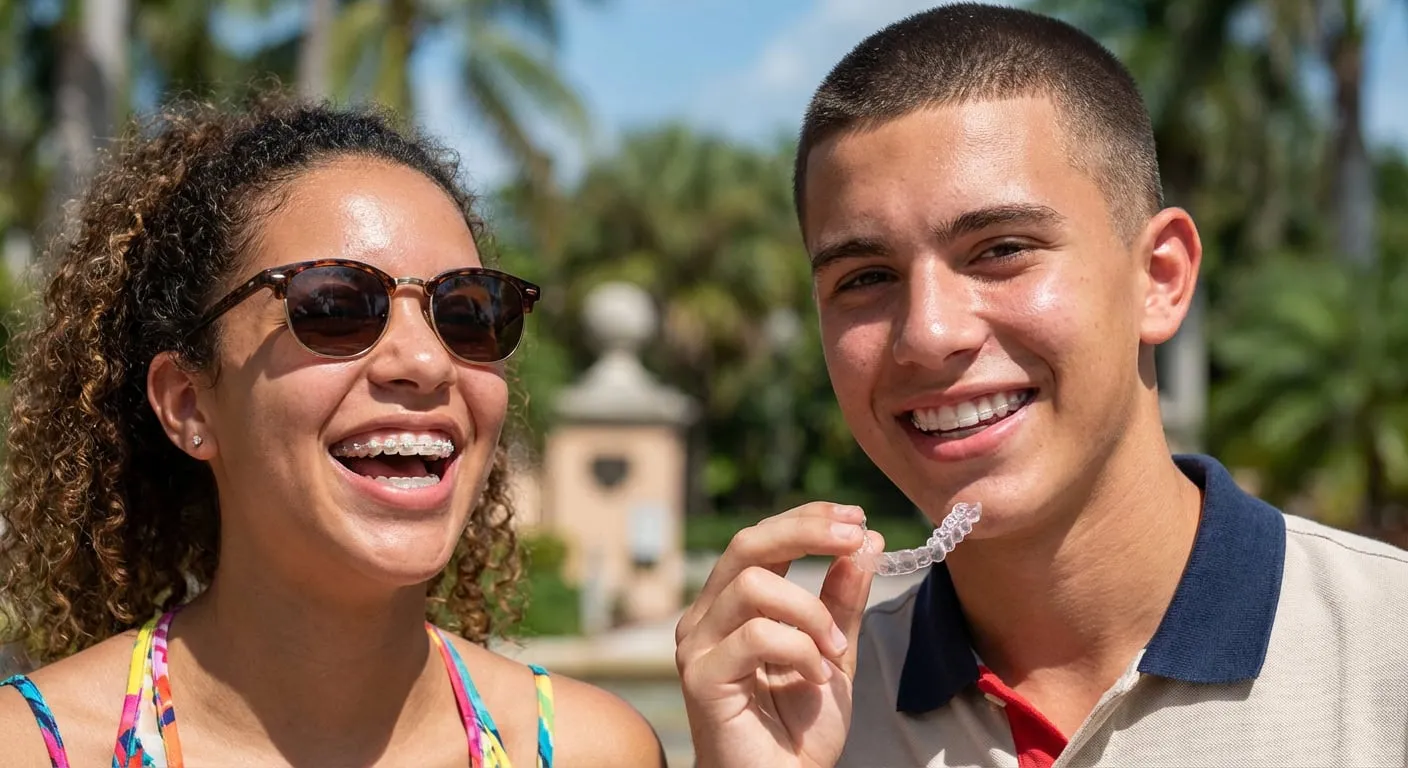
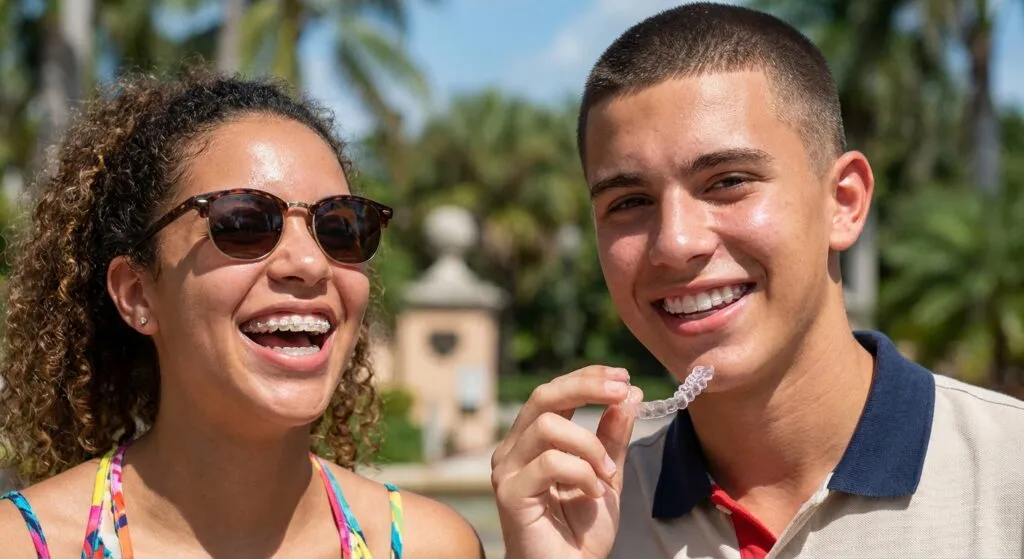
Braces vs Invisalign for Teens in Broward
Your teen's smile matters, and choosing between braces and Invisalign in Broward County is a real decision that affects their confidence every single day. Parents from Pembroke Pines, Hollywood, Weston, Cooper City, Davie, and Fort Lauderdale face the same question: which option actually works best? The truth is, there's no one-size-fits-all answer. What works for your neighbor's kid might not work for yours. That's why understanding both options is critical before you commit to 18-24 months of treatment.
Teen orthodontic treatment in Broward County requires balancing three things that honestly matter: how well it actually fixes the bite, whether your kid feels self-conscious wearing it, and how it fits into their life—school, sports, after-school stuff, all of it. At SMILE-FX in Miramar, we've helped thousands of families make this exact choice, and we've learned what actually moves the needle for teens.
The Real Difference Between Braces and Invisalign for Teens
Let's start with the obvious: they look different and they work differently. But here's what matters beyond the surface.
Traditional braces are the workhorses of orthodontics. Metal brackets, wires, the whole setup—they've been fixing teeth for decades because they just work. Ceramic options exist too if your teen wants something less visible, though the mechanics stay the same. The advantage? Your teen doesn't have to do anything. The braces do the work whether they like it or not. There's no forgetting to wear them, no taking them out before lunch, no losing them. It's fixed and permanent until the orthodontist removes them.
Invisalign clear aligners are different beasts entirely. They're custom-made plastic trays that your teen switches out every week or two. They're nearly invisible, which appeals to a lot of self-conscious teenagers. You can take them out to eat, brush your teeth properly, play sports without worrying. Sound perfect? Here's the catch: your teen has to actually wear them 20 to 22 hours every single day. That's the real commitment, and honestly, it separates the kids who see results from the kids who don't.
Why Braces Still Excel for Complex Teen Cases
Not all misaligned teeth are created equal. Some bite problems are straightforward. Others are genuinely complicated.
If your teen has severe crowding—teeth basically stacked on top of each other—deep bites where the upper teeth overlap the lower ones way too much, or significant rotations, braces are your best bet. Traditional metal or ceramic braces give your orthodontist precise control over how each tooth moves and exactly when it moves. This matters because fixing complex cases wrong wastes time and money.
At SMILE-FX, we use AI-precision bracket bonding to place each bracket in the exact optimal spot. This isn't standard practice everywhere. A lot of general dentists still hand-bond brackets, which means the placement depends on their skill that specific day. Our approach reduces treatment time across the board because we're starting from a stronger position from day one.
Dr. Tracy M. Liang, our board-certified specialist, doesn't use a cookie-cutter approach for kids and teens. Your teen gets a customized plan based on their specific bite issues, jaw structure, and what matters to them. Options include self-ligating braces (which reduce friction and typically feel more comfortable) or even gold braces for teens who want to make a statement instead of hide the hardware. Seriously, we've had teens rock gold braces as a fashion choice.
Here's what you need to know: if your teen has a genuinely complex bite problem, Invisalign might not be enough on its own. Clear aligners work best on mild to moderate issues. Trying to use aligners on a severe case is like trying to unwind a tangled necklace using tweezers instead of your hands—technically possible, but way harder and slower than it needs to be.
Invisalign Advantages for Motivated Teens
Now, if your teen has a straighter starting point—mild crowding, small bite discrepancies, just generally good foundation with a few alignment issues—Invisalign clear aligners can actually outpace braces.
Let's talk about what makes Invisalign appealing for teenagers because it's not just the invisible thing (though that matters to a lot of them). The reality is that teens with mild to moderate alignment issues who actually commit to wearing the trays see results in 12 to 18 months, which is faster than braces typically work. Your teen also avoids the dietary restrictions that come with braces—no popcorn, no gum, no hard candy. With Invisalign, they take the trays out, eat whatever they want, then put the trays back in.
At SMILE-FX, we offer our in-house clear aligners through both our SMILE-FX brand and Ortho-FX. When your teen finishes treatment, they get free whitening (a $500 value) and retainers ($600 value) included. That's real value that parents appreciate because these are expenses that add up fast.
We also use remote monitoring technology that cuts office visits by up to 40 percent. For busy Broward families juggling work, school, and activities, fewer trips to the orthodontist matters. Your teen can send photos and progress updates from home, and we track progress digitally. It's not fancy for the sake of being fancy—it's practical for real life.
The catch, and we say this because it's true: Invisalign requires genuine compliance. Your teen has to wear the trays 20 to 22 hours daily. That means they come out to eat, brush teeth, floss, then go right back in. Some teenagers crush this. Some forget constantly. Some take them out and conveniently "lose" them. You know your kid. Be honest with yourself about whether they can handle that responsibility.
Comparing Braces and Invisalign Head-to-Head for Broward Families
Let's put the main differences side by side so you can see what actually matters for your situation:
| Factor | Braces | Invisalign for Teens |
|---|---|---|
| Best For | Severe bite issues, rotations, complex cases | Mild to moderate alignment problems |
| Visibility | Metal is obvious; ceramic blends better | Nearly invisible when worn properly |
| Compliance Required | Fixed in place; no removal or discipline needed | Requires consistent 20-22 hour daily wear |
| Treatment Time | 18-24 months typical range | 12-18 months with strong compliance |
| Office Visits | Every 6-8 weeks for adjustments | Reduced frequency with remote monitoring |
| Cost Range (Broward) | $4,500-$7,500 depending on complexity | $3,500-$6,500; Invisalign often slightly lower |
| Sports/Activities | Safe with protective wax; no loss risk | Can remove; need to track not to lose trays |
| Food Freedom | Dietary restrictions apply | Remove trays; eat anything without restrictions |
Cost in Broward varies based on case complexity and insurance coverage. Both options typically qualify for insurance benefits, and we maximize those for you. The real question isn't which costs more—it's which one actually solves your teen's specific bite problem.
Understanding Your Teen's Specific Case
Before you decide between braces and Invisalign, understand what you're actually dealing with. Bite issues fall into categories, and your teen probably fits into one of them.
Crowding means teeth are bunched up and overlapping. Mild crowding (just slight overlaps) responds well to Invisalign. Severe crowding (teeth actually stacked or rotated significantly) needs braces.
Spacing is the opposite—gaps between teeth. Both braces and Invisalign handle this, but severe gaps with spacing issues need braces.
Bite problems include overbites (upper teeth stick out too far), underbites (lower jaw extends beyond upper), and cross bites (teeth cross when biting). These range from simple to complex. Simple overbites might work with Invisalign. Severe underbites almost always need braces.
Rotations are teeth turned at angles instead of facing forward. Slight rotations respond to Invisalign. Significant rotations need braces.
The honest truth: you can't accurately assess your teen's case by looking in a mirror. You need professional evaluation. At SMILE-FX, we do comprehensive assessments and show you exactly what we're dealing with using 3D imaging technology. You'll see the problem and understand why we recommend what we recommend.
Why Broward Families Trust SMILE-FX for Teen Orthodontics
Parents drive from Pembroke Pines (10 minutes via Pines Boulevard), Hollywood (15 minutes via I-95), Weston (20 minutes via I-75), Cooper City (12 minutes), Davie (15 minutes), and Fort Lauderdale (25 minutes) to choose SMILE-FX, and it's not random. We're a board-certified orthodontic specialist practice, not a high-volume mill or a general dentist doing orthodontics on the side.
Our location in Miramar works logistically for families across Broward County. We offer evening and weekend appointments specifically so teens don't miss school. After-school slots mean your teen can come straight from Marjory Stoneman Douglas High, Western High, or wherever they study. We have free parking, bilingual support, and staff who actually understand what it's like to be a teenager in South Florida.
Quick emergencies get handled quickly because we're set up for it. Broken wire? Loose bracket? We fix it same day or next day, not weeks out. That matters when your teen has a school presentation or school photo day coming up.
We have over 3,000 patients who've trusted us, and they leave reviews because they see actual results and feel genuinely cared for. We're not trying to upsell you on treatments you don't need. We're trying to solve your teen's actual problem.
Technology That Actually Makes a Difference
Technology matters in orthodontics, but only if it actually improves outcomes. At SMILE-FX, we use VIP technology including 3D smile design to plan treatment precisely and show your teen what their smile will look like after treatment. This isn't theoretical—it's your teen's actual projected result based on their specific case.
For braces, our AI-precision bracket bonding reduces treatment time and improves outcomes. For Invisalign and our clear aligner options, remote monitoring means less commute time and better progress tracking.
The difference between a place with cutting-edge technology and a place using outdated methods isn't academic—it's measurable in months of treatment saved and better-aligned teeth.
The Question Parents Actually Ask: Which One Is Right for My Teen?
Here's how to think about it simply: If your teen has a complex bite problem with severe crowding or significant rotations, braces work faster and more reliably. If your teen has a milder alignment issue and genuine motivation to comply with wearing aligners consistently, Invisalign offers speed and discretion.
But if you're unsure about your teen's specific situation—and most parents are because you can't see the full bite structure just by looking—you need proper evaluation. That's not us trying to get you in the door. That's just how orthodontics actually works.
We offer a free 3D scan and VIP smile consultation to assess your teen's case and explain exactly what's needed and why. You'll see the issue, understand the options, and know the timeline and cost before you decide anything. No pressure, no surprise bills, no recommendations for treatment you don't actually need.
Your teen's smile confidence matters. Getting it right the first time matters even more. Let's figure out the best path forward together—book that free consultation today at SMILE-FX.
What Happens After Braces or Invisalign Treatment: Retainers, Maintenance, and Long-Term Smile Care
Your teen's braces come off or the last clear aligner goes in the drawer, and you feel relief wash over you. The hard part is done, right? Not quite. What happens next matters just as much as the treatment itself. This is where most people get blindsided because nobody talks about the retention phase. You can spend 18 months getting teeth perfectly straight, then lose half those gains in six months if you skip this step. That's not fear mongering, that's just how teeth work.
The retention phase is non-negotiable. Your teen's teeth want to go back to where they started. That's called relapse, and it happens to everyone unless you stop it. At SMILE-FX, we make sure families understand what comes after treatment because the real goal isn't perfect teeth for one day. It's a smile your teen can be proud of for life.
Why Teeth Shift Back Without a Retainer
Think of orthodontic treatment like moving a house. You use equipment to physically move the structure, straighten it up, get it exactly where you want it. But the ground underneath still wants that house in its original spot. Teeth are the same way. The bone around them has memory. Muscles pull toward old positions. Jaw growth doesn't stop just because braces came off.
Your teen's gums actually remember where teeth used to be. The fibers around each tooth take months to stabilize in their new location. If your teen stops wearing a retainer too early, those fibers start pulling teeth back toward the original position. Slowly at first, then faster. This isn't a small drift either. Without retention, significant relapse happens in the first year alone.
The bottom line: retainers aren't optional. They're as important as the braces or aligners themselves.
Types of Retainers Your Teen Actually Needs to Know About
There are two main retainer types, and your teen will probably end up using both at different stages.
Fixed retainers are thin wires bonded to the back of your teen's front teeth. They stay there permanently. Your teen doesn't have to remember anything. The wire just sits there, holding teeth exactly where they finished treatment. The catch is they make flossing harder (special floss exists), and they need periodic checks to make sure the bond stays strong. Some people keep fixed retainers for years. Some get them removed after a few years of stability. It's personal.
Removable retainers are what most teens picture. They come out every day, get cleaned, and go back in. There are a few types within this category. Clear retainers look like thin Invisalign trays. Hawley retainers are the older wire-and-acrylic style that looks like a small orthodontic device. Most teens prefer clear retainers because they're nearly invisible. The problem is they wear out faster, so replacement every couple years is normal.
At SMILE-FX, your teen gets free retainers when treatment finishes. That's real value because replacement retainers run $300 to $600. We also include clear retainers, not the older style, because we know what actually works for busy teenagers.
The Retainer Schedule That Actually Works
Here's where most people get it wrong. They think retainers are just for right after treatment ends. Actually, the schedule changes over time.
Months 0 to 6 after treatment finishes: Full time, 24/7. Your teen wears the retainer all day and all night. This is when relapse risk is highest. The bone is still settling, muscles are still adjusting, everything is still unstable. No breaks, no days off.
Months 6 to 12: Nights only. Once that first six months passes and things stabilize, daytime wear isn't as critical. Nights are where the real holding happens anyway. Your teen should wear the retainer every single night though. No skipping, even if they feel fine.
After one year: Honestly, some people wear retainers every night forever. Some shift to wearing them four nights a week after a couple years. Some stop completely and get lucky. The smartest move is wearing them every night indefinitely. That's not me being dramatic. That's actually what keeps smiles looking perfect ten years down the road.
Your teen's orthodontist will give them specific instructions based on their case, but this timeline is the standard.
What Makes Retainer Care Actually Simple
Retainers are small and easy to care for if you know what to do.
Cleaning removable retainers: Rinse with cool water after taking them out. Brush gently with a soft toothbrush and regular toothpaste. Never use hot water because heat warps the plastic. Soak overnight in a retainer cleaning solution (like Retainer Brite) once or twice a week. That's it. Takes two minutes.
Storing retainers: Your teen needs a retainer case. Not a napkin. Not the bathroom counter. An actual case. Lost retainers happen constantly because people leave them sitting around. A case costs five bucks and prevents a $400 replacement.
Checking for damage: Once a month, look at the retainer under good light. Cracks, cloudiness, warping, loose areas around teeth. Catch problems early before they get worse. Small issues get fixed or replaced. Big cracks mean it's time for a new one.
Fixed retainers: Floss underneath them carefully using a floss threader or special floss. Get regular checkups to make sure the bond is holding. Sometimes the wire breaks. Your orthodontist rebonds it in fifteen minutes.
Common Retainer Problems Parents See
Even careful people run into issues. Knowing what to expect helps.
Retainers don't fit anymore: This happens when your teen goes through growth or their bite shifts slightly. Wearing a retainer that doesn't fit perfectly actually causes problems instead of preventing them. New retainers are needed.
Retainers feel uncomfortable: For the first few days after getting them, minor discomfort is normal. If it lasts longer than a week or feels like real pain, contact your orthodontist. Something might be off with the fit.
Teeth hurt when wearing retainers: This usually means some shifting already happened and the retainer is trying to pull teeth back to their treatment position. This is actually the retainer doing its job, but pain means you need to get it adjusted or make sure your teen is wearing it on schedule.
Retainers smell bad: This means bacteria are growing because they're not being cleaned properly. Better cleaning fixes it. If the smell sticks around even after deep cleaning, replacement might be necessary.
Clear retainers get cloudy: This is normal over time. They still work, but they look less invisible. Replacement every two to three years keeps them clear and looking new.
Insurance Coverage for Retainers
Most orthodontic insurance covers retainers, especially if they're part of the original treatment plan. Some plans cover the first set. Some cover replacements too. At SMILE-FX, we understand your insurance coverage and maximize benefits. We also offer payment plans if retainers aren't covered, so cost doesn't become a barrier to keeping your teen's smile straight.
What Actually Happens If Your Teen Stops Wearing Retainers
Let's be real about this because some parents think their teen can skip it.
First week: Nothing visible. Your teen might feel slight movement.
First month: Small shifts become noticeable. Teeth aren't back to the original position, but the progress starts reversing.
First six months: Significant relapse. Maybe half the treatment gain is gone. Gaps reappear. Crowding comes back.
One year: The smile looks almost like pre-treatment. All that time and money for straightening gets undone.
This isn't inevitable though. It only happens if your teen completely skips retainers. Wearing them most of the time, even imperfectly, prevents most relapse. It's not all or nothing.
Beyond Retainers: Maintaining Your Teen's Straight Smile
Retainers stop teeth from shifting, but keeping teeth straight also means good daily habits. This is where orthodontic treatment becomes a lifestyle thing.
Brushing and flossing matter more now. Straight teeth are easier to clean than crooked ones, which means less cavity risk. But good habits still matter. Your teen should brush twice daily, floss daily, and see a dentist twice yearly.
Avoid habits that stress teeth. Nail biting, chewing on pens, ice chewing, hard candy—these create pressure on teeth that can cause relapse. After spending all that money on orthodontic treatment, these habits undo progress.
Protect teeth during sports. A mouthguard is non-negotiable. A hit to the mouth can crack, loosen, or knock teeth around even after they're straight. Every sport involving any contact requires a custom or quality store-bought mouthguard.
Watch for jaw clenching. Some people clench their teeth when stressed. Constant pressure from clenching causes relapse over time. If your teen grinds or clenches, talk to your orthodontist about a night guard.
The Real Conversation About Long-Term Commitment
Your teen needs to understand that orthodontic treatment isn't truly done when the braces come off or the last aligner gets used. The real commitment continues indefinitely. Retainers become a permanent part of life, like brushing teeth or showering. It's just what you do.
Teens who approach retainers as a short-term burden fight the process. Teens who understand retainers as the price of keeping their smile straight actually stick with it. The mindset matters as much as the physical habit.
This is a good conversation to have before treatment even starts. Make sure your teen knows what comes next so there are no surprises.
FAQ: What Teens and Parents Actually Ask About Retention
Can my teen play sports with a retainer? Removable retainers come out during sports. Your teen wears a mouthguard instead. Fixed retainers stay in place during sports. Either way, sports are fine. Just make sure your teen puts the removable retainer back in right after practice or games.
Do retainers hurt? The first few days might feel weird, not painful. Real pain means something is wrong. Contact your orthodontist if pain lasts more than a few days.
Can my teen eat with retainers in? No. Clear retainers and Hawley retainers come out before eating. Remove, eat, brush teeth, put back in. Fixed retainers stay in place during eating, but careful eating prevents damage.
How long do retainers actually last? Clear retainers last two to three years before needing replacement. Hawley retainers last five to ten years typically. Fixed retainers last indefinitely if the bond stays strong, though they might need rebonding at some point.
What if my teen loses a retainer? Call your orthodontist immediately. Waiting days or weeks while your teen goes without a retainer means relapse starts. New retainers take a few days to make, so don't delay.
Do retainers work if my teen wears them inconsistently? Somewhat, but not as well as consistent wear. One night on, two nights off means slower relapse but still some shifting. Consistency matters.
Why Professional Retention Monitoring Keeps Your Teen's Smile Safe
After treatment finishes, periodic check-ins with your orthodontist catch problems early. Your teen doesn't need monthly appointments anymore, but annual or semi-annual visits are smart. Your orthodontist can see if relapse is starting, check the fit of retainers, and make adjustments before teeth move significantly.
At SMILE-FX, we schedule post-treatment check-ins as part of our care. You're not forgotten after the braces come off. We want to see how your teen's smile holds up and make sure retention is working.
Treatable cases at SMILE-FX include various orthodontic issues, and we ensure long-term success through comprehensive retention protocols. Understanding what makes treatment stick matters more than just getting teeth straight initially.
Building the Right Retainer Habits From Day One
Your teen is more likely to actually wear retainers if the habit builds immediately after treatment. If they take them out and don't put them back in for three days, the habit breaks. If they put them in every single night starting day one, it becomes automatic.
Set phone reminders if needed. Build it into the bedtime routine. Make it as automatic as brushing teeth. The first thirty days are hardest. After that, most teens stop thinking about it and just do it.
Some families use small reward systems for the first month of consistent wear. Nothing crazy, but acknowledging the commitment helps. It's not bribing them. It's recognizing that building new habits takes effort.
The Smile That Lasts: Choosing SMILE-FX for Lifetime Results
At SMILE-FX Orthodontic & Clear Aligner Studio, we don't just treat teeth. We create long-term relationships with families. Your teen gets board-certified specialist care from Dr. Tracy M. Liang, which means expertise in retention planning as much as initial treatment. Our approach includes cutting-edge technology that helps you see exactly what post-treatment maintenance looks like for your specific case.
We work with kids, teens, and adults across Broward County. Whether your teen gets braces, Invisalign, or clear aligners, retention planning starts during the initial consultation. You'll know exactly what to expect and how to protect your investment in your teen's smile.
Your teen's orthodontic treatment is successful when their smile stays straight. That's the real win. Book your free 3D scan and VIP smile consultation today to learn how SMILE-FX ensures retention success for braces, Invisalign, and clear aligner treatment for teens, kids, and adults. Let's build a smile that actually lasts.
Cost, Financing, and Insurance: Making Orthodontics Affordable for Your Broward Family
Let's talk about the thing nobody wants to discuss but everyone thinks about: how much this actually costs and how you're going to pay for it.
Orthodontic treatment for your teen doesn't have to drain your savings account. I know that sounds like marketing talk, but it's not. The reality is that affordable braces in Broward and clear aligner options exist at different price points, and you have real financing options that work with your actual budget. The problem is most families don't know where to start or what questions to ask, so they either overpay or skip treatment altogether thinking it's out of reach.
Here's what I want to cover: actual pricing, how insurance works (and doesn't work), what financing really looks like, and how to stop feeling stressed about the financial side of getting your teen's smile straight.
What Orthodontic Treatment Actually Costs in South Florida
Price varies based on case complexity, treatment length, and which option you choose.
Traditional braces in Broward typically run $4,500 to $7,500 for full treatment. Metal braces sit on the lower end. Ceramic braces cost slightly more because they're less visible. Self-ligating braces (which reduce friction and can shorten treatment time) fall in the middle to upper range.
Invisalign and clear aligners generally cost $3,500 to $6,500. This is often slightly lower than braces because they don't require as many office adjustments. The cost depends on how many trays your teen needs and treatment complexity. A simple alignment case might cost $3,500. A complex case needing forty or fifty trays could hit $6,000.
These aren't just random numbers. They reflect the actual time, materials, technology, and expertise involved. A board certified orthodontist South Florida isn't charging more to rip you off. They're charging what it costs to do the job right using quality materials and precision planning.
Why Cost Varies Between Practices
Two orthodontists in the same town might quote your teen different prices, and there's usually a reason.
Practices using outdated equipment charge less because their overhead is lower, but treatment often takes longer. Practices using cutting-edge technology like 3D imaging and AI-precision bracket bonding charge appropriately because that technology reduces treatment time and improves outcomes. You're not paying for fancy equipment. You're paying for faster, better results.
Some practices are high-volume mills that crank through patients. Others are selective and spend more time per case. Volume practices might quote lower, but your teen gets fifteen minutes per visit instead of thirty. That matters when something needs careful attention.
The best move is comparing not just price, but what you actually get for that price. Does the quote include retainers? Does it include adjustments and emergency care? Are there hidden charges? At SMILE-FX, our pricing is transparent. You get free retainers and whitening included, so there's no surprise $500 charge later.
Does Insurance Actually Cover Braces and Invisalign?
This is where families get confused, so let's clear it up.
Most dental insurance plans cover orthodontics, but not all. Some plans don't cover it at all. Others cover it but with limits. The typical breakdown looks like this: insurance covers 50 percent of treatment cost, up to a lifetime maximum of $1,500 to $2,500. That's really helpful, but it's not full coverage.
Here's what that actually means in dollars. If your teen's treatment costs $5,000 and insurance covers 50 percent up to $2,000 maximum, insurance pays $2,000 and you pay $3,000. That $2,000 from insurance is real money that helps, but you're still responsible for the rest.
Some plans won't cover treatment until your teen is twelve or older. Some plans require a waiting period before orthodontics kicks in. Some plans cover traditional braces but not clear aligners. Every plan is different, which is why you need to actually call your insurance company and ask specific questions.
Questions to ask your insurance company right now:
Does my plan cover orthodontics for minors? (It might not cover adults, so ask specifically for your teen.)
What's my annual maximum? What's my lifetime maximum?
What percentage do you cover after I meet my deductible?
Do you cover both braces and clear aligners, or just one?
Is there a waiting period before coverage starts?
Does my teen need to be a certain age?
At SMILE-FX, we handle insurance verification for you. That means we call your insurance, find out exactly what they cover, and build your treatment cost around that number. You're not guessing. You know exactly what insurance pays and what you owe before your teen even starts treatment.
What Financing Actually Looks Like
Okay, so insurance helps but doesn't cover everything. Now what?
Most orthodontic practices offer payment plans. This is not a credit card. This is an arrangement where you pay your portion of treatment over the course of treatment instead of upfront.
A typical setup: your teen needs two years of treatment costing $5,000 out of pocket after insurance. Instead of paying $5,000 upfront, you pay roughly $208 per month for 24 months. That's manageable for most families because it spreads the cost across the treatment period.
Some practices require money down upfront. Some offer $0 down options. At SMILE-FX, we offer $0 down braces financing in Miramar, Broward, and West Palm Beach because we know upfront costs are often what stops families from moving forward. You get started with zero out-of-pocket, then pay monthly as your teen gets treated.
Other financing options exist too. CareCredit is a healthcare credit card that works like a personal loan specifically for medical and dental procedures. If you pay it off in a certain timeframe (usually 12 to 24 months), there's no interest. If you don't pay it off in time, interest kicks in retroactively. Read the terms carefully because that interest hits hard if you miss the deadline.
Some families use personal loans from their bank. Others use home equity lines of credit. Some put it on a regular credit card if they have rewards that make sense. The point is you have options beyond just "pay everything now" or "can't afford it."
Questions People Actually Ask About Cost
Is treatment more expensive if my teen's case is complex?
Yes, usually. Simple cases cost less than complex cases. Your quote should reflect your teen's specific situation, not just a generic price. At SMILE-FX, we assess your teen's case first, then give you pricing based on what's actually needed.
Do I pay the same amount if treatment takes longer?
Not always. Some practices charge a flat fee regardless of how long treatment takes. Others build in adjustments if treatment goes significantly longer than expected. You should understand this upfront. Ask whether your fee is flat or if there are conditions that might increase it.
What if my teen needs extractions or other procedures?
Some practices include basic procedures. Some charge extra. Extractions, if needed, might add $200 to $500 to your total cost depending on how many teeth need removal. This is another question to ask during consultation.
Do I still pay if my teen breaks something?
Damage to braces from sports, accidents, or normal wear usually gets repaired for free or minimal cost during regular treatment. But if your teen breaks the retainer after treatment ends, replacement costs apply. That's covered separately from the treatment plan.
The Real Numbers: What Families Actually Budget
Let me give you realistic scenarios based on what families in Broward actually deal with.
Scenario one: Your teen has mild crowding, no bite issues, just needs straightening. Treatment cost is $4,000. Insurance covers 50 percent up to $2,000, so insurance pays $2,000. You owe $2,000. With $0 down financing, you pay about $83 per month for 24 months. That's doable for most families.
Scenario two: Your teen has severe crowding, overbite, and needs treatment for two years. Cost is $6,000. Insurance covers 50 percent up to $2,000. Insurance pays $2,000. You owe $4,000. Monthly payment is roughly $167 for 24 months. Still reasonable for families planning ahead.
Scenario three: Your teen gets Invisalign for a simple case. Cost is $4,500. Insurance doesn't cover clear aligners (some plans don't). You owe the full $4,500. With $0 down, monthly payment is $188 for 24 months.
These aren't small numbers, but they're also not impossible. The fact that you can spread payment makes it actually manageable.
How to Actually Save Money Without Skipping Treatment
Some families try to save money by choosing options that aren't actually right for their teen. That backfires. Choosing Invisalign when your teen has a complex case that needs braces might save $1,000 initially but costs $5,000 more if treatment fails and needs redoing.
The real money-saving moves are these:
Get treatment as a teen, not as an adult. Adult orthodontics often costs more because teeth are fully developed and take longer to move. Treating your teen now is an investment that costs less than waiting until they're twenty-five.
Choose a practice that includes retainers and basic services in the treatment cost. You'll pay $300 to $600 out of pocket anyway for replacement retainers eventually, so including them upfront saves money long-term.
Ask about insurance benefits aggressively. Some families don't claim their benefits because they don't understand the process. At SMILE-FX, we maximize your insurance benefits and handle the paperwork.
Commit to the full treatment plan rather than stopping early and trying aligners or other fixes later. Sticking with one plan from start to finish costs less than multiple attempts.
Why the Cheapest Option Isn't Always the Best Deal
I see families pick orthodontists based purely on price, then regret it.
The practice that quotes $3,500 for braces might use outdated bonding techniques that require more frequent adjustments, extending treatment beyond what's necessary. That saves $1,000 upfront but costs you an extra six months of treatment and fifteen extra office visits.
The practice offering affordable braces in South Florida at rock-bottom pricing might be high-volume, meaning your teen spends ten minutes per visit instead of thirty. Quality gets sacrificed for speed and profit.
A top rated orthodontist in Fort Lauderdale or Miramar charges appropriately because they spend time getting it right. That investment in precision saves money overall through shorter treatment and better outcomes. Better teeth are straighter teeth that stay straight longer.
Choose based on value, not just price. Value means the cost relative to what you actually get.
Your Next Step: Getting an Accurate Quote
Stop guessing about cost and get real numbers.
Book a free 3D scan and VIP smile consultation at SMILE-FX. You'll see your teen's exact situation with 3D imaging, understand what treatment your teen actually needs, and get transparent pricing. No surprises, no upsells.
We work with all major insurance plans and maximize your coverage. We offer $0 down financing in Broward and South Florida. We include retainers and whitening in most treatment plans so you're not hit with surprise costs later.
As a board certified orthodontist in South Florida, Dr. Tracy M. Liang doesn't cut corners to save money. You get genuine specialist care with transparent pricing that works for your family's budget.
Your teen's smile is worth the investment. Financing makes it affordable. Book your consultation today and stop stressing about cost.