
Early Orthodontics for Kids in Pembroke Pines Ages 6-10
Your kid's teeth are coming in crooked.
You're wondering if you should worry.
And you're not sure if now is the right time to do something about it.
I get it. As a parent in Pembroke Pines, you're watching your child grow and noticing things that feel off, but you don't know if it's actually a problem or just part of the normal process.
The truth is simple: catching orthodontic issues early, around ages 6 to 10, can save your kid from way bigger dental work down the road.
This is where Phase 1 orthodontics comes in.
It's not about slapping braces on your child right now. It's about guiding their growing jaw and teeth into the right positions while their bones are still soft and moldable. Think of it like steering a young tree before it grows into the wrong shape, instead of trying to bend a fully grown oak tree.
At SMILE-FX Orthodontics, we've walked hundreds of Broward families through this exact journey, and we know what actually works for kids in your area.
What Phase 1 Orthodontics Actually Is (And Isn't)
Phase 1 treatment is interceptive care.
That means we're stepping in early to stop problems before they get bigger.
The American Association of Orthodontists recommends getting your child evaluated around age 7, not to scare you into spending money, but because this is when we can spot real opportunities to help.
Here's what makes it different from regular braces:
You're working with your child's natural growth.
We use custom appliances, often removable ones, that guide the jaw and teeth as they develop.
Kids usually visit every 6 to 8 weeks for quick check-ins.
The goal is to create the right foundation so that when adult teeth come in, they have space and alignment.
In a lot of cases, this means less need for major orthodontic work later.
Sometimes it means no braces at all.
And here's the part nobody talks about: not every kid needs Phase 1.
We'll tell you straight if your child doesn't need it. That's the difference between board-certified orthodontists and people just trying to book more appointments.
Why Your Pembroke Pines Kid Might Need Early Orthodontic Care
Watch for these signs in your 6 to 10 year old:
Crowding. Teeth overlapping or packed too tight.
Early crowding is the most common reason kids come in.
Crossbite. When the upper and lower jaws don't line up right.
Your child bites down and their back teeth close on the wrong side.
Open bite. Front teeth don't touch when they bite down.
Often related to thumb sucking or tongue thrusting.
Mouth breathing or thumb sucking. These habits actually shift how jaws grow.
We can help normalize these patterns without pressure.
Early spacing or gaps. Sometimes teeth are too spread out, and we need to manage that as more teeth come in.
Protrusions. Front teeth sticking out too far. Catching this early prevents bigger issues.
The reality is that baby teeth guide permanent teeth into position.
When baby teeth are crowded or misaligned, permanent teeth follow suit.
Phase 1 care fixes this before it becomes a bigger problem.
The SMILE-FX Difference for Pembroke Pines Families
Look, there are orthodontists everywhere.
But here's what actually matters for your kid:
You want specialists, not general dentists dabbling in orthodontics.
You want technology that's actually current, not ten years old.
You want your child to feel comfortable, not anxious about appointments.
We're just 10 to 15 minutes from Pembroke Pines depending on where you are in town.
Our Miramar location is easy to reach off the Turnpike or I-75, with hassle-free parking.
We schedule appointments around your kid's school day, whether that's after school or Saturday mornings.
We're right near Pembroke Lakes Mall and local schools like Silver Lakes Elementary, so it fits your routine.
Every orthodontist on our team is board-certified. No shortcuts. No general dentists cutting corners on your child's smile.
We use low-dose CBCT scans for precise 3D imaging that actually shows us what's happening with your kid's growing jaw and teeth.
Custom expanders are designed to fit each child individually, minimizing discomfort and maximizing results.
Pediatric dentists in Broward refer their patients to us because we get it.
We're the trusted partner they choose when their young patients need orthodontic help.
What a Phase 1 Visit Actually Looks Like
Your kid walks in and the first thing they notice isn't clinical.
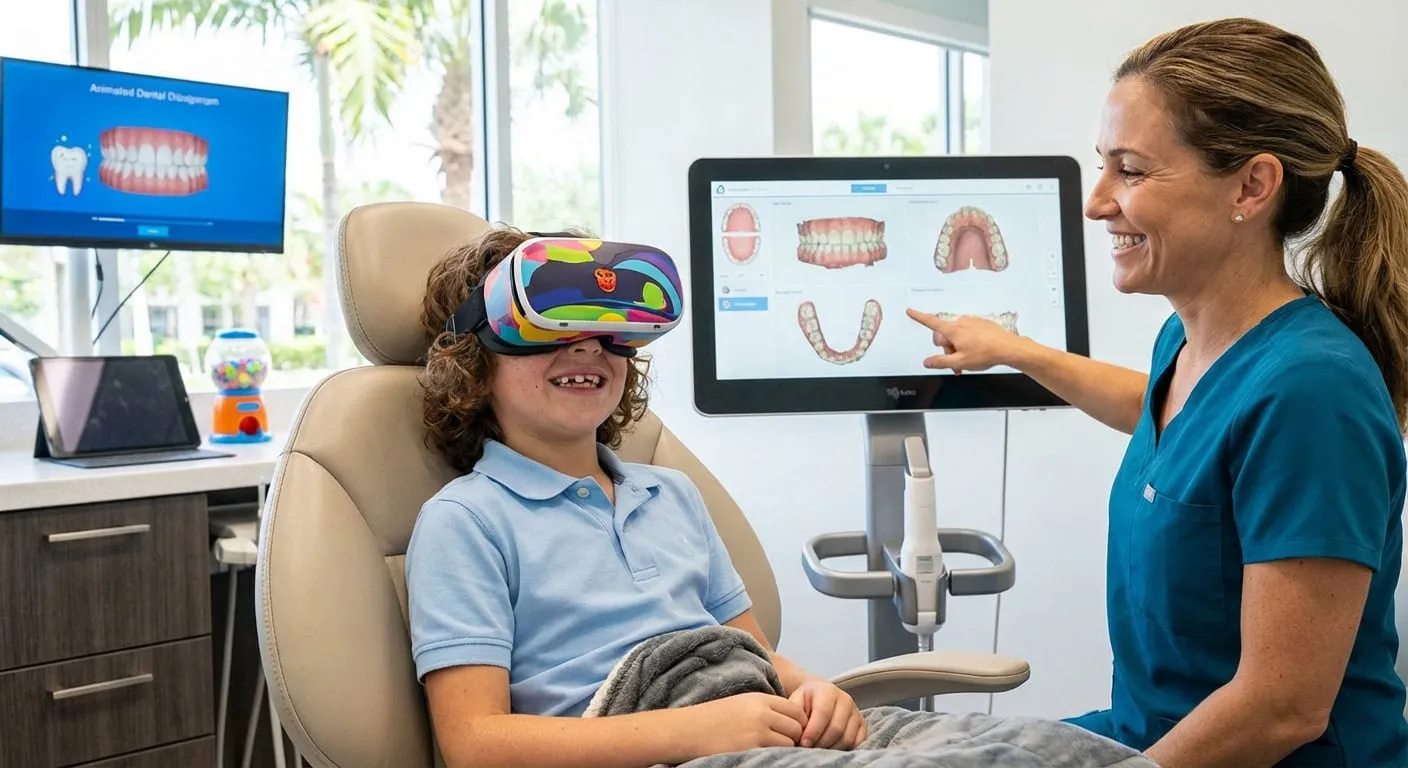
We've got VR games, weighted blankets, noise-canceling headphones in our VIP suites, and snacks.
The whole point is to make this not scary.
The actual appointment is short. We check your child's progress, make adjustments if needed, and schedule the next visit in 6 to 8 weeks.
No long waits in a sterile office.
We use cutting-edge technology that lets us see exactly what's happening and plan the next steps.
Your child leaves feeling good about coming back.
That matters more than you'd think.
How Much Does Phase 1 Cost and What About Insurance
This is the question every parent asks first, and I respect that.
Phase 1 treatment costs way less than full braces later.
Many dental insurance plans cover a portion of early orthodontic care, especially if it's medically necessary.
We work with most major insurance companies and we'll break down what your plan covers.
We also offer flexible payment plans because we know not everyone has cash lying around.
The real cost calculation is this: spend less now on Phase 1, or spend a lot more later on comprehensive orthodontic treatment that could have been prevented.
Most families figure it out pretty quick.
Monitoring Growth Without Overcorrecting
One thing we're careful about is not doing too much too early.
Phase 1 isn't about perfecting your child's smile right now.
It's about managing growth and creating space.
We monitor progress every 6 to 8 weeks and adjust based on how your kid is actually growing.
Every child develops at their own pace.
What works for one kid might be different for another kid the same age.
This is why board-certified orthodontists matter. They know what to watch for and when to adjust course.
Habits That Affect Your Kid's Jaw Growth
Some of the biggest factors in how your child's teeth and jaw develop aren't genetic.
They're habits.
Thumb sucking. Kids who suck their thumbs past age 3 or 4 can develop an open bite and change how their palate grows.
Mouth breathing. When kids breathe through their mouth instead of their nose, it changes the shape of their face and jaw over time.
Tongue thrusting. Some kids push their tongue forward when they swallow, which can push front teeth out.
Phase 1 care helps redirect these habits gently.
We don't shame kids or make them feel bad.
We work with them to normalize healthier patterns.
When to Start Thinking About Phase 1
The ideal age to get your child evaluated is around 7 years old.
This is when most children have a mix of baby teeth and permanent teeth coming in, which gives us the best information.
You don't have to wait for a problem to be obvious.
Regular check-ups with your pediatric dentist can catch things early.
If your dentist mentions anything about bite alignment or spacing, that's a good time to see an orthodontist.
A free consultation won't hurt anything and costs nothing.
Phase 1 Versus Waiting Until Teenage Years
Some parents think they'll just wait until their kid is a teenager and do braces then.
That's a choice, but here's what you're missing:
During Phase 1 ages, your child's jaw bones are still growing and moldable.
By the time they're a teenager, growth is mostly done.
This means less ability to guide growth naturally.
Waiting sometimes means more invasive treatment later, like tooth extraction or jaw surgery in severe cases.
Phase 1 prevention is cheaper and easier than Phase 2 correction.
What Parents in Pembroke Pines Actually Think
We've worked with families from Pembroke Pines, plus Hollywood, Weston, Cooper City, Davie, and Fort Lauderdale.
Check our patient reviews and you'll see a pattern.
Parents say things like their kids felt comfortable immediately.
They say the team explained everything clearly without jargon.
They say they're glad they got started early instead of waiting.
That's because we treat kids like people, not just patients with teeth.
Different Treatment Options Available
Phase 1 isn't one-size-fits-all.
Depending on what your child needs, we might recommend:
Palatal expanders. These gradually widen the upper jaw to create space for teeth.
Partial braces. Sometimes we use braces on just a few teeth to guide growth.
Removable appliances. Many Phase 1 treatments use custom removable devices that kids can take out for eating and brushing.
The specific approach depends on your child's unique situation.
This is why that first consultation matters so much.
Next Steps for Your Pembroke Pines Family
If you're seeing signs that your 6 to 10 year old might benefit from early orthodontic care, the next step is simple.
Book a free 3D scan and VIP smile consultation.
No obligation, no pressure.
We'll take a look, run some imaging, and tell you exactly what we see.
If your child needs Phase 1 care, great, we'll walk you through it.
If they don't, we'll tell you that too and you can relax.
You'll leave knowing whether early orthodontics makes sense for your kid.
That peace of mind is worth the appointment alone.
Phase 1 orthodontics in Pembroke Pines can be the difference between a confident smile later and complicated dental work.
Start the conversation today.
Beyond Phase 1: What Happens Next for Kids and Teens Getting Braces or Clear Aligners in Pembroke Pines
So your kid finished Phase 1 treatment.
Their jaw grew better, their bite improved, and now you're wondering what comes next.
Or maybe your teenager is just now starting orthodontic treatment and you're confused about why they can't just go straight to braces.
Either way, there's a whole second chapter of the orthodontic story that parents don't always understand.
It's called Phase 2, and it's where the real smile transformation happens.
The difference between getting it right and winging it can mean the difference between a smile your kid loves for life and regret that lasts just as long.
Why Phase 2 Treatment Matters More Than You Think
Phase 2 is comprehensive orthodontic treatment.
This is when we bring in all the permanent teeth and align them perfectly.
If your kid did Phase 1, Phase 2 is typically shorter and less complicated because we already fixed the foundation.
If you're skipping Phase 1 and jumping straight to Phase 2, that's fine too, but it might take longer.
Here's what Phase 2 really is: it's the time we align every single tooth so they work together, not just look good.
Bad bites cause real problems down the road.
They lead to jaw pain, worn-down teeth, speech issues, and confidence problems that stick with your kid into adulthood.
Getting it right matters.
The Timeline: When Kids and Teens Actually Start Phase 2
Most kids are ready for Phase 2 between ages 11 and 13.
This varies because growth is different for every kid.
Some kids are done growing their permanent teeth by 11.
Others don't finish until 13 or 14.
That's why we don't rush it.
Starting Phase 2 before all permanent teeth are in is like painting your house before the frame is finished.
If your kid did Phase 1, we've been monitoring their growth the whole time, so we know exactly when to move to Phase 2.
If you're starting now, we'll take some 3D imaging to see where your kid is in their growth cycle.
Braces vs. Clear Aligners: Which One Actually Works Better for Your Teen
This is the question every parent asks.
And the honest answer is: both work if the kid actually uses them.
Traditional braces are still the gold standard for complicated cases.
They work on every type of bite problem.
They're glued on, so there's no way your kid can forget to wear them.
The downside is they're visible and some kids hate that.
Clear aligners, like Invisalign for teens, are nearly invisible.
Your teen can take them out to eat and brush their teeth.
But and this is a big but, they only work if your kid actually wears them 22 hours a day.
A lot of teens don't.
We've seen kids put their aligners in a drawer and forget about them for months.
Then they come back six months later wondering why nothing changed.
So here's what I tell parents: pick based on your kid's responsibility level, not just what looks better.
If your teen is organized and can handle the responsibility, clear aligners are great.
If they lose their phone charger every other week, go with traditional braces.
Either way, they're both effective when used right.
What Happens During Phase 2 Appointments
Phase 2 appointments look different from Phase 1.
Instead of quick check-ins every 6 to 8 weeks, your teen comes in every 4 to 6 weeks for adjustments.
If they're wearing braces, we're tightening wires and changing rubber bands.
If they're in clear aligners, we're checking fit and giving them the next set of trays.
Appointments are still short, usually 20 to 30 minutes.
Your teen doesn't need you in the room unless they're really anxious.
We get a lot of teens who want to feel more independent at this age, and that's totally normal.
How Long Does Phase 2 Actually Take
Most Phase 2 treatment takes 18 to 24 months.
Some cases are faster, some slower.
It depends on how much work needs to happen and how well your kid complies with treatment.
If your teen is wearing their aligners 22 hours a day, things move faster.
If they're wearing them 14 hours a day, it takes longer.
If your kid had Phase 1, Phase 2 is usually on the shorter end of that range because we already did half the work.
We give realistic timelines at your first appointment so you know what to expect.
Cost: What Phase 2 Actually Costs and Insurance Coverage
Phase 2 is more expensive than Phase 1, but it's still less than doing everything at once without interceptive care.
The cost depends on your kid's specific case and what treatment they're getting.
Braces and clear aligners are usually in the same price range, with some variation based on complexity.
Most dental insurance covers orthodontics, but coverage varies.
Some plans cover 50%, some cover less.
We work with your insurance to maximize what they'll pay.
We also offer payment plans so you're not paying everything upfront.
A lot of families pay a monthly amount that fits their budget.
What Your Teen Can and Can't Eat with Braces
If your kid gets braces, this matters.
Braces mean no sticky, hard, or chewy foods.
No popcorn, no gum, no hard candy, no caramel, no nuts, no corn on the cob.
I know that sounds restrictive.
But brackets break, wires bend, and one broken bracket means an emergency appointment.
Your teen can eat soft foods, pasta, rice, bread, soft fruits, yogurt, ice cream, and basically anything they can bite into easily without it sticking to their teeth.
With clear aligners, your teen can eat whatever they want because they take the aligners out.
That's one reason some families prefer them.
Keeping Teeth Clean During Phase 2: It's Harder Than You Think
Braces make brushing and flossing way harder.
Your teen has to brush around brackets and wires.
Flossing requires special threaders or water flossers.
A lot of teens blow this off and end up with cavities during treatment.
That's frustrating because it adds time to the whole process.
With clear aligners, teeth cleaning is way easier because the aligners come out.
But your teen has to actually take them out and brush before putting them back in.
Either way, oral hygiene matters.
We give your teen a home care routine at the start of treatment.
Stick to it and you avoid problems.
What to Expect: Common Discomfort During Phase 2
Braces feel weird at first.
Your teen's mouth will be sore for a few days.
Eating soft foods helps.
Ibuprofen if they need it.
After that initial week, most kids adjust fine.
Clear aligners feel tighter when you first put in a new set of trays.
That's pressure doing its job.
It's not painful, just uncomfortable for a day or two.
Neither type of treatment should hurt.
If your kid is in real pain beyond the first few days, call us.
Something might be wrong.
The Retainer Question: What Happens After Phase 2 Ends
Here's the part a lot of parents don't understand: treatment doesn't end when the braces come off.
Teeth want to move back to where they started.
It's like gravity for teeth.
That's why retainers exist.
Your teen will wear a retainer after Phase 2 finishes.
Some kids wear a fixed retainer bonded to the back of their teeth forever.
Most also wear a removable retainer at night.
Some wear it 24/7 for the first few months, then just at night.
We tell your teen exactly what the plan is.
If they skip retainers, their teeth shift and you're paying for treatment all over again.
That's not us trying to make money.
That's just how teeth work.
Teen Compliance: The Real Secret to Fast Treatment
Here's something nobody likes to talk about: the speed of treatment depends mostly on your kid, not us.
If your teen wears their aligners or takes care of their braces, treatment moves fast.
If they don't, it stalls.
Some teens are super motivated.
They want their braces off before senior pictures or prom.
They're religious about compliance.
Other teens don't care as much.
They forget their aligners, they don't brush properly, and honestly, that's normal teenage behavior.
We're not here to judge.
We're here to work with what we've got.
But parents need to understand that compliance matters.
What Happens if Your Kid Has a More Complex Case
Not every orthodontic problem is simple.
Some kids have severe crowding, really bad bites, or jaw growth issues that need extra attention.
That's where our treatable cases page shows the range of what we handle.
Complex cases might take longer than 24 months.
Some need rubber bands or headgear to guide jaw growth.
Some kids need to see an oral surgeon if the jaw problem is really severe.
We figure this out at your first appointment and we're honest about what it takes.
No surprises.
Technology We Use During Phase 2 Treatment
Phase 2 is where our cutting-edge technology really shows its value.
We use 3D imaging to plan every step of treatment.
Your kid can actually see a simulation of what their smile will look like when we're done.
It's like a before and after preview.
We use digital wire technology that's more comfortable and works faster than old metal wires.
We can track progress with apps so your teen can see the changes happening in real time.
That keeps them motivated.
FAQs About Phase 2 Treatment
Do my teen's teeth hurt while wearing braces?
Yes, for the first few days.
After that, discomfort is minimal.
It's not pain, just pressure.
Can my teen play sports or instruments with braces?
Yes to both.
Sports might require a mouth guard, which we can help with.
Instruments take a little adjustment but kids manage fine.
What if my teen breaks a bracket?
We fix it at the next appointment if it's not urgent.
If it affects their bite, we fit them in sooner.
Can my teen whiten their teeth during Phase 2?
No.
Wait until after braces come off.
Whitening under brackets leaves marks.
Why Board-Certified Orthodontists Matter for Phase 2
Phase 2 is complex.
There are a lot of decisions about tooth movement, bite correction, and timing that need real expertise.
A board-certified orthodontist has spent years learning how to handle complicated cases.
We know how to solve problems that come up mid-treatment.
We know how to adjust plans based on how your kid's teeth are actually responding.
That's not something general dentists can do.
Real Talk: What Parents Tell Us After Phase 2 Finishes
We've worked with hundreds of families through Phase 2 treatment.
The common theme from our patient reviews is that parents wish they'd started earlier.
They say the money was worth every penny.
They say their teen is confident in a way they weren't before.
They say they understand now why we pushed for Phase 1.
The kids say things like they forgot they even had braces after a few weeks.
They got excited watching their smiles change.
That transformation is real.
How to Support Your Teen During Phase 2
Phase 2 is a couple years of appointments and adjustment.
Your teen might be self-conscious about their braces.
That's normal.
But remind them that almost every adult had braces at some point.
It's temporary.
The smile lasts forever.
Help them stick to the hygiene routine.
Remind them to wear their retainer after treatment.
Show them the progress at each appointment.
Celebrate the small wins.
It matters to them.
What Treatment Options We Offer Beyond Traditional Braces
Phase 2 doesn't have to mean traditional metal braces.
We offer clear aligners as a full Phase 2 option, not just for simple cases.
We offer ceramic braces that are tooth-colored if your teen wants something less visible.
We work with your family to find what fits your kid's life and your budget.
The best treatment is the one your teen will actually wear.
Starting Phase 2: The First Appointment
Your first Phase 2 appointment is different from Phase 1 consultations.
We take impressions or scans of your teen's teeth.
We take photos and X-rays.
We show your teen exactly what we're going to do.
We answer questions.
We talk about what to expect in the coming months.
Then we schedule the appointment to start treatment.
Usually that's a week or two later.
The Difference Between Phase 2 Success and Failure
Success is simple: your teen ends up with a healthy bite and a smile they're proud of.
Failure is when teeth shift back because retainers weren't worn, or treatment didn't address the real problem.
The difference between the two is usually just following the plan we laid out.
Wear your retainers.
Come to appointments.
Take care of your teeth.
That's it.
How SMILE-FX Orthodontic & Clear Aligner Studio Handles Phase 2
We treat Phase 2 like it's the most important step in your kid's smile.
Because it is.
We have board-certified orthodontists who specialize in comprehensive treatment for kids and teens.
We use technology that helps us see exactly what's happening and plan precisely.
We schedule appointments that fit your family's life.
We offer braces, clear aligners, and everything in between.
We make sure your teen feels comfortable, not anxious.
We're transparent about cost, timeline, and what to expect.
Most importantly, we're honest about whether your kid needs Phase 2 or if what we did in Phase 1 is enough.
Get Started on Phase 2 Today: What's Next
If your teen is ready for comprehensive orthodontic treatment, or if your kid finished Phase 1 and you're wondering what comes next, the next step is to schedule an appointment.
Book a FREE 3D scan and VIP smile consultation with our team at SMILE-FX.
We'll show you exactly where your kid is in their growth and what Phase 2 looks like for them specifically.
We'll talk about your options for braces or clear aligners.
We'll explain the cost and how insurance works.
We'll answer every question you have.
Phase 2 orthodontic treatment for kids and teens in Pembroke Pines doesn't have to be complicated or expensive.
It just has to be done right.
Let's get your teen's smile to where it needs to be.
What Happens Between Phases: Maintenance, Monitoring, and Making Sure Your Smile Stays Perfect in South Florida
You just finished Phase 1 treatment and your kid's teeth look better.
But now what?
Your orthodontist mentions something about monitoring and maintenance, and you're sitting there thinking that sounds expensive and complicated.
Here's the thing: what happens between Phase 1 and Phase 2, and what happens after Phase 2 ends, is actually the difference between a smile that lasts and a smile that falls apart.
Most parents don't understand this part, so let me break it down straight.
The Gap Between Phases: Why Waiting Isn't Just Sitting Around
After Phase 1 wraps up, your kid doesn't jump straight into Phase 2.
There's usually a waiting period of 6 months to 2 years, depending on when all the permanent teeth are ready to come in.
This isn't wasted time.
This is actually critical.
Your board-certified orthodontist is tracking growth patterns, watching how new permanent teeth are coming in, and making sure everything is staying on track.
If something starts to shift or regress, we catch it early.
Think of it like maintenance on your car.
You don't just drive it off the lot and never check it again.
Same with teeth.
Monitoring Appointments: Short, Simple, and Worth Your Time
During this gap period, your kid comes in for monitoring visits every 6 to 12 months.
These aren't like regular appointments.
They're quick check-ins, usually 15 to 20 minutes.
We take a few photos, maybe an X-ray, and see how things are progressing.
We're looking for:
New permanent teeth coming in straight or crooked.
The bite staying where we left it or shifting.
Any signs of bad habits returning, like thumb sucking or mouth breathing.
Space management as more teeth erupt.
If everything looks good, you schedule the next visit.
If we see something that needs attention before Phase 2, we address it then.
That's why these visits matter.
Can Teeth Shift Back During the Gap? Yes, and Here's Why
This is the question parents always ask.
And the answer is yes, they can shift back if you're not careful.
Teeth have what we call a memory for their original position.
They want to go back to where they started.
That's why some kids are prescribed a retainer during the gap between phases.
Not all kids need one, but if your orthodontist recommends it, that's not them trying to sell you something extra.
That's them protecting the work we already did.
Wearing a retainer during the gap keeps everything stable while permanent teeth are still coming in.
Once Phase 2 starts, the braces or clear aligners take over that job again.
Cost During the Gap: What You'll Actually Pay
Monitoring visits are usually included in your Phase 2 cost or covered by your initial treatment plan.
You're not getting hit with surprise bills for check-ups.
If your kid needs a retainer during the gap, that might be an additional cost, but most practices work with you on pricing.
We offer flexible payment plans because we know not every family has cash sitting around.
The cost of maintaining what we've already done is way less than starting over from scratch if something goes wrong.
Insurance Coverage During the Gap and Between Phases
Most dental insurance plans cover orthodontics, but coverage varies.
Some plans break it into two separate benefits for Phase 1 and Phase 2.
Others give you one annual orthodontic benefit regardless of which phase you're in.
Monitoring visits might be covered as a regular dental visit instead of an orthodontic visit.
That actually works in your favor sometimes because your deductible might be lower.
We work with your insurance to figure out what they'll cover and what you're responsible for.
You won't be surprised by bills.
Does insurance cover braces is something every parent wants to know, and the answer depends on your specific plan, but most do cover at least a portion of orthodontic treatment.
Life During the Gap: What Your Kid Can and Can't Do
If your kid was in Phase 1 and now they're in the gap, life is pretty normal.
They can eat whatever they want.
They can play sports without worrying about broken brackets.
They can brush and floss like normal kids.
If they're wearing a retainer, the only commitment is wearing it as directed, which is usually at night.
No special foods to avoid, no special care routine.
Just normal life with a simple habit of putting in a retainer before bed.
What Parents Miss About Retainers During the Gap
A lot of parents think retainers are optional after Phase 1.
They're not.
If your orthodontist prescribes one, that's because they see a risk of relapse without it.
Relapse means teeth shifting back toward their original position.
When that happens, you're looking at more treatment time in Phase 2 or potentially braces all over again in a few years.
Wearing a retainer for a few years of the gap is way easier than that.
I know retainers feel like a hassle, but they're the difference between a stable foundation going into Phase 2 and a mess you have to clean up.
The Role of Permanent Tooth Eruption and Why Timing Matters
Here's something not every orthodontist talks about openly: the timing of when permanent teeth come in affects everything.
Some kids have all their permanent teeth by age 12.
Others don't finish until age 14 or 15.
If you start Phase 2 before all permanent teeth are in, you're basically treating a moving target.
New teeth come in and mess up all your planning.
That's why we monitor during the gap.
We're watching for that moment when your kid is ready to move to Phase 2 based on their actual growth, not a calendar.
Every kid develops at their own pace, and that's okay.
Signs That Your Kid Might Need to Move to Phase 2 Early
Most kids transition to Phase 2 between ages 11 and 13.
But sometimes we see signs that it's time to move forward earlier:
All permanent teeth are in and the bite is getting crowded again.
Growth has slowed down and we have a clear picture of the final result.
Bad habits have returned and need addressing with full braces or aligners.
New teeth are coming in so crooked that it's affecting overall bite alignment.
Your orthodontist will bring this up at a monitoring visit if they see any of these signs.
We're not trying to rush you into treatment.
We're reading what your kid's teeth are actually telling us.
Adult Patients: What the Gap Looks Like for Late Starters
Not everyone gets orthodontics as a kid.
A lot of adults are starting orthodontics for the first time in their 20s, 30s, 40s, and beyond.
For adult patients, there's no gap between phases because adult growth is done.
Most adults go straight into comprehensive Phase 2 treatment with braces or clear aligners.
The timeline is usually 18 to 24 months, no waiting around.
Adult orthodontics works faster because there's no growth variable to manage.
If you're an adult thinking about orthodontics, that's actually good news for you.
Why SMILE-FX Makes the Gap Period Easy
At SMILE-FX Orthodontic & Clear Aligner Studio, we treat the gap period like it's just as important as Phase 1 and Phase 2.
We schedule monitoring visits at times that work for your family.
We don't overcharge for visits or pretend you need treatment you don't actually need.
We're transparent about what we're seeing and what comes next.
Our cutting-edge technology means we can track changes with precision and catch problems early.
We use digital imaging that lets us show your kid exactly what's changing with their teeth.
That keeps them engaged and excited for the next phase.
Technology That Keeps You Connected During the Gap
You don't have to wonder what's happening with your kid's teeth during the gap period.
We use apps and digital tools that let you see progress between visits.
Some practices use AI-powered monitoring that tracks tooth position over time.
We can send you updates about how erupting permanent teeth are positioning themselves.
It's like having a window into what's going on in your kid's mouth without having to come in every week.
Common Questions About the Gap Period Answered
Can my kid start Phase 2 whenever we want, or do we have to wait?
You have to wait until permanent teeth are mostly in and growth has slowed down.
We decide together based on what the 3D scans and X-rays show, not what your schedule wants.
What if a permanent tooth comes in really crooked during the gap?
We monitor it at your visits.
Sometimes it self-corrects as surrounding teeth come in.
Sometimes we need to address it in Phase 2.
Either way, we're watching.
Do I need to do anything special during the gap to prepare for Phase 2?
Keep up with regular dental hygiene.
Wear a retainer if we prescribed one.
Come to monitoring visits as scheduled.
That's it.
Can my kid play sports during the gap?
Yes, absolutely.
They're not in any orthodontic appliances, so there are no restrictions.
What if my kid's permanent teeth come in straighter than expected?
That happens sometimes.
We'll let you know if Phase 2 might not be necessary or if it will be much simpler than originally planned.
Less treatment for your kid is always a win.
Preparing Mentally for Phase 2: Managing Expectations During the Wait
The gap between phases can feel like forever when you're a teenager.
Your kid finished one thing and now they're waiting for the next phase.
That's normal to feel antsy about.
But remind them that this waiting period means less time in braces or aligners later.
We did half the work already in Phase 1.
Phase 2 is going to be smoother and faster because of that foundation we built.
We're not delaying things randomly.
We're timing everything for maximum efficiency.
Moving Forward: Transitioning From Gap to Phase 2
When your kid is ready to move into Phase 2, we'll schedule a more comprehensive appointment.
This isn't a quick check-in.
This is where we take new impressions, photos, and detailed scans.
We'll walk through exactly what Phase 2 will look like for your kid specifically.
We'll discuss braces versus clear aligners and what makes sense for them.
We'll talk about cost, timeline, and what to expect.
We'll answer every question you have before you commit to anything.
That first comprehensive Phase 2 appointment is where the real plan comes together.
Your Next Step: Book a Monitoring Visit or Start Your Journey
If your kid is in the gap between phases right now, schedule a monitoring appointment.
If you're a new patient wondering about Phase 1, Phase 2, or if your kid needs treatment at all, the best next step is booking a FREE 3D scan and VIP smile consultation.
We'll show you exactly where your kid is and what the journey looks like from here.
No pressure, no sales pitch, just honest answers about your kid's smile and what it needs.
Whether you're looking for the best orthodontist for kids in South Florida or searching for affordable braces near you, SMILE-FX is here to guide you through every phase of your orthodontic journey.