
Phase 1 Orthodontics Pembroke Pines Kids Ages 6-10
As a parent in Pembroke Pines, you're probably wondering if your kid's teeth need help.
Maybe you've noticed some crowding.
Maybe their bite looks a little off.
Or maybe you're just not sure what's normal and what isn't.
That's where Phase 1 orthodontics comes in.
It's not about jumping straight into braces.
It's about catching things early when your child's jaw is still growing, and guiding that growth in the right direction.
Families across Broward County trust SMILE-FX Orthodontics because we get this.
We're board-certified specialists, not general dentists playing orthodontist.
We use real tools, real science, and real expertise to set your kid up for a confident smile that lasts.
What Is Phase 1 Orthodontics, Really?
Phase 1 orthodontics is interceptive treatment.
Fancy word, simple idea.
Your child still has baby teeth mixed with adult teeth.
Their jaws are actively growing.
This is the perfect window to guide that growth before adult teeth are fully in.
You're not forcing their teeth into place permanently.
You're creating the space and conditions they need to come in right the first time.
Think of it as preventive medicine for smiles.
The American Association of Orthodontists recommends an evaluation around age 7.
Why 7?
Because that's when enough adult teeth have come in that we can spot real patterns.
You can see if a kid has crowding that'll get worse.
You can catch a crossbite before it becomes a bigger problem.
You can identify habits like mouth breathing or thumb sucking that might be shifting jaw growth.
It's not about rushing into treatment.
It's about knowing whether your kid needs it.
Why Pembroke Pines Parents Are Choosing Early Evaluation
Here's what I hear from parents around here.
They see their kid's teeth coming in wonky and feel stressed.
They Google whether they need braces.
They read scary stories about complicated cases that could have been simpler.
Then they feel guilty for not catching it sooner.
Stop.
That's not how this works.
Early evaluation at SMILE-FX takes that stress away.
We use low-dose CBCT scans to get a real picture of what's happening with your child's jaw and teeth.
No guessing.
No drama.
Just honest answers about whether Phase 1 treatment makes sense for your kid right now.
And honestly, lots of kids don't need it.
If treatment isn't necessary, we tell you that straight up.
That's trust.
That's what separates a real specialist from someone just trying to book more appointments.
You're only 10-15 minutes from our Miramar location via I-75.
Easy drive.
Easy parking.
No headache.
That matters when you've got school runs and activities pulling you in a hundred directions.
The Red Flags That Say Phase 1 Might Help Your Kid
Not every kid needs Phase 1 treatment.
But some signs are worth paying attention to.
Crowding is the big one.
If your child's baby teeth are tight and overlapping, their permanent teeth probably won't have room either.
Phase 1 can expand the jaw gently while it's still growing, creating that space naturally.
This means fewer extractions later and a better foundation for their adult smile.
Crossbites are another thing.
This is when the upper and lower jaws don't line up quite right.
Maybe the bottom jaw is pushed forward.
Maybe it's pulled back.
Either way, if you fix this while the jaw is still growing, you avoid way bigger problems down the road.
We're talking potential jaw joint issues, uneven wear on teeth, and way more complicated treatment later on.
Mouth breathing or persistent thumb sucking past age 4 or 5 can actually shift how a kid's jaw grows.
These habits change the pressure on growing bones.
If your kid is still doing either of these, Phase 1 treatment can help normalize their breathing and growth patterns without pressure or guilt.
We work with the behavior, not against it.
Underbites or overbites that are more than just cosmetic are worth addressing early.
If there's a real structural difference, catching it now means better results and less time in braces later.
What Happens During Your First Visit
Your first appointment at SMILE-FX is 30-45 minutes.
We start with a real conversation.
We ask about your kid's health history, their habits, any concerns you have.
No rushing.
No clipboard and go.
Then we do a clinical exam.
We look at how their teeth are coming in, how their jaws are aligned, how they're breathing and swallowing.
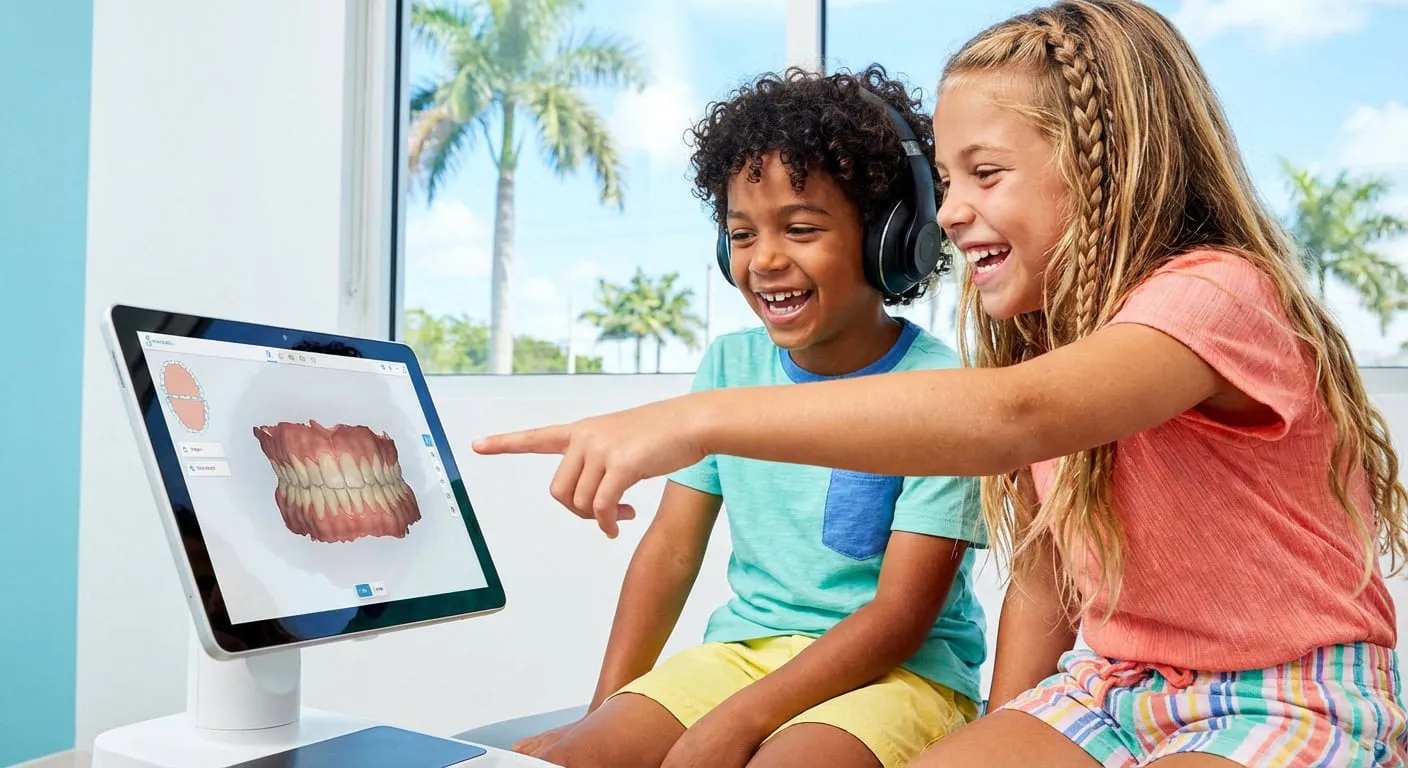
We take a low-dose digital scan and explain it in a way your kid actually understands.
No scary X-ray talk.
Just real information about what we're seeing.
Here's what makes SMILE-FX different.
While we're working, your kid gets to play VR games, watch their favorite show on a personal TV, or chill with a weighted blanket.
We have noise-canceling headphones.
We have snacks.
We're not trying to make this feel like a medical appointment because kids can smell fear a mile away.
We're making it feel like playtime while we do real work.
At the end, we talk through our findings and recommendations.
No pressure.
No sales pitch.
If your kid needs treatment, we explain what that looks like and why it makes sense.
If they don't need anything yet, we tell you that and schedule a check-in down the road.
Honest, straightforward, no games.
Phase 1 Treatment Options at SMILE-FX
If your kid does need Phase 1 treatment, the good news is you've got options.
Palatal expanders are one common approach.
These gently widen the upper jaw to create more space for teeth and improve airflow.
They sound scary, but they're actually super comfortable once your kid gets used to them.
We use advanced technology and digital scanners to make sure they're custom-fit and work properly.
Your kid turns a little screw each night, and their jaw gradually expands as it grows.
No force.
No pain.
Just natural growth guidance.
Habit correction appliances help with thumb sucking or tongue thrusting.
These gentle reminders help kids break the habit without feeling punished or embarrassed.
Partial braces on just the front teeth sometimes make sense for Phase 1.
Again, we're working with growth, not against it.
The goal is to get things aligned while you've got room to work with.
In some cases, we recommend just monitoring for now.
We'll see your kid every 6-8 months and track how things develop.
Sometimes jaw growth takes care of the problem on its own.
Why The Timing Matters So Much
Here's the thing about early intervention.
Your child's jaw bones are still soft and moldable.
Growth is happening.
Permanent teeth are coming in.
This window doesn't last forever.
By age 12 or 13, most of that growth is done.
Jaws are harder to influence.
If you've got crowding or alignment issues, you're dealing with them when it's much harder and more expensive to fix.
Phase 1 isn't rushing into anything.
It's actually the smart way to avoid rushing later.
You're being proactive instead of reactive.
You're giving your kid's smile the best possible foundation before all the adult teeth are even in.
This is why the American Association of Orthodontists recommends that evaluation by age 7.
It's not early.
It's right on time.
The SMILE-FX Difference For Pembroke Pines Families
I could tell you about our board-certified team, our state-of-the-art technology, or our patient reviews.
All that's true.
But what actually matters to you is this: we get how stressful this is for families.
We know you want answers, not sales pressure.
We know you want your kid to feel comfortable, not scared.
We know you want real expertise, not a general dentist moonlighting as an orthodontist.
We know you want a team that's nearby and easy to work with because life is already complicated enough.
We're different because we actually listen to what parents need.
We've built our whole practice around that idea.
Our patient reviews speak for themselves, but the real test is talking to us directly.
Common Questions About Phase 1 Orthodontics For Your Kid
Does Phase 1 mean my kid will need braces later?
Not necessarily.
Sometimes Phase 1 treatment takes care of the problem completely.
Sometimes it makes Phase 2 treatment shorter and simpler.
Either way, you're ahead of the game.
Early intervention often prevents bigger problems down the road.
How long does Phase 1 treatment usually take?
It depends on what we're treating and how your child's jaw responds.
Most Phase 1 cases take 12-24 months.
We monitor progress and adjust as we go.
No guessing games.
Is Phase 1 treatment painful?
Not at all.
Your kid might feel slight pressure when we adjust their appliance, but it's nothing close to pain.
We're working gently and following their growth, not fighting against it.
Most kids say the VR games are more exciting than anything else happening in the appointment.
What about cost?
Phase 1 treatment is usually less expensive than comprehensive braces treatment later.
We work with most insurance plans and offer flexible payment options because cost shouldn't be a barrier to giving your kid a healthy smile.
Book a free 3D scan and VIP smile consultation and we'll talk through all your options with no obligation.
How do I know if my kid needs it?
That's what the evaluation is for.
Come in, get the real picture, and make an informed choice.
No pressure.
We see kids every day who don't need Phase 1, and we tell their parents that honestly.
What Sets Phase 1 Apart From Just Waiting
Some parents ask: why not just wait until all the adult teeth are in and then do braces?
That's a fair question.
And sometimes that's actually the right move.
But sometimes, early guidance prevents years of problems.
If your child has a real crossbite, waiting means their jaw develops asymmetrically.
That's harder to fix.
If crowding is severe, waiting means potential extractions that could have been avoided.
If mouth breathing is changing growth patterns, waiting just reinforces those patterns.
Phase 1 isn't about rushing.
It's about working with your child's natural growth instead of fighting against it later.
Ready To Get Your Kid Evaluated?
You don't have to wonder if your child's smile needs help.
You don't have to stress about whether you're making the right choice.
Book a free 3D scan and VIP smile consultation at SMILE-FX and get real answers from real specialists.
We'll show you exactly what's happening with your child's teeth and jaw, explain your options clearly, and let you decide what's best for your family.
No pressure.
No games.
Just honest orthodontic care from a team that actually listens.
Parents in Pembroke Pines have been choosing SMILE-FX for years because we deliver results and make the whole process easy.
Your child's confident smile starts with one simple decision to get them evaluated for Phase 1 orthodontics.
Phase 2 Orthodontics After Phase 1: What Parents Need To Know About Comprehensive Treatment
So your kid finished Phase 1 treatment and you're wondering what comes next.
Maybe their jaw grew the way we hoped.
Maybe some teeth still need work.
Maybe you're thinking about whether braces or clear aligners make more sense now.
That's where Phase 2 orthodontics steps in.
This is the part where we take everything we learned from Phase 1 and build on it.
Your child's jaw is mostly done growing.
All the adult teeth are in or coming in.
Now we align everything perfectly for that smile that lasts a lifetime.
Understanding Phase 2 Treatment After Your Child's First Phase
Phase 2 is different from Phase 1 in one big way.
We're not trying to guide growth anymore.
Growth is basically complete.
Now we're positioning teeth exactly where they need to be.
This is comprehensive orthodontic treatment.
It's the meat and potatoes of what people think of when they hear the word braces.
The cool part is that Phase 1 already did half the work.
Your kid's jaw has room.
Bite patterns are better.
Bad habits are gone.
Phase 2 just fine-tunes everything so teeth are straight, aligned, and functional.
You've already prevented way bigger problems by doing Phase 1.
Now Phase 2 makes sure the final result is perfection.
Most kids move into Phase 2 around age 11 or 12.
That's when all or almost all adult teeth have come in.
Some kids don't need Phase 2 at all because Phase 1 fixed the problems completely.
Some kids wait a year or two after Phase 1 ends.
It all depends on what we see during your checkups and how your child's mouth keeps developing.
Braces Vs Clear Aligners: Which Works Better For Phase 2
This is probably the biggest decision you'll make.
Both work.
Both get results.
The difference is how they feel and how much responsibility your kid takes on.
Traditional braces are the workhorse.
Brackets on teeth, wire running through, monthly adjustments.
Your kid can't forget about them because they're stuck there.
They handle complex bite problems better.
They work faster for tough cases.
They're also the cheaper option most of the time.
You can learn more about how braces work at SMILE-FX and what the process looks like start to finish.
The trade is that braces are visible.
Some kids care.
Some don't.
Food gets stuck.
Brushing takes longer.
But kids bounce back from these things fast.
Most adapt within a week.
Clear aligners are the invisible option.
Your kid wears a series of custom trays that gradually move teeth.
They pop out for eating and brushing.
Nobody knows they're doing treatment.
That's huge for confidence during teenage years.
Invisalign and other clear aligner systems have come a long way and can handle most Phase 2 cases now.
The catch is that clear aligners need discipline.
Your kid has to wear them 20+ hours a day.
They have to actually put them back in after meals.
They have to keep track of them and not lose them.
If your kid is forgetful or resistant, clear aligners turn into an expensive paperweight.
That's just real talk.
Here's what I see work best: matching the treatment to the kid's personality.
Responsible and image-conscious?
Clear aligners win.
Less detail-oriented or has complex bite issues?
Braces are the move.
There's no wrong choice if your kid actually follows through.
How Long Does Phase 2 Actually Take
Most Phase 2 cases run 18 to 24 months.
Some shorter, some longer depending on what we're fixing.
If you did Phase 1, you're usually on the shorter end because that groundwork is done.
If your kid is jumping straight to Phase 2 without Phase 1, we might need more time.
The timeline also depends on how fast your kid's teeth move and how well they follow instructions.
If they wear clear aligners only 18 hours a day instead of 20, treatment takes longer.
If they follow the program exactly, they move faster.
Braces patients don't really have this variable because the braces are always working.
We adjust braces or swap aligners every 4 to 6 weeks.
You come in, we check progress, we make the next move.
It's steady, predictable, and measurable.
You can actually see change happening each month.
What Phase 2 Treatment Actually Fixes
Phase 1 handled growth problems.
Phase 2 handles position problems.
These are different things.
Crowding gets completely resolved.
Teeth are straightened and positioned so they're not overlapping anymore.
This makes brushing easier and prevents decay in spots that were hard to reach before.
Bite alignment gets dialed in.
We make sure your kid's front teeth overlap correctly.
We align the back teeth so they touch evenly.
We eliminate any remaining crossbites or open bites.
This is pure mechanics and takes real expertise to get right.
Tooth rotation is corrected.
Some teeth come in rotated.
Phase 2 twists them into place.
It's not cosmetic.
A rotated tooth doesn't function right and can wear down unevenly.
Spacing gets closed.
Some kids have gaps between teeth.
Phase 2 brings those teeth together so there's no space for food to get stuck and no room for future movement.
Vertical alignment gets balanced.
Sometimes teeth erupt at different heights.
We level those out so the bite is balanced and even.
What To Expect During Phase 2 Appointments
Appointments are pretty straightforward.
They're shorter than Phase 1 visits, usually 20 to 30 minutes.
We look at how teeth are moving.
We take progress photos and maybe X-rays a couple times a year.
We make adjustments.
If your kid has braces, we tighten the wire or replace it with a slightly heavier one.
This gentle pressure keeps teeth moving.
Some discomfort is normal for a few days after an adjustment.
Nothing like pain, just pressure and slight soreness.
It goes away.
If your kid has clear aligners, we swap out for the next tray in the series.
It's faster.
No discomfort.
The tray feels tight for a day or two as teeth start moving into new positions, but again, nothing serious.
We talk about oral hygiene at every visit.
This is critical because braces make it harder to brush properly and food gets caught.
Clear aligners are easier to keep clean, but the teeth underneath still need serious attention.
We teach your kid the right techniques.
Most kids nail this pretty quick once they understand why it matters.
The Real Cost Of Phase 2 Treatment
This is the question every parent asks and deserves a straight answer.
Phase 2 comprehensive treatment runs anywhere from $3,000 to $7,000 depending on complexity and whether you're doing braces or clear aligners.
Clear aligners usually cost more.
Braces usually cost less.
Here's what you need to know: if your kid did Phase 1, you probably already spent $1,500 to $3,000.
But you prevented complications that would have made Phase 2 way more expensive or complex.
So the total investment over both phases is actually less than if you'd jumped straight to comprehensive treatment without Phase 1.
Most insurance covers Phase 2 treatment if it's deemed medically necessary.
We'll check your coverage before you commit.
We also offer payment plans because orthodontics shouldn't force a family into debt.
Book a free 3D scan and VIP smile consultation and we'll break down exactly what Phase 2 costs for your kid and what financing options work for your situation.
Why Phase 2 Matters Even If Phase 1 Went Great
Some parents think: well, Phase 1 solved the bite problem, so why do we need Phase 2?
Fair question, but here's the thing.
Phase 1 prevented future problems.
It gave room for teeth to erupt.
It fixed growth patterns.
But individual teeth still need to be straightened and perfectly positioned.
A crossbite that's been corrected still leaves teeth that might be rotated or slightly off.
A jaw that's now the right size still needs teeth arranged perfectly within it.
Think of Phase 1 as building the foundation for a house.
Phase 2 is actually building the house.
Both matter.
Plus there's the confidence factor.
Kids notice their teeth.
They compare their smile to other kids' smiles.
A perfectly straight smile during the teenage years is worth something real to their self-esteem.
That's not superficial.
That's human.
How Clear Aligners Are Changing Phase 2 Treatment
Clear aligners have come a long way in the last 10 years.
Clear aligner systems can now handle cases that used to require braces.
Rotations, vertical movements, complex bites.
They do it all with invisible trays.
The technology uses 3D mapping to plan the exact movements.
Each tray is a tiny increment of that plan.
Your kid wears one tray for 1 to 2 weeks, then moves to the next.
It's gradual, predictable, and invisible.
The downside is still discipline.
Wear them less and treatment stalls.
Forget to put them back after snacks and you slow down progress.
But for kids who are responsible and care about appearance, clear aligners are changing the game.
Real Talk About Retention After Phase 2 Ends
Here's something a lot of parents don't think about: retention.
Teeth want to move back to where they came from.
This isn't a failure on anyone's part.
It's just biology.
After Phase 2 finishes, your kid needs to wear a retainer.
For the first few months, that's every night.
Then it drops to a few nights a week for years.
Most kids end up wearing a retainer forever if they want that smile to stay perfect.
It's not a burden once it becomes routine.
But it's important.
We offer different retention options: wire retainers bonded to the back of teeth, removable plastic retainers, or both.
We'll talk through what makes sense for your kid's specific situation.
The goal is compliance, and some kids comply better with certain types.
When Phase 2 Might Be Skipped Entirely
Not every kid who does Phase 1 needs Phase 2.
If Phase 1 treatment corrects all the problems and teeth come in aligned, you're done.
Teeth are straight.
Bite is good.
No Phase 2 needed.
This happens maybe 20% of the time.
It's unpredictable going in.
That's why we check in every 6 to 8 months during Phase 1 and reassess.
If teeth are tracking toward good alignment, we might not start Phase 2.
If we see potential problems, we plan ahead for it.
The checkups are worth it whether Phase 2 happens or not.
You get peace of mind knowing someone's watching.
You get honest guidance about what's actually needed instead of guessing.
Choosing Your Orthodontist For Phase 2 Treatment
Phase 2 is complicated.
It requires expertise, good clinical judgment, and ongoing problem-solving.
You want a board-certified orthodontist, not a general dentist doing braces on the side.
That's non-negotiable.
You also want someone who has access to cutting-edge technology.
3D imaging, digital treatment planning, real-time progress tracking.
These tools make Phase 2 predictable and faster.
They also mean fewer surprises and better results.
At SMILE-FX, we've built our whole practice around doing this right.
We use board-certified specialists.
We use the best technology.
We offer all treatment options: braces, clear aligners, and other specialized treatments for complex cases.
We also actually care about making this easy on your family instead of just booking appointments.
Questions You Should Ask Before Starting Phase 2
How much will Phase 2 cost and what does that include?
Get a written estimate.
Know what's covered and what costs extra.
Ask about payment plans.
No surprises.
How long will it actually take for my kid's case?
Get a realistic timeline.
Average is 18 to 24 months, but some cases are 12 months and some are 30.
Know which your kid is.
Are there any reasons Phase 2 might not work out the way we plan?
Honest orthodontists will tell you sometimes teeth don't move as predicted or growth happens we didn't expect.
It's rare, but possible.
Ask about what happens if that occurs.
Will my kid need extractions?
Some Phase 2 cases require removing teeth to make room.
This is sometimes necessary and sometimes optional.
Know where you stand before committing.
What happens if we're not happy with results?
Good orthodontists stand behind their work.
Ask about their refinement policy if results aren't what you expected.
Making Phase 2 Easier On Your Kid
Help your kid understand why this matters.
Not just the smile part, though that's real.
But also the function part.
Straight teeth last longer.
They're easier to keep clean.
A good bite protects the jaw.
This isn't vanity.
It's investment in their health for life.
If they're wearing braces, help them develop a brushing routine.
Get them an electric toothbrush and a water flosser.
These tools make cleaning around brackets way easier.
Make it a game if they're younger or just a normal part of their day if they're teenagers.
If they're wearing clear aligners, set phone reminders for insertion and removal if they need them.
Some kids are naturally good at this.
Others need nudges.
Neither is wrong.
You're helping them succeed.
Schedule appointments at times that don't make them miss tons of school.
This sounds small but it matters for compliance and making the whole process feel less disruptive.
We work with your schedule to make it work.
The Long Game: What Phase 2 Means For Your Kid's Future
Phase 2 isn't just about looking good for the next 24 months.
It's about setting your kid up for life.
Straight teeth are easier to clean, which means fewer cavities and less decay.
A good bite distributes force evenly across teeth, which means less wear and fewer dental problems down the road.
A confident smile affects how your kid sees themselves and how others see them.
Research shows people with straight smiles get treated differently in social and professional settings.
That's not fair, but it's real.
Giving your kid that advantage costs money now but pays dividends for decades.
This is why our patients keep coming back and referring their friends.
We do Phase 2 right.
We get results that last.
We treat kids like humans instead of just mouths that need fixing.
Ready To Start Phase 2 Or Not Sure If Your Kid Needs It
If your kid finished Phase 1 and you're wondering what's next, we'll tell you straight up.
Some kids need Phase 2.
Some don't.
You won't know until we check them out properly.
If your kid skipped Phase 1 and is now at the age where comprehensive treatment makes sense, same deal.
We evaluate, we explain your options, and we let you decide what's best for your family.
Book a free 3D scan and VIP smile consultation and find out exactly what Phase 2 looks like for your kid.
We'll show you the plan, explain the timeline and cost, and answer every question you have.
No pressure.
No sales pitch.
Just honest orthodontic care from specialists who actually know how to do this right.
Phase 2 orthodontics with SMILE-FX gets your kid a smile that works hard and looks great for life.
Making The Right Choice: Why Your Orthodontic Provider Matters As Much As The Treatment Itself
You've heard the pitch before.
Every orthodontist says they're the best.
Every office claims they use the latest technology.
Every team swears they care about your family.
But here's the thing that nobody talks about: choosing the right orthodontist matters more than you think, and not because of the fancy equipment or the marketing.
It matters because orthodontics is a partnership.
It's you and your kid and your orthodontist working together for 2-3 years.
That relationship determines whether your kid actually follows through, whether you feel confident in the plan, and whether results actually stick.
So let's talk about what separates a real board-certified orthodontist from someone just filling a chair.
Let's talk about what makes an office actually different.
And let's talk about how to spot the difference between a place that treats smiles and a place that treats people.
Board Certified Versus Everyone Else: Why Your Orthodontist's Credentials Matter
This is the baseline.
Not the ceiling.
The baseline.
A board-certified orthodontist has spent 2-3 extra years after dental school learning specifically how to move teeth and guide jaw growth.
They've done hundreds of cases under supervision.
They've passed rigorous exams.
They maintain continuing education to keep their certification active.
A general dentist can legally place braces.
They learned orthodontics in dental school the same way they learned filling cavities and cleaning teeth.
A few weeks in a broader curriculum.
That's not the same thing.
It's like going to a eye doctor versus an ophthalmologist.
Both know about eyes.
One specializes.
That specialization matters when things get complicated.
At SMILE-FX, we're board-certified specialists.
That's not a marketing line.
That's a commitment.
We went all in on this one thing.
We got trained deeply.
We stay sharp.
We know how to handle the cases that make other people nervous.
When you're looking at orthodontists near you, check if they're board-certified.
It's not everything, but it's where trust starts.
Technology That Actually Matters Versus Tech For Tech's Sake
Walk into any modern orthodontic office and you'll see cool equipment.
3D scanners.
Digital treatment planning software.
Fancy computers showing your smile in 3D.
It looks impressive.
But here's what separates smart technology from gadgets: does it actually make treatment better?
Real technology does three things.
It makes diagnosis more accurate.
It makes planning more precise.
It makes tracking progress simpler.
If a tech tool doesn't do those three things, it's just expensive decoration.
We use cutting-edge technology at SMILE-FX because it works, not because it's shiny.
3D imaging lets us see exactly what's happening with your kid's teeth and jaw.
Digital planning lets us show your family exactly what treatment will look like before we start.
Real-time progress tracking means we know within weeks if something's not going according to plan and we can adjust.
That's technology that earns its place in the office.
The Real Question About Affordability: What Does It Actually Cost To Fix Your Kid's Smile
Money matters.
Let's not pretend it doesn't.
You're looking at braces near you or clear aligners because you want your kid to have a good smile, but you also want to know it's not going to wreck your budget.
Here's the thing about cost: the cheapest option isn't always the cheapest when you count everything.
If you go to someone with less experience and treatment takes longer, you're paying more in the long run.
If your kid's treatment doesn't actually work and you need refinements or redoing parts, that costs more.
If you pick clear aligners because they seem cheaper and your kid doesn't wear them, that money's wasted.
Affordable braces in South Florida exist, but affordable doesn't mean cheap.
It means reasonable.
It means payment plans that actually work for families.
It means no surprises.
We offer $0 down braces financing because paying for treatment shouldn't force you to choose between orthodontics and groceries.
Ask any orthodontist office what their pricing covers.
Ask about payment plans.
Ask what happens if treatment takes longer than planned.
Ask if there's a refinement period included or if that costs extra.
These answers tell you whether they're thinking about your family or just your wallet.
Braces Versus Invisalign Versus Clear Aligners: The Real Breakdown
This decision comes up in every consultation.
Your kid wants invisible treatment.
You want something that actually works.
Everyone wants it to be fast and painless.
Reality check: you can have two out of three, not all three.
Traditional braces are the fastest option for most cases.
They're always working.
Your kid can't accidentally leave them out or forget them.
They handle complicated bite problems that clear aligners struggle with.
They're also the most visible option and require more work to keep clean.
Braces work by applying steady pressure through a wire, and that pressure is constant whether your kid remembers to wear something or not.
Invisalign and other clear aligner systems are invisible.
That's massive for teenagers who care about appearance.
Trays come out for eating and brushing, which means less food gets stuck and cleaning is easier.
They feel more comfortable once your kid gets used to them.
The catch is real: they only work if worn 20-22 hours daily.
Worn inconsistently and treatment stalls.
Clear aligner treatment is predictable only if your kid is predictable about wearing them.
What nobody tells you about invisalign cost: pricing varies wildly.
Some offices charge $3,500.
Some charge $8,000.
That's not because the treatment's different.
It's because of how they set pricing and what they include in the plan.
Ask your orthodontist what the range is for your kid's specific case and what affects pricing.
The best choice depends on your kid's maturity level and your case complexity.
Responsible kid with a straightforward bite issue?
Clear aligners win.
Less consistent kid with a complex bite?
Braces are the smarter bet.
What You're Actually Paying For: Breaking Down The Real Cost Of Orthodontic Treatment
People think orthodontics is expensive because they're looking at the big number.
$5,000.
$6,500.
Whatever the cost is for your kid.
But you're not just paying for brackets or trays.
You're paying for a ton of stuff that doesn't feel obvious until you think about it.
You're paying for the orthodontist's education and experience.
Board-certified training isn't cheap.
Continuing education isn't free.
That knowledge costs something.
You're paying for clinical time.
Those adjustments and checkups take skill and attention.
You're paying for technology and equipment.
3D scanners and digital planning software cost real money.
You're paying for the outcome.
A good orthodontist stands behind their work.
Break it down over 24 months and you're looking at maybe $200-250 per month for comprehensive treatment.
That's less than most people spend on coffee or subscriptions.
But it only feels affordable if you're financing it smartly.
Ask about financing before you commit.
Ask if insurance covers part of treatment.
Ask what's included in the price and what costs extra.
A best orthodontist near me will explain all this without making you feel pressured.
Finding The Right Fit: How To Spot A Real Specialist From A Wannabe
Here's what separates practices that actually care from practices that just book appointments.
Real specialists ask questions.
They listen to your concerns.
They explain why treatment matters, not just that you need it.
They tell you when treatment isn't necessary.
They're honest about outcomes.
Real specialists also don't make you feel rushed.
Your first consultation shouldn't be 15 minutes and a hard sell.
It should be enough time to understand your situation and explain options clearly.
Real specialists stay current.
They know about what cases they can treat and what they can't.
They're not pretending they can handle every situation.
They know their limits and refer out when necessary.
Real specialists make you feel like your kid's a person, not a mouth.
They remember your kid's name.
They know about their sports or hobbies.
They make checkups feel like seeing someone who knows your family, not visiting an assembly line.
Does Insurance Actually Cover Braces: The Real Answer
This question comes up constantly because dental insurance is confusing.
Here's the straight answer: it depends on your plan.
Some plans cover orthodontics fully.
Some cover part of it.
Some don't cover it at all.
Some have age limits, meaning they only cover treatment if your kid's under 18.
Does insurance cover braces?
That's a question your insurance company can answer in 5 minutes.
Call them.
Ask if they cover orthodontic treatment.
Ask what percentage they cover.
Ask what your out-of-pocket cost would be.
Write it down.
Now you know.
If insurance doesn't cover it or covers only part of it, financing becomes important.
Payment plans spread the cost over months so it's manageable.
Monthly costs are usually less than the monthly premium you're already paying for insurance.
That's worth knowing.
Location And Access: Why Your Orthodontist Being Close Matters
Orthodontics involves appointments every 4-6 weeks for 2+ years.
That's 12-18 visits minimum.
If your orthodontist is 45 minutes away and traffic is bad, you're spending hours just commuting.
That adds up to real time and real frustration.
Being close matters.
Being easy to park near matters.
Having hours that don't conflict with school matters.
Saturday availability matters when your family's busy.
A top-rated orthodontist Miramar or near your home saves more than time.
It makes your kid more likely to actually go to appointments.
It makes the whole process feel less like a burden.
Small things add up when you're doing this for 24+ months.
Our Miramar location is convenient for families across the Broward area.
Easy access from I-75.
Easy parking.
Appointments that work with school and activities.
It's not just location.
It's location designed around what families actually need.
Reading Past The Reviews: What Actually Matters In Patient Feedback
Everyone looks at reviews.
Five stars feels safer than three stars.
But here's what I look for in reviews that matters.
Did they mention their orthodontist by name?
That means they got actual care from a real person, not a rotating team.
Did they mention that treatment finished on time?
That means the office manages cases well.
Did they mention their kid felt comfortable?
That means the environment actually supports kids, not just tolerates them.
Did they mention the office was honest about cost and timeline?
That means no surprises.
Our patient reviews reflect what families actually experienced.
Not polished testimonials.
Real feedback from real families who trusted us with their kids' smiles.
The Consultation That Actually Tells You What You Need To Know
A real orthodontic consultation does four things.
It evaluates your kid's teeth and jaw thoroughly.
It explains what you're seeing and what it means.
It shows you what treatment would look like.
It answers your questions honestly without pressure.
If a consultation skips any of those steps, that's a red flag.
If they push you into treatment before you understand why you need it, that's a red flag.
If they can't explain their plan clearly, that's a red flag.
Book a free 3D scan and VIP smile consultation and experience what a real consultation feels like.
We use 3D imaging so you see exactly what we're seeing.
We explain what's happening and why.
We show you options.
We answer everything.
No pressure.
No sales pitch.
Just straight talk from specialists who know this inside and out.
Your orthodontist matters as much as the treatment itself.
Choose someone who's board-certified, uses technology that actually works, charges fairly, and treats your kid like a person.
Everything else follows from that.