
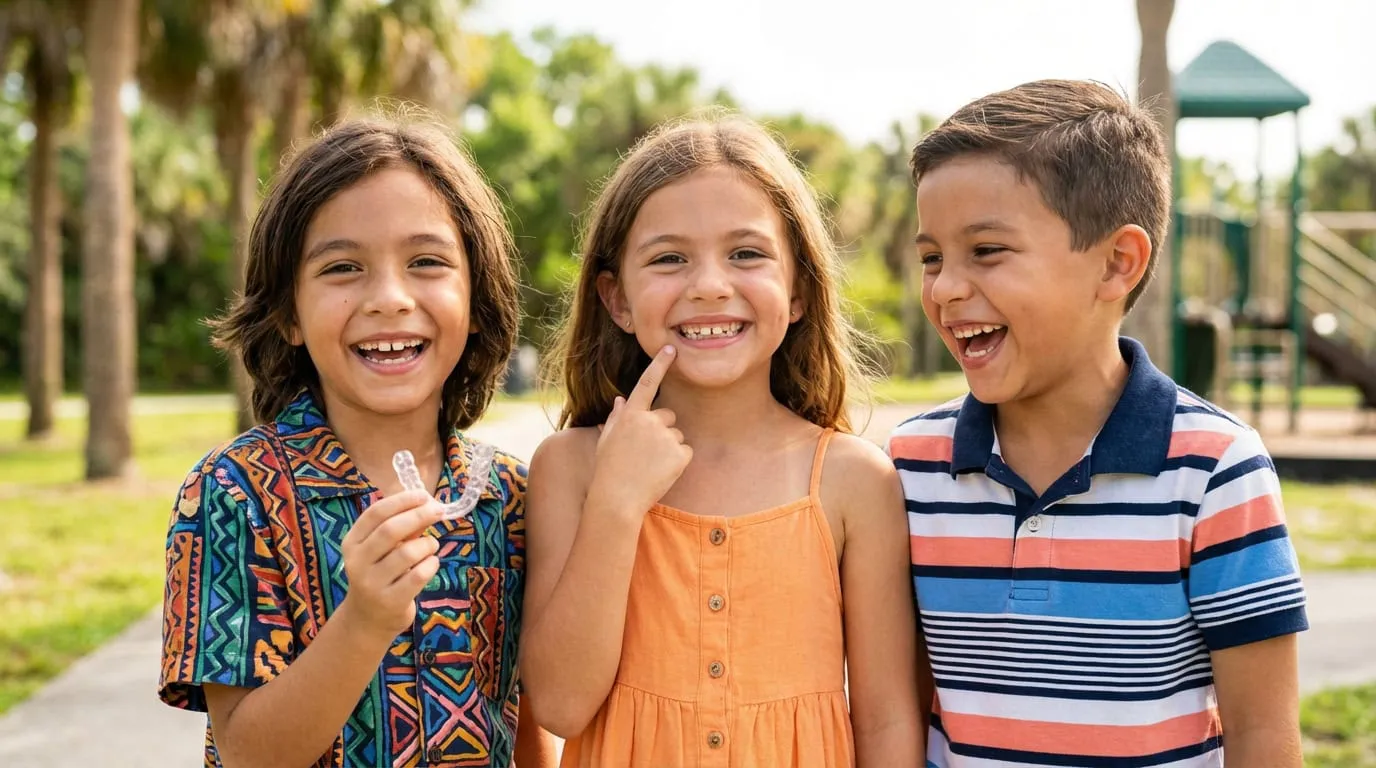
Phase 1 Orthodontics for Kids Ages 6-10 in Pembroke Pines
Your kid just smiled for the school photo and you noticed something—their teeth are crowded, or maybe their bite looks a little off.
That feeling hits different as a parent.
You start wondering if it's something you should worry about, if it'll fix itself, or if your child needs braces right now.
Here's the thing: Phase 1 orthodontics is exactly what you're looking for.
It's early intervention that catches dental issues when your kid's mouth is still growing, making future treatment simpler and way less dramatic.
I get the stress because I've been there too.
When my own child showed early signs of crowding, I found SMILE-FX Orthodontics in Miramar, just a quick 15-minute drive from Pembroke Pines.
What started as worried parent questions turned into relief because their approach to Phase 1 treatment is nothing like the old-school orthodontics your parents probably experienced.
What Actually Is Phase 1 Orthodontics and Why It Matters
Let me break this down without the jargon.
Your child's mouth at age 6-10 is basically a construction site.
Baby teeth are falling out, adult teeth are coming in, and their jaw is still growing fast.
Phase 1 early treatment works with that growth instead of fighting it.
Think of it like building the foundation of a house right the first time rather than fixing a cracked foundation later.
The American Association of Orthodontists recommends kids get evaluated by age 7, and here's why: about 75% of jaw growth happens before your child turns 12.
If you catch something early, you're working with growth, not against it.
This means less time in braces later, fewer extractions, and a smile that fits your kid's face naturally.
Phase 1 isn't about rushing into full braces treatment.
It's strategic guidance using expanders, partial appliances, or habit-correcting devices that kids barely notice.
At SMILE-FX, they use cutting-edge technology like AI-guided planning and 3D-printed custom fitters so there's basically zero irritation.
Your kid wears something that helps their mouth develop correctly while they're just living their normal life.
Real Signs Your Pembroke Pines Kid Might Need Phase 1 Treatment
So how do you actually know if your child needs this?
You don't need to be a dentist to spot these things.
Watch for crowded or overlapping teeth that seem way too tight.
Notice if baby teeth are hanging around longer than they should, creating a traffic jam for adult teeth.
Look for a crossbite where upper and lower teeth don't line up right when they bite down.
Listen for mouth breathing, especially at night—it's more common than you'd think and it actually affects how jaws develop.
See thumb sucking that's still happening past age 4 or 5, or tongue thrusting when they swallow.
These aren't just cosmetic quirks.
They're red flags that catching early prevents bigger problems.
The cost difference between fixing something small now versus dealing with a complex bite issue at 14 is massive.
Not just money-wise, but in terms of treatment time and what your kid actually goes through.
Why Pembroke Pines Families Choose SMILE-FX Over Generic Options
Here's what separates real orthodontists from general dentists offering "braces services."
SMILE-FX has board-certified orthodontists, not dentists dabbling in orthodontics.
That's literally a different level of training and expertise.
When you bring your child in, they're seeing a specialist who's spent extra years learning how jaws and teeth develop, how to guide growth, and how to create beautiful smiles that actually function right.
They're using low-dose CBCT scans—basically 3D photos of your kid's mouth that show everything, including roots you can't see on regular X-rays.
That data gets fed into AI systems that plan treatment precisely.
It's medical-grade technology that general dentists typically don't have access to.
Families from Pembroke Pines, Weston, Cooper City, Davie, and Fort Lauderdale make the short drive because this practice is trusted by South Florida pediatric dentists.
That means pediatricians are referring families here.
That's not something you get by accident.
Board-certified specialists are different because they're held to higher standards and continuing education requirements.
It matters more than you might think.
What Actually Happens During Phase 1 Treatment
So let's get specific about what your child actually experiences.
Phase 1 might involve a palatal expander if the upper jaw needs widening.
These aren't painful—they gradually expand over weeks or months while your kid's mouth is still flexible enough to respond.
Partial braces on just certain teeth might be used to create space.
Habit-breaking devices help fix thumb sucking or tongue thrusting.
Some kids get removable appliances they can take out for eating and brushing.
Others get fixed appliances that stay on until treatment goals are reached.
The point is, your Phase 1 orthodontist picks the right tool for your specific kid's specific problem, not a one-size-fits-all approach.
At SMILE-FX, the whole thing is designed around making your child comfortable.
We're talking about the first visit being 45-60 minutes in a personal VIP suite with TV shows, noise-canceling headphones, weighted blankets, VR games, and snacks.
Your kid isn't white-knuckling through an appointment.
They're in an environment that feels more like a cool tech space than a dentist's office.
The Real Benefits of Catching Issues Early
Let's talk about what Phase 1 actually prevents.
Crowding relief: Creating space now means adult teeth have room to come in straight, cutting extraction risk dramatically.
Crossbite correction: Guiding the upper and lower jaw to line up right prevents one side from growing faster than the other, which causes chewing problems and speech issues.
Mouth breathing fix: Promoting nasal breathing instead improves sleep quality and actually helps facial development be more normal.
Habit correction: Stopping thumb sucking early prevents it from changing how teeth and jaw grow.
The game-changing part: Phase 1 treatment can mean Phase 2 is either much shorter or sometimes not needed at all.
Some kids do Phase 1 and their adult teeth come in perfectly aligned, no Phase 2 required.
That's the win you're actually going for.
What the First Appointment Actually Looks Like
First appointments can feel big and scary for kids.
SMILE-FX gets this and designed their process around reducing that anxiety.
You'll come in and your child gets evaluated thoroughly.
That means looking at their current bite, taking low-dose digital X-rays or CBCT scans if needed, and getting a full picture of what's happening with their developing teeth and jaw.
The team explains everything simply—not with complicated dental words, but actually explaining what they're seeing and why it matters.
There's a conversation between the orthodontist and you about your child's specific situation, not a hard sell on treatment.
Sometimes kids come in and don't need anything yet.
SMILE-FX will literally tell you straight up if your child should wait a few years.
That builds trust from day one because you're not being pushed into something unnecessary.
Real parent reviews show this commitment to honesty and kid-focused care.
Cost and Payment Reality for Pembroke Pines Families
Let's be real about money because that's usually the second question after "will it work?"
Phase 1 treatment typically runs between $3,500-$6,000 in the Broward area.
That sounds like a lot until you compare it to comprehensive braces treatment later ($5,000-$8,000+) plus all the additional appointments and adjustments.
Doing Phase 1 early often saves money overall because Phase 2 is shorter or skipped entirely.
SMILE-FX works with flexible payment plans, not just one rigid option.
They understand that families have different financial situations and they adjust accordingly.
Most insurance plans cover Phase 1 orthodontic treatment at least partially, treating it as preventive care rather than cosmetic.
Check your specific plan because coverage varies, but it's worth investigating before assuming you're paying out of pocket for everything.
Practical Questions Parents Actually Ask
Does Phase 1 treatment hurt?
Minimal discomfort, honestly.
Kids might feel pressure as appliances are adjusted, but sharp pain isn't part of it.
When sensitivity happens, SMILE-FX has comfort wax and adjusters that kids actually don't mind.
How long does Phase 1 take?
Typically 12-24 months depending on what your kid needs, but everyone's situation is different.
Can my child play sports?
Absolutely, yes.
They get custom mouth protectors that work with their appliances.
Whether it's soccer at David Park or anything else, orthodontia doesn't sideline kids.
What happens after Phase 1 finishes?
There's usually a rest period where the appliance comes off and you monitor how the permanent teeth come in.
If Phase 2 is needed, it typically happens around age 12-13 when all permanent teeth are in.
Some kids get traditional braces, others get clear aligners or Invisalign.
It's not a huge deal to transition because SMILE-FX handles it all seamlessly.
The Technology Side of Modern Phase 1 Treatment
You might wonder what's actually different about how Phase 1 is done now versus 10-15 years ago.
The technology changes everything.
AI-guided planning means the orthodontist isn't just eyeballing it.
They're using software that analyzes growth patterns and predicts where your child's teeth and jaw will be at different stages.
3D-printed appliances fit each specific kid perfectly, not a one-size-fits-all mold.
That's why irritation and discomfort drop so dramatically.
CBCT scans show root development and bone density, catching things regular X-rays miss.
Low-dose radiation means parents don't need to worry about unnecessary exposure.
This stuff makes treatment faster, more predictable, and way more comfortable for kids.
It's not magic, it's just better tools being used by better-trained people.
Why Early Intervention Actually Saves Money and Time
Let's talk economics for a minute because this matters.
Ignoring early signs costs you later.
A kid who should have gotten Phase 1 at age 8 but didn't comes back at 13 with severe crowding.
Now extractions might be necessary.
Now comprehensive braces treatment is longer and more complex.
Now your kid is in treatment for 3-4 years instead of 1-2.
The cost difference is real.
More importantly, the inconvenience is massive.
Catching issues early means your child gets intervention when their mouth is most responsive to it.
Growth is working for you, not against you.
That's why dentists recommend getting evaluated by 7, not waiting until something is obviously wrong.
How to Know If SMILE-FX Is Right for Your Family
You want Phase 1 orthodontics that's actually specialized pediatric care, not just a general dentist doing braces work.
You want someone using modern technology, not methods from the 1990s.
You want honesty about whether your child needs treatment or should wait.
You want a practice that respects your kid's experience and makes them comfortable.
You want specialists who are actually different in meaningful ways.
SMILE-FX checks every one of these boxes.
They've handled over 1,000 Phase 1 cases, meaning they've seen every variation of what can happen with kids' developing smiles.
They're trusted by South Florida pediatric dentists, which says something about their reputation.
Parent reviews are consistently strong, not because they tell everyone what they want to hear, but because the results actually speak for themselves.
Taking the First Step
If your Pembroke Pines kid shows any signs of dental issues, the next move is straightforward.
Book a free consultation and let specialists actually look at your child's mouth.
You'll get real answers, not sales pressure.
You'll understand what's happening and what, if anything, needs to happen next.
You'll walk out knowing way more than you do right now, and you'll know whether Phase 1 treatment is actually the right call.
Book your free 3D scan and VIP smile consultation here, or take the Smile Quiz to start thinking through your kid's specific situation.
That's how you go from worried parent to informed parent with a clear plan.
Because getting Phase 1 orthodontics for ages 6-10 right means your kid's smile—and their confidence—gets built on the strongest foundation possible.
What Happens After Phase 1 Orthodontics: The Real Timeline for Your Kid's Smile
Phase 1 orthodontics gets the job done, but then what?
Your kid finishes their early treatment and you're standing there thinking, "Okay, we're done, right?"
Not exactly.
There's a whole chapter after Phase 1 that most parents don't understand until they're living it.
The good news is it's straightforward once you know what to expect.
I remember when my kid's Phase 1 ended and I realized I didn't actually know the next steps.
Nobody walks you through what happens during the waiting period or when Phase 2 kicks in.
That's where most parents get confused and stressed for no reason.
Let me clear that up for you.
The Resting Period Between Phase 1 and Phase 2 Orthodontic Treatment
After Phase 1 wraps up, your child's appliance comes off.
That's the moment where parents think they're finished.
But there's actually an important waiting period that comes next.
This rest phase typically lasts 6 months to a year, sometimes longer.
During this time, the permanent teeth continue coming in naturally.
Your kid's mouth is still growing and shifting.
The goal isn't to leave things alone and hope for the best.
The goal is to let the growth process show you what still needs work.
Think of it like building something and then stepping back to see how it looks before finishing the details.
At SMILE-FX Orthodontic & Clear Aligner Studio, they monitor your kid's progress every few months during this period.
Not because something went wrong, but because this is normal and important.
They're watching to see which permanent teeth erupt normally and which ones might need correction.
Some kids come out of Phase 1 and finish strong without needing Phase 2.
That actually happens more often than you'd think when Phase 1 was done right.
Other kids show they need Phase 2 once all their permanent teeth have come in.
You don't know which category your kid falls into until you're in this waiting period.
How Your Child's Permanent Teeth Come In During the Waiting Phase
This is where the real picture emerges.
Your child starts with Phase 1 treatment around age 6-10.
By the time they're done, they've got a mixture of adult and baby teeth.
Over the next couple years, the remaining baby teeth fall out and adult teeth erupt.
This is when you see if Phase 1 actually solved the crowding problem or if there's still work to do.
The permanent teeth might come in straighter than expected.
Or they might reveal that you do need Phase 2 after all.
This is why the waiting period isn't wasted time.
It's critical information-gathering time.
SMILE-FX checks in regularly because they're not just monitoring teeth movement.
They're also tracking jaw growth and bite development.
Sometimes a bite issue that looked complicated at first actually corrects itself naturally during this phase.
Other times you see new issues pop up that didn't exist before.
It's all part of how kids' mouths develop.
The key is having someone who knows what they're looking at.
When Phase 2 Starts and What It Actually Involves
Phase 2 usually starts around age 11-13, after all permanent teeth have erupted.
This is comprehensive orthodontic treatment that addresses your child's full bite and smile.
By now you're not guessing anymore.
You know exactly what needs to happen.
Phase 2 might mean traditional braces, clear aligners, or Invisalign for teens.
The choice depends on your kid's specific needs and what works best for their situation.
Some kids need to straighten out remaining crowding.
Others need bite correction where the upper and lower teeth don't line up right.
Some need both.
The beauty of doing Phase 1 first is that Phase 2 is usually way simpler than if you'd skipped Phase 1 entirely.
Your kid might need 18-24 months in Phase 2 instead of 3-4 years of full comprehensive treatment.
That's not a small difference when you're the kid wearing braces.
Why Some Kids Skip Phase 2 Entirely
This is the plot twist nobody expects.
Some kids finish Phase 1 and their teeth come in perfectly aligned with no Phase 2 needed.
How often does this happen?
More than you'd think, but it depends on what the initial problem was.
If Phase 1 was mainly about creating space for crowded teeth, and the permanent teeth erupt into that space correctly, you're done.
If Phase 1 was about correcting a habit like thumb sucking before it created permanent problems, and the habit is gone, you might be done.
If Phase 1 expanded a narrow jaw and that solved a crossbite, Phase 2 might not be necessary.
The kids who completely skip Phase 2 usually had straightforward issues caught early.
They're the wins that make Phase 1 worth doing.
At SMILE-FX, they're honest about whether your kid will likely need Phase 2 or not.
They don't pretend they know for sure in the resting period because they genuinely don't until the permanent teeth finish coming in.
But they give you realistic expectations based on what they're seeing.
Clear Aligners vs Braces in Phase 2: Which Option Makes Sense
By the time Phase 2 rolls around, your kid is older and probably has opinions about how they want to fix their teeth.
The options are pretty different from what Phase 1 looked like.
Traditional braces are still the most powerful tool for complex bite correction.
They're metal or ceramic brackets bonded to teeth with a wire running through them.
They look different than they did 10 years ago, but the concept is the same.
Some kids are fine with them.
Others would rather have something less visible.
Clear aligners like Invisalign and other aligner systems are nearly invisible.
Your kid wears a series of custom trays that gradually move teeth.
They take them out to eat and brush, which means cleaner teeth and no food restrictions.
The tradeoff is they require more discipline because the kid has to remember to wear them 20-22 hours a day.
Not all Phase 2 cases can be treated with aligners though.
Severe bite problems sometimes need braces for the correction to work properly.
SMILE-FX uses both options depending on what makes sense for your kid's specific teeth and bite.
The conversation about which method to use happens when Phase 2 is recommended, not before.
The Reality of Being a Teenager in Phase 2 Treatment
Phase 2 hits during the teenage years when your kid cares way more about how they look.
It's a different vibe than Phase 1 when they were younger.
If your kid needs braces, it's worth knowing that modern braces are smaller and less noticeable than old-school ones.
Ceramic brackets are tooth-colored instead of silver.
The wires are smaller.
Kids today don't see braces the same way kids did 20 years ago.
But teenagers are still teenagers.
Some want to avoid braces no matter what, which is when clear aligners make sense.
The thing to remember is that Phase 2 is temporary.
The awkward phase lasts 18-24 months usually.
Then your kid has the straight smile and perfect bite for the rest of their life.
That's a pretty good deal when you think about the timeline.
SMILE-FX designs treatment plans for teenagers keeping their actual lives in mind.
Sports schedules, dance competitions, theater performances, school events.
They work around your kid's life instead of making it the center of treatment.
What Happens If Phase 2 Wasn't Needed
For the lucky kids who skip Phase 2, there's still follow-up.
Retention is the thing that makes your work stick.
After Phase 1, your kid probably wears a retainer at night to keep their teeth where they ended up.
This is non-negotiable if you want teeth to stay straight.
Teeth naturally drift throughout your entire life.
A retainer prevents that drift and keeps the smile stable.
Your kid wears it every night, probably forever.
That sounds like a lot but it becomes automatic, like brushing teeth.
Most people don't think about it after the first few weeks.
The Cost of Phase 2 and What That Means for Your Budget
Phase 2 typically costs $4,000 to $7,000 depending on complexity and treatment method.
That's less than starting comprehensive treatment from scratch with no Phase 1.
The reason is Phase 1 already solved half the problem.
Phase 2 is finishing work, not starting from zero.
Insurance often covers Phase 2 similarly to Phase 1, treating it as medical necessity not cosmetic work.
Check your plan because every insurance is different.
SMILE-FX works with flexible payment plans for Phase 2 just like they do for Phase 1.
The total cost of Phase 1 plus Phase 2 is usually less than doing comprehensive braces without Phase 1.
That's the financial argument for early intervention right there.
Questions About Phase 2 That Parents Actually Have
How painful is Phase 2?
Minimal, similar to Phase 1.
Your kid might feel pressure when braces are adjusted or aligners are changed.
There's sometimes soreness for a day or two but nothing major.
SMILE-FX has comfort solutions if sensitivity happens.
Can my teenager still do everything they do now?
Yes, basically.
Braces don't stop sports, music, theater, or any other activities.
Aligners are even easier because they come out during performances or games.
Will my kid need retainers forever?
Night-time retainers, yes.
It's a small commitment for keeping a straight smile permanent.
Most people wear them for life.
What if Phase 2 doesn't work as well as expected?
Refinements happen sometimes.
If teeth aren't as straight or bite isn't as perfect as wanted, there are adjustments.
This is discussed with your orthodontist if needed.
SMILE-FX includes refinements in their treatment plan so you're not charged separately for fine-tuning.
How to Prepare Your Teenager for Phase 2
If Phase 2 is coming, start talking to your kid about options before the appointment.
Do they care more about invisible treatment or are they okay with braces?
What fits their lifestyle best?
Teenagers who choose their treatment option rather than having it imposed are more compliant and happier about it.
Get them involved in understanding what's happening and why.
Explain that Phase 1 already solved the hard part.
Phase 2 is just finishing the details.
That mindset makes the process way less dramatic.
Let them know that 18-24 months is temporary but the straight smile lasts forever.
Take the Smile Quiz together to get clarity on what your kid might need.
It's not scary, it's informational.
Why Full-Service Orthodontists Make This Transition Seamless
Some families switch orthodontists between Phase 1 and Phase 2.
That's usually a mistake.
A practice that handles both phases knows your kid's history, their mouth, and what worked in Phase 1.
They don't have to start over with new records and observations.
SMILE-FX has board-certified specialists who handle kids all the way from Phase 1 through Phase 2 to final retention.
That continuity matters more than you'd think.
Your kid knows the team, feels comfortable, and the treatment is coordinated perfectly.
There's no miscommunication between different offices or different doctors about what was done and why.
It's one team with one plan.
What Phase 2 Success Actually Looks Like
Success isn't just straight teeth, though that's part of it.
Success is a bite that functions right so your kid can chew and speak clearly.
Success is a smile that fits their face and makes them confident.
Success is treatment being done in the most efficient time possible.
Success is your kid going through Phase 2 without major disruption to their life.
The full scope of treatable cases at SMILE-FX shows what comprehensive success looks like across different situations.
Every case is different but the goal is always the same: a healthy, functional, beautiful smile.
The Long-Term Payoff of Getting Orthodontics Right
Here's what most people don't think about until years later.
A kid who goes through Phase 1 and Phase 2 correctly ends up with teeth that actually work.
Not just teeth that look good, but teeth that function properly for eating, speaking, and breathing.
That's the stuff that matters long-term.
A good bite prevents jaw problems down the road.
Straight teeth are easier to keep clean, which means better dental health forever.
Confidence from having a great smile lasts a lifetime.
The money you spend on orthodontics early prevents way bigger dental problems later.
Your teenager is wearing braces for 18-24 months.
That investment pays back over 60+ years of their life.
That's the real story of why this stuff matters.
Starting Phase 2 When You're Ready
The resting period after Phase 1 ends eventually, and Phase 2 conversations begin.
When that time comes, you already know what to expect.
You know it's normal that your teenager is older and has more opinions.
You know that Phase 2 is shorter and simpler because Phase 1 did its job.
You know that clear aligners and braces are both solid options depending on circumstances.
You know that this is temporary but the results are permanent.
And you know you want a board-certified orthodontist who's been with your kid from the start.
SMILE-FX Orthodontic & Clear Aligner Studio handles all of this, from Phase 1 through Phase 2 through final retention.
Your family gets one consistent team focused on building your kid the best smile possible.
Book your free 3D scan and VIP smile consultation here if your child is ready to start their orthodontic journey or transition to Phase 2.
The process starts with understanding where things stand right now, not with pressure or long-term commitments.
Get answers about what your kid actually needs and build a real plan from there.
That's how you make sure Phase 2 orthodontic treatment fits your child's life perfectly.
Fixing Your Bite: Why Correction Matters More Than You Think
Your kid bites their cheek constantly when they eat.
Or maybe their jaw clicks when they open their mouth.
You notice they chew mostly on one side.
These aren't just annoying habits.
They're signs that bite correction needs to happen, and most parents miss this stuff entirely.
A bad bite isn't just a cosmetic problem.
It's a functional problem that gets worse over time if you ignore it.
I didn't realize this until my kid started complaining about headaches and jaw soreness.
That's when I understood that bite correction isn't optional.
It's preventive medicine for your child's mouth.
When I found SMILE-FX Orthodontic & Clear Aligner Studio, they explained how bite problems cascade into bigger issues down the road.
TMJ problems, speech issues, uneven tooth wear, sleep problems.
All of that starts with a bite that doesn't line up right.
What Exactly Is a Bad Bite and Why It Creates Real Problems
A bad bite happens when your upper and lower teeth don't meet correctly.
There are different types, and each one causes different problems.
An overbite means your upper front teeth stick out too far.
That creates pressure on your lower jaw and can cause clicking or popping.
An underbite is the opposite, where lower teeth jut forward.
This affects how your kid chews and can make speech sound weird.
A crossbite is when upper teeth sit inside lower teeth instead of outside.
This throws off the whole alignment and causes one side of the face to develop differently.
An open bite means teeth in front don't touch at all when you bite down.
That makes it hard to bite food properly.
Most kids have some combination of these issues, not just one problem alone.
The reason this matters: every time your kid chews, they're reinforcing a bad pattern.
The muscles in their jaw are working harder because teeth aren't aligned.
Their tongue has to compensate for the bad bite position.
That's exhausting for your mouth and creates pain over time.
The Connection Between Bite Problems and Bigger Health Issues
Parents don't usually connect a bad bite to their kid's headaches.
But they're directly related.
When teeth don't fit together right, jaw muscles work overtime.
Those muscles connect to your head and neck.
Tension there creates headaches, especially tension headaches that feel like a band around the head.
Your kid might not even realize the headaches are coming from their bite.
They just know their head hurts after school.
Sleep quality gets affected too.
If a bite problem contributes to mouth breathing instead of nasal breathing, sleep becomes restless.
Your child doesn't sleep as deeply, which affects everything from mood to school performance.
Speech can sound off with certain bite problems.
If teeth don't come together right, it's hard to make certain sounds.
Your kid might lisp or have trouble pronouncing certain letters.
Teachers might flag it as a speech issue when really it's a bite issue.
Tooth wear happens unevenly with a bad bite.
Some teeth take all the pressure while others don't.
That means some teeth wear down faster and develop problems earlier.
Cavities can develop faster too because uneven pressure creates stress points on teeth.
This is why bite correction isn't cosmetic.
It's about preventing real problems from getting worse.
How a Board Certified Orthodontist Diagnoses Bite Problems
Not every dentist can spot bite problems accurately.
A board certified orthodontist has extra training in how jaws and bites work.
They don't just look at your kid's teeth.
They analyze the whole system: jaw position, muscle function, growth patterns, tooth relationships.
At SMILE-FX, they use cutting edge technology like 3D imaging to see exactly how the bite is off.
CBCT scans show bone structure and root positions, not just the visible parts.
That's information regular X-rays can't give you.
They take measurements and analyze growth patterns specific to your kid.
Then they explain what's happening in plain language.
Not everyone needs bite correction right away.
A good orthodontist tells you if your kid should wait or if intervention now prevents bigger problems later.
That's the difference between specialists and general dentists trying to do orthodontic work.
Bite Correction Options for Kids and Teenagers
The way you fix a bad bite depends on what the problem is and how old your kid is.
In younger kids (ages 6-10), you're working with growth.
Expansion appliances can widen a narrow jaw.
Habit-breaking devices fix thumb sucking or tongue thrusting that causes bite problems.
These are usually less intense than full braces.
By the time your kid is a teenager, all permanent teeth are usually in.
Now you're correcting the actual bite, not just guiding growth.
Traditional braces are still the gold standard for complex bite problems.
They give the orthodontist precise control over tooth position and angle.
That precision matters when you're fixing something complicated.
Clear aligners and Invisalign work for less complicated bite issues.
They're nearly invisible, which teenagers appreciate.
The tradeoff is they can't fix really severe bite problems.
Your orthodontist tells you which option actually works for your specific kid.
The Cost Reality of Bite Correction Treatment
Parents always ask about cost first, and that's fair.
Affordable braces and bite correction at a practice like SMILE-FX in Miramar, Fort Lauderdale, and throughout Broward typically runs $4,000 to $7,000 for comprehensive treatment.
That sounds expensive until you consider what happens if you don't fix the bite.
TMJ problems later need physical therapy or surgery.
That costs thousands more.
Severe tooth wear requiring caps or crowns costs way more than braces.
Sleep problems affecting school performance have their own costs.
The math works out that fixing it early saves money long term.
Insurance often covers bite correction as a medical necessity, not cosmetic work.
Check your plan because coverage varies.
SMILE-FX offers $0 down braces financing options so cost doesn't become a barrier.
Payment plans spread the cost over the treatment period.
That makes it actually affordable for most families in South Florida.
Bite Correction in Adults: It's Never Too Late
You might think bite correction is just for kids.
Not true.
Adults deal with bite problems all the time.
Maybe you never got your teeth straightened as a kid.
Or maybe your bite got worse over time.
Either way, adult orthodontics in Miami and South Florida is totally normal now.
A lot of adults are getting Invisalign and clear aligners because they look professional in work environments.
You don't have to choose between fixing your bite and looking professional at work.
Adults actually have some advantages.
You're not waiting for growth to finish.
Treatment is more predictable because your bones are fully developed.
You understand the commitment and stick with it better than teenagers sometimes do.
The biggest thing is finding the best orthodontist for adults who gets that your life is different than a teenager's life.
You have work, maybe kids, schedules that don't include 45-minute orthodontist visits every month.
That's why SMILE-FX uses technology that reduces appointment time and spacing.
You're not rearranging your whole life to fix your bite.
Questions About Bite Correction That Come Up Constantly
Can a bad bite fix itself?
No.
Bites don't naturally correct as you grow.
They usually get worse as adults if untreated.
Gravity and chewing pressure reinforce bad patterns.
How long does bite correction take?
It depends on severity, but usually 18-36 months for significant correction.
Complex cases take longer.
Simple cases go faster.
Will my kid's bite relapse after treatment?
Not if you use a retainer consistently.
Teeth want to drift their whole life.
A retainer keeps things stable.
Most people wear night-time retainers forever.
Does bite correction hurt?
Minimal discomfort, usually just pressure sensations.
The first few days after adjustment might be sore, but nothing severe.
Can I get bite correction with clear aligners?
Some bite problems, yes.
Complex bite issues need braces.
Your orthodontist tells you what actually works for your situation.
Why Finding the Best Orthodontist Matters for Bite Correction
Not all orthodontists are the same.
Some general dentists offer braces, but that's not the same as seeing a specialist.
A board certified orthodontist has 2-3 extra years of training beyond dental school.
That training is all about how teeth and jaws work together.
They understand bite biomechanics that general dentists don't.
They have better tools and technology.
They handle complex cases that would be impossible for a general dentist.
When you're dealing with a real bite problem that needs correction, you want someone who specializes in exactly that.
SMILE-FX has patient reviews that show real results from families across South Florida.
When you read reviews from parents talking about how their kid's headaches went away or their speech improved, that's what real bite correction looks like.
Getting Started With Bite Correction
The first step is getting evaluated by someone who knows what they're looking at.
A free consultation lets you understand what's actually happening with your bite.
Not a sales pitch, just information.
You find out if correction is needed now or if you can wait.
You learn which treatment option actually works for your situation.
You see what the timeline looks like and what it costs.
Book a FREE 3D scan and VIP smile consultation here to get started.
That's how you go from wondering if your kid's bite is a real problem to having a clear plan.
Bite correction isn't optional when something's wrong.
It's preventive medicine that saves your kid from bigger problems down the road.
Find the best orthodontist near you who specializes in what you actually need, whether that's for kids or adults dealing with bite problems.