
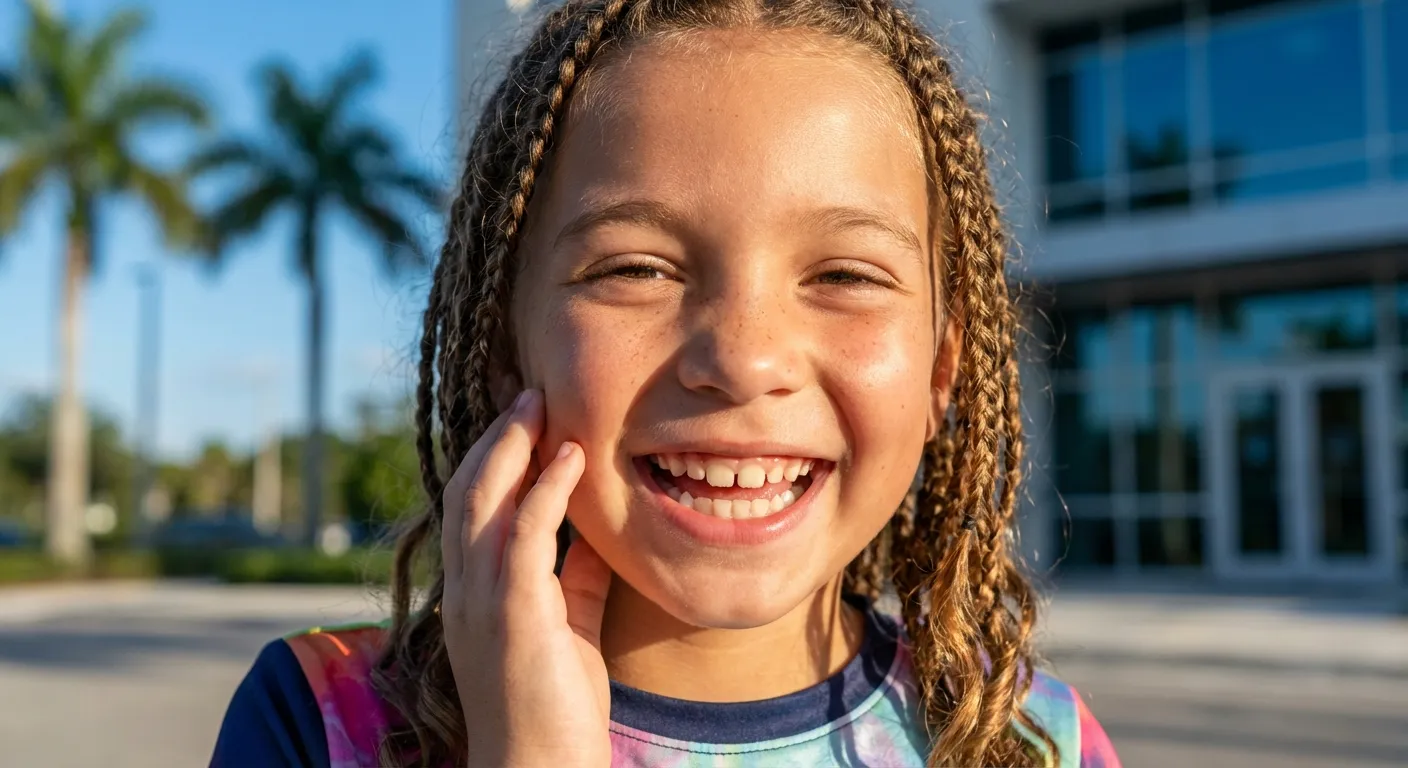
Early Orthodontics for Kids Ages 6-10 in Pembroke Pines
Your kid's smile is one of the first things people notice.
And if you're seeing crowded teeth, a weird bite, or your child breathing through their mouth all the time, you're probably wondering if something needs to happen now.
The good news?
You're not alone, and catching these things early actually changes the game.
The American Association of Orthodontists recommends that every kid gets evaluated by age 7.
Not because they need braces yet, but because some issues are way easier to fix when kids are still growing.
We're talking about guiding jaw development, creating space naturally, and avoiding bigger problems down the road.
That's what Phase 1 orthodontics is all about.
At SMILE-FX Orthodontic & Clear Aligner Studio, we see kids from Pembroke Pines, Hollywood, Weston, and all over Broward County.
We're board-certified specialists who focus on early intervention for kids ages 6 to 10.
Not general dentists doing orthodontics on the side.
Actual specialists with the training to catch what matters.
What Phase 1 Orthodontics Actually Does for Your Kid
Here's the thing most parents don't realize.
Your child's jaw is still growing.
Their adult teeth are still coming in.
Their habits (like thumb sucking or mouth breathing) are still shaping how everything develops.
That's the window.
Phase 1 treatment uses that growth to our advantage.
Instead of fighting against what's happening naturally, we guide it.
Palatal expanders gently widen the upper jaw.
Growth appliances help the lower jaw develop properly.
Interceptive devices stop habits that are causing problems.
The goal isn't to give your 7-year-old a perfect smile right now.
It's to set things up so when adult teeth come in, they have room to go where they belong.
It's to fix crossbites before they cause jaw problems.
It's to stop mouth breathing before it affects sleep and breathing.
It's to turn a situation where your kid might need full braces for 3 years into one where they might need them for 1.5 years, if at all.
That's the payoff.
Why Pembroke Pines Families Choose SMILE-FX Over Local Options
Pembroke Pines is a great place to raise kids.
Good schools, safe neighborhoods, solid community feel.
But when it comes to specialized orthodontic care, sometimes the best option isn't in your backyard.
SMILE-FX is in Miramar, about 15 to 20 minutes from most of Pembroke Pines.
Worth the drive?
Let me break down why families think so.
First, we're board-certified orthodontists.
That means we've completed years of specialized training beyond dental school.
We know how kids' jaws grow.
We know what to look for.
We know when to step in and when to wait.
General dentists can offer basic services, but they don't have the depth of training for complex growth cases.
Second, we use cutting-edge technology.
We're talking low-dose digital X-rays, 3D scans (CBCT), and treatment planning software that lets us see exactly what's happening.
We can show your kid on a screen what we're seeing, which takes away the mystery and fear.
That matters when you're dealing with a 7-year-old.
Third, our team actually knows how to work with kids.
We have VIP suites with TV, VR games, weighted blankets, and noise-canceling headphones.
We keep things fun, not scary.
Parents often tell us their kid asked when the next appointment is.
That doesn't happen because of fancy furniture.
It happens because we respect that kids need a different experience.
Check out our patient reviews if you want to see what real families from your area are saying.
The Six Common Signs Your 6-10 Year Old Needs Phase 1 Assessment
You don't need to be an orthodontist to notice when something's off.
Here are the signs that bring parents into our office.
Crowding and Overlapping Teeth
Your kid's adult teeth are coming in, but there's no room.
You see one tooth sitting behind another, or teeth all jammed together.
This often means the jaw needs more width.
Phase 1 expanders can create that space naturally as the jaw grows.
Crossbite
The lower teeth sit outside the upper teeth.
Not just a little bit, but noticeably.
Left alone, this causes uneven jaw growth.
Kids start chewing on one side.
The jaw develops unevenly.
Fixing it at age 7 prevents major issues at age 16.
Open Bite
Front teeth don't touch even when the mouth is closed.
Often tied to thumb sucking, tongue thrusting, or mouth breathing.
Early intervention stops these habits and lets the teeth develop normally.
Mouth Breathing
Your kid's mouth is always open.
Breathing through the mouth, not the nose, is a habit that affects jaw development and even sleep quality.
We address this because it impacts more than just teeth.
Thumb Sucking Past Age 4
Most kids naturally stop around age 3 or 4.
If your child is 6, 7, 8 and still doing this, it's actively shaping their bite in the wrong direction.
Gentle appliances help break the habit without drama.
Underbite or Severe Overbite
The lower jaw juts out, or the upper teeth hang way over the lower ones.
These are growth issues that get worse, not better, over time.
Early guidance can prevent or reduce the need for jaw surgery later.
What Happens at Your First Visit to SMILE-FX
You're probably wondering what to expect.
No surprises here.
It's straightforward.
Your kid comes in.
We do a basic exam to see what's going on with their teeth and jaw.
We take low-dose digital X-rays and photos.
We talk to you and your child about what we're seeing.
We explain options in plain language, not dental jargon.
We answer questions.
That's it.
Thirty to forty-five minutes, tops.
Not every kid needs immediate treatment.
About 25 percent do, according to AAO guidelines.
Sometimes we recommend monitoring, which just means checkups every 6 months to watch how things develop.
We're honest about that.
We're not trying to sell you treatment your kid doesn't need.
Building trust matters more than booking appointments.
If your child does need Phase 1 care, we'll explain exactly what that looks like, how long it takes, and what the plan is.
We use tools like our VIP technology suite to make everything visual and easy to understand.
How Phase 1 Different From Full Braces at Age 12
This is where a lot of parents get confused.
Phase 1 isn't just braces for little kids.
It's a different approach altogether.
Phase 1 uses growth-guided appliances.
Expanders, retainers, gentle braces on just a few teeth.
The goal is to guide development while your kid's still growing.
Most kids finish Phase 1 by age 10 or 11.
Then there's often a rest period while adult teeth continue coming in.
Phase 2, usually around age 12 or 13, is when we do full braces (if needed).
But because of Phase 1, Phase 2 is often shorter and less intensive.
Some kids skip Phase 2 altogether.
That's the win.
If you skip Phase 1 and go straight to braces at 12, you're not using the growth window.
You're fighting the jaw instead of working with it.
Longer treatment, more appointments, sometimes more complex issues to untangle.
The Real Cost of Waiting vs. Acting Early
I get it.
You're thinking, why spend money now if my kid might not need braces later anyway?
Fair question.
Here's the thing.
Doing Phase 1 when it's needed costs less than full braces later.
It takes less time.
It's less invasive.
And it prevents problems that might need more serious intervention down the road.
Some issues, if left alone, actually get worse as your kid grows.
That underbite gets more pronounced.
That crossbite causes jaw problems.
That crowding creates a situation where full braces at 13 takes two years instead of eighteen months.
The financial math usually works out in favor of early care.
But even if it cost slightly more upfront, the peace of mind alone is worth it.
You're not gambling on how your kid's face will develop.
You're actually influencing it in the right direction.
Why Board-Certified Specialists Make a Difference
This is important, so I'm going to say it clearly.
Not all orthodontists are the same.
Not all dentists can do what a specialist can do.
General dentists can straighten teeth.
Board-certified orthodontists understand jaw development, growth patterns, and complex bite problems.
There's a big difference, especially for kids.
At SMILE-FX, our board-certified specialists have spent years mastering growth guidance.
We know what Phase 1 can and can't do.
We know when to use expanders, when to use other appliances, and when it's better to wait.
We know how to communicate with kids in a way that makes sense to them.
That training matters.
Look at our why SMILE-FX page if you want more details on our credentials and approach.
Real Talk About Comfort and Fear
Let's be honest.
A lot of kids are nervous about the orthodontist.
It's unfamiliar.
There are strange instruments.
Sometimes there's pressure.
We get it.
That's why we designed our experience differently.
Personal treatment rooms (not big open spaces where kids see other kids getting worked on).
Comfort tools like weighted blankets.
Shows on the ceiling or VR headsets to distract.
An actual kid-focused approach, not just an orthodontist's office that also sees kids.
We also explain everything before we do it.
We show kids on the screen what's happening.
We let them ask questions.
We don't rush.
Most kids walk out less scared than they came in.
Some kids actually want to come back for their next appointment.
That's not magic.
That's just respect for what kids need.
Getting Started With Phase 1 Orthodontics in Pembroke Pines
If your child is between 6 and 10, and you're seeing any of the signs we talked about, the next step is simple.
Schedule a free consultation.
Book a FREE 3D scan and VIP smile consultation here at SMILE-FX.
You can come in person at our Miramar location or do it virtually.
No pressure.
No sales pitch.
Just an honest conversation about whether Phase 1 makes sense for your kid.
We'll take a 3D scan, do a full assessment, and talk to you about what we're seeing.
If your kid doesn't need treatment, we'll tell you that.
If monitoring is the right move, we'll explain why.
If Phase 1 is the way to go, we'll map out exactly what that looks like.
Families from Pembroke Pines, Hollywood, Weston, Davie, Fort Lauderdale, and all over Broward County trust SMILE-FX because we're honest, we're specialists, and we actually care about getting results that last.
Your kid's smile is worth the small investment in time to get it right.
Let's talk.
Phase 1 Orthodontics vs. Waiting Until Teens: What Pembroke Pines Parents Need to Know About Braces and Clear Aligners
Here's what keeps parents up at night.
Your kid's got a wonky bite or crowded teeth, and you're staring down two paths.
Option one: Do something now while they're young.
Option two: Wait and see what happens.
Most people think option two is safer because, well, less invasive sounds better, right?
Wrong.
Waiting actually costs you more time, more money, and sets your kid up for bigger problems later.
Let me explain why early orthodontic treatment makes sense for kids in Pembroke Pines and Broward County, and why delaying it often backfires.
The Money Question That Nobody Asks Out Loud
Parents ask me this constantly: "If I wait until my kid's 13, won't braces cost the same?"
Not quite.
Here's the real picture.
When you do Phase 1 treatment now, you're using your kid's growth to fix problems.
The jaw expands naturally.
Space opens up for teeth.
Bite issues correct before they get worse.
Fast forward to age 13.
Your kid either needs minimal braces, shorter treatment time, or possibly nothing at all.
Now look at the kid whose parents waited.
That crowding got worse as more adult teeth came in.
That crossbite threw off jaw development.
Braces at 13 now need to do double duty: fix the original problem AND correct the damage that happened while waiting.
That's 24 to 30 months of braces instead of 18.
More appointments.
More adjustments.
More expense.
The math is clear: doing something early usually costs less.
And if it costs roughly the same, you're getting a better result faster.
What Your Kid's Smile Actually Looks Like in Five Years
I want you to picture this scenario.
Your 7-year-old has crowded lower teeth and a narrow upper jaw.
You wait.
By age 12, all those adult teeth have come in, and they're jammed even tighter because there's no more space.
Now a palatal expander won't work as well because the jaw isn't growing at the same rate anymore.
You need traditional braces to force things into place.
More force.
More time on the teeth.
More potential for damage.
Versus the kid who did Phase 1.
At age 7, we used an expander to gently widen the upper jaw with growth.
By age 12, there's plenty of space.
Teeth are already positioned better.
At age 13, maybe they need light braces for 12 months just to perfect alignment.
Or they skip braces entirely.
Same kid.
Different outcome.
This isn't theory.
This is what I see happen every month.
Why Teeth Don't Straighten Themselves Out
Some parents hope crowding magically fixes when adult teeth come in.
It doesn't.
Here's the thing about tooth development.
Your kid's jaw is only growing for so long.
Once they hit their growth spurt and it stops, the jaw size is locked in.
Adult teeth don't shrink to fit.
They stay the size they are.
So if the jaw is too narrow and you don't expand it during growth, you're stuck.
Teeth stay crowded.
Or you remove healthy teeth to make room, which nobody wants.
This is why interceptive orthodontics works.
We're working with nature, not against it.
Growth happens.
We just guide where it goes.
The Bite Problems That Get Worse, Not Better
Certain bite issues are red flags.
A crossbite doesn't fix itself.
Left alone, the jaw develops unevenly.
Your kid chews on one side more.
That side grows more.
The jaw shifts.
TMJ problems start showing up in the teenage years.
An underbite gets more pronounced as the lower jaw grows larger during puberty.
By age 16, what was a mild underbite might now need jaw surgery to correct.
Early intervention stops this.
At age 7, we catch it and guide the jaw in the right direction.
At age 16, surgery gets avoided.
That's not a small thing.
How Clear Aligners Factor Into The Big Picture
Clear aligners are everywhere now, and parents ask if those are an option for younger kids.
The answer is: sometimes, but not always.
Clear aligners work great when the main job is moving teeth that are already positioned okay.
They're less effective when you need to guide jaw growth or fix serious bite issues.
For an 8-year-old with significant crowding and a narrow jaw, braces or an expander works better.
For a 12-year-old whose Phase 1 already fixed the bite and jaw, clear aligners might be perfect for fine-tuning.
The tool depends on the job.
This is why getting a real evaluation matters, not just guessing.
Check out our clear aligner options and braces information to see how different treatments work.
The Sleep and Breathing Connection Nobody Talks About
Here's something most parents miss.
Crowded teeth and narrow jaws sometimes cause mouth breathing.
Mouth breathing affects sleep quality.
Sleep quality affects school performance, behavior, and development.
We're not dentists treating teeth.
We're specialists treating the whole picture.
When we expand the upper jaw, nasal passages open up.
Kids breathe through their nose instead of their mouth.
They sleep better.
Everything else improves from there.
This is one reason why early treatment isn't just about teeth.
It's about your kid's health.
What Actually Happens During Phase 2 After Early Treatment
Let me be real about the timeline.
Phase 1 typically runs from age 6 or 7 to age 10 or 11.
Then there's a rest period while the last adult teeth come in.
Phase 2 happens around age 12 or 13.
That's when we do full braces or clear aligners to fine-tune everything.
But here's the key difference.
Kids who did Phase 1 need maybe 12 to 18 months of Phase 2.
Kids who skipped Phase 1 need 24 to 36 months.
Some Phase 1 kids skip Phase 2 entirely.
Why?
Because the hard work already happened when we had growth on our side.
That's the value.
That's the game changer.
Monitoring vs. Waiting: There's Actually a Difference
Here's where I need to be honest.
Not every kid with minor crowding needs Phase 1 treatment right now.
Sometimes monitoring makes sense.
Monitoring means checkups every 6 months to watch how things develop.
We're looking for changes.
We're watching if problems get worse or if growth helps naturally.
But monitoring is not the same as ignoring.
With monitoring, you have a professional watching.
You catch problems early if they show up.
Without monitoring, you're just hoping, and hoping loses.
If we recommend monitoring, we tell you exactly what to watch for and when to come back.
That's professional oversight, not abandonment.
The Confidence Factor That Parents Forget About
Here's something that doesn't show up on X-rays but matters just as much.
Confidence.
A kid with crowded teeth often gets self-conscious around age 9 or 10.
They stop smiling in photos.
They cover their mouth when they laugh.
They become aware of something being different.
When you fix this at age 8, by age 12 they don't even remember having crooked teeth.
They grew up with a normal smile.
Compare that to a kid who waits until 13 to start treatment.
They've spent five years being self-conscious.
The confidence boost from early treatment is real.
I see kids smile bigger when we show them their progress pictures.
That matters.
Why SMILE-FX's Approach Is Different For Young Kids
Not every orthodontist treats kids the same way.
We treat kids differently because they are different.
Our approach to treatment focuses on what makes sense for growing patients.
We use 3D scanning and digital planning so kids can see exactly what we're doing.
Scared kids feel braver when they understand.
We have treatment spaces designed for comfort, not intimidation.
We explain everything in words that make sense to a 7-year-old, not in dental jargon.
Our board-certified specialists have spent years learning growth patterns and bite development.
That training matters.
It's not the same as a general dentist offering braces on the side.
Real Questions Parents Ask
How do I know if my kid actually needs treatment or if you're just trying to sell me something?
Fair question.
We show you the X-rays and scans.
We explain what we see.
We tell you if monitoring makes sense instead of treatment.
We're not commission-based on selling treatment.
Our job is getting the right answer, not the most expensive answer.
Check our patient reviews to see what real families say.
What if my kid is scared or doesn't cooperate?
Most kids are more scared of the unknown than the actual experience.
Once they see it's not painful and we explain everything, they settle down.
We go slow.
We don't force anything.
Sometimes the first visit is just getting comfortable.
If a kid genuinely can't handle treatment yet, we're honest about that too.
We wait until they're ready.
Do I have to go to Miramar if we're in Pembroke Pines?
We're located in Miramar, which is about 15 to 20 minutes from most of Pembroke Pines.
It's worth the drive for specialists instead of settling for general dentist-level care.
Many families from Pembroke Pines, Hollywood, Weston, Davie, and Fort Lauderdale come to us for the quality difference.
You can also schedule a virtual consultation first if you want to learn more before visiting in person.
The Bottom Line On Early Orthodontic Treatment
Waiting until your kid is 13 to deal with bite problems sounds like it might save money and hassle.
It actually does the opposite.
Early treatment with phase 1 orthodontics uses your kid's growth to fix problems naturally.
It costs less money in the long run.
It takes less time overall.
It prevents bigger problems from developing.
It gives your kid years of confidence instead of years of being self-conscious.
The American Association of Orthodontists recommends evaluation by age 7 for a reason.
They know what works.
They know what saves problems.
Your kid's smile five years from now depends on decisions you make today.
Your Next Step
If your child is between 6 and 10 years old and you're noticing any signs of crowding, bite problems, or mouth breathing, the move is simple.
Get a professional evaluation from someone who actually knows growth and development.
Not a guess.
Not a wait-and-see.
A real assessment from board-certified orthodontists who specialize in kids.
Book a FREE 3D scan and VIP smile consultation here at SMILE-FX Orthodontic & Clear Aligner Studio.
We'll scan your kid's teeth and jaw.
We'll show you what we see.
We'll tell you if treatment helps or if monitoring makes sense.
No pressure.
No sales pitch.
Just honest, clear answers from specialists.
Families from Pembroke Pines, Hollywood, Weston, and all over Broward County trust us because we treat kids like kids and tell you the truth.
Your child's smile, confidence, and long-term jaw health are worth 45 minutes of your time right now.
Let's talk about braces, clear aligners, and early orthodontics for kids that actually work.
Insurance, Financing, and The Real Cost of Orthodontics in South Florida
Your kid needs braces or clear aligners, and the first thing running through your head is probably the price tag.
I get it.
Orthodontic treatment isn't cheap, and you're trying to figure out if your insurance covers it or if you're looking at dropping a few grand out of pocket.
The truth is messier than you'd hope, but it's not impossible.
Let me break down how insurance actually works for orthodontics, what financing looks like, and why affordable braces in Broward don't mean you're settling for less.
Does Insurance Cover Braces? The Real Answer
Most dental insurance plans do cover orthodontics.
But here's the thing nobody mentions.
They usually cover between 50 percent of the cost, and that's before your annual maximum kicks in.
Let's say your orthodontic treatment costs $5,000.
Your insurance might pay $2,500.
You're still left covering the other $2,500.
Some plans have an annual maximum of $1,000 or $1,500.
That means once you hit that number, you're paying out of pocket for everything else.
Plus, most plans have a waiting period.
You need to have had the coverage for at least 12 months before they'll pay anything for orthodontics.
So if your kid just got on your plan, you might be waiting a full year before insurance kicks in.
This is why you can't just assume insurance will handle it.
You need to call your provider, find out your coverage limits, and get the real numbers before you commit to treatment.
What Does Orthodontic Treatment Actually Cost in South Florida?
In South Florida, braces cost somewhere between $3,500 and $7,000 depending on how complex the case is.
Clear aligners like Invisalign usually run $3,500 to $8,000.
Traditional metal braces land on the lower end.
Ceramic braces are slightly higher.
Invisalign Cost South Florida varies based on how many trays you need and how long treatment takes.
The thing is, these numbers don't tell the whole story.
A board-certified orthodontist who uses advanced technology and customized treatment plans might charge more upfront, but you're getting shorter treatment times and better results.
That's the real value.
A budget option might save you a few hundred dollars initially, but if treatment runs longer or you need retreatment, you've actually spent more.
This is why picking the right practice matters way more than picking the cheapest price.
Breaking Down Monthly Payments for Braces
Most practices, including SMILE-FX Orthodontic & Clear Aligner Studio, break treatment cost into monthly installments.
You might pay $200 to $400 per month depending on the total cost and your plan.
Some months you'll have fewer appointments.
Some months you'll have more intensive work.
But you're looking at predictable payments that fit into a family budget.
That's a lot easier to stomach than writing one check for $6,000.
When you're comparing affordable braces in Miramar or looking for affordable braces near me, ask about payment plans.
Most orthodontists offer them because they know families need time to pay.
What About $0 Down Braces Financing?
You've probably seen ads for $0 down braces financing in South Florida.
These programs exist, and some are legitimate.
Basically, you defer your down payment and spread everything into monthly payments.
This helps if you don't have a few hundred dollars upfront but can handle monthly costs.
The catch is interest.
If you use a credit card or third-party financing, you might end up paying more overall when interest adds up.
Some practices offer in-house financing with no interest if you pay on time.
That's the better deal.
Always ask what the total cost is with interest included, and compare that to practices offering interest-free payment plans.
When Your Insurance Actually Helps
Let's say your insurance covers 50 percent up to $2,000 per year.
Your treatment costs $5,000 and takes two years.
Year one, insurance pays $2,000.
You pay $3,000.
Year two, insurance pays your remaining $1,000 (the other $1,000 of their 50 percent), plus another $1,000 hits your new annual maximum.
Insurance covers $2,000 total.
You pay $3,000 total.
That $2,000 from insurance makes a real difference.
But you still need to handle financing the other half.
This is why I always tell families to ask for a treatment plan that shows the total cost, then have a conversation about insurance coverage and payment options.
Don't try to figure it out alone.
Let your orthodontist's team help.
They deal with insurance every single day.
The Price Difference Between Best Orthodontist Near Me Options
Here's what I've noticed working with families across South Florida.
When you search orthodontist near me or best orthodontist near me, you get a range of prices from general dentists offering braces to board-certified orthodontists using advanced technology.
The difference isn't just a few hundred bucks.
A top-rated orthodontist in Fort Lauderdale using SureSmile technology or Invisalign plans custom-made to your teeth costs more than someone doing cookie-cutter plans.
But you get shorter treatment times and way better results.
A complex case handled by a best orthodontist for complex cases costs more because the expertise is deeper.
You're not paying for the name.
You're paying for the skill and technology that makes treatment faster and more precise.
When comparing quotes, don't just look at the total cost.
Look at what's included.
Does the price cover all appointments?
Are refinements included?
What about retainers after treatment?
A cheaper price that doesn't include these things often becomes more expensive.
Why Best Pediatric Orthodontist South Florida Costs What It Does
Parents sometimes ask why a pediatric orthodontist charges more than a general dentist.
Fair question.
A pediatric specialist, or someone who focuses on kids, has spent extra years training on how children's jaws grow.
They know when to use expanders, when to use growth-guidance appliances, and when to wait.
That training costs time and money.
They also run their office differently for kids.
Comfortable treatment rooms, staff who know how to talk to kids, technology that doesn't scare them.
That investment in creating a kid-friendly experience costs money.
But you get a child who actually wants to go to their appointments instead of dreading them.
You get faster treatment because the kid cooperates.
You get better results because the specialist knows growth patterns inside and out.
That's worth paying for.
What About Adult Orthodontics Costs?
Adults often ask if treatment costs the same or more since their jaws aren't growing.
The answer depends on complexity.
A straightforward case on an adult might cost less because we're not using growth-guidance appliances.
A complex case on an adult might cost more if it needs surgical coordination or special techniques.
Adult orthodontics in Aventura or anywhere in South Florida runs about the same ballpark as treating kids: $3,500 to $8,000.
The advantage adults have is clear aligners often work really well for you because we're just moving teeth, not managing growth.
That means Invisalign or clear aligners are often a viable option, and some people like the price point and convenience better than traditional braces.
Insurance for Adult Orthodontics
Here's something most adults don't know.
Some insurance plans don't cover adult orthodontics at all.
Others do, but the coverage is lower than for kids.
You might get 30 percent coverage instead of 50 percent, or a lower annual maximum.
The logic behind this is that kids' orthodontics is considered medically necessary to guide growth.
Adult orthodontics is often considered cosmetic.
That's not fair, but it's how a lot of plans see it.
So if you're an adult looking at orthodontic consultation South Florida, call your insurance first.
You might be surprised that they cover nothing, which changes your financing strategy completely.
Hidden Costs Nobody Mentions
The price you get quoted doesn't always include everything.
Sometimes X-rays and 3D scans are separate.
Sometimes retainers after treatment cost extra.
Sometimes emergency visits beyond regular appointments have fees.
Sometimes teeth cleaning before braces is an add-on.
These aren't huge costs individually, but they add up.
When you're looking at quotes, ask what's included in the treatment fee.
Is everything bundled, or will you get surprise bills later?
A practice that's transparent about this upfront saves you headaches down the road.
Financing Through Third Parties
Some families use CareCredit or similar medical credit cards to pay for orthodontics.
These work like any credit card, but they often offer promotional periods with no interest if you pay off the balance within a certain timeframe.
The advantage is flexibility and spreading payments.
The danger is missing the interest-free deadline and getting hit with retroactive interest.
That can turn a $5,000 treatment into a $6,000 or $7,000 bill if you're not careful.
If you go this route, make sure you have a solid plan to pay it off before the interest kicks in.
Why Specialist Fees Make Sense
When you go to a top-rated orthodontist in Miramar or a board-certified orthodontist in South Florida, you're paying for expertise.
Check out what makes SMILE-FX different by looking at our how we're different page to see exactly what you get for your investment.
Using cutting-edge technology, custom treatment plans, and specialists who've spent years mastering their craft costs more than a basic approach.
But shorter treatment times, fewer complications, and better results often pay for themselves.
You spend less time in braces or aligners.
You need fewer appointments.
You're less likely to need retreatment because the initial plan was precise.
That math usually works out in your favor.
Getting Real Numbers Before Committing
The only way to know what something actually costs is to get a proper consultation and treatment plan.
That's why SMILE-FX offers a FREE 3D scan and VIP smile consultation.
We scan your teeth, show you what we see, and give you an honest treatment plan with exact pricing.
No guessing.
No surprises later.
You walk in knowing exactly what treatment costs, what insurance covers, and what your monthly payment would be.
Then you can make an informed decision about whether it works for your family budget.
That's how it should work.
Families from Pembroke Pines, Miramar, Fort Lauderdale, and across Broward County trust us because we're honest about costs and we work with you on financing that makes sense.
The best orthodontist isn't always the most expensive.
But the cheapest isn't always the best deal either.
It's the one who uses modern technology, has actual credentials, and gives you clear pricing upfront.
That's SMILE-FX Orthodontic & Clear Aligner Studio.
Book your FREE consultation today and get the real numbers on braces cost, clear aligners cost Miami, and what your insurance actually covers.