
Phase 1 Orthodontics Pembroke Pines Ages 6-10
Your kid's smile is one of the first things people notice about them.
So when you spot crowded teeth, a crossbite, or gaps that just don't look right, it hits different.
You start wondering if braces are coming, how much it'll cost, and whether your child will actually sit still for treatment.
I get it.
I've been there as a parent in Pembroke Pines watching my own child's teeth shift and grow in weird directions.
That's exactly why I'm breaking down Phase 1 orthodontics for ages 6-10 in plain language.
No fluff, no dental jargon, just what actually works.
Here's the thing about Phase 1 orthodontics: it's not about slapping braces on your kid and calling it a day.
It's interceptive care that works with your child's natural growth instead of fighting it.
Think of it like steering a ship while it's still in the harbor, not after it's hit rocks.
And SMILE-FX Orthodontics is the practice that gets this approach right.
What Phase 1 Orthodontics Actually Means for Your 6-10 Year Old
Most parents hear "Phase 1" and assume their child needs a full set of braces right now.
Wrong.
Phase 1 is about catching issues early when your kid's jaw is still growing and more responsive to guidance.
The American Association of Orthodontists (AAO) recommends an orthodontic evaluation by age 7, even if teeth look fine.
Why?
Because by that age, enough permanent teeth have erupted to spot real problems before they become expensive fixes later.
This phase typically lasts 12-18 months, then your child gets a rest period where their permanent teeth keep coming in.
Around ages 11-14, you might move into comprehensive treatment if needed, but many kids never need full braces at all because Phase 1 did its job.
The real benefit is avoiding bigger interventions down the road, like tooth extractions or even jaw surgery.
That's not fear-mongering, that's just how orthodontics works.
Early intervention saves time, money, and your kid from spending their teen years in heavy braces.
Common Signs Your Child Might Benefit from Phase 1 Treatment
Not every kid needs Phase 1, and that's okay.
But if you're seeing these patterns, it's worth a conversation with an orthodontist:
- Teeth crowded together or overlapping.
- A crossbite where the upper and lower teeth don't align properly.
- Significant gaps between teeth that are widening.
- Mouth breathing instead of nasal breathing.
- Thumb-sucking or tongue-thrusting habits still happening.
- One side of the jaw growing faster than the other.
- Front teeth biting inward (anterior open bite).
Here's what separates good orthodontists from mediocre ones: they only recommend treatment when it actually helps.
Board-certified specialists like those at SMILE-FX won't push unnecessary treatment just to make a sale.
They evaluate your child's unique growth pattern and make honest recommendations.
Why Pembroke Pines Families Choose SMILE-FX for Phase 1 Care
You've got options for orthodontics in the area.
But families from Pembroke Pines keep choosing SMILE-FX, and there's a reason.
We're just 10 miles away, roughly 15-20 minutes on Pines Boulevard, so it's not a haul.
More important than location, though, is what happens when you get there.
SMILE-FX is the number one trusted partner for pediatric dentists across Broward County and South Florida.
That's not marketing speak, that's based on referral patterns from actual pediatric practices that know what they're doing.
We use board-certified orthodontists only, no general dentists trying to handle orthodontics as a side hustle.
Your child gets cutting-edge tools like low-dose CBCT scans that give better images than traditional X-rays with less radiation, plus AI-guided growth predictions that show us exactly where your kid's jaw is headed.
That means custom Phase 1 plans that actually match your child's specific growth pattern, not some one-size-fits-all approach.
And here's what parents really talk about: the experience itself.
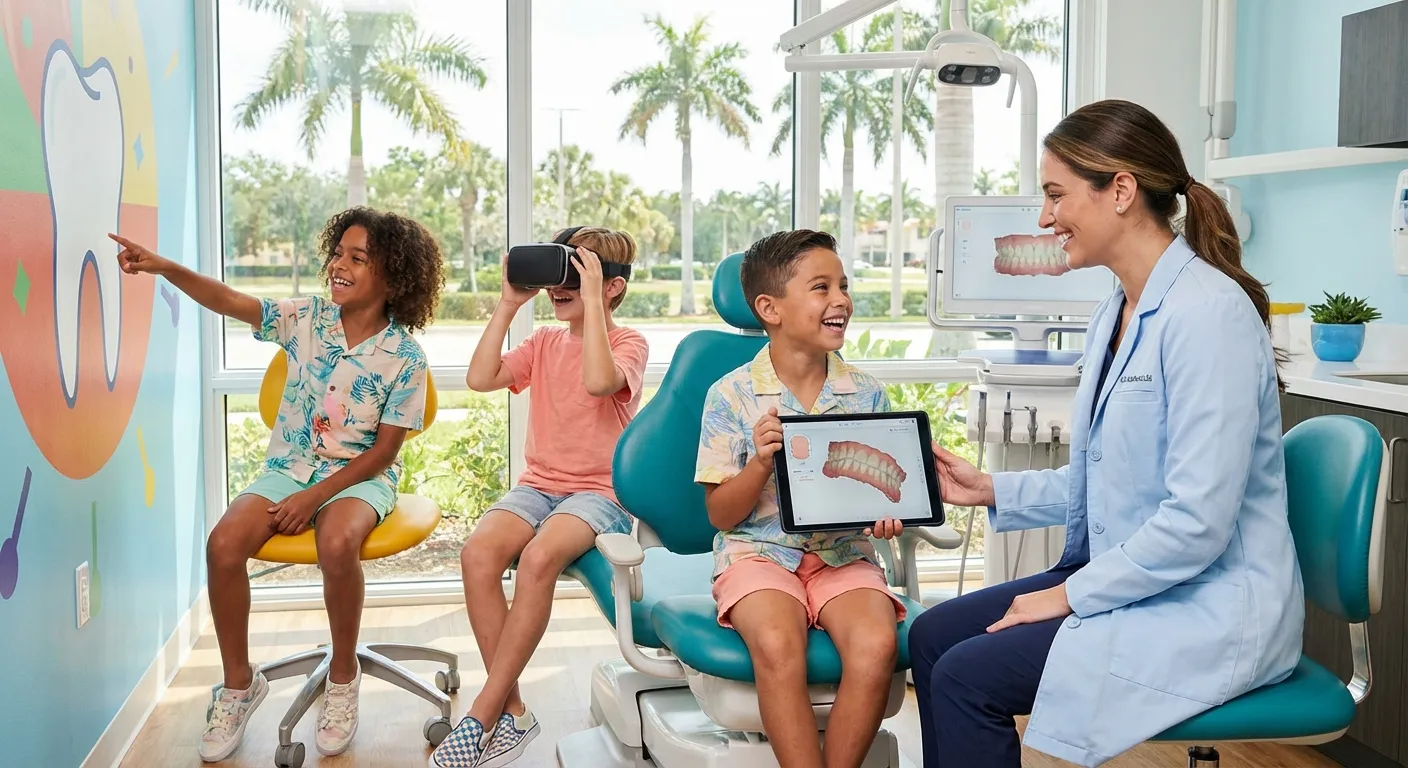
Our VIP treatment suites have their favorite shows playing, noise-canceling headphones if they need them, weighted blankets for anxiety, VR games to keep their mind off the appointment, and real snacks after you're done (not the stale stuff from 2015).
Parents from Silver Lakes Elementary and Panther Run Middle tell us it's genuinely the calmest orthodontic experience their kids have had.
Your First Visit: What to Expect and How Long It Takes
Most parents stress about that first appointment.
You're thinking about how long your kid will sit in the chair, whether they'll freak out, if they'll cooperate.
Let me walk you through exactly what happens.
Plan for 45-60 minutes total.
That's not because we're slow, it's because we're thorough and we're not rushing your child.
First, we take photos of their smile from different angles so we can track changes over time.
Then comes a low-dose CBCT scan, which sounds scary but honestly, kids handle it fine.
It's a cone beam that rotates around their head for about 10 seconds, and we explain it simply so they get what's happening.
While we're gathering information, your child hangs out in our play area or watches a show.
No endless waiting in a sterile dental office feeling uncomfortable.
Our pediatric scheduling means appointments actually fit school pickups, not the other way around.
Then we sit down with you and talk through what we found.
If Phase 1 makes sense, we explain exactly why, show you 3D simulations of what we're aiming for, and discuss timeline and costs in straight talk.
If your child doesn't need treatment yet, we'll monitor growth at no extra cost until they do.
Phase 1 Treatment Options and What They Do
Phase 1 isn't just one type of appliance.
Depending on what your child needs, we might recommend different approaches, all designed to work with their growth.
Palatal Expanders are probably the most common.
These gently widen the upper jaw to create space for teeth and improve airway capacity.
They look intimidating but work quietly over weeks or months, and most kids adjust within days.
We use custom-designed expanders with AI monitoring that we track digitally, so you're not guessing if it's working.
Growth-Guided Appliances work with braces or sometimes alone to steer jaw development.
Instead of forcing teeth into place, they encourage the jaw to grow in the right direction.
This is why Phase 1 is so powerful: we're working with your child's natural growth, not against it.
Habit Correction Devices address mouth breathing, tongue thrusting, or thumb sucking that's affecting tooth position.
Sometimes a small, barely-noticeable appliance stops the habit and lets normal growth happen.
All of these use cutting-edge technology at SMILE-FX, with self-ligating components that mean fewer adjustments and less discomfort overall.
Timeline and What Happens After Phase 1 Ends
Phase 1 typically runs 12-18 months, depending on how your child responds and what we're treating.
Some kids finish faster, some take longer, and that's fine.
There's no rush.
After Phase 1, your child enters an "observation phase."
Their permanent teeth keep erupting on their own, and we monitor progress with periodic check-ins to make sure everything's tracking right.
Many kids never need braces after this because we fixed the root issues early.
If comprehensive treatment is needed later, it usually happens around ages 11-14 when most permanent teeth are in.
But here's the kicker: research from the AAO shows that kids who go through Phase 1 first need 20-30% less comprehensive treatment time afterward.
You're not adding treatment time overall, you're actually saving it by starting smart.
Comfort and Pain: What Your Child Actually Experiences
Real talk: kids worry about pain, and frankly, so do parents.
Phase 1 causes minimal discomfort with the tools we use now.
Self-ligating brackets, gentle expansion protocols, and modern appliances don't hurt like what your parents might have experienced.
The first few days after getting appliances adjusted, your child might feel pressure or mild soreness, similar to what you feel in your legs after a light workout.
It's not pain, it's the sensation of movement.
Over-the-counter pain relief handles it if they're sensitive, but most kids don't need it.
Because we're working with growth rather than forcing teeth, the forces are gentler.
Your child won't be limping around the house or unable to eat.
Cost, Insurance, and Making Phase 1 Affordable
Phase 1 treatment costs vary based on what's needed, complexity, and duration.
But here's what matters: our team knows how to work with insurance.
Most plans do cover Phase 1 because it's interceptive care, not cosmetic.
We maximize your benefits so you're not blindsided by costs.
If insurance doesn't cover everything, we're transparent about the gap and work with you on options.
No surprise bills, no fine print that bites you later.
Book a free 3D scan and VIP consultation to discuss specifics with actual numbers, not estimates.
Why Board-Certified Specialists Matter for Your Child's Growth
This is important enough to say clearly: not all orthodontists are created equal.
A board-certified specialist has completed extra training, passed rigorous exams, and stays current with the latest science.
They're not cutting corners.
SMILE-FX uses board-certified specialists only, which means precision outcomes that actually last.
Your child's face is still developing over the next decade, so getting Phase 1 right now prevents compounding problems later.
That requires expertise and experience, not a general dentist dabbling in orthodontics on the side.
When you see patient reviews from families across Hollywood, Weston, Cooper City, Davie, and Fort Lauderdale choosing us for Phase 1 care, that's parents voting with their trust.
We're not a high-volume mill processing kids like widgets.
The Real Impact of Getting Phase 1 Right at Ages 6-10
Getting Phase 1 right now shapes your child's entire smile for life.
You're preventing extractions, reducing the chance of jaw surgery down the road, and often eliminating the need for full braces in the teen years.
Beyond the mechanics, your child gets confidence early.
They see improvements in how they look and feel better about themselves before the social pressures of middle school hit.
That's not just orthodotics, that's parenting smart.
Ready to see if Phase 1 is right for your child?
Book a FREE 3D scan and VIP smile consultation here.
No pressure, no sales pitch, just an honest conversation about your child's growth and what actually makes sense for their situation.
Phase 1 orthodontics for ages 6-10 in Pembroke Pines isn't about rushing treatment, it's about being proactive with your child's smile and growth.
What Happens After Phase 1: Your Child's Smile Journey from Ages 11-14
Your kid finished Phase 1 and now you're wondering what comes next.
The appliances are off.
Their jaw has grown.
Their permanent teeth keep coming in.
So do they need braces now, or are they done?
That's the question every parent asks after Phase 1 wraps up, and honestly, it depends on what Phase 1 actually fixed.
Here's what most parents miss: Phase 1 isn't the finish line, it's the foundation.
Think of it like building a house.
You got the bones right, the structure sound.
Now Phase 2 (if it's even needed) is about making sure everything sits perfectly once all the permanent teeth arrive.
For some kids, that means nothing.
For others, it means a few more months of guidance to get their smile exactly where it should be.
The Observation Phase: What's Actually Happening
Right after Phase 1 ends, your child enters what we call the observation phase.
This isn't waiting around doing nothing.
We're actively monitoring their growth every 6-8 weeks.
We take photos, check how their bite is coming together, and watch to see if their permanent teeth are erupting on schedule.
It's like having a spotter while they grow.
During this time, their second molars are still coming in.
Their jaw is still adjusting from the work we did in Phase 1.
Sometimes teeth shift a tiny bit as new ones push through.
That's normal.
That's why we're watching, not abandoning them.
Most kids spend 1 to 3 years in observation.
Some finish Phase 1 at age 9 and don't need anything else until age 12.
Others finish at 10 and are ready to move forward by age 11.
Every kid's timeline is different because every kid grows differently.
Do They Actually Need Phase 2 Braces?
This is where the real value of Phase 1 shows up.
Kids who had proper interceptive treatment often never need comprehensive braces at all.
Their jaws are wider.
Their bite is aligned.
Their permanent teeth have room to come in.
Phase 1 did what it was supposed to do, and Phase 2 is just maintenance.
But some kids do need Phase 2.
Maybe there's still some crowding.
Maybe their bite needs fine-tuning.
Maybe one tooth came in at a weird angle.
That's when comprehensive braces or clear aligners come into play.
The difference is huge though: kids who went through Phase 1 first typically need 20 to 30% less time in braces.
We already fixed the hard part.
Here's what matters: we don't decide this stuff alone.
We show you the 3D scans.
We explain what we're seeing.
We show you what happens if you wait versus what happens if you move forward.
Then you decide.
No surprises, no pressure.
Clear Aligners vs. Braces for Phase 2: Which One Makes Sense
By the time kids are 11 to 14, they're getting opinions on how they look.
They care about appearance more than an 8-year-old does.
That's why clear aligners have become so popular for this age group.
Clear aligners are basically invisible.
They're removable for eating and cleaning.
Your kid can still play sports and eat whatever they want without worrying about broken brackets.
The catch is they only work if your kid actually wears them.
We're talking 20 to 22 hours a day.
That's the deal.
If your kid loses them or forgets them constantly, aligners aren't happening.
Traditional braces work regardless.
Your kid can't lose them.
Can't forget them.
They stay on 24/7 and do the job.
Some kids actually prefer that because there's no thinking about it.
The best option is the one your kid will actually wear.
That's it.
We've seen kids with the best aligner plan fail because they wouldn't wear them, and kids with braces who did amazing because they knew they had to.
How Long Does Phase 2 Usually Take
If your kid needs Phase 2, expect 18 to 24 months typically.
That's way less than kids who skip Phase 1 and jump straight into comprehensive treatment at age 12.
Those kids often need 24 to 36 months.
The timeline depends on what we're treating.
A few crowded teeth? Probably closer to 18 months.
A significant bite problem that we're still correcting? Maybe closer to 30 months.
But we know these numbers going in.
We show you the 3D simulation of the plan.
You know how long it'll take before you start.
The observation phase in between doesn't count toward this number.
That's free monitoring.
You're only paying for active treatment time.
What Your Kid Experiences During Phase 2
By age 11 to 14, your kid is basically a teenager with opinions.
They care about pain, appearance, and whether they look normal at school.
We get it.
If we're using clear aligners, they swap out a new set every 1 to 2 weeks.
The first day in new aligners, there's slight pressure.
Nothing like pain.
Just the feeling of movement.
By day 3, they don't even notice they're wearing them.
If we're using braces, modern brackets are way smaller and less painful than what parents remember from their own childhoods.
Our technology uses self-ligating systems that mean fewer adjustments and gentler pressure overall.
The biggest thing that changes is their confidence.
As their smile improves, they stand taller.
They smile in photos.
They stop covering their mouth when they laugh.
That psychological boost is real, and it happens during Phase 2.
Food, Sports, and Keeping Things Clean
Parents always ask about whether braces interfere with school activities.
With clear aligners, your kid just takes them out for sports, lunch, and playing around.
No special mouthguards needed.
No food restrictions.
They can eat pizza at lunch like everyone else.
With braces, we recommend a mouthguard for contact sports.
That's it.
Plenty of athletes wear braces.
It doesn't stop them from playing.
Food restrictions with braces are real but simple.
No hard candy, no caramel, no popcorn kernels.
Not because braces are fragile, but because those things actually break them.
Your kid can eat literally everything else.
Pasta, tacos, burgers, fries, ice cream.
All fine.
Cleaning is easier with aligners because your kid just removes them and brushes normally.
With braces, we teach them special brushing and flossing techniques.
It takes 30 seconds longer than normal cleaning, and most kids are fine with it by their second week.
Retainers: Why They Matter After Phase 2
Here's the thing nobody talks about enough: retainers are literally the difference between keeping the smile you paid for and watching it shift back.
After Phase 2 ends, your kid wears a retainer.
Some kids wear a fixed wire retainer glued behind their front teeth plus a removable retainer at night.
Some wear clear retainers every night.
Some wear them permanently on the back teeth.
It depends on how much their teeth naturally want to shift.
The first 6 months after braces or aligners come off is critical.
Teeth can shift fast if you don't lock them in place.
We usually recommend nightly wear for at least that first year, then we reassess based on what we're seeing.
This isn't us trying to keep your kid attached to us forever.
It's literally how teeth work.
They have memory.
They want to go back to where they came from.
A retainer is the tool that says no, they're staying right here.
Cost for Phase 2 and What Insurance Covers
Phase 2 treatment costs vary depending on complexity and method.
Clear aligners fall in a different price range than braces.
Mild cases cost less than severe ones.
It's all relative.
The good news is we already factored Phase 2 into the original plan if you had Phase 1 with us.
We talked about the total cost upfront.
Your kid isn't getting surprise bills two years later when we start Phase 2.
Most insurance covers Phase 2 similar to how they covered Phase 1.
Your annual maximum applies.
We handle that paperwork.
We make sure you maximize your benefits.
If your family status changed since Phase 1 and you lost dental insurance, we have payment plans.
We're not going to abandon your kid mid-treatment because finances shifted.
Why Board-Certified Specialists Matter for Phase 2
By Phase 2, your kid has already been under care.
But the complexity actually goes up.
Their jaw is more developed.
Their permanent teeth are all in.
We're doing final precision adjustments on a face that's still growing.
Board-certified orthodontists have the training and experience to handle this level of precision.
General dentists can't cut it here.
The difference between a decent smile and a great one often comes down to who's managing Phase 2.
Real Questions Parents Ask About Phase 2
Will their smile still change after Phase 2 ends?
Yes, slightly, as their face continues to mature through their late teens.
That's why retainers exist.
But major shifts stop once they're locked in.
Can we skip Phase 2 if they don't really need it?
Absolutely.
If Phase 1 fixed everything and their permanent teeth are coming in perfectly, we're done.
We're not treating for the sake of treatment.
What if they have a relapse and their teeth shift back?
This rarely happens if they wear their retainer.
But if it does, we handle it.
We don't leave your kid hanging.
How do we know which option is better, clear aligners or braces?
We show you both.
We explain the pros and cons.
We tell you honestly which one we think gives the best result for their specific situation.
Then you choose what works for your family.
Staying Connected Through Phase 2
Your kid probably spent 12 to 18 months coming to see us during Phase 1.
They got comfortable.
They know the team.
They know the routine.
Phase 2 feels familiar because it is.
No new office, no new doctor.
Just the same trusted partner moving into the next chapter.
We check in regularly.
We answer questions at appointments.
We handle adjustments and swaps.
If something hurts or feels wrong, you call us and we fit them in.
This isn't a transaction, it's an ongoing relationship.
The families who come through our practice stick with us because they feel supported.
They're not just a number in a chart.
Their kid's smile matters to us.
Getting Ready for Phase 2: What Happens at the Transition
When we decide it's time to move forward, we have a specific conversation.
We show your kid the plan.
We explain what's about to happen.
We answer all their questions without dumbing it down.
Preteens and teens aren't stupid, they just appreciate straight talk.
We talk about their role.
If we're doing aligners, we explain the 20-hour rule clearly.
If we're doing braces, we cover food restrictions and cleaning.
We give them ownership of the process.
We also set realistic expectations.
This phase takes time.
There will be moments when they're tired of treatment.
That's normal.
But by the time we're done, their smile will be exactly what we planned.
The Transition from Phase 1 to Phase 2 at SMILE-FX
We don't just kick your kid out after Phase 1.
We have a structured transition plan.
During observation, we're gathering data.
We're seeing how their bite is settling.
We're checking if their smile is stable.
Then we schedule a comprehensive consult to discuss what's next.
This is where cutting-edge technology shows its value.
We can show you exactly where your kid's smile is heading.
Not guesses, not estimates.
AI-guided growth predictions that show you the actual plan and the actual timeline.
Your kid gets personalized treatment options based on their specific case.
We're not pushing one approach because it's easier for us.
We're recommending what actually works best for them.
Moving Forward: Your Next Steps
If your kid finished Phase 1 and you want to understand exactly what Phase 2 looks like for them, book a FREE 3D scan and VIP smile consultation here.
We'll show you the 3D plan.
We'll explain your options.
We'll give you real numbers and real timelines.
No surprises, no pressure.
Your child's smile journey from ages 6 to 18 is a partnership between your family and your orthodontist.
We're here to make sure they end up with a smile they love for life.
What Makes Your Orthodontist Choice Matter: Why Board-Certified Specialists Beat Everyone Else for Your Family's Smile
You're scrolling through Google looking for an orthodontist near me, and suddenly you've got fifty options staring back at you.
Some promise the cheapest braces.
Some say they're the fastest.
One claims to use "revolutionary technology" that doesn't exist yet.
Your inbox fills with discount emails.
Your phone rings with salespeople trying to book you in.
And you're sitting there thinking: does it actually matter who I pick?
The short answer is yes, it matters.
A lot.
But not for the reasons the marketing emails are telling you.
The Real Difference Between a Board-Certified Orthodontist and Everyone Else
Here's what most people don't know.
You can call yourself an orthodontist in some places without any specialized training.
Some general dentists take a weekend course and suddenly they're doing braces on the side.
Others go through years of formal training, pass rigorous exams, and commit to staying current with what actually works.
Those are your board-certified orthodontists.
A board-certified specialist has completed a two to three year residency after dental school.
They've spent thousands of hours managing complex cases.
They've passed exams that test whether they actually know their stuff, not just whether they paid tuition.
And they're required to take continuing education every year to stay certified.
That matters because your kid's face is still developing.
Their jaw is still growing.
One wrong move in Phase 1 can affect their entire smile and bite for life.
That's not something you want handled by someone who watched a YouTube video last Tuesday.
Why the Best Orthodontist Near Me Isn't Always the Cheapest One
Cheap braces sound great until you realize what you're paying for.
You're paying for a busy office that's trying to process as many patients as possible.
You're paying for a provider who cut corners on technology to save money.
You're paying for someone who might not catch complications until they become expensive problems later.
I've talked to parents who went with the discount option and regretted it.
Their kid's bite got worse during treatment.
Their teeth shifted back after braces came off.
They needed additional treatment that cost more than the original price difference.
That's the problem with affordable braces South Florida that are actually just cheap braces.
The best orthodontist for your family isn't the cheapest.
It's the one who gets the results right and stands behind them.
Sometimes that costs more upfront.
Sometimes it saves money in the long run because you're not fixing mistakes.
What Board-Certified Actually Means for Your Smile Outcomes
A board-certified orthodontist has studied the science behind tooth movement.
They understand growth patterns.
They know how to recognize when something isn't tracking right and adjust mid-treatment instead of pushing forward blindly.
They can handle complex orthodontic cases that would trip up a general dentist.
Research shows that board-certified specialists have better long-term outcomes.
Fewer relapses.
Better bite alignment.
Fewer complications during treatment.
That's not opinion, that's data.
When you're sitting in a consultation, ask if your orthodontist is board-certified.
If they hesitate or change the subject, you have your answer.
The Technology Gap: Why Modern Orthodontists Do It Better
Orthodontics has changed dramatically in the last decade.
The cutting-edge technology that exists now didn't exist ten years ago.
3D scanning instead of X-rays.
AI growth predictions that show exactly where your kid's jaw is headed.
Self-ligating brackets that use less force and cause less discomfort.
Digital treatment planning that shows you what the smile will look like before you start.
An orthodontist who's committed to staying current invests in this stuff.
An orthodontist who's just trying to make a quick buck uses what they bought fifteen years ago and calls it a day.
When you're comparing orthodontist options near you, ask what technology they use.
If they can't explain it or don't seem excited about it, that tells you something.
Clear Aligners vs. Braces: Which Approach Wins and Why It Matters
The debate between traditional braces vs. Invisalign isn't really about one being better universally.
It's about which one fits your kid's specific case.
Clear aligners like Invisalign work great for mild to moderate crowding.
Your kid gets a more invisible treatment option.
They can remove them for eating and cleaning.
The comfort level is generally higher because the forces are gentler.
The catch is your kid actually has to wear them.
Twenty to twenty-two hours a day isn't a suggestion, it's a requirement.
I've seen cases where a kid lost their aligners, forgot them at school, or just decided they weren't going to wear them anymore.
That's a failed treatment right there.
Traditional braces work for anything and everything.
Severe crowding, complex bites, jaw alignment issues.
Your kid can't lose them.
Can't forget them.
They do the job regardless of compliance.
Some kids actually prefer braces because there's no thinking about it.
An honest orthodontist tells you which one will actually work for your family's situation, not which one makes them more money.
Why Pediatric Expertise Matters for Kids and Teens
A best pediatric orthodontist in South Florida isn't just someone who treats kids.
It's someone who understands growth and development specific to different ages.
A six-year-old's orthodontic needs look nothing like a fourteen-year-old's needs.
The psychological component matters too.
A kid who feels scared and uncomfortable at appointments is going to be a nightmare to treat.
When you're interviewing orthodontists, ask how much pediatric experience they have.
Ask how they handle anxious kids.
Ask what their office environment is actually like.
These details matter.
Adult Orthodontics South Florida: Why It's Different for Grown-Ups
Your jaw stopped growing years ago.
Your teeth have decades of habits and positions.
The bone underneath your teeth is denser and responds differently to pressure than a growing kid's does.
Orthodontics for adults Miami and elsewhere requires a different approach.
An orthodontist with adult experience understands that you can't force tooth movement the same way you can with a kid.
The timeline might be longer.
The forces need to be gentler.
The overall approach is different because the biology is different.
If you're an adult looking for orthodontic treatment, find someone who specializes in adult cases.
It makes a real difference in outcomes and comfort.
Insurance, Financing, and Making Treatment Actually Affordable
Does your insurance cover braces?
Maybe.
Maybe not.
It depends on your plan and what you're treating.
Interceptive care like Phase 1 is often covered because it's preventive.
Cosmetic treatment sometimes isn't covered at all.
A practice that knows how to work with insurance maximizes what you're paying for.
They file claims correctly.
They know what codes to use.
They don't let you overpay because of administrative mistakes.
$0 down braces financing South Florida and payment plans exist because orthodontists know that cost is real.
The question is whether the practice will work with you on options or make you choose between treating your kid's teeth and paying rent.
When you're comparing costs, ask for a detailed breakdown.
Ask what's included.
Ask what happens if something breaks or goes wrong mid-treatment.
Ask if they have financing options.
The cheapest initial price means nothing if there are hidden costs later.
How to Spot a Practice That Actually Cares About Your Family
You can tell a lot about an orthodontic practice by how they treat you before you're a paying customer.
Do they answer your questions or rush you off the phone?
Do they offer a free consultation or try to charge you for an initial exam?
Do they explain things in plain language or use technical jargon to make themselves sound smarter?
Do they listen to what you actually want or just push their own agenda?
Look at patient reviews from actual families.
Not the fake five-star reviews that every business leaves for themselves.
Real reviews from real parents about their actual experience.
A practice that books appointments efficiently respects your time.
A practice that explains treatment clearly respects your intelligence.
A practice that follows up and stays accessible respects your commitment.
These are the markers of a practice you can actually trust.
Why Your Orthodontist Choice Affects Your Entire Smile Journey
You're not just picking someone to put braces on your kid for eighteen months.
You're picking a partner for a multi-year journey.
Phase 1 might last until age ten.
Then observation.
Then maybe Phase 2 in the early teens.
Then retainers for life.
If you pick wrong, you're stuck with someone you don't trust for years.
If you pick right, you've got someone who's genuinely invested in your kid's outcome and your family's satisfaction.
The best orthodontist near you is someone with real credentials, modern technology, honest recommendations, and a track record of actual results.
Not the prettiest website.
Not the catchiest commercials.
Not the one who promised the cheapest treatment.
The one who consistently gets families smiling.
Taking Action: Finding Your Family's Orthodontic Partner
Start by looking at the orthodontists in your area and checking their credentials.
Are they board-certified?
How long have they been practicing?
What technology do they use?
What do actual patients say about their experience?
Then schedule consultations with the ones that stand out.
This should be free or close to it.
You're not paying to figure out if you trust someone.
Ask the questions that matter to your family.
Listen to how they answer, not just what they say.
When you walk into an office, notice the details.
Is it comfortable or sterile?
Do the staff seem to actually like working there?
Do they remember your kid's name or treat them like a number?
These small things add up.
If you're in South Florida looking for the best orthodontist who actually has board-certified specialists, modern technology, and a genuine track record with hundreds of satisfied families, book a FREE 3D scan and VIP smile consultation here.
We'll show you exactly what's happening with your kid's teeth using 3D imaging.
We'll explain your options in plain language.
We'll give you honest recommendations based on what actually works, not what makes us the most money.
No pressure, no sales pitch, just real talk about your family's smile.
Your choice of orthodontist matters more than you think, and the best one for your family is the one you can actually trust.