
Early Braces for Kids: What Every Miramar Parent Needs to Know
You're sitting at breakfast and you notice your kid's teeth don't quite look right.
Maybe they're crowded.
Maybe their jaw shifts when they chew.
Maybe they're breathing through their mouth constantly.
And suddenly you're asking yourself: "Should I do something now, or wait?"
This is the moment where most parents freeze.
You don't know if you're overreacting or if you're missing a critical window.
You're not sure if "Phase 1 orthodontics" is real science or just a way for orthodontists to make more money.
And you definitely don't want to put your 7-year-old through unnecessary treatment.
I get it.
That's exactly why I'm writing this.
At SMILE-FX Orthodontics and Clear Aligner Studio, we work with kids aged 6 and up every single day.
We've seen what happens when parents act early.
We've also seen what happens when they wait too long.
And we've learned that the real question isn't whether Phase 1 orthodontics works—it does.
The real question is whether your specific kid needs it right now.
Let me break down exactly what Phase 1 is, when it actually matters, and how to know if your child is a candidate.
What Phase 1 Orthodontics Actually Is (Not What You Think)
Phase 1 goes by a lot of names.
Early orthodontics.
Interceptive treatment.
Growth guidance.
They all mean the same thing: working with your child's jaw while it's still growing to prevent bigger problems down the road.
Here's the key part that most parents miss: it's not about making your kid's smile perfect at age 8.
It's about creating conditions for their smile to develop naturally without major obstacles.
Think of it like this.
Imagine you're building a house.
You can either fix the foundation now while you're just starting, or you can build the whole thing and then tear it apart to fix it later.
One is smart planning.
The other is expensive and destructive.
Phase 1 treatment can:
- Create space for adult teeth to come in straight instead of crowded
- Fix crossbites and underbites while your child's jaws are still malleable
- Stop bad habits like mouth breathing and thumb sucking that make bite problems worse
- Shorten or even eliminate the need for braces or aligners in the teenage years
That last one gets parents' attention, and it should.
If you can prevent or reduce treatment later, that's less time in braces, less cost, and a healthier bite sooner.
The Age 7 Recommendation: Why It Matters Without the Hype
The American Association of Orthodontists says every kid should see an orthodontist by age 7.
But here's what that really means.
It doesn't mean every 7-year-old needs braces.
Not even close.
It means age 7 is when a specialist can finally see the full picture.
By then, some adult teeth are coming in.
The jaw growth pattern is becoming clearer.
And bite problems that were hidden at age 5 are now visible.
When we do an exam at age 7, most of the time we say exactly this:
"Everything looks normal.
We're going to watch it grow for the next 6 to 12 months and check in."
No treatment.
No rush.
Just smart monitoring as your child grows.
We call this our Growth and Guidance Plan.
And it's free.
The ones who do need treatment?
We catch them early enough to make a real difference.
When Your Kid Actually Needs Phase 1 Treatment
So when do we actually recommend early orthodontics?
Here are the signs that warrant a professional evaluation:
- Crowding that's visible now: Their teeth look jammed or overlapping
- Crossbite: Top teeth bite inside the bottom teeth (in front or back)
- Underbite or significant overbite: The jaws don't meet the way they should
- Mouth breathing: Lips are apart most of the time, even when they're relaxed
- Tongue thrusting: Pushing the tongue forward when swallowing
- Persistent thumb sucking past age 5: This actually shapes the palate and teeth
- Baby teeth falling out way too early or way too late: Compared to their friends
- Jaw shift when chewing: They move their jaw to the side to bite down properly
- Speech issues: Like a lisp or certain sounds that are hard for them to make
If you're seeing any of these, that's not just a cosmetic thing.
That's your kid's bite and jaw development getting off track.
And while it might seem small now, it compounds.
A small crossbite at age 7 can become a serious jaw problem by age 13 if left alone.
A kid who mouth breathes is setting themselves up for sleep issues, posture problems, and more complex orthodontic treatment later.
When You Should Actually Wait (And We'll Tell You)
Here's what separates a practice you can trust from one that just wants to sell treatment.
We say "let's wait" a lot.
And we're proud of it.
Your child might not need Phase 1 treatment if:
- The bite is working fine even if it doesn't look "perfect" yet
- There's mild crowding but plenty of space is coming as adult teeth emerge
- Jaw growth is tracking normally for their age and family genetics
- The issue is mostly cosmetic and can be handled in one clean phase later
In these situations, we put your child in a no-cost observation program.
You come back every 6 to 12 months.
We take photos and check how things are progressing.
If something shifts, we catch it early.
If nothing changes, you never pay for treatment you didn't need.
That's the SMILE-FX approach.
What Actually Happens at Your First Visit
I know the orthodontist's office can feel intimidating.
Weird instruments.
Bright lights.
Your kid gets nervous.
You get nervous.
So here's what to expect when you walk in, step by step.
Step 1: They Actually Make Your Kid Feel Welcome
We greet your child by name.
We show them around.
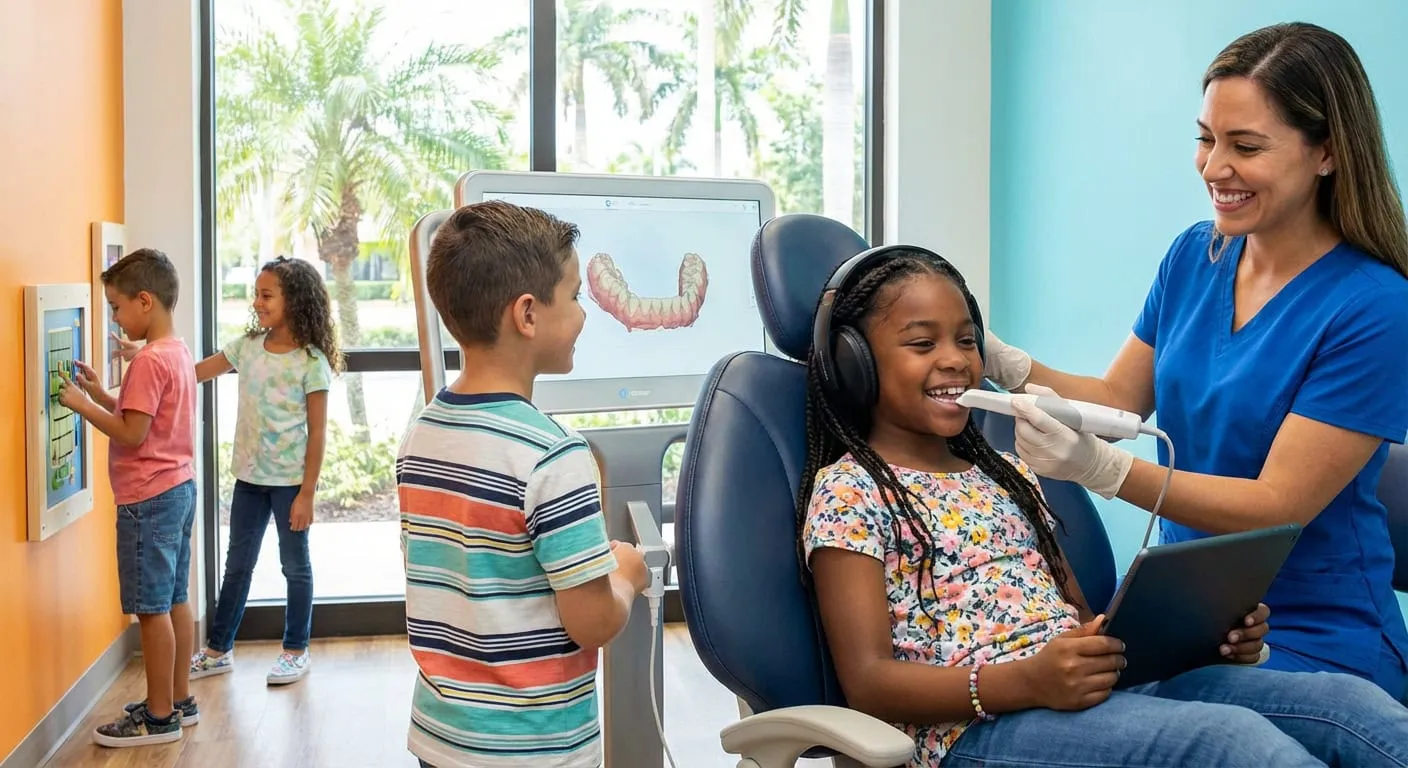
Games, snacks, virtual reality setups in some rooms, a chill vibe.
The goal is zero mystery.
Your kid knows what's coming.
They've got entertainment options.
And they're not sitting in a sterile, scary waiting room watching clock.
Step 2: Imaging (Only If We Need It)
If we recommend X-rays or 3D scans, we explain it in kid language first.
"We're taking special pictures to see how your teeth are growing."
We use low-dose digital X-rays and advanced 3D imaging to get the full picture with minimal radiation.
And here's the thing: if we don't need imaging, we don't do it.
That's it.
Step 3: Exam With an Actual Orthodontist
Your child is examined by a board-certified orthodontist—not a general dentist doing braces on the side.
We check:
- How teeth come together when biting
- Jaw growth and facial balance
- Space available for adult teeth
- Any functional issues with breathing, chewing, or speech
Step 4: A Real Conversation With You
We sit down with you (and your kid if it makes sense) and walk through what we see.
Photos, images, zero jargon.
You'll hear:
- What's normal for their age
- What we're keeping an eye on
- Whether Phase 1 treatment is recommended, optional, or not needed
- What treatment would actually accomplish (and what it won't)
- Cost and timeline if we recommend moving forward
Step 5: Comfort Extras for Anxious Kids
If your child gets nervous in medical settings, we have you covered:
- Weighted blankets to help them feel grounded
- Noise-cancelling headphones with their favorite shows
- Private VIP suites so they're not in a busy room
- Staff trained in pediatric anxiety, who move at your child's pace
Most kids walk out saying, "That was it?"
Why Families Across Broward County Drive to Miramar for This
We get families from Pembroke Pines, Hollywood, Weston, Cooper City, Davie, and Fort Lauderdale all the time.
They pass other orthodontist offices to get to us.
Why?
Because they've figured out that the provider you choose for your kid's orthodontics actually matters.
Board-certified specialists vs. general dentists doing braces.
Advanced 3D treatment planning vs. old-school impressions.
Comfort-first offices vs. standard dental chairs.
Transparent treatment decisions vs. "start now, ask questions later."
When your kid's bite and jaw development are on the line, that difference compounds for years.
Our Miramar location is minutes from I-75, the Turnpike, and I-95, making it accessible from across the county.
We offer early morning, after-school, and Saturday appointments so it doesn't destroy your schedule.
And we've built a reputation as the trusted orthodontist partner for pediatric dentists across South Florida.
That doesn't happen by accident.
The Real Cost of Phase 1 Treatment vs. Doing Nothing
Let's talk money, because it matters.
Phase 1 treatment is an investment.
Typically runs 12 to 18 months.
And yes, it costs something.
But here's what parents don't realize: waiting and doing nothing can cost way more later.
A crossbite that's fixable now at age 7 might require jaw surgery at 16.
Mild crowding now could turn into extractions plus two years of braces later.
Mouth breathing habits that develop unchecked lead to sleep-disordered breathing, posture problems, and more.
So when you're comparing the cost of Phase 1 now versus potential Phase 2 later, you're often looking at savings.
Plus, we offer flexible payment plans because we get that it's an expense for families.
The question isn't whether to get help for your kid.
The question is when to get it, and from who.
What Makes SMILE-FX Different for Your Kid's Smile
We use cutting-edge technology like 3D digital treatment planning and digital scanners instead of goopy impressions.
We follow American Association of Orthodontists guidelines and evidence-based protocols, not trendy shortcuts.
We combine growth science with real-world parenting reality.
The treatment plan has to work in your kid's mouth, in your schedule, and in your budget.
Not just on paper.
And we say "let's wait" when waiting is the right call.
That's not a bug.
That's a feature.
If you want braces for kids, clear aligners, or Invisalign for your family, you want someone who specializes in young patients and knows when to treat and when to observe.
Common Questions Parents Ask About Phase 1 Orthodontics
Does my 7-year-old actually need braces now?
Probably not.
Most kids don't.
The age 7 visit is about evaluation and planning, not jumping into treatment.
If we recommend it, there's a clear, functional reason.
Not cosmetics.
How long does Phase 1 usually last?
12 to 18 months typically.
Then there's a break while more adult teeth come in.
After that, Phase 2 (if needed) is usually shorter because we've already guided the foundation.
What if I just wait until all the adult teeth come in?
Sometimes that's fine.
We'll tell you if that's the smart play.
Other times, waiting means missing critical growth windows, and you end up with way more invasive treatment later (extractions, jaw surgery, years of braces).
That's why an expert evaluation early matters.
Is my kid going to be scared?
We're designed around child comfort.
From how we talk to them, to entertainment, to sensory tools.
If your child has anxiety, tell us before you come in.
We'll build a plan around them.
Your Next Move: Get an Expert Opinion
If you're a parent in Miramar, Pembroke Pines, Hollywood, Weston, Cooper City, Davie, Fort Lauderdale, or anywhere in Broward County, and you're wondering whether to act now or wait, here's what I'd do:
Get an expert opinion from someone you can trust.
Then decide.
At SMILE-FX, your first visit is designed to educate, not sell.
You'll know whether your child needs Phase 1 treatment, later-stage treatment, or just monitoring.
You'll understand the goals and what it looks like for your family.
And you can make that decision from a place of clarity, not confusion.
Book your free 3D scan and VIP smile consultation here.
Or take our quick online smile quiz to see if an in-person visit makes sense.
Your kid only grows once.
Make sure the orthodontist you trust is a true specialist in pediatric care, advanced technology, and growth guidance.
For families across Miramar and South Florida, that's SMILE-FX Orthodontics and Clear Aligner Studio.
Teen Orthodontics and Adult Braces: Beyond Phase 1 Treatment in South Florida
Your teenager just looked in the mirror and said, "I hate my smile."
Or maybe you're an adult thinking, "I've waited this long, is it even worth it now?"
Both of those thoughts are real.
And both of them land people in my chair every single week.
Here's what I want you to know right off the bat: orthodontics isn't just for kids anymore.
In fact, one out of every five orthodontic patients is an adult.
And teenagers have their own set of concerns that are totally different from what younger kids face.
Peer pressure hits different in middle school and high school.
Looking good matters more.
And at the same time, they're old enough to have opinions about their treatment.
They don't want something that screams "I'm getting braces."
They want options that fit their life.
That's where things get interesting.
Whether you're a parent worried about your teenager's bite, or you're an adult who's been thinking about straightening your teeth for years, this breaks down what actually works and why timing matters less than you think.
Why Teenagers Need Different Orthodontic Conversations Than Kids Do
Phase 1 treatment wrapped up around age 12 or 13 for the kids who got it.
Now the remaining adult teeth are coming in.
The jaw is almost done growing.
And if Phase 2 treatment is happening, this is where it happens.
But here's what changes: your teenager has a voice.
They care what their friends think.
They're scrolling Instagram and seeing influencers with perfect teeth.
And they're asking questions like, "Do I have to wear metal braces?"
That's not vanity talking.
That's them being a real human in the world.
This is exactly why having clear aligner options and modern braces choices matters so much for this age group.
They get to choose an approach that feels right for them.
And when they buy into the treatment, they're way more likely to stick with it.
No fights about keeping aligners in.
No rebellion against the process.
Just a teenager who's invested in their own smile.
The Straight Talk on Invisalign for Teens and Clear Aligners
Clear aligners are the teenager favorite.
And I get why.
They're nearly invisible.
They come out for eating, drinking, pictures, everything.
No wires poking your gums during a kiss.
No food stuck in brackets.
Sounds perfect, right?
Here's the real thing though: they only work if your teen actually wears them.
The recommendation is 20 to 22 hours a day.
That's not optional.
I've seen teenagers who said they'd be responsible, then wore their aligners like 12 hours a day, and guess what happened.
Treatment took twice as long.
And sometimes it didn't work at all.
So before you go all-in on Invisalign because it sounds cool, have a real conversation with your teenager about compliance.
Can they commit to wearing them?
Or are they the type who loses things and forgets stuff?
If it's the latter, traditional braces might actually be the better move because the brackets stay on and do the work regardless.
That's not a failure.
That's just knowing your kid.
What Adults Need to Know About Getting Braces or Aligners Later
You're 35 and thinking about straightening your teeth.
Or you're 50 and your dentist finally convinced you.
Maybe you tried getting braces as a kid and your parents couldn't afford it.
Or maybe you just didn't care back then and now you do.
The good news is simple: your age doesn't matter.
Your teeth will move at any age.
The bone around your teeth stays responsive to pressure your whole life.
The bad news is you might be dealing with some stuff younger patients don't have to think about.
Gum disease that needs cleaning up first.
Missing teeth that need to be replaced.
Old crowns or fillings that might need work.
Bone loss from years of not flossing.
None of that stops you from getting braces or aligners.
It just means your treatment plan looks a little different.
And it takes more planning upfront.
That's why getting a full evaluation from a board-certified orthodontist matters so much.
Not just someone who does braces on the side.
Someone who knows how to work with adult teeth and adult complications.
The Timeline Thing: How Long Does This Actually Take?
Teenagers usually finish in 18 to 24 months.
Adults might take a little longer, maybe 24 to 36 months, depending on how much movement is needed and what else is going on.
But here's the mind shift: that's not as long as you think.
Two years sounds like forever when you're 16.
It's a significant chunk of your high school years.
I get that.
But as an adult?
Two years goes by.
You blink and you're done.
And then you have a lifetime of results.
So the real question isn't "how long," it's "what am I getting out of this?"
If the answer is a bite that works better, teeth that are easier to clean, a smile you actually like looking at, that's worth the time.
The Money Conversation: What Does Braces or Aligners Actually Cost?
This varies.
Treatment complexity matters.
Your location matters.
Your insurance matters.
For teenagers, comprehensive treatment usually runs somewhere in the range that makes parents think about payment plans.
For adults, same thing.
Here's what I want you to know: the price isn't random.
It's based on actual work.
The technology being used.
How many appointments you need.
Whether we're using 3D digital planning and advanced imaging or old-school methods.
And whether you're going with a specialist or someone who just does this part-time.
The investment in a board-certified specialist who uses modern technology usually means faster treatment and better results.
Which actually saves you money in the long run because you're not dragging things out.
At SMILE-FX, we work with what you can actually afford.
Payment plans that make sense.
Insurance coordination so you get what your plan covers.
Real conversations about cost upfront so there are no surprises.
What About Retainers? The Part Everyone Forgets About
Your braces come off.
You think you're done.
Plot twist: you're not.
Retainers are the part of treatment that actually determines if your results stick around.
I've seen teenagers get braces off and stop wearing their retainer, and within a year their teeth start moving back.
All that time and money, undone.
For adults, this is even more important because your teeth naturally want to shift as you age.
Retainers hold them where they're supposed to be.
There are different types.
Fixed retainers that stay glued to the back of your teeth.
Removable retainers you wear at night.
Sometimes you need both.
And yeah, wearing a retainer every night for the rest of your life sounds annoying.
But it's way less annoying than going through treatment again because you skipped that step.
Teenagers and Sports: Can You Still Play If You Have Braces?
Your teenager is a soccer player, football player, hockey player, something.
And they're worried braces are going to mess that up.
Real answer: they won't.
Athletes wear braces all the time.
The only thing you need is a mouthguard that fits over them.
And honestly, if you're a teenage athlete, you should be wearing a mouthguard anyway.
Protecting your teeth is protecting your investment in your smile.
Clear aligners are actually easier for sports because you can take them out during the game and put them back in after.
Just don't lose them on the field.
We've seen that happen.
It's not fun.
Social Life and Dating: The Real Concerns Teenagers Have
Let's be honest about what teenagers are actually worried about.
It's not the treatment itself.
It's how it affects their social life.
First kiss while wearing braces?
It's awkward, but it happens and it's fine.
Going to prom with clear aligners?
Nobody even knows.
School dances, first dates, trying to look your best for a crush.
These are the moments teenagers stress about.
And that's valid.
That's why having options matters so much.
Some teenagers actually prefer regular braces because they don't have to worry about remembering to wear aligners.
Others go invisible route because the thought of metal in their mouth feels wrong.
There's no universal answer.
There's just what works for your teenager.
The Adult Reality: Why Now Might Be Your Time
You're an adult and you've been thinking about this for years.
Maybe you were told as a kid that orthodontics would take too long or cost too much.
Maybe you didn't have access to it.
Maybe you just didn't care back then.
Here's what I want to tell you: there's no deadline.
You're not too old.
Your teeth aren't too crooked.
Your bite isn't too messed up.
The only question is whether you want to do it.
Because if you do, the logistics are straightforward.
And the results change things.
People smile more when they like their smile.
They take better care of their teeth when those teeth are straight and easier to clean.
They feel more confident in professional settings and personal ones.
That's not superficial.
That's real.
How Treatment Works When You're Busy
Teenagers have school.
Adults have jobs and families and actual responsibilities.
Orthodontics can't become this massive logistical nightmare.
Appointments at SMILE-FX are scheduled around your life.
Early morning slots before school or work.
After-school times for teenagers.
Saturday appointments so you don't have to take time off.
Virtual consultations if that works better for you.
Treatment with clear aligners actually requires fewer in-office visits than traditional braces because you're changing them at home.
So if you're pressed for time, that might be your move.
But if you need something set-it-and-forget-it, braces work while you live your life.
Either way, we're not making this harder than it needs to be.
What Treatable Cases Actually Look Like
You might be wondering if your specific situation is even something we can treat.
The answer is probably yes.
We handle everything from simple crowding to complex bite problems.
Overbites where your top teeth stick out too far.
Underbites where your bottom teeth are in front.
Open bites where your front teeth don't touch when you bite down.
Crossbites where your bite is shifted to one side.
Teeth that are rotated or in weird positions.
Gaps between teeth.
All of it is treatable.
The question is just what approach makes sense for your situation.
And that's something we figure out in an actual evaluation, not over the phone.
Why You'd Want a Board-Certified Specialist, Not Just Anyone
This matters more than you might think.
A general dentist can do braces.
They can take a course and start offering it.
A board-certified orthodontist has done thousands of hours of specialized training beyond dental school.
They know how to handle complicated cases.
They know how to work with adult teeth and adult gums.
They know what can go wrong and how to prevent it.
And when something does go wrong, they know how to fix it.
That's not a small difference.
That's the difference between good results and results you actually love.
Common Questions About Teenage and Adult Orthodontics
Will braces affect my teenager's speech?
Not really.
They might talk a little different for a few days while they get used to them, but their actual speech isn't affected.
And if you're using aligners, there's no speech effect at all.
Do I need to floss more carefully with braces?
Yes.
Flossing with braces takes more time.
But it's doable.
With aligners, you floss like normal, which is way easier.
Can I still eat normal food?
With braces, you need to skip hard, sticky, crunchy stuff.
With aligners, you take them out and eat whatever you want.
That's one of the big quality-of-life differences.
Will treatment affect my sports performance?
Nope.
In fact, some athletes swear their performance improves because having braces makes them feel more focused and committed to their goals.
Is it normal to feel sore after appointments?
Yes.
Your teeth are being moved, so soreness is part of the deal.
It usually lasts a few days and is manageable with over-the-counter pain relief if you need it.
Can I get braces if I have existing dental work?
Probably.
Crowns, bridges, fillings, implants, it all depends on the specifics.
That's what the evaluation is for.
What if I'm nervous about the whole thing?
That's normal.
We work with nervous patients every single day, teenagers and adults.
Tell us about your anxiety and we build the experience around you.
Your Next Step: Get Real Answers About Your Specific Situation
Whether you're a parent trying to figure out what's next for your teenager, or you're an adult finally ready to do this for yourself, the best thing you can do is get a professional opinion.
Not a sales pitch.
An actual evaluation from someone who specializes in this.
At SMILE-FX, that's what we do.
We look at your teeth, your bite, your specific goals.
We explain what's happening in plain English.
We show you options that actually work for your life.
And then you decide.
No pressure.
No surprises.
Just clarity.
Book your free 3D scan and VIP smile consultation here.
If you're in Miramar or anywhere across South Florida, we're here for teenagers, adults, everyone.
We do things different because we know what actually matters to people.
Your smile is worth getting right.
Whether you're getting braces for teens or adult clear aligner treatment, the best time to start is when you're ready.
For families across Miramar, Pembroke Pines, Hollywood, Weston, Davie, Fort Lauderdale and all of Broward County, that's SMILE-FX Orthodontics and Clear Aligner Studio.
Financing Your Smile: Payment Plans and Insurance for Braces and Clear Aligners in South Florida
You're ready to get braces or clear aligners.
Your teeth are ready.
Your orthodontist is ready.
But then someone asks, "How much is this going to cost?" and suddenly you're frozen again.
The truth is, orthodontic treatment is an investment.
It's real money.
And if you're sitting there thinking you can't afford it, you're not alone.
That question comes up literally every single day in our office.
People asking about affordability, insurance coverage, payment options, whether there's a way to make this work for their budget.
And here's what I've learned: cost shouldn't be the thing that stops you from getting your teeth straight.
It should just be something we figure out together.
Whether you're looking for affordable braces in South Florida, wondering about insurance coverage, or trying to find a way to make clear aligners work financially, this is the real breakdown.
The Actual Cost of Braces and Clear Aligners
Let's start with the number everyone's thinking about.
How much does orthodontic treatment actually cost?
The answer is: it depends.
And I know that's annoying to hear, but it's true.
A simple case of minor crowding that takes 18 months costs less than a complex bite problem that takes 30 months.
Clear aligners at a general dentist's office cost different from clear aligners at a board-certified orthodontist.
Treatment at a budget practice looks different from treatment with cutting-edge technology.
The range for comprehensive orthodontic treatment typically falls somewhere between what younger kids pay and what adults might expect.
For traditional braces, you're looking at a price that reflects the complexity of your case and the duration of treatment.
For Invisalign or clear aligners, the cost structure is similar but sometimes slightly higher because of the custom manufacturing involved.
But here's the thing nobody talks about: the cheapest option isn't always the best deal.
I've seen families go with the lowest price and end up needing more treatment later because the first go-around wasn't done right.
That actually costs more money in the end.
So the real question isn't "what's the cheapest," it's "what's the best value for my money."
Does Insurance Actually Cover Braces?
This is probably the first thing you want to know.
Does insurance cover braces?
The answer is: sometimes.
Many dental insurance plans do cover orthodontic treatment.
But the specifics matter.
Some plans cover 50 percent of the cost.
Some cover 25 percent.
Some have a maximum benefit per year or per lifetime.
Some don't cover it at all.
And almost all insurance plans have a waiting period before orthodontic coverage kicks in.
Usually 6 to 12 months.
The only way to know what your specific plan covers is to call your insurance company or have us call them for you.
Which we do, by the way.
One of the first things we do when you come in is figure out your insurance situation.
We contact your plan, find out exactly what they'll pay for, what they won't, and what your out-of-pocket responsibility is.
No surprises.
No guessing.
Just clarity.
The Insurance Benefit Breakdown: What You Actually Need to Know
Let's say your insurance does cover orthodontics.
Here's what that typically looks like.
Most plans have an annual maximum.
Maybe $1,500 per year.
That sounds like a lot until you realize comprehensive treatment lasts multiple years.
So if your treatment is 24 months and your annual max is $1,500, your insurance pays up to $3,000 total.
Anything beyond that is your responsibility.
Some plans also require a waiting period.
So you can't start treatment on day one of having insurance.
You have to wait out that eligibility period.
That's annoying, but it's standard.
And some plans only cover orthodontics if a dentist says it's medically necessary.
Not just cosmetic.
That's actually a lower bar than you'd think.
Most bite problems qualify as medically necessary because they affect chewing, breathing, or jaw function.
Pure cosmetic straightening is harder to get covered, but we can often frame it differently based on what's actually happening with your bite.
Affordable Braces Options in Broward and South Florida
If you're in Broward County looking for affordable braces, you have options.
And I don't just mean finding the cheapest place.
I mean finding a practice that's transparent about cost, willing to work with your budget, and won't nickel and dime you for things you didn't expect.
At SMILE-FX, we offer affordable braces in Miramar, Fort Lauderdale, and across South Florida specifically because we know cost matters.
We use efficient treatment protocols that don't drag things out unnecessarily.
We use technology that actually speeds up treatment, which means you're in treatment for less time.
That means lower cost.
We also don't require huge upfront payments.
There are payment options that make sense for regular people with actual budgets.
No $0 down nonsense that hides higher payments later.
Just real financing that we can explain clearly upfront.
Payment Plans That Actually Work for Your Life
Here's the thing about payment plans: they should make your life easier, not more stressful.
At SMILE-FX, we offer flexible financing options because we get that orthodontic treatment is expensive.
You might see "$0 down braces financing" advertised everywhere in South Florida.
And yeah, $0 down sounds great.
But read the fine print.
Usually what's happening is the interest gets rolled into your monthly payments, making them way higher than if you'd just paid a smaller upfront amount.
We're not like that.
Our payment plans are straightforward.
You know what you're paying each month.
There's no surprise balloon payment at the end.
No hidden fees.
Just a plan that works for your budget.
Some patients prefer to put half down and spread the rest over the treatment period.
Some prefer equal monthly payments from start to finish.
Some have specific insurance benefits and want their payments structured around that.
We work with all of it.
The key is sitting down before treatment starts and building a payment plan that actually works for you.
What About Clear Aligners? Are They More Expensive?
Clear aligners cost about the same as traditional braces.
Sometimes slightly more, sometimes slightly less, depending on your case and the provider.
But here's where the actual cost difference comes in: what you're paying for.
With clear aligners, each set is custom-made for your teeth.
That manufacturing process costs money.
With traditional braces, you're paying for the brackets, wires, and frequent adjustments.
Both have real costs.
Neither is inherently more expensive if it's done well.
The best way to figure out which is more affordable for you is to get evaluated by someone who offers both options and isn't pushing you toward one because it makes them more money.
A board-certified orthodontist who specializes in both traditional and clear aligner treatment can tell you which approach makes sense for your specific case and your budget.
Insurance and Clear Aligners: How That Works
Insurance covers clear aligners the same way it covers traditional braces.
Some plans do.
Some don't.
It depends on your specific plan.
And honestly, a lot of dental insurance plans were written before clear aligners became mainstream, so some older plans don't mention them at all.
When we call your insurance, we specifically ask if clear aligners are covered under your orthodontic benefit.
Some plans cover them fully if they're recommended by a board-certified specialist.
Some cover them but at a lower percentage than traditional braces.
Some don't cover them at all.
The cost difference between what insurance pays and what you pay out of pocket is something we calculate and walk through with you before you start treatment.
No surprises.
The Hidden Costs Nobody Talks About
When you're budgeting for orthodontic treatment, the payment to the orthodontist is only part of the picture.
There are other things that come up.
Sometimes you need a dental cleaning or a filling before treatment starts.
Your regular dentist handles that, and your regular dental insurance usually covers it.
Sometimes you need X-rays or 3D scans.
Most practices include those in the treatment cost, but it's worth asking.
With braces, you're replacing brackets and wires throughout treatment, and that's included in your fee.
With clear aligners, you're getting new trays every couple weeks, and that's also included.
The thing that can sneak up on you is retainers.
Some practices include retainers in the treatment cost.
Some charge extra for them.
Ask about that upfront.
Because retainers are non-negotiable if you want your results to stick around long-term.
And paying extra for them after treatment ends is frustrating when you think you're already done.
Comparing Providers: Why the Cheapest Isn't Always the Best Value
You're going to see ads for really cheap braces.
Bargain prices.
Orthodontists undercutting everyone else.
Here's what I want you to think about before choosing based purely on price.
Are they a board-certified specialist or a general dentist doing braces part-time?
Are they using modern technology or old-school methods?
Do they have a treatment plan specific to your case or a generic approach for everyone?
What happens if something goes wrong mid-treatment?
Are they accessible if you need them?
What's the office environment like?
Sometimes the cheapest option saves you a couple hundred dollars upfront and costs you thousands in longer treatment time, redoing work, or dealing with complications.
The best value is the practice that gets you results efficiently, uses proven methods, and stands behind their work.
How to Actually Get a Clear Cost Estimate
You should never feel pressured to commit to treatment without knowing exactly what it costs and what's included.
A real orthodontist will give you a written estimate before treatment starts.
That estimate should include the total fee for treatment, what insurance will pay, what you'll pay out of pocket, and what your monthly payment would be if you go with a payment plan.
It should also spell out what's included in the treatment fee and what costs extra.
If someone won't give you a clear written estimate before you commit, that's a red flag.
Move on.
At SMILE-FX, we give you a detailed cost breakdown after your evaluation, once we know exactly what your treatment will involve.
We're not guessing.
We're specific.
And we explain it in a way that makes sense, not in dental jargon that leaves you confused.
Questions People Actually Ask About Orthodontic Costs
Can I get a payment plan with bad credit?
We work with most people regardless of credit history.
Some payment plan options require credit approval, some don't.
Have that conversation with our team and we'll find something that works.
What if I can't afford treatment right now?
You have options.
Phase 1 treatment for younger kids costs less than comprehensive treatment.
Some cases are simpler and therefore cheaper.
Sometimes spacing treatment or early intervention now prevents more expensive treatment later.
We can talk about what makes sense for your situation.
Is there a discount if I pay in full upfront?
Some practices offer that.
It's worth asking about.
Do you cover braces if my orthodontist recommends them for medical reasons?
Most insurance plans do if they're deemed medically necessary.
That's something we verify with your insurance specifically.
Can I switch orthodontists mid-treatment if costs are an issue?
Technically you can, but it gets complicated.
You might have to restart treatment or lose fees you've already paid.
That's why choosing the right practice from the start matters.
The Real Investment: What You're Actually Paying For
When you're thinking about orthodontic costs, remember you're not just paying for brackets and wires or plastic trays.
You're paying for expertise.
You're paying for technology.
You're paying for someone who knows how to handle complications.
You're paying for results that last.
A cheap treatment that drags on for 40 months costs you more than smart treatment that finishes in 24 months, even if the upfront price is higher.
A practice that prioritizes your comfort and communication costs slightly more than a factory-like office but saves you stress and headaches.
When you're comparing costs, think in terms of total value, not just total price.
Getting Started Without Breaking Your Budget
If you're ready to straighten your teeth but worried about cost, the first step is getting evaluated.
At SMILE-FX, your initial consultation is free.
We do a free 3D scan and VIP smile consultation where we look at your teeth, figure out what needs to happen, explain it clearly, and give you a real cost estimate.
Then you decide if it works for your budget.
No pressure.
No obligation.
Just the information you need to make a real decision.
We're the best orthodontist near you in South Florida because we believe cost shouldn't stop you from getting a healthy, straight smile.
Book your free consultation at https://smile-fx.com/lp/free-consult today.