
Early Orthodontics for Kids in Miramar Ages 6-10
You're sitting at your kitchen table at 11 PM, scrolling through Reddit threads about whether your 7-year-old needs braces. Your kid's teeth look a little crowded. The dentist mentioned something about seeing an orthodontist. And now you're spiraling wondering if you missed some magical window where everything could have been easier.
Stop. You're in the right place.
I get it. The uncertainty sucks. You want to do right by your kid without making knee-jerk decisions that cost time and money. You don't want to be that parent who either ignores real problems or jumps into treatment that wasn't even needed.
That's exactly why we built SMILE-FX Orthodontics & Clear Aligner Studio in Miramar. We're here to cut through the noise and give you straight answers about Phase 1 orthodontics for kids ages 6 to 10.
What Phase 1 Orthodontics Actually Is (Not What You Think)
Phase 1 orthodontics, sometimes called interceptive treatment, isn't about slapping braces on your kid's face and hoping for the best.
It's strategic.
It's limited. It's targeted work done while your child's jaw is still growing and malleable. We're talking about the sweet spot between ages 6 and 10 when their permanent teeth are just starting to come in and their jaw bones are still soft enough to guide in the right direction.
Here's what Phase 1 actually does:
- Protects jaw growth while it's easy to influence
- Makes room for permanent teeth to come in straight
- Fixes bite problems before they become worse
- Stops bad habits like thumb sucking from damaging teeth
- Supports healthy breathing patterns and facial balance
The key thing nobody tells you? Sometimes Phase 1 is a watchful waiting game, not active treatment. And that's actually the smart play.
Why Your Child Needs an Evaluation by Age 7 (And Why It's Not Scary)
The American Association of Orthodontists recommends every kid get checked by age 7. Not because they all need braces. But because by 7, an orthodontist can see what's really happening inside your child's mouth and jaw.
By age 7, your kid's jaw has shown enough cards that we can actually predict where things are heading.
Their permanent first molars have come through. Their front incisors are starting their journey. We can see patterns. Crowding. Spacing issues. Bite problems. Breathing concerns.
An evaluation at SMILE-FX gives you one of three honest outcomes:
- Everything looks great, see you in a year
- Something's off, let's monitor for now
- Let's do Phase 1 treatment, and here's exactly why
That's it. No pressure. No upselling. Just clarity.
The Red Flags Every Miramar Parent Should Know
You don't need a dental degree to spot when something's off.
If your kid has any of these, it's worth a free orthodontic consultation:
- Crowded teeth stacking or overlapping because there's no space
- Crossbite where top teeth bite behind or inside bottom teeth
- Open bite where front teeth don't touch when they bite down
- Mouth breathing with lips hanging open, snoring, or difficulty closing the mouth
- Thumb sucking past age 5 or 6 that's still happening
- Baby teeth falling out way too early or way too late compared to their friends
- Jaw shifting where your kid moves their jaw sideways to make teeth fit
- Speech issues like lisping that might connect to bite position
One of these doesn't automatically mean "braces now." But it means get expert eyes on it.
What Actually Happens at Your First Visit to SMILE-FX
You're probably imagining a sterile, cold office where they rush through your kid and hand you a massive bill.
That's not us.
Here's the real experience:
Step 1: Kid-First Environment
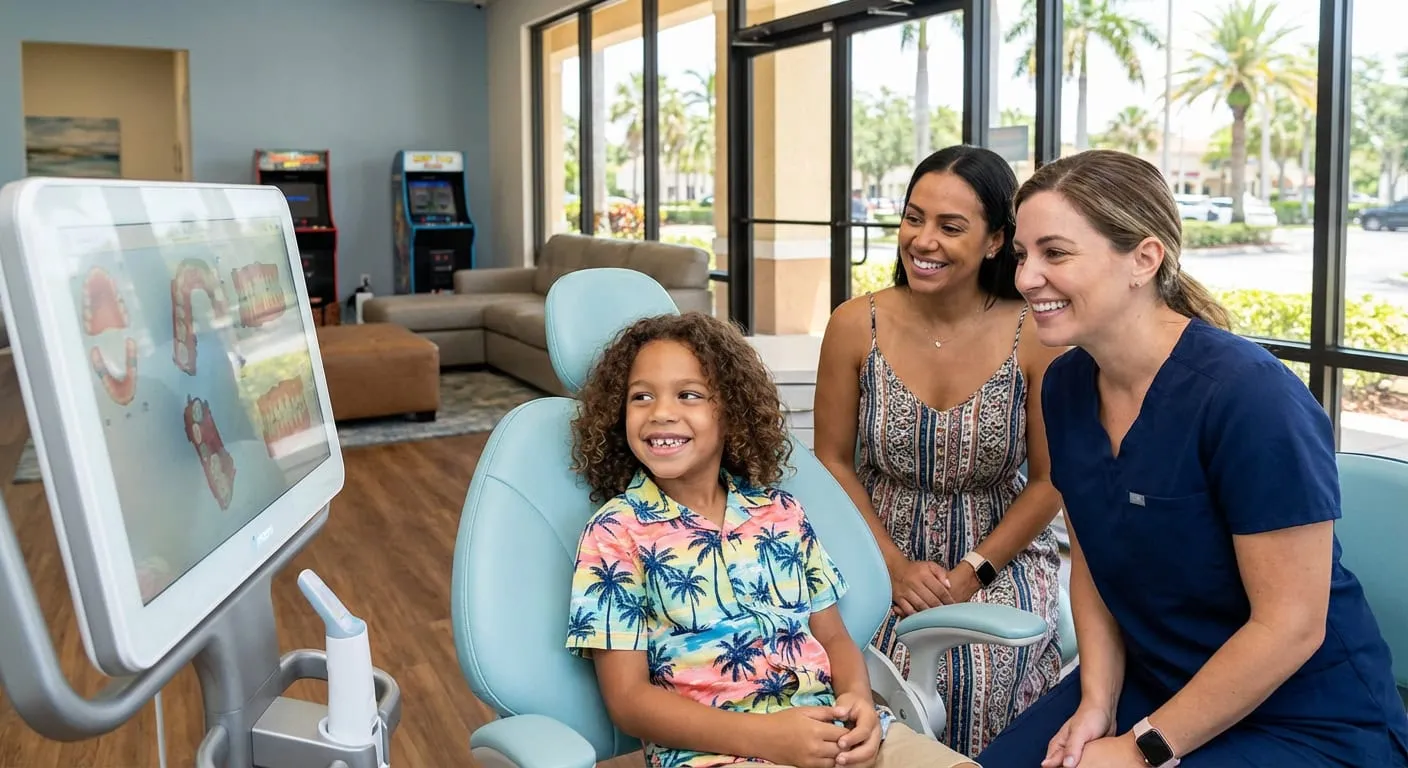
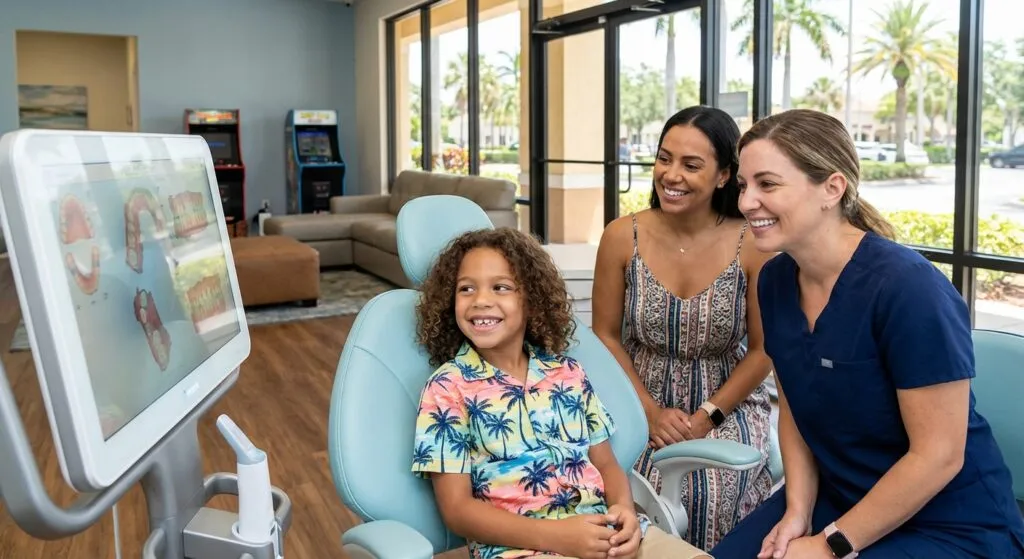
Your child walks into a lobby that doesn't feel like a torture chamber. Video games. Tablets. Movies on screens. Weighted blankets. Snacks. Our team talks to your kid like an actual human, not a mouth with a problem.
Step 2: Smart Imaging (Only When Needed)
We use low-dose digital imaging and 3D scans with cutting-edge technology designed to give us the clearest picture with the least radiation. We explain what we're looking at in real time. No mystery box stuff.
Step 3: Real Evaluation
A board-certified orthodontist specialist (not a general dentist offering braces on the side) looks at jaw alignment, bite, spacing, crowding, growth patterns, and oral habits. We check how their upper and lower jaws work together. We look at their face and how everything balances.
Step 4: Honest Conversation
We sit down with you in plain English and explain what we found. What needs treatment now. What we should monitor. What happens if you do nothing. How long treatment takes. What it costs. No surprises. No pushing you toward the most expensive option.
When Phase 1 Treatment Is Actually Worth It
Phase 1 makes sense when your orthodontist can clearly show you that early intervention protects your child's long-term bite and jaw health.
Common reasons Phase 1 helps:
- Severe crossbites that damage teeth or jaw joints
- Extreme crowding leaving zero room for permanent teeth
- Narrow upper jaw that needs widening while it's still growing
- Bite problems affecting how your kid eats or speaks
- Habits like thumb sucking causing real damage
- Underbite or overbite getting worse as they grow
At SMILE-FX, we use advanced planning tools to show you exactly what Phase 1 will fix and what Phase 2 (teen treatment) will handle later.
Most Phase 1 treatment runs 9 to 18 months. Then your kid gets a break. Then Phase 2 happens around age 11 or 12 when all permanent teeth are in.
When Watching and Waiting Is the Right Call
Here's what makes us different from other practices in Broward County and South Florida.
We're not afraid to say no.
Your child might not need Phase 1 if teeth are mildly crowded but will probably straighten as their jaw grows. If the bite works fine. If jaw growth looks balanced. If they stopped thumb sucking early enough.
In these cases, we create a Growth & Smile Monitoring Plan. Quick check-ins every 6 to 12 months. You get peace of mind knowing you're watching without locking into unnecessary treatment.
Plenty of parents actually prefer this because it means their kid gets to be a kid, no appliances in their mouth, but we're staying ahead of any real problems.
Why Families From Miramar, Pembroke Pines, Weston, and Beyond Trust SMILE-FX
We're not just another orthodontic office in Broward County.
We're the place pediatric dentists refer to when they want a specialist who actually cares about their patients as people.
Our board-certified specialists focus only on orthodontics. Not general dentistry. Not a side hustle. This is what we trained for and what we do every single day.
We use 3D digital planning and advanced technology to see things other offices miss. We design our office around kids, not around what's cheapest to build. We move at your child's pace. We explain everything clearly.
Parents from Pembroke Pines, Weston, Davie, Cooper City, Hollywood, and Fort Lauderdale drive to Miramar specifically because they know the difference.
You can even start with a virtual consultation to see if it's worth the drive before you ever get in a car.
Real Questions Parents Ask Us Every Week
Does my 7-year-old really need braces right now?
Probably not. Age 7 is about getting evaluated, not automatically getting braces. Most of our young patients in Miramar go on a monitoring plan. We recommend Phase 1 only when it clearly helps.
Will early treatment mean my kid skips braces as a teenager?
Sometimes it simplifies teen treatment. Makes it shorter. Makes it easier. But we won't promise "no braces later" if that's not realistic. We deal in honesty, not best-case fantasies.
Should I see an orthodontist or wait for my dentist to refer me?
Your general dentist is great for cavities and cleaning. But they didn't specialize in jaw growth and bite development. That's our entire world. Get an expert opinion early. It costs nothing for a consultation.
What if my kid has anxiety about dental stuff?
We see anxious kids all the time. We use noise-canceling headphones. Quiet rooms. Weighted blankets. VR. We go at their pace. Tell us what helps before your visit and we'll have it ready.
SMILE-FX Does More Than Early Orthodontics
If your child needs Phase 1 now and Phase 2 later, you stay with us. We handle comprehensive teen braces too.
For older kids and adults, we offer clear aligner treatment and Invisalign-style options if you want straighter teeth without metal brackets.
Everything lives under one roof at SMILE-FX. Same team. Same technology. Same commitment to getting it right.
Check out our complete treatment options at smile-fx.com to see what's available for every age and situation.
The Move You Need to Make Right Now
You're already the parent who cares enough to look into this stuff. You're not cutting corners on your kid's health.
The next smart step is simple: get facts from a specialist so you stop guessing.
Book your child's free 3D scan and VIP smile consultation at SMILE-FX Orthodontics & Clear Aligner Studio and find out whether Phase 1 treatment is needed or if watchful waiting is the better path.
Schedule your free 3D scan and VIP smile consultation here.
Your child gets one shot at growing their jaws and teeth the right way. Get a specialist's eyes on it. Phase 1 orthodontics for kids ages 6 to 10 done right can set them up for life.
Phase 2 Orthodontics and Teen Braces: What Happens After Early Treatment in Miramar
Your kid finished Phase 1 treatment six months ago.
They wore their expander like a champ.
You stuck to the monitoring appointments.
Their jaw grew.
Their permanent teeth started coming in.
And now you're getting the call that Phase 2 is starting around age 11 or 12.
So what happens now?
This is where the real work begins, and honestly, it's when you see the actual payoff from doing Phase 1 right.
Phase 2 is typically where your teenager gets braces or clear aligners to straighten all their permanent teeth and lock in that perfect bite for life.
But here's what makes it different from starting fresh at age 13 without Phase 1 behind them: the groundwork is done.
Their jaw is already in the right position.
Their permanent teeth have room to come in.
Their bite is halfway fixed already.
So Phase 2 is usually shorter, simpler, and less invasive than if you'd skipped Phase 1 entirely.
Why Phase 2 Treatment Matters for Your Teen
By age 11 or 12, nearly all your kid's permanent teeth have erupted.
Now you need to align them perfectly.
Phase 2 finishes what Phase 1 started.
This is when we use comprehensive braces treatment or clear aligner therapy to position every single tooth exactly where it needs to be.
The goal is a bite that looks amazing and functions without problems for the next 50 years.
Think of it like building a house.
Phase 1 pours the foundation and frames the walls.
Phase 2 finishes the interior, installs the appliances, and makes it livable.
Skip Phase 1 and you might need to rebuild the foundation during Phase 2.
That's more time. More appointments. More money.
That's not happening to you.
Traditional Braces vs. Clear Aligners for Teenagers
When your kid hits Phase 2, you have real choices.
Traditional metal braces for teens still work great.
They're reliable, predictable, and your orthodontist can make micro-adjustments every month to keep things moving.
Most Phase 2 cases run 18 to 24 months with braces.
The downside is obvious: your teen sees the brackets and wires.
Some kids own it.
Some kids hate it.
That's where clear aligner treatment comes in.
Invisalign and similar systems let teenagers straighten their teeth invisibly.
They take out the aligners to eat, brush, and floss.
Nobody knows they're doing orthodontics unless they tell them.
But aligners require discipline.
Your teen needs to wear them 20 to 22 hours a day.
They need to remember to take them out before eating.
They need to keep them clean.
Some teenagers nail this.
Some forget constantly.
At SMILE-FX, we help you pick what actually works for your teen's personality and commitment level.
Not what works on paper.
What works in real life.
How Phase 2 Treatment Actually Works Month by Month
Let's walk through what your teen experiences during Phase 2.
Month 1: You come in, we bond the brackets or deliver the first set of aligners.
We explain the care routine.
What to eat, what to avoid, how to clean everything.
It feels weird in their mouth for about a week.
Then they forget about it.
Months 2 through 6: Your teen comes in every 4 to 6 weeks.
If they're in braces, we tighten the wires and move them to new brackets as their teeth shift.
There's some soreness for a day or two after each appointment.
Totally normal.
They can manage it with over-the-counter pain meds if they need to.
If they're in aligners, they swap to a new set every 1 to 2 weeks and come in for check-ups less often.
Months 7 through 18: The teeth move into their final positions.
The changes slow down a bit.
But the final positioning is actually the most important part.
This is where we get the bite perfect and lock everything in.
Final months: We remove the brackets or stop the aligners.
We take impressions and photos to compare with day one.
Your teen sees the actual transformation.
It's wild how different they look.
Then we fit them with a retainer to keep everything locked down for life.
The Retainer Talk Nobody Wants to Hear
Here's the part that actually matters: what happens after Phase 2 ends.
Your teen's teeth will shift back if they don't wear a retainer.
Not because we did something wrong.
Because teeth naturally want to move.
That's just biology.
Some kids need a fixed retainer bonded behind their teeth permanently.
Some get a removable retainer they wear at night forever.
Some need both.
We figure out what your teen's teeth actually need based on how aggressive they are to shift.
The key is getting your teenager on board with retainer wear before Phase 2 even starts.
Not during, not after.
Before.
We've seen too many parents who did everything right through Phase 1 and Phase 2, then their teen stopped wearing their retainer at age 16 and everything went backward.
Don't be that story.
What Happens If Your Kid Never Did Phase 1?
Maybe you're reading this because your 12-year-old never had early treatment and now needs braces.
That's okay.
Phase 2 still works.
It just takes longer.
Typically 24 to 30 months instead of 18 to 24.
Why?
Because we're fixing the jaw position AND straightening the teeth at the same time.
It's more complicated.
More appointments.
More adjustments.
But the end result is the same: a straight, healthy smile.
The only difference is the timeline and the cost.
If you have a younger sibling who still could do Phase 1, don't skip it thinking "we'll just do Phase 2 later like we did with the older one."
Give yourself options.
Cost of Phase 2: What You're Actually Spending
Phase 2 with traditional braces typically runs between 4000 and 6500 dollars.
Phase 2 with clear aligners runs similar or slightly higher, maybe 4500 to 7000 dollars.
If your kid did Phase 1 first, your total investment across both phases is usually less than starting fresh at 12 with no early treatment.
Most practices also break Phase 2 into payments.
Monthly plans, quarterly payments, financing options.
At SMILE-FX, we make this affordable because we know cost matters.
We work with families, not against them.
And we're upfront about what you're paying for.
No surprise bills.
No hidden fees.
You know exactly what Phase 2 costs before you commit.
Questions Every Parent Asks About Phase 2
Will my teenager have to wear rubber bands?
Maybe, depending on their bite.
Some cases need them for a few months to fine-tune how the upper and lower teeth connect.
Kids complain about them constantly.
But they work.
Your orthodontist will tell you if they're necessary.
Can my teen play sports with braces?
Yes, but they need a mouthguard.
Not the tiny sports kind.
A thick one that fits over the brackets.
Music too.
Playing trumpet or violin with braces is weird at first, but kids adapt fast.
What if my teen has a cavity during Phase 2?
You deal with it like normal.
See your regular dentist, get it filled.
If you're in aligners, you take them out during the appointment.
If you're in braces, the dentist works around them.
Nothing stops Phase 2 treatment.
Do they need to see a specialist or can my regular dentist do this?
You want a board-certified orthodontist specialist for Phase 2.
Not a general dentist offering braces on the side.
Orthodontics requires specific training and skill that general dentists don't have.
This is complicated bite work.
Get a specialist.
Why Starting Phase 2 at the Right Time Matters
Timing isn't everything, but it's something.
Some kids are ready for Phase 2 at 11.
Some not until 12 or 13.
It depends on how many permanent teeth have erupted and how their jaw growth is tracking.
Starting Phase 2 too early means you're trying to straighten teeth that are still coming in.
That's fighting nature and losing.
Starting too late means your kid might have already developed bad bite habits or jaw positioning issues that take longer to fix.
Your orthodontist watches for the sweet spot where Phase 2 makes sense.
That's why the monitoring plan from Phase 1 matters so much.
We're not guessing when Phase 2 should start.
We know because we've been watching the whole time.
The Technology That Makes Phase 2 Better Now
Phase 2 in 2024 is not what it was 10 years ago.
We use 3D treatment planning software to map out exactly where every tooth needs to go before we even start.
Your teen can see their final result before they get their braces or aligners.
That's huge for buy-in.
They know what they're working toward.
It's not some mystery.
Our advanced technology lets us make smaller adjustments more efficiently, which means less discomfort and faster results.
Braces and aligners are smarter now too.
Less friction on the wires.
Better materials.
Aligners that move teeth more predictably.
Your teen's Phase 2 experience is legitimately better than what kids got five years ago.
What Makes Phase 2 at SMILE-FX Different
We don't treat Phase 2 like assembly line dentistry.
Your teenager gets the same board-certified orthodontist the entire time.
Not a different person every visit.
Same person. Same plan. Same commitment to their smile.
Our whole practice is built around understanding that teens have different needs than kids.
They care about looking good now.
They want to know they have a choice in their treatment.
They need an orthodontist who gets it.
We do.
We also handle all your child's care under one roof.
If they did Phase 1 with us, Phase 2 continues seamlessly.
If they're coming to us for Phase 2 only, we pull their growth records and jump right in.
No starting from scratch.
No repeating X-rays they don't need.
Just smart, efficient, focused orthodontics.
The Real Talk About Phase 2 Compliance
Here's something orthodontists don't always say out loud: the patient is the hardest part.
Not the science.
Not the treatment.
The patient.
Your teenager has to:
Brush and floss around brackets or under aligners
Avoid hard, sticky, crunchy foods that break braces
Show up to appointments every 4 to 6 weeks
Wear their retainer religiously after treatment ends
Kids forget.
They get lazy.
They prioritize other stuff.
That's normal teenage behavior.
But it messes with their results.
The best thing you can do is set expectations before Phase 2 even starts.
Make it clear that braces or aligners work great, but only if they participate.
Not you.
Them.
They need to own this.
After Phase 2 Ends: The Long Game
When your teenager's Phase 2 treatment wraps up, that's not the end of the story.
That's actually when the real work begins.
Keeping those teeth straight for life is on them and you.
A retainer is forever.
Or close to it.
Some people wear theirs every night for 30 years.
Some wear them just a few nights a week after the first year.
Your orthodontist will tell you what your kid's teeth specifically need.
The teeth that wanted to shift aggressively during treatment want to keep shifting.
A retainer stops that.
It's the insurance policy on your entire Phase 1 and Phase 2 investment.
Don't skip it.
Is Your Teen Ready for Phase 2 Right Now?
Maybe your kid finished Phase 1 and is waiting on the timeline.
Maybe they never did Phase 1 and now their school photo looks like they could use some smile work.
Maybe they have crowding that's getting worse as they grow.
Whatever the situation, Phase 2 might be next.
The best move is the same move that worked for Phase 1: get a specialist's opinion before you decide anything.
Book a free 3D scan and VIP smile consultation at SMILE-FX Orthodontics and Clear Aligner Studio.
We'll tell you if Phase 2 makes sense right now or if you should wait.
We'll show you what treatment options exist.
We'll be honest about timeline and cost.
And we'll answer every question your teenager has too, because they're the one getting the braces or aligners.
Their comfort matters.
Their input matters.
Getting Phase 2 orthodontics and teen braces treatment in Miramar right means making sure everyone's on the same page.
Learn more about our comprehensive braces options for teens or explore our clear aligner solutions today.
Your teenager's smile is about to change completely.
Make sure it's done right.
Insurance Coverage, Financing Options, and Affording Orthodontic Treatment in South Florida
You're staring at the orthodontist's quote and your stomach drops.
Braces or clear aligners aren't cheap.
Phase 1 treatment, Phase 2 treatment, retainers for life.
Your insurance card sits on the table and you're wondering if it even covers any of this.
And now you're thinking maybe orthodontics is just something wealthy families do.
It doesn't have to be that way.
I'm going to walk you through how insurance actually works with orthodontics, what financing options exist, and how families across Broward County, West Palm Beach, and Miami are getting affordable braces South Florida without going broke in the process.
Does Your Insurance Actually Cover Braces or Clear Aligners?
Here's the real answer: sometimes yes, sometimes no, and sometimes partially.
Most dental insurance plans include some orthodontic coverage.
The catch is the details matter.
Typical orthodontic coverage breaks down like this:
- About 50 percent of your treatment cost after you meet your deductible
- A lifetime maximum benefit, usually between 1000 and 2000 dollars
- Coverage for braces, but sometimes not clear aligners
- Different rules for kids versus adults
- Age limits that might exclude teenagers or adults
That 50 percent sounds good until you realize it caps out fast.
If your full treatment cost is 5000 dollars and your insurance covers 50 percent up to 1500 dollars lifetime, you're paying 3500 dollars out of pocket.
The question becomes: how do you cover that 3500 dollars without stress?
Why Insurance Doesn't Cover Everything and What That Means
Insurance companies treat orthodontics differently than emergency dental work.
They see it as elective.
Cosmetic.
Not medically necessary.
Even though a bad bite affects how your kid eats, speaks, and breathes.
Even though severe crowding leads to cavities and gum disease.
Even though crossbites damage jaw joints.
Insurance doesn't see it that way.
So your coverage is limited.
Your deductible still applies.
Your out-of-pocket maximum still hits.
And suddenly that best orthodontist near me visit gets complicated by the money piece.
The good news is you don't have to pay full price out of pocket anyway.
Financing Your Orthodontic Treatment: The Real Options
Most orthodontic practices offer payment plans.
We're not talking predatory lending.
We're talking about breaking your treatment cost into manageable monthly payments so you don't drop 5000 dollars in one check.
In-House Payment Plans
Many practices, including SMILE-FX Orthodontics and Clear Aligner Studio, split your treatment into 24 to 36 monthly payments.
No interest.
No hidden fees.
Just a straightforward monthly amount that fits your budget.
You pay part of it upfront and the rest spreads across your treatment months.
Zero Down Financing Options
Some practices advertise $0 down braces financing South Florida.
This means your first month payment doesn't happen until after your treatment starts.
You're not paying anything out of pocket day one.
Your treatment begins and then the monthly bill starts hitting.
It's a way to ease families into the cost without the massive upfront hit.
Third-Party Financing Companies
CareCredit, Affirm, and similar services let you finance your orthodontic treatment separately from your insurance.
You get approved for an amount, you pay the orthodontist directly, and then you pay the financing company monthly.
Some have promotional periods with zero interest if you pay it off in time.
Some charge interest right away.
Read the fine print before you sign up.
- CareCredit: typically offers 6 to 24 month interest-free periods depending on the balance
- Affirm: usually charges interest but has flexible payment terms
- LendingClub: personal loans that can cover orthodontic costs
The catch with these is you need decent credit.
If your credit is rough, you might not qualify.
That's why many practices still offer their own payment plans as backup options.
Insurance Questions You Need Answered Before Treatment Starts
Before you book your orthodontic consultation at any practice, call your insurance company and ask these specific questions:
Do you cover orthodontics for my child's age?
Some plans only cover kids under 18.
Some exclude kids under 12.
Some only cover adults.
Know your plan's age limits.
What's my annual deductible and has it been met?
You might have already paid your deductible with regular dental cleanings.
If so, your orthodontic coverage starts sooner.
What's my lifetime maximum benefit for orthodontics?
This is the ceiling for what insurance will ever pay toward braces or aligners.
Once you hit it, you're paying the rest yourself.
Do you cover traditional braces, clear aligners, or both?
Some plans cover traditional braces but not Invisalign or other clear aligners.
This might push you toward traditional braces even if you'd prefer aligners.
Is there a waiting period before orthodontic coverage kicks in?
Some plans have waiting periods after you enroll before orthodontic benefits activate.
You could be in a plan for months before you can actually use orthodontic coverage.
Get these answers in writing if you can.
Your orthodontist's office can also call your insurance and verify coverage as part of your consultation.
That's what a board certified orthodontist South Florida does for you.
What About Medicaid or Public Insurance Programs?
Medicaid coverage for orthodontics varies by state and by county.
Florida Medicaid generally covers orthodontics for children under 21, but only in cases of severe malocclusion.
Crowded teeth alone usually doesn't qualify.
Crossbites, open bites, and jaw growth issues are more likely to be approved.
You need a referral from a dentist and the orthodontist has to document medical necessity, not just cosmetic benefit.
If your family qualifies for Medicaid, contact your local Medicaid office and ask about orthodontic benefits.
Not every orthodontist takes Medicaid, so you might have fewer practice options.
But it's worth checking if it's available to you.
Employer-Sponsored Dental Insurance and Orthodontics
If you get dental insurance through your job, it probably includes some orthodontic coverage.
Most employer plans cover 50 percent of orthodontic costs with a yearly maximum around 1000 to 1500 dollars.
Here's what many people miss: that maximum resets every calendar year.
So if your kid's braces cost 5000 dollars and their treatment spans two years, you could potentially get coverage from both years.
Year one: insurance pays up to 1500 dollars out of 2500 dollars spent.
Year two: insurance pays up to 1500 dollars out of the remaining 2500 dollars spent.
You still pay most of it, but insurance helps more than it looks like at first glance.
Ask your HR department or insurance broker specifically how orthodontic benefits work in your plan.
Shopping for Insurance With Orthodontics in Mind
If you're self-employed or between jobs and shopping for dental insurance, consider orthodontic coverage as part of your decision.
Some plans offer better orthodontic benefits than others.
A plan with 60 percent coverage instead of 50 percent, or a higher lifetime maximum, could save you hundreds of dollars across your family's treatment.
It might cost a few dollars more per month now, but it pays off when you need braces or aligners.
When you're comparing plans, ask about:
- Percentage of orthodontic costs covered
- Lifetime maximum for orthodontics
- Waiting periods before coverage starts
- Age limits for coverage
- Whether clear aligners are covered at the same rate as traditional braces
The best orthodontist Miami can work with whatever insurance you have, but having better coverage makes the whole process less painful financially.
The True Cost of Delaying Treatment
Here's something people don't think about: delaying orthodontic treatment doesn't save you money long term.
It usually costs you more.
If your kid has a severe crossbite and you skip Phase 1 treatment to save money now, Phase 2 treatment later will take longer and cost more.
A mild crowding problem you ignore at age 7 becomes a severe crowding problem at age 13.
More teeth to move.
More appointments.
Higher cost.
And potentially jaw damage that could have been prevented.
The math doesn't work out in favor of waiting.
Early treatment when costs are more manageable often saves money and pain later.
Transparent Pricing at a Top Rated Orthodontist Fort Lauderdale and Miramar
No surprise bills.
No hidden fees that show up months into treatment.
We give you a treatment plan with a specific cost attached to it.
We verify your insurance coverage in advance.
We show you exactly how much insurance will contribute.
We show you exactly how much you'll pay out of pocket.
And we work with you on affordable braces Broward payment plans that fit your budget.
Whether you're looking at traditional braces vs Invisalign, the cost transparency is the same.
You know what you're getting into.
Making Your Decision With Money in Mind
Cost matters.
It's not the only thing that matters.
But it's real.
When you're choosing between practices or deciding whether to move forward with treatment, factor in the full financial picture.
Insurance coverage, down payment, monthly payments, financing options, the whole thing.
A practice that offers $0 down braces financing South Florida with reasonable monthly payments might be more doable for your family than a practice that demands 50 percent upfront.
A board certified orthodontist South Florida using cutting-edge technology might charge slightly more but finish treatment faster, saving you money overall.
The cheapest option isn't always the best value.
The best value is getting great results without being stressed about money the whole time.
Next Steps: Get Your Numbers Before You Commit
Book your free 3D scan and VIP smile consultation here to understand what your family's orthodontic treatment actually costs.
Bring your insurance card.
Be honest about your budget.
Ask every question you have about payment plans and financing.
A great orthodontist won't judge you for caring about cost.
They'll work with you because they know affordable braces South Florida for families who need them is part of their job.
Your kid's straight smile shouldn't require financial stress.
Get the facts, make the call, and move forward with confidence about what your family will actually spend on orthodontic care.