
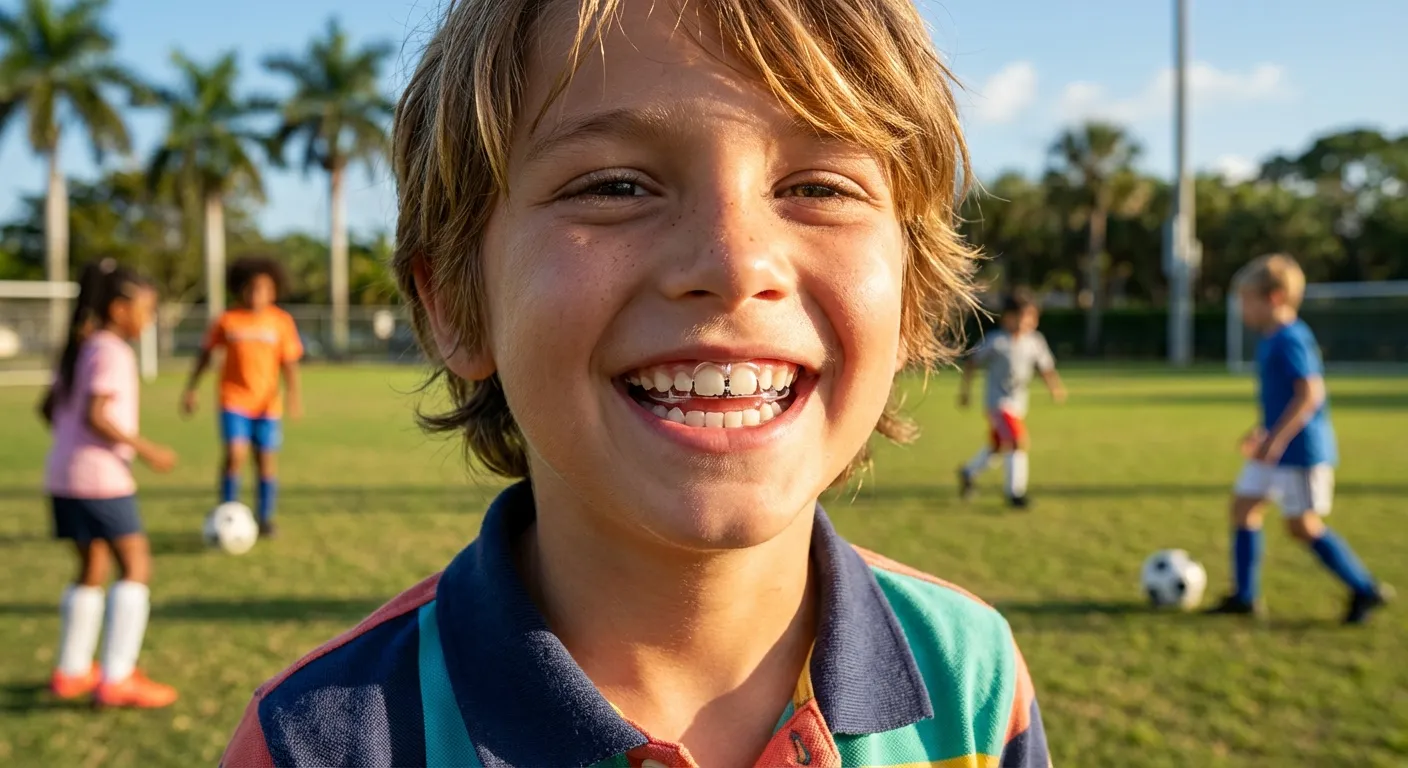
Phase 1 Orthodontics for Ages 6-10 in Pembroke Pines
Your kid's teeth are coming in crooked. You notice one side of their bite looks off. Maybe they're still sucking their thumb at seven or breathing through their mouth instead of their nose. You're wondering if you need to panic or if this is just a normal phase that'll work itself out.
Here's the thing: catching these signs early isn't about rushing your child into braces. It's about giving them a head start.
The American Association of Orthodontists recommends a first evaluation around age seven. Not because every kid needs treatment. But because some kids benefit from what we call Phase 1 orthodontics, also known as interceptive treatment. This is the early intervention that can guide natural jaw growth and prevent bigger problems down the road.
What Phase 1 Orthodontics Actually Means
Phase 1 is treatment that happens while your child's jaw is still growing. Most kids ages 6 to 10 have a lot of growth ahead of them, and that's the sweet spot for guiding things in the right direction.
Think of it like this: your child's mouth is still under construction. The teeth are still moving in. The jaw is expanding. The facial bones are developing. Phase 1 treatment uses light, consistent pressure to guide all that natural growth toward a better outcome.
It's not about getting their teeth perfect right now. It's about creating space, correcting bite issues, and stopping habits that could mess with growth. Sometimes this means using custom expanders to widen the upper jaw. Sometimes it's straightforward braces for a few months to move things into better positions. The goal is always the same: set up the foundation for a healthier bite and straighter teeth later.
At SMILE-FX Orthodontics & Clear Aligner Studio, we use low-friction appliances and digital scanning technology to make this process as comfortable and effective as possible for kids.
The Real Benefits of Starting Early
Let me break down what Phase 1 actually does for your kid.
It prevents bigger problems later. If your child has crowding now, starting treatment guides jaw growth to create natural space. This can mean fewer teeth need to be pulled down the road. Fewer extractions means less time in braces during Phase 2. That's a win.
It corrects bad bites before they become structural issues. Crossbites, overbites, underbites: these aren't just cosmetic problems. They affect how your child chews, speaks, and breathes. Catching them early means we can guide correction while the jaw is still developing, often without needing surgery later.
It breaks damaging habits. Thumb sucking and mouth breathing might seem harmless, but they're actually pushing your child's teeth and jaw development in the wrong direction. Phase 1 treatment corrects these habits and stops them from getting worse.
It boosts confidence. A kid who sees their smile improving in elementary school walks into middle school with more confidence. That matters more than people think.
It shortens total treatment time. Most Phase 1 treatment takes 6 to 12 months. Then there's a rest period while your child continues to grow. Phase 2, if needed, is usually shorter and simpler because the foundation is already there. We're talking about potentially reducing Phase 2 needs by half.
Signs Your Child Might Benefit from Phase 1 Treatment
Not every child needs Phase 1 treatment. But these are the signs that it could help:
Crowded teeth. If your child's baby teeth are overlapping and packed together, that's a sign the jaw might not be big enough for all the permanent teeth coming in. Phase 1 can expand the jaw naturally and create the space needed.
A crossbite. This is when the upper teeth bite inside the lower teeth on one or both sides. It looks off and it affects how the jaw grows. Correcting it early prevents the jaw from developing unevenly.
Mouth breathing. If your kid is constantly breathing through their mouth instead of their nose, it's affecting how the palate develops and how teeth come in. We can help shift this habit.
Thumb sucking past age five. This habit pushes the front teeth forward and can create an open bite where the front teeth don't touch even when the mouth is closed. Phase 1 treatment breaks the habit and guides the teeth back.
Protruding front teeth. If your child's front teeth stick out significantly, they're at higher risk for getting chipped or broken during sports or play. Phase 1 can bring them back into better alignment and protect them.
Teeth that are way too big or way too small for the jaw. Sometimes the jaw is too narrow for the teeth that are trying to come in. Phase 1 expands the jaw to make room.
Here's what I'm not saying: if your kid has none of these signs, they don't need treatment. Some kids' teeth come in perfectly fine without intervention. We're not looking to treat kids who don't need it. We're looking to catch the ones who do and give them the best shot at a healthy bite.
What Makes SMILE-FX Different for Kids in Pembroke Pines
There's a difference between a general dentist who offers orthodontics on the side and a specialized orthodontic studio built specifically for kids.
SMILE-FX is the second one. We're board-certified specialists who focus on orthodontics. We know growth patterns. We understand how to work with kids. We have the right technology and the right training.
Families from Pembroke Pines, Weston, Cooper City, Hollywood, and Fort Lauderdale come to our Miramar location because we do this right. We're about fifteen to twenty minutes from Pembroke Pines, and parents tell us it's worth the drive.
Why? Because we treat kids like VIPs, not like they're on an assembly line. Each child gets a personal suite. We have VR to distract them during appointments. We offer weighted blankets, noise-canceling headphones, snacks, and kid-friendly shows. We're literally designed around making this comfortable for young patients.
Our technology is current. CBCT imaging gives us detailed 3D scans with minimal radiation. Digital scanning eliminates messy impressions. We can show your child exactly what we're planning before we start treatment. That transparency builds trust.
Our patient reviews speak for themselves. Real parents from South Florida sharing why they chose us and what changed for their kids. That's the best marketing any orthodontist can have.
What Happens at Your First Visit
You call. We schedule. You show up with your kid, and it's not stressful.
The first appointment is about thirty to forty-five minutes. We start with a warm welcome because your child's nervousness matters. We take photos, do a quick Smile Quiz to understand what you're concerned about, and take low-dose digital X-rays or CBCT scans. Your kid might be nervous about this part, so we explain it simply: it's like a fast 3D photo of their teeth and jaw.
While we're looking at the images and building a plan, your child is playing games or watching VR. We're talking with you in plain language, not dental jargon. We're showing you what we see and being honest about whether treatment is needed right now or if we should monitor things.
That honesty is huge. Sometimes kids don't need treatment yet. We'll tell you that. We'll monitor them at no extra cost and check in as they grow. We're building a long-term relationship, not trying to sell you something you don't need.
The Investment in Your Child's Smile
Phase 1 treatment is an investment in preventing bigger problems later. But it's not as expensive as people think.
The cost depends on what your child needs. An expander is different from braces. The amount of time varies kid to kid. We work out payment plans that fit real family budgets.
But here's the thing to remember: not treating a problem that should be treated is more expensive. More expensive in terms of extractions later. More expensive in terms of longer Phase 2 treatment. More expensive in terms of surgical corrections you might have avoided. Phase 1 is the smart investment.
Why Specialists Matter More Than You Think
Your pediatric dentist might refer you to an orthodontist. That's great. But there's a difference between a generalist offering orthodontics and someone who's specialized in it.
Board-certified orthodontists have specific training in growth patterns, bite development, and interceptive treatment. We see cases all day. We know what we're looking at. We know what's normal and what needs attention.
Pediatric dentists across South Florida refer their most complex cases to us. That tells you something.
Start Your Child's Journey Today
If your child is between six and ten and you're seeing signs that something's off with their bite or their teeth, Phase 1 orthodontics in Pembroke Pines at SMILE-FX is your move.
We offer a free 3D scan and VIP smile consultation. No referral needed. No pressure. Just clarity on what your kid needs and what options look like. We explore everything from traditional braces to clear aligners and figure out what makes sense for your family.
Your child's smile is worth catching early. Give them that advantage.
Phase 2 Orthodontics and Beyond: What Happens After Early Treatment in South Florida
So your kid finished Phase 1 treatment and their jaw has grown like it should.
Now what?
This is where a lot of parents get confused.
Phase 1 did its job. The foundation is solid. The jaw is wider. The bite is better. But your child still has baby teeth falling out. Adult teeth are still coming in. Things are still shifting.
That's where Phase 2 comes in.
Understanding Phase 2 Orthodontic Treatment
Phase 2 happens after most of your child's permanent teeth have erupted.
Usually around age eleven or twelve, but timing varies kid to kid.
This is comprehensive orthodontic treatment.
We're talking about getting every tooth in the right spot. Aligning the bite perfectly. Making sure the roots are positioned correctly. Fine-tuning everything so your child's smile is not just better looking, but healthy and functional for life.
Phase 2 is more involved than Phase 1.
It takes longer. Usually anywhere from eighteen to thirty months depending on what needs to happen. But because Phase 1 already created space and corrected the big structural issues, Phase 2 is simpler and faster than it would have been without that early intervention.
That's the whole point of the two-phase approach.
The Different Treatment Options Available
You're not locked into one choice.
When Phase 2 starts, you have real options about what kind of treatment makes sense.
Traditional metal braces are still the gold standard for complex cases.
They move teeth reliably and work on basically every situation you throw at them. Kids see them as normal now. Most of their friends are wearing them too. And honestly, kids don't care as much as adults do about the way they look.
Clear aligners are another path.
They're removable. Your kid can take them out to eat, drink, and brush. They're less visible. They're comfortable. But they require compliance. Your kid has to actually wear them twenty to twenty-two hours a day for them to work. Some kids are ready for that responsibility. Some aren't.
Invisalign is the specific brand most people know, but there are options in the clear aligner space.
We talk about all of them at your consultation.
The right choice depends on how complex the case is, how responsible your kid is, and what your family preferences are.
Why Phase 2 Timing Matters
Starting Phase 2 too early is a waste of time and money.
If most of your child's baby teeth are still there, braces won't anchor properly. You're fighting biology. It doesn't work.
Starting too late means missing some growth windows that could make treatment faster.
There's a sweet spot.
Most kids are ready around age eleven or twelve, but that's not a hard rule. Some kids develop faster or slower. That's why monitoring during the gap between Phase 1 and Phase 2 is important. We're watching. We know when your child is ready to move forward.
What Actually Happens During Phase 2 Treatment
If you go with traditional braces, appointments happen every four to six weeks.
We're adjusting wires. Making small changes that add up over time. Your kid feels some pressure but not pain. They might have sore teeth for a day or two after an adjustment. That's normal.
With clear aligners, appointments are less frequent.
You pick up new sets of aligners every couple of weeks or they're shipped to your home. You come in less often but your kid needs to be more responsible about actually wearing them.
Either way, your child is eating normally. Playing sports normally. Living normally.
Orthodontics doesn't stop life from happening.
The Reality of Wearing Braces as a Teenager
You're worried your kid will hate it.
I get it.
But here's what I see: most kids adjust fast.
Yeah, the first week is weird. They're learning how to brush with braces. Food gets stuck sometimes. Their mouth feels different. But by week two, it's just part of their day. Their friends either have braces too or they've seen enough kids with braces that it's not a big deal.
What actually boosts confidence is watching their smile change.
Teeth straightening out. The bite improving. By the time braces come off, your kid feels completely different about their appearance. That confidence shift is real. Parents see it all the time.
The short-term awkwardness is worth the long-term payoff.
Keeping Teeth Healthy During Phase 2
Hygiene gets harder with braces.
Food gets stuck in places that are annoying to clean out. Plaque builds up more easily around the brackets and wires. If your kid isn't careful, they can end up with white spot lesions on their teeth. Those are permanent marks.
At SMILE-FX, we teach kids how to brush and floss with braces properly.
It's not complicated, but it matters.
We also recommend:
Electric toothbrushes clean better around brackets than manual ones do.
Water flossers are easier to use than traditional floss when you have braces.
More frequent professional cleanings during treatment help prevent decay and staining.
Your kid's teeth are being moved. They're more vulnerable during that time. Taking care of them during Phase 2 protects them for life.
FAQs Parents Actually Ask About Phase 2
Can my kid play sports with braces?
Yes. We recommend a mouthguard, but kids play football, soccer, hockey, and everything else with braces on. Athletes do it all the time.
Will braces damage my kid's teeth?
No. Braces don't damage teeth. Poor hygiene during treatment damages teeth. That's why home care matters.
What about eating? Are there restrictions?
Hard and sticky foods can break brackets or bend wires. We give a full list at your first appointment. But your kid can still eat pizza, chips, and basically everything normal. A few things to avoid, yes. A food prison, no.
How much does Phase 2 cost?
It depends on the complexity and the type of treatment. We work out payment plans. Many families finance orthodontics. You're not expected to write a check for everything upfront.
What if my kid gets braces off and their teeth shift back?
That's why retention matters. After braces come off, your kid wears a retainer. Typically at night. This keeps everything in place while the bone and ligaments around the teeth stabilize. Skip this step and yeah, teeth can shift. Follow through and you're protecting the investment you just made.
Retention: The Part That Lasts Forever
Braces come off.
That's not the end.
It's actually the beginning of a new phase.
Retention is the reason your kid's teeth stay straight.
Most of the time, we recommend wearing a retainer at night indefinitely. Not for a year. Not for five years. For life. Your teeth naturally want to shift back to where they started. A retainer holds them where we moved them.
This is non-negotiable if you want the result to stick.
We talk about retention options. Fixed retainers bonded to the back of teeth. Removable retainers that look like clear aligners. Sometimes both. The goal is getting your kid in a pattern they'll actually follow.
The Real Transformation Parents See
I've been doing this for years.
The physical change is obvious. Straight teeth. Aligned bite. Better facial aesthetics. All real.
But the emotional change is bigger.
A kid who was self-conscious about smiling starts smiling all the time. They make more eye contact. They speak louder. They participate more in class. They're more confident in social situations. They take better care of their teeth because they care about keeping them nice.
Orthodontics isn't just cosmetic.
It's life-changing for a lot of kids.
Why SMILE-FX Is Different for Phase 2 Treatment
We're not a factory.
Each kid gets a customized plan based on their situation, not a cookie-cutter approach.
We use cutting-edge technology to plan treatment precisely.
We have board-certified specialists who know how to handle complex cases.
We treat teenagers like people, not problems.
We make appointments feel less like a chore and more like a place they don't mind going.
Our Miramar location serves families across South Florida including Pembroke Pines, Weston, Cooper City, and Fort Lauderdale.
Parents tell us the experience matters as much as the results.
Treatment Options for Different Cases
Not every kid needs the same approach.
Simple crowding might be solved with clear aligners in twelve months.
A severe open bite might need braces for two years.
Some cases need multiple types of treatment combined.
At your consultation, we talk about all the treatable cases and what makes sense for your situation.
You're making an informed choice, not getting sold something you don't need.
The Investment Perspective
Orthodontics costs money.
Phase 2 is a significant investment.
Here's the way to think about it though.
You're investing in thirty, forty, fifty years of having straight teeth.
Straight teeth are easier to keep clean. They're less prone to decay. They function better. They look better. Your kid gets to carry that through their entire life.
That's not an expense.
That's an investment in their future.
Getting Started With Phase 2
If your kid is approaching their teenage years and Phase 1 is behind them, it's time to think about Phase 2.
Or if your kid is a teenager and you've never done Phase 1, we can jump straight to comprehensive treatment.
Either way, the first step is a free consultation.
We take 3D scans. We take photos. We use the Smile Quiz to understand what matters to your family. We show you exactly what treatment would involve and what the timeline looks like.
No pressure. No commitment. Just honest information.
Book a free 3D scan and VIP smile consultation at SMILE-FX today.
Your teenager's smile is worth it. Phase 2 orthodontics combined with the right specialist transforms more than teeth.
Adult Orthodontics and Special Cases: Why It's Never Too Late for a Better Smile in South Florida
You're forty-two years old and you've had crooked teeth your whole life.
Maybe you didn't have the money as a kid.
Maybe your parents thought it wasn't worth it.
Maybe you just figured this is how your teeth were supposed to be.
Now you're wondering if there's any point in fixing it.
The answer is yes.
Adult orthodontics isn't some new trendy thing. It's real. It works. And more adults are doing it than you think. At SMILE-FX, we treat plenty of grown-ups who decided their smile was worth the effort.
Why Adults Are Choosing Orthodontic Treatment Now More Than Ever
Teeth don't stop being a thing when you turn thirty.
Your smile impacts how you look in photos. How you feel in meetings. How confident you are on dates. Whether you hide your teeth when you laugh. These things matter at fifty the same way they matter at fifteen.
The difference is adults are making the choice for themselves instead of their parents forcing them into it.
That motivation is huge.
Adults who want braces or clear aligners tend to be more committed because nobody's making them do it. They're doing it because they actually want to.
Plus the technology has changed.
Clear aligners are discreet. They don't scream "I have braces" to every person in the room. For professionals who care about appearance at work, that matters.
Adults in corporate jobs, sales, client-facing roles, anyone where their appearance affects their paycheck, they're jumping on clear aligners. And it's working.
Traditional Braces vs Clear Aligners for Adults
This is the big question most adults ask right off.
Can I do this without everyone knowing?
Traditional braces are visible. No way around it. Metal brackets on your teeth. Wires showing. Bands of color if you want them. Some adults are fine with this. Some aren't.
Clear aligners solve the visibility problem.
They're basically invisible.
You pop them out to eat and drink. You put them back in. Most people won't even notice you're in treatment. That's appealing to a lot of working adults.
But here's what matters: clear aligners only work if you actually wear them. Twenty-two hours a day minimum. For most of the day and night.
Invisalign and other clear aligner systems are effective, but they're also discipline-dependent.
Adults who are serious about this commit. They wear them religiously. They get results.
Adults who take them out every time they eat and forget to put them back in don't get results.
It's that simple.
How Long Does Adult Orthodontic Treatment Actually Take
You're thinking about this investment and time is a real factor.
With traditional braces, you're looking at somewhere between eighteen and thirty-six months depending on how complex your case is.
Simple crowding might be eighteen months.
A severe bite correction could push toward three years.
With clear aligners, the timeline is usually similar but sometimes faster because the technology is pretty precise.
Most adults can expect somewhere in that eighteen to twenty-four month range.
That sounds like a long time when you say it out loud.
But think about it differently. You've had crooked teeth for forty years. Spending two years fixing it means you get to have a straight smile for the rest of your life. That's the math worth doing.
Adult Teeth Move Slower Than Kid Teeth
Here's something most people don't know.
Adult teeth move slower than kid teeth because the bones around the teeth are more mature and settled.
Kids have growth on their side. Their jaws are expanding. Their bodies are still developing. Everything moves faster.
Adults don't have that. So teeth take a bit longer to shift into place.
That doesn't mean it doesn't work. It just means patience matters more.
We're still moving your teeth the same amount. It just might take an extra few months compared to a teenager.
What About Gum Disease and Other Dental Issues
A lot of adults hesitate because they've got existing dental work or gum problems.
Fair concern.
The truth is we can work around most of this stuff.
If you've got cavities, we fill them first. If you've got gum disease, we work with your general dentist to get it under control before we start moving teeth. If you've got old crowns that need replacing, we can plan around that.
The key is being honest about what's going on in your mouth when you come in for your consultation.
At SMILE-FX, our board-certified specialists know how to handle complex cases where someone's got a mix of issues. It's not simple. But it's doable.
We use cutting-edge technology to plan everything out so we're not creating problems while we're fixing the teeth.
The Cost Factor and What Insurance Actually Covers
Most people think orthodontics is unaffordable.
It's expensive, sure. But not impossible.
A lot of dental insurance plans cover some orthodontics even for adults. Not all of them. But enough that you should check your policy before you assume you're paying out of pocket.
If insurance doesn't help, we offer payment plans that spread the cost over the treatment period. You're not writing one giant check upfront. You're paying monthly.
With Invisalign or braces, we work with you to make it fit your budget. That's why we do the Smile Quiz at your consultation. We understand what matters to you and we price it accordingly.
What Makes Adult Cases Complicated
Some adults come in and their case is straightforward.
Just some crowding. Minimal bite issues. Nothing major.
Those cases move quickly and cost less.
But some adults have significant bite problems that developed over decades.
Severe underbites or overbites that might need jaw surgery to truly fix. Open bites that affect how you chew and speak. Severe crowding that means extracting teeth to create space.
These are real situations we see.
And yeah, they're more complex.
But complex doesn't mean impossible. It just means we need a solid plan.
This is where working with a specialist matters. A board-certified orthodontist knows how to handle complicated cases that general dentists wouldn't touch.
Cosmetic Versus Functional Benefits for Adults
Everyone talks about how straight teeth look better.
That's true and it matters.
But the functional benefits are just as real for adults as they are for kids.
Straight teeth are easier to keep clean. Less decay. Less gum disease long-term. Better chewing function. Less wear on teeth. Some adults have jaw pain that improves when their bite is corrected.
This isn't just about vanity.
This is about quality of life and health.
Adult Orthodontics Across South Florida
If you're an adult in the South Florida area looking for the best orthodontist, you've got options.
But not all orthodontists are equal.
Some are general dentists who dabble in orthodontics on the side. Some are specialists who focus on it.
SMILE-FX is built specifically for orthodontic treatment at all ages. Our Miramar location serves adults from Aventura, Miami, Fort Lauderdale, and West Palm Beach.
We're the best orthodontist for adult cases in South Florida because we combine cutting-edge technology with specialists who actually know what they're doing.
We're not rushing you through appointments. We're not treating you like a transaction. We're building a plan that works for your life.
Why Starting Now Actually Makes Sense
You might be thinking about waiting.
Waiting for the right time. Waiting until you've saved more money. Waiting until things settle down at work.
Here's the thing about waiting.
The longer your teeth stay crooked, the more years you're living with them that way. And teeth don't get easier to move the older you get. Your bones get more dense. The process gets slower.
The best time to start was twenty years ago. The second-best time is now.
What Your First Adult Consultation Looks Like
You call. We schedule. You show up.
Unlike with kids, you know what you're walking into. You're an adult. You've had dental appointments. This isn't scary.
We take photos and 3D scans using our advanced imaging technology.
We talk about what brought you in. What bothers you about your smile. What your goals are.
We show you options. Braces. Clear aligners. Invisalign. Whatever makes sense.
We talk cost and timeline and what to expect.
You leave knowing exactly what your smile could look like and how to get there.
No pressure. No surprises. Just information.
Making the Decision as an Adult
Adult orthodontics is a choice only you can make.
But if you're reading this, some part of you already wants it.
Otherwise you wouldn't be looking into it.
Trust that instinct.
Book a free 3D scan and VIP smile consultation at SMILE-FX.
See what's possible. See what the timeline looks like. See what the investment actually is.
Then make the call.
Your smile at sixty depends on what you do about it now. Find the best orthodontist near you in South Florida and get it done.