
Early Orthodontics for Kids Ages 6-10 in Pembroke Pines
Your kid's teeth are coming in crooked, and you're wondering if something's actually wrong or if you're just being paranoid.
That feeling hits different when you're a parent in Pembroke Pines watching your child's smile develop.
The truth is, spotting early signs of orthodontic issues around age 6-10 isn't paranoia, it's smart parenting.
At SMILE-FX Orthodontics, we've worked with hundreds of Broward families through what's called Phase 1 orthodontics, and it's genuinely changed how parents think about their kids' dental health.
This isn't about jumping into braces the second you see a gap.
It's about catching real problems early when your child's jaw is still growing and you can guide development naturally.
Why Pembroke Pines Parents Choose SMILE-FX for Early Orthodontic Care
Let's be real about location first.
Our Miramar office sits just 10-15 minutes from Pembroke Pines depending on traffic.
You're driving down Pines Blvd or Flamingo Rd, not heading halfway across the county.
Parking's easy, appointment slots fit around school schedules, and your kid won't spend half the day in a car.
But convenience is just the opening act.
What makes families drive to us instead of stopping at their local general dentist is the expertise piece.
We're board-certified orthodontists, not dentists dabbling in braces on the side.
That difference matters when you're talking about guiding a child's jaw development.
Our VIP setup is built for kids.
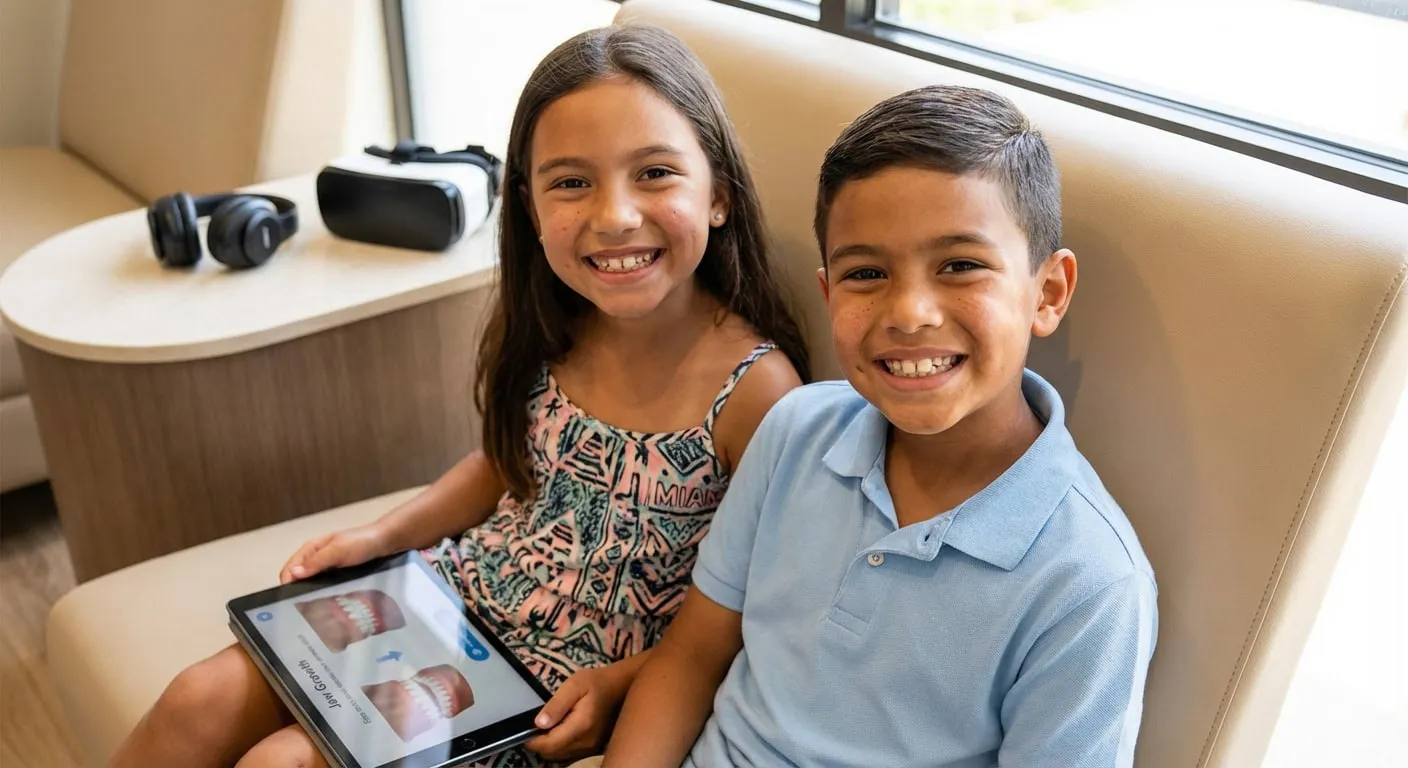
We're talking TV shows, games, snacks, VR headsets, noise-cancelling headphones, and weighted blankets in the treatment suite.
Your child isn't sitting in some sterile room counting ceiling tiles.
We use cutting-edge tech like low-dose CBCT scans and AI-driven growth predictions aligned with American Association of Orthodontists guidance.
That means we're not guessing about your kid's development.
We're measuring it, tracking it, and planning around it.
The Real Signs Your 6-10 Year Old Might Need Phase 1 Treatment
Knowing what to look for keeps you from overthinking every little tooth variation.
The American Association of Orthodontists recommends evaluation by age 7, and there's solid reasoning behind that timeline.
Your child's jaw is still growing hard at that age.
If something's off, we can guide the growth instead of fighting it later with aggressive treatment.
Crowding happens early.
You notice teeth overlapping or pushed backward already.
Phase 1 creates space naturally using the jaw's growth trajectory, not force.
Crossbite shows up when the upper and lower teeth don't line up right.
Your kid bites down and the top teeth sit inside the bottom teeth instead of outside.
That uneven pressure causes wear and jaw problems down the road if left alone.
Mouth breathing instead of nose breathing is a big one.
Kids who breathe through their mouth develop differently than nose breathers.
We spot this and can guide habit changes early.
Thumb sucking past age 5-6 pushes teeth and jaw development in the wrong direction.
We have tools that encourage healthier habits without judgment or shame.
Spacing between teeth that looks too big.
Sometimes this resolves naturally, sometimes it needs guidance.
The honest truth we tell every parent: sometimes early evaluation shows us nothing needs treating yet.
That's not a sales miss for us, that's good news for you.
We'd rather tell you to come back in six months than push treatment nobody needs.
What Actually Happens at Your Child's First Phase 1 Visit
Walking in with your kid, you're probably wondering what to expect.
We keep it simple and low-pressure.
The whole visit takes about 45 minutes.
We start with a friendly chat, getting to know your child and understanding what brought you in.
Then we take quick low-dose digital x-rays, which are safer than traditional film and way faster to explain to kids.
We take photos from different angles so we can track changes over time.
Our staff keeps kids comfortable with play areas nearby and constant reassurance that nothing hurts.
After the imaging, we map out a personalized growth plan based on what we see.
This isn't a pressure pitch to start treatment tomorrow.
It's a roadmap showing you what we found, what we'd recommend, timing, and what happens next.
Parents consistently tell us they felt informed instead of pressured.
Check our patient reviews to see real feedback from Broward families.
Phase 1 Orthodontics Works Around Your Child's Life
Your kid plays sports, has clubs, school events, and a social life.
Orthodontic treatment shouldn't disrupt all that.
Phase 1 uses removable appliances most of the time, not fixed braces glued to teeth.
Your child wears them at night and during specific daytime hours, keeping them out during sports, school photos, and social events.
Compliance's actually better with kids because they're not wearing something for years straight.
The treatment phase is shorter, typically 12-24 months depending on what we're correcting.
Kids adjust faster to removable appliances than you'd expect.
They're not self-conscious, they understand the goal, and they see results relatively quickly.
Understanding Interceptive Treatment and Why It Matters
Interceptive treatment is the fancy term for what Phase 1 actually does.
Instead of waiting for all adult teeth to come in and then correcting everything with braces, we intercept problems while the jaw's still growing.
Think of it like steering a ship while it's still turning versus trying to turn it around after it's sailed the wrong direction.
We guide the upper and lower jaw into better alignment, create space for adult teeth that are coming in crowded, and correct bite issues before they become structural problems.
This often means your child needs less invasive treatment later, sometimes skipping Phase 2 entirely.
Sometimes they need lighter Phase 2 treatment because we handled the heavy lifting during Phase 1 when growth was on our side.
Cost Breakdown for Phase 1 in the Pembroke Pines and Broward Area
Let's talk money because nobody wants surprises.
Phase 1 treatment in Broward typically runs between 3,500 to 6,000 dollars depending on what's being corrected and how long treatment takes.
That's not a one-time fee either.
We offer flexible payment plans that work for real family budgets, not just people with cash sitting around.
We work with most insurance plans, and many cover portions of Phase 1 since it's interceptive treatment, not cosmetic.
Check our pricing and payment details to see exactly what your situation would look like.
Why SMILE-FX Stands Out for Kids' Orthodontics in Broward and South Florida
We could tell you we're the best, but that's meaningless.
What matters is what families actually experience.
Families from Hollywood, Weston, Davie, Cooper City, and Fort Lauderdale drive past closer options to come to us.
They do that because results speak louder than marketing.
Kids finish Phase 1 with better breathing, better bite alignment, and genuine confidence about their smile.
Parents finish it knowing their child's jaw development is optimized for whatever comes next.
We use VIP technology that tracks growth precisely instead of guessing.
We have compliance tools that actually work because they fit into kids' real lives.
We offer clear aligners, traditional braces, and Invisalign for kids, giving families actual choices instead of one-size-fits-all treatment.
We're not volume mills.
We're growth experts who see your child's development over years, not appointments.
Common Questions Parents in Pembroke Pines Ask About Phase 1
How far is the drive from Pembroke Pines schools like Silver Lakes Elementary?
Most schools in Pembroke Pines are under 15 minutes away, making after-school appointments totally realistic without disrupting your schedule.
What if my kid's already in sports?
Phase 1 works great around sports because most appliances are removable.
Your child takes them out for practice and games, puts them back in after.
Why not just go to our local dentist?
General dentists do solid cleanings and cavity work.
Guiding jaw development and correcting bite problems requires specialist training that board-certified orthodontists have and general dentists don't.
What if Phase 1 doesn't work for us?
We're honest about outcomes.
If treatment isn't tracking like we expected, we adjust.
If your child's not compliant with removable appliances, we discuss alternatives.
Next Steps for Your Child's Smile in Pembroke Pines
You're not making a forever commitment by booking an evaluation.
You're getting clarity about whether your child needs treatment, what that treatment looks like, timing, and cost.
That information alone helps you sleep better at night knowing you've checked the box instead of wondering if something's wrong.
Take our smile quiz if you want a quick assessment before scheduling, or just book the evaluation straight up.
Book your FREE 3D scan and VIP smile consultation here and get the answers you're looking for without any pressure or sales pitch.
Your child's smile development is happening right now, with or without guidance.
Choose guidance from board-certified orthodontists who see your kid as a person, not a patient number, and watch their confidence grow alongside their adult teeth.
What Happens After Phase 1: Your Child's Path to a Lifetime Smile in Broward County
Your kid finished Phase 1 treatment and you're thinking, "Wait, we're done right?"
Not quite.
Here's the thing nobody talks about enough: Phase 1 is the foundation, not the finish line.
It's like building a house.
Phase 1 gets the structure right so Phase 2 can make it perfect.
Most kids who go through Phase 1 with us need a second phase of treatment, but it's shorter, easier, and way less invasive because we did the heavy lifting when their jaw was still growing.
Some kids skip it entirely.
That's the goal, but we don't oversell it.
What matters is understanding what comes next so you're not caught off guard.
The Gap Between Phase 1 and Phase 2 Treatment
After we finish Phase 1, your child goes into what we call the observation phase.
This isn't waiting around doing nothing.
We're monitoring what's happening as adult teeth come in and jaw growth continues.
Your kid comes back every 4 to 6 months so we can check progress.
Think of it like having a growth chart on your kitchen wall, but for teeth and jaw alignment.
This observation period usually lasts 12 to 24 months depending on how fast your child's permanent teeth are coming in.
Some kids need Phase 2 right after Phase 1 ends.
Others wait another year or more before Phase 2 makes sense.
We don't rush it.
Timing matters because you want all permanent teeth to come in before you start finalizing their position.
If you put braces on too early, you're fighting teeth that haven't finished erupting yet.
That's inefficient and can cause problems.
We let nature do its job, then we clean up what needs cleaning up.
How Phase 2 Differs From Phase 1
Phase 2 is usually where fixed braces come into play.
Remember how Phase 1 used removable appliances most of the time?
Phase 2 is different because now we're positioning individual teeth and fine-tuning bite relationships.
That requires something bonded to teeth that stays put.
We have options though.
Some kids get traditional metal braces, which work fast and give us maximum control.
Some get clear aligners like Invisalign, which are nearly invisible and removable for eating and cleaning.
Some get ceramic braces that blend with teeth better than metal.
The right choice depends on your kid's case and what your family prefers.
Phase 2 typically runs 18 to 24 months, sometimes shorter if Phase 1 did its job right.
The better your child complied with Phase 1, the less we have to do in Phase 2.
Compliance matters more than people think.
Why Some Kids Skip Phase 2 Entirely
Real talk: some kids finish Phase 1 and their permanent teeth come in nearly perfect.
The jaw guidance we did worked so well that Phase 2 becomes unnecessary.
This happens maybe 20 to 30 percent of the time if I'm being honest.
Your kid got lucky, and we did our job right.
We don't push Phase 2 on kids who don't need it.
We look at the teeth, look at the bite, look at jaw alignment, and we tell you straight up: Phase 2 isn't happening unless something's actually off.
That's how you know we're not just trying to maximize treatment time.
We're trying to minimize it while getting the best results.
The kids who skip Phase 2 usually had good cooperation during Phase 1 and the case was straightforward to begin with.
Not every orthodontic situation is fixable by guiding growth alone though.
Sometimes bite problems or crowding issues need that second phase of precision work.
Cost Expectations for Phase 2 Braces and Aligners
This is the question every parent asks and wants a straight answer on.
Phase 2 treatment typically costs between 4,000 and 7,000 dollars depending on complexity and whether you choose traditional braces or clear aligners.
Metal braces tend to run on the lower end.
Invisalign for teens costs a bit more because the technology is more sophisticated.
Here's what matters though: most families have already paid for Phase 1.
The total cost for both phases together is often comparable to what you'd pay if you waited and did everything at once with full braces as a teenager.
Except with the two-phase approach, your kid had easier treatment in Phase 1, potentially skips Phase 2, and gets better results overall.
We work with your insurance on both phases.
Most plans cover orthodontics for kids, though coverage varies.
We handle the insurance verification so you know exactly what you're responsible for before treatment starts.
Payment plans spread the cost over time so it's not crushing your monthly budget.
Understanding Your Child's Treatment Plan Document
We give every family a treatment plan that maps out what we found, what we're treating, and what comes next.
This plan includes timing, cost breakdown, and realistic expectations.
It's not a contract saying Phase 2 definitely happens.
It's a roadmap showing what we see and what the plan is based on current information.
Things change as your kid grows.
Maybe they have a growth spurt we didn't predict and teeth shift differently than expected.
Maybe jaw growth went slower than average.
We adjust the plan as we go.
This is where our VIP technology comes in handy.
We're tracking growth with 3D scans and measurements, not guessing.
We can see if the plan is tracking right or if we need to adjust.
You get updates at every appointment about where things stand.
What Your Child Needs to Do During the Observation Phase
Between Phase 1 and Phase 2, your kid's job is simple.
Keep good oral hygiene.
Brush twice a day, floss once a day, and watch out for cavities.
If a permanent tooth comes in crooked or there's something odd happening, let us know at your next appointment.
Don't wait months hoping it fixes itself.
Come see us and we'll check it out.
Keep wearing any retainers we give you if we recommend them during the observation phase.
Some kids need a light retainer to hold what Phase 1 accomplished while we wait for more teeth to come in.
If your child plays contact sports, keep using a mouthguard.
That hasn't changed.
Avoid hard candy, popcorn kernels, and anything else that could crack or damage teeth or appliances.
Basic stuff, but it matters.
Questions Parents Ask About the Phase 1 to Phase 2 Transition
Does Phase 2 hurt more than Phase 1?
Fixed braces create different sensations than removable appliances, but pain is overstated.
Most kids report soreness for a few days after braces are placed or adjusted, then it's fine.
We have strategies to minimize discomfort.
Can my child play sports with Phase 2 braces?
Yes, absolutely.
We recommend a mouthguard, which we can fit over braces or use a custom type that works better.
Clear aligners are even easier for sports because your kid can remove them during games and practices if they want.
How do I know if my child actually needs Phase 2?
We tell you based on objective measures: bite alignment, tooth position, jaw relationships.
Not guesses or sales pressure.
If Phase 2 isn't necessary, you'll know that at the time we finish Phase 1.
What if we move away from Broward before Phase 2?
We prepare your records so another orthodontist can pick up treatment seamlessly.
We don't make it difficult.
We want your kid's smile to finish strong wherever you end up.
Can Phase 1 failures happen?
Rarely, but if your child wasn't compliant with wearing appliances or something unexpected happened with growth, we adjust the plan.
We don't abandon you.
We figure out what's actually needed and move forward.
Retainer Life After All Braces Come Off
Here's the thing nobody likes hearing: retainers are forever.
Not wearing them 24/7 forever, but your kid will need to wear something indefinitely to keep teeth from shifting back.
We typically recommend a fixed retainer bonded behind the teeth plus a removable retainer worn at night.
Some families just do removable retainers.
It depends on the case.
This isn't us trying to make money on retainers forever.
It's physics.
Teeth want to move back to their original positions if you don't hold them.
Retainers prevent that.
We give your kid retainers after Phase 2 ends.
If they lose or break one later, we can make replacements, but that's not our primary goal.
Our goal is your kid keeping that perfect smile for the rest of their life.
The Real Timeline From Braces to Finished Smile
Let's map out what a typical timeline looks like so you know what to expect.
Phase 1 starts around age 7 to 10.
It runs 12 to 24 months depending on what we're treating.
Observation phase happens next.
12 to 24 months of check-ups every 4 to 6 months.
Phase 2 starts when permanent teeth have finished coming in and we're ready to finalize positions.
That's usually around age 11 to 13, sometimes older.
Phase 2 runs 18 to 24 months.
By the time your kid is 13 to 16, they're done with active treatment and in retainers.
Total time from Phase 1 start to braces off: typically 3 to 4 years.
That sounds long, but it's actually shorter than getting comprehensive braces at age 13 or 14 and having them on for 2 to 3 years straight.
Plus the results are usually better because we worked with growth, not against it.
Why Board Certified Orthodontists Handle Phase Transitions Better
I mentioned this in Part 1 but it bears repeating.
Board-certified orthodontists have training that goes way beyond what general dentists get.
We understand growth patterns, jaw development, and how to time treatment correctly.
A general dentist might say Phase 2 is needed when it actually isn't.
Or they might miss that Phase 2 is necessary.
Our specialty training means we see patterns and make better calls about timing and treatment approach.
This matters most when transitioning between phases.
That's where the art and science of orthodontics really show up.
Virtual Consultations If You Can't Come In Person
Sometimes Broward families are dealing with schedule conflicts or just want to ask questions before committing to an in-person visit.
We offer virtual consultations where you can talk to our team remotely.
It's not a full evaluation, but it helps you understand what we're about and what to expect.
You can ask about Phase 2 costs, timing, and what happens between phases.
No pressure, no sales pitch, just real information.
What Sets SMILE-FX Apart for Multi-Phase Treatment
A lot of places do Phase 1 and Phase 2.
Not all of them do it well.
What makes us different is that we see your child's development across years, not just appointments.
We're checking in regularly, adjusting as growth patterns show us new information, and timing Phase 2 based on actual readiness, not a schedule.
We have a whole philosophy built around doing things right, not rushing.
We offer multiple treatment options so families can choose what works for their life.
We handle the insurance complexity so parents don't have to.
We don't ghost families between phases.
You know us, we know your kid, and we're tracking progress the whole way.
Your Next Move for Phase 1 and Beyond
If you're considering early orthodontic treatment for your child in Pembroke Pines, Miramar, or anywhere in Broward County, the first step is simple.
Get a real evaluation from people who specialize in kids' orthodontics.
We can tell you exactly what your child needs, when they need it, and what the whole journey looks like from Phase 1 through Phase 2 and beyond.
No surprises, no upsells, just honest guidance about your kid's smile development.
Book your FREE 3D scan and VIP smile consultation here and let's map out the best path forward for your child's teeth and jaw growth across both phases of orthodontic treatment.
Finding the Best Orthodontist South Florida for Your Family's Smile Journey
You're standing in your kitchen watching your kid eat breakfast, and you notice their teeth look different than they did last month.
Maybe they're crowding, maybe the bite looks off, maybe you're just noticing things you didn't see before.
The question hits: should we see an orthodontist?
And if we do, how do we find the best orthodontist South Florida has to offer, not just the one with the fanciest website?
Here's what most parents don't realize.
Finding an orthodontist near me isn't the same as finding a great one.
Location matters, but expertise matters way more.
You want someone who's board certified, who specializes in your kid's specific needs, who uses real technology instead of guessing, and who won't try to sell you treatment you don't actually need.
What Makes a Board Certified Orthodontist Different
You'll see the letters "DDS" or "DMD" after a lot of people's names, which just means they went to dental school.
You'll see "Orthodontist" after that, which means they did extra training in straightening teeth.
But board certification?
That's different.
A board certified orthodontist South Florida has passed rigorous exams, maintains continuing education, and follows strict ethical standards.
It's like the difference between someone who took a weekend course in your field versus someone who earned a masters and keeps their license current.
Board certified specialists have deeper training in growth guidance, complex bite problems, and timing treatment correctly.
This matters because your kid's teeth aren't coming in on some standard schedule.
Every mouth develops differently, and you want someone who understands that complexity.
The Technology Behind Top Rated Orthodontist Rankings
When you search best orthodontist near me, the results you see aren't random.
They're based on reviews, ratings, location, and what people are actually saying about their experiences.
What separates a 5-star rated orthodontist Florida from everyone else is usually the technology they use and how they communicate with families.
Real talk: most general dentists who offer braces are still using the same techniques from ten years ago.
They take X-rays, they make impressions, they guess about how your kid's teeth will move.
A top-rated orthodontist near me who's serious about results uses cutting-edge technology like 3D scans, AI-driven growth predictions, and digital treatment planning.
This isn't fancy for fancy's sake.
It means we're measuring instead of guessing, predicting instead of hoping, and adjusting treatment based on real data.
That changes outcomes.
Why Insurance Coverage Matters When Choosing Your Orthodontist
One of the biggest questions parents ask is straightforward: does insurance cover braces?
The answer is usually yes, but how much varies wildly.
Most dental insurance plans cover orthodontic treatment for kids, typically at 50% after you hit your deductible.
Some plans cap coverage at 1,500 to 2,000 dollars.
Some cover nothing.
When you're looking for a top rated orthodontist Miramar or anywhere in South Florida, find someone who actually handles insurance verification instead of leaving you to figure it out.
We contact your insurance, tell you exactly what's covered, what your responsibility is, and what your out-of-pocket cost looks like before you commit to anything.
That's not standard, but it should be.
The same goes for affordable braces South Florida options.
You want someone offering $0 down braces financing South Florida so treatment doesn't blow up your budget in month one.
Orthodontist Near Me vs. The Best Orthodontist for Your Kid's Specific Case
Proximity is convenient, but it's not the main thing.
You could have a braces near me that's literally two blocks away, but if they don't understand your kid's bite pattern or they oversell treatment nobody needs, that convenience becomes a liability.
A best orthodontist for complex cases is someone who's seen hundreds of mouths, who knows how to handle crowding, underbites, crossbites, and weird growth patterns that don't fit the textbook.
They're the people you want because they don't get flustered by unusual situations.
They have a plan.
That specialist mindset matters whether you're looking for best pediatric orthodontist South Florida for your eight-year-old or adult orthodontics Aventura for your forty-year-old self.
Clear Aligners vs. Traditional Braces: What Your Orthodontist Should Explain
The traditional braces vs Invisalign conversation comes up constantly, and a good orthodontist doesn't push one over the other.
They explain both, tell you what each does best, and let your family decide.
Clear aligners work amazing for mild to moderate cases and for kids who are responsible about keeping them in.
Invisalign cost South Florida varies, but you're usually looking at similar pricing to traditional braces when you factor in everything.
Clear aligners cost Miami typically runs 3,500 to 8,000 depending on complexity and treatment length.
Traditional braces often come in slightly lower on cost but they're bonded to your teeth the whole time.
No removing them, which some kids prefer because it takes the compliance question out of the equation.
The best orthodontist explains that Invisalign provider near me certification means they've trained specifically in aligner technology, not just that they bought the software and call themselves an Invisalign provider.
Certification matters.
Training matters.
What People Actually Search For When They Need Orthodontic Help
When families start looking for orthodontic care, they're usually asking specific questions.
Can my insurance cover this?
How much do clear aligners really cost?
Is there financing available?
Can my kid play sports with braces?
Those are real concerns, not theoretical ones.
An orthodontist worth your time answers those questions straight up, not buried in fine print or during a sales pitch.
We tell families the actual cost breakdown, show them exactly what insurance covers and what they pay, and explain the financing options without pressure.
We talk about playing sports with different appliances, about eating with braces, about what maintenance actually looks like month to month.
No surprises, no hidden fees, no gotchas.
The Difference Between a Tech-Driven Practice and a Traditional One
You'll see different types of practices when you're searching for a best orthodontist Miami or top tech driven orthodontist Miramar.
Some are run old school.
They've been doing it the same way for twenty years because it works and they see no reason to change.
Other practices invest in technology because it delivers better outcomes faster.
The difference shows up in treatment time, accuracy, and how precisely we can predict what's going to happen.
A SureSmile orthodontist South Florida uses digital wire technology that creates custom treatment paths for each tooth, not one-size-fits-all approaches.
That tech precision cuts treatment time and gives better results.
But here's the thing: technology is just a tool.
The person using it matters more.
You want someone who invests in technology because they care about results, not because they're trying to seem fancy.
Understanding Orthodontic Consultation South Florida Options
When you're searching orthodontist near me, you're usually thinking about scheduling a consultation.
That's smart, but know what to expect.
A real orthodontic consultation South Florida isn't a ten-minute chat where someone tells you to come back with your insurance card.
It's a detailed evaluation where we take images, look at your kid's growth patterns, assess bite relationships, and explain what we found in plain English.
Some practices offer virtual consultations too, which is helpful if you're busy or just want to ask questions before committing to an in-person visit.
During consultation, you should learn:
What problems exist (if any)
Why treatment is recommended (or not)
What options are available
How long treatment takes
What it costs and what insurance covers
What happens if you wait versus treating now
If someone can't answer those questions clearly, keep looking.
Adult vs. Pediatric Orthodontics: Both Need Specialists
There's this assumption that orthodontics is mostly for kids.
Reality is different.
More adults are getting braces and aligners now than ever before, and they need different approaches than kids do.
Adult orthodontics Aventura and throughout South Florida accounts for way more patients than people realize.
A best pediatric orthodontist South Florida understands growing jaws and developing teeth and how to guide growth.
An adult orthodontist understands that growth is done, so we're working with what's already there, sometimes coordinating with your general dentist or other specialists.
The best practices do both well because they understand the science behind each, not just the mechanics.
Questions You Should Ask Before Booking Treatment
Before you commit to any orthodontist, ask these questions:
Are you board certified?
How much experience do you have with cases like mine?
What technology do you use for planning and treatment?
How often will I have appointments?
What's the total cost, what does insurance cover, and what financing do you offer?
What happens if I'm not happy with the results?
Can you provide references from other families?
A confident orthodontist answers all of these directly.
If you're getting vague answers or feeling pressured, that's a red flag.
Real Stories From South Florida Families
We've worked with hundreds of families across South Florida, from Pembroke Pines to West Palm Beach to Aventura.
They come in worried about their kid's smile, stressed about costs, uncertain about what treatment actually involves.
They leave knowing exactly what's happening, feeling confident about the plan, and excited about the results they'll see.
That's not luck.
That's what happens when you have specialists who care about clarity and results.
Check our patient reviews to see what real families are saying about their experience.
The Real Cost of Braces and Clear Aligners in South Florida
Affordable braces West Palm Beach, Miramar, and throughout Broward typically run 3,500 to 8,000 depending on what you're treating and how long it takes.
That's not small money, but it's comparable to other major expenses most families handle.
The key is understanding that upfront instead of getting sticker shock at your first appointment.
We break down costs, explain payment plans, and show you exactly how much your insurance covers.
Book your FREE 3D scan and VIP smile consultation here and find out your actual cost with no surprises or pressure.
Getting orthodontic care from a real specialist in South Florida is an investment in your kid's health, confidence, and how their teeth function for life.
That's worth finding the best orthodontist near you who actually knows what they're doing.