
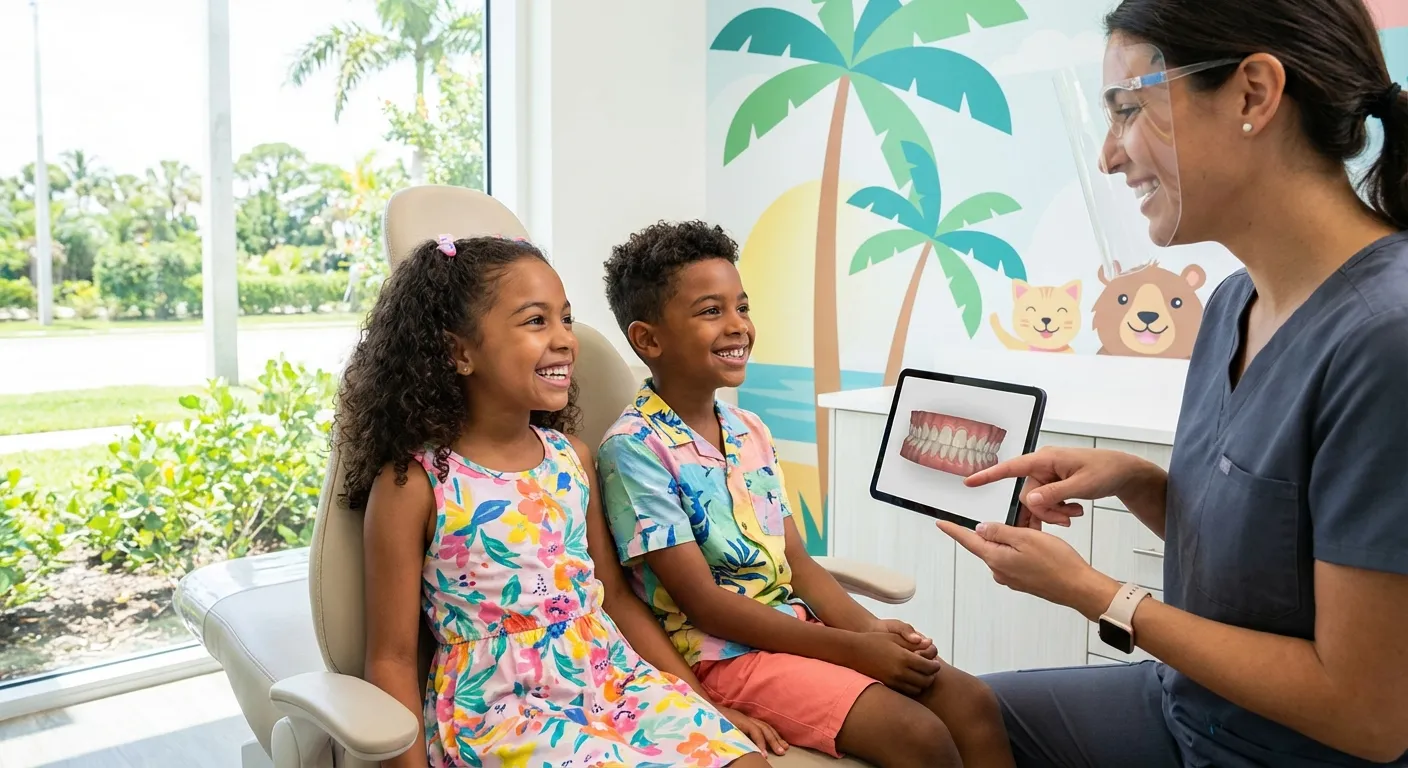

Early Orthodontics for Kids in Pembroke Pines Ages 6-10
Your kid's teeth are coming in crooked, and you're wondering if you should wait it out or do something now.
I get it. As a parent watching your child's smile develop, you spot the crowding or that weird bite pattern, and suddenly you're googling "do kids need braces this young" at midnight.
Here's the thing: Phase 1 orthodontics isn't about slapping braces on your six-year-old and calling it a day. It's about working with your child's natural growth to guide their teeth and jaw into the right position before bigger problems show up later.
The American Association of Orthodontists actually recommends kids get checked around age 7, not to scare you, but because that's when we can spot real opportunities to make a difference with minimal intervention.
At SMILE-FX Orthodontics in Miramar, we work with Pembroke Pines families every day who were in your exact spot. Let me break down what Phase 1 actually is, why it matters, and what to expect when you bring your kid in.
What Exactly Is Phase 1 Orthodontics for Young Children
Phase 1 treatment is early intervention orthodontics, usually happening between ages 6 and 10 while your child still has their baby teeth mixed in with permanent ones.
This is the sweet spot.
Your kid's jaws are still growing. Their bones are still developing. This means we can guide that growth in the right direction without fighting against a fully formed jaw structure.
We're not trying to straighten every tooth perfectly right now. That's Phase 2, which comes later if needed. Phase 1 is about creating space, fixing bite problems early, and making sure the foundation is solid.
Think of it like building a house. Phase 1 is getting the foundation and framing right. Phase 2 is the finishing work.
The tools we use are gentler than full braces. Custom expanders, light wires, and simple appliances do most of the heavy lifting. Our board-certified orthodontists use the latest low-dose imaging to map out exactly what needs to happen with your kid's jaw and teeth, then we make a plan that works with their growth, not against it.
Why Pembroke Pines Families Trust SMILE-FX for Early Orthodontics
Parents in Pembroke Pines drive about 15 to 20 minutes down Pines Boulevard to reach our Miramar location, and honestly, that short drive is worth it.
Here's why families keep coming back to us.
We don't have general dentists dabbling in orthodontics. We have orthodontists. That's our specialty. That's all we do. We're trained exclusively in moving teeth and guiding jaw development, and we bring that focus to every single patient, especially kids.
We're also the number one trusted orthodontic partner for South Florida pediatric dentists. That matters. Other pediatric specialists know us, refer to us, and trust us with their own kids because they've seen our results.
But here's what really sets us apart for kids: We get that coming to the orthodontist can feel weird and uncomfortable for a seven-year-old.
So we made our offices for them. VIP suites. VR distractions during treatment. Weighted blankets. Noise-canceling headphones. A kid-friendly lounge where you can grab a snack while you wait. We turn what could be a stressful appointment into something your child might actually look forward to.
Near Panther Run Elementary or Silver Lakes Middle School? You can drop your kid off for an appointment and grab coffee knowing they're in hands-down the most experienced orthodontic team in Broward County for pediatric care.
Real Signs Your Child Needs Phase 1 Orthodontics
Not every kid needs Phase 1 treatment, and we're honest about that from day one.
But watch for these red flags.
Crowding. You're seeing teeth overlap early, or there's just no space for permanent teeth coming in. Phase 1 creates that space naturally as the jaws grow, preventing the need for tooth extraction later.
Crossbite. One side of the bite comes down inside the other. This affects how your child chews and can cause uneven jaw growth. Our palatal expanders fix this gently while the jaw is still developing.
Mouth breathing. If your kid is constantly breathing through their mouth, it's often tied to a narrow jaw or airway issue. Phase 1 can address the jaw development piece, which improves airflow and sleep quality. That's a big deal for a growing child.
Lingering thumb sucking. Most kids stop by age four or five, but some don't. If it's still happening at seven or eight, it's pushing teeth forward and affecting bite development. We use minimal appliances to gently break the habit without making your kid feel bad about it.
Open bite or overbite starting to show. These develop early sometimes, and catching them now prevents major corrections later.
Here's what we don't do: We don't pressure parents into treatment they don't need. Our free consultation includes a full exam, and if watchful waiting is the right call, we tell you that. We're AAO-aligned, which means we follow evidence-based guidelines, not commission-based selling.
How Phase 1 Treatment Actually Works
Your first visit is straightforward. No surprises, no pressure.
We do a thorough exam. We take low-dose digital X-rays and explain them to your kid in simple terms (we're not using scary technical language). We chat about what you've noticed, what concerns you, and what your goals are for your child's smile.
From there, we build a personalized treatment plan. We might recommend palatal expansion if the jaw is too narrow. We might use light wires and brackets to guide tooth movement. We might suggest a simple appliance to address a specific bite issue.
The key is everything happens at your child's pace. We're not rushing. We're not forcing. We're guiding.
Treatment typically lasts 18 to 24 months for Phase 1, though every kid is different. We monitor growth and adjust as needed. Our team stays in constant communication with you about progress and next steps.
And here's something most parents don't expect: Phase 1 treatment is often way less expensive than fixing everything with full braces later. You're investing in prevention, which saves money and time down the road.
Phase 1 Versus Waiting Until They're Older
Some parents ask, "Can't we just wait until they're 12 or 13 when all the baby teeth are gone?"
You can.
But you lose something important: growth.
When your kid is 6, 7, 8, their jaws are actively growing. That growth is a tool we can use. We work with it. We guide it. We make corrections that take advantage of that natural development.
By age 12 or 13, growth is slowing down. The jaw is mostly formed. Now we're working against the skeleton, not with it. That means more invasive treatment. Full braces for a longer time. Sometimes even surgery as an adult if things get severe enough.
Phase 1 often shortens the total time your child spends in orthodontic treatment. It prevents more serious problems from developing. And it uses the body's natural growth instead of fighting it.
Is every kid a Phase 1 candidate? No. Some kids' teeth are developing fine and don't need intervention. We'll tell you honestly. But for the ones who do benefit, starting early changes everything.
What Makes SMILE-FX Different for Kids' Orthodontics
We're not a high-volume mill pushing patients through every 15 minutes.
Each appointment gets real time and attention. Our cutting-edge technology means we use low-dose CBCT imaging to see exactly what's happening with jaw development and tooth position. No guessing. No generic treatment plans.
We use clear aligner technology and traditional braces, depending on what works best for your child. We customize the approach.
And we prioritize comfort in ways other offices don't. Self-ligating brackets mean less friction and faster adjustments. Our team is trained in pediatric behavioral management, meaning we know how to work with kids and keep them relaxed during treatment.
Check our patient reviews if you want proof. Parents from Pembroke Pines, Hollywood, Weston, Cooper City, Davie, and Fort Lauderdale consistently tell us the same thing: their kids feel comfortable here, and they see real results.
The First Consultation: What to Expect
Bring your child and come with your questions. That first visit is about 30 to 45 minutes.
We'll chat with you both. We'll do imaging. We'll explain what we see in terms you actually understand. We'll show your child the treatment room, let them sit in the chair, and make sure they feel safe and comfortable.
If Phase 1 treatment makes sense, we build a plan together. If it doesn't, we tell you that too. Some kids genuinely just need periodic check-ins to monitor growth. We're fine with that.
The whole vibe is low-pressure. We want your kid to feel good about being here, because if they're relaxed and comfortable, treatment goes better, results are better, and everyone's happier.
Ready to get started? Book a FREE 3D scan and VIP smile consultation here.
It's time to stop wondering and start knowing exactly what your child's smile needs.
Braces and Clear Aligners for Teens and Adults in South Florida: Beyond the Basics
Your kid's in Phase 1 and doing great. But now you're thinking about your own smile.
Yeah, the one you've been hiding in photos for the last decade.
Or maybe your teenager's Phase 1 treatment wrapped up and they need Phase 2 to finish the job.
Or you're an adult who never got braces as a kid and figured it's too late.
It's not.
Getting your teeth straight isn't just vanity. It's easier to clean straight teeth. Your bite works better. You don't get headaches from jaw misalignment. And yeah, you actually smile in pictures.
The difference between now and even five years ago is huge. You don't have to choose between metal braces or nothing anymore. You've got real options.
Braces, clear aligners, Invisalign for adults and teens all work. The question is which one fits your life.
Let me walk you through what's actually available, what works for different situations, and why SMILE-FX Orthodontic & Clear Aligner Studio is where I'd send my own family.
The Reality of Adult Braces and Teen Phase 2 Treatment
Here's what stops most people: they think getting braces as an adult is weird.
It's not.
Walk into any orthodontist's waiting room and you'll see teenagers finishing Phase 2, adults in their thirties, forties, and even people in their sixties straightening teeth.
Your bones are fully formed as an adult, so it takes slightly longer than it does for kids. Usually 18 to 36 months depending on how much work needs to happen.
But your body still moves teeth. Bone still remodels. It just happens at a different pace than it does when you're growing.
For teens finishing Phase 1, Phase 2 is where we get everything perfect. Those early corrections we made gave us space and fixed major bite issues. Now Phase 2 is about precise positioning of every single tooth.
The good news is Phase 2 usually takes less time because the hard work's already done.
Three Options That Actually Work: Braces, Clear Aligners, and Invisalign
You're not locked into one choice anymore.
Traditional braces.
Still the gold standard for complex cases. Brackets bonded to teeth, wires connecting them, adjustments every four to six weeks.
Why pick them?
They work on everything. Severe crowding, major bite problems, rotated teeth, all of it.
They're reliable. No discipline needed from you except keeping them clean.
Cost is usually lower than clear options.
Modern brackets are smaller and more comfortable than they used to be. Our self-ligating braces at SMILE-FX use technology that means less friction and faster movement. Less pain, fewer appointments.
The downside is they're visible. Some people don't care. Some do.
Clear aligners.
Custom-made plastic trays that fit your teeth perfectly. You wear each one for about two weeks, then move to the next set.
The big advantage is they're nearly invisible.
You can take them out to eat and brush. No food restrictions like you have with braces.
Your teeth move gradually with less pressure, so some people report less discomfort.
The catch is they only work on certain cases. Mild to moderate crowding, spacing, minor bite corrections. If you've got severe problems, aligners aren't your answer.
And you've got to be disciplined. You need to wear them 20 to 22 hours a day. You need to actually wear every tray in order. Forget to wear them and your treatment stalls.
SMILE-FX's clear aligner program uses the most advanced software and technology available. We customize treatment to your teeth specifically, not a generic plan.
Invisalign.
This is actually a brand of clear aligner made by Align Technology. It's the most popular one, but it's not the only one.
When people say "Invisalign," they usually mean any clear aligner, but technically Invisalign is one specific system.
It works the same way as other clear aligners: custom trays, replaced every two weeks, 20 to 22 hours a day wear.
Invisalign has been around longer than most, so there's more data on how it performs over time.
Cost is usually higher because it's the brand name option.
Which Option Actually Works Best for Your Situation?
Here's the truth: there's no one best option for everyone.
Your choice depends on your specific case, your lifestyle, and what matters to you.
Pick braces if:
You've got a complicated bite issue or severe crowding that needs serious correction.
You want the fastest, most reliable option and don't mind them being visible.
Cost is your biggest concern.
You're someone who'd forget to wear aligners consistently.
Pick clear aligners or Invisalign if:
You've got mild to moderate crowding or spacing issues.
Your bite is mostly fine and only needs minor adjustments.
Appearance matters to you for work or social reasons.
You can commit to wearing them almost all the time.
You like the flexibility of being able to remove them.
Here's what we do at SMILE-FX: we do a full assessment and show you what each option would look like for your teeth. We don't push one direction. Some people come in wanting clear aligners and we tell them braces will actually work faster for their case. Some want braces and we show them aligners could work. You make the choice that fits your life.
What Actually Happens During Treatment With Each Option
With braces:
First visit is bonding brackets and wires. Takes about an hour. It doesn't hurt, but it's a weird feeling.
You get used to them fast. A few days of feeling like your teeth are sore, then nothing.
Every four to six weeks you come back for adjustments. These take 20 to 30 minutes.
You learn how to keep them clean. Honestly, it's a bit of a pain, but it becomes routine.
No food restrictions, but some foods are harder to manage. Sticky candy, hard nuts, corn on the cob. You learn what to avoid.
With clear aligners:
First visit is scanning your teeth in 3D and planning your treatment. We show you a digital preview of how your teeth will move week by week.
You get your first set of aligners and wear them 20 to 22 hours a day.
Every two weeks you move to the next set yourself at home.
You come back for check-in appointments every four to six weeks to make sure everything's tracking on plan.
Remove them to eat, brush, floss. Your mouth feels normal most of the time.
The hard part is remembering to put them back in after eating. Some people forget. That's where treatment falls off track.
Real Talk About Cost: What's This Actually Going to Cost You?
Nobody wants to talk about price, but here it is.
Braces usually run between three thousand and six thousand dollars depending on how complex your case is.
Clear aligners and Invisalign usually run between four thousand and eight thousand because they require more technology and customization.
Most insurance plans cover fifty to eighty percent of orthodontic treatment if you've got orthodontia as a benefit. Lots of plans do, but you've got to check your specific coverage.
We offer payment plans so you're not paying the whole thing upfront. Most people spread it over the course of treatment, so you're paying monthly.
Think of it as an investment in something you use every single day for the rest of your life. Your mouth. Your smile. Your confidence.
The cost usually balances out because you're not dealing with tooth decay, gum disease, or jaw problems from a bad bite down the road.
Why This Matters Beyond Just Looking Good
I know, straight teeth look better. That's obvious.
But here's what people don't talk about enough.
Crowded or misaligned teeth are harder to clean. Plaque gets trapped between overlapping teeth. Your gums get inflamed. You're at higher risk for cavities and gum disease.
A bad bite puts pressure on your jaw joints. This causes headaches, neck pain, and jaw tension. Some people don't realize their headaches are coming from their bite until they get it fixed.
Your teeth wear unevenly if your bite's off. Some teeth get flattened from grinding. Some wear down faster. You end up needing more dental work later to fix the damage.
When your bite's aligned properly, you chew more efficiently. Your food gets broken down better. Digestion starts better. Sounds weird, but your whole system works more smoothly.
And yeah, you smile more. People respond to you differently. You feel more confident. That's not shallow. That's real.
The Phase 2 Conversation for Teenagers
Your kid's Phase 1 is wrapping up. Now what?
Phase 2 usually starts when most of the permanent teeth have come in, around age 11 or 12, sometimes older depending on growth.
It's when we do the finishing work.
Phase 1 created space and fixed the big problems. Phase 2 is about getting every tooth in its perfect position and making sure the bite is locked in tight.
Most teens wear full braces for Phase 2. Some cases can use clear aligners if the bite's already been corrected in Phase 1.
Phase 2 usually takes about 18 to 24 months.
Then comes the retention phase, which is a conversation for another time. But basically, your kid wears a retainer to keep the teeth where they are.
The investment in Phase 1 and Phase 2 is worth it. Your teenager gets to keep that straight smile for life.
How to Actually Know What's Right for You
Stop guessing.
Get a real exam from someone who knows what they're looking at.
At SMILE-FX, we have board-certified orthodontists who specialize in this stuff. Not general dentists doing orthodontics on the side. Actual specialists.
We do a 3D scan of your teeth and jaw. We show you digital previews of what treatment would look like. We explain the pros and cons of each option specifically for your teeth.
No pressure. No upsell. We tell you what makes sense.
If you need treatment, great. If your teeth are fine and you're just being paranoid, we'll tell you that too.
Our Smile Quiz is a good starting point if you want to get a sense of your situation before you come in, but it's not a replacement for a real exam.
For treatable cases ranging from mild to severe, we've got options that work.
What Makes SMILE-FX Stand Out for Adult and Teen Treatment
We don't treat everyone the same way.
Adults want a different experience than kids. Teenagers need something different than both.
We've got that figured out.
Our team is trained in working with all ages. We understand that an adult is worried about how this impacts work and dating. A teenager's worried about how their friends see them. These are different concerns and we treat them differently.
We use the most advanced technology available to plan treatment precisely. Less guessing. Better results. Faster treatment.
We offer flexible scheduling because adults and older teens have jobs and lives. Early morning appointments. Evening appointments. Virtual check-ins when possible.
Our patient reviews speak for themselves. People come in skeptical and leave amazed at the results.
Want to see what's possible for your teeth?
Book a FREE 3D scan and VIP smile consultation here.
Stop wondering what braces, clear aligners, or Invisalign could do for your smile. Find out for real.
Retention After Braces and Aligners: Keeping Your Straight Smile for Life in South Florida
You just got your braces off. Your teeth look amazing. You're smiling in every photo now.
Then your orthodontist says something that sounds boring: "Now you need to wear a retainer."
Your first thought is probably: "For how long?"
The answer might surprise you. It's not a few months. It's not a year. For most people, it's pretty much forever.
But here's the thing nobody explains well: retention isn't punishment. It's actually the easiest part of the whole orthodontic journey.
Your teeth want to move back to where they started. That's not a flaw in the treatment. That's just how your mouth works. Bone remodels around your teeth slowly over time, and if you don't keep them in place, they'll shift.
Some people find this out the hard way. They get braces, finish treatment, skip the retainer, and five years later their teeth look almost as crooked as they did before.
That's not happening to you. Let me explain how retention actually works and why it matters.
Why Your Teeth Want to Move Back (And What You Can Do About It)
This is the part nobody wants to hear, but it's real.
Your teeth are held in place by bone and ligaments. When we move your teeth with braces or clear aligners, we're literally remodeling the bone around them.
That bone is still settling for months and months after treatment ends. Your teeth have a memory of where they used to be. Without something holding them in their new position, they'll gradually creep back.
This happens to everyone. It's not because you did something wrong. It's biology.
The difference between people who keep their straight smile for decades and people whose teeth drift is simple: the ones who kept their straight smile wore a retainer.
At SMILE-FX Orthodontic & Clear Aligner Studio in Miramar, we make sure you understand this from the start. Retention is built into your overall treatment plan, not something we spring on you at the end.
The Two Main Types of Retainers: Which One Is Right for You
Fixed retainers.
This is a thin wire bonded to the back of your front teeth. Usually the lower front teeth, sometimes the upper ones too.
It stays there. You can't take it out. You just live with it.
The advantage is you never have to remember to wear it. It's always working.
The downside is you have to be careful when you floss. It doesn't restrict eating or anything, but flossing takes a bit more attention so you don't break the bond.
Most people get a fixed retainer on their lower teeth because that's where relapse happens fastest.
Removable retainers.
These come in two flavors.
Hawley retainers are the old school option. Wire and acrylic that wraps around your teeth. They're durable and last forever. They're also visible when you smile, which some people don't like.
Clear retainers look like thin Invisalign trays. They're basically invisible. They're comfortable and most people prefer how they look.
The catch with removable retainers is you've got to wear them. Every night, at least. Some people wear them 24/7 for the first few months, then just at night.
Many patients at our practice end up with a combination: a fixed retainer on the lower teeth and a removable retainer on the upper teeth. You get the security of the fixed one where teeth relapse fastest, and the flexibility of a removable one.
The Real Timeline for Retention: What Doctors Won't Tell You
Here's the standard answer: "Wear your retainer every night for the rest of your life."
That's true, but it leaves out important details.
The first three months after treatment are critical. Your teeth are still settling. Wear your retainer all the time. Day and night. This locks in your results while bone is still remodeling.
After three months, most people switch to nights only. This is when it becomes easier. You're basically just wearing it while you sleep.
As time goes on, some people can get away with wearing their retainer three or four nights a week instead of every night. But this depends on your specific case and how much your teeth want to move.
Your orthodontist will guide this. We monitor you at your retention appointments and let you know if you can back off or if you need to stick with every night.
The honest answer is this: if you want your smile to stay straight, you're wearing something for the long haul. But it gets easier. What starts as a big commitment becomes part of your routine, like brushing your teeth.
Common Retention Questions (People Actually Ask These)
Can I stop wearing my retainer after a year? Not if you want your teeth to stay straight. Some people test this and their teeth start moving back within a few months. Then they're frustrated and back to wearing their retainer every night. Save yourself the frustration.
What if I forget to wear my retainer for a week? Your teeth will start to shift. Not dramatically, but noticeably. The longer you go without it, the more they move. Just get back into the habit and they'll settle back down. But don't make it a regular thing.
Do I need both a fixed retainer and a removable one? Lots of people do, especially after braces. It depends on how aggressive your bite correction was and how much your teeth tend to move. We'll let you know what makes sense for your situation.
Can I sleep with my removable retainer every night forever? Yes. Most people do. It becomes second nature. You barely feel it.
What if my retainer breaks? Call your orthodontist. We can repair or replace it. Don't wait and keep trying to wear a broken retainer. That won't keep your teeth where they need to be.
Keeping Your Retainer Clean and In Good Shape
A retainer is a piece of dental equipment. It needs care.
Clean it every day. Brush it gently with a soft toothbrush. Don't use toothpaste because it's abrasive. Just warm water and gentle scrubbing.
Soak it once a week in cleaning solution. You can use denture cleaner or retainer cleaner. Let it sit for thirty minutes. This keeps bacteria from building up.
Keep it in a case when you're not wearing it. Not wrapped in a napkin. Not in your pocket. A proper case protects it from getting crushed or lost.
If you wear a removable retainer, bring it to every dental appointment so your dentist can check it. They'll spot issues early.
If you have a fixed retainer, floss carefully around it. Use a floss threader if you need to. The wire can break if you're rough with it, so be gentle.
What Happens If You Skip Retention (Real Stories)
I've seen this story play out dozens of times.
Patient finishes treatment. Their teeth look perfect. They're thrilled. They get their retainer and wear it religiously for a couple months.
Then life gets busy. They forget a few nights. Then a few more. Eventually they stop wearing it entirely.
Fast forward two years. Their teeth have drifted back toward where they started. Not all the way back, but noticeably. Their bite's off again. They're frustrated because they just spent time and money getting this fixed.
The worst part is they sometimes think this means their original treatment didn't work. It did. What failed is the retention.
If they had just kept wearing their retainer, their smile would still be perfect.
Don't be this person. Retention is not optional. It's the difference between a straight smile that lasts forever and one that slowly falls apart.
Insurance and Retention: Does It Cover Retainers
Most dental insurance plans cover retainers after orthodontic treatment.
They'll usually cover one set of retainers. If it gets damaged or lost and you need a replacement, that might not be covered. That's why we stress taking care of them.
If you don't have insurance or your plan doesn't cover retainers, the cost is usually between one hundred and five hundred dollars depending on whether it's fixed or removable and whether you get one or both types.
That's cheap compared to what you spent on your actual orthodontic treatment. Think of it as insurance on your investment.
Retainers and Your Long-Term Smile Health
Keeping your teeth straight isn't just about looks.
Straight teeth are easier to clean. You're less likely to develop cavities or gum disease. Your bite works properly, which means less jaw pain and headaches down the road. Your teeth wear evenly, so you're not dealing with uneven wear or damage.
All of this adds up to fewer dental problems and lower dental costs over your lifetime.
When you wear your retainer faithfully, you're protecting your teeth. You're keeping your investment solid. You're making sure that amazing smile sticks around.
Getting Your Retainer At SMILE-FX
When your treatment is finished at SMILE-FX, we don't just hand you a retainer and say see you later.
We explain exactly how to care for it. We show you the best way to wear it. We schedule regular retention appointments to make sure everything's staying in place.
If something changes with your teeth, we catch it early. We're a board certified orthodontist practice, which means we have the expertise to handle any retention issues that come up.
We also use advanced technology to monitor your teeth over time. We can spot minor shifts before they become problems.
Our patients rave about our retention support because we actually follow up. We're not just treating and ghosting. We're invested in keeping your smile straight for life.
Retention for Different Situations
If you finished braces, your retention plan starts immediately after we remove them.
If you finished Invisalign or clear aligners, your last few aligners function as retainers. Then we transition you to formal retainers.
If you had Phase 1 treatment as a kid and now you're in Phase 2, we build retention into your overall plan from the beginning.
Every situation is different, and we treat it that way.
The Bottom Line on Keeping Your Straight Smile
Getting your teeth straight took months of commitment.
Keeping them straight takes minimal effort. A removable retainer you wear at night. Maybe a fixed wire that you barely notice.
That's it. That's your whole life maintenance plan.
The people who have perfect smiles for decades aren't genetic lottery winners. They're people who understood that retention is part of the deal and they showed up for it.
You've got this. And we've got your back.
Ready to start your orthodontic journey and learn more about how retention fits into your overall treatment plan?
Book a FREE 3D scan and VIP smile consultation here.
We'll show you exactly what's possible for your teeth and explain the whole retention strategy upfront so there are no surprises. That's what the best orthodontist near me in South Florida actually does.