

Phase 1 Orthodontics for Pembroke Pines Kids Ages 6-10
Your kid's smile matters, and honestly, spotting crowding or a crossbite in a 6-10 year old can shake you up a bit. You start wondering: Is it normal? Do we need to do something now? Will they need braces for years? These questions keep parents up at night, and that's exactly why Phase 1 orthodontics exists.
Here's the thing: Phase 1 isn't about slapping braces on your kid early and hoping for the best. It's about working with your child's growth, guiding their jaw and teeth during the years when they're still developing. Think of it as steering the ship while it's still being built, not trying to rebuild it after launch.
For families in Pembroke Pines, getting expert Phase 1 care doesn't mean a long haul across the county. It's just 15-20 minutes down Pines Boulevard to our office in Miramar, and that makes a real difference when you've got soccer practice, school pickups, and a million other things happening.
What Exactly Is Phase 1 Orthodontics?
Phase 1 is interceptive treatment for kids whose baby teeth and adult teeth are mixing.
Your child's mouth goes through major changes between ages 6 and 10. Their jaw is growing. Adult teeth are starting to push through. Sometimes there's room for everything, and sometimes there's not.
Phase 1 steps in to create space, fix bite problems early, and guide growth in the right direction. The American Association of Orthodontists (AAO) actually recommends that every kid gets checked by an orthodontist around age 7. Not because every kid needs treatment, but because some do, and catching it early saves time, money, and hassle down the road.
We're talking about gentle appliances like palatal expanders, habit breakers, and other tools that work quietly in the background while your kid's mouth is still malleable. No forcing. Just smart guidance.
Why Pembroke Pines Parents Trust SMILE-FX for Early Orthodontics
Here's what sets things apart when you choose SMILE-FX for your kid's Phase 1 treatment.
We're the number one trusted partner for pediatric dentists across Broward County and South Florida. That's not just talk. It means pediatricians, family dentists, and other dental professionals know we deliver results because we specialize in orthodontics and only orthodontics. We're not general dentists trying to do braces on the side. Our board-certified orthodontists live and breathe this stuff.
What parents really notice is how we treat the kid, not just the teeth.
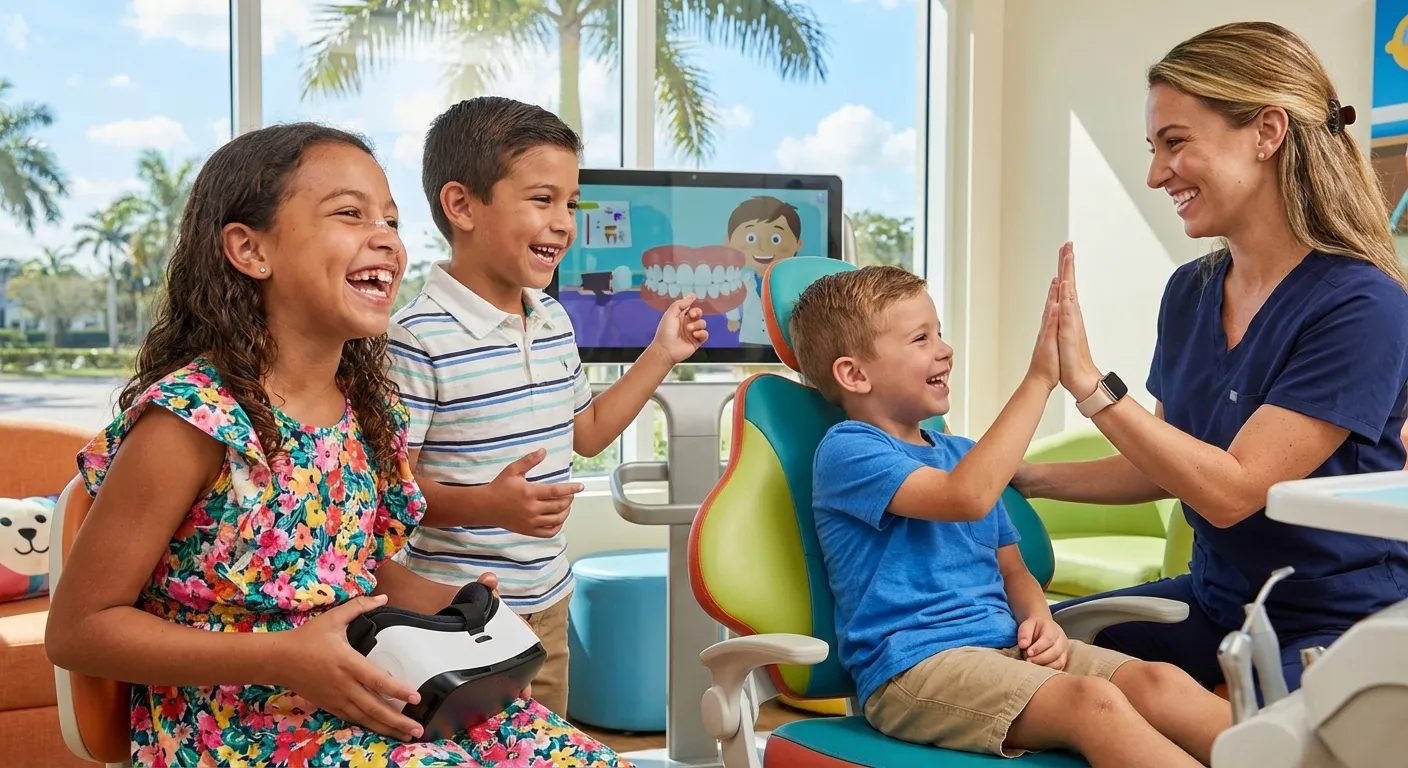
Walk into our office and you'll see VIP suites with TVs, VR distractions, weighted blankets, noise-canceling headphones, and snacks after your visit. We're not trying to make kids hate the dentist. We're trying to make them actually want to come back. Sounds weird, but it works. Kids are calmer, parents are happier, and treatment goes smoother when everyone's comfortable.
We also use cutting-edge technology like low-dose CBCT scans that catch issues early. Digital imaging lets us see exactly what's happening with your kid's growth, and we can plan treatment with precision. This means fewer surprises and better outcomes.
Real Signs Your 6-10 Year Old Might Need Phase 1
Not every kid needs Phase 1 treatment, and we'll be straight with you if your child doesn't.
Watch for these common signs that Phase 1 might help:
Crowding or gaps between teeth. Baby teeth are pushing around because there's not enough room. Phase 1 creates space and guides growth.
Crossbite. The top teeth bite inside the bottom teeth. This is a bite problem that gets worse if you wait. Early treatment fixes it gently.
Open bite. There's space between the upper and lower front teeth even when the mouth is closed. Often tied to tongue thrust or thumb sucking.
Mouth breathing and thumb sucking. These habits affect how the jaw grows. Phase 1 includes custom appliances and habit counseling to break the cycle.
Protruding teeth. Front teeth sticking out put them at risk of getting knocked or broken. Early treatment brings them back to a safer position.
During the first visit, we run through everything with you and your kid. Low-dose digital x-rays, a quick exam, and a conversation about what we see. If your child needs Phase 1, great. If they don't, we'll tell you that too. No pressure, no upselling. Just honesty.
What Phase 1 Appliances Actually Do
Palatal expanders widen the upper jaw gradually.
Think of it like this: the roof of the mouth (palate) has a natural seam down the middle. A palatal expander gently widens that space, creating room for teeth and improving airflow. It's not painful. Kids wear it for a few months, and their jaw simply grows wider.
Habit breakers stop thumb sucking and tongue thrust.
A small appliance sits behind the upper front teeth. When kids try to suck their thumb, they hit the appliance and it reminds them to stop. Over time, the habit breaks naturally.
Bite correctors. For crossbites and other alignment issues, we use custom appliances that guide the bite into the right position as the kid grows.
All of these work because your child's mouth is still developing. The bones are softer, growth is happening fast, and we're working with nature instead of fighting it.
The First Visit: What to Expect
Bring your kid in and expect 30-45 minutes total.
First, we welcome them and explain what's about to happen in language they understand. No surprises, no stress. Then we take digital x-rays using our low-dose technology, which means less radiation and clearer images. We do a thorough exam, checking bite, jaw alignment, tooth position, and growth patterns.
Our team uses games and VR to keep kids relaxed and engaged. This isn't old-school dentistry where the kid sits there feeling nervous. We make it interesting.
After the exam, we sit down with you and explain what we found. If Phase 1 treatment makes sense, we show you the plan: what appliance we'd use, how long it takes, what you can expect at home, and what the cost looks like. If your kid doesn't need it, we tell you that straight up and maybe suggest checking back in a year.
Real parents from across Broward leave reviews saying how calm their kids felt and how easy the whole thing was. That matters to us because anxiety about orthodontics shouldn't start at age 7.
Why Convenience Matters in Pembroke Pines
You've got school, sports, activities, and a life outside of dental appointments.
From Pembroke Pines, our Miramar location is fast to reach. We offer after-school and weekend slots so you're not pulling your kid out of class. Parking is easy right off I-75. Directions are simple. We get it: your time is precious.
Parents from Davie, Weston, Cooper City, Fort Lauderdale, and Hollywood make the drive because they know they're getting specialized care from board-certified orthodontists who actually know kids and how to make treatment smooth for them.
Honest Questions Parents Ask About Phase 1
Will my kid need braces later after Phase 1? Maybe, maybe not. Phase 1 handles specific growth issues and creates space. Some kids finish Phase 1 and never need full braces. Others need a shorter Phase 2 later on. We're honest about the odds when we start.
Is it expensive? Phase 1 costs less than full braces because it's focused and typically shorter. We work with insurance and offer payment plans. Ask about pricing at your visit.
What if my kid hates it? Kids surprise you. Most of them get used to the appliance within a few days. We teach them how to care for it, clean it, and get comfortable with it. Our comfort-first approach helps a lot.
When should we start Phase 1? Age 7 is the AAO sweet spot, but every kid's different. Some kids show signs earlier, some later. Bring them in for an evaluation and we'll tell you when makes sense for your child.
Why Board-Certified Orthodontists Matter
Our board-certified specialists aren't just dentists who took a weekend course in braces. They went through years of extra training, passed rigorous exams, and stay current on the latest techniques.
For Phase 1, this matters because we understand growth patterns, jaw development, and timing. We know exactly when to push and when to wait. General dentists don't have that depth of knowledge, and it shows in the outcomes.
Pediatric dentists refer to us because they trust our work. That trust comes from consistency, results, and actually caring about the kid's experience.
Start Your Child's Smile Journey Today
Phase 1 orthodontics for kids in Pembroke Pines is about catching issues early and guiding your child's smile to grow right.
Stop wondering if your kid needs treatment. Stop second-guessing yourself. Book a free 3D scan and VIP smile consultation with us and get answers from people who actually know what they're talking about.
We'll show you exactly what's happening with your child's teeth, jaw, and growth. We'll tell you if Phase 1 makes sense or if watchful waiting is better. And we'll do it all in a way that keeps your kid calm and comfortable.
Your child's smile is worth the short drive from Pembroke Pines. Give us a call or book online right now and let's get started on creating the best smile possible during these critical growth years.
Phase 2 Orthodontics and Beyond: What Happens After Early Treatment for Pembroke Pines Teens
Your kid finished Phase 1 and you're thinking: what's next?
Some parents expect their child to be done with braces forever after Phase 1 interceptive treatment wraps up.
The reality is different for every kid.
Some need nothing else and they're golden.
Others benefit from Phase 2, which is typically full braces or clear aligners that come later, usually around age 11 or 12 when most of the adult teeth have come in.
Think of it like building a house.
Phase 1 was the foundation work.
Phase 2 is finishing the structure so everything lines up perfectly.
For Pembroke Pines families, knowing what to expect down the road takes some of the mystery out of the process and helps you plan.
When Does Phase 2 Start and Why
Phase 2 usually kicks in between ages 11 and 13.
This is when your kid's permanent teeth are mostly erupted and the jaw growth has slowed down but isn't finished.
It's the sweet spot for comprehensive orthodontic treatment.
We look at a few things to decide if Phase 2 makes sense:
How much space we created in Phase 1.
Whether remaining teeth are coming in straight or twisted.
If the bite still needs adjustment.
Growth patterns we've been tracking with our cutting-edge technology over the past few years.
Sometimes Phase 1 does so much work that Phase 2 is shorter or lighter.
Other times we need more comprehensive treatment to get the final result we're aiming for.
The key difference: Phase 1 works with growth.
Phase 2 refines what's there and aligns everything precisely.
Braces vs Clear Aligners in Phase 2: Which One Works
Here's where it gets interesting for teens.
You've got real options now.
Traditional braces are still the gold standard for complex cases.
They move teeth predictably, they work on any tooth type, and teens actually don't hate them anymore because they come in colors and styles.
Braces are especially good if your kid's Phase 1 treatment corrected some bite issues but left other complications.
They give us total control to fine-tune everything.
Then there's the clear aligner option.
If your teen can handle responsibility, this is a game-changer.
Aligners look way better and they're removable for eating and cleaning.
The catch: they only work if your kid actually wears them 22 hours a day.
We've seen teenagers succeed with aligners because they care about appearance and they don't want metal brackets.
We've also seen teenagers lose them in backpacks or forget to wear them.
It comes down to maturity level and commitment.
At your Phase 2 consultation, we'll be honest about which direction makes sense for your specific teen.
How Long Does Phase 2 Take
Most Phase 2 treatment takes between 18 to 24 months.
Some cases move faster, some need a bit longer.
It depends on how much work Phase 1 already did and how complex the remaining alignment issues are.
The good news: Phase 2 is usually faster than starting braces from scratch at age 14 or 15 with no prior interceptive work.
Because of what Phase 1 accomplished, we're not starting from zero.
We're just finishing the job.
Your teen will come in for adjustments every 6 to 8 weeks if wearing braces, or we'll swap aligners on a schedule if doing clear aligners.
Appointments are quick usually under 30 minutes.
After Phase 2 is done, we move into retention, which is the part that keeps teeth straight forever.
The Retention Game: Making Sure Everything Stays Put
This is the part parents don't always think about, but it's critical.
After braces or aligners come off, teeth want to shift back to where they started.
That's just biology.
Retention stops that from happening.
We use two main retention methods:
Fixed retainers are tiny wires bonded to the back of the teeth.
Your teen can't lose them or forget to wear them because they're permanently attached.
Perfect for kids who can't be trusted with removable stuff.
Removable retainers come in different styles like clear retainers or traditional wire retainers.
These require wear, usually at night, every night for life.
Or at least several times a week after the first year.
Most families use a combo: fixed retainers on the front teeth where shifting is most obvious, plus removable retainers as backup.
Retention isn't forever treatment.
It's insurance that the thousands you spent on braces actually stays straight.
Cost Reality for Phase 2 Treatment
Families often ask: how much is this going to cost us now?
Phase 2 is less than starting comprehensive treatment from scratch.
You already paid for Phase 1.
Phase 2 builds on that foundation.
Typical Phase 2 with braces or clear aligners runs between $3,500 and $6,500 depending on complexity.
Insurance often covers part of it since most plans cover up to $1,500 to $2,000 in lifetime orthodontic benefits.
We work with almost all insurance plans and we offer payment plans so you're not hit with one massive bill.
Many families spread Phase 2 costs over 24 months, which makes it manageable.
At your Phase 2 consultation, we'll give you exact pricing for your teen's specific needs and we'll show you insurance breakdown so you know what you're paying and what insurance covers.
What If Your Teen Doesn't Need Phase 2
Not every kid who gets Phase 1 needs Phase 2.
We've had plenty of kids finish Phase 1 and their teeth straighten out naturally as the remaining adult teeth erupt and the jaw finishes growing.
If that's the case, you just move into retention mode and keep monitoring.
We'll see your teen every 6 to 12 months just to make sure everything's staying where it should be.
No additional treatment needed.
This is actually the best outcome because it means Phase 1 did exactly what it was supposed to do: guide growth in the right direction.
The only cost is routine checkups and retention wear, which is minimal.
Real Talk: Teen Compliance During Phase 2
Here's something nobody wants to talk about but every parent thinks about: will my teen actually cooperate?
Phase 1 was easy because you controlled it.
The appliances were simple and there wasn't much your kid had to do besides show up.
Phase 2 with braces requires your teen to brush more, floss better, avoid sticky foods, and come to appointments.
With aligners, they have to remember to wear them constantly and keep them clean.
The kids who do best are the ones who want straight teeth themselves.
They're not doing it because mom and dad said so.
They're doing it because they care about their smile.
At our office, we talk to your teen directly about what to expect and what their role is.
We're not trying to motivate them with guilt or force.
We're being real about the fact that their cooperation matters and the outcome depends on them showing up and taking care of their teeth.
Most teens step up when they understand the deal.
Monitoring Growth and Adjusting the Plan
Between Phase 1 ending and Phase 2 starting, we're still watching your kid's mouth develop.
Growth doesn't stop at age 10.
Jaws keep growing until the mid-teens.
We take progress pictures and updated scans periodically so we're not surprised when Phase 2 starts.
Sometimes what we see is different from what we predicted.
Maybe the growth went one direction and we need to adjust our Phase 2 plan.
That's fine.
It's why we don't lock you into a rigid plan years in advance.
We adjust as your teen develops.
Your board-certified orthodontist is trained to read growth patterns and know when to shift strategy.
General dentists don't have that expertise.
That's why it matters to stick with a specialist who's been following your kid's case since Phase 1.
Special Cases: When Phase 2 Gets More Complex
Some teens finish Phase 1 and their bite issues are more serious than typical crowding.
Maybe they have an underbite or overbite that needs correction.
Maybe they have skeletal issues where the jaw itself isn't growing straight.
In those cases, Phase 2 might involve more than just braces.
We might recommend functional appliances alongside braces to guide jaw growth further.
Or in extreme cases, if the skeletal problem is severe enough, we might recommend your teen work with an oral surgeon later to correct it surgically.
But that's rare and it's something we discuss openly during Phase 2 planning.
You won't be blindsided.
We lay out all options and timelines.
Staying with the Same Orthodontist Matters
This might sound like a sales pitch, but it's not.
Starting Phase 1 at one office and going somewhere else for Phase 2 is a terrible idea.
The new orthodontist doesn't have your kid's growth history.
They don't know what appliances were used or why.
They have to start over with treatment planning instead of building on what's already been done.
You pay more money and treatment takes longer.
By staying with SMILE-FX from Phase 1 through Phase 2 and beyond, you get continuity.
Your orthodontist knows your kid's mouth inside and out.
They know what worked, what didn't, and exactly how to approach Phase 2 for the best result.
That expertise saves you time and money.
The Technology Advantage in Phase 2
By the time your teen reaches Phase 2, our advanced imaging and digital planning have been tracking their case for years.
We have baseline scans and growth records.
We can show your teen exactly what their teeth look like now versus when Phase 1 started.
We can show them what Phase 2 will accomplish with predictive imaging.
This isn't guesswork.
It's data-driven planning.
Teens respond to seeing actual predictions and evidence.
It motivates them because they see the before, now, and planned after.
That visual proof helps them understand why they need to wear their braces or aligners properly.
Insurance and Phase 2: What You Need to Know
Most dental insurance plans cover orthodontics at 50% after you meet your deductible.
The catch is annual maximums and lifetime limits.
If Phase 1 used part of your lifetime benefit, that's subtracted from what you get for Phase 2.
Some plans reimburse based on the type of treatment.
Braces might be covered differently than aligners.
We'll run your insurance before Phase 2 starts so you know exactly what's covered and what you're responsible for.
We submit claims for you and we handle the paperwork.
You don't have to figure out the insurance nightmare yourself.
Post-Phase 2 Life: Keeping the Smile Forever
Once Phase 2 is done and braces come off or the last aligner is worn, that's the moment.
Your teen finally has the straight teeth you've been working toward since they were 7 years old.
But the job isn't finished.
Retention is forever.
Most teens need to wear retainers nightly for at least a year after Phase 2 ends, then several nights a week indefinitely.
The fixed retainers on the front teeth stay bonded permanently.
It sounds like a hassle, but it's honestly not.
It's two minutes before bed.
Most teenagers who see the before-and-after of their smile are happy to do it.
They don't want to lose the investment.
Questions Parents Ask About Phase 2
Do all kids who do Phase 1 need Phase 2? No. About 70% of kids who do Phase 1 will benefit from Phase 2 treatment. About 30% have teeth and jaws that line up well enough that Phase 2 isn't needed. We'll know as Phase 1 wraps up.
Can we wait longer to start Phase 2? Not really. The ideal window for Phase 2 is after most permanent teeth erupt and before major growth stops, typically ages 11 to 13. If you wait until age 16 or 17, the jaw's mostly done growing and we have less biological cooperation. It can still be done, but it's harder.
Is Phase 2 necessary if Phase 1 fixed everything? Sometimes yes, sometimes no. Even if Phase 1 solved the original problem like a crossbite or crowding, some kids still need Phase 2 to get teeth perfectly aligned. Other times Phase 1 was enough. We assess when Phase 1 ends.
What if we can't afford Phase 2? We have payment plans and we work with insurance. Many families pay for Phase 2 over the course of treatment. If cost is a real barrier, we talk about prioritizing what's most important for your teen's bite and smile.
Moving Forward with Confidence
Phase 2 orthodontics for Pembroke Pines teens is just the next step in a journey that started with Phase 1.
Because we've been tracking your teen's growth and development from age 7 or 8, Phase 2 isn't a surprise or a guessing game.
It's a clear continuation of a plan we made years ago and have been fine-tuning based on real growth data.
Your teen gets a straighter smile, a better bite, and the confidence that comes with knowing their teeth are built to last.
Ready to know what Phase 2 looks like for your teen?
Book a free 3D scan and VIP smile consultation with our board-certified specialists at SMILE-FX.
We'll show you exactly where your teen's smile is headed and what the next steps look like.
Phase 2 orthodontics and comprehensive treatment are best handled by specialists who know your teen's case and care about the long-term result.
That's us.
Call or book online right now.
Adult Orthodontics in South Florida: Why It's Never Too Late for the Smile You Want
You're 35, 45, maybe 55 years old, and you're looking at your smile in the mirror thinking about what could be different.
Maybe your teeth shifted after you stopped wearing your retainer twenty years ago.
Maybe you never had braces and always wished you did.
Maybe life just happened and orthodontics wasn't on your radar until now.
Here's what nobody tells you: getting braces or clear aligners as an adult is actually easier than doing it as a kid.
You're motivated, you understand the commitment, and you actually want to be there.
That's worth something.
The Real Reason Adults Avoid Orthodontics and Why It Doesn't Matter
Walk into most orthodontist offices and you'll see mostly teenagers and kids.
Adults are the ones sitting in the waiting room feeling like they're the oldest person there.
That's partly why people hesitate.
There's this weird social anxiety about getting braces as a grown-up.
Like you're supposed to be done with that stuff by thirty.
The truth is way simpler: your smile affects you every single day for the rest of your life.
Your career, your confidence, how you feel in photos, whether you smile freely in meetings.
That stuff matters more than whatever judgment you think might come from getting your teeth straightened.
Adults in South Florida are getting braces and Invisalign all the time, and most of them wish they'd done it sooner.
Why Adult Teeth Straightening Actually Works Better Than You Think
Here's the biology side that actually helps you.
Adult teeth move just fine.
Your jaw isn't growing anymore, which means we don't have to work around growth patterns like we do with kids.
We're not trying to guide anything.
We're just moving teeth into position and your bone adapts to keep them there.
It's straightforward.
The time frame is pretty predictable too.
Most adults see their full result in 18 to 24 months, sometimes faster depending on how much movement is needed.
That's not forever.
That's less time than some people spend paying off a car they don't even want anymore.
Clear Aligners vs Traditional Braces for Working Adults
The decision between Invisalign and braces comes down to your life and your priorities.
Clear aligners win on one thing: nobody knows you're straightening your teeth unless you tell them.
You take them out to eat, drink coffee, and see clients.
You put them back in after.
For people in client-facing roles or anybody who cares about aesthetics, this is the move.
The catch is discipline.
You need to wear them 22 hours a day minimum.
You need to clean them.
You need to actually want to do this.
Adults usually handle this better than teens because they're doing it for themselves, not because their parents made them.
Traditional braces are the workhorse option.
They move teeth faster in complex cases.
They require less from you in terms of responsibility because they're bonded to your teeth.
You can't forget to wear them or lose them.
Modern braces don't look like what you remember from the 1990s either.
Clear ceramic braces blend with your teeth.
Colored brackets if you want them.
It's way less obvious than it used to be.
The best orthodontist in South Florida will sit down and help you pick based on your actual lifestyle, not what sounds cool in theory.
Adult Orthodontics Cost: What You Actually Pay
Okay, let's talk money because that's usually the real question.
Braces or clear aligners for adults typically run between $3,500 and $7,000 depending on how much movement is needed and which option you pick.
Invisalign costs roughly the same as traditional braces in most cases.
Clear aligners might run a bit more because the lab work is more involved, but not dramatically.
Here's the part people don't expect: insurance sometimes covers adult orthodontics.
Not all plans do, but some do.
Most plans that cover it pay 50% after your deductible, up to a lifetime maximum of $1,500 to $2,000.
That takes a real chunk out of the cost.
Beyond insurance, payment plans exist for a reason.
Most practices let you spread the cost over 24 months of treatment.
That means $150 to $300 a month instead of one big hit.
When you think about what a nice watch costs or what you spend on coffee in a year, it starts looking reasonable.
The real question isn't whether you can afford it.
It's whether you can afford not to do it when you're thinking about it anyway.
Common Adult Orthodontic Cases and How They Get Fixed
Adults come in with different issues than kids do.
Your teeth didn't just shift for fun.
Something happened.
Maybe you had braces as a kid, stopped wearing your retainer, and your teeth slowly drifted back.
This is super common and it's totally fixable.
Sometimes an adult lost a tooth or a tooth got knocked out years ago, and now the teeth next to that space are leaning in.
We can close that space or create room for an implant later.
Crowding happens in adults too.
You never had enough space, or your jaw shifted over decades.
We can straighten it out.
Open bites where there's a gap between your front teeth when you bite down.
That usually comes from tongue thrust that was never corrected as a kid, and we can still fix it as an adult.
Underbites and overbites that you've lived with your whole life.
If it's not a severe skeletal issue, adult braces or aligners can correct bite problems that have been bothering you for decades.
The cool part is that our cutting-edge technology lets us show you exactly what your result will look like before we even start.
No surprises.
Health Reasons Adults Get Orthodontic Treatment
Some adults come in for cosmetic reasons, which makes total sense.
Other adults come in because they have real health problems connected to their bite.
A bad bite can cause jaw pain, headaches, and wearing down of teeth.
Crooked teeth are harder to clean, which leads to gum disease and cavities.
Sleep apnea sometimes correlates with bite problems and jaw positioning.
Straightening your teeth and fixing your bite can actually help with medical stuff, not just how you look.
Your dentist might have recommended you see an orthodontist for this reason.
That's not cosmetic.
That's healthcare.
Insurance is more likely to cover treatment when there's a medical reason behind it versus purely cosmetic goals.
The First Appointment: What to Expect as an Adult
Show up and you'll go through the same process as anybody else, but faster.
Adults don't need as much hand-holding.
We take digital scans and 3D imaging to see exactly what's happening with your teeth and jaw.
You get a full exam.
Then we sit down and talk about options, cost, timeline, and what you actually want.
No pressure.
No judgment.
We've done this for adults ranging from 25 to 75 years old.
Age isn't the factor here.
Commitment is.
Book a free 3D scan and VIP smile consultation and see what's possible for your smile.
Timeline Reality: How Long This Actually Takes
You're probably thinking this is going to eat up the next few years of your life.
It won't.
Most cases finish in 18 to 24 months.
You come in every 6 to 8 weeks for quick adjustments.
That's it.
Life doesn't stop.
You still work, travel, exercise, do everything normal.
The appointments are short and convenient if you pick an office that actually gets location.
Our Miramar location is accessible, has flexible hours, and fits into your actual schedule.
We get that you're not a kid who can leave school early for an appointment.
What Happens After: Retention for Life
Once your teeth are straight, you need retainers to keep them that way.
Teeth naturally want to drift back to their original position over time.
Retainers stop that.
Most adults wear a combination of a fixed retainer bonded to the back of their teeth plus a removable retainer at night.
The fixed one you can't lose or forget about.
The removable one is easy and takes two minutes before bed.
This isn't temporary.
This is permanent maintenance.
But it's simple and way cheaper than doing orthodontics twice.
Myths About Adult Orthodontics That Stop People
Myth: Your teeth are too old to move.
Reality: Adult teeth move fine.
Your bones adapt just like they do in teenagers.
Age is not a factor.
Myth: You'll get cavities and gum disease from braces.
Reality: Clean your teeth and you're fine.
Braces don't cause problems.
Not brushing and flossing causes problems.
Adults are usually better at hygiene than teenagers anyway.
Myth: You'll look weird or unprofessional.
Reality: Clear aligners are invisible.
Modern braces are way less noticeable than they were.
Most people won't even notice.
And the ones who do will probably think it's cool that you're doing something for yourself.
Myth: It costs too much money.
Reality: Payment plans and insurance make it manageable.
Spread over 24 months, it's usually less than people think.
Find the Right Orthodontist for Adult Treatment
Not every orthodontist is equally good at treating adults.
You want someone who understands that your motivations are different from a 14-year-old's.
You want a board-certified orthodontist who actually specializes in orthodontics.
Not a general dentist who does braces on the side.
Look for practices that treat adults regularly and have good reviews from adult patients.
Check if they handle complex cases because sometimes adults have bite issues that need real expertise.
The best orthodontist near you is the one who listens, explains things clearly, and doesn't make you feel weird for wanting to straighten your teeth in your 40s.
That's us at SMILE-FX.
We treat adults every single day and we know this journey.
Book your free 3D scan and VIP smile consultation with the top-rated orthodontist in South Florida and see what adult orthodontics can do for you.