
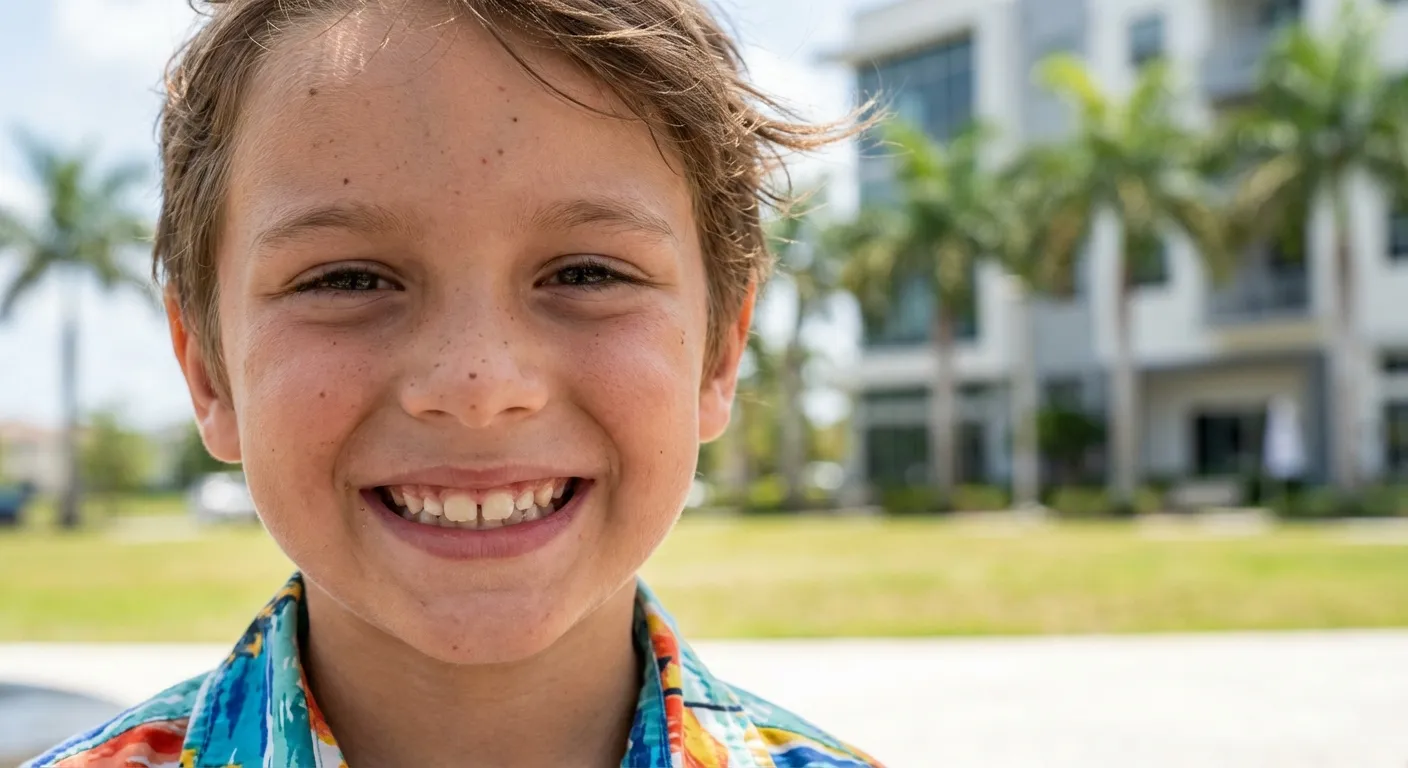
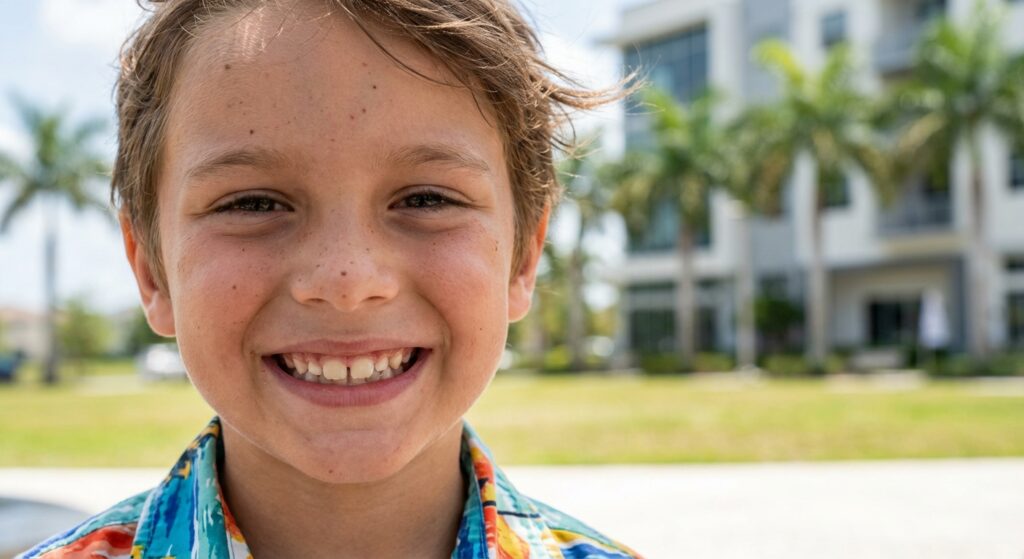
Phase 1 Orthodontics in Miramar: Why Age 7 Matters (And When It Doesn't)
Your seven-year-old's first permanent molars just came in, and suddenly you're wondering: is this the moment to call an orthodontist?
Here's what most parents don't know: age 7 isn't a magic trigger. It's a window. The American Association of Orthodontists recommends that every child have their first orthodontic screening by age 7, not because every kid needs braces, but because some kids benefit enormously from early intervention, and others don't need anything yet.
The difference is understanding what to actually look for.
Why Age 7 Is The Right Time For A Checkup (Not Necessarily Treatment)
At age 7, your child's mouth is doing something remarkable.
Baby teeth are falling out.
Permanent teeth are arriving.
The upper and lower jaws are still growing and reshaping themselves.
It's like watching a construction site, things are changing fast.
This is exactly why an early screening matters.
An experienced orthodontist can see patterns emerging that might benefit from gentle guidance now, rather than waiting until your teen is 14 and needs braces for two years.
Phase 1 treatment, also called interceptive orthodontics, uses this growth window strategically.
Instead of waiting for all the permanent teeth to arrive and then correcting everything at once, we work with your child's natural growth to prevent or reduce bigger problems later.
But here's the real talk: not every 7-year-old needs it.
Some kids' jaws are tracking perfectly fine on their own.
That's why a proper evaluation from a board-certified orthodontist matters so much.
Four Clear Signs Your Child Might Benefit From Early Orthodontic Treatment
1. Severe Crowding (Even If Not All Teeth Are In)
If your child's front teeth look cramped or overlapping, and you're watching permanent teeth come in sideways, that's a red flag.
Early phase 1 treatment can create space and guide teeth into better positions, potentially reducing the need for extractions later.
This is huge because nobody wants their teenager dealing with tooth removal when it could've been prevented.
2. Crossbite
This is when the upper and lower teeth don't align properly when they bite together, often one side is shifted.
Crossbites can cause uneven jaw growth and should be corrected early.
The good news is they respond beautifully to phase 1 intervention when caught at the right time.
3. Mouth Breathing
Does your child consistently breathe through their mouth instead of their nose?
Mouth breathing affects jaw development and can contribute to sleep issues, posture problems, and teeth misalignment.
Phase 1 treatment often includes palate expansion and habit correction, which improves not just teeth but overall development.
This is something a lot of parents miss, but it's actually critical.
4. Severe Underbite or Overbite
When the lower jaw is significantly behind or ahead, early intervention can guide growth more favorably.
This is especially important because these patterns typically worsen without guidance.
Catching it early means better long-term outcomes.
When Your Child Might NOT Need Phase 1 Treatment Yet
Just as important as knowing when to treat is knowing when to wait.
Your pediatric dentist in Broward might notice:
- Slightly crowded teeth that will have more space as permanent molars erupt
- A small overbite that's within normal ranges
- Teeth that look misaligned now but are on a normal path as the jaw grows
- No functional problems like breathing issues, chewing troubles, or speech concerns
In these cases, a simple monitoring plan checking in every 6 to 12 months is smarter than unnecessary treatment.
We believe in doing the right thing at the right time, not the maximum thing.
That's the philosophy that guides every recommendation we make at SMILE-FX Orthodontic & Clear Aligner Studio.
What Actually Happens At Your First Orthodontic Evaluation
When you bring your 7-year-old in for their first orthodontic evaluation in Miramar, here's exactly what to expect.
Comfort First, We Mean It
Your child walks into a space designed for them.
Our VIP pediatric suite has weighted blankets, noise-canceling headphones, snacks, and shows playing.
We're not trying to distract from anxiety, we're showing your child this is a place where they matter.
This changes everything about how kids feel about their orthodontic journey.
The Real Conversation (15 minutes)
We talk with you and your child.
What concerns brought you in?
How does your child feel about their smile?
Are there any functional issues like breathing, chewing, or speech?
This isn't clinical interrogation, it's understanding your family's real situation.
The Clinical Exam (15-20 minutes)
We look at how teeth are positioned, how the jaws are aligned, and how they're growing.
We check bite, spacing, and any crossbites or other concerns.
All of this is explained to your child in simple language as we go.
No surprises, no confusion.
Digital Imaging With Low-Dose Technology
We take a low-dose digital X-ray and may recommend a CBCT, which is a 3D scan to see jaw growth patterns.
Both are explained clearly: "This shows us what's happening inside so we can make the best plan."
The X-ray takes seconds.
Your child isn't scared because you're not scared.
Our cutting-edge technology makes the whole process comfortable and quick.
The Real Recommendation (15 minutes)
Here's where we differ from most practices: we tell you what your child actually needs, not what we can sell you.
If phase 1 treatment makes sense, we explain why, specifically for your child.
What problem are we solving?
How long will it take?
What does success look like?
If monitoring is the smarter choice, we say so.
We'll outline exactly what to watch for and when to return.
No guilt.
No pressure.
Just clarity.
Why Board-Certified Orthodontists Beat General Dentists For Kids
Here's something parents should know: general dentists can place braces, but they're not trained in the complexity of growth-guided treatment.
Phase 1 interceptive care requires specialized training in jaw development, growth patterns, and timing.
It's the difference between following a recipe and understanding the science of cooking.
Every SMILE-FX orthodontist is board-certified and specializes in cases like your child's.
We've spent additional years studying exactly what we're doing.
That expertise matters most when your child is 7, because timing and precision in early treatment create the foundation for everything that comes after.
Families across Broward, from Pembroke Pines to Weston to Cooper City to Davie, choose SMILE-FX because they want board-certified specialists, not general practitioners making guesses about their child's jaw development.
Real Questions Miramar Parents Ask All The Time
Q: If my child gets phase 1 treatment at 7, do they still need braces later?
A: Sometimes yes, sometimes no.
Phase 1 treatment aims to create the best foundation possible.
Some kids finish phase 1 and never need phase 2.
Others benefit from a shorter, simpler phase 2 in their early teens.
Either way, phase 1 reduces overall treatment time and complexity.
Q: How much does phase 1 cost?
A: Phase 1 treatment typically ranges from $2,000 to $5,000, depending on what's needed.
We always discuss payment options upfront, many families spread costs over time.
At your free consultation, we'll give you a real number for your child's specific situation, not an estimate.
Q: Will phase 1 hurt?
A: There's no pain, but some kids notice slight pressure as their teeth and jaw begin moving.
We use the gentlest forces possible.
Most kids adjust in a few days.
Comfort is genuinely our priority, if your child is uncomfortable, we adjust.
Q: What if I'm not sure my child needs anything yet?
A: That's what the free screening is for.
We look, we explain what we see, and we give you honest guidance.
If your child's development is on track, you'll know.
If there are concerns that benefit from early attention, you'll understand why.
No pressure.
Just clarity.
Q: How often do we come in during phase 1?
A: Typically every 4 to 6 weeks for adjustments and monitoring.
We work around school schedules, appointments are short, and many families from Miramar and across Broward find it easy to fit in around their routines.
Why Families Travel To SMILE-FX Instead Of Going Local
If you're reading this, you probably already know that choosing orthodontic care for your child matters.
You might have looked at a few practices.
You might be wondering if the one nearest you is good enough.
Here's what sets us apart:
Specialist expertise, not general dentistry.
Our orthodontists studied growth-guided treatment.
It's what we do every day.
Honest recommendations, not sales pressure.
We tell you what your child needs, when they need it.
Not before, not more than necessary.
Pediatric comfort by design.
From the moment your child walks in, we're thinking about their experience.
VIP suites, weighted blankets, choice of shows on the ceiling, comfort isn't an afterthought.
Cutting-edge technology with simple explanations.
Low-dose digital X-rays, 3D imaging, and the latest phase 1 appliances, all explained in language your child understands.
Regional authority trusted by pediatric dentists.
We're the number one partner for pediatric dentists across South Florida because we deliver results and integrity.
Parents from Pembroke Pines, Hollywood, Weston, Cooper City, and Fort Lauderdale choose SMILE-FX not because we're closest, but because we're best.
Your Next Move For Early Orthodontic Care In Miramar
If your child is 6, 7, or 8 years old, or if you're wondering whether early evaluation makes sense, there's one simple next step.
Book a FREE 3D scan and VIP smile consultation at SMILE-FX today.
We'll look at your child's development, explain what we see, answer every question you have, and give you a clear recommendation.
No sales pitch.
No pressure.
Just the truth.
Your child's smile development happens now.
Let's make sure it's heading in the right direction.
You can also visit our Miramar location page to learn more about how we serve families across Broward County and South Florida.
We're here to guide your child's smile, not to rush treatment.
That's the SMILE-FX promise.
Phase 1 orthodontics in Miramar starts with one simple decision: getting your child evaluated at the right time by the right people.
Beyond Phase 1: What Happens When Your Teen Needs Braces, Clear Aligners, or Invisalign in Miramar
Your kid finished phase 1 treatment, and now you're staring down the reality of phase 2.
Or maybe you skipped early treatment altogether, and now your teenager is ready for comprehensive orthodontic care.
Either way, you're faced with a choice that feels bigger than it probably is: traditional braces, clear aligners, or Invisalign.
Every parent asks the same question: which one actually works?
Why Phase 2 Is Different From Phase 1 Treatment
Phase 1 was about guiding growth and preventing bigger problems.
Phase 2 is about perfecting alignment and creating a bite that lasts.
By the time your teen reaches phase 2, most permanent teeth are in place.
Growth has slowed down.
Now we're working with what we've got, not trying to influence what's coming next.
This is why the appliance choice matters more in phase 2 than it did in phase 1.
In phase 1, we were mainly using expanders and light wires to guide teeth and jaws.
In phase 2, you're choosing an appliance that your teen will wear every day for 18 to 24 months.
That's a big commitment, and the right choice depends on what your kid will actually stick with.
A patient who loses their Invisalign trays three times a month isn't getting results, no matter how good the technology is.
A patient with braces who doesn't brush properly ends up with decalcification and cavities.
The best treatment is the one your teen will comply with.
Understanding Your Three Main Options For Teenage Orthodontics
Traditional Metal Braces: The Reliable Workhorse
Metal braces are still the gold standard for a reason.
They work faster than clear options.
They handle the toughest cases.
They never get lost or forgotten at home.
Your teen can't accidentally leave them on the bathroom counter.
For complex bite problems, significant crowding, or severe rotations, metal braces are still your most efficient path to results.
They're also usually the most affordable option, which matters when you're paying out of pocket.
The catch: they're visible.
Some teens don't care at all.
Others would rather walk barefoot through a parking lot than wear them.
That's the real barrier with braces, not the treatment itself.
Clear Aligners: Flexibility Meets Discipline
Clear aligners are exactly what they sound like: a series of custom-made plastic trays that gradually move teeth.
Your teen wears one set for about two weeks, then switches to the next set.
They're nearly invisible, which appeals to teenagers who care about appearance.
They're removable, so eating and brushing teeth feels normal.
Your teen isn't restricted to soft foods or worried about food getting caught in brackets.
Here's the reality though: clear aligners only work if they're worn 20 to 22 hours per day.
That means they're in during school, during meals if we're being honest, and during sleep.
The six hours they're out should be mostly for eating and brushing.
A teenager who forgets them at school, leaves them at a friend's house, or just decides not to wear them one day is going to stall treatment.
Some kids handle this perfectly.
Others struggle with the responsibility.
We're honest about this at the start because we want you to know what you're getting into.
Invisalign: The Premium Clear Option
Invisalign is the brand-name clear aligner system, and it's become synonymous with invisible braces.
It works the same way as generic clear aligners, but Invisalign has more established track records, more refinement options if teeth don't track perfectly, and more predictable results on complex cases.
Invisalign also offers SmartTrack material, which some patients find more comfortable.
The tradeoff is cost, Invisalign typically costs more than traditional braces.
We use both clear aligners and Invisalign at our Miramar office, and the choice depends on the case complexity and your budget.
For a teenager with mild crowding and good bite alignment, generic clear aligners work great and save money.
For a teenager with a complex bite problem or significant rotations, Invisalign's precision tracking makes the difference.
What Actually Matters When Choosing Between Braces and Clear Aligners
Treatment Speed
Metal braces finish faster, typically 18 to 22 months for straightforward cases.
Clear aligners average 20 to 28 months, sometimes longer if your teen isn't consistent with wear.
If you want this done and your teen is committed to the process, braces win.
Aesthetic Concerns
Some teenagers genuinely don't care about visible braces.
Others would rather delay treatment than wear them.
This isn't shallow, it's real.
If appearance is going to determine whether your teen complies, clear aligners or Invisalign are worth the extra cost.
Complexity of the Case
Severe crowding, major bite problems, or teeth that need to rotate significantly often respond better to braces.
Clear aligners can handle these cases, but they might take longer or require midtreatment adjustments.
Maintenance and Responsibility
Braces require consistent brushing and flossing around brackets, but your teen can't forget to put them in.
Clear aligners require your teen to actually remember to wear them.
If your kid loses things regularly, braces are safer.
If your kid is responsible and motivated by the invisible option, clear aligners work.
Dietary Restrictions
Braces mean avoiding hard candy, popcorn, chewing gum, and other sticky foods.
Clear aligners mean your teen eats normally, just takes the trays out first.
For some teenagers, this matters psychologically.
Cost
Metal braces are typically the least expensive option at SMILE-FX.
Clear aligners fall in the middle.
Invisalign is usually the premium price.
We always discuss this upfront so there are no surprises.
Real Teen Scenarios and What Actually Works Best
The Athlete Who Plays Contact Sports
For teenagers playing football, hockey, or any contact sport, clear aligners or Invisalign are often better choices.
We can fit a custom mouthguard over aligners.
With braces, your teen is stuck with uncomfortable guard options that feel awkward.
A hockey player we treated switched from braces to Invisalign midtreatment, and suddenly he was compliant because the physical discomfort was gone.
The Self-Conscious Kid
If your teenager is already struggling socially or dealing with anxiety about appearance, braces can amplify those feelings.
We've seen kids who got braces and then stopped smiling in photos for months.
For these kids, clear aligners aren't just cosmetic preference, they're mental health.
That's worth paying extra for.
The Forgetful One
If your teenager can't remember their locker combination or has a track record of losing things, clear aligners are risky.
We've treated kids whose parents had to set phone reminders, check their backpacks weekly, and basically manage the whole process.
Some families made it work.
Others switched to braces because it was less stress.
The Straightforward Case
If your teenager's teeth are only mildly crowded and the bite is good, any option works.
Choose based on what your teen wants, what you can afford, and what fits your lifestyle.
The Complex Case
If your teenager has a significant overbite, underbite, or severe crowding, braces usually finish faster and more predictably.
Clear aligners can do it, but you need realistic expectations about timeline.
What You Should Know About Maintaining Either Treatment
With Braces
Brushing takes longer because you're cleaning around brackets and wires.
Your teen needs to learn to use a Waterpik or similar device to clean under the wire.
They'll need to avoid certain foods.
They'll have appointments every four to six weeks for wire adjustments.
Braces can break if your teen gets hit in the mouth or chews on things they shouldn't.
We fix broken brackets quickly, but it's an interruption.
With Clear Aligners or Invisalign
Your teen needs to clean the aligners daily with a soft toothbrush and cool water.
They need to keep track of their trays, which sounds simple but trips up more families than you'd think.
They need to wear them consistently, which is the biggest factor in success.
Appointments are less frequent than with braces, typically every six to eight weeks.
If a tray cracks or gets lost, there's usually a short delay in getting a replacement.
The Real Question Every Parent Wants Answered
After all the details, here's what matters: which option will your teenager actually commit to?
A teenager wearing metal braces every day for two years because they have no choice will get results.
A teenager with Invisalign who wears them four hours a day because they keep forgetting will waste your money and your time.
We've seen both scenarios.
The teenagers who succeed are the ones whose treatment choice matches their personality and habits.
That's why we spend time understanding your teenager before recommending anything.
We ask what they want, not just what the condition requires.
We talk about their concerns, their social life, their sports commitments, their responsibility level.
Then we recommend the treatment that actually fits into their real life.
What Happens During Phase 2 Treatment Planning
When your teenager is ready for comprehensive orthodontic care, here's exactly what we do.
Updated Digital Imaging and Assessment
We take new X-rays and 3D scans to see exactly where everything stands now.
Growth has slowed, and we need a fresh blueprint.
We use advanced imaging technology to plan precise tooth movement.
Honest Conversation About Options
We present all viable options for your teenager's specific case.
We explain what each option accomplishes, how long it takes, and what's required for success.
We tell you pros and cons without sugar coating.
Your Teenager Gets to Choose
This is important: your teenager should have input on their treatment.
They're wearing it, not you.
If they want braces and you want Invisalign, or vice versa, we help you both understand the tradeoffs and reach a decision together.
Realistic Timeline and Cost Discussion
We tell you exactly how long treatment will take, what it will cost, and what payment options work for your family.
We discuss how many appointments are needed and whether that fits your schedule.
No guesses, no surprises at the end.
Questions Miramar Families Ask About Phase 2 Treatment
Q: Can we do phase 2 sooner if we skip phase 1?
A: Not really.
Your teenager needs to be growth-done, which typically happens around age 13 or 14 for girls and 15 or 16 for boys.
Starting phase 2 too early means you're fighting growth, which slows everything down.
If phase 1 treatment was done, phase 2 usually starts six months to a year after phase 1 ends.
If you skipped phase 1, phase 2 starts when your teenager is ready, usually mid-teens.
Q: Will my teenager need retainers after treatment?
A: Yes, always.
Teeth naturally shift over time, especially in teenagers whose jaws are still settling.
Retention is permanent, but that usually means a fixed wire behind the front teeth plus removable retainers at night.
We discuss retainer options at the end of treatment so you know what to expect.
Q: What if treatment takes longer than expected?
A: Sometimes teeth don't track exactly as planned, or your teenager's bite is more complex than initial assessment showed.
Clear aligners especially can have midtreatment adjustments that extend the timeline.
We communicate this early so you're never blindsided.
Q: Can my teenager play sports with braces?
A: Yes, with a custom mouthguard.
We recommend brackets on the front teeth of athletes, and they adapt quickly.
Thousands of kids play sports every day with braces.
Q: What if my teenager loses or damages their aligners?
A: We have replacement trays available quickly.
There's a replacement fee, which is why we emphasize responsible storage and care upfront.
Most teenagers who understand the stakes take better care.
Q: Can treatment start mid-school year or should we wait for summer?
A: There's no wrong time to start.
Honestly, your teenager adjusts faster than you'd think.
Starting mid-school year means getting partway through before graduation stress hits.
Summer starts feel good but there's no advantage treatment-wise.
Why Specialists Matter for Teenage Orthodontics
Your teenager's case is probably more straightforward than a seven-year-old's phase 1 case.
But that doesn't mean it's simple.
Teenagers' jaws are almost fully grown, but not quite.
Bite relationships matter in ways they didn't during phase 1.
Gum health becomes critical because orthodontic treatment stress impacts gum tissue.
Tooth roots need to be positioned correctly to support long-term health, not just current alignment.
This is why board-certified orthodontists spend additional years in specialty training.
A general dentist can place braces on straight teeth.
An orthodontist solves complex bite problems while protecting long-term oral health.
For your teenager, that difference matters.
Braces, Clear Aligners, and Invisalign All Work, But Only If Your Teenager Does
Here's what we've learned from treating hundreds of teenagers across South Florida: the appliance matters less than the patient's commitment.
A teenager who hates their braces but wears them every day gets a perfect result.
A teenager who loves Invisalign but forgets to wear them loses momentum.
Your job is to choose an option your teenager will actually use.
Our job is to make that option work as efficiently as possible.
Everything else is just details.
When you're ready to explore phase 2 options for your teenager, we handle cases for all ages, and we're honest about what works best for your situation.
Whether your teenager needs traditional braces, clear aligners, or Invisalign, we'll show you exactly what to expect.
Comprehensive orthodontic treatment for teenagers doesn't have to feel overwhelming if you're working with SMILE-FX Orthodontic and Clear Aligner Studio in Miramar.
Book a free 3D scan and VIP smile consultation today and get a clear recommendation for your teenager's specific needs.
We'll explain all the options, answer every question, and help your teenager feel confident about their treatment choice.
Teenage braces and clear aligner treatment in Miramar works best when your teenager understands their options and has input on the decision.
Retainers, Long-Term Care, and Keeping Your Smile Perfect After Orthodontic Treatment in South Florida
Your orthodontic treatment is done.
Your teeth are straight.
You're done with appointments, done with adjustments, done with the whole process.
Except you're not.
This is the part nobody wants to hear about, but it's the part that separates people with perfect smiles years later from people wondering why their teeth shifted back.
Retention isn't optional.
It's not negotiable.
It's the difference between spending $5,000 on braces that stick around versus spending $5,000 and then watching your investment disappear.
Why Your Teeth Want to Move Back (And What You Can Actually Do About It)
Teeth aren't permanent.
They never were.
Your orthodontist just convinced them to move in a better direction for 18 to 28 months.
But the moment that pressure stops, your teeth remember their old position.
This is called relapse, and it's not a failure of treatment.
It's biology.
Your teeth are held in place by ligaments called the periodontal ligament.
When we move your teeth with braces or clear aligners, those ligaments get stretched.
When we stop moving them, the ligaments want to pull them back to where they started.
This happens with every type of treatment, whether you had traditional braces, clear aligners, or Invisalign.
The solution is retention.
Real retention.
Not wearing your retainer occasionally.
Not skipping nights because you're tired.
Actual, consistent retention.
The Two Types of Retainers You Need to Understand
Fixed Retainers: The Safety Net You Don't Think About
A fixed retainer is a thin wire bonded to the back of your front teeth.
It's there permanently, and you don't have to remember anything.
You brush around it, floss under it carefully, and that's it.
This wire prevents your front teeth from shifting, which is where most relapse happens.
We place this on almost every patient who finishes treatment at SMILE-FX Orthodontic & Clear Aligner Studio.
The reality is that a fixed retainer is not indestructible.
If you hit it hard playing sports, bite down on something hard, or get hit in the mouth, it can break.
When it does, you need to call your orthodontist to get it reattached.
This is where people sometimes get frustrated because they think the retainer should last forever.
It should, but accidents happen.
The good news is that we catch broken fixed retainers quickly and fix them before your teeth shift.
Removable Retainers: The Part That Actually Requires Your Effort
Removable retainers come in two styles: Hawley retainers and clear retainers.
Hawley retainers are the classic style with a wire and acrylic.
They're durable, last for years, and very visible when you're wearing them.
Clear retainers look like thin Invisalign trays.
They're nearly invisible and feel similar to what you wore during treatment.
Both work equally well if you actually wear them.
Here's the catch: you have to want to wear them.
The first year after treatment, you wear your removable retainer every single night.
No exceptions.
Not five nights a week.
Not when you remember.
Every night.
After the first year, most people can go to three to five nights a week and maintain results.
But that first year of nightly wear is non-negotiable if you want your teeth to stay straight.
We talk about this extensively before treatment ends so you know exactly what you're committing to.
How Insurance and Payments Factor Into Long-Term Retention
People often wonder, does insurance cover braces and retainers?
The answer depends on your plan.
Many insurance plans cover a portion of orthodontic treatment, which can be somewhere between 40 to 60 percent of the cost.
Retainers often fall under a different category.
Some plans cover them as part of your lifetime orthodontic benefit.
Others treat them as separate and may not cover them at all.
This is why we always pull your insurance information early and give you a clear breakdown of what's covered and what you're paying out of pocket.
We also offer payment plans that extend through retention, so you're not hit with surprise costs.
At SMILE-FX, we believe in affordable braces and affordable clear aligners for everyone in South Florida, including the retention phase.
We work with families across Broward, from Miramar to Fort Lauderdale to Aventura, to make sure cost never stops someone from getting the right treatment and keeping results long-term.
The Real Cost Difference Between Keeping and Losing Your Retainers
Let's talk about what happens when people don't wear retainers consistently.
Teeth shift gradually.
It might take six months, might take a year, but they move.
Sometimes a little.
Sometimes a lot.
When patients come back to us with shifted teeth, we have options.
If the shift is minor, a simple refinement with clear aligners for three to six months gets everything back in place.
If the shift is significant, you might need a full second round of treatment, which costs almost as much as the original treatment.
This happens regularly.
Not because our treatment didn't work.
It happened because retention wasn't maintained.
So the real question isn't whether you can afford retainers.
It's whether you can afford not to wear them.
What Happens When You Skip Retainers or Wear Them Inconsistently
Here's a story we see constantly.
Patient finishes treatment, gets their retainers, and wears them perfectly for the first four months.
Then life gets busy.
They skip a night here and there.
They go on vacation and forget them at home.
They lose one and figure they'll get it replaced next month.
By month six, they're not wearing them most nights.
By month 12, they can see their bottom front teeth starting to crowd again.
Now they're stressed and calling to ask if they need treatment again.
The answer is usually yes.
We see this play out the same way repeatedly, and it's preventable.
The solution is treating retention like the non-negotiable habit it needs to be, not like something you'll get to when you have time.
Set a phone reminder for every night if that helps.
Put your retainers in your phone charger so you see them when you charge your phone.
Whatever system makes wearing them automatic is the right system.
Cleaning and Caring for Your Retainers Properly
Retainers need maintenance just like your teeth do.
Fixed retainers need special flossing care.
You can't floss normally when there's a wire on the back of your teeth.
You need a floss threader or water flosser to get under and around the wire.
This takes 30 seconds longer than regular flossing, but it prevents decay around the bonded wire.
If you don't floss properly around a fixed retainer, bacteria accumulate and you end up with cavities exactly where you don't want them.
Removable retainers need daily cleaning.
Clear retainers should be rinsed and cleaned with a soft toothbrush and cool water every morning.
Never use hot water because heat warps the plastic.
Hawley retainers need the same approach.
Both types benefit from soaking in a denture cleaner or retainer cleaner once a week.
This removes bacteria and keeps them fresh.
We provide detailed care instructions with your retainers, but the basic rule is simple: clean them as part of your daily routine, not as an afterthought.
When to Replace Your Retainers and How Often That Actually Happens
Retainers don't last forever.
Clear retainers typically last three to five years with proper care before they start to get cloudy, crack, or no longer fit perfectly.
Hawley retainers last longer, often seven to ten years or more, but the wire can bend and the acrylic can crack.
Fixed retainers can last indefinitely if you care for them, but as we mentioned, they can break from impact.
How often you replace retainers depends on how well you care for them and how much wear they take.
Some patients keep the same retainer for ten years.
Others need replacements every three to four years.
The cost of replacement retainers is usually between $200 and $600 per set, which is significantly less than repeating treatment.
We always recommend replacing retainers when they show wear rather than waiting until they fail completely.
Special Situations: Retention After Complex Cases
If your treatment involved correcting a severe bite problem, significant crowding, or major jaw alignment issues, retention is even more critical.
These cases have more relapse potential because your bite was farther from its natural position to begin with.
For complex cases, we sometimes recommend more aggressive retention protocols.
This might mean wearing your removable retainer nightly for two or three years instead of one year.
It might mean a fixed retainer on both upper and lower teeth instead of just the upper.
It might mean periodic check-ins to monitor how your bite is settling.
If you had a board-certified orthodontist handle your complex case, they'll have outlined the specific retention plan you need.
This is why working with a specialist rather than a general dentist matters for complicated cases.
Specialists understand the long-term stability requirements for different types of treatment.
Habits That Damage Your Retainers Faster Than Normal Wear
Some habits make retainers fail before their time.
Sleeping with clear retainers in a dry container instead of with a little water deteriorates the plastic faster.
Chewing on your retainers or biting down on them intentionally warps them.
Using hot water damages plastic retainers.
Leaving them in your car in the sun melts them.
Grinding your teeth at night puts extra stress on all retainers and can cause them to crack.
If you grind your teeth, we sometimes recommend a nightguard in addition to your retainer, or we use a more durable Hawley style retainer instead of a clear one.
The point is that retainers are durable tools, but they're not indestructible.
Treating them with care makes them last longer.
Building the Retention Mindset
Here's the shift we want you to make in your thinking.
Retainers aren't something you wear for a year after treatment.
Retainers are something you wear for life, even if the commitment changes after that first year.
Some people move to wearing retainers three nights a week indefinitely.
Some people wear them every night indefinitely.
Some people wear them mostly and accept that their teeth might shift a little over decades, which is normal.
The point is being intentional about retention rather than hoping your teeth stay straight without effort.
We talk to every patient about what a realistic long-term retention plan looks like for their life.
For someone who hates wearing retainers, that might mean accepting slightly more shift over time than someone who doesn't mind wearing them nightly.
For someone with a high-stakes smile like a public speaker or healthcare worker, it might mean more aggressive retention.
The key is making a plan you'll actually follow, not a plan that sounds good in theory.
When to Call Your Orthodontist About Your Retainers
Contact your orthodontist immediately if your fixed retainer breaks, if you lose or severely damage your removable retainer, or if you notice your teeth shifting despite wearing your retainer consistently.
If you start grinding your teeth or notice new habits that might affect your retainers, call and discuss options.
If you're having trouble remembering to wear your retainer and want to troubleshoot better systems, talk to your team.
We're here to help retention succeed, not to make it harder than it needs to be.
The best orthodontist for you is one who stays involved in your retention journey, not one who disappears after treatment ends.
Book Your Comprehensive Retention Consultation Today
Whether you're finishing treatment and starting retention for the first time, or you're a few years out and wondering if you're on the right track, book a FREE 3D scan and VIP smile consultation with the top-rated orthodontist near you at SMILE-FX.
We'll review your specific retention needs, talk about what's realistic for your lifestyle, and make sure you have a plan that actually works.
Long-term smile stability after braces or clear aligners isn't complicated when you have the right support.
Your perfect smile is worth protecting, and that's exactly what we help you do every single day in South Florida.