
Early Orthodontics for Kids Ages 6-10 in Pembroke Pines
Your kid's smile is changing fast, and you're noticing things that make you wonder if braces are coming down the road.
Maybe there's crowding, maybe a crossbite, or you catch them breathing through their mouth more than their nose.
You start googling "Phase 1 orthodontics" at midnight, and suddenly you're down a rabbit hole of conflicting information.
That's normal.
Here's what I know after working with hundreds of families in Pembroke Pines: catching these early signs and acting on them isn't about panic—it's about giving your child's jaw and teeth the best shot at growing in the right direction.
The American Association of Orthodontists recommends getting your kid evaluated by age 7, and there's a real reason for that.
At that age, your child's jaw is still growing, which means we can guide that growth instead of fighting against it later with heavy braces.
Phase 1 orthodontics isn't full braces—it's strategic intervention that creates space, fixes habits, and prevents bigger problems from showing up in the future.
What Is Phase 1 Orthodontics and Why It Matters for Your Kid
Phase 1 is early interceptive treatment, which sounds fancy but really just means we're stepping in while your kid's mouth is still developing.
This phase typically runs from age 6 to 10, right when the first permanent teeth are coming in and the jaw is still moldable.
Think of it like this: if you notice a tree growing crooked when it's young, you can gently stake it and guide it straight.
Wait until it's fully grown and massive, and you've got a much bigger problem on your hands.
Same logic applies to orthodontics.
During Phase 1, we use targeted appliances like palatal expanders, habit correctors, and partial braces to create space, fix bite issues, and address things like thumb sucking or mouth breathing that can actually change how a face develops.
The goal isn't perfection at this stage.
The goal is to give permanent teeth room to come in right and set up your kid for a simpler Phase 2 treatment (if they even need one) down the road.
Sometimes after Phase 1, a kid's bite and spacing work out so well that they don't need braces at all.
That's a win worth celebrating.
The Red Flags Your 6-10 Year Old Might Need Early Orthodontic Care
So how do you know if your kid is a candidate for Phase 1?
Here are the things to watch for in day-to-day life:
Crowding or visible gaps between teeth.
As your kid's permanent teeth come in, they might look jammed together or spaced out weirdly.
That crowding often signals the jaw doesn't have enough room, which is something we can expand during Phase 1.
Crossbite or underbite.
If the upper teeth sit inside the lower teeth when your kid bites down (crossbite) or if the lower jaw juts out in front of the upper jaw (underbite), that's a sign the jaws aren't aligning properly.
Fixing this early saves complications later.
Open bite.
When the front teeth don't touch when the back teeth are closed, there's an open bite.
This often connects to thumb sucking or tongue thrusting.
Mouth breathing or tongue thrusting.
Kids who breathe through their mouths instead of their noses, or who push their tongue forward when they swallow, can develop facial changes that braces alone can't fix later.
Catching these habits early and correcting them can literally change facial development.
Persistent thumb sucking past age 4.
A little thumb sucking is normal, but if your kid is still doing it at 6, 7, or 8, it can push teeth forward and create bite problems.
Phase 1 appliances with habit correctors work surprisingly well here.
How Phase 1 Treatment Actually Works at SMILE-FX
When you bring your kid in for a consultation at SMILE-FX Orthodontics, we don't just jump into treatment.
We take time to understand what's going on.
Your first visit is usually around 45 minutes, and we use low-dose digital X-rays and 3D imaging to see exactly how your kid's teeth and jaw are positioned and growing.
We talk to your kid about what they're experiencing, explain things with models so they understand what's happening, and make sure they feel comfortable with the idea of treatment.
If treatment is needed, we customize a plan based on your kid's specific issues.
This might mean a palatal expander that widens the upper jaw gradually over months, creating room for teeth to come in without crowding.
Or it might be a habit corrector appliance that discourages thumb sucking or tongue thrusting.
Some kids get partial braces on just a few teeth, not the full mouth.
The key difference between Phase 1 and full braces is that Phase 1 focuses on creating the right environment for growth, not perfecting tooth position.
We're literally guiding your kid's jaws to develop in a healthier way.
Our cutting-edge technology lets us use AI-driven growth predictions to see how your specific child's jaws will develop and adjust the plan as needed.
This isn't guesswork—it's science-backed planning.
Why Pembroke Pines Families Are Making the Short Drive to SMILE-FX in Miramar
You might think the closest orthodontist is always the best choice, but families in Pembroke Pines consistently choose to drive the short 10-15 minutes to our Miramar location.
Here's why:
We have board-certified orthodontists only, not general dentists trying to do orthodontics on the side.
There's a huge difference in expertise and outcomes.
Our board-certified specialists have extra years of training focused specifically on moving teeth and guiding jaw growth.
We're the trusted partner for pediatric dentists across South Florida.
When other dentists in the area need to refer a patient, they send them to us.
That matters because it means other dental professionals trust our work with their own patients.
We actually care about comfort.
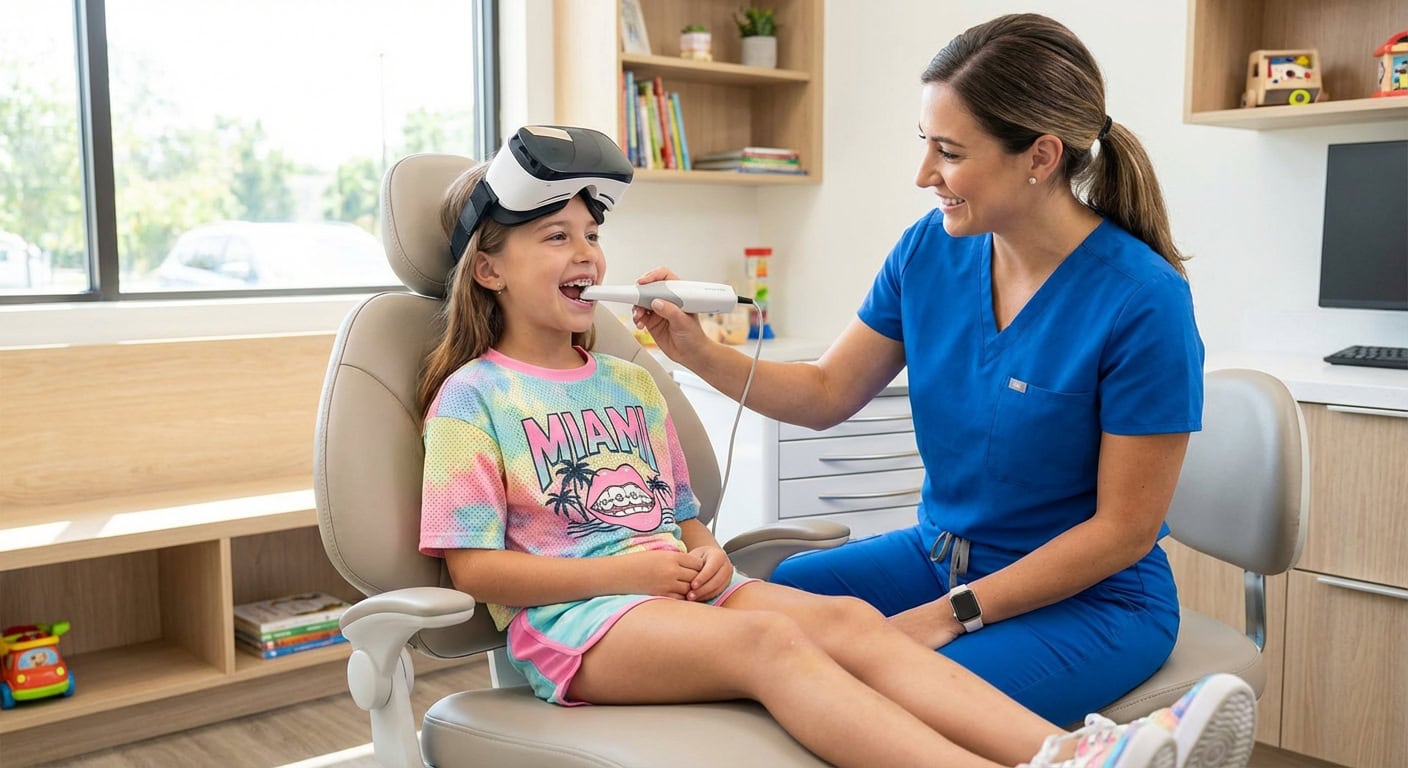
We use VR headsets to distract kids during appointments, have weighted blankets and noise-canceling headphones available, and keep a VIP suite stocked with snacks and shows.
Most offices don't do this.
We do because we know anxiety doesn't help anyone.
Scheduling fits real life.
We have after-school appointments, weekend slots, and quick 30-minute visits for check-ins.
If you work, you're busy, and we get that.
You're working with a team, not a churning machine.
We're not trying to squeeze in as many patients as possible.
We spend real time with each kid and family because that's how you actually get good results.
What Parents Really Want to Know About Phase 1
Will my kid need full braces after Phase 1?
Maybe, maybe not.
The whole point of Phase 1 is to set things up so that Phase 2 is simpler or not needed at all.
Some kids finish Phase 1 and their bite and spacing are good enough that they don't need further treatment.
Others do benefit from Phase 2 braces later, but those braces are usually on for less time and involve less heavy lifting because we've already done the groundwork.
How long does Phase 1 take?
It varies, usually anywhere from 6 months to 2 years, depending on what we're treating and how quickly your kid's jaw responds.
We monitor growth and adjust as needed.
Is Phase 1 painful?
Nope, not painful—uncomfortable sometimes, yeah, but not painful.
Kids might feel pressure or slight soreness for a day or two after an adjustment, but we manage that with soft foods and over-the-counter pain relief if needed.
Most kids adjust fast.
How much does it cost?
Costs vary based on what treatment your kid needs, but we're transparent about it from day one.
We discuss options, payment plans, and what insurance covers during your consultation.
No surprises.
Do I have to drive to Miramar?
If you live in Pembroke Pines, yes, the office is in Miramar.
But the drive is quick, and families tell us it's worth it for the quality of care and the difference they see in their kid's development.
The Phase 1 Difference: Why Early Intervention Matters Long Term
Here's the thing nobody tells you: the decisions you make about your kid's teeth now affect their confidence, their health, and even their development for the next 10-15 years.
A kid with bite problems might develop speech issues.
A kid with mouth breathing problems might have trouble sleeping well.
A kid with crowded teeth struggles to clean between them, leading to cavities and gum problems down the line.
These aren't just cosmetic issues—they're real, functional problems that get harder to fix the longer you wait.
Phase 1 intercepts these problems while your kid's body is still flexible and responsive to guidance.
It's not about vanity or rushing into treatment.
It's about setting your kid up for a healthier, easier path forward.
Check out real stories from families who've been through Phase 1 at SMILE-FX—you'll see the difference it makes.
Next Steps: Getting Your Kid Evaluated
If any of this resonates with what you're seeing in your kid's mouth, the next step is simple: get an evaluation from someone who knows what they're looking at.
We offer a free 3D scan and VIP smile consultation where we look at your kid's current situation, explain what we see, and outline options.
No pressure, no sales pitch—just honest feedback.
Families from Pembroke Pines, Weston, Cooper City, Davie, and all across South Florida come to SMILE-FX because we deliver results with kids at the center of everything we do.
Book a free 3D scan and VIP smile consultation today—spots fill up fast because word travels when people get real results.
Let's give your kid the best foundation for their smile and their confidence.
What Happens After Phase 1 Orthodontics: Planning Your Kid's Path to the Perfect Smile
Your kid finished Phase 1 treatment and now you're wondering what comes next.
Maybe their bite looks better, maybe the crowding improved, or maybe they're finally done with that palatal expander.
But there's this nagging question in the back of your head: do they still need braces?
How long will the next phase take?
What's the timeline actually look like?
I get this question from parents all the time, and it's smart to ask because understanding what's ahead helps you plan and manage expectations.
The truth is that early orthodontic treatment in Pembroke Pines and across South Florida sets up a completely different trajectory than kids who never get Phase 1 care.
Some kids graduate Phase 1 and they're done for good.
Others move into Phase 2, which looks and feels totally different from what they experienced before.
Let's walk through how this actually works.
The Real Difference Between Phase 1 and Phase 2 Treatment
Here's what most parents miss: Phase 1 and Phase 2 are completely different animals.
Phase 1 was all about guiding jaw growth and creating space.
Phase 2 is about perfecting tooth position once all the permanent teeth have come in.
Think of Phase 1 as building the foundation for a house and Phase 2 as doing the final finishing work.
You can't finish the walls if the foundation is crooked, right?
That's why getting Phase 1 right matters so much.
When Phase 2 happens, usually around age 11 to 13, your kid's permanent teeth are mostly in place and their jaw has finished growing.
This is when comprehensive braces or clear aligners come into play to fine tune everything.
But because you did the groundwork in Phase 1, Phase 2 is typically shorter, less invasive, and way more straightforward.
We're not fighting against a jaw that developed the wrong way.
We're just aligning teeth that have plenty of room to move into.
How to Know if Your Kid Actually Needs Phase 2
Not every kid does.
This is the part that surprises people, but it's absolutely true.
Some kids finish Phase 1 and their bite, spacing, and tooth alignment are solid enough that they don't need braces at all.
We monitor their development closely after Phase 1 ends, and if their permanent teeth are coming in straight and their bite is aligning naturally, we might just observe and let nature finish the job.
If Phase 2 is needed, we typically recommend it once your child is around 11 or 12 years old and most permanent teeth have erupted.
At that point, we look at:
Whether there's still crowding or spacing issues that need fixing.
If the bite needs refinement (overbite, underbite, or crossbite that didn't fully resolve in Phase 1).
How the permanent teeth are positioned relative to each other.
Whether the jaw has fully grown and stabilized.
If any of these factors show we need to do more work, Phase 2 is the answer.
If everything looks good, we skip it.
Phase 2 Braces vs. Clear Aligners: What's Right for Your Kid
When Phase 2 starts, you'll have options.
Some families stick with traditional braces, which are incredibly effective and honestly, way different from the clunky metal brackets of 20 years ago.
Modern braces work faster, are more comfortable, and come in tooth colored or clear options.
Other families go with clear aligners like Invisalign, which are basically invisible and let your kid eat whatever they want without worrying about food getting stuck.
Both work.
It comes down to what fits your kid's lifestyle and personality.
Here's the real talk though: because of what we accomplished in Phase 1, Phase 2 is usually shorter and simpler no matter which option you choose.
We're looking at 18 to 24 months instead of the 24 to 36 months many kids need who never did Phase 1.
That's real time savings and real money savings.
At SMILE-FX, we use clear aligners and braces that are backed by the latest technology.
Your kid gets to choose what feels right for them, and we make sure whatever path they pick actually works with how they live their life.
The Money Question: How Much Does Phase 2 Actually Cost
Let's be straight: this is what parents really want to know.
Phase 2 costs vary depending on complexity and treatment type, but here's what usually happens.
If you started with Phase 1, the total cost for both phases combined is often less than doing comprehensive treatment all at once.
You already paid for Phase 1.
Phase 2 is billed separately, and because the work is simpler, it's typically more affordable than full braces would have been without the Phase 1 groundwork.
Payment plans and insurance coverage work the same way for Phase 2 as they did for Phase 1.
We're transparent about costs from day one, and we work with you on scheduling payments in a way that doesn't wreck your budget.
No hidden fees, no surprises.
What the Waiting Period Between Phases Actually Looks Like
After Phase 1 ends and before Phase 2 starts, there's usually a break.
This gap, sometimes called the "observation period," is actually critical.
Your kid's permanent teeth are still coming in, and their jaw is still settling into its final position.
We schedule check ups maybe twice a year to watch how everything is developing and make sure we're not missing anything.
These visits are quick, usually 20 to 30 minutes.
We're not making adjustments, just taking X rays, looking at how teeth are positioned, and charting growth.
This is when we decide whether Phase 2 is actually needed or if your kid is tracking well enough that we can call it done.
Most families appreciate this break because it gives their kid time to forget about orthodontics for a while.
No appliances, no adjustments, just life happening normally.
What About Retention After Phase 2 Ends
Here's something a lot of parents don't think about until it comes up: retention.
After Phase 2 braces or aligners come off, your kid will need to wear a retainer to keep their teeth from shifting back.
This isn't optional.
Teeth want to move, especially in the first year after treatment ends.
Retainers keep them where they're supposed to be.
Most kids wear a retainer at night for a good long time, sometimes years.
It's a small commitment compared to actually getting braces off, and it's what stands between keeping your kid's perfect smile and watching it slowly drift back to where it started.
We talk through retention options with every family.
Some kids get bonded retainers behind their teeth that they never think about.
Others wear clear retainers at night.
Some use both.
There's no one right answer, just what works for your kid.
Real Talk: Common Parent Worries About Phase 2
Parents often ask whether Phase 2 is going to be harder or more uncomfortable than Phase 1.
The answer is no, it's usually easier.
By the time Phase 2 starts, your kid already knows what to expect.
They've been through adjustment appointments, they know how their mouth feels with something in it, and they've got strategies for managing any soreness.
It's old hat to them.
Another worry is whether Phase 2 will take forever.
Like I said, because Phase 1 did the heavy lifting, Phase 2 is typically one and a half to two years, not three or four.
You're already through the long part.
Parents also wonder if their kid will feel self conscious about braces or aligners during Phase 2.
Clear aligners solve this for a lot of families because they're barely visible.
Modern braces are also less noticeable than they used to be.
And honestly, by the time Phase 2 starts, most kids have friends who are already in braces or have been, so it doesn't feel weird or isolating.
The bigger picture is that your kid has already benefited from early intervention, and now they're just finishing what they started.
How SMILE-FX Approaches Phase 2 Planning
At SMILE-FX Orthodontics, we start talking about Phase 2 possibilities during Phase 1.
We don't wait until the last minute to figure it out.
Our board certified orthodontists use advanced growth prediction technology to forecast how your kid's permanent teeth will come in and whether Phase 2 will be needed.
This isn't guessing.
It's science based planning that lets families make real decisions with real information.
When Phase 2 time comes, we sit down with you and your kid and explain exactly what we're seeing, what our options are, and what we recommend.
You get to choose how you want to proceed.
Some families pick traditional braces because they want the fastest results.
Others pick Invisalign and clear aligners because they want something invisible.
We support whatever choice makes sense for your family.
What matters to us is that your kid ends up with a healthy bite, straight teeth, and a smile they're proud to show off.
The Long Game: Thinking Beyond Phase 2
Here's what gets lost in the conversation a lot of the time.
Orthodontics isn't just about looks, even though that's what people focus on.
It's about function.
A kid with a properly aligned bite chews better, breathes better, and often sleeps better.
Their teeth are easier to keep clean because they're not jammed on top of each other.
They're less likely to grind their teeth or develop TMJ problems down the road.
These are the things that matter 10 years from now, not just what their Instagram pictures look like.
By doing Phase 1 early and following through with Phase 2 if needed, you're investing in your kid's health and function, not just their appearance.
That investment pays off for their entire life.
Questions Parents Ask About the Full Journey
Will my kid still need a retainer after Phase 2 comes off?
Yes, retention is non negotiable.
Teeth shift naturally over time if they're not held in place.
A retainer keeps that from happening.
How often should we come in for Phase 2 check ups?
Typically every 6 to 8 weeks while braces or aligners are active, then less frequently once treatment wraps up.
Can Phase 2 happen faster if we want it to?
Not really, and we wouldn't recommend pushing it.
Teeth move at a specific rate for a reason.
Trying to speed it up just leads to problems.
What if my kid's Phase 2 is more complex than we expected?
We communicate that with you early and adjust the plan accordingly.
No surprises.
Is there anything my kid shouldn't eat with braces during Phase 2?
Yeah, hard or sticky foods that can break brackets or bend wires.
We give a full list of what to avoid and what's fine.
The good news is clear aligners have almost no food restrictions, which a lot of families appreciate.
Getting Started on Your Kid's Phase 2 Path
If your kid just finished Phase 1, you're probably in observation mode right now.
We'll keep monitoring and let you know when we think Phase 2 should start.
If you haven't done Phase 1 yet and your kid is older, it's not too late to think about comprehensive braces or clear aligners.
Every kid's mouth is different, and we can work with where you're at.
The best move is to get your kid evaluated so we can see what we're working with and map out a real plan.
We offer a free 3D scan and VIP smile consultation where we look at your kid's teeth, explain what we see, and talk through options with zero pressure.
Book a free 3D scan and VIP smile consultation and let's map out your kid's path to a healthy smile and perfect bite.
SMILE-FX Orthodontic and Clear Aligner Studio is where Pembroke Pines families trust their kids' smiles with braces, clear aligners, and Invisalign treatment for all ages.
Orthodontic Treatment for Adults in South Florida: Why It's Never Too Late for Your Best Smile
You're looking in the mirror and thinking about your teeth again.
Maybe you never got braces as a kid, or maybe you did and your teeth shifted back over the years.
Either way, you're wondering if it's too late to fix things at your age.
Spoiler: it's not.
Adult orthodontics has changed completely in the last decade, and the best orthodontist in South Florida isn't just treating teenagers anymore.
Tons of adults are getting their teeth straightened right now, and they're doing it with options that fit their lives, their careers, and their budgets.
Here's what I've seen work for hundreds of adult patients: the right treatment approach makes all the difference between something that feels like a burden and something that actually improves your life.
Why Adults Are Finally Getting Their Teeth Fixed
Adults come to us for different reasons than kids do.
Some people never had the chance to get braces growing up.
Others had them and their teeth shifted back because they didn't wear their retainer or life just happened.
Some folks realized their bite is affecting their jaw, causing headaches or TMJ issues.
And a bunch of people simply decided they were tired of being self conscious about their smile.
The thing nobody tells you is that orthodontics for adults is way more common than you think.
In fact, about one in five orthodontic patients is an adult.
That number keeps growing because adults finally understand that your smile directly impacts your confidence, and confidence affects everything.
Your job interviews, your dating life, your willingness to laugh out loud in public.
These things matter.
The Adult Orthodontics Reality Check
Let's be honest about what's different when you're an adult versus a kid.
Your jaw has finished growing, so we're not guiding development.
We're working with what you've got and making the best of it.
Your teeth might take slightly longer to move because adult bone is denser than kid bone.
But the upside is that adult teeth move predictably and consistently.
There's no surprises or wild growth spurts throwing off the plan.
You also probably care more about how treatment looks, and that's completely valid.
Nobody wants to look like they're wearing a mouth full of metal during board meetings or client presentations.
That's why clear aligners and invisible braces have become game changers for adult patients.
You can straighten your teeth without anyone knowing it's happening.
Clear Aligners vs. Traditional Braces for Adults
When you're picking between treatment options, you're basically choosing between two paths.
Clear aligners like Invisalign are custom made trays that slowly shift your teeth into place.
You wear them about 22 hours a day and swap them out every one to two weeks.
The biggest wins here are that nobody can see them, and you can eat whatever you want.
No restrictions on food, no sticky stuff getting trapped, no extra cleaning steps.
You just take them out, eat, brush, and pop them back in.
For busy professionals and adults with active social lives, this is huge.
Traditional braces are still incredibly effective and actually faster for complex cases.
Modern braces aren't your parents' braces.
They're smaller, more comfortable, and a lot less noticeable than they used to be.
You can get tooth colored brackets or clear brackets that blend with your teeth.
Both work.
It comes down to your lifestyle, your specific dental situation, and what feels right for you.
A board certified orthodontist in South Florida can tell you which option makes more sense for your particular case.
How Long Does Adult Orthodontic Treatment Actually Take
Most adults ask this question first because time equals money when you're working.
The honest answer is that it depends on how much movement we need to do.
Simple cases might take 12 to 18 months.
More complex situations might run 24 to 30 months.
But here's the thing that matters: you're not wearing braces for years and years like some people think.
Adult teeth move steadily and predictably, which means we know pretty much from day one how long you're looking at.
No surprises, no extensions.
With Invisalign cost in South Florida, you're typically looking at similar timeframes, sometimes even shorter depending on your situation.
The speed never comes at the cost of safety.
We move teeth at the right pace so they stay healthy and don't get damaged.
Adult Orthodontics and Your Professional Life
One of the biggest worries I hear from professionals is whether orthodontic treatment will impact their work.
Here's the reality: it doesn't have to at all.
If you go with clear aligners, nobody knows anything is happening.
You wear them during the day, take them out for important meetings if you want, and nobody sees a thing.
Even with braces, modern brackets are so much smaller and less visible than before that most people don't care or notice.
And honestly, lots of adults getting braces or aligners find that their colleagues are actually supportive.
People think it's cool that you're taking care of yourself.
The only real inconvenience is getting to appointments every six to eight weeks, but most orthodontists offer flexible scheduling.
We do early morning appointments, lunch hour appointments, and evening slots specifically because we get that adults work.
Does Insurance Cover Adult Orthodontics
This is the money question everyone wants answered.
Insurance coverage for adult orthodontics varies wildly depending on your plan.
Some plans cover it, some don't, and some cover it partially.
The average is around 50 percent coverage if your plan includes orthodontics, but only up to a certain dollar amount.
Here's what you need to do: check your insurance document or call your insurance company and ask specifically if they cover adult orthodontics.
Get the exact percentage and the annual maximum.
Then bring that information to your orthodontist.
We can look at your coverage, estimate your treatment cost, and show you exactly what your insurance is going to pay and what you're responsible for.
No guessing, no surprises.
Affordable braces in Miramar and across South Florida don't have to mean cheap quality.
They mean transparent pricing and payment plans that work for real people with real budgets.
Payment Plans and Financing for Adult Braces
Even if your insurance doesn't cover orthodontics, treatment is still doable.
Most orthodontists offer payment plans so you're not dropping thousands of dollars upfront.
You might do zero down and spread it out over the length of treatment, which makes sense because you're paying as you're getting the benefits.
Some offices offer $0 down braces financing in South Florida with monthly payments that fit your budget.
Others break the cost into chunks based on treatment phases.
The key is finding an orthodontist who's willing to work with you on finances instead of expecting you to have a chunk of cash ready to go.
If cost is your main concern, ask about clear aligners versus traditional braces.
Sometimes one is more affordable than the other depending on your specific situation.
Bite Problems and Jaw Issues in Adults
A lot of adults don't realize that their crooked teeth might be causing actual problems beyond looks.
An overbite or underbite puts extra stress on your jaw joints, which can lead to headaches, neck pain, and TMJ issues.
Crowded teeth are hard to clean, which means more cavities and gum disease down the road.
A crossbite can cause uneven wear on your teeth and jaw problems that get worse over time.
Getting orthodontic treatment isn't just cosmetic.
It's functional and it protects your long term dental health.
A board certified orthodontist can assess whether your bite is causing issues and whether treatment would help.
Sometimes fixing your bite also fixes the headaches you've been living with for years.
That's worth something.
What to Look for in the Best Orthodontist Near Me
Not all orthodontists are created equal, and your experience depends heavily on who you choose.
You want someone who is actually board certified, meaning they have extra training and credentials beyond dental school.
You want a practice that uses modern technology so you're getting the most efficient and effective treatment.
You want flexibility with scheduling because you're busy.
And you want honest communication about what treatment will cost, how long it will take, and what your options are.
Check out reviews from actual patients to see how people feel about their experience.
Real patient stories tell you a lot about whether an office cares about your comfort and results.
The top rated orthodontist near me probably has patient reviews that actually sound like real people having real conversations.
Advanced Technology and Adult Orthodontics
The best orthodontist for complex cases in South Florida uses cutting edge technology to plan treatment and monitor progress.
This includes 3D imaging that shows us exactly how your teeth and jaw are positioned, AI powered treatment planning that predicts how your teeth will move, and digital scanning so you can see your future smile before treatment even starts.
Technology like this makes treatment faster, more accurate, and way more predictable.
You're not guessing whether this is going to work.
You're seeing the plan and trusting the science.
Look for an office that invests in tech driven orthodontist services in Miramar and beyond because it directly impacts your results.
Getting Started with Adult Orthodontics
The first step is a consultation where an orthodontist evaluates your teeth and bite, explains what options exist for you, and gives you real numbers on cost and timeline.
A good consultation takes time.
You shouldn't be rushed through it.
You should walk out understanding exactly what you're getting into and feeling confident about your choice.
Many orthodontic offices offer free consultations because they know that once you see the plan and understand the process, you're ready to move forward.
For best orthodontist for kids and adults in South Florida, look for a practice that treats the whole age range and understands that adults have different needs than teenagers.
Book a free 3D scan and VIP smile consultation to see what's actually possible for your smile and get a real plan with real numbers.
You deserve to feel confident about your teeth, and it's never too late to make that happen.