
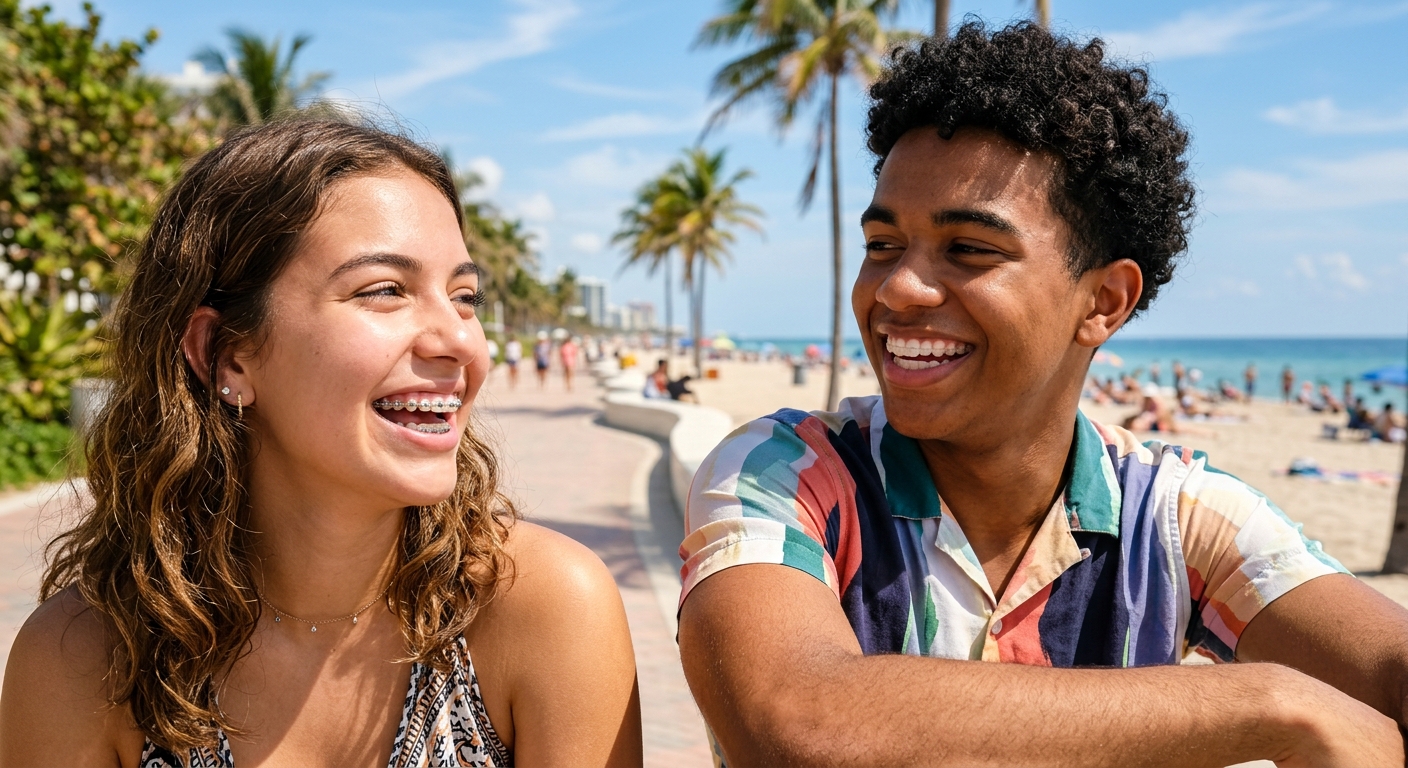
Braces vs Invisalign for Teens in Broward County
Every parent in Broward County hits the same wall at some point: your teen needs orthodontic treatment, and suddenly you're staring down two completely different paths — traditional braces or Invisalign.
Which one actually works better for teenagers?
Which one fits your kid's life, their sports schedule, their self-consciousness about their smile?
And more importantly — which one gives you real results without wasting time or money?
I'm going to break all of that down for you right here, no fluff, no runaround.
The Real Difference Between Braces and Invisalign for Teens
Let's keep it simple.
Traditional braces use metal or ceramic brackets bonded directly to your teen's teeth, connected by wires that slowly shift everything into place.
They stay on 24/7. There's no option to remove them. And that's actually a feature, not a flaw — more on that in a second.
Invisalign uses a series of custom clear aligners your teen swaps out every one to two weeks.
They're nearly invisible. They come out for meals and brushing. And when worn consistently — at least 20 to 22 hours a day — they produce real, measurable results.
Both are legitimate, proven options.
The right choice depends on your teen's specific bite issues, lifestyle, and yes — their ability to stay disciplined.
When Braces Are the Better Call
If your teen has a deep bite, significant crowding, rotations, or jaw alignment issues, metal braces are often the stronger tool.
Here's why:
- Braces apply constant, controlled force around the clock
- They handle complex tooth movements that aligners can struggle with
- There's zero compliance required — they just work
- They're built tough enough for teens who play contact sports at schools like Marjory Stoneman Douglas High or Cypress Bay High
At SMILE-FX Orthodontics in Miramar, FL, the team uses an advanced FX AI Braces system with 3D-printed components — which means the precision goes way beyond what a standard bracket-and-wire setup delivers at a general dentist's office.
Ceramic braces are also an option for teens who want a more subtle look but still need the strength of fixed appliances.
Think of it this way: if the case is complex, you want the tool that gives your provider the most control. Braces do that.
When Invisalign Makes More Sense
For teens with moderate spacing, mild crowding, or aesthetic concerns — especially heading into high school where confidence matters — Invisalign Teen can be a game-changer.
Here's what parents from Pembroke Pines, Hollywood, and Weston tell us all the time:
- Their teen actually wore the aligners consistently because they didn't feel embarrassed
- School photos, prom, beach days — no metal in sight
- Eating was easy — remove the trays, eat whatever, brush, put them back in
- Hygiene improved because there were no brackets trapping food
SMILE-FX is a top 1% Invisalign provider and a Pink Diamond OrthoFX provider.
That's not a marketing badge — it reflects actual case volume and outcome quality.
The aligners used here are custom 3D-printed, not the generic trays you'd get from a mail-order kit or a general dentist who occasionally does Invisalign on the side.
Want to see if your teen is a candidate? Take the Smile Quiz — it takes two minutes.
What Most Parents Get Wrong About This Decision
The biggest mistake I see is parents treating this like a lifestyle choice instead of a clinical decision.
"My teen wants Invisalign because it's invisible" — that's valid input, but it can't be the only input.
A severe bite issue treated with aligners alone, by someone without the expertise to manage it, can drag on for years or produce incomplete results.
That's why who is doing the treatment matters as much as what they're using.
Dr. Tracy Liang at SMILE-FX is a Diplomate of the American Board of Orthodontics — a credential held by only 30% of practicing orthodontists in the country.
She oversees every single treatment plan using AI-assisted precision and remote monitoring technology that cuts in-office visits by 40%.
For families in Davie, Cooper City, or Fort Lauderdale making the drive to Miramar — that means fewer trips, faster progress, and better outcomes.
You can learn exactly what sets this practice apart at the how we're different page.
Broward County Teens Have Specific Needs
South Florida is not a generic market.
Teens here are involved in year-round sports leagues, beach culture, competitive academics, and social environments where how they look matters to them.
That creates real, specific orthodontic considerations:
- Sports-active teens from schools like Nova High or West Broward High often need braces that can handle physical contact or Invisalign with a proper mouthguard protocol
- Image-conscious teens heading into high school frequently lean toward clear aligners or ceramic braces
- Teens with complex bites — deep bites, open bites, crossbites — need a provider with the technical skill to manage those cases, not just hand over a tray kit
At SMILE-FX, the full range of treatable cases is covered — from simple alignment to surgical orthodontics for the most complex presentations.
The Cost Conversation Nobody Wants to Have
Let's talk numbers because this always comes up.
In Broward County, orthodontic treatment typically runs:
- Braces: $3,500 to $7,500 depending on case complexity
- Invisalign: Similar range, based on the number of aligners and treatment length
SMILE-FX offers interest-free financing options, so the monthly cost becomes manageable for most families.
The thing most people don't account for is the cost of a bad outcome.
Retreatment — fixing work that was done incorrectly or incompletely — is more expensive, more time-consuming, and more frustrating than getting it right the first time with a board-certified specialist.
That's the investment worth making.
Why Families Across Broward Drive to SMILE-FX in Miramar
It keeps coming up in conversations with parents: they drove past local options to come here.
From Pembroke Pines — 15 minutes via I-75.
From Weston — 10 minutes via I-75.
From Hollywood — 20 minutes via Stirling Road.
From Fort Lauderdale — 25 minutes via I-95.
The reason is consistent: they wanted a specialist, not a generalist.
They wanted Dr. Liang's ABO credentials, the in-house 3D printing technology, the VIP Tech Suite with VR immersion for anxious teens, and the airway-focused evaluations using 3D CBCT scanning that most local offices simply don't offer.
You can check out real feedback from families just like yours at the patient reviews page.
So Which One Is Right for Your Teen?
Here's the honest answer: you need a clinical evaluation to know for certain.
But here's a framework to start with:
- Complex bite issues, jaw problems, or severe crowding — braces are likely the stronger choice
- Moderate spacing or alignment with a disciplined teen — Invisalign can absolutely deliver
- Teen who won't wear aligners consistently — braces remove that variable entirely
- Aesthetic concerns are a top priority — ceramic braces or Invisalign both address that
The most important thing is getting a real evaluation from someone qualified to give you a real answer.
Not a free consultation that's really just a sales pitch. A legitimate clinical assessment with 3D imaging and a clear treatment plan.
That's exactly what SMILE-FX delivers — and right now, you can book a FREE 3D scan and VIP Smile Consultation here.
Whether your teen needs braces, Invisalign, or something more, the team at SMILE-FX: Orthodontic and Clear Aligner Studio in Miramar, FL is the most qualified practice in Broward County to guide that decision — for teens, kids, and adults alike.
What Happens After You Choose: The Orthodontic Treatment Journey for Broward County Families
Most parents spend all their energy on the braces vs. Invisalign debate and then get completely blindsided by what comes next.
What does treatment actually look like month to month?
How do you keep your teen on track?
What happens if something goes wrong mid-treatment?
And what does life look like after the braces come off or the last aligner tray is done?
These are the questions that matter just as much as which treatment you pick, and most offices skip right over them.
Let me walk you through all of it.
The First 30 Days of Orthodontic Treatment for Teens
The first month is always the adjustment period, and knowing what to expect makes it a whole lot easier.
With braces, your teen will feel pressure and mild soreness for the first few days after each adjustment appointment.
Soft foods become their best friend.
Brackets can occasionally rub against the inside of the cheek until the mouth toughens up.
Orthodontic wax handles that problem immediately.
With clear aligners, the first tray tends to create the most noticeable pressure because the teeth haven't started moving yet.
That fades within a day or two.
The bigger challenge in month one with aligners is building the habit of putting them back in after every meal.
That habit either gets formed early or it doesn't, and it makes a massive difference in whether treatment finishes on time.
Does My Teen Really Need to Wear Aligners 22 Hours a Day?
Yes.
This is not a guideline. It's a requirement.
The math is simple: aligners only move teeth when they're on the teeth.
Every hour they're sitting on a lunch tray or a bathroom counter is an hour of zero progress.
Teens who consistently wear aligners 20 to 22 hours a day finish treatment close to their projected timeline.
Teens who wear them 14 to 16 hours a day end up needing extra trays, extra time, and extra appointments.
That's not a scare tactic. That's just how the biology of tooth movement works.
At SMILE-FX, the remote monitoring system actually tracks progress between visits, so if a teen is falling behind, the team catches it early and adjusts the plan before it becomes a bigger problem.
What About Kids Who Are Not Teens Yet — Is It Too Early?
This question comes up constantly from parents in Miramar, Pembroke Pines, and Weston with kids in elementary and middle school.
The short answer is that early evaluation matters a lot more than most people realize.
The American Association of Orthodontists recommends an orthodontic screening by age seven.
Not because seven-year-olds need braces, but because some jaw and bite issues are significantly easier to treat while the face is still growing.
Catching a crossbite, a narrow palate, or a developing underbite early can prevent much more invasive treatment later.
It can also shorten overall treatment time when the teen years arrive.
At SMILE-FX, the team evaluates kids at all stages and only recommends early treatment when there's a genuine clinical reason, not just to start billing sooner.
That honesty matters when you're choosing where to take your kid.
Orthodontic Treatment for Adults in Broward County Is More Common Than You Think
Here's something that surprises a lot of people: adults make up a significant portion of orthodontic patients today.
In Broward County, I see parents come in for their own consultations after bringing their teen in for one.
They had braces as a kid, the teeth shifted after years without a retainer.
Or they never got treatment and just learned to live with a bite that causes jaw tension, uneven wear, or a smile they've always been self-conscious about.
Clear aligners changed the adult orthodontics picture completely.
The ability to straighten teeth without anyone at work or in a social setting noticing is a legitimate reason adults who never considered treatment are now doing it.
The clear aligner options at SMILE-FX are built for adults who want results without disrupting their professional or personal lives.
And for adults with more complex bite issues, the braces options here include ceramic and advanced AI-assisted systems that are far more refined than what existed 20 years ago.
What Technology Actually Changes About Your Treatment
Most people assume orthodontics is orthodontics.
Wire goes in, teeth move, you come back every six weeks.
That model is outdated.
The cutting-edge technology at SMILE-FX changes the experience in ways that are worth understanding before you choose a provider.
Here's what actually matters:
- 3D CBCT imaging gives a full picture of the teeth, roots, jaw, and airway before treatment even starts, which means the treatment plan is based on reality, not a guess
- AI-assisted treatment planning maps out tooth movement with a level of precision that manual methods cannot match
- Remote monitoring means the clinical team can track progress between visits and catch problems before they extend treatment
- In-house 3D printing means aligners and components are made to exact specifications, not mass-produced and shipped in batches
For families making the drive from Dania Beach, Lauderhill, or Tamarac, that level of technology means fewer trips and faster, more predictable results.
What Happens When Treatment Ends
A lot of families treat the removal of braces or the final aligner as the finish line.
It's not.
Retention is the part that actually locks in the results permanently.
Teeth have memory.
After years of being in one position, they want to drift back toward where they started.
The retainer is what prevents that.
Here's what proper retention looks like:
- Most patients wear retainers full-time for the first few months post-treatment
- After that, nighttime wear becomes the standard long-term protocol
- Fixed retainers bonded behind the front teeth are often used in combination with removable ones for the highest level of stability
- Skipping retainer wear, even for a few weeks, can allow noticeable shifting
The adults who come in saying their teeth shifted after childhood treatment almost always have one thing in common: they stopped wearing their retainer.
Getting this right at the end is just as important as everything that happened during treatment.
How to Pick the Right Orthodontist in Broward County
This is the part most guides skip because they don't want to make it about the provider.
But it's the most important variable in your outcome.
Here's what to look for:
- Board certification from the American Board of Orthodontics means the provider completed additional voluntary testing beyond dental school and residency. It's not required. Only about 30% of orthodontists have it.
- High Invisalign case volume matters because clear aligner treatment is a skill set, not just a system. Providers who do one or two Invisalign cases a month are not in the same league as top 1% providers.
- In-house technology tells you a lot about how serious a practice is about precision. If they're still taking plaster molds and using traditional X-rays only, that's a gap worth noting.
- A treatment plan that is explained clearly before you commit is non-negotiable. You should understand exactly what is being done, why, and how long it will take.
SMILE-FX checks every single one of those boxes, and then some.
The Airway Connection Most Orthodontists Miss
Here's something that almost never comes up at a standard orthodontic office: the link between jaw development, bite alignment, and airway health.
Narrow arches and misaligned bites can contribute to restricted airways, which affects sleep quality, breathing patterns, and even focus and behavior in kids and teens.
The 3D CBCT scans used at SMILE-FX are not just for mapping tooth position.
They also give a clear picture of the airway, which means issues that might otherwise go unnoticed for years get flagged early.
For parents who have noticed their teen snoring, mouth breathing, or struggling with sleep, this is worth asking about specifically.
It is one of the areas where a specialist with advanced imaging technology provides something a general dentist simply cannot.
Still Not Sure Where to Start?
That's completely normal.
Orthodontic treatment is a multi-year commitment and a real financial investment.
You should feel confident before you say yes to anything.
The Smile Quiz on the SMILE-FX website takes about two minutes and gives you a starting point based on your specific situation.
Or if you want to skip straight to answers, a virtual consultation is available at this link so you can get real feedback from the team without leaving your house first.
But if you are ready to get a full clinical picture with 3D imaging and a clear, honest treatment plan, there is one obvious next step.
Book a FREE 3D scan and VIP Smile Consultation at SMILE-FX here.
For teens, kids, and adults across Broward County, SMILE-FX: Orthodontic and Clear Aligner Studio in Miramar, FL is the practice that brings board-certified expertise, advanced imaging, and real precision to every single case, whether that's braces, Invisalign, or clear aligners.
The best time to get a proper evaluation for your teen, your child, or yourself is before the problem gets harder to fix.
The Real Cost of Getting Orthodontics Wrong in South Florida
Here is the question nobody asks until it is too late: what does it actually cost when you pick the wrong orthodontist?
Not just in dollars, though that part stings plenty.
In time. In extra appointments. In redoing treatment that was done halfway.
If you are searching for the best orthodontist in South Florida for your teen, your kid, or yourself, this is the section of the conversation most offices skip because it does not make them look good.
I am going to give it to you straight.
Does Insurance Cover Braces and Invisalign in Broward County?
This comes up constantly, and the answer is: sometimes, and it depends entirely on your plan.
Here is what most families across Pembroke Pines, Miramar, and Weston actually find:
- Most dental insurance plans with orthodontic benefits cover a lifetime maximum between $1,000 and $2,500 per child
- Coverage for adults is less common but not unheard of
- Many plans only cover treatment that starts before age 18 or 19
- Invisalign is now covered by most plans that cover braces, because it is classified the same way clinically
The gap between what insurance pays and what treatment costs is where financing becomes critical.
Affordable braces in Broward are possible when your provider builds payment flexibility into the process from day one.
SMILE-FX®: Orthodontic and Clear Aligner Studio in Miramar offers interest-free financing with $0 down braces financing options so families from Fort Lauderdale to Dania Beach can get started without a lump sum payment upfront.
The free consultation is also genuinely free, not a soft pitch with a price tag at the end.
Traditional Braces vs Invisalign: The Cost Breakdown Most People Want
People search this comparison constantly, and for good reason.
Here is a realistic picture for Invisalign cost in South Florida and braces in the same market:
- Metal braces: typically $3,500 to $6,500 depending on case complexity and treatment length
- Ceramic braces: slightly higher, usually $4,000 to $7,000
- Invisalign: comparable range, $3,800 to $7,500 based on the number of trays needed and clinical complexity
Clear aligner cost in Miami and across South Florida trends higher with generalist providers who do low aligner volume, because their refinement and revision rates go up.
A top-rated Invisalign provider near you who handles hundreds of cases a year knows how to plan treatment so it finishes on time, which actually keeps costs predictable.
SMILE-FX® is a top 1% Invisalign provider and a board-certified orthodontist in South Florida, which means the clinical outcome you are paying for is backed by the highest credential in the specialty.
What Makes an Orthodontist Worth the Drive Across Broward County
If you are in Aventura, Lauderhill, or Tamarac and you are looking at a 20-minute drive to Miramar, I want to tell you exactly why families make that trip consistently.
It is not about flashy branding.
It is about what the technology and credentials actually do for your result.
The cutting-edge technology at SMILE-FX® includes tools that the majority of local offices, including many that bill themselves as top-rated, simply do not have:
- 3D CBCT scanning for full jaw, root, and airway imaging
- AI-driven treatment simulation that maps out every movement before treatment starts
- In-house 3D printing for aligners and custom components
- Remote monitoring that tracks your progress between visits and flags issues early
This is what separates a top tech-driven orthodontist in Miramar from a practice that ordered an Invisalign scanner and calls itself a provider.
For families asking what the best orthodontist for complex cases looks like in practice, this is the answer.
Orthodontics for Adults in South Florida Is Not a Niche Anymore
Adult orthodontics in Aventura, Miami, and across Broward County has grown dramatically, and the reason is simple.
Clear aligners removed the social barrier.
Adults who would never have considered metal brackets in a boardroom or at a client dinner are now finishing treatment they put off for 20 years.
But adult cases come with a different set of considerations:
- Bone density is different from teen biology, so movement requires precise force and timeline management
- Gum health matters more, and a board-certified specialist screens for periodontal issues before starting treatment
- Many adult cases involve prior dental work, crowns, or missing teeth that require coordinated care
The clear aligner options at SMILE-FX® are built for adults who want results that fit their real life, not a treatment protocol designed for a 14-year-old.
And for adults with bite complexity, the braces systems here use AI-assisted precision that is nothing like the bracket-and-wire setup from two decades ago.
The Best Pediatric Orthodontist in South Florida Starts Early
Here is something most parents do not know until a problem is already obvious: the best time for an orthodontic screening is age seven.
Not because a seven-year-old needs braces.
Because that is when trained eyes can spot jaw development patterns, bite issues, and skeletal concerns that are far easier to manage before the face finishes growing.
A narrow palate caught at eight can often be corrected with a simple expander before it causes crowding that requires extractions at fourteen.
An underbite caught early can be guided in a direction that prevents surgical options later.
The full range of treatable cases at SMILE-FX® includes early treatment planning for kids and phased treatment that coordinates childhood intervention with full orthodontics in the teen years.
That kind of long-term thinking is what a board-certified specialist in South Florida brings that a general dentist adding orthodontics to the menu simply cannot.
How to Know You Are Choosing the Right Provider
If you are Googling best orthodontist near me or top-rated orthodontist in Fort Lauderdale, here is a fast checklist to cut through the noise:
- Are they a board-certified orthodontist, not just a general dentist offering braces on the side?
- Do they use 3D imaging or are they still working from flat X-rays and impressions?
- Is their Invisalign case volume high enough to qualify as a top provider?
- Do they explain the treatment plan clearly before you commit to anything?
- Are financing options transparent and flexible?
SMILE-FX® meets every single one of those benchmarks, and the patient reviews back it up from families across Miami-Dade and Broward County.
Whether you are looking for affordable braces in Miramar, a SureSmile orthodontist in South Florida, or a provider who handles the most complex bite cases from Miami to Palm Beach, the answer is the same practice.
Start with two minutes on the Smile Quiz to get a sense of where your case stands.
Then take the next step and book a FREE 3D scan and VIP Smile Consultation at SMILE-FX® here.
For anyone in Broward County or South Florida looking for the best orthodontist for teens, kids, or adults, SMILE-FX®: Orthodontic and Clear Aligner Studio in Miramar, FL is the practice that delivers board-certified expertise, real technology, and outcomes that hold up long after treatment ends.