
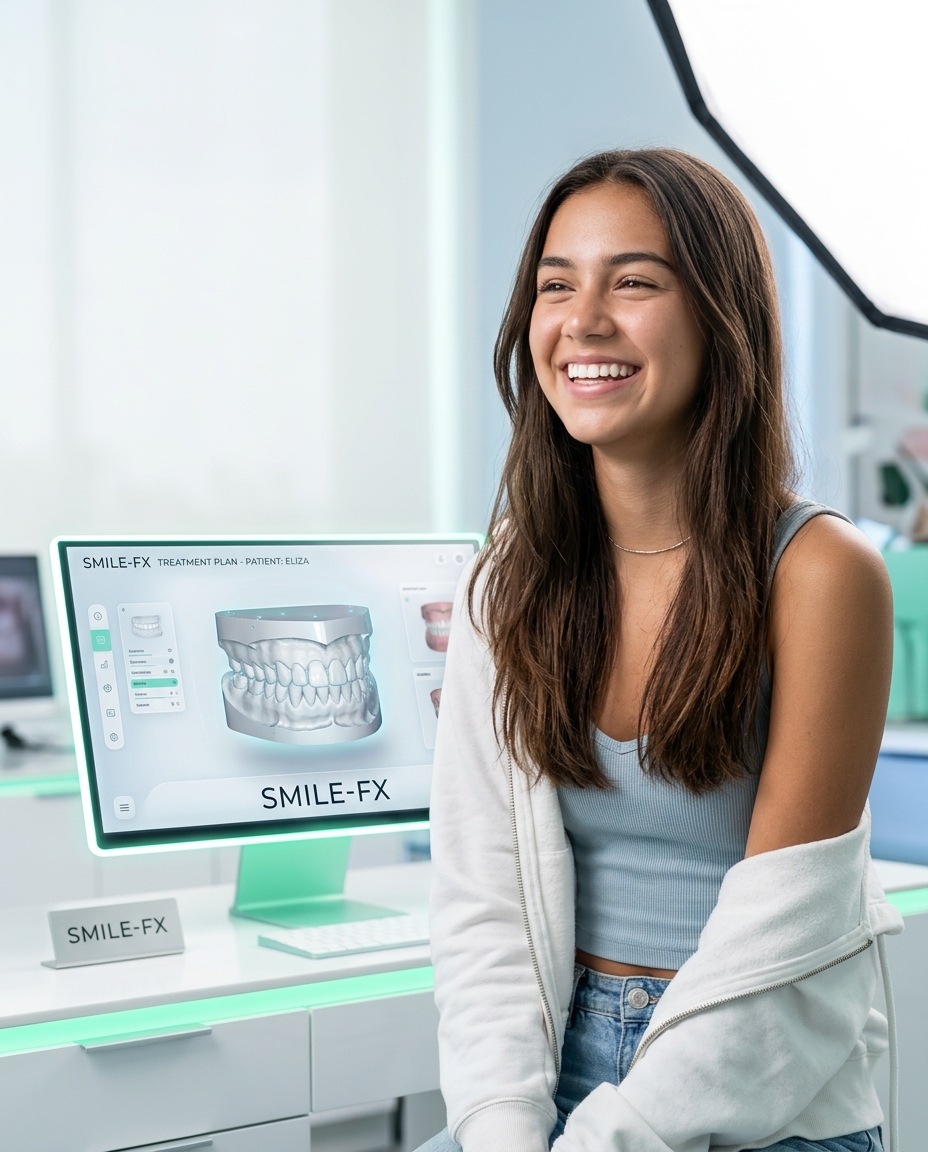

AI BRACES by SMILE-FX Definitive Guide
Orthodontics isn't just about bending wires anymore. If you walked into a clinic a decade ago, you’d sit in the chair, a doctor would manually assess your teeth, swap out a wire, and essentially say, "We'll see how this moves by next month." It was highly reactive. Fast forward to the digital landscape of 2026, and the entire paradigm has shifted from reactive adjustments to proactive, data-driven foresight. The introduction of artificial intelligence into dental care isn’t just a buzzword—it's completely reshaping the predictability of treatment.
But let’s cut through the noise. What does "AI" actually mean when you’re sitting in an orthodontic chair? It doesn't mean a robot is gluing brackets to your teeth. Instead, it refers to advanced algorithmic software that assists a Board Certified Orthodontist in mapping out the exact trajectory of every single tooth. This is precisely what the SMILE-FX® AI Braces™ System is designed to do. It marries decades of clinical expertise with massive datasets of tooth movement to help create a highly tailored, highly efficient plan.
Patients seeking AI Braces™ by SMILE-FX® benefit from a workflow that is heavily front-loaded. We figure out the end result before we even begin. It’s an intricate dance of biology and technology. You push a tooth here, the root moves there. The software helps us see the invisible—the root structures, the bone density, the eventual collision of teeth if we take the wrong path. By visualizing this digitally, we can bypass the trial-and-error phase that used to be a staple of traditional braces.
What “AI BRACES™” Means in Orthodontics (And What It Doesn't)
There is a lot of misinformation out there. Some folks assume AI braces implies some futuristic, self-tightening metal in your mouth. Not quite. The hardware—the brackets and the wires—might look relatively similar to what you’ve seen before, though often smaller and more refined. The true innovation happens behind a computer screen.
When we talk about SMILE-FX® AI Braces™, we are talking about the ecosystem of planning. A traditional workflow relies heavily on 2D X-rays and the human eye to gauge how a wire will express force on a bracket. But human eyes can't compute thousands of micro-movements simultaneously. An AI-assisted software platform can. It takes the digital replica of your mouth and runs simulations based on millions of previous orthodontic cases to suggest the optimal sequence of wire changes and bracket placements.
However, AI is completely blind to context. It doesn't know if you grind your teeth at night. It doesn't know if your jaw joints (TMJ) click when you chew. It doesn't know your aesthetic preferences regarding your smile arc. This is why the technology never operates in a vacuum. It requires a human pilot—a Board Certified specialist—to review the algorithmic suggestions, reject the ones that don't make biological sense, and fine-tune the master plan. The machine does the heavy computational lifting; the doctor makes the clinical decisions.
The Anatomy of the SMILE-FX® AI Braces™ System
So, how does this actually play out when you become a patient? The process is distinct from traditional methods right from the first day. The SMILE-FX® AI Braces™ System operates on a heavily structured, step-by-step digital pipeline.
Phase 1: The Digital Twin
Gone are the days of biting into goopy, gag-inducing impression trays. We start by capturing a flawless, 3D replica of your mouth using cutting-edge optical scanning technology, such as Trios or iTero scanners. This scan takes thousands of pictures per second to stitch together a highly accurate topographic map of your teeth and gums. We pair this with specialized low-dose 3D X-rays (CBCT) to see exactly where the roots of your teeth sit in your jawbone.
Phase 2: Algorithmic Planning
Once your digital twin is uploaded into the system, the AI goes to work. It segments each individual tooth, separating the crown from the gum line. It then calculates the most efficient path from where your teeth are right now to where they need to be. It helps the orthodontist decide precisely where to place each bracket to achieve the ideal torque and angulation. If a tooth needs to rotate 12 degrees, the software helps us calculate the exact bracket positioning required to express that specific movement with the first wire.
Phase 3: Custom Fabrication and Indirect Bonding
In a traditional setup, an orthodontist manually glues each bracket to your teeth, eyeballing the placement. With our system, the placement is determined digitally. We then use in-house 3D printing to create a custom transfer tray. This tray holds all the brackets in their exact, digitally planned positions. When we place the tray in your mouth, all the brackets are bonded simultaneously. It’s faster, vastly more comfortable, and removes human error from the placement equation. Precision is everything.
Monitoring Progress: Remote Tech and In-Office Synergy
You’ve got the braces on. Now what? Historically, you'd come into the office every 4 to 6 weeks so the doctor could take a look and decide the next step. But biology doesn't operate on a strict 6-week schedule. Sometimes your teeth move faster; sometimes a specific tooth gets stubborn.
This is where remote dental monitoring platforms—like Grin or Dental Monitoring—come into play within the AI Braces ecosystem. Using a specialized ScanBox and your own smartphone, you take a quick video of your teeth weekly from your couch. The AI analyzes your video, comparing your current tooth positions against the 3D treatment plan we built on day one.
If the AI detects that a wire has stopped expressing force, or if it spots early signs of gum inflammation, it alerts our clinical team. We can then tell you, "Hey, it's time to come in for your next wire." Conversely, if your teeth are tracking perfectly and the current wire is still doing its job, we might say, "You're looking great, let's skip the office visit this month and let the wire keep working." This often means fewer overall office visits, less time missing school or work, and a treatment plan that adapts to your actual biology rather than a calendar.
AI BRACES™ vs Traditional Braces vs Clear Aligners
Patients constantly ask how this approach stacks up against traditional metal braces and clear aligners like Invisalign®. It’s a fair question. Let's break down the nuances.
Against Traditional Braces:
Traditional braces are a phenomenal tool. They have straightened millions of smiles. But they rely heavily on reactive adjustments. The doctor places a standard bracket in a standard position and bends the wire to compensate for your unique anatomy. The SMILE-FX® AI Braces™ approach flips this. By customizing the plan digitally upfront, we rely less on manual wire bending and more on the programmed prescription of the bracket itself. This often results in a smoother experience and can sometimes reduce the overall treatment timeline, simply because we eliminate the "detours" of unintended tooth movements.
Against Clear Aligners:
Clear aligners are incredibly popular, especially for adults looking for discretion. Interestingly, aligner therapy has used a form of digital planning for years. The difference is the delivery mechanism. Aligners rely on pushing the teeth with plastic, which is highly dependent on patient compliance (you have to wear them 22 hours a day, no exceptions). Furthermore, certain complex movements—like pulling a severely impacted canine down into the arch, or heavy root torquing—can be biologically difficult for plastic to achieve efficiently.
AI Braces offer the best of both worlds: the extreme precision of digital, AI-backed software planning, combined with the continuous, unyielding biomechanical control of fixed brackets and wires. You don't have to remember to wear them, and they are capable of handling the most complex bite corrections with absolute authority.
Tackling Complex Cases: Crowding, Overbites, and Spacing
Not all orthodontic challenges are created equal. How the software models a solution depends entirely on the specific malocclusion (bite issue) you bring to the table.
When dealing with severe crowding, the primary issue is a lack of real estate. Traditional methods sometimes lean toward extracting healthy teeth to make room. While extractions are still occasionally necessary for severe skeletal discrepancies, AI-assisted planning allows us to simulate different scenarios before touching a tooth. We can digitally test arch expansion (widening the smile) or IPR (Interproximal Reduction—safely polishing fractions of a millimeter between teeth to create space). The software visualizes the exact amount of space gained, helping us avoid extractions whenever biologically possible.
Overbites and underbites are usually skeletal issues combined with dental issues. Fixing an overbite isn't just about tilting the front teeth back; it requires careful coordination of the upper and lower jaws. In our digital planning, we can model the usage of rubber bands (elastics) to see how the bite will settle. This predictive modeling is crucial because it ensures that when the front teeth look perfectly straight, the back teeth mesh together like gears in a watch. A beautiful smile is useless if you can't chew your food properly.
Cost, Financing, and The Value of Predictability
Let’s talk numbers, because it’s always top of mind. A common assumption is that because the SMILE-FX® AI Braces™ System utilizes high-end 3D scanning, 3D printing, and algorithmic software, it must cost significantly more than traditional treatment.
The reality is quite different. While the upfront technology investment for the clinic is substantial, the efficiency it brings offsets much of the cost. Fewer emergency visits for broken brackets (due to precise, customized placement) and a streamlined treatment sequence mean less chair time for you. Therefore, the overall fee for AI-assisted braces is typically very comparable to traditional braces or comprehensive clear aligner therapy.
Your exact cost will depend on individual factors: the complexity of your bite, the anticipated duration of treatment, and whether you require complementary appliances (like palatal expanders). At SMILE-FX®, we believe financial surprises are the worst kind of surprises. During your initial consultation, once the doctor has reviewed your digital records, you will receive a transparent breakdown of the costs. We routinely help patients navigate flexible financing options, HSA/FSA utilization, and insurance benefits to ensure that advanced care remains accessible.
Safety, Oversight, and YMYL (Your Money or Your Life) Standards
Because orthodontics directly affects your facial structure, airway, and oral health, it falls strictly under the category of healthcare where safety cannot be compromised. The term "artificial intelligence" can sometimes conjure ideas of automated medicine without oversight. We want to be incredibly clear: AI does not diagnose, and AI does not treat.
The software is a high-powered calculator. It is a navigational aid. Just as a commercial airline pilot relies on advanced avionics to fly through a storm safely, our Board Certified Orthodontists rely on the SMILE-FX® AI Braces™ System to navigate complex bite corrections. But the doctor is always in the driver's seat. Every single treatment plan is manually reviewed, scrutinized, altered, and ultimately approved by a human doctor before your braces are made.
This oversight is crucial because biological responses vary. While an algorithm might predict a tooth will move 1 millimeter in 4 weeks, your specific bone density might dictate a different reality. The integration of remote monitoring allows our clinical team to maintain a constant, watchful eye over your biological response, ensuring that the treatment remains safe, comfortable, and on track. We do not guarantee unrealistic timelines or "pain-free" miracles—tooth movement naturally involves temporary soreness—but we do provide a highly managed, scientifically backed approach to your care.
Hygiene and Lifestyle with Your New Braces
Getting AI Braces doesn't exempt you from the fundamental rules of orthodontic maintenance. Your role in the process is just as critical as the software's. Plaque doesn't care how advanced your treatment plan is; if it sits around a bracket, it will cause decalcification (white spots) and cavities.
Brushing and flossing require adaptation. We strongly recommend investing in a high-quality electric toothbrush and a water flosser. These tools make navigating around the brackets and wires significantly easier. When it comes to diet, the classic rules still apply: avoid anything excessively sticky, chewy, or hard. Popcorn kernels, ice, and sticky candies are the enemies of orthodontic hardware. A broken bracket halts tooth movement and requires a detour from our carefully mapped digital plan. Consistency with your oral hygiene and dietary choices ensures that the advanced technology can do its job without interruption.
Retention: Protecting Your Investment
Imagine going through the entire process, getting your braces off, marveling at your new smile in the mirror, and then tossing your retainer in a drawer and forgetting about it. Within months, your teeth would begin their subtle migration back to their original crowded or gapped positions. This is known as orthodontic relapse.
The biological reality is that teeth have a memory, rooted in the periodontal ligaments that connect them to the bone. After active treatment concludes with the SMILE-FX® AI Braces™ System, the retention phase begins. It is arguably the most important part of your journey. We utilize the same precise 3D scans to fabricate highly accurate, comfortable retainers. Wearing these exactly as prescribed by your orthodontic team is the only way to safeguard your results long-term. Orthodontics gives you the smile; retention keeps it.
Key Takeaways: Understanding the System
To summarize the core differences and benefits of this digital workflow, here is a breakdown of what you can expect:
| Feature of the System | How It Benefits the Patient |
|---|---|
| Predictive 3D Modeling | Eliminates much of the guesswork, allowing doctors to visualize the final outcome and potential roadblocks before treatment starts. |
| Indirect Bracket Bonding | Custom 3D-printed trays allow for simultaneous, mathematically precise bracket placement, making the bonding appointment faster and more comfortable. |
| Remote Dental Monitoring | Weekly smartphone scans help the clinic track your biological progress in real-time, often reducing unnecessary in-office visits. |
| Algorithmic Efficiency | By reducing unintended tooth movements ("round-tripping"), the workflow can often streamline the overall treatment timeline based on individual factors. |
| Doctor Oversight | The AI acts as an advanced tool, but all clinical decisions, safety checks, and plan approvals are executed by a Board Certified specialist. |
Where Everything Connects: Your Next Steps
Making a decision about your orthodontic care shouldn't feel like a leap in the dark. You deserve to understand exactly what is happening in your mouth, why certain decisions are being made, and what the roadmap looks like. The integration of artificial intelligence into our practice isn't about replacing the human element—it’s about enhancing it. It gives our specialists a superpower of foresight, and it gives you a more transparent, predictable, and comfortable experience.
If you're wondering whether this specific digital approach is the right fit for your unique bite, the best way to find out is to see the technology in action. By scheduling a free consultation, you can get a firsthand look at your own 3D digital scan and sit down with our team to explore your personalized options without any pressure.
Frequently Asked Questions
1. Does the AI Braces system guarantee a faster treatment time?
No system can guarantee a specific speed because tooth movement relies heavily on individual biology and bone density. However, the advanced planning often reduces inefficient tooth movements, which may streamline your overall timeline compared to reactive, traditional approaches.
2. Is the placement of the brackets painful?
The bonding process itself is entirely painless—no needles or drills are involved. Because we use 3D-printed indirect bonding trays to place the brackets simultaneously, the time you spend with your mouth open is significantly reduced, making it much more comfortable.
3. Can adults use the SMILE-FX® AI Braces™ System?
Absolutely. In fact, many adults prefer this system. The combination of precise digital planning and remote monitoring is highly convenient for busy adult schedules, as it often means fewer disruptions for in-office appointments.
4. How often will I need to visit the office?
Visit frequency varies based on your individual plan and progress. By utilizing remote monitoring technologies from your smartphone, we can often space out in-person visits to 8, 10, or even 12-week intervals, bringing you into the clinic only when a physical wire change or adjustment is actually necessary.
5. Will my dental insurance cover this type of treatment?
If your dental insurance plan includes orthodontic benefits, those benefits typically apply to AI-assisted braces just as they would for traditional braces. Our financial coordinators will verify your benefits and help maximize your coverage during your consultation.
6. What happens if I break a bracket between appointments?
If a bracket comes loose or a wire pokes, you can immediately send us a scan or photo through your remote monitoring app. Our clinical team will assess the issue remotely and instruct you on whether it requires an immediate repair visit or if it can wait until your next scheduled check-in.
Ready to See the Future of Your Smile?
Experience the precision of advanced orthodontic planning for yourself. Connect with our expert team to get your questions answered and review your customized digital map.
Disclaimer: The information provided in this article is for educational purposes only and does not constitute personal medical advice. Orthodontic outcomes, treatment speeds, and comfort levels vary significantly from patient to patient based on individual biological factors, complexity of the case, and patient compliance. Always consult with a qualified, licensed orthodontic professional regarding your specific dental health needs.