
AI BRACES by SMILE-FX Definitive Guide
Look in the mirror for a second. Notice that slightly out-of-place incisor? It’s funny how a single millimeter of tooth positioning can completely dictate the way we feel about our smiles in photographs. For decades, the journey to a straighter smile meant surrendering to a somewhat unpredictable process of tightening, waiting, and hoping for the best. But things are changing, and honestly, it’s about time.
The conversation around orthodontics has shifted massively over the last couple of years. We aren't just talking about wires and brackets anymore; we're talking about digital mapping, predictive software, and highly personalized treatment architectures. SMILE-FX® recently introduced the SMILE‑FX® AI Braces™ into their clinical workflow, blending the undeniable expertise of Board Certified Orthodontists with the heavy-lifting computational power of modern technology.
So, what does this actually look like for you, sitting in the patient chair? Let’s strip away the technical jargon and break down exactly what this means for your teeth, your time, and your peace of mind.
What “AI BRACES” Actually Means Today
When you hear the phrase "artificial intelligence," your mind probably jumps to sci-fi movies or chatbots. In the world of orthodontics, however, it’s much more grounded in reality. AI, in this context, is essentially an incredibly advanced navigational tool for your orthodontist.
Patients seeking AI Braces™ by SMILE‑FX® benefit from a system where millions of data points from previous orthodontic cases are analyzed to help map out tooth movement. Traditional methods often relied heavily on the naked eye and manual adjustments—which, while effective in skilled hands, leaves room for human fatigue or minor inefficiencies. By incorporating AI-assisted treatment planning, the orthodontist can visualize the projected biological pathways of your teeth before a single bracket is even bonded.
Does this mean a computer is doing the work? Absolutely not. Think of it like a commercial airline pilot using an advanced autopilot system. The pilot (your Board Certified Orthodontist) is still entirely in command, making the clinical decisions, setting the course, and adjusting for turbulence. The AI simply provides a hyper-detailed topographical map to help get you there as smoothly as possible.
The Mechanics of the SMILE‑FX® AI Braces™ System
Getting started with the SMILE‑FX® AI Braces™ System feels distinctly different from the orthodontic appointments you might remember from childhood. The days of choking on foul-tasting alginate putty for dental impressions are, thankfully, mostly behind us.
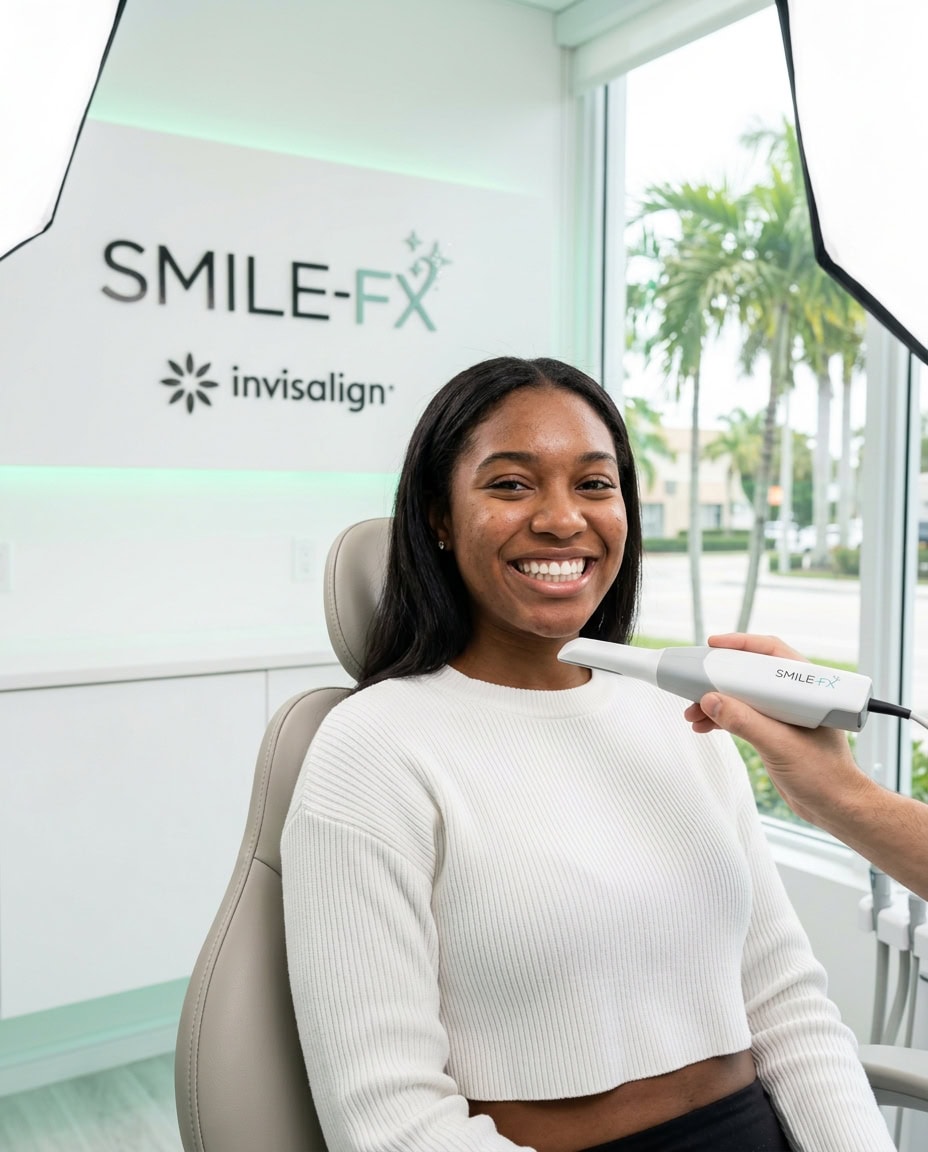
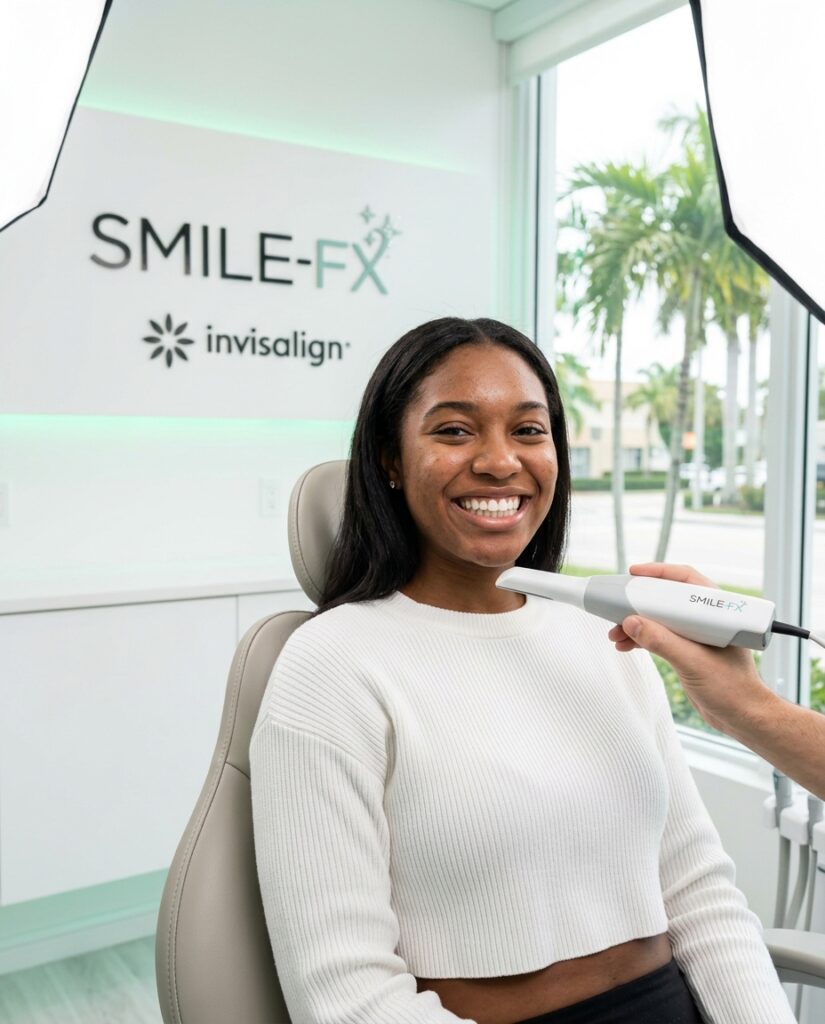
Instead, your journey usually kicks off with a digital wand. High-tech optical scanners—like the iTero® or Trios systems—take thousands of pictures per second inside your mouth. This paints a perfect, full-color 3D rendering of your bite on a monitor right in front of you. It’s pretty wild to see your own teeth digitized in real-time.
Once that digital twin of your mouth is created, the software gets to work. It helps the clinical team simulate the optimal placement for every individual bracket. Because every tooth has its own unique topography, placing a bracket off by even a fraction of a millimeter can change the way the wire interacts with it. The digital planning phase aims to reduce these variables, which may often lead to fewer repositioning appointments later down the line.
Traditional Hardware vs. Digital Workflows
A lot of people ask us how this compares to the old-school metal braces. Visually, you might not notice a massive difference from the outside—you’re still wearing brackets and wires. The magic is entirely in the prep work and the custom wire bending.
In a traditional setup, standard brackets are placed, and standard wires are used to slowly wrangle the teeth into an arch. With AI-assisted workflows, the exact prescription required to move your specific tooth is calculated digitally. This means the force applied by the wires can be highly customized. Many patients find that this planned approach optimizes comfort, though some initial soreness is always normal whenever teeth begin to shift.
Of course, this isn't the only tech-forward option available. For those who prefer a removable option, clear aligners also utilize robust digital planning. Deciding between the two often comes down to your personal lifestyle, your discipline with wearing removable trays, and the specific biomechanical needs of your bite.
Remote Monitoring: A Major Quality of Life Upgrade
Here is where things get really interesting for busy adults and parents of teens. One of the biggest hurdles of orthodontic treatment has always been the schedule. Taking time off work or pulling a kid out of AP Biology every four weeks for a quick visual check just isn't practical anymore.
Modern setups frequently integrate remote dental monitoring platforms (like Grin). Using a specialized lens that attaches to your smartphone, you can literally take a high-def video scan of your teeth from your couch on a Sunday morning. You send that scan securely to the SMILE-FX® clinical team. They review the AI-sorted data to ensure your teeth are tracking according to the digital plan.
If everything looks great, you might not need to come into the office. If a wire is poking or a tooth is being stubborn, they’ll catch it early and schedule a targeted visit. It’s a beautifully efficient way to respect your time while maintaining intense clinical oversight.
Timelines, Cost, and Setting Realistic Expectations
Let's talk about the elephant in the room: how long is this going to take, and what is it going to cost?
It’s tempting to look for guarantees, but biology doesn't work that way. Your bone density, the severity of your crowding or spacing, and—crucially—your compliance with things like rubber bands all play a massive role in your timeline. What the technology *does* offer is a highly structured roadmap. Because the tooth movements are pre-calculated to minimize unnecessary friction and round-tripping (moving a tooth one way just to move it back later), the treatment pathway is often highly efficient.
As for affordability, you might assume that marrying 3D printing, advanced optical scans, and AI software would make the price skyrocket. Surprisingly, the improved clinical efficiencies often allow practices to keep the costs remarkably similar to traditional comprehensive braces. Plus, most modern clinics offer flexible, zero-interest financing to make the monthly overhead manageable.
Safety First: What Artificial Intelligence Does *Not* Do
With all this talk about algorithms, YMYL (Your Money or Your Life) safety standards are paramount. It is vital to understand what the computer cannot do.
- It cannot diagnose pathology. A digital scan won't tell you if you have active periodontal disease that needs treating before moving teeth.
- It cannot feel bone resistance. An orthodontist understands the tactile reality of jaw structure; a computer only understands pixels.
- It cannot replace clinical judgment. If a tooth isn't tracking, the human doctor must intervene and change the strategy.
This is why the phrase "AI Braces" should never imply an automated medical procedure. It is a deeply collaborative effort between cutting-edge software and human medical residency training.
Key Takeaways
| Concept | What it Means for You |
|---|---|
| Digital Planning | Teeth are mapped in 3D before brackets are placed, aiming for more precise, calculated movements. |
| Goo-Free Impressions | High-speed optical scanners replace uncomfortable traditional putty molds. |
| Remote Check-Ins | Smartphone scans may reduce the number of physical office visits you need to make. |
| Human Oversight | Board Certified Orthodontists review, modify, and approve every single digital plan. |
Six Questions to Ask at Your Consultation
If you're considering setting up a virtual consultation or walking into a clinic for the first time, you need to be an advocate for your own smile. Don't just sit back; engage with the process. Here are a few things you should definitely ask your orthodontic team:
- Based on my 3D scan, what are the primary challenges with my specific bite?
- How does the digital planning workflow address my particular crowding/spacing issues?
- Will I be a candidate for remote monitoring, and how frequently will I need in-office visits?
- What are my responsibilities at home (elastics, hygiene) to keep this plan on track?
- Are retainers included in the estimated cost, and what type do you recommend for my case?
- If a tooth stops tracking according to the software, how is the plan adjusted?
Frequently Asked Questions
Are AI Braces more painful than regular braces?
Discomfort varies based on individual factors. However, because digital planning allows for highly customized, calculated wire forces, many patients report a manageable experience. Some initial tenderness is expected whenever teeth are actively moving.
Can the SMILE‑FX® AI Braces™ System fix severe overbites?
Yes, advanced digital planning is frequently used for complex bite corrections, including overbites and underbites. However, the exact approach depends entirely on your specific anatomical needs, which must be evaluated by your orthodontist.
Do I still need to wear rubber bands?
If your bite requires front-to-back correction, elastics (rubber bands) will likely still be necessary. Technology cannot replace the biological force needed to align your upper and lower jaws.
Is the total cost more expensive?
Pricing heavily depends on the complexity of your case and geographic location. Generally, the cost remains highly competitive with traditional braces, and most practices offer financing options to break up the payments.
How long will my treatment take?
Orthodontic timelines can range anywhere from 6 to 24+ months. While optimized planning aims to create efficient pathways, your unique biology and compliance with the doctor's instructions will ultimately dictate the speed.
Are my results permanent?
Teeth naturally want to shift as we age, regardless of the treatment method. Consistent, long-term retainer wear as prescribed by your orthodontic team is the only way to maintain your newly aligned smile.
Ready to Explore Your Options?
Deciding on orthodontic care is a big step, but you don't have to figure it out alone. Our team is here to answer your questions without any pressure. If you’re curious about how digital planning can map out your new smile, we invite you to take the next step.