
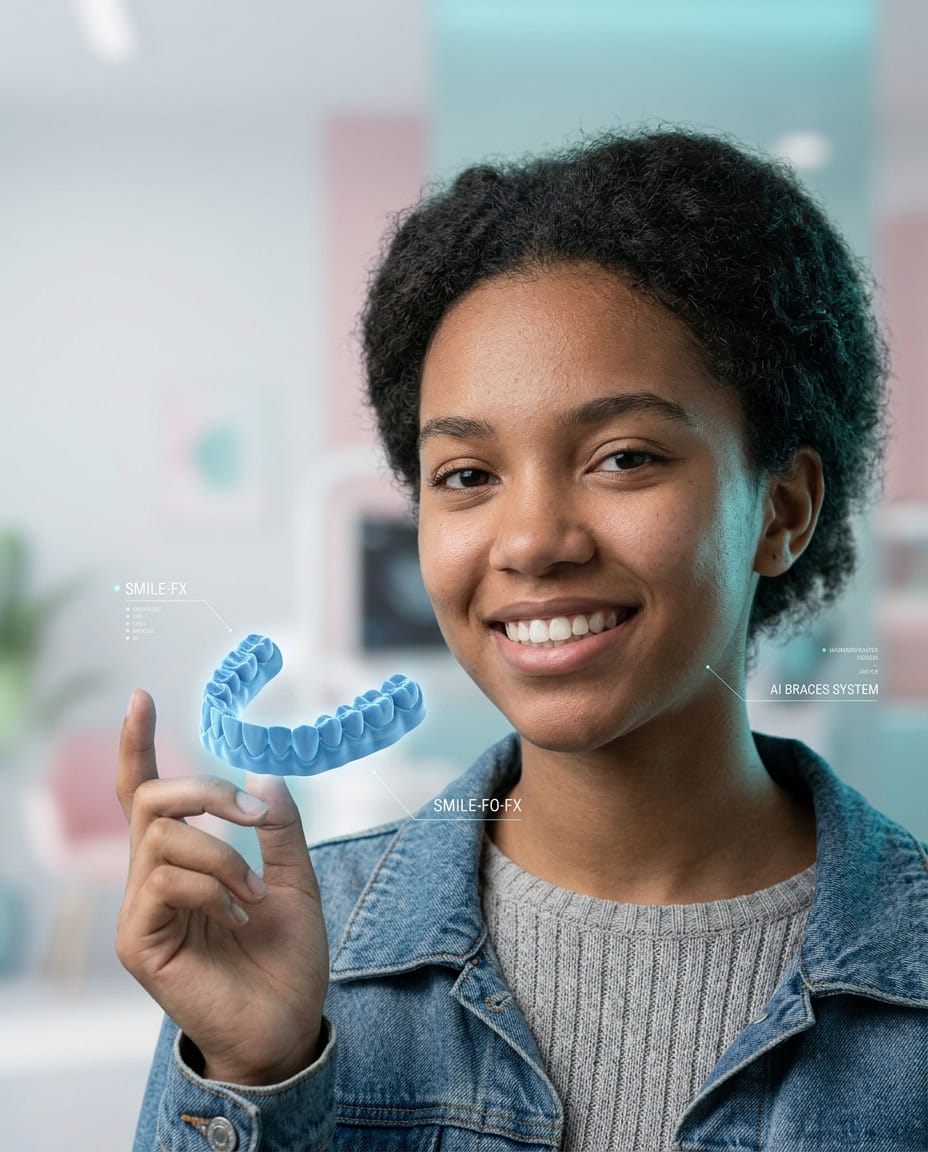
Definitive Guide to AI Braces™ by SMILE-FX®
Think about the last time you navigated a road trip using a folded-up paper map. Hard to imagine now, right? The digital revolution practically rewired how we get from point A to point B—replacing guesswork with calculated, real-time precision. Strangely enough, for decades, orthodontics kind of stayed in the paper-map era. Standard brackets. Eyeballed placements. A lot of "let's wait and see how these teeth move by next month." It worked, but it wasn't exactly hyper-efficient.
Shift gears to today. The landscape has entirely transformed, and if you’re looking into orthodontic care right now, you’ve probably heard the buzz surrounding artificial intelligence. But let’s cut through the noise. What does it actually mean when a clinic says they use AI? Look, nobody actually enjoys the thought of prolonged dental treatments. We all want the same thing: an effective, predictable, and aesthetically pleasing result—safely and efficiently.
That is precisely why we developed the SMILE-FX® AI Braces™ System. It's not some sci-fi gimmick where a robot works on your teeth. Rather, it’s a beautifully orchestrated synergy between cutting-edge computational power and the irreplaceable expertise of a Board Certified Orthodontist. As the proud home of the AI Braces™, we want to pull back the curtain. This comprehensive guide will walk you through exactly how this system operates, why it’s shifting paradigms, and what it truly means for your smile.
What "AI BRACES™" Actually Means in Orthodontics
Let's clear the air right out of the gate. "AI" is a heavyweight buzzword thrown around in almost every industry today, often masking mediocre tech. In the realm of orthodontics, true artificial intelligence isn't about automating the doctor away; it’s about giving that doctor a superhuman set of analytical tools.
Every single mouth is wildly unique. The density of your jawbone, the exact rotation of your lateral incisors, the way your upper and lower arches meet—it’s an intricate biological fingerprint. Historically, an orthodontist would look at a 2D X-ray, take some gooey impressions, and rely on their clinical experience to glue brackets where they thought they’d work best. Then, they’d bend wires manually over the course of two years to course-correct.
When you choose AI Braces™ by SMILE-FX®, that foundational guesswork evaporates. The artificial intelligence we utilize acts as an advanced predictive engine. It ingests millions of data points from 3D optical digital scans—using elite tech like Trios and iTero scanners—and computes the most biologically sound path for each individual tooth to reach its final destination. It simulates the entire treatment before a single bracket is placed on your teeth. It calculates the necessary force, the optimal bracket angulation, and the precise wire sequence required to execute that movement.
It’s math. It’s physics. And it’s incredibly cool.
The Architecture of the SMILE-FX® AI Braces™ System
So, what differentiates a pie-in-the-sky concept from a practical, clinical reality? A system. A highly structured, repeatable, and heavily monitored workflow. The SMILE-FX® AI Braces™ System is built on four core pillars that elevate it above standard traditional approaches.
Pillar 1: The Digital Twin (Hyper-Accurate 3D Scanning)
Say goodbye to the gag-inducing alginate putty of the 90s. Your journey starts by creating a flawless, high-resolution digital twin of your mouth. Using state-of-the-art intraoral scanners, we capture the micro-anatomy of your teeth and gums in real-time. This optical scan forms the baseline dataset that the AI will analyze.
Pillar 2: Algorithmic Treatment Planning
Here is where the magic happens. The software analyzes your digital twin and proposes a movement trajectory. But—and this is a massive "but"—the AI does not have the final say. Our Board Certified Orthodontists review, manipulate, and refine this digital plan. The AI might suggest a direct route, but human clinical judgment might recognize that a slower movement is safer for your specific bone architecture. This marriage of machine efficiency and human medical oversight is non-negotiable for patient safety.
Pillar 3: Custom 3D Printed Indirect Bonding
Once the digital plan is locked in, how do we get that exact prescription onto your actual teeth? Traditionally, brackets are placed one by one, directly in the mouth—a process prone to microscopic human error. With AI Braces™, we utilize 3D printing technology in-house to create a custom transfer tray. This tray holds all your brackets in the exact algorithmic positions calculated by the software. When applied to your teeth, the brackets are bonded simultaneously. The precision is unmatched, and it often cuts your time in the chair by more than half.
Pillar 4: Remote Dental Monitoring
Treatment doesn't stop when you leave the office. Integrating platforms like Grin remote dental monitoring allows us to track your progress virtually. You snap a quick scan with your smartphone from your couch, and our team evaluates the movement against the AI's predicted timeline. If a wire is off track or hygiene needs improvement, we catch it instantly rather than waiting for your next 6-week appointment.
Key Takeaways: The AI Braces™ Workflow
To summarize the core differences and expectations, review this quick breakdown of how our methodology shifts the orthodontic experience.
| System Component | SMILE-FX® Approach |
|---|---|
| Initial Records | 100% digital 3D optical scans (Trios/iTero). No messy impressions. |
| Bracket Placement | AI-guided indirect bonding via 3D printed trays for extreme precision. |
| Progress Tracking | Remote dental monitoring supplements in-office visits, ensuring teeth track to the plan. |
| Oversight | AI calculations are always overridden and approved by a Board Certified Orthodontist. |
| Overall Experience | Often yields fewer emergency visits and a more predictable treatment arc. |
AI BRACES™ vs. Traditional Braces vs. Clear Aligners
Decisions, decisions. When staring down the barrel of orthodontic treatment, the options can feel overwhelming. Let's stack the SMILE-FX® AI Braces™ System up against the old-school methods and the popular clear tray alternatives.
The Traditional Braces Comparison
Standard braces are the workhorse of orthodontics. They handle complex bite issues effectively. However, the traditional approach is highly reactive. The doctor places the bracket, waits a month, looks at the movement, and adjusts the wire to fix whatever didn't move right. This cycle of react-and-adjust is largely why traditional braces can take 24 to 36 months.
AI Braces™ flip this to a proactive model. Because the movement is mapped backward from the final desired smile, the wire bending and bracket placement are optimized from day one. You aren't taking scenic detours; you are on a clinical highway. Patients often find that this targeted approach may reduce overall treatment times and minimize those annoying mid-treatment bracket repositioning appointments.
The Clear Aligner (Invisalign®) Comparison
Clear aligners, such as Invisalign®, are fantastic. In fact, AI has been used in clear aligner planning for years. They offer top-tier aesthetics and the convenience of removal for eating and brushing. But—and this is a hurdle many patients face—aligners require rigorous, unwavering compliance. You have to wear them 22 hours a day. Period. If you don't, the plan derails.
Furthermore, aligners push teeth from the outside. Brackets hold the tooth and can exert complex torquing forces that aligners sometimes struggle with. The SMILE-FX® AI Braces™ System takes the digital, predictive power previously reserved for clear aligners and applies it to the biomechanical superiority of braces. You get the brains of digital planning paired with the brawn of fixed orthodontics. For teenagers who might "forget" to put their trays back in, or adults with complex root movements, AI Braces™ offer an incredibly compelling middle ground.
Cost, Timeline, and Complexity Factors
Let's talk about the elephant in the room: time and money.
First, the timeline. We never guarantee speeds because human biology doesn't care about our deadlines. Bone remodels at its own pace. However, the efficiency generated by precise digital planning often means fewer wasted movements. The teeth take a more direct route to their final positions. While treatment length varies widely based on individual factors—such as the severity of crowding or bite discrepancies—many of our patients experience a noticeably streamlined timeline compared to traditional estimates.
As for the cost? You might assume that strapping artificial intelligence and 3D printing to your dental care would skyrocket the price. Surprisingly, it doesn't. Because the workflow is highly efficient, reducing the number of total appointments and unexpected emergency visits, the overhead balances out. In most cases, AI Braces™ by SMILE-FX® are similarly affordable to traditional braces or comprehensive clear aligner therapy. We also structure flexible financing because world-class, tech-forward healthcare shouldn't be reserved just for the elite.
Whether you're addressing minor aesthetic shifting or severe malocclusions, understanding your various treatable cases is step one. We walk you through every financial option transparently before a single scan is taken.
Safety, Oversight, and What AI Does NOT Do
In a world increasingly anxious about AI taking over, we need to address safety—especially when it concerns your health. It is critical to understand the boundaries of the technology we use.
AI does not diagnose pathology. It does not look at an X-ray and say, "That root is too short to move safely." It does not understand if a patient has periodontal disease that contraindicates orthodontic force. AI is a sophisticated calculator; it requires a pilot.
That is why the phrase "AI-assisted" is so crucial. At SMILE-FX®, a Board Certified Orthodontist is at the helm of every single treatment plan. The software generates a proposal based on geometric efficiency. The doctor then reviews that proposal through the lens of human biology, medical history, and aesthetic artistry. If the algorithm suggests moving a tooth too quickly, risking bone loss, the doctor overrides the system. Your safety, comfort, and long-term oral health are always dictated by human medical expertise, never by code.
Questions to Ask at Your Consultation
Advocating for yourself in a clinical setting is vital. When you come in to discuss your options, we actually want you to grill us a little bit. An informed patient is our favorite kind of patient. Here are a few questions you should bring to your consultation:
- How does my specific bone structure affect the AI's predicted timeline? (This helps you understand the biological limits of your treatment.)
- Will my plan require extractions or IPR (Interproximal Reduction) to create space? (The digital simulation can actually show you exactly why or why not this is needed.)
- How frequently will I need to use the remote dental monitoring tools? (Sets your homework expectations.)
- What happens if a tooth stubborn and doesn't follow the digital map? (We explain our mid-course correction protocols.)
You can get a head start on these answers by start with a free consult with our clinical team. We’ll show you the tech in person.
Frequently Asked Questions About AI Braces™
1. Are AI Braces™ more painful than traditional braces?
Discomfort levels vary from person to person, but AI Braces™ are designed to apply consistent, optimized forces rather than the heavy, reactive forces sometimes used in traditional adjustments. Many patients report that the initial adjustment period is quite manageable, though you may still experience the standard mild soreness after bonding.
2. Can adults get the SMILE-FX® AI Braces™ System, or is it just for kids?
Absolutely for adults! In fact, adults frequently choose this system because the predictive planning often leads to fewer in-office visits, which dovetails perfectly with busy work schedules. Bone responds differently as we age, and the AI helps map a safe trajectory for adult teeth.
3. How does remote monitoring work with this system?
Using an app and a specialized lens attachment for your smartphone, you'll take periodic scans of your teeth at home. Our clinical team reviews these images to ensure your teeth are tracking with the AI's digital plan, allowing us to catch issues early without you having to drive to the clinic.
4. Will my teeth stay straight forever after treatment?
No orthodontic treatment guarantees permanent results without maintenance. Teeth naturally shift as we age. Once your AI Braces™ are removed, we will implement a strict retention plan (using retainers) to hold your new smile in its precise, algorithmically-planned position.
5. Do AI Braces™ fix severe overbites or underbites?
Yes, they can address complex bite issues. The 3D planning software allows our orthodontists to visualize the jaw relationship and plan the required biomechanical steps—often incorporating elastics—to safely correct significant overbites and underbites.
6. Does insurance cover AI Braces™ differently than regular braces?
Generally, no. Most dental insurance plans with orthodontic coverage view AI Braces™ under the same category as comprehensive orthodontic treatment. Our billing coordinators will verify your specific benefits to maximize your coverage.
The Future of Orthodontics is Here
Embracing the SMILE-FX® AI Braces™ System isn't just about using flashy technology for the sake of it. It’s about respecting your time, your comfort, and your biology. By stripping away the guesswork and replacing it with a hyper-accurate digital blueprint, we are fundamentally changing the patient experience. You get the predictability you crave, backed by the rigorous safety standards of Board Certified professionals.
No more guessing. No more unending timelines. Just a clear, computed, and clinically sound path to the smile you deserve.
Ready to See Your Future Smile?
If you're curious about how this technology can be customized to your unique dental anatomy, we invite you to experience it firsthand. Bring your questions, meet our team, and let us show you the digital difference.
Take the first step:
Schedule Your Free Consultation Today
Learn More at SMILE-FX® Main Site
Disclaimer: The content provided in this article is for educational and informational purposes only and does not constitute professional medical or dental advice. Treatment outcomes, timelines, and comfort levels vary significantly based on individual biological factors, adherence to clinical instructions, and case complexity. AI technology serves as an assistive planning tool; all final clinical decisions, diagnoses, and treatment interventions are determined by a licensed orthodontic specialist. We cannot guarantee specific results, speeds, or permanent outcomes. Please consult with your orthodontic team to discuss a personalized treatment plan appropriate for your health needs. SMILE-FX® and AI Braces™ are protected trademarks. Invisalign® is a registered trademark of Align Technology, Inc.