
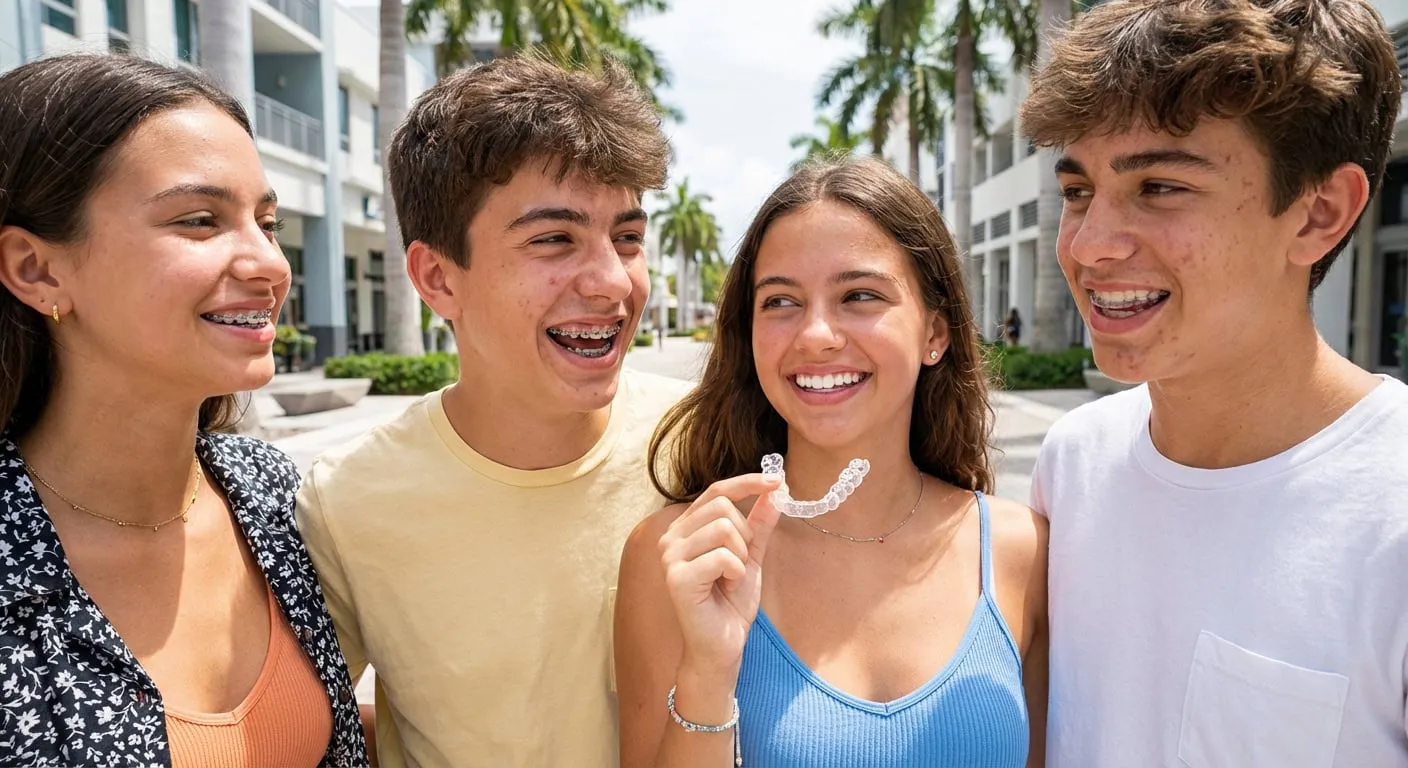

Braces vs Invisalign for Teens in Broward County
Parents in Broward County are asking the same question every single day: should my teenager get traditional braces or Invisalign?
It's not a simple answer, and that's exactly why we're breaking it down for you today.
Your teen's smile matters, but so does their confidence during the journey to get there.
At SMILE-FX Orthodontics in Miramar, FL, we work with board-certified specialists who've seen thousands of cases just like your kid's.
We help families cut through the noise and pick what actually works best for their situation.
What Makes Teen Orthodontics Different
Here's the reality: treating a teenager's teeth isn't the same as treating an adult's.
Teens are active, they're self-conscious, and they need something that fits into their lives, not the other way around.
Your kid might be playing football at a South Florida high school, working a part-time job, or juggling college prep classes.
That's where the choice between metal braces and Invisalign Teen becomes real.
Both work, but they work differently, and one might be way better for your family than the other.
Metal Braces: The Proven Powerhouse
Metal braces have been around for decades because they flat-out work.
They're especially strong when your teenager has severe crowding, bite issues, or complicated tooth movements that need serious correction.
What's changed is the technology.
We're not talking about the braces your parents had.
Modern metal braces use AI-precision bonding, which means we can make faster adjustments and your teen visits the office less often.
That's huge when you're managing a busy schedule.
Check out our detailed braces page to see exactly how the process works.
The real strength of metal braces is reliability.
They don't require your teenager to remember to wear anything or take anything off.
No compliance issues, no forgotten aligners at school.
For kids who have tried other options and struggled with following instructions, metal braces eliminate that problem entirely.
If your teenager plays contact sports, metal braces can actually be a solid choice with a proper mouthguard.
Many athletes we work with prefer them because there's zero guesswork.
Invisalign Teen: Invisible, Removable, and Smart
Invisalign Teen is a game-changer for the right kid.
These are clear, removable aligners that practically nobody can see.
Your teenager takes them out to eat, brush their teeth, and play sports.
For mild-to-moderate cases, many of our SMILE-FX patients finish their treatment in just four to six months.
That's fast.
Here's what most parents don't know: Invisalign Teen comes with something called compliance indicators.
Think of it as a built-in system that shows us when your kid is actually wearing their aligners.
We can track progress remotely, which cuts office visits by up to 40 percent through our VIP Tech suite.
Learn more about how Invisalign works on our dedicated page.
This matters because busy families get fewer appointments, and your teenager spends less time in the orthodontist's chair.
The aligners are nearly invisible, so your teen gets the transformation without the metal-mouth look during school photos.
If your kid is worried about how they look at school, Invisalign takes that stress away almost immediately.
Head-to-Head: What Actually Works Better for Your Teen
Let's get real about the differences.
Effectiveness matters first.
If your teenager has severe malocclusion (fancy word for "bad bite"), braces are going to be your best bet.
Invisalign works great for mild-to-moderate cases, but severe situations call for traditional braces.
Comfort and lifestyle come next.
Aligners are removable, so eating, brushing, and sports don't require adjustments.
Braces stay put, which some parents actually prefer because it removes the temptation to skip wearing them.
Ceramic braces blend with your teen's teeth and look way less obvious in school photos at places like Pembroke Pines Charter or Marjory Stoneman Douglas High.
Maintenance is easier with Invisalign.
Braces need periodic tightening, which means office visits every month or so.
Invisalign uses app-based monitoring, so busy families in Davie or Hollywood get more flexibility with scheduling.
Cost in Broward County runs similar.
Both options range from $3,500 to $7,500 after insurance kicks in.
We work hard to maximize your benefits, so check out why families choose SMILE-FX to see how we make orthodontics affordable.
Why Location and Specialist Care Actually Matter
Here's something most parents miss: not every orthodontist is the same.
General dentists can place braces, but they're not specialists.
A board-certified orthodontist has spent years training specifically on tooth movement, bite alignment, and complex cases.
That's what you're paying for when you choose a specialist.
Our board-certified specialists have the experience to handle your teenager's case with precision.
We don't do high-volume, quick-fix work.
We focus on results that last.
Location matters too.
SMILE-FX is centrally located in Miramar, making it accessible for families across South Florida.
We offer pediatric-friendly after-school slots and weekend appointments for parents who work.
That flexibility makes orthodontic treatment actually happen instead of getting pushed to next year.
Common Parent Questions We Hear All the Time
Do braces or Invisalign work faster?
It depends on the case, but Invisalign Teen often wins for mild-to-moderate situations, especially with our VIP Tech monitoring.
What if my teenager forgets to wear their aligners?
The compliance indicators show us what's happening, and we adjust the treatment plan as needed.
Braces don't have this problem because they stay on.
Can my kid play sports with braces or Invisalign?
Yes to both, but they're different.
With braces, use a proper mouthguard.
With Invisalign, remove the aligners during contact sports and wear a mouthguard.
How much does orthodontic treatment really cost?
Plan on $3,500 to $7,500 after insurance, but we have payment plans that work with your budget.
Does my teenager need to see an orthodontist or just a regular dentist?
Specialists like our board-certified team deliver better outcomes for teens because they focus exclusively on orthodontics.
What Our Patients Actually Tell Us
We ask patients why they chose us, and the answers are consistent.
Families say the experience is personal, not factory-like.
Parents appreciate that we actually explain things instead of just going through motions.
Teenagers like that we listen to their concerns about appearance and fitting treatment around their lives.
Check out patient reviews to see what real families in Broward County are saying.
People trust other people's words more than any marketing pitch, and our reviews speak for themselves.
Getting Started With Your Teen's Orthodontic Journey
The first step is always a consultation.
We'll look at your teenager's teeth, discuss their concerns, and outline what treatment looks like.
Our VIP Tech suite lets us show your kid exactly what their smile will look like after treatment, which honestly blows most teenagers' minds.
They can see the end result before we even start, and that builds confidence.
We serve families from Miramar, Pembroke Pines, Hollywood, Weston, Cooper City, Davie, Fort Lauderdale, and across greater South Florida.
No matter where you live, we make it easy to access world-class orthodontic care.
The real question isn't braces versus Invisalign.
It's whether you're getting treatment from a specialist who actually cares about your teenager's outcome.
That's where SMILE-FX stands apart, and book your FREE 3D scan and VIP smile consultation here to see the difference yourself.
Beyond Teen Braces and Invisalign: What Parents Need to Know About Long-Term Orthodontic Success in South Florida
Let's be honest.
Most parents get caught up in the braces versus Invisalign debate and miss the bigger picture.
The real question isn't which treatment option looks better in a school photo.
It's whether your teenager's teeth will stay straight five years, ten years, and twenty years from now.
That's where most conversations fall short.
We're going to talk about what actually matters after the treatment ends, because that's where the difference between getting results and keeping results shows up.
Retention: The Part Nobody Wants to Talk About
Here's what happens after your teenager finishes their treatment.
The braces come off or the aligners get boxed up, and everyone celebrates.
But teeth want to move.
That's just biology.
Without a proper retention plan, your kid's teeth can shift back toward their old position, sometimes within months.
I've seen families spend $5,000 on treatment only to watch the results fade because they skipped the retention phase.
Don't let that be you.
Retention typically involves wearing a retainer at night for life.
It sounds annoying, but it's the real secret to keeping that perfect smile permanent.
At SMILE-FX, we make retention part of the plan from day one.
Your teenager gets a custom-made retainer that fits their teeth perfectly, and we explain exactly how often they need to wear it.
Most of our patients wear theirs every night during high school and college, then shift to a few nights a week as adults.
It's not complicated, but it's non-negotiable if you want results that last.
The Hidden Costs Nobody Mentions Upfront
You know the sticker price.
$3,500 to $7,500 for treatment in Broward County.
But there are costs that show up after treatment starts.
Emergency bracket repairs, replacement aligners if they get lost, extra retainers when your kid loses theirs at soccer practice.
These add up fast.
The better move is to find an orthodontist who includes this stuff in your original agreement.
We build those costs in and make it predictable so you don't get blindsided six months into treatment.
Also, ask about whether your insurance covers retainers.
Most plans don't, but some do if you ask the right questions.
Check what your plan actually covers before you commit to treatment.
It changes the real cost significantly.
How Your Teen's Habits During Treatment Predict Long-Term Success
I can usually tell within the first month whether a teenager is going to have good results.
It's not about their teeth.
It's about their behavior.
Kids who remember to wear their retainers are the same kids who showed up for appointments and took care of their aligners during treatment.
Responsibility compounds.
If your teenager struggled with compliance during active treatment, they're probably going to struggle with retention too.
That's a real conversation to have before you start.
Some families find that metal braces actually solve this problem because there's nothing to remember to wear.
The brackets stay on, the work gets done, and then retention is the only thing that requires discipline.
Other families find that their teenager thrives with clear aligners because they feel more ownership over the process.
There's no one right answer, but knowing your kid's personality matters way more than which technology is fancier.
What Happens When Treatment Goes Wrong
Sometimes teeth don't respond the way we expect.
A teenager's jaw keeps growing, the bite shifts, or the roots move differently than the treatment plan predicted.
This isn't common, but it happens.
When it does, you need an orthodontist who handles complications without charging you thousands more.
Our board-certified specialists have the training to adjust treatment on the fly and solve problems that general dentists would refer out.
That expertise is built into your initial fee, not charged as an add-on.
It's the difference between getting a band-aid fix and actually solving the problem.
The Bite is More Important Than the Look
Parents see pictures of straight teeth and assume the job is done.
But your teenager's bite is what actually determines long-term health.
A bad bite creates problems that show up years later: jaw pain, headaches, difficulty chewing, uneven tooth wear.
The goal of orthodontic treatment isn't just to make teeth line up pretty.
It's to create a functional bite that protects your teenager's teeth and joints for life.
That means checking how their back teeth come together, whether their jaw closes in the right spot, and whether the forces are balanced across all their teeth.
A board-certified orthodontist checks all of this.
A general dentist usually doesn't.
This is why it matters who you choose.
Treatment Length: Why Speed Isn't Always Better
Some orthodontists promise fast results.
Three months, six months, done.
But teeth moved too quickly have roots that don't follow.
You end up with straight teeth mounted on weak foundations, and they shift again within a few years.
The research is clear: slower, steady movement creates stability.
Our cutting-edge technology lets us move teeth efficiently, but we don't sacrifice long-term results for short-term speed.
Expect treatment to take anywhere from 18 months to three years depending on your teenager's case.
That's normal.
If someone promises much faster, ask why.
Wisdom Teeth and Their Role in Long-Term Success
Most teenagers still have wisdom teeth coming in.
Sometimes those teeth push other teeth forward and wreck the alignment we just worked so hard to create.
It's one reason retention is so important.
Before treatment starts, we take X-rays and look at whether your teenager's wisdom teeth are going to be a problem.
If they are, we discuss extraction options with you and your family dentist.
This is a conversation that needs to happen early, not after treatment is done and teeth start shifting again.
Planning ahead for wisdom teeth is part of what separates good orthodontics from average orthodontics.
Why Some Teenagers Need a Second Round of Treatment
Here's something people don't like to hear.
Sometimes adults come back to us at 25 or 30 years old saying their teeth shifted again.
Usually, this happens because they stopped wearing their retainer.
Sometimes it's because wisdom teeth came in aggressively or their jaw kept growing.
We call it relapse, and while it's usually preventable with good retention habits, it's not a failure.
It's just a fact that teeth are always trying to move.
The fix is straightforward: a second, shorter round of treatment to get everything back where it needs to be.
It's faster the second time because the teeth remember where they're supposed to go.
But it's also why prevention through retention is your best friend.
Choosing the Right Orthodontist for Long-Term Outcomes
You're not just picking someone to straighten your teenager's teeth for the next two years.
You're picking someone to be your family's orthodontist for the next two decades.
That person should:
Have board certification because it means they've proven expertise beyond general dentistry.
Offer multiple treatment options because not every teenager is the same.
Use modern technology like digital scans and treatment planning because it reduces surprises.
Build retention into the fee, not as an afterthought.
Be willing to adjust plans when things don't go exactly as expected.
Have a real location where you can see them regularly, not just a pop-up clinic.
At SMILE-FX in Miramar, we check every one of those boxes.
We're here long-term for your family, which means we care about retention and long-term success, not just getting through the active treatment phase.
The Cost of Doing Nothing
Some parents put off treatment because of cost.
They figure their teenager can wait until college or later.
Here's what actually happens: teeth that don't get straightened during the teenage years often need more invasive treatment as an adult.
Severe crowding might need extractions.
Bad bites might need jaw surgery.
Those treatments cost three to four times more than getting braces or aligners as a teenager.
We have payment plans that spread the cost across your treatment timeline.
It's way more affordable than you think, and it's cheaper than waiting.
What Your Teenager Should Know Going In
The best predictor of success is when your teenager actually wants the treatment.
If they're doing it just because their parents made them, they won't take it seriously.
But if they understand why straight teeth matter, they'll stay committed.
Have that conversation before you call us.
Let your teenager know that treatment is a partnership.
We handle the clinical side.
They handle wearing their retainer, showing up for appointments, and keeping their teeth clean.
Everyone has to do their part.
When that happens, the results are incredible and lasting.
The Real Timeline From Start to Finish
Month one through month eighteen (or 36): Active treatment with either braces or aligners.
You're coming in for adjustments or new trays every four to six weeks.
Month 19 onward: Retention phase.
Your teenager wears a retainer every night for the rest of their life.
The frequency might decrease over time, but it's non-negotiable for keeping teeth straight.
This is the real timeline.
Don't let anyone tell you treatment is done after the brackets come off.
That's when the real work begins.
Why We Do What We Do
I got into orthodontics because I wanted to create lasting change in people's lives.
Straight teeth are nice, but they're not the point.
The point is giving your teenager confidence that lasts decades.
That only happens when we focus on long-term success, not short-term metrics.
Our patient reviews reflect that philosophy.
Families come back to us years later and say things like, "My daughter's teeth are still perfect, and she barely remembers wearing her retainer."
That's the goal.
Not just a straight smile, but a smile that stays straight.
Your Next Step: Getting Professional Guidance
Stop guessing about what your teenager needs.
We offer a free 3D scan and VIP smile consultation where we look at their specific case and explain exactly what treatment would look like.
You'll see the projected results before you commit to anything.
Your teenager gets to meet our team and ask questions without any pressure.
We work with families across South Florida in Miramar, Pembroke Pines, Weston, Cooper City, Davie, Hollywood, and Fort Lauderdale.
No matter where you live, we make it easy to get expert guidance.
The decision between braces, clear aligners, and Invisalign matters, but it's not the most important decision you'll make.
The most important decision is choosing an orthodontist who keeps your teenager's long-term health and confidence in focus.
Book your FREE 3D scan and VIP smile consultation here and let's talk about what real, lasting results look like for your teenager.
Adult Orthodontics and Complex Cases: What South Florida Families Should Know Before Starting Treatment
You're not alone if you're thinking about getting braces or aligners as an adult.
More people over 30 are straightening their teeth than ever before, and honestly, the stigma is gone.
Your boss doesn't care, your coworkers adjust in a week, and your confidence boost makes it worth every second.
But adult orthodontics plays by different rules than teen treatment.
Your jaw isn't growing anymore, your teeth might have years of wear and tear, and you probably have a tighter schedule than a high schooler.
That's why finding the right board certified orthodontist in South Florida makes such a massive difference.
Why Adult Teeth Are Different From Teen Teeth
I see a lot of adults who think orthodontics is the same process at 40 as it is at 14.
It's not.
Your teeth have settled into their positions, your bone density has changed, and your roots are fully developed.
This means movement takes longer and requires more precision.
The good news is your teeth are stable now, so we're not fighting against jaw growth like we do with teenagers.
What we're fighting against is time and the habits you've built over decades.
Maybe you've been grinding your teeth at night, which wears them down and affects how they sit.
Maybe you lost a tooth years ago and the others shifted to fill the gap.
Maybe you had braces as a kid, stopped wearing your retainer, and now you're back where you started.
All of this matters when we plan your treatment.
At SMILE-FX, our board certified orthodontist takes time to understand your specific situation before jumping into treatment.
That's what separates real orthodontics from assembly-line dentistry.
Complex Cases Require Expertise You Can't Compromise On
Some adults have what we call complex cases.
This means your bite is severely off, you have missing teeth, or your teeth need to move in multiple directions at once.
These aren't straightforward.
A general dentist might see your case and get nervous.
A board certified orthodontist specializing in complex cases sees it as an opportunity to create real change.
Complex cases might involve:
Severe crowding where teeth overlap significantly.
Open bites where your front teeth don't touch when you close your mouth.
Crossbites where your upper teeth sit inside your lower teeth.
Situations where you've lost teeth and need to move others to close the gaps.
Cases requiring coordinated work with other specialists like your general dentist or surgeon.
The reality is that complex cases need someone who specializes in orthodontics, not someone who squeezed it in as a side service.
Our cutting edge technology at SMILE-FX uses 3D scanning and digital planning to map out exactly how we'll move your teeth and why each movement matters for your long-term success.
Traditional Braces vs Invisalign for Adults: What Actually Works Better
Adults always ask me which option is better.
The honest answer is that it depends on your case and your life.
With traditional braces for adults, you get maximum control and predictability.
We can move teeth in directions that clear aligners struggle with, and we can do it faster in most situations.
The trade-off is visibility, though modern braces are way more subtle than they used to be.
Ceramic braces match your teeth color, and nobody stares like they used to.
With Invisalign or clear aligners, you get discretion and comfort.
You take them out to eat, so no food restrictions and no awkward conversations about what's stuck in your teeth.
They're nearly invisible in work meetings and social situations.
The trade-off is that they require discipline and compliance.
If you forget to wear them or remove them too often, treatment slows down.
For complex adult cases, we sometimes recommend traditional braces because the control matters more than the convenience.
For mild to moderate cases, clear aligners work great if you're committed to wearing them 20+ hours a day.
Real Talk About Invisalign Cost and Insurance Coverage
You're wondering what this actually costs, and I get it.
In South Florida, Invisalign cost typically runs between $3,500 and $8,000 depending on how complex your case is.
Braces run similar ranges.
The difference comes down to complexity, treatment length, and what's included in your fee.
Here's what most people don't know: insurance sometimes covers adult orthodontics.
Not always, and usually not fully, but it happens.
The coverage depends on your specific plan and whether your case qualifies as medically necessary versus cosmetic.
A severe bite problem that affects your chewing or jaw function might be covered.
Straightening your teeth for appearance usually isn't.
Before you start, we run your insurance and tell you exactly what they'll cover.
No surprises, no fine print.
Our patient resources include payment plans that make treatment affordable without breaking your budget.
We work with people, not against them.
Does Insurance Cover Braces and Orthodontics? Breaking Down Your Benefits
This is one of the biggest questions adults ask, and the answer is frustrating because it varies so much.
Some plans cover orthodontics fully.
Some cover a percentage.
Some don't cover anything.
Your best move is to grab your insurance card and call the number on the back.
Ask them specifically: "Does my plan cover orthodontic treatment, and if so, what's the annual maximum?"
Write down what they tell you.
When you come in for your consultation, we'll verify that information with your insurance company directly.
We know how to work the system and maximize your benefits.
Some adults are shocked to find out their employer-sponsored plan covers up to $1,500 toward orthodontics.
That's real money off your treatment cost.
Why Adults Delay Treatment and What It Costs Them
I talk to adults all the time who say, "I wish I'd done this ten years ago."
Waiting doesn't make things better.
It makes them worse.
When you put off orthodontic treatment, your teeth continue shifting, your bite gets worse, and your facial structure changes slightly.
You might develop jaw pain, headaches, or uneven tooth wear that requires expensive dental work later.
A patient came in last year who waited 15 years to fix her bite.
By then, three of her back teeth were severely worn down from grinding.
She needed braces plus crowns to fix the damage, which cost triple what orthodontics alone would have.
The cost of waiting is always higher than the cost of starting now.
Adult Orthodontics and Your Work Life
You probably care about how orthodontics will affect your job.
Most people in professional positions choose clear aligners specifically because nobody can see them.
You go to meetings, presentations, and client dinners, and nobody knows you're straightening your teeth.
If you choose braces, ceramic options blend with your teeth and look way less noticeable than metal.
The real talk is that your coworkers might notice for a week or two, then forget about it completely.
Adults are usually worried about this way more than they need to be.
Most people don't care, and the ones who do usually ask questions out of genuine curiosity, not judgment.
Special Situations: When You've Lost Teeth or Had Previous Treatment
Some adults come in with missing teeth, failed previous orthodontic treatment, or a combination of both.
These situations need careful planning.
If you lost a tooth and never replaced it, the teeth around the gap shifted.
We need to move those teeth back to create space for an implant or a bridge.
This takes precision and a board certified specialist who understands how to work with other dental professionals.
If you had braces as a teenager and your teeth shifted back, don't feel bad.
It's actually super common.
You probably stopped wearing your retainer, which is also super common.
A second round of orthodontics is usually shorter and faster because your teeth remember where they're supposed to go.
We'll also make sure you understand the retention part this time so it doesn't happen again.
Gum Disease, Root Issues, and When You Need to Pause Treatment
Adult teeth sometimes come with complications younger teeth don't have.
If you have gum disease, we need to address that before starting orthodontics.
Moving teeth when your gums are inflamed creates bigger problems down the road.
This means a conversation with your general dentist and possibly a periodontist before we start.
Short root length is another thing we screen for.
Some adults have naturally shorter roots or roots that were damaged by previous trauma.
This affects how aggressively we can move teeth and how long treatment needs to take.
Our treatable cases page breaks down what we look for before accepting someone into treatment.
We're transparent because it's better to know upfront what we're dealing with.
The Timeline for Adult Orthodontic Treatment
Adults often have less time to wear braces or aligners than teenagers.
You're busier, your schedule is packed, and you want results faster.
Here's the real timeline for most adults:
Mild cases: 12 to 18 months.
Moderate cases: 18 to 24 months.
Complex cases: 24 to 36 months.
These timelines depend on how much your teeth need to move and how they respond to treatment.
We can't rush this part without compromising your results.
Fast orthodontics sounds good until your teeth shift back two years later.
Why Choosing the Best Orthodontist Near You Matters for Long-Term Results
You could go to a general dentist who offers braces, or you could choose a top rated orthodontist in Miramar or your area who focuses exclusively on teeth movement.
The difference shows up in your results.
A specialist understands nuances that a generalist misses.
They know how to handle complications, adjust treatment when things don't go as planned, and create bite relationships that last decades.
At SMILE-FX, we're a board certified orthodontist practice serving Broward County and beyond.
We treat complex adult cases, we use the latest technology, and we stand behind our work.
Our patient reviews speak to our commitment to quality.
People come back and tell us five years later that their teeth are still perfect.
That's the goal.
Book Your Consultation With a Specialist
Stop wondering if orthodontics is right for you.
The only way to know is to get a professional assessment from someone who specializes in orthodontics.
We offer a free 3D scan and VIP smile consultation where we look at your specific situation and explain exactly what treatment would look like.
You'll see projected results before you commit to anything.
We serve families and adults across South Florida, and we make it easy to schedule.
If you're looking for the best orthodontist near me or the best orthodontist in South Florida, start with a consultation that costs nothing and gives you clarity.