
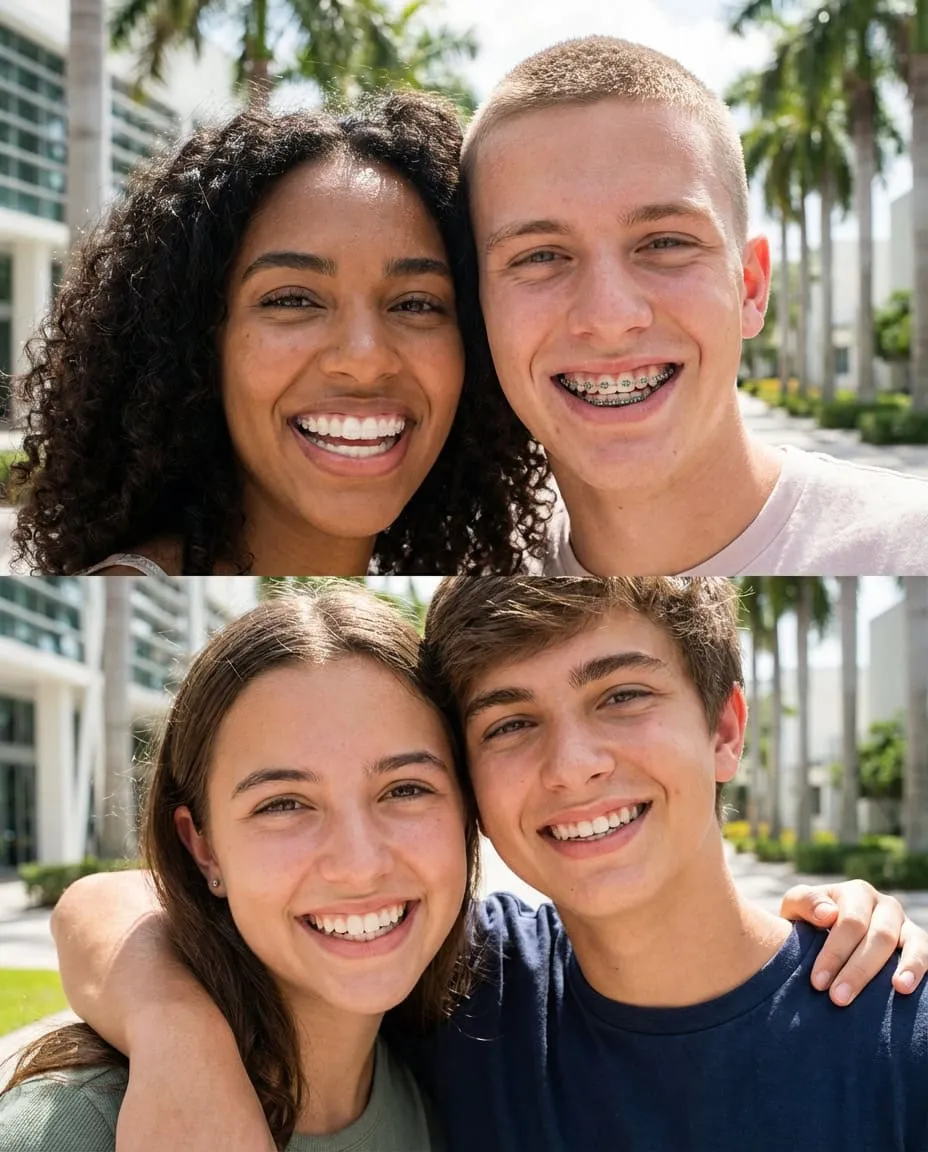

Braces vs Invisalign for Teens in Broward County and South Florida
Your teen needs orthodontic treatment and you're standing at a crossroads.
Braces or Invisalign?
Metal brackets or clear trays?
The choice feels massive because it is.
You're not just picking a treatment—you're picking what your teen's life looks like for the next one to three years.
School photos, sports, band concerts, dating, social media—all of it gets affected by this decision.
And if you're in Broward County or South Florida, you're probably juggling long drives, traffic on I-75, and coordinating with work and school schedules.
At SMILE-FX Orthodontics & Clear Aligner Studio in Miramar, we work with families from Pembroke Pines, Weston, Hollywood, Davie, Cooper City, and Fort Lauderdale who face this exact decision every week.
The good news?
It's not as complicated as it feels.
Why This Decision Matters More Than You Think
Picking between braces and Invisalign clear aligners isn't about which one works better.
Both work.
When planned and supervised properly by a real board-certified Orthodontic Specialist, both get your teen's teeth straight.
The real difference is lifestyle fit.
Some teens thrive with braces.
Others do way better with aligners.
And your job as a parent is figuring out which path matches your teen's actual life, not which path sounds cooler.
The Real-World Differences That Matter
Let's cut through the noise and talk about what actually impacts your teen's day-to-day.
Visibility and Social Impact
Metal braces are visible.
Clear trays are nearly invisible.
That's the simplest difference.
If your teen is self-conscious about their appearance—and most are—Invisalign removes a major stressor.
They can smile in photos without worry.
But here's the thing: modern braces aren't the bulky metal boxes from the 1990s.
At SMILE-FX, we offer ceramic braces, color-coordinated metal braces, even gold brackets that some teens actually wear as a style statement.
Some of the most confident teens we see rock their braces like they own the place.
The Responsibility Factor
This is where things get real.
Braces sit on your teen's teeth 24/7.
They work without asking permission.
Your teen doesn't have to remember anything.
Invisalign requires your teen to wear the trays 20 to 22 hours every single day.
That means removing them to eat.
Removing them to drink anything but water.
Keeping track of them.
Not losing them.
Putting them back after every meal.
If your teen frequently loses their phone, glasses, or retainer, braces might be the safer bet.
If your teen is naturally organized and responsible, aligners could be perfect.
Food Freedom
Braces mean restrictions: no sticky foods, no hard candy, no popcorn, no chewing gum.
Your teen has to watch what they eat for 12 to 24 months.
With Invisalign, your teen removes the trays and eats whatever they want.
No restrictions at all.
For teens who love snacking or play sports where they need quick fuel, this matters.
Sports and Instruments
If your teen plays contact sports, braces can mean mouth injuries.
Brackets can cut lips and cheeks if there's impact.
Most athletes with braces wear custom mouthguards.
Invisalign? The trays are smooth.
No cuts.
No irritation.
For band or orchestra kids, braces can affect embouchure and sound quality.
Clear aligners don't interfere at all.
Your teen can pull them out for practice and put them back after.
When Braces Make the Most Sense
Braces are the right choice when you need a no-questions-asked solution.
Your teen has a severe bite problem—major crowding, large overbite, or complex jaw issues?
Braces handle it.
Your teen can't remember to wear anything consistently?
Braces handle it.
You want something that works without daily discipline?
Braces handle it.
At SMILE-FX, our braces cases use AI-powered planning and precision bracket placement to shorten treatment time and maximize comfort.
We're not slapping brackets on and hoping for the best.
We're designing each case like it's custom—because it is.
Here's what we offer:
- Traditional metal braces with color options that match school colors or personal style
- Ceramic clear braces for a less visible look on front teeth
- Gold or champagne brackets for teens who want their braces to pop
- Lingual braces that sit behind the teeth for total invisibility
All planned using the same advanced technology we use for Invisalign.
Families from Hollywood, Weston, and Fort Lauderdale choose us for braces because we actually know what we're doing.
We're not a general dentist offering braces on the side.
This is what we do.
When Invisalign or Clear Aligners Are the Better Play
Invisalign and other advanced clear aligners have completely changed teen orthodontics in South Florida.
For the right teen, they're genuinely game-changing.
Clear aligners work best when:
- Your teen is naturally responsible and doesn't lose things constantly
- The bite problem is mild to moderate (though we can handle complex cases too)
- Your teen plays sports or instruments
- Your family needs fewer office visits because of the drive from Weston or northern Broward
Here's what makes our aligner program different:
- We use AI-driven treatment design to map out exactly how teeth will move
- You see a 3D simulation before treatment even starts
- Remote monitoring means many visits happen from home or school
- You get complimentary whitening and a free retainer at the end
- Nighttime-focused options for busy teens who can't wear them all day
Real talk: clear aligners work because they're invisible, removable, and they let your teen live their life without constant restrictions.
But they only work if your teen actually wears them.
We've seen it go both ways.
Motivated teens crush their treatment in 12 to 18 months.
Unmotivated teens wear them for a month, stop, and then their teeth stop moving.
How Fast Will Treatment Actually Take?
Parents always ask: which is faster, braces or Invisalign?
The honest answer is this—it depends way more on your doctor's planning skill and your teen's cooperation than it depends on the tool.
We've done braces cases that finish in 10 months and aligner cases that take 24 months.
We've done aligner cases that finish in 14 months and braces cases that take 20 months.
Using AI-powered planning and precision technology, most of our teens finish in 12 to 24 months regardless of whether they chose braces or aligners.
What actually matters?
Your teen following the plan.
Wearing their aligners consistently.
Not breaking their brackets.
Not skipping appointments.
The tool is only as good as the commitment behind it.
Comfort, Emergencies, and Real Life in South Florida
You're driving from Davie, Cooper City, or Fort Lauderdale to Miramar.
The last thing you want is an emergency visit.
So let's talk about comfort and what actually happens when things go sideways.
Braces Reality
Brackets and wires can cause soreness after adjustments.
New patients usually feel tenderness for a few days.
Wires can poke.
Brackets can cut lips if they break.
Loose brackets happen sometimes.
At SMILE-FX, we use smoother, low-profile brackets and high-tech wires that reduce irritation dramatically.
We also send detailed home comfort instructions with every patient.
And if something breaks, we have evening and after-school appointments specifically for busy families.
Aligner Reality
Aligners are smoother and gentler overall.
Discomfort usually lasts just a few days when your teen switches to a new tray.
The main "emergency" is losing a tray or breaking one.
When that happens, we can often ship replacements directly to your home.
No need for an office visit.
For families dealing with I-75 traffic and packed schedules, this is huge.
The Money Question
Let's be straight: cost matters.
At SMILE-FX, the price difference between teen braces and Invisalign is usually way smaller than families expect.
That's because we plan both using the same advanced technology.
Same expertise.
Same precision.
What you're actually paying for is value:
- Advanced technology included in every single case
- Fewer visits because we use remote monitoring
- Payment plans built for South Florida family budgets
- No surprise fees or "mandatory extras"
We work with most major dental insurance plans.
And our team walks you through exactly what your out-of-pocket cost will be before you commit to anything.
Why Families Keep Driving from Across Broward to See Us
Parents from Pembroke Pines, Hollywood, Cooper City, Davie, and Fort Lauderdale pass closer practices to come here.
They do that because we're different.
We're a specialty practice—orthodontics is literally all we do.
Our team is board-certified and uses cutting-edge technology.
We treat kids, teens, and adults with the same precision and care.
We offer after-school and evening appointments built around school schedules.
We use cutting-edge technology like AI planning and 3D imaging to design smiles that actually fit your teen's face.
We reduce office visits through remote monitoring and virtual check-ins.
We don't rush you through an appointment.
We take time to answer questions and explain what's happening every step of the way.
Common Questions Parents Actually Ask
What if my teen isn't responsible enough for Invisalign?
Then braces is your answer.
Simple as that.
Braces work regardless of whether your teen remembers to do the right thing.
They're fixed in place.
They do their job automatically.
At SMILE-FX, we can make braces look great and we can make them comfortable—so your teen gets excellent results without the responsibility burden.
Can my teen switch from one option to the other?
Yes, sometimes.
If your teen starts in braces and later becomes a good candidate for aligners—or vice versa—we can transition them.
We evaluate each case individually to make sure the switch doesn't compromise the final result.
We'll also walk you through any fee adjustments before making a change.
Is Invisalign actually as good as braces for serious bite problems?
Modern clear aligners can handle cases that used to require braces only.
But some severe or surgical cases still need braces or a combination approach.
That's why a full evaluation with a board-certified orthodontist matters.
Tools are important, but the person planning the treatment is what really counts.
How often does my teen have to come in?
Most braces patients visit every 6 to 10 weeks for adjustments.
Aligner patients can often go longer between visits because of our remote monitoring system.
Since we serve families across Broward County, we design schedules with commuting in mind and combine steps when we can.
Does my teen need a retainer after treatment?
Yes, absolutely.
No matter which option you choose.
Teeth want to move back.
Retainers keep them in place permanently.
We educate teens early about retainer wear and build solutions that fit active lifestyles.
Clear aligner patients also get a free retainer at the end of treatment.
Our Free Consultation—Here's What Actually Happens
This isn't a sales pitch disguised as a consultation.
This is us helping you and your teen make the right call.
At your complimentary visit, we:
- Capture detailed 3D scans and photos of your teen's teeth and bite
- Evaluate growth patterns, jaw relationships, and facial balance
- Show you side-by-side simulations of what braces and aligners can achieve
- Talk through timelines, comfort, visit frequency, and daily life with each option
- Explain payment options and how we work with your insurance
You walk out with a clear plan and zero pressure.
Just a honest conversation about what's right for your teen's smile and your family's situation.
Ready to Make This Decision?
If you're in Miramar, Pembroke Pines, Hollywood, Weston, Cooper City, Davie, Fort Lauderdale, or anywhere in South Florida and you're still weighing braces versus Invisalign for your teen, the next step is simple.
Book your FREE 3D scan and VIP smile consultation here to see personalized braces and Invisalign plans side-by-side, review real timelines and fees, and get all your questions answered by a board-certified Orthodontic Specialist.
The right decision for your teen's smile and your family's schedule starts with one honest conversation.
What Happens After Your Teen's Orthodontic Treatment Ends: The Real Talk About Retention and Long-Term Results
You made the call.
Your teen got braces or clear aligners.
Months went by.
Then one day your orthodontist says the magic words: treatment is done.
Your teen's smile looks amazing.
Teeth are straight.
Bite is fixed.
Everyone's happy.
But here's what most parents don't realize until it's too late: the real work isn't over.
It's just shifting.
What comes next determines whether that perfect smile stays perfect or slowly drifts backward over the next decade.
At SMILE-FX Orthodontics & Clear Aligner Studio in Miramar, we see it happen every year.
Families from across Broward County, from Pembroke Pines to Fort Lauderdale, think their orthodontic journey ends at the last appointment.
It doesn't.
The retention phase is where most people mess up because nobody explains what's actually happening.
Why Teeth Move Back: The Biological Reality
Your teeth aren't glued in place.
They're held by bone, ligaments, and soft tissue.
All of that spent months adjusting to their new position.
But your body doesn't just accept it and move on.
Your body pushes back.
It wants teeth to return to where they started.
That's called relapse.
And it's not a failure of your orthodontist.
It's biology.
Think about it like this: if you bend a tree sapling every day for two years, it adapts.
But if you stop bending it and walk away, what happens?
It slowly straightens back out.
Teeth work the same way.
The first three months after treatment ends are critical.
That's when relapse happens fastest.
Then it slows down over the next few years.
But it never completely stops unless you're wearing a retainer.
The Three Types of Retainers: What Your Teen Will Actually Use
Not all retainers are the same.
Your orthodontist isn't just handing your teen a retainer and hoping for the best.
There are real options, and which one works depends on your teen's situation.
Fixed Bonded Retainers: The Set-It-And-Forget-It Option
This is a thin wire bonded to the back of your teen's front teeth.
It's permanently attached.
Your teen can't lose it.
Can't forget to wear it.
It just stays there doing its job.
The catch: it takes extra care to keep clean.
Food gets stuck behind it.
Flossing is more annoying.
If your teen breaks the wire, we have to replace it.
Most families use this on the lower front teeth because that's where teeth shift the most.
Clear Plastic Retainers (Like Invisalign): The Convenient Choice
These look like clear aligners.
Your teen wears them at night.
Easy to clean.
Easy to store.
Easy to use.
The problem: your teen has to actually wear them.
Every night.
Forever.
If your teen's the type who remembers to wear their retainer, this works perfectly.
If they're not, teeth start shifting within weeks.
Traditional Wire Retainers (Hawley Retainers): The Durable Classic
Metal wire and acrylic.
Visible when your teen talks.
But they last forever and they're nearly impossible to damage.
Some teens prefer these because they feel more secure.
Others hate the look.
Most families use a combination approach: bonded wire on the bottom front teeth plus a clear retainer for nighttime wear on the full upper arch.
How Long Does Your Teen Actually Need to Wear a Retainer?
This is the question we get asked constantly.
And the honest answer isn't what people want to hear.
Forever.
Not as much forever.
But some form of retainer wear needs to stay part of your teen's life indefinitely.
Here's the breakdown:
- First 3 months after treatment: full-time wear (all day and night except eating)
- Months 3 to 12: nightly wear
- Year 2 and beyond: nightly wear, with flexibility as bone stabilizes
- Adulthood: most people transition to a few nights per week, or whenever they notice any shifting
Some of our patients who finished treatment five years ago still wear their retainer three nights a week.
Others wear it every night because they don't want to risk anything.
The point is there's no magic cutoff date where you can just stop.
That's not us being paranoid.
That's biology.
What Causes Retainer Failure and How to Prevent It
We see families lose their entire smile in less than a year because of retainer mistakes.
Not because the retainer was bad.
Because they stopped wearing it or didn't get replacements when needed.
The Lost Retainer Problem
Clear retainers are easy to lose.
Your teen takes it out to eat, sets it on the lunch table, forgets it.
Or wraps it in a napkin and throws it away.
Or leaves it at a friend's house.
This happens constantly.
Solution: keep replacement retainers on hand.
Most families order extras before they even need them.
When one gets lost or damaged, there's already a backup ready to go.
The Forgotten Retainer Problem
Your teen wears it for three months.
Then gets busy with school or sports.
Then forgets for a week.
Then thinks oh well, it's been a while, maybe I don't need it anymore.
Two months later they put it back in and it doesn't fit.
Teeth have already shifted.
Now we're in trouble.
Solution: set phone reminders.
Make retainer wear part of the nightly routine like brushing teeth.
Build it into the schedule, not as a choice but as an automatic habit.
The Damaged Retainer Problem
Your teen sits on it.
Steps on it.
Runs it through the dishwasher on hot.
Leaves it in a hot car and it warps.
Clear retainers break easier than you think.
Solution: store retainers in their case, not loose in pockets or backpacks.
And replace them every couple years even if they look fine, because they lose shape over time.
The Cost of Retainers and Replacement
When you finish Invisalign treatment at SMILE-FX, you get one set of retainers included.
That's our commitment to making sure your teen starts off right.
But after that, replacements are needed at some point.
Clear retainer replacements typically run between $150 to $300 per set.
A bonded retainer replacement if the wire breaks is similar.
Hawley retainers cost more upfront (around $300 to $500) but last longer.
It's not expensive compared to the cost of retreatment if your teen's teeth shift back into the original position.
That's when you're looking at thousands of dollars to fix relapse.
So the math is simple: spend a couple hundred on retention now or several thousand on fixing the problem later.
When Relapse Actually Becomes a Problem Requiring Retreat
Not every little movement requires going back into treatment.
Slight shifting happens.
But when does it cross the line?
If your teen stops wearing their retainer for six months and their teeth shift noticeably, they'll likely need a few months of orthodontic treatment again.
If they go years without a retainer and teeth go back halfway to the original position, that's a major problem requiring six to twelve months of treatment all over again.
We've had families come back with significant relapse because a retainer got lost and nobody replaced it.
They assumed a little shifting would stop on its own.
It doesn't.
The good news: if caught early, minor relapse is quick and inexpensive to fix.
Which is why we always tell families to stay on top of retention from day one.
Beyond Retention: Lifestyle Factors That Affect Long-Term Results
Retention isn't just about wearing a retainer.
What your teen does with their mouth affects their smile too.
Tongue Thrusting and Bad Habits
Some people have a habit of pushing their tongue against their front teeth.
Over years, this can push teeth forward slightly.
Same with pen chewing, nail biting, or other habits.
Not enough to cause major damage.
But enough to notice.
Wisdom Teeth Coming In
If your teen still has wisdom teeth coming in, that can shift front teeth.
Not always.
But it's possible.
Some families choose to have wisdom teeth removed as a preventative measure.
That's a conversation between your teen's dentist and oral surgeon.
Jaw Growth and Changes
Even after treatment ends, jaws can continue changing slightly through the late teens and early twenties.
That's why some people's bites shift a bit after they're done with braces.
It's usually minor.
Retainers catch most of it.
What Makes SMILE-FX Different With Retention Education
We're not done when your teen's treatment ends.
We actually have a retention protocol that most practices skip.
Every patient leaves with:
- Clear written instructions on when and how to wear retainers
- A timeline showing the first year of retention wear
- Our contact info so they know where to go if a retainer breaks or gets lost
- A system for ordering replacement retainers before they're needed
- Phone reminders during the critical first three months
We check retainer wear at every follow-up visit.
If your teen isn't wearing them, we have that conversation early when it's easiest to course correct.
And when replacements are needed, we have them ready to go fast.
We understand that you're managing busy schedules across Broward County.
Making retention easy is part of how we're different.
Real Talk About Teen Compliance With Retainers
Let's be honest: retention is boring.
Your teen's teeth are straight now.
The work is done.
Why wear a retainer?
Because teeth will literally move without it.
The challenge is that relapse is slow and invisible at first.
Your teen doesn't feel it happening.
They don't see it for weeks or months.
By the time it's noticeable, they've already gotten months behind on wear.
That's why the conversation about retention starts during treatment, not after.
We talk about retention goals with your teen directly.
Not lecturing.
Just real talk about why it matters and what happens if they don't do it.
Most teenagers get it when you explain it that way.
Questions Parents Ask About Retention
Can my teen ever stop wearing a retainer?
Technically yes, but rarely smart.
Some people who've had orthodontic treatment for 20+ years can back off to just occasional wear without relapse.
But every person is different.
The safest approach: wear it nightly forever, or at least until adulthood, then decide based on what your orthodontist recommends.
Why does my teen's retainer feel tight when they put it back in after a few days?
Because teeth move.
Even a few days without a retainer and teeth shift slightly.
That's normal.
The retainer pushes them back into position and then feels normal again.
Is it normal for a retainer to break?
Yes.
Clear retainers get cracked or warped over time from normal use.
That's why replacements exist.
It's not a sign that something went wrong with your orthodontist's work.
What if my teen loses their retainer on vacation?
Call us.
We can often ship a replacement fast so they can keep wearing something during those critical early months.
Or if it's toward the end of the first year and they'll be back soon, missing a week or two is less critical than the first three months.
But we'd rather not risk it.
The Retention Timeline Your Teen Will Actually Follow
Here's what the first year of retention looks like at SMILE-FX:
- Week 1 to 12: Full-time wear except eating and brushing. Your teen wears the retainer basically all day and all night.
- Week 13 to 26: Nightly wear begins. Your teen can go about their day without the retainer but wears it every night.
- Week 27 to 52: Continued nightly wear. We check in to make sure wear is consistent.
- Month 13 onward: Nightly wear continues. We transition to every-other-night or a few nights per week only if bone is stable and we're confident in your teen's compliance.
This isn't made up.
This is based on actual science about bone remodeling and when teeth stabilize.
When families follow this timeline, relapse is almost never an issue.
Combining Retainers With Other Smile Goals
Your teen's teeth are straight now.
But what if they want to whiten them?
Or address other cosmetic goals?
That's the fun part that comes after orthodontics.
Retainers don't prevent teeth whitening.
Your teen can pursue cosmetic dentistry whenever they want.
At SMILE-FX, we offer complementary services that work alongside your orthodontic results.
And we have a smile quiz that helps your teen understand what's next if they want to take their smile even further.
Insurance and Retainer Coverage
Most dental insurance covers the initial retainers as part of your orthodontic treatment.
Replacements after the first set usually aren't covered because they're considered maintenance, not initial treatment.
But it's worth asking your insurance directly.
Some plans do cover replacement retainers in certain situations.
We work with your insurance to clarify what's covered and what your out-of-pocket cost will be.
Making Retainer Wear Actually Stick
The hardest part of retention isn't the retainer itself.
It's making it a habit.
Here's what actually works:
- Pair retainer wear with something your teen does every day (brushing teeth, getting into bed)
- Use phone alarms for the first few months until it becomes automatic
- Keep the retainer case in a visible spot, not hidden in a drawer
- Have backup retainers ordered before the first one breaks
- Make it clear that this is non-negotiable, like wearing shoes to school
When families treat retainer wear as a normal part of daily life, not as a chore, compliance is way better.
Your Orthodontist's Role in Long-Term Success
A good orthodontist doesn't disappear after treatment ends.
At SMILE-FX, our board-certified specialists stay involved in your teen's smile for years after treatment finishes.
We schedule retention check-ins.
We catch issues early if they start developing.
We replace retainers fast when needed.
We answer questions when your teen has concerns.
That's what modern orthodontic care looks like.
Not a one-time transaction.
An actual partnership in keeping your teen's smile straight for life.
Next Steps: Staying Connected After Treatment
Once your teen finishes braces or clear aligner treatment, staying connected with your orthodontist matters more than you think.
We schedule regular retention visits to check how everything's holding up.
We're also available if questions come up or problems develop.
Your teen's smile is our work.
We take long-term results seriously.
Getting Professional Guidance on Your Teen's Retention Plan
Every teen's retention needs are different based on their specific case, how much movement they had, and how compliant they'll realistically be.
That's why generic advice about retention misses the mark.
Your teen needs a personalized plan from someone who understands their case inside and out.
That's where a consultation at SMILE-FX makes the real difference.
We'll map out exactly what your teen's retention plan looks like, what types of retainers work best for their situation, and how to make sure they actually wear them.
Whether your teen in Miramar, Pembroke Pines, Weston, Hollywood, Davie, Cooper City, Fort Lauderdale, or anywhere across South Florida, book your FREE 3D scan and VIP smile consultation here to get a complete picture of treatment options and long-term retention strategy from a board-certified Orthodontic Specialist.
Your teen's smile after braces or Invisalign treatment depends on what happens next.
Make sure next actually has a plan.
Choosing the Right Orthodontist for Your Family: What Actually Matters Beyond Location and Price
You've decided your teen needs braces or clear aligners.
Now comes the next decision that feels just as big.
Which orthodontist do you actually pick?
You could drive five minutes to a general dentist offering braces on the side.
Or you could drive thirty minutes to a specialist who does nothing but this.
You could pick based on price alone.
Or you could look at what actually matters for long-term results.
Most families get this wrong.
They pick the closest office or the cheapest option without understanding what they're really trading away.
At SMILE-FX Orthodontics & Clear Aligner Studio in Miramar, we serve families from Pembroke Pines to Palm Beach who made the switch after realizing that location and cost aren't the things that determine whether your teen ends up with a great smile or regret.
Why Your Orthodontist Choice Matters More Than You Think
Here's what most people don't realize.
Braces and clear aligners are tools.
They work.
But the person using them matters way more than the tool itself.
A board-certified orthodontist planning your teen's case versus a general dentist offering braces creates completely different outcomes.
Same brackets.
Different results.
Same clear aligners.
Different timelines and comfort levels.
When you're choosing an orthodontist in South Florida, you're not just picking someone to put brackets on teeth.
You're picking someone to handle your teen's facial growth, jaw alignment, bite correction, and smile design over the next one to three years.
That's not a small thing.
Board Certified vs. Non-Certified: What's Actually the Difference
This is where most families get confused.
Not all orthodontists are the same.
A board-certified orthodontist specialist has completed dental school, then a full residency program in orthodontics, then passed rigorous board exams.
That's years of extra training focused specifically on moving teeth and aligning jaws.
A general dentist who does some orthodontics took a course or two.
Maybe they watched some videos.
Maybe they did a weekend certification program.
Both can technically place braces.
Only one has the depth of knowledge to handle complex cases or catch problems early.
When you're searching for the best orthodontist near me or the best orthodontist for kids in South Florida, the board certification matters.
It's the difference between someone who dabbles and someone who's dedicated their entire career to getting this right.
At SMILE-FX, our team includes board-certified specialists who treat complex cases every single day.
We're not splitting focus between general dentistry and orthodontics.
This is all we do.
What Makes a Top-Rated Orthodontist Actually Different
You'll see lots of five-star ratings online.
But how do you know which ones are real and which ones matter?
Real differences between a top-rated orthodontist and an average one come down to specifics.
Treatment Planning That Actually Uses Technology
Average orthodontists use basic X-rays and a visual exam, then start moving teeth.
Top-rated orthodontists use cutting-edge technology to plan your teen's treatment before anything happens.
We scan teeth in 3D.
Run AI-powered treatment simulations.
Show your teen exactly what their smile will look like before we start.
That's not just fancy.
That's the difference between a guessed outcome and a planned one.
Fewer Office Visits Because of Smart Planning
Some orthodontists see patients every four weeks.
Others every six weeks.
Some practices use remote monitoring so your teen doesn't have to come in as often.
For families managing schedules across Broward County and dealing with I-75 traffic, this matters big time.
A top-rated orthodontist near you will minimize office visits without skipping care.
Real Expertise in Multiple Options
Some orthodontists only offer braces.
Some only do Invisalign.
Top practices offer both braces, clear aligners, and Invisalign because they understand that different cases need different tools.
A true best orthodontist for complex cases doesn't push one treatment.
They recommend what your teen actually needs.
Patient Education That Sticks
Average practices hand you a sheet of instructions and hope you read it.
Top-rated practices walk you through everything.
They explain why retention matters.
They show you how to care for braces.
They answer real questions from your teen, not just from parents.
Why Insurance Coverage and Payment Plans Matter
Here's a question nobody asks until it's too late: does your insurance cover braces?
The short answer is sometimes.
Most dental insurance plans cover orthodontics partially, usually around fifty percent.
Some cover eighty percent.
Some cover nothing.
A good orthodontist will know your plan inside out before treatment starts.
They'll tell you exactly what you're paying and what insurance covers.
They won't surprise you after treatment begins.
At SMILE-FX, we work with major insurance plans and we're upfront about costs.
We also offer affordable braces financing options including zero down payments for families in Broward, West Palm Beach, Miami, and across South Florida.
The goal isn't to charge you the most.
It's to make orthodontics accessible while keeping quality high.
What to Look for in Orthodontist Reviews and Ratings
When you're searching for a top-rated orthodontist Fort Lauderdale or looking for an orthodontist near me, reviews matter.
But not all reviews tell you what matters.
Skip reviews that just say things look great.
Focus on reviews that talk about specific experiences.
Good reviews mention:
- The orthodontist explained the treatment plan clearly
- Office staff was friendly and efficient
- Appointments happen on time
- The orthodontist answered questions from the teen directly, not just parents
- Results matched what was promised
- They handled problems quickly if something came up
Check patient reviews that mention specific details about the actual experience.
Those tell you what to expect.
Generic five-star reviews without details tell you nothing.
Invisalign Provider Near Me: How to Know If They Actually Know Invisalign
Not every orthodontist who offers Invisalign really knows Invisalign.
There's a difference between being an Invisalign provider and being an Invisalign expert.
Real expertise shows up in things like:
- They ask detailed questions about your teen's bite and goals before recommending Invisalign
- They explain why Invisalign might not be best for certain cases
- They use advanced features like precision attachments and rubber bands properly
- They have high case completion rates because patients actually finish treatment
- They're comfortable with complex cases, not just simple ones
An Invisalign provider near you should feel more like a specialist than someone just offering another product.
Pediatric Orthodontist vs. Regular Orthodontist: What's the Real Difference
Some practices call themselves best pediatric orthodontist just because they treat kids.
Real pediatric expertise goes deeper.
Actual pediatric orthodontists understand:
- Growth patterns and jaw development in growing kids
- When to do early treatment and when to wait
- How to make the experience less intimidating for younger kids
- The psychology of compliance in different age groups
A good orthodontist can treat kids, teens, and adults well.
But knowing the specific needs of each age group makes a real difference.
Adult Orthodontics is Different: Finding the Right Fit
Adult orthodontics in Miami, Aventura, and across South Florida is growing because more adults want to fix their smiles.
But adult cases are different from teen cases.
An orthodontist treating adults needs to understand:
- Bone density is different in adults (it moves slower but stays in place better)
- Most adults have existing dental work that complicates treatment
- Adults care more about appearance during treatment
- Treatment timelines are different
Not every orthodontist who treats kids is good with adults.
Find someone with specific adult orthodontics experience.
Technology and the Modern Orthodontist
A tech-driven orthodontist in Miramar isn't someone who just uses fancy equipment to charge more.
It's someone who uses technology to get better results and reduce your teen's appointment time.
Look for practices that use:
- 3D imaging instead of just 2D X-rays
- AI-powered treatment planning
- Digital progress tracking so you see improvements over time
- Remote monitoring capabilities to cut down office visits
- Digital bite scanning instead of impression trays
These aren't gimmicks.
They're the tools that separate best orthodontist South Florida practices from the rest.
Questions to Ask Before Booking Your Consultation
Before you commit to any orthodontist, ask these straight questions.
Are you board-certified in orthodontics?
What's your typical treatment timeline for a case like mine?
How often will my teen come in for appointments?
What technology do you use for treatment planning?
What happens if something breaks or goes wrong?
Do you offer payment plans?
How do you handle insurance?
Answers matter more than location or a fancy office.
The Free Consultation: What You Should Actually Get Out of It
Most orthodontists offer free consultations.
Use them.
But know what to look for when you're there.
A real consultation isn't just a sales pitch.
It's a chance for your orthodontist to evaluate your teen and for you to evaluate them.
You should leave understanding:
- What needs to happen and why
- What treatment options actually make sense
- How long treatment will take
- What it costs and what insurance covers
- What you need to do after treatment to keep results
If the consultation doesn't cover those things, skip that practice.
At SMILE-FX, your FREE 3D scan and VIP smile consultation includes personalized treatment plans, technology simulations showing exactly what results will look like, detailed cost breakdowns, and time to ask every question on your mind.
Finding the Best Orthodontist for Your Specific Situation
Best orthodontist in Miami for one family might not be best for another.
Your needs matter.
If your teen has a complex bite problem, you need someone with expertise in best orthodontist for complex cases, not just someone offering basic treatment.
If your teen plays sports, you need someone understanding of options that don't interfere with mouthguards.
If your family's schedule is packed, you need someone offering efficient visit schedules and telehealth options.
The real best orthodontist near you is the one who matches your teen's specific needs and your family's actual situation.
For families across Broward County, from Miramar to West Palm Beach, SMILE-FX Orthodontics & Clear Aligner Studio is designed for South Florida life.
Board-certified specialists.
Advanced technology.
Flexible scheduling.
Real results.
If you're still figuring out which orthodontist makes sense for your teen, book your FREE 3D scan and VIP smile consultation to see personalized treatment options, technology simulations, real timelines, and honest answers from a board-certified orthodontist specialist who's done this thousands of times.
Your teen's smile depends on picking the right person for the job.