
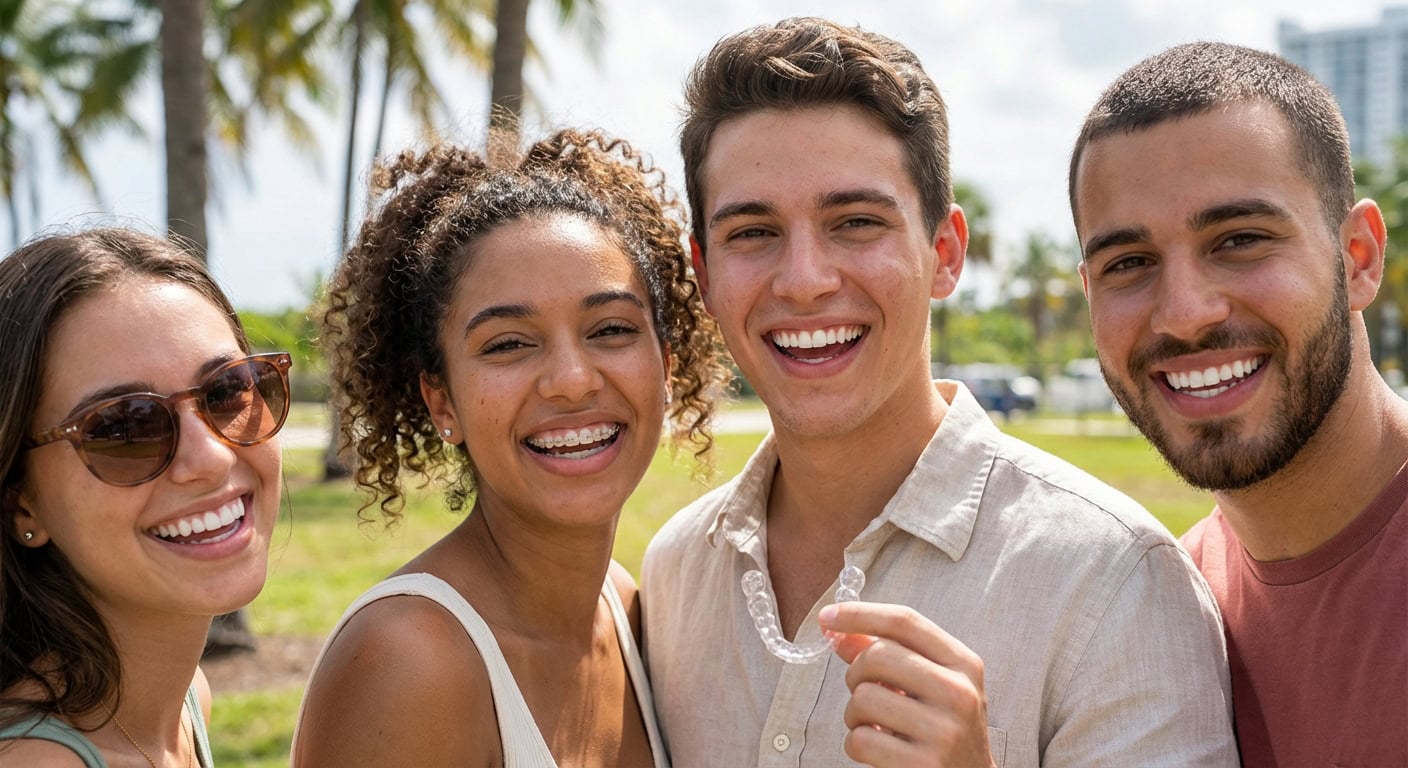
Braces vs Invisalign for Teens in Broward County
Your teenager needs orthodontic treatment, and you're standing at a crossroads.
One path shows traditional braces with metal brackets and wires.
The other shows clear aligners that vanish against the teeth.
Both work. But which one actually fits your kid's life in Broward County?
That's the real question parents ask me every single day, and it's not a simple answer because teenagers aren't simple.
They've got sports schedules, school dances, social media obsessions, and a deep need to feel confident walking down the hallway.
I get it. My job is to cut through the noise and show you exactly what each option does, who it works best for, and why SMILE-FX Orthodontics in Miramar has become the go-to choice for families across Pembroke Pines, Hollywood, Weston, Cooper City, Davie, and Fort Lauderdale.
The Real Difference Between Braces and Invisalign for Active Teens
Let's start with what braces actually do.
Traditional metal or ceramic braces are fixed.
They stay on your teen's teeth 24/7 until treatment ends.
Each bracket is bonded to a tooth, and a wire runs through them, applying constant, calculated pressure to shift teeth into the right position.
Ceramic braces look more subtle than metal ones, but they're still visible.
That matters to teenagers.
Here's what makes SMILE-FX braces different from the standard setup you might find elsewhere.
We use AI-precision bracing systems, including self-ligating options that reduce friction and treatment time.
Translation: your teen gets faster results and less discomfort during appointments.
Some families choose our gold braces option, which blends aesthetics with performance.
Adjustments happen every 4 to 6 weeks during office visits, and that's the structure some teenagers actually prefer because they know exactly when they're coming back.
Now, Invisalign for teens works completely differently.
Clear aligners are removable trays custom-made from 3D scans of your teen's mouth.
Each aligner is worn for about two weeks before switching to the next one in the sequence.
The aligners slowly move teeth into alignment without anyone really noticing.
For school photos, sports events, or just feeling normal at lunch, Invisalign wins on the visibility front.
At SMILE-FX's Invisalign program, we include compliance indicators on the aligners so you can track whether your teen is actually wearing them (and let's be honest, that's a real concern).
Most Broward teens finish treatment in 12 to 18 months, though complex cases take longer.
Braces vs Clear Aligners: Head-to-Head Breakdown
The choice between clear aligners and braces comes down to a few key factors.
Visibility is obvious: aligners nearly disappear, braces stay visible.
But that's just one piece of the puzzle.
Maintenance and office visits matter differently for different families.
Braces need adjustments every month and a half at the orthodontist's office.
Aligners get switched out at home, with fewer appointments needed.
If your teen's schedule is packed with school, extracurriculars, and part-time jobs, fewer office visits might be a win.
Comfort and pressure are real considerations too.
Braces can feel sore for the first few days after an adjustment, though the pain is manageable and usually goes away quickly.
Invisalign applies gentler pressure, about 40% less force than traditional systems, which means less initial soreness.
Diet and eating is another practical thing to think about.
With braces, certain foods are off-limits: sticky stuff like gum, hard candy, popcorn, or anything that could break a bracket.
With Invisalign, your teen removes the aligners to eat whatever they want.
They just rinse the teeth and put the aligners back in.
That freedom matters to a lot of teenagers in Broward who love their barbecues, snacks during school, and casual eating.
Treatment complexity is the real wildcard.
For mild to moderate spacing or alignment issues, Invisalign works great.
But for severe crowding, major bite problems like overbite or underbite, or cases involving missing teeth, braces provide more control and faster correction.
Why Braces Still Win for Complex Cases
Not every teenage smile is a simple fix.
Some teens come to us with crowded teeth where there's barely room for all of them.
Others have bite problems that affect chewing and jaw alignment.
These are the cases where braces shine.
The fixed nature of brackets and wires gives the orthodontist precise three-dimensional control.
Every angle, every rotation, every millimeter of movement can be calculated and executed.
Invisalign has gotten really good, and it handles a lot of cases that it couldn't years ago, but it still has limits with severe crowding or complex rotations.
This is why a proper consultation matters.
At SMILE-FX, we're different because our board-certified specialists don't just recommend the solution that's easiest to sell.
We recommend what actually works for your teen's specific mouth.
Sometimes that's braces. Sometimes it's aligners. Sometimes it's a combination approach.
Invisalign Teens: Perfect for the Active Lifestyle
Now let's talk about why Invisalign wins for a different group of teenagers.
If your teen plays sports, whether it's football at Marjory Stoneman Douglas High in Parkland or soccer at any field in Weston, removable aligners are a game-changer.
They pop out for practice and games, eliminating any worry about brackets getting damaged or wires causing mouth injuries.
With braces, athletes can still play (we provide custom mouthguards), but there's always that extra layer of concern.
Invisalign also wins for the social side of teenage life.
Pictures at events, hanging out with friends, first dates, presentations in class—all of it feels more normal when teeth are invisibly straightening.
Teenagers are already self-conscious. Removing that visible orthodontic barrier can actually boost compliance because they're not avoiding wearing them out of embarrassment.
The compliance indicators we mentioned earlier are real too.
They show a color change when aligners are being worn consistently, which helps parents know what's actually happening and lets the orthodontist track progress accurately.
Cost Reality Check for Broward Families
Let's be straight about money because it's usually the tie-breaker.
Traditional braces typically run between four thousand five hundred and seven thousand five hundred dollars in the Broward area, depending on how complicated the case is and how long treatment takes.
Teen Invisalign usually falls between three thousand eight hundred and six thousand two hundred dollars.
Notice that Invisalign is often slightly cheaper, which surprises people.
The difference depends on case complexity, treatment duration, and which insurance benefits apply.
Most families have coverage through dental insurance plans, and our office maximizes what you get from those benefits.
The real move is getting a precise quote for your teen's specific situation.
Book a FREE 3D scan and VIP smile consultation here to get real numbers instead of guessing.
Why Your Location in Broward Actually Matters
Broward County is big, and driving time adds up when you're scheduling appointments every month and a half for braces or switching aligners every two weeks.
If you're in Pembroke Pines, SMILE-FX in Miramar is about 10 miles away, roughly 15 minutes via I-75 depending on traffic.
That's close enough for same-day emergencies if something breaks.
From Hollywood, you're looking at 12 miles on Pembroke Road, about 20 minutes.
The benefit here is our evening hours fit perfectly after school.
You're not dragging your teen out of class for appointments.
If you're in Weston, it's only 8 miles away.
Worth the drive for the AI technology and board-certified specialists you won't find at generic high-volume aligner mills.
Cooper City and Davie families get 15-minute access, which is perfect for early intervention cases with younger kids still in elementary school.
Fort Lauderdale families drive about 20 miles, south on the coast, but evening slots work around soccer practices and other commitments.
The point is simple: proximity matters, and SMILE-FX's location serves most of Broward with real convenience.
What Actually Happens During Your Teen's First Appointment
Parents ask this constantly because the unknown is scary.
Your teen comes in, we take 3D scans of their mouth, and we do a real examination.
No pressure sales pitch. We explain what we see, what options exist, and what timeline looks like.
The SMILE quiz helps us understand your teen's priorities, lifestyle, and concerns.
Are they worried about appearance? Do they play sports? How disciplined are they about wearing aligners?
These answers guide our recommendation.
Our board-certified specialists don't work off a script.
We listen, ask the right questions, and build a plan that works for your actual teenager, not some generic version of one.
The Real Testimonials from Broward Families
Parents and teens tell us what matters most when treatment is done.
Check out patient reviews from Broward families who've been through both systems.
You'll see real people talking about real results, real comfort levels, and real experiences with our team.
That social proof matters because you're not just picking an orthodontist; you're picking someone your teen trusts for two to three years.
Technology That Actually Changes the Game
Here's where we get a little different.
SMILE-FX invests in cutting-edge technology that you won't find everywhere.
3D scanning, AI-precision bracket placement, digital treatment planning—this isn't flashy tech for flashy sake.
It actually reduces treatment time, improves outcomes, and makes the whole experience smoother for your teen.
It's the difference between guessing where teeth need to go and knowing exactly.
The Bottom Line for Braces vs Invisalign in Broward
Choose braces if your teen has complex bite or crowding issues and you want the fastest, most controlled result.
Choose Invisalign if your teen is active, social, disciplined about compliance, and has mild to moderate spacing issues.
Or choose us to figure it out together in a real consultation instead of guessing online.
SMILE-FX Orthodontics has served thousands of Broward families, from Pembroke Pines to Fort Lauderdale, with results that actually stick.
We offer free retainers and whitening after treatment ends because we care about what happens after the braces or aligners come off.
Your teen deserves a confident smile, and the right orthodontic choice matters more than you think.
Book a FREE 3D scan and VIP smile consultation here and let's figure out which path is right for your teenager's smile and lifestyle.
Teen Orthodontics Beyond Braces and Invisalign: What Parents Really Need to Know About Treatment Options
Your teenager finally agreed to get their teeth fixed.
That alone is a win.
But now you're wondering what comes after the initial decision between braces and clear aligners.
What if their case needs something different?
What if they're worried about pain, cost, or how long treatment actually takes?
These are the real questions I hear from parents in Broward County every single week, and they matter way more than the marketing hype you'll see online.
The truth is that braces and Invisalign aren't the only tools we have to straighten teeth and fix bites.
There are other treatments that work for specific situations, and knowing what's available can change the entire outcome for your kid's smile.
What Happens When Standard Options Don't Fit Your Teen's Needs
Let's say your teenager has a bite problem that goes beyond simple crowding.
Maybe their jaw doesn't line up right, or their teeth come together in a way that affects how they chew or breathe.
Those cases need more than just moving teeth around.
They need comprehensive treatment that addresses the root cause.
This is where understanding what cases we can treat becomes super important.
Some orthodontists will push every kid into braces or aligners regardless of whether that's actually the best path.
We look at your teen's specific situation and build a plan that works for them.
That might mean traditional braces for part of treatment, then switching to aligners to finish.
Or it might mean combining orthodontics with other treatments to get the best results.
The Middle Ground: Combination Approaches That Actually Work
Here's something most parents don't know.
Your teenager doesn't have to pick one treatment and stick with it for the whole time.
Starting with braces for the heavy lifting, then finishing with clear aligners is becoming really common.
Why?
Because braces are monsters at handling the complex movements early on.
They move teeth in three dimensions faster and more forcefully than aligners can.
Once the teeth are mostly where they need to be, aligners take over for the fine details.
This hybrid approach gets your teen out of visible braces sooner, which usually means better compliance down the stretch.
The math is simple.
Teen starts with braces for 12 months, then switches to Invisalign for 6 months of refinement.
They're not stuck with metal brackets for 24 months straight, and they still get the precision that makes a real difference.
At SMILE-FX, we're different because we aren't stuck on one approach for every mouth that walks through the door.
We customize the plan based on what your teen's teeth actually need.
Beyond Teeth: Other Treatments That Change the Game
Orthodontics isn't just about straightening teeth anymore.
There are other treatments that work alongside braces or aligners to get faster results and better outcomes.
Accelerated orthodontics uses special devices or procedures to speed up tooth movement.
Some teens finish treatment in half the normal time because we're using these techniques.
Surgical orthodontics is another option for teens with severe jaw misalignment.
If your teenager's bite problem is big enough that straightening teeth alone won't fix it, we might recommend working with an oral surgeon alongside orthodontic treatment.
This isn't common, but for the right case, it changes everything.
Retention therapy gets overlooked all the time.
This is the part after braces or aligners come off.
Your teen needs to wear retainers, and how they do that determines whether the smile stays perfect or slowly drifts back.
We include complimentary retainers and whitening after treatment ends at SMILE-FX because we're not just checking out once the brackets come off.
We actually care about the long-term result.
When Your Teen Needs Early Intervention
Sometimes the best time to treat orthodontic problems isn't when your teenager is a teenager.
Younger kids in elementary or middle school can benefit from early treatment that sets them up for easier, faster results later.
This might mean simple appliances to guide jaw growth or expanding the upper jaw to make room for teeth.
It doesn't mean full braces at age eight.
It means catching problems early when they're easier to fix.
If your child is younger than a typical braces age, ask about other treatment options we offer.
A quick evaluation can tell you whether early intervention makes sense for your kid or if waiting a few years is the smarter move.
Real Talk About Pain, Discomfort, and What to Actually Expect
Your teenager is probably nervous about this.
Pain is the thing everyone worries about, and it's worth talking about honestly.
Getting braces put on doesn't hurt.
The brackets are bonded to teeth and wires are threaded through, and there's no pain during that process.
What happens after is different.
Within a few hours, as the wires start pulling teeth, your teen will feel pressure and maybe soreness.
This is normal.
It usually peaks at 24 to 48 hours and fades after three or four days.
Taking ibuprofen helps.
Eating soft foods helps.
It's manageable.
With Invisalign, the discomfort is usually less intense because aligners apply gentler force over time.
Your teen might feel pressure and tightness, but actual pain is rare.
The bigger adjustment is mental.
They need to remember to wear the aligners 20 to 22 hours every day, and they can't just pop them out whenever they feel like it.
That discipline matters way more than the physical discomfort.
Here's what we tell teens straight up: orthodontics is uncomfortable, but it's not painful.
There's a difference.
Uncomfortable means you feel it working.
Painful means something's wrong and needs fixing.
We make sure your teen knows what to expect so there are no surprises.
Insurance, Financing, and Making This Affordable for Your Family
Cost is real.
Orthodontic treatment isn't cheap, and I get why families stress about it.
Most dental insurance plans cover a chunk of orthodontic treatment, usually between 1,000 and 2,000 dollars.
That's solid help, but it's not the whole bill.
Here's where we're different.
We work with your insurance to maximize your benefits, and we offer flexible payment plans that fit actual family budgets.
Some families pay monthly.
Some pay a deposit and then break the rest into chunks.
We're not going to turn away a kid because payment is tight.
We also have promotions throughout the year and discounts if you have multiple kids getting treatment.
The real move is getting honest numbers during a consultation.
Book a FREE 3D scan and VIP smile consultation here to see what your specific situation costs and what financing options work for you.
No guessing, no hidden fees, just real numbers.
The Retention Phase: The Part Everyone Skips That Ruins Everything
Your teenager is going to be so excited when their braces come off.
That's awesome.
But this is when the work actually gets harder, not easier.
Teeth want to move back to where they started.
It's biology.
If your teen doesn't wear retainers consistently after treatment, the money you spent and the two years of effort will slowly disappear.
We've seen it happen.
A perfect smile six months later looks totally different because the teen stopped wearing their retainer.
The good news?
At SMILE-FX, we include retainers in our treatment package.
Your teen gets a fixed retainer bonded behind their front teeth and a clear retainer they wear at night.
No extra cost.
We also include professional whitening after treatment ends because after two years of brackets, teeth deserve to shine.
We're not just moving teeth and saying goodbye.
We're protecting the investment and keeping that smile locked in place.
Questions Parents Ask All the Time About Teen Orthodontics
What's the fastest orthodontic treatment for teens?
Usually a combination approach where braces do the heavy lifting first and aligners finish the details.
This can cut total treatment time by several months compared to aligners alone.
Can my teen still play sports with braces?
Yes, but they'll need a custom mouthguard that fits over the brackets.
We can help with that.
Aligners are easier for athletes because they can be removed during games and practice.
How often does my teen need to come in during treatment?
Braces require appointments every four to six weeks.
Aligners typically need fewer in-office visits because your teen switches trays at home.
What if my teen loses their aligners or breaks their braces?
We've got backup plans and quick fixes.
Contact us and we'll work you in ASAP.
Emergencies happen.
Do braces or aligners look better?
Aligners are invisible.
Braces are visible but cleaner looking than they used to be.
Some teens actually like the look of braces because their friends have them too.
Why Your Teen's First Visit Matters More Than You Think
The initial consultation isn't just about taking pictures and making a diagnosis.
It's about building trust between your teen and their orthodontist.
If your teenager doesn't feel heard or understood during that first visit, compliance goes down for the entire treatment.
They need to feel like this is a partnership, not something being forced on them.
At our office, we start by listening.
What's your teen worried about?
What matters most to them?
Is it speed, appearance, comfort, or something else?
We answer their questions directly and honestly, not with sales pitch language.
We show them 3D scans of their mouth so they can actually see what we're seeing.
We explain the plan in a way that makes sense to a teenager, not just parents.
This foundation of trust is what gets them to wear their aligners 22 hours a day or stick with braces for the full treatment when they're frustrated.
Our board-certified specialists aren't just technical experts.
They're communicators who actually work with teenagers every single day.
The Long-Term View: What Happens After Treatment Ends
Orthodontics is a two-part job.
Part one is moving the teeth.
Part two is keeping them there.
Your teenager will wear retainers for life, or the smile will shift back.
The good news is that retainer-wearing becomes a habit quickly.
Most teens wear them at night without even thinking about it after a few months.
We check in during annual retainer appointments to make sure everything's still perfect.
We adjust or replace retainers if needed.
We make sure your teen knows how to keep their smile looking the way it did on day one after treatment.
This is the real secret that separates orthodontists who care about long-term outcomes from ones who just want to hit numbers.
Choosing the Right Orthodontist for Your Teen's Specific Needs
Not every orthodontic office is built the same.
Some are high-volume clinics that see tons of patients and rush through appointments.
Others are small shops without modern technology or experience with complicated cases.
You want an office that has both the expertise and the heart to do right by your teenager.
That means board-certified specialists who stay current on techniques.
It means access to cutting-edge technology like 3D scanning and AI-powered treatment planning.
It means honest conversations about what works for your teen instead of pushing one solution for everyone.
It means caring about what happens after the brackets come off.
At SMILE-FX, we hit all those marks.
We've treated thousands of teens across Broward County, and we know what works for teenagers in your area.
Our technology is built for precision and speed, which means your teen gets faster results and a better experience.
Your teenager deserves orthodontic treatment that's customized for their mouth, their lifestyle, and their goals.
Not a cookie-cutter plan that works for nobody and fits everybody.
Book a FREE 3D scan and VIP smile consultation here to see what options actually exist for your teen's orthodontic treatment, and let's build a plan that works for their life, not against it.
Advanced Orthodontic Solutions for South Florida Teens and Adults: Beyond the Basics
You've probably figured out that braces and Invisalign are the main players in straightening teeth.
But here's what most people don't know: if your situation is complicated, there's a whole toolkit of advanced approaches that work better than the standard options.
This is especially true for teens and adults across South Florida who need faster results, have complex bite problems, or want options that fit their life better.
I'm talking about specialized techniques, technology-driven treatments, and personalized strategies that the best orthodontist near me should offer but most don't.
The Technology That Changes Everything for Serious Cases
Let's talk about SureSmile orthodontist technology and similar AI-powered systems that are reshaping how board certified orthodontist South Florida practices handle tough cases.
This isn't futuristic stuff anymore.
It's here now, and it works.
These systems use robotic wire-bending and 3D treatment planning to map out exactly where each tooth needs to go before treatment even starts.
Your orthodontist can show you a digital model of your final smile before day one.
You see what you're getting into.
For best orthodontist for complex cases, this technology cuts treatment time by months because there's zero guesswork.
The wire knows what to do.
The brackets know where to go.
At SMILE-FX's cutting-edge technology center, we use exactly this kind of system.
Adults who need results fast and teens with serious crowding or bite problems benefit most.
The precision saves time, reduces office visits, and means fewer adjustments that cause discomfort.
What About Serious Bite Problems That Need More Than Teeth Movement
Some people have bite issues that go deeper than tooth position.
Their jaw doesn't line up right, or they have a skeletal problem that affects how their face looks and how they chew.
This is where orthognathic surgery comes in.
It sounds intense because it is, but for the right case, it's life-changing.
Here's how it works: an orthodontist works with an oral surgeon to first align the teeth, then surgery repositions the jawbones into the correct position.
The result is a bite that functions properly and a face that looks balanced.
It's not something every person needs, but if your orthodontist tells you that you're a candidate, it means you'll get a much better outcome than straightening teeth alone could give you.
This is one reason board certified specialists matter.
They know when teeth movement isn't enough and when to bring in surgical expertise.
Accelerated Orthodontics: Get Results in Half the Time
The question everyone asks is: how do I speed this up?
Accelerated orthodontics answers that directly.
We're talking about techniques and devices that stimulate bone remodeling around your teeth so they move faster.
Micropulsing devices, special medications, and strategic pressure protocols all play a role.
Some top rated orthodontist Fort Lauderdale offices offer this.
Not all of them do.
The result is real: treatment that normally takes 24 months finishes in 15 to 18 months instead.
For teens who are impatient or adults with time pressures, this is huge.
Your orthodontist should explain whether your case is a good fit for accelerated techniques.
Pushing too hard too fast causes problems.
Doing it right means understanding the biology and knowing how far you can safely go.
Multiple Bracket Types: Ceramic, Self-Ligating, and Hybrid Options
Not all braces look the same anymore.
You've got metal brackets that are traditional and tough.
You've got ceramic brackets that blend in better with teeth.
You've got self-ligating brackets that don't use rubber bands, so they're faster and easier to clean.
And you've got hybrid setups where your orthodontist uses different bracket types on different teeth depending on what needs to happen.
The best orthodontist Miami practices offer choices because what works for one patient doesn't work for everyone.
Self-ligating brackets cut treatment time by roughly 20 percent because the friction is lower.
Your teeth can move faster and smoother through the wire.
They're also easier for your orthodontist to adjust and faster to clean at home.
Ceramic brackets cost more but look way better, which matters a lot if you're an adult who feels self-conscious about braces.
The best orthodontist for kids South Florida often uses metal because kids don't care as much about appearance and metal is the most reliable.
The point is simple: your orthodontist should talk through these options with you instead of putting everyone in the same bracket type.
The Reality of Affordable Options: $0 Down Financing and Insurance Navigation
Cost is the real barrier for most families.
Affordable braces South Florida and affordable braces Broward options exist, but you have to know where to look.
First, insurance.
Most dental plans cover orthodontics, usually between 1,000 and 2,000 dollars of the total cost.
Your orthodontist's office should do the legwork to maximize that benefit.
If they're not talking about your insurance benefits during your consultation, they're leaving money on the table for you.
Second, $0 down financing plans.
Real orthodontists offer monthly payment plans that don't require a big upfront hit.
You pay maybe 500 dollars down and then 150 to 200 dollars a month for treatment.
That's manageable for most families.
Third, discounts for multiple kids.
If you've got more than one teenager, most offices give you a break on the second child.
At SMILE-FX's free consultation, we break down exactly what your treatment costs, what insurance covers, and what your actual monthly payment looks like.
No surprises, no hidden fees.
Does Insurance Cover Braces: The Real Answer
Short answer: sometimes, but not always, and it depends on your plan.
Most dental insurance covers a percentage of orthodontic treatment up to a maximum dollar amount.
The catch is that many plans consider orthodontics cosmetic and don't cover it at all.
If you have a documented bite problem or health issue related to your teeth, insurance is more likely to help.
Some plans only cover kids, not adults.
Others cover adults but with limits.
The only way to know for sure is to call your insurance company or have your orthodontist's office do it for you.
Most offices have staff who do this all day and know how to get your maximum benefit.
Adult Orthodontics Aventura and Across South Florida: It's Never Too Late
Adult orthodontics Miami and orthodontics for adults Miami are real categories now because more adults are fixing their smiles than ever before.
Your teeth move the same way at 35 as they do at 15.
Biology doesn't change.
What changes is your priorities and what you're willing to do about your smile.
Adults often prefer aligners over braces because they care about appearance at work and don't want visible brackets.
That makes sense.
But some adults with serious bite issues actually need braces because aligners can't handle the complexity.
Treatment usually takes the same amount of time regardless of age.
The difference is that adults are often better at compliance because they chose the treatment for themselves rather than being forced into it by parents.
They wear aligners consistently and follow care instructions better.
That speeds everything up.
Finding the Right Orthodontist: What Top Rated Means in Real Life
You see reviews all over the place.
Five stars here, top rated there.
But what actually makes a top rated orthodontist Miramar or top rated orthodontist near me different from an average office?
Board certification is the first filter.
A board certified orthodontist South Florida has passed rigorous exams and continues education to stay current.
That matters way more than you'd think.
Technology is the second filter.
If your office still uses 2D X-rays and hand-drawn treatment plans, you're getting 1990s care in 2024.
3D scanning, digital planning, and AI-assisted treatment are standard now at good offices.
Communication is the third filter.
Does your orthodontist listen to what you want?
Do they explain things in language you understand?
Do they show you 3D models so you can see what's happening?
Or do they just tell you what you're getting?
Results speak loudest.
Check patient reviews and testimonials to see what real people say about their outcomes and experience.
The Cost of Clear Aligners vs Braces: What You Actually Pay
Invisalign cost South Florida typically runs between 3,800 and 6,200 dollars depending on complexity.
Traditional braces cost South Florida typically runs between 4,500 and 7,500 dollars.
The difference usually comes down to how long treatment takes and what complications show up along the way.
Severe crowding costs more because it takes longer.
Bite problems cost more because they're complex.
Clear aligners cost Miami can be lower if your case is straightforward because treatment is faster.
Your orthodontist should give you a quote based on your specific teeth, not a generic price.
If they're quoting you without examining you, they're guessing.
Advanced Retention: Keeping Your Smile Perfect After Treatment Ends
Here's the part nobody talks about enough: what happens after the braces come off or you finish your last aligner.
Your orthodontist should provide retention solutions.
Most good offices give you a fixed retainer bonded behind your front teeth permanently and a removable retainer you wear at night.
Some use fancy retainers with better materials that last longer.
The key is that your orthodontist doesn't just disappear after treatment.
They check your retention at regular appointments and replace retainers when they wear out.
This is why picking a practice that cares about long-term outcomes matters.
Ready to Get Started: Your Next Step
You know the options now.
You understand what technology matters and what's just hype.
You know what to look for in a best orthodontist South Florida or orthodontist near me.
The only thing left is booking a real consultation with someone who will actually listen to your situation and build a plan around your teeth and your life.
Book a FREE 3D scan and VIP smile consultation here to see exactly what advanced solutions exist for your smile and what treatment will actually cost you and how we can make it work financially.
Stop guessing about orthodontics and start getting real answers from board certified orthodontist South Florida specialists who use the latest technology and actually care about results.