
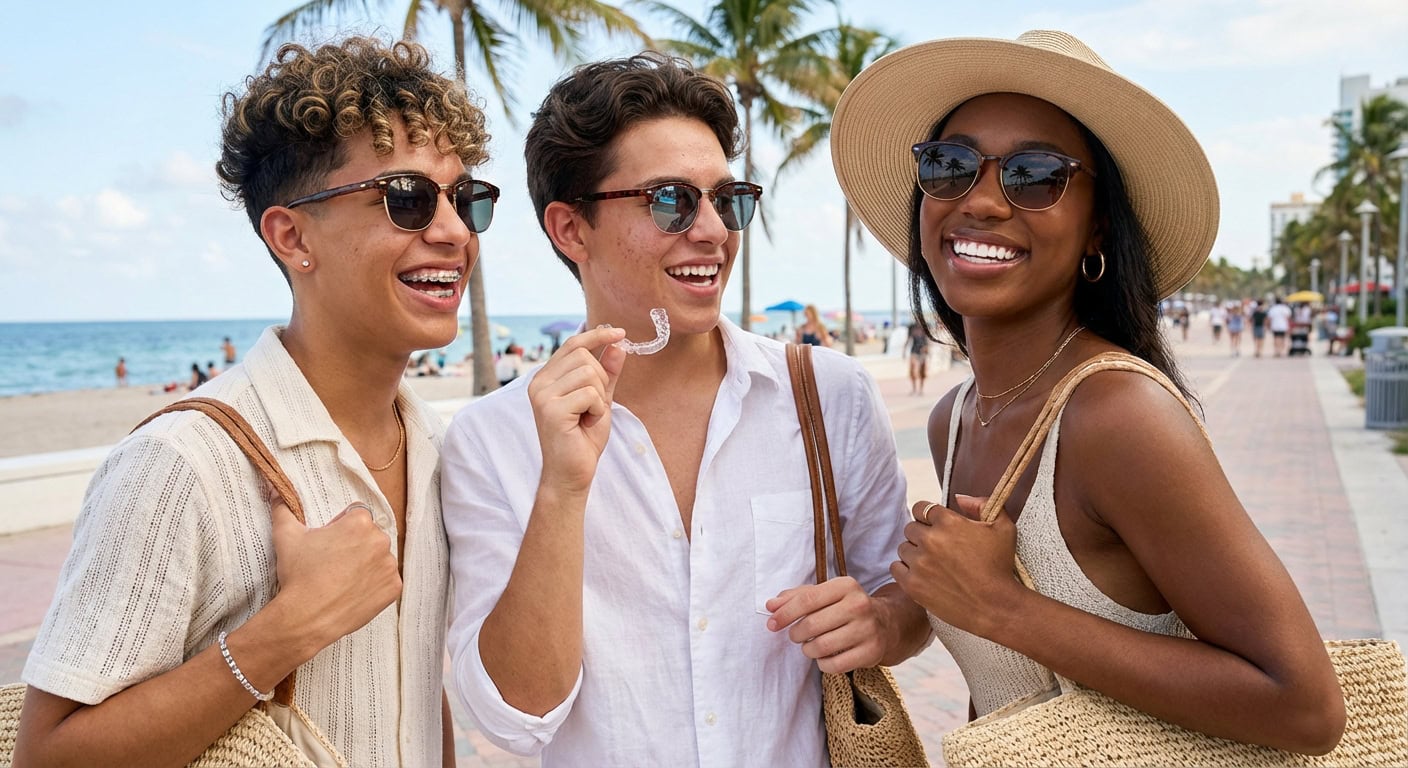
Braces vs Invisalign for Teens in Broward
Your teen needs braces or clear aligners, and you're stuck between two choices.
Metal braces or Invisalign?
Both work.
Both have tradeoffs.
And honestly, most parents in Broward County pick wrong because they don't know what actually matters for their kid's lifestyle.
Here's what I've learned after watching hundreds of families make this call: the best choice depends on three things.
How severe is the bite issue?
How active is your teen?
And do they actually care what their friends think during treatment?
Let me walk you through both options so you can stop second-guessing yourself.
The Real Difference Between Braces and Invisalign for Broward Teens
Traditional braces and Invisalign clear aligners both straighten teeth.
They just do it differently.
Braces use constant pressure.
Metal or ceramic brackets bond to each tooth.
A wire runs through them and gets tightened every few weeks.
This steady pressure moves teeth gradually over time.
It's been the gold standard for over a century because it works for basically every situation you throw at it.
Invisalign uses a series of custom trays.
Each tray is slightly different from the last.
Your teen wears one for about two weeks, then switches to the next.
Over months, these small shifts add up to a straight smile.
The big selling point: they're removable, so no food gets stuck, and nobody sees them during school.
At SMILE-FX Orthodontics & Clear Aligner Studio in Miramar, we use AI-precision bracket bonding for braces and custom-designed aligners for Invisalign.
The difference is we don't push one over the other.
We match the treatment to your teen's actual needs, not what trends online.
When Braces Win for Your Teen
Braces are the right call if your teen has a serious bite problem.
We're talking about:
- Severe crowding where teeth overlap badly
- Overjets (upper front teeth sticking way out)
- Underbites or other complex alignment issues
- Cases where multiple teeth need major movement
Braces handle these situations faster and more reliably than aligners.
They don't depend on your teen remembering to wear them 22 hours a day.
You stick them on, and physics does the work.
Most of our braces cases finish between 18 to 24 months.
Faster for simpler cases, longer for the really complex ones.
Self-ligating braces are a game-changer for comfort.
Instead of using rubber bands to hold the wire in place, they use a clip system.
Less friction, less pressure, less soreness after adjustments.
Your teen still has adjustment visits, but they hurt way less than old-school braces.
Learn more about our braces options if you think your teen might need them.
When Invisalign Makes More Sense
Clear aligners are the move if your teen has mild to moderate crowding or spacing issues.
Clinical data shows Invisalign works for about 70-80% of moderate cases.
Your teen puts the trays in before bed, takes them out for meals and sports, and switches them out every couple weeks.
This is perfect for the active kid.
Plays soccer?
Takes them out for practice, put them back after.
Has a school photo?
Nobody knows they're wearing them.
Eats lunch at school?
No brackets means no spinach stuck in their teeth.
Treatment time is usually 12 to 18 months with good compliance.
The catch: compliance matters.
If your teen forgets to wear them or only wears them at night, the timeline stretches out.
One real advantage at SMILE-FX: remote monitoring reduces office visits by up to 40%.
You're not making the trip to Miramar every month.
We check in using 3D scans and photos.
Cuts down on missed school time and parent stress.
Check out our Invisalign options to see if it's right for your teen.
Comfort and Lifestyle: What Actually Matters to Your Teen
This is where most conversations fall apart.
Parents care about cost and speed.
Teens care about whether they can still be themselves.
With braces:
Certain foods are off limits.
Popcorn, nuts, hard candy, sticky stuff.
Your teen learns pretty fast not to bite down on a pencil.
The wires and brackets can feel weird the first week, but they adjust.
Adjustment day soreness is real but manageable.
Ibuprofen and soft foods fix it.
With Invisalign:
No food restrictions because they come out to eat.
Sports?
No problem.
They slip them out, play, clean their teeth, put them back.
The aligners feel like a tray against your teeth, not as noticeable as you'd think.
Some teens forget they're wearing them.
For teens in Hollywood or Weston who are self-conscious about appearance, Invisalign is basically invisible during school.
For active kids in Davie or Pembroke Pines who play multiple sports, the removability is huge.
The Aesthetics Question: Metal, Ceramic, or Invisible
Let's be straight: your teen probably cares about how they look.
Metal braces are the cheapest and most durable.
Lots of kids wear them now, so it's less of a social thing than it used to be.
But they're visible.
Ceramic braces use tooth-colored or clear brackets.
The wire still shows a bit, but from a distance, they blend way better than metal.
Slightly more expensive, but worth it if appearance matters to your teen.
Invisalign is virtually invisible.
Seriously.
Unless someone is looking directly at your teen's teeth from close up, they won't notice the aligners.
This is a huge deal for teenagers.
Cost and Insurance: The Money Talk
Both treatments cost roughly the same in Broward County.
Braces run $4,000 to $7,000.
Invisalign is in the same ballpark, sometimes slightly higher depending on complexity.
Insurance usually covers about 50% of orthodontic treatment, whether it's braces or clear aligners.
We handle the insurance verification for you at SMILE-FX so you're not blindsided by costs.
Most practices offer payment plans.
You don't pay the full amount upfront.
Breaking it into monthly payments makes it way more manageable for families.
Why SMILE-FX Gets Results Where Others Don't
Here's the thing about orthodontics: there are orthodontists, and there are board-certified orthodontic specialists.
Not the same.
Dr. Tracy M. Liang is board-certified.
That means continuing education, rigorous standards, and staying current with the latest techniques.
We don't do the high-volume, one-size-fits-all approach that mills use.
Each teen gets a personalized plan.
We use cutting-edge technology like 3D scanning to map out exactly how we're moving their teeth.
No guessing, no surprises.
See why our board-certified expertise matters and check out patient reviews from families in Cooper City and Fort Lauderdale who've been through this.
Location and Scheduling: Actually Convenient
Our Miramar office is about 10 to 20 minutes from most Broward County cities.
From Pembroke Pines, it's a quick drive via Pines Boulevard.
Hollywood and Weston are close too.
Even Fort Lauderdale families appreciate the evening hours that fit around school schedules at places like Dillard High.
Free parking, pediatric-friendly scheduling, and weekend appointments.
We get that your teen has a life outside of orthodontics.
Our team speaks English, Spanish, and Mandarin, so language is never a barrier.
Check our interactive map for directions and make scheduling easy.
Remote Monitoring Means Less Time in the Chair
If your teen goes with Invisalign, you're not coming in monthly.
We use remote monitoring: your teen submits 3D scans and photos from home.
We review them and give feedback.
Only come in person when we need to.
This cuts your office visits down significantly and keeps your teen focused on school instead of appointments.
The Bottom Line: Which Should Your Broward Teen Choose
Severe bite issues or complex crowding?
Braces.
Mild to moderate crowding with an active, self-conscious teen?
Invisalign.
Somewhere in the middle and can't decide?
Come in for a consultation.
We'll scan your teen's teeth, show you exactly what we'd do with either option, and let you make an informed call together.
Stop overthinking it.
Book your free 3D scan and VIP smile consultation here: https://smile-fx.com/lp/free-consult
We serve Miramar, Pembroke Pines, Hollywood, Weston, Cooper City, Davie, Fort Lauderdale, and all of South Florida.
Braces vs Invisalign for teens in Broward doesn't have to be complicated when you have the right specialist in your corner.
What Happens After Braces Come Off: Retention and Maintaining Your Teen's Straight Smile
Your teen finally gets their braces removed or finishes their Invisalign treatment.
You feel relief.
They feel excited.
Then reality hits.
Nobody tells you that getting straight teeth is only half the battle.
Keeping them straight is where most families mess up.
I've seen too many parents spend years and thousands of dollars on braces or clear aligners, only to watch their teen's teeth shift back because they didn't understand retention.
It's not their fault.
Most orthodontists don't explain it well enough.
Let me break down what actually happens after treatment ends and how to make sure your teen's smile stays perfect for life.
Why Teeth Move Back: The Biology Behind Relapse
Your teeth don't want to stay where you moved them.
That sounds dramatic, but it's true.
Teeth are held in place by periodontal ligaments.
These ligaments are like tiny rubber bands connecting your tooth root to the bone.
When braces or aligners move your teeth, these ligaments stretch and reshape.
But here's the thing: they have memory.
They want to go back to their original position.
That's called relapse.
It's not a failure of treatment.
It's just biology.
The first three to six months after treatment is when relapse happens fastest.
Your teen's teeth are most eager to move back during this window.
If they don't wear their retainer during this time, they could lose 50% of their correction.
Not all of it comes back, but enough to notice.
This is why retention isn't optional.
It's as important as treatment itself.
The Two Types of Retainers: Fixed and Removable
There's no one-size-fits-all retainer solution.
Most orthodontists use a combination of both types.
Fixed retainers (bonded retainers):
This is a thin wire bonded to the back of your teen's front teeth.
They can't take it off.
They can't forget to wear it.
It works 24/7.
The catch: it only protects the front six to eight teeth.
And you have to be careful when flossing (special floss picks work best).
It can break if your teen eats something too sticky or hard.
But for keeping your teen's most visible teeth locked in place, it's brilliant.
Removable retainers (like Essix or Hawley):
Essix retainers look like thin, clear plastic trays.
They're basically invisible and feel similar to Invisalign.
Hawley retainers are wire and acrylic.
They're more visible but incredibly durable and adjustable.
Your teen wears these at night, every night.
Some teens wear them during the day too for the first few months.
This is where compliance becomes real.
If your teen forgets to wear their removable retainer, teeth will start shifting within weeks.
The Retention Timeline: What Your Teen Actually Needs to Do
Months 0 to 3 (Critical period):
Full-time wear.
Fixed retainer stays on 24/7.
Removable retainer goes in every single night.
Some orthodontists recommend 24/7 removable retainer wear during month one.
Teeth are most unstable now.
Months 3 to 12:
Still nightly wear.
Every night, no exceptions.
This is when your teen needs to build the habit.
If they skip nights, teeth start drifting.
Year 1 and beyond:
Nightly wear continues indefinitely.
Teeth have memory.
Skipping retainer wear opens the door to relapse.
Some patients claim they can drop down to a few nights per week after a year.
Maybe.
But why risk it?
A few minutes every night is cheap insurance for keeping their smile perfect.
Common Retention Mistakes Parents and Teens Make
Thinking retention is temporary.
It's not.
Retention is for life.
Your teen can't just stop wearing retainers after a year and expect their teeth to stay put.
Forgetting that retainers need replacements.
Essix retainers wear out in two to three years.
Hawley retainers last longer but wires can break.
Fixed retainers can debond.
Build replacement costs into your budget.
Assuming one retainer type is enough.
Using both fixed and removable retainers gives the best results.
One protects front teeth 24/7.
The other keeps the rest of the smile stable.
Putting retainers in a pocket or loose in a bag.
Get your teen a small case for their retainer.
Retainers left loose get lost or damaged.
Not cleaning retainers regularly.
Bacteria and plaque build up on retainers just like on teeth.
Soak them in a cleaning solution a few times per week.
Brush them gently with a toothbrush.
Don't use hot water (it warps them).
Real Talk: How to Get Your Teen to Actually Wear Their Retainer
This is the hard part.
Getting your teen to remember something every single night is like trying to herd cats.
Here's what works:
Make it part of their routine.
Retainer goes in right after brushing teeth at night.
Same time, same place, every day.
No thinking required once it's a habit.
Set a phone reminder for the first month.
Sounds silly, but it works.
After 30 days, the habit sticks.
Get them a cool retainer case.
If they like how it looks, they're more likely to use it.
Explain the why.
Teens respond better when they understand consequences.
Show them pictures of relapse.
Let them know that skipping retainer wear means teeth move back.
More appointments.
More time in the orthodontist's chair.
Possibly more money.
Don't nag.
Once they understand, let them own it.
Nagging backfires with teens.
What Happens If Your Teen's Teeth Shift After Treatment
Life happens.
Your teen goes to college, gets busy, stops wearing their retainer for a few months.
Their teeth start to shift.
Now what?
Catch it early.
Small shifts can be fixed with a new retainer or a short round of refinement treatment.
Don't wait.
The longer teeth shift, the harder they are to move back.
You might need braces or clear aligners again.
Some practices offer lifetime refinements.
Check with your orthodontist about this before treatment ends.
At SMILE-FX Orthodontics & Clear Aligner Studio, we build retention plans that work for your teen's life, not just the treatment phase.
Our approach uses cutting-edge technology to track tooth movement over time.
If something's shifting, we catch it before it becomes a problem.
The Cost of Retention: Budget This In
Retainers aren't free, but they're way cheaper than redoing treatment.
Fixed retainers cost $200 to $500.
Removable retainers run $150 to $300 each.
Most patients get at least two removable retainers (one as backup).
So budget $300 to $600 for initial retention.
Replacements every few years add another $200 to $400.
That's nothing compared to $4,000 to $7,000 for retreatment.
And definitely worth it for a smile that lasts a lifetime.
Why Your Orthodontist's Retention Plan Matters
Not all retention plans are created equal.
Some orthodontists hand you a retainer and say "wear it every night" without explaining specifics.
That's not good enough.
You need a clear plan that includes:
How long to wear removable retainers each day.
When to replace them.
What to do if something breaks or feels wrong.
A schedule for follow-up visits to check retention.
Insurance information about retainer replacement costs.
SMILE-FX provides a comprehensive retention protocol that covers all of this.
We're board-certified, which means we stay current with best practices in retention science.
Your teen gets a custom plan, not a generic one.
Different Cases Need Different Retention Strategies
The amount of retention your teen needs depends on their case.
If they had severe crowding or spacing:
They need aggressive retention.
Both fixed and removable retainers, worn consistently.
Longer duration of full-time wear.
If they had mild crowding:
A fixed retainer on front teeth plus nightly removable retainer may be enough.
If they had a bite correction:
Retention often needs to last longer because bite problems have deeper patterns.
If they had jaw surgery:
Retention is especially important.
Bones are still remodeling.
Teeth want to shift back toward their original bite.
Check our treatable cases page to understand what your teen's case needs in terms of long-term retention.
FAQ: Questions Parents Ask About Retention
Q: Can my teen stop wearing their retainer after one year?
A: Not safely.
Teeth have lifelong memory of their original position.
Nightly retainer wear should continue indefinitely to prevent relapse.
Q: What if my teen hates wearing their retainer?
A: Essix retainers are nearly invisible and feel like Invisalign.
Many teens prefer them to other types.
Make it a non-negotiable part of their bedtime routine.
Q: Can my teen wear their Invisalign as a retainer?
A: No.
Invisalign trays wear out and aren't designed for long-term retention.
A proper retainer is required.
Q: What happens if my teen loses their retainer?
A: Call your orthodontist immediately.
They'll make a replacement.
In the meantime, your teen's teeth will start shifting, so time matters.
Q: Do adults need retainers too?
A: Yes.
Teeth shift at any age.
If you or your child had braces as a kid and stopped wearing retainers, that's why your teeth shifted.
Adult retention works the same way as teen retention.
Making Retention Stick: The Parent's Role
You're not doing the retainer wear, but you're responsible for supporting it.
Buy backup retainers.
Stuff happens.
Having a spare means no gaps in protection if one gets damaged.
Schedule follow-up appointments.
Your orthodontist should see your teen periodically to check retention.
These visits catch problems early.
Normalize the conversation.
Talk about retainer wear the same way you'd talk about brushing teeth.
It's not punishment.
It's maintenance.
Pay for replacements without complaint.
If your teen wore their retainer faithfully and it wore out, that's a success story.
Replace it as part of the cost of keeping their smile straight.
Model good habits.
If you had braces and wore your retainer, tell your teen.
Your credibility matters.
The Long-Term Investment: Why Retention Isn't an Afterthought
Treatment ends, but retention is forever.
Your teen spent months or years getting their teeth straight.
Retention is the simple part that keeps all that work intact.
A few minutes every night.
That's the price of keeping their smile.
When you think about it that way, retainers aren't annoying.
They're the best deal in orthodontics.
You've already invested time and money into getting your teen's teeth right.
Retention protects that investment for life.
Getting Started: Choosing the Right Orthodontist for Retention Support
Not every practice treats retention with the same care they treat the initial correction.
Some hand you a retainer and wish you luck.
Others build a lifetime retention plan.
You want the second kind.
At SMILE-FX, our board-certified specialist works with every patient to create a retention strategy specific to their case.
We track your teen's progress.
We're available when questions come up.
We handle replacements and adjustments.
Retention isn't something that happens after your appointments end.
It's part of the entire relationship.
Ready to start your teen's journey toward a smile that lasts?
Book a FREE 3D scan and VIP smile consultation at https://smile-fx.com/lp/free-consult.
We'll show you the exact retention plan your teen will need and answer any questions about keeping their smile perfect for decades to come.
SMILE-FX Orthodontics & Clear Aligner Studio serves teens, kids, and adults throughout Broward County, Fort Lauderdale, Miramar, Pembroke Pines, Hollywood, Weston, Cooper City, and Davie.
Whether your teen had braces, Invisalign, or custom clear aligners, retention is the foundation of a lasting smile.
Why Board-Certified Orthodontists Get Better Results: The Difference You'll Actually Notice
You're looking at orthodontists in South Florida and seeing the word "orthodontist" everywhere.
On websites.
On business cards.
On Google Maps.
But here's what nobody tells you: not all orthodontists are the same.
The difference between a board-certified orthodontist and someone calling themselves an orthodontist is massive.
Like, thousands-of-dollars-and-years-of-treatment massive.
I see families make this mistake all the time.
They pick based on location or cost or a nice website.
Then halfway through treatment, they realize something's wrong.
The bite isn't tracking right.
The teeth aren't moving the way they should.
Or worst case, the treatment plan was never going to work in the first place.
By then, they've already paid half the bill.
This article is about what actually separates a board-certified orthodontist from the rest and why it matters more than you think, especially if you're looking for the best orthodontist near me or the top-rated orthodontist in Fort Lauderdale, Miramar, or anywhere else in Broward County.
What Board Certification Actually Means
General dentists can offer orthodontic treatment.
Some do it well.
Most don't.
That's not a knock on dentists.
It's just reality.
Orthodontics requires specialized training that dentists don't get in dental school.
A board-certified orthodontist has gone way further.
After dental school, they complete a two to three-year orthodontic residency.
That's additional schooling focused only on straightening teeth and correcting bites.
They learn biomechanics, diagnosis, case planning, and the biology of tooth movement.
Then they take boards.
A written exam, a practical exam, and a case review by other specialists.
If you fail any part, you don't get certified.
It's not participation trophy stuff.
It means this person has been vetted by the American Board of Orthodontics.
They know what they're doing at a level that most people don't.
Learn more about what board certification means and why it matters for your treatment outcomes.
The Real Difference in Treatment Planning
This is where you see the split.
A general dentist looks at your teeth and thinks, "I'll put braces on, tighten them every month, and hope they come out straight."
A board-certified orthodontist does something completely different.
They start with 3D imaging.
They map out every tooth, the bone supporting it, the jaw position, and how everything relates.
Then they build a treatment plan that accounts for:
- Exactly how much each tooth needs to move and in what direction
- The order teeth should move to avoid problems
- How the treatment will affect your bite and your profile
- What happens after treatment (retention strategy)
- Timeline based on your biology, not just a guess
A best orthodontist for complex cases uses this level of detail even on straightforward situations.
Because even simple cases get better results when planned properly.
We use cutting-edge technology at SMILE-FX to make sure every detail is accounted for before we even bond a bracket.
Why This Matters: The Cost of Getting It Wrong
Let's talk money.
If treatment gets planned badly, you end up paying for corrections.
Maybe your teen needs refinement treatment.
Maybe they need more time in braces.
Maybe the bite doesn't come out right and now you're looking at jaw surgery down the line.
A bad plan that costs $5,000 upfront but needs $3,000 in fixes later is worse than a $6,500 plan done right the first time.
That's why affordable braces in South Florida from a board-certified specialist often end up being cheaper overall.
You're not paying for rework.
You're not paying for extended treatment.
You pay once, it works, you're done.
Even if financing is tight, book a FREE 3D scan and VIP smile consultation to see exactly what the right plan looks like and what it costs before committing to anything.
Board Certification and Continuing Education
Once someone gets board-certified, they don't just coast.
The American Board of Orthodontics requires ongoing education.
New techniques come out.
Technology evolves.
Research shows better ways to move teeth with less discomfort.
A board-certified orthodontist has to stay current or they lose the credential.
That's not true for everyone else.
Some practices use the same wires, the same brackets, the same approach they've used for twenty years.
It works, sure.
But it's not the best option anymore.
When you choose a top-rated orthodontist near me who takes continuing education seriously, you're getting access to methods that actually reduce pain, speed up treatment, and give better outcomes.
How Board Certification Shows in Your Treatment Experience
You'll notice it in small ways.
Your first appointment takes longer.
Not because they're slow.
Because they're thorough.
They ask about your health history, your goals, your concerns.
They take images, study them, and explain exactly what they see.
When you ask a question, they answer it in plain English, not medical jargon.
They talk about the "why" behind every decision.
Adjustments are smoother.
You're not in pain for days after an appointment.
Your teeth move predictably because the force is calculated, not guessed.
Treatment timeline is realistic.
If they say eighteen months, it's eighteen months.
Not "somewhere between eighteen and thirty-six months, we'll see how it goes."
This is what separates a best orthodontist in Miami or best orthodontist for kids in South Florida from someone who just has a chair and some wire.
Board-Certified Specialists and Complex Cases
If your kid has a severe bite problem, a crowding issue that's really bad, or needs jaw surgery, you want a board-certified orthodontist specializing in complex cases.
These situations require knowledge that comes from experience and training.
A generalist might be able to handle it.
A specialist knows the exact approach that works.
They've seen it before.
They know what to expect at each stage.
They know how to adjust if something isn't tracking right.
Check what cases we handle to see if your situation fits what a true specialist can deliver.
The Tech Advantage: SureSmile and Modern Diagnostics
A SureSmile orthodontist in South Florida is using AI and robotics to place brackets with millimeter precision.
That's not something you'll find everywhere.
SureSmile uses 3D mapping to determine the exact angle, height, and position for each bracket before treatment starts.
Then a robot places them.
No guessing.
No variation from bracket to bracket.
This level of precision means:
- Shorter treatment time because teeth move more efficiently
- Better final results because mechanics are exact
- Fewer adjustments needed
- Less discomfort because forces are optimized
This is the kind of cutting-edge technology that board-certified specialists invest in because they understand the difference it makes.
Insurance, Financing, and What Board Certification Means for Your Wallet
Here's something interesting: insurance companies know the difference too.
They're more likely to cover treatment from a board-certified specialist because they know outcomes are better and rework is less common.
If you're asking "Does insurance cover braces," the answer is usually yes, but the percentage they cover can depend on the provider.
Some practices offer $0 down braces financing in South Florida and payment plans that break treatment into manageable chunks.
A board-certified specialist usually has more confidence in their treatment plan, so they can be flexible with payment options.
They know the case will finish on schedule, so spreading payments out works for everyone.
Finding the Right Board-Certified Orthodontist Near You
So how do you actually find a board-certified orthodontist near me that's worth your time?
Check the credentials.
The American Board of Orthodontics keeps a directory of certified specialists.
If they claim to be board-certified, you can verify it.
Ask about technology.
Do they use 3D imaging?
Do they have digital scanners?
Are they using modern wire and bracket systems?
Read reviews.
Check patient reviews from families who've actually been through treatment.
Look for people mentioning professionalism, clear communication, and realistic timelines.
Book a consultation.
A top-rated orthodontist in Miramar or anywhere else worth your time will offer a free consultation.
See how they treat you.
Do they listen?
Do they answer questions thoroughly?
Do they pressure you into treatment or let you make an informed choice?
The Bottom Line on Board Certification
Board certification isn't just a credential hanging on a wall.
It's evidence that someone has been trained properly, tested rigorously, and commits to staying current.
That translates into better treatment outcomes for you and your family.
Better outcomes mean shorter treatment, fewer problems, and a smile that actually lasts.
When you're choosing between options for braces near me or invisalign provider near me, pick someone who's board-certified and uses modern technology.
Your teeth will thank you.
Your wallet will thank you later.
SMILE-FX Orthodontics and Clear Aligner Studio is a board-certified orthodontist serving families throughout South Florida, Miami, Fort Lauderdale, Miramar, Pembroke Pines, Hollywood, Weston, Cooper City, and Davie.
Book your FREE 3D scan and VIP smile consultation here to see what proper board-certified orthodontics can do for your smile.
This is about getting results that matter, from someone qualified to deliver them.