
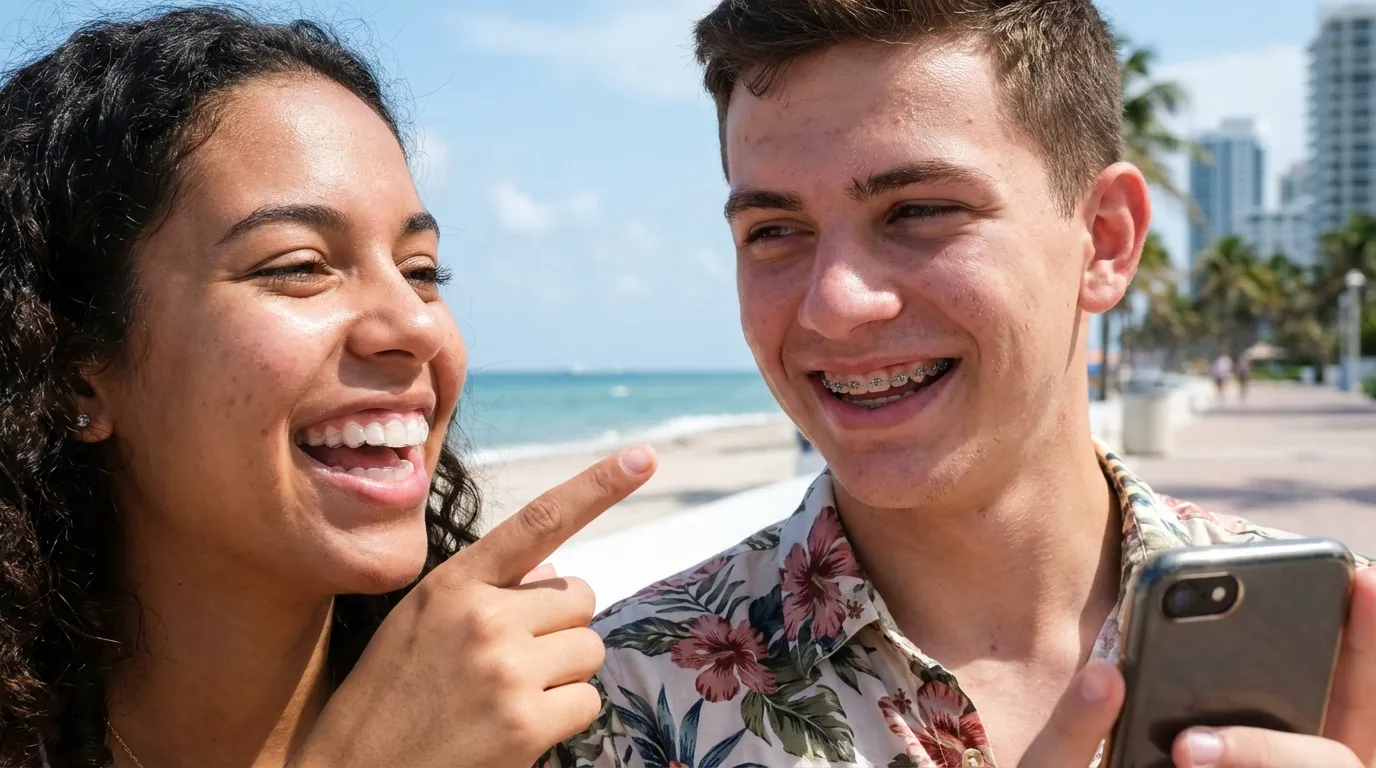

Braces vs Invisalign for Teens in Broward
Your teen's smile matters.
And you're stuck wondering if traditional braces or Invisalign clear aligners are the right call for them.
It's a real question parents in Broward County ask us every single week.
The truth is both work, but they work differently depending on who your kid is and what their teeth actually need.
Here's what I've seen over years of helping families make this choice: the answer isn't about which one is "better" in general.
It's about which one fits your teen's actual life.
Are they a sports kid?
Do they care what their friends think?
Are they responsible enough to wear aligners 20 hours a day?
These things matter more than you'd think.
Why This Choice Matters Right Now
Teen years are weird.
Your kid is figuring out who they are, how they look, and what matters to them.
Adding orthodontic treatment into that mix means picking something that works with their life, not against it.
Braces are fixed.
They're always there doing their job.
Invisalign is removable, which sounds great until your teen forgets to put them back in.
The stakes feel high because they kind of are.
Getting this wrong means 12 to 24 months of treatment that could go smoother or rougher depending on what you pick.
That's a lot of time in your teen's life.
At SMILE-FX Orthodontics in Miramar, we work with this reality every day.
We're not here to push you toward one option.
We're here to help you pick what actually works for your specific kid, not some generic version of what a teenager should do.
Breaking Down Braces: What You Actually Need to Know
Metal braces and ceramic braces are the traditional route.
They've been around forever because they work.
A bracket goes on each tooth, a wire connects them, and that wire applies pressure to move teeth into the right position.
It's straightforward.
It's effective.
It's permanent while it's on.
Here's what works well with braces: they handle the tough cases.
If your teen has severe crowding, a major bite issue, or complex spacing problems, braces are often the better call.
They apply continuous force without relying on your teen to remember to do anything.
The wire is always there, always working.
For Broward teens playing sports at schools like Marjory Stoneman Douglas High or Cypress Bay High, braces actually have an advantage you might not expect.
A direct hit to the face happens, and your teen's teeth are protected by those brackets and wires.
With aligners, there's nothing there to absorb impact the same way.
The comfort part is real though.
First week with braces can hurt.
Your teen's mouth needs to adjust.
There's soreness, maybe some sensitivity.
It passes, but it's there.
At SMILE-FX, our VIP Tech and AI precision bonding reduce the number of adjustments needed, which means less of that discomfort cycle.
Maintenance with braces means a monthly office visit.
You're driving to the orthodontist every 30 days.
For busy Broward families, that's either a feature or a problem depending on your schedule.
Hygiene matters more with braces.
Food gets stuck.
Plaque builds up differently.
Your teen needs to learn how to brush and floss around all those brackets and wires, or they end up with white spots where the brackets were.
Those spots don't go away.
It's preventable, but it takes actual effort.
Invisalign Clear Aligners: The Modern Alternative
Invisalign is the newer approach that's changed how a lot of people think about orthodontics.
Clear plastic trays that fit over your teeth.
You wear them, they apply gentle pressure, you switch to a new tray every week or two.
After 12 to 24 months, your teen has straight teeth without ever having visible braces.
For teens who care about how they look right now, this is huge.
Nobody sees them.
Dating, school photos, everyday interactions—your teen isn't thinking about their orthodontics.
That matters psychologically for a lot of kids.
The flip side is responsibility.
Invisalign only works if your teen actually wears the aligners 20 to 22 hours a day.
That means putting them in after they eat, keeping track of them, not losing them.
If your teen is the type to leave things in random places or forget they're supposed to be doing something, Invisalign becomes harder.
Here's the real talk on success rates: Invisalign works great for mild to moderate cases with about 90% success when worn as prescribed.
The "as prescribed" part is key.
That's where families sometimes struggle.
Eating is easier with Invisalign.
Remove the tray, eat normal food, put the tray back in.
With braces, your teen can't have sticky foods, hard candies, or anything that might damage the brackets.
It's a real quality-of-life difference.
Hygiene is simpler too.
Aligners come out.
Your teen brushes and flosses like normal.
No special tools needed.
Less risk of white spots or permanent marks on teeth.
Office visits are different with Invisalign.
Remote monitoring means up to 40% fewer trips to the orthodontist.
For families across Broward County, from Pembroke Pines to Fort Lauderdale, that's real convenience.
Head to Head: How They Really Compare
Effectiveness and Complexity
Braces win on severe cases.
Crowding, bite problems, complex orthodontic needs—braces are the standard for a reason.
They apply pressure in ways that are hard to replicate with removable trays.
If your teen's case is straightforward, Invisalign handles it just fine.
Aesthetics and Social Confidence
Invisalign is practically invisible.
Braces, even ceramic ones, show.
For a teen worried about their appearance during these formative years, Invisalign removes that anxiety.
That's worth something.
Comfort Through Treatment
Both involve some discomfort when adjustments happen.
Braces start uncomfortable and gradually improve as your mouth adapts.
Invisalign's soreness comes with new trays but is usually milder.
At SMILE-FX, we've worked hard to minimize this on both fronts.
Daily Life and Convenience
Braces are always on, which means always working.
Invisalign requires active participation—remembering to wear them, cleaning them, managing them.
Your teen's personality and maturity level matters here.
Timeline for Results
Both typically take 12 to 24 months.
Sounds like a long time when you're a teenager.
The good news is our VIP Tech can accelerate treatment to as little as 4 to 6 months for some cases.
Faster is nice, but faster doesn't mean better if it means skipping important steps.
Real Talk About Cost in Broward
Let's not dance around it.
Money matters.
Braces in the Miramar area run between $4,500 and $7,500 depending on case complexity.
Invisalign typically costs $3,900 to $6,500.
Insurance often covers a portion of either option.
Most plans have an orthodontic benefit that covers 50% of treatment, up to a lifetime maximum.
What we don't do at SMILE-FX is hide fees.
You know what you're paying.
No surprises later.
We help you verify insurance coverage before starting, so you understand the actual cost to your family.
Geographic Convenience Across Broward County
Our Miramar location matters if you're anywhere in Broward.
Pembroke Pines is a 15-minute drive via I-75.
Hollywood is 20 minutes on Stirling Road.
Weston, Cooper City, Davie, and Fort Lauderdale are all manageable.
We're near Pines Ice Arena for easy navigation.
We offer evening and weekend hours because we get it—families are busy.
Free parking so you're not hunting for a spot.
Bilingual care because South Florida is diverse and language shouldn't be a barrier to quality orthodontics.
Why the Choice of Orthodontist Matters as Much as the Choice of Braces or Invisalign
Here's something most parents don't think about: who you pick to do the treatment matters more than which treatment you pick.
A board-certified orthodontist who's trained specifically in orthodontics sees cases differently than a general dentist offering Invisalign on the side.
We know how teeth move.
We know what to do when complications happen.
We have the experience to customize treatment to your teen's actual needs.
SMILE-FX is different because Dr. Tracy M. Liang isn't running a high-volume shop.
Your teen isn't case number 47 today.
They're a person with unique teeth, unique needs, and unique goals.
We use cutting-edge technology to create 3D previews of what your teen's smile will look like.
Same-day starts for new patients.
Treatment that actually fits into your family's life instead of your family having to fit into some rigid treatment schedule.
Book your free 3D scan and VIP smile consultation at our consultation page and see why Broward families trust us with their teen's smile.
What Happens After Braces Come Off: The Real Truth About Retention and Long-Term Results
Your teen just got their braces removed.
That moment feels like graduation day.
But here's what nobody tells you: taking off the braces is actually the starting line, not the finish line.
What comes next determines whether that straight smile stays straight or slowly drifts back to where it started.
I've seen families do everything right for 18 months, then lose it all in the retention phase because nobody explained what retention actually means.
That's the gap I want to fill right now.
Why Retention Matters More Than You Think
Teeth have memory.
Not the kind you're thinking about.
They have a biological tendency to move back to their original positions.
It's called relapse, and it happens naturally without a retainer holding them in place.
The bone around your teeth is still remodeling months after treatment ends.
Your gums are still settling.
Your bite is still stabilizing.
This is when retention does the heavy lifting that keeps everything locked in place.
At SMILE-FX, we treat retention like it's part of treatment, not something separate.
Because it is.
Skip this phase and you're basically saying the last two years don't count.
Types of Retainers: Understanding Your Options
Fixed Retainers (Bonded Wire)
A thin wire gets bonded to the back of your teeth.
It stays there.
Your teen doesn't have to think about it.
It's always working.
The downside is cleaning around it takes technique, and it's not visible so problems can hide.
Removable Retainers (Hawley)
The old school choice.
Metal wire and acrylic that your teen takes in and out.
They're durable, they last forever, and they're visible when worn.
Some teens hate how they look.
Some teens lose them constantly.
Clear Retainers (Essix or Vivera)
These look like Invisalign trays.
Clear, custom-fitted, nearly invisible.
Your teen wears them at night.
They're comfortable and discreet.
The catch is they wear out and need replacing every few years.
Most of the time, the best plan uses two types together.
A fixed wire on the lower teeth where relapse happens fastest, plus a removable retainer on top for flexibility.
The First Year After Braces: When Relapse Happens Fastest
The first three months are critical.
This is when teeth move back the most aggressively.
Your teen needs to wear their retainer religiously during this window.
We recommend full-time wear for the first six months, then nighttime only after that.
But this isn't one-size-fits-all.
Some people's teeth are more stubborn than others.
Some bite patterns need longer retention periods.
This is where having a board-certified specialist matters, because we customize the plan to your teen's actual teeth, not a generic protocol.
Real talk: compliance is the problem here.
Your teen finally got their braces off.
They're excited.
They don't want to think about orthodontics anymore.
Then we tell them they need to wear a retainer every night for the next few years.
The resistance is real.
This is when motivation drops, and teeth start moving.
The families who win are the ones where the conversation happens upfront.
Your teen knows the deal before treatment starts.
They know retention is non-negotiable.
They pick a retainer type they'll actually use.
Common Retention Mistakes Families Make
Stopping too early.
Your teen wore their retainer for six months, teeth look great, so they stop wearing it.
Teeth held for a few months, so maybe they're permanent now.
Wrong.
Teeth move slowly.
By the time you notice something's off, significant shifting has happened.
Inconsistent wear.
Retainers work on consistency.
Wearing them three nights a week doesn't cut it.
Either they're worn nightly or they're not getting the job done.
This is where clear retainers actually help some families, because teens are more likely to wear something invisible at night than they are a visible Hawley retainer.
Forgetting about replacement.
Clear retainers deteriorate.
They crack.
They get cloudy.
They lose their grip.
Your teen needs replacements every two to three years, and this costs money.
Factor this into your long-term planning.
Not cleaning them properly.
Retainers collect bacteria just like teeth do.
If your teen isn't cleaning their retainer, they're basically breeding plaque holders.
Soak them in a cleaning solution, brush them gently, and keep them in a case when not wearing them.
How Long Does Retention Last? The Honest Answer
This is where people get frustrated.
The honest answer is: forever.
Or at least most of your teen's life.
The first two years are non-negotiable.
Every single night.
After that, most people can move to a few nights a week, but it depends on how their teeth behave.
Some people have teeth that are stable enough to drop retainers entirely after five years.
Others need to wear one permanently.
There's no way to predict which category your teen falls into until you try.
This is why communication matters.
At the end of active treatment, we give families a specific retention plan.
It's tailored to your teen's case.
It includes how long to wear, when to switch to nighttime-only, and what to watch for.
We also schedule follow-up visits to monitor how things are holding.
When Teeth Move: Catching Problems Early
Movement happens gradually.
Your teen won't wake up one morning and notice a big shift.
But over months, small shifts add up.
The key is regular check-ins.
We schedule retention visits to catch any relapse before it becomes a problem.
At these appointments, we check the fit of the retainer and make sure teeth are stable.
If we catch early relapse, we can address it fast.
If you wait until something looks noticeably wrong, you might need retreatment.
Some families do an annual visit just to verify everything's still locked in.
It's cheap insurance against losing all your progress.
Nighttime vs. Full-Time Wear: What Matters
The shift from full-time to nighttime-only wear usually happens after the first six months.
But how your teen handles this matters.
During full-time wear, the retainer is basically doing what the braces did.
It's keeping teeth in their new position 24/7.
When you drop to nighttime only, you're assuming your teen's bite is stable enough to stay put during the day without support.
This works for most cases.
For some cases with significant bite changes or stubborn tooth movement, full-time wear needs to continue longer.
This is another reason why personalized plans matter more than blanket rules.
Cost of Retention: What to Budget
Retainers aren't free, and they need replacing.
Budget around $200 to $600 for initial retainers, depending on the type.
Clear retainers that need replacement every few years add ongoing costs.
Fixed wires might need repair if they break.
Most families view this as maintenance, like car insurance.
It costs money to keep what you've already paid for in good condition.
When you call to verify insurance, ask what retention costs are included or covered.
Some insurance plans cover replacements.
Others don't.
Know this upfront so there are no surprises.
What to Watch For During the Retention Years
Spacing appearing between teeth.
This is the first sign something's moving.
Small gaps show up, usually between front teeth.
It's subtle, but if your teen notices it, that's your sign to check in with us.
Crowding returning.
Teeth that were separated nicely start overlapping again.
This happens slowly, but when it does, it's usually because retainer wear dropped off or the retainer stopped fitting right.
Bite feeling different.
Your teen says their bite feels off or something clicks when they chew.
This could mean teeth are shifting slightly.
Don't ignore this.
Retainer not fitting anymore.
If a retainer suddenly feels loose or doesn't fit, teeth have moved.
Time to come in for an adjustment or replacement.
The Retention Conversation: What to Tell Your Teen Now
Start this conversation before treatment even starts.
Your teen needs to know that life after braces isn't actually life without braces.
It's life with a retainer.
Frame it this way: the retainer is the maintenance phase.
You brush your teeth every day not because your teeth suddenly broke, but because that's what keeping teeth healthy looks like.
Retainers work the same way.
Let your teen pick the retainer type.
If they choose something they actually like wearing, compliance skyrockets.
If you force them into a retainer they hate, they'll find reasons not to wear it.
Some teens do great with fixed wires because they don't have to remember anything.
Some teens prefer clear retainers because they're invisible.
Some want a Hawley retainer because they're durable.
There's no wrong choice as long as it gets worn.
Special Situations: Sports, Accidents, and Damage
If your teen plays contact sports, retainer damage is inevitable.
Plan for replacements.
A mouthguard that fits over a fixed wire is different from one that goes over a removable retainer.
We can help you figure out the right mouthguard setup for your teen's specific retainer type.
If a retainer breaks or gets damaged, replace it fast.
Teeth start moving within days of losing retainer support.
Why We Recommend SMILE-FX for Retention Planning
Retention isn't an afterthought for us.
It's built into every treatment plan from day one.
At SMILE-FX, we're different because we think about the endgame before we even start moving teeth.
We talk retention strategy upfront.
We customize retention plans to your teen's specific situation.
We schedule regular retention checks so you're not wondering if things are still holding.
Our technology lets us create precise retainers that fit perfectly.
We monitor your teen's progress during retention and catch any problems early.
The goal is simple: we want your teen's straight smile to last their entire life.
That takes planning, the right equipment, and consistent follow-up.
It takes a team that cares about what happens after the braces come off.
Clear Aligners and Retention: Is There a Difference
If your teen finished treatment with clear aligners instead of braces, retention still happens the same way.
Teeth still have the tendency to move back.
Teeth still need retention to stay in place.
The retainer process is identical.
Same timeline, same types of retainers, same commitment needed.
Don't assume that because your teen wore clear aligners they won't need retention.
Clear aligners are the treatment method.
Retention is the lock that keeps the results.
The Five-Year Mark: What Changes Then
By year five, most people's teeth are stable enough to shift to less frequent retainer wear.
Maybe nighttime three times a week instead of nightly.
Maybe just weekends.
This is where we customize again based on how your teen's teeth behave.
Some people can drop to twice a week.
Some need nightly wear forever.
We'll know by monitoring progress.
But dropping retention completely without checking first is risky.
Have that conversation with us before you stop wearing a retainer altogether.
Starting Retention: What to Expect on Day One
The day braces come off, your teen gets fitted for their retainer.
We take impressions or use digital scans to create a perfectly fitted retainer.
Your teen gets instructions on how to wear it, how to clean it, how to take care of it.
We schedule a one-week follow-up to make sure everything fits right and your teen knows what they're doing.
Then regular checks after that to monitor retention and catch any early relapse.
This is when having detailed instructions matters.
At SMILE-FX, we give written instructions, show your teen exactly how to care for their retainer, and answer every question before you leave the office.
FAQ: Retention Questions We Hear All The Time
Can my teen skip retainer wear for a week?
No.
A week off and teeth start moving.
It might be small, but it's happening.
Consistency is what matters.
What if my teen loses their retainer?
Call us immediately.
We can make a replacement fast.
In the meantime, teeth are moving.
The sooner you replace it, the better.
Do fixed wires hurt to clean?
No.
It takes a technique, but it doesn't hurt.
We show your teen exactly how to floss and brush around the wire at the end of treatment.
Will retention fix a bad bite?
No.
Retention keeps the bite you ended treatment with.
If the bite still isn't right, that's a different conversation that should happen before braces come off.
How much does a replacement retainer cost?
Between $150 and $400 depending on the type.
Ask about this at your last appointment so you know the cost before you need a replacement.
Make a Plan Right Now
Don't wait until braces come off to think about retention.
Talk about it now.
At your next appointment, ask about retention options.
Ask about the timeline.
Ask about costs.
Ask what happens if something goes wrong.
A good orthodontist will answer all these questions before treatment starts.
A great orthodontist will keep answering them for years after treatment ends.
Book a free 3D scan and VIP smile consultation here so we can build a full retention plan for your teen's specific situation and make sure that straight smile lasts for life.
The Hidden Costs of Choosing the Wrong Orthodontist in South Florida: What Every Parent Needs to Know
You're looking for an orthodontist near me in Broward County.
You see a few options.
You pick based on price or convenience.
Eighteen months later, your teen's teeth aren't where they should be.
Or the treatment took longer than promised.
Or you're dealing with damage that costs extra money to fix.
Sound familiar?
The cost of picking the wrong board certified orthodontist South Florida goes way beyond what you paid upfront.
Most parents think orthodontics is just braces or Invisalign.
You pick one, pay the bill, and you're done.
But there's a whole layer of decisions that happen before you even start treatment.
And if you get those wrong, you end up paying thousands more than you should.
Why the Right Orthodontist Matters More Than the Treatment Method Itself
Here's what I've learned: the difference between best orthodontist near me and just any orthodontist is massive.
It shows up in results, timelines, and costs.
A board certified orthodontist has gone through specific training that general dentists offering braces haven't done.
They understand tooth movement.
They know how to handle complications.
They can predict problems before they happen.
The cheaper orthodontist who rushes through 30 patients a day isn't doing the same thing as someone who spends time on your teen's case.
Both call themselves orthodontists.
The outcomes are different.
At SMILE-FX, our board certified specialist looks at your teen's teeth like a puzzle.
Not like a transaction.
The Price Trap: Why Cheap Isn't Always Cheap
You find affordable braces Broward for $2,500.
Another office quotes $5,000 for the same treatment.
You think you're saving money by picking the cheaper one.
What actually happens is this: the cheap office makes money by seeing more patients faster.
They use lower grade materials.
They schedule shorter appointment times.
They miss things that a thorough exam would catch.
Six months in, there's a problem.
Your teen's teeth aren't moving right.
Now you need extra appointments.
The treatment extends past the original timeline.
Suddenly you're spending more than if you'd paid the higher price at the start.
Or your teen ends up with white spots on their teeth because they weren't given proper hygiene training.
Those spots don't go away.
That's a permanent cost that has nothing to do with the orthodontist's price but everything to do with their approach.
Location and Convenience: The Real Cost of Driving Everywhere
An orthodontist near me that's actually convenient saves you hundreds of hours.
Let's do the math.
If you're driving 45 minutes each way for monthly appointments, that's an hour and a half per visit.
Over 18 months of treatment, you're looking at 27 hours of driving.
That's more than a full day of your life spent in a car.
Now add gas, wear and tear on your vehicle, and the time your teen misses from school or activities.
We're in Miramar, which puts us 15 minutes from Pembroke Pines, 20 minutes from Hollywood, and accessible from anywhere in South Florida.
That matters.
But it's not just about distance.
A best orthodontist for kids South Florida also needs to offer flexible scheduling.
Evening appointments.
Saturday hours.
Same-day starts for new patients.
Our Miramar location does all of this.
Free parking so you're not hunting for spots.
We understand that Broward families are busy.
The Hidden Cost of Poor Communication and Follow-Up
Your teen finishes braces.
You get a retainer.
Nobody explains how to actually use it.
Your teen stops wearing it after three months.
Teeth start moving back.
Now you need retreatment.
That retreatment costs 50 to 75 percent of the original treatment price.
Thousands of dollars lost because nobody had a clear conversation about what happens after braces come off.
The right orthodontist treats retention as part of treatment, not an afterthought.
They explain it before you start.
They check in during the retention years.
They catch early problems before they become expensive problems.
At SMILE-FX, we schedule retention visits to make sure your teen's teeth are staying put.
We customize retention plans to your teen's specific teeth.
We answer questions without making you feel stupid for asking.
Insurance Verification: Don't Assume You Know What You'll Pay
A lot of parents call an orthodontist, hear a price, and think that's what they'll pay out of pocket.
Then they get a bill and realize their insurance coverage is different than they thought.
A top rated orthodontist near me verifies your insurance before treatment starts.
They tell you what's covered.
They tell you what isn't.
They explain your deductible and your annual maximum.
Some insurance plans cover 50 percent of orthodontics up to a lifetime max of $1,500 or $2,000.
That means your teen could need more treatment than your insurance covers.
You need to know this before you start, not halfway through.
When you contact us, we verify your insurance coverage immediately.
You get a clear picture of what you're actually going to pay.
Technology Costs: What You're Actually Getting
Some orthodontists use technology from 15 years ago.
3D imaging, AI-powered planning, and precision bonding cost more upfront.
But cutting-edge technology actually saves you money long-term.
Better planning means fewer adjustments.
Fewer adjustments means fewer appointments.
Fewer appointments means less time off work and school.
A top tech driven orthodontist Miramar uses this technology to create 3D previews of your teen's smile before treatment even starts.
Your teen sees exactly what they'll look like.
That's not just cool, it's practical.
It reduces changes mid-treatment that would cost extra time and money.
What About Financing Options and Zero Down Braces
If $0 down braces financing South Florida is the only way your family can do orthodontics, that's okay.
But understand what you're actually signing up for.
Some financing plans have high interest rates.
Some charge upfront fees.
Some require monthly payments that add a lot to the actual cost of treatment.
A good orthodontist works with multiple financing partners so you can pick what works for your family.
They're transparent about costs and don't hide fees in the fine print.
At SMILE-FX, we partner with financing options that actually work.
We show you the total cost upfront.
No surprises later.
Adult Orthodontics and Special Cases: Why Experience Matters
If your teen has a complex case, the cost difference between a general dentist and a best orthodontist for complex cases is huge.
Severe crowding.
Bite problems.
Previous orthodontic work that didn't go right.
These need someone who's seen thousands of cases and knows how to handle complications.
Complex cases require specialized knowledge that only comes from focused training and experience.
Trying to save money on treatment like this is like trying to save money on a roof replacement by hiring someone who's never done one before.
Invisalign Cost in South Florida: Why Prices Vary
Invisalign cost South Florida ranges from $3,500 to $8,000 depending on where you go.
That's a huge range for the same treatment.
A top rated Invisalign provider near me charges what they do because of expertise, technology, and oversight.
They monitor your progress closely.
They catch problems early.
They're an actual Invisalign specialist, not just someone who ordered some trays from a website.
The cheapest Invisalign provider might be using older technology or checking in less frequently.
You get what you pay for.
Insurance and Braces: Does Insurance Cover Braces
A lot of parents ask: does insurance cover braces?
The answer is yes, but with limits.
Most dental insurance plans cover 50 percent of orthodontic treatment up to a certain lifetime maximum.
Some cover 0 percent.
Some cover 80 percent for kids under 18 but nothing for adults.
An orthodontist who knows your insurance inside and out helps you maximize your coverage.
They know which treatment methods your insurance is more likely to cover fully.
They can structure the treatment plan in a way that works with your insurance benefits instead of against them.
Comparing Traditional Braces vs Invisalign Costs in Real Terms
Both cost roughly the same for a straightforward case.
But the total cost picture is different.
Affordable braces West Palm Beach and affordable braces Miramar typically range from $4,500 to $7,500.
The monthly visits are included.
The wire changes are included.
The adjustments are included.
Clear aligners cost Miami runs $3,900 to $6,500 for basic cases.
But if your teen loses an aligner or needs a replacement before the plan says they should, that costs extra.
The invisible cost with Invisalign is replacement trays.
If your teen loses one or damages one, expect to pay $300 to $500 for replacements.
The Cost of Starting With the Wrong Provider
Some families start with a general dentist doing Invisalign.
Six months in, something's wrong.
The teeth aren't moving right.
The bite's getting worse, not better.
Now they need to switch to an actual orthodontist to fix the problem.
That switch costs money and time.
Your teen wasted months in a treatment that wasn't working.
A board certified orthodontist South Florida knows this happens and can evaluate cases that other providers started.
But it costs extra to fix problems that shouldn't have happened in the first place.
Why Pediatric Expertise Costs What It Costs
A best pediatric orthodontist South Florida charges more than someone who does general orthodontics.
That's because treating kids requires different skills.
Kids lose baby teeth on their own schedule.
Their jaws are still growing.
Their motivation is different from adults.
Their compliance is different.
An orthodontist trained specifically in kids' cases knows how to work with all of this.
They plan treatment differently.
They space appointments differently.
They communicate differently with the kid and the parent.
The cost is higher because the expertise is more specific.
What to Ask Before Committing to Any Orthodontist
Don't just ask the price.
Ask these questions instead.
What's included in the treatment cost?
Are all adjustments included or do some cost extra?
Are emergency visits included?
Are retainers included or do they cost separately?
What happens if treatment takes longer than expected?
Do you pay more or is it included?
Who decides if extra time is needed?
What's your approach to retention?
How long do they recommend wearing retainers?
Do they schedule regular retention checks?
What do replacement retainers cost?
If something goes wrong, what's the plan?
If a bracket breaks, is repair included?
If teeth aren't moving right, what happens next?
Are there extra costs for fixes?
How do you handle insurance?
Do you verify coverage upfront?
Do you bill insurance directly or do I pay and submit?
What happens if my insurance benefit runs out mid-treatment?
The Real Question: Is Your Family Actually Getting Orthodontics or Just Paying for Teeth Straightening
There's a difference.
Orthodontics is a medical specialty that treats tooth and jaw alignment for function and health.
Just straightening teeth is cosmetic.
A best orthodontist Miami does both, but they prioritize function first.
A good bite matters.
Proper jaw alignment matters.
How your teen can chew and speak matters.
The cheaper route often focuses only on making teeth straight.
The right orthodontist makes teeth straight while ensuring the bite functions properly and the smile lasts.
At SMILE-FX, we're different because we think about your teen's entire mouth, not just their front teeth.
We use cutting-edge technology to plan treatment that works.
Your teen gets straight teeth.
Your teen also gets a bite that functions properly.
Your teen gets a smile that lasts.
That's orthodontics.
That's what you're actually paying for.
Book a free 3D scan and VIP smile consultation and let's build a treatment plan that actually works for your family's budget and your teen's needs.