
Does Your 7-Year-Old Need Early Orthodontic Care?
You're sitting in your pediatrician's office and they mention your kid should see an orthodontist. Your stomach drops. Braces? Now? Your kid is barely in second grade. You start Googling at 11 PM, reading conflicting advice, and getting more confused instead of less.
Here's what I want you to know: you're not alone, and you don't need to panic.
Most parents I talk to are in the exact same spot. They're wondering if their 6, 7, 8, or 9-year-old really needs orthodontic treatment or if waiting is fine. They're worried about making the wrong call. They don't want to over-treat their kid just because a dentist is trying to fill chairs. But they also don't want to miss a critical window if early care could actually help.
This is exactly why I'm writing this. At SMILE-FX Orthodontics & Clear Aligner Studio, we work with families across Miramar, Pembroke Pines, Hollywood, Weston, Cooper City, Davie, Fort Lauderdale, and all over Broward County. We see this question every single week. And we've learned how to answer it honestly.
What Phase 1 Orthodontics Actually Means for Your Kid
Phase 1 is early orthodontic treatment. It happens while your child still has baby teeth mixed in with their adult teeth. And here's the thing that most people get wrong: it's not about giving your 8-year-old a perfect smile right now.
It's about setting them up for long-term success.
When we talk about Phase 1 care, we're talking about:
- Giving the jaw room to grow properly so adult teeth have space to come in
- Fixing bites that could damage teeth or mess with jaw joints down the road
- Supporting healthy breathing through the nose instead of the mouth
- Breaking habits like thumb sucking before they shape your kid's face
- Making teenage braces shorter, simpler, or sometimes not needed at all
That last one is huge. Parents ask us all the time: "If we do Phase 1 now, won't my kid need more braces later?" The answer is no, not when it's done right. A good Phase 1 treatment is like preventative care. You're not "doing braces twice." You're preventing bigger problems.
Phase 1 can involve expanders to widen the upper jaw, partial braces on just a few teeth, custom appliances that guide growth, or sometimes just smart monitoring over time. Every kid is different.
Why Age 7 Is the Sweet Spot (Not a Sales Tactic)
The American Association of Orthodontists (AAO) recommends every child gets an orthodontic checkup by age 7. I get it. It sounds like a marketing thing. But it's actually science-based, and here's why.
By age 7, your kid has enough adult teeth coming in and enough jaw growth happening that an orthodontist can actually see what's coming. We can look at X-rays and tell if:
- The jaw is too narrow for the teeth that are about to erupt
- The bite is lined up front-to-back and side-to-side, or if it's off
- Adult teeth are blocked or trapped with nowhere to go
- Mouth breathing or thumb sucking is reshaping your kid's face as they grow
Once we see this, we know what to do. Sometimes that's immediate treatment. Sometimes it's waiting and checking back in 6 months. And sometimes it's just telling you everything is fine and seeing them again in a couple years.
Here's what matters: we tell you the truth, not what we think you want to hear.
A lot of parents worry that orthodontists just want to stick braces on every kid to make money. I'm not going to sit here and tell you that never happens somewhere. But at SMILE-FX, we're comfortable telling parents "let's wait" or "let's just watch this" when that's actually the right call. It doesn't make us more money. It makes us more trustworthy.
When Your Kid Doesn't Need Treatment Yet (And That's Okay)
Here's something that might surprise you: we see a lot of kids in Miramar and across Broward who come in for a Phase 1 evaluation and end up not needing treatment right away. And we think that's great.
We skip treatment when:
- Crowding is mild and teenage years can handle it just fine
- The bite works well and isn't hurting teeth or gums
- Jaw growth looks normal and doesn't need guidance
- Bad habits are already fading on their own
When this is the case, we send you home with a clear growth plan. We'll see your kid in 6 or 12 months and check again. No pressure to start treatment. No guilt. No "but wait, let me tell you why you should start now."
That's a promise we make to every family we see.
Red Flags That Mean Your Kid Should Get Checked
You don't need a dental degree to spot when something might need attention. Here are the actual signs that warrant an orthodontic evaluation:
Crowding or Teeth That Don't Fit
If adult teeth are coming in and they're overlapping or twisting, that's crowding. If your kid has baby teeth coming out super early or staying in way too long, that's worth checking. Sometimes early expansion can create room before adult teeth get stuck in bad positions.
Bites That Are Off (Crossbite, Overbite, Underbite)
A crossbite means top teeth bite inside the bottom teeth. An underbite means the lower jaw sticks out. These aren't just cosmetic things. They can wear down teeth faster, stress jaw joints, and affect how your kid's face grows. Catching these in elementary school can be a game-changer.
Your Kid Breathes Through Their Mouth
Does your kid sleep with their mouth hanging open? Snore? Have perpetually chapped lips? Chronic mouth breathing can narrow the upper jaw and impact how the face develops. When we address this early with orthodontics and work with pediatric ENT specialists, we can support better nasal breathing and better facial growth.
Thumb or Finger Sucking That Won't Quit
If your kid is still sucking their thumb past age 4 or 5, and especially if front teeth are flaring out or an open bite is forming, we can help. We use gentle strategies to break the habit without shaming your kid.
What Actually Happens at Your First Visit
Let me walk you through what a typical first appointment looks like at SMILE-FX so you know exactly what to expect:
You walk in and your kid is actually greeted like a person. We know their name. We ask about school, their favorite sport, what they're into. No treating them like a number.
Your kid gets a tour of the office. We show them the waiting area, the chairs, the equipment. We explain what we're going to do before we do it. We have games, snacks, weighted blankets, noise-cancelling headphones, TV shows playing, and VIP private suites so anxious kids feel safe.
Then we take low-dose digital X-rays or CBCT imaging if we need them. We use cutting-edge technology to see what we need to see with the lowest radiation exposure possible. Everything is explained in plain language.
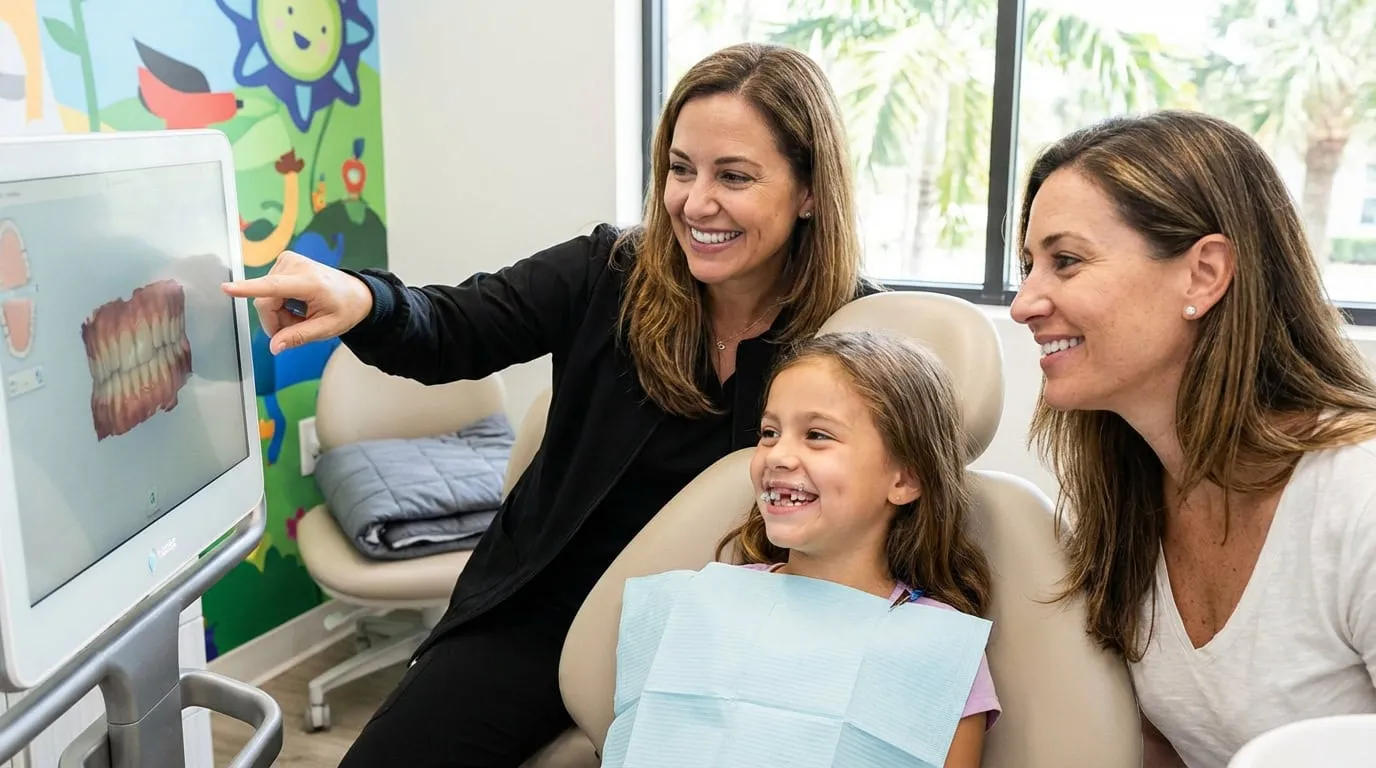
We also take a 3D digital scan instead of those gross impression trays. No gagging, no mess, super accurate.
Then your kid sees a board-certified orthodontist. Not a general dentist. Not a hygienist. An actual board-certified orthodontic specialist who spent years training specifically in this.
We walk you through what we see. Is treatment needed now? Later? Not at all? What would Phase 1 actually do for your kid? How long would it take? What does daily life look like with an expander or braces?
You leave with a written plan. Real numbers. Honest timelines. No pressure to decide that day.
Making Orthodontics Less Scary for Your Kid
A lot of parents ask: "My kid is already nervous about dentists. Will this be worse?"
It doesn't have to be.
We've built the entire office around making kids feel safe and actually want to come back. Friendly staff who treat kids like kids, not mini-adults. Entertainment in the lobby. TV and music during appointments. Games. VR. Snacks. Weighted blankets for sensory-sensitive kids. Private rooms if your kid needs quiet and space.
The goal isn't just to get through the appointment. It's for your kid to walk out and think, "That was actually fine. When's my next snack?"
Why Families Drive Across Broward for Phase 1 Care
We're in Miramar. But we see families from Pembroke Pines, Hollywood, Weston, Cooper City, Davie, Fort Lauderdale, and all over South Florida. They pass other orthodontists to get to us. Why?
Because they want their kid treated by specialists who actually specialize in kids. Not generalists who dabble in braces. Not high-volume aligner mills. They want what sets us apart: growth-focused, airway-aware, board-certified experts who care about long-term health.
Families also tell us they appreciate honest guidance about when to treat and when to wait. We're not running a production line. We're looking at your specific kid's growth pattern and recommending what's actually best for them.
The comfort-first experience matters too. Most kids actually look forward to coming back. And that changes everything about long-term care.
Real Talk on Phase 1 Costs
Every kid is different, so there's no one price. But let me give you the honest version:
Some kids need no treatment yet. You pay for the evaluation and monitoring, which is just a few hundred bucks.
Some kids benefit from a limited appliance like an expander. That's a different investment.
Some kids need a full Phase 1 plan with expansion and partial braces.
At your consultation, we talk about real numbers. What insurance covers. Monthly payment options. How Phase 1 and Phase 2 costs relate. We don't make you pay twice for the same work.
Our belief: when you understand the why, the timeline, and the total investment, you can make a smart decision. Financial clarity cuts through confusion.
Your Next Move
If your kid is between 6 and 10 and you're wondering whether now is the time for an orthodontic evaluation, stop guessing.
Book a free 3D scan and VIP smile consultation with our board-certified team. We'll give you a clear picture of your kid's growth trajectory, explain what needs attention and what doesn't, and walk you through realistic options without pressure.
Schedule your free 3D scan and VIP smile consultation here.
We serve families across Miramar, Pembroke Pines, Hollywood, Weston, Cooper City, Davie, Fort Lauderdale, and all of Broward County. Your kid deserves the right care at the right time, delivered by people who actually know what they're doing.
Orthodontic Treatment Options Beyond Braces: Finding the Right Path for Your Child
Your kid doesn't have to wear traditional metal braces.
That's the reality most parents don't know when they walk into an orthodontist's office worried about their child's smile.
You picture those big metal brackets and wires from the 90s, and you immediately think about your kid dealing with that for years.
But here's the thing: orthodontics has changed.
There are multiple pathways to get your child's teeth and bite where they need to be. Some kids still need traditional braces. Some kids thrive with clear aligners. Some kids benefit from a combination approach. And some kids only need Phase 1 treatment with an expander or partial appliance before their permanent teeth ever come in.
The right choice depends on your kid's specific situation, not on what looks coolest or what your neighbor's kid used.
Clear Aligners for Kids: The Real Talk
Clear aligners are not just for adults anymore.
We fit kids as young as 8 or 9 with clear aligner systems when their case calls for it.
Here's what makes clear aligners different:
- They're removable, so your kid can eat whatever they want without worrying about breaking brackets
- They're nearly invisible, so no social pressure at school
- They require less frequent office visits than traditional braces
- Brushing and flossing is way easier because they just take them out
- No emergency wire breakage at 9 PM on a Sunday
But here's where I need to be honest with you: clear aligners only work for certain types of cases.
Your kid has to be mature enough to wear them 20-22 hours a day.
If your 8-year-old loses their retainer every week or "forgets" to wear their aligner, traditional braces might be the move because they stay on and do the work without relying on your kid's compliance.
If you have a responsible kid who can handle the responsibility, clear aligners can be a game-changer.
We use the latest technology to map out exactly what the movement will look like before we even make the first aligner. Your kid sees a 3D preview of their entire treatment.
Traditional Braces: They're Not What You Wore in High School
Metal braces still exist, and they're actually better than they used to be.
Modern braces are smaller, more efficient, and way less noticeable than the hockey-puck sized ones from twenty years ago.
Here's why some kids still need them:
- Severe crowding or bite problems that need maximum control
- Kids who won't be consistent with removable appliances
- Complex rotations that need exact pressure angles
- Treatment that needs to happen fast for whatever reason
Traditional braces give us total control over tooth movement in three dimensions.
We can fine-tune pressure, direction, and timing in ways that clear aligners sometimes can't.
The stigma around braces isn't what it was in the 80s and 90s.
Kids see other kids wearing them all the time now.
It's way less of a social thing than parents think.
What Actually Happens with Invisalign for Teens and Younger Kids
You've heard of Invisalign.
Everyone has.
But do you know how it actually works for a 10-year-old versus a 35-year-old?
Invisalign Teen and even younger versions are specifically designed for growing kids.
The compliance indicators actually change color if your kid isn't wearing them enough, so you can see in real time if they're slacking.
The aligners are made to account for the fact that your kid's teeth are still coming in and their jaw is still growing.
If your child loses an aligner, replacement costs are built into the plan instead of you paying huge fees to replace them individually.
The question isn't whether Invisalign works for kids.
The question is whether your specific kid has the maturity and discipline to use it consistently.
We can tell you that within five minutes of talking to your child.
Hybrid Approaches: Phase 1 Plus Clear Aligners Later
Here's something that catches a lot of parents off guard: your kid might not fit neatly into one treatment category.
Some kids benefit from a hybrid approach.
For example, we might do Phase 1 expansion with an appliance when your kid is 7 or 8 to create space and guide jaw growth.
Then when they're 11 or 12 and their permanent teeth are mostly in, we transition to clear aligners for Phase 2 to fine-tune the bite and achieve the final result.
This approach gives you the benefit of early intervention without committing your kid to years of braces.
It's like having a roadmap instead of just randomly treating problems as they show up.
How to Know Which Option Actually Fits Your Kid's Life
This is where most orthodontists fail parents.
They recommend a treatment type without asking real questions about your kid's lifestyle, maturity level, or what you actually want.
Here's what we ask:
Is your kid an athlete playing contact sports where a mouthguard might be easier with aligners?
Does your kid have sensory sensitivities that make the feeling of brackets uncomfortable?
Is your kid naturally responsible about keeping track of things, or do you buy four pairs of earbuds a year because they disappear?
Are there specific cosmetic concerns about being visible during treatment?
Does your family have access to our office easily, or are longer appointment gaps better for your schedule?
The right treatment isn't the one that works best in theory.
It's the one your kid will actually use consistently for the duration of treatment.
What the Research Says About Treatment Speed
Parents always ask: "Which one is faster?"
The honest answer is it depends on the case.
Some bite problems move faster with braces.
Some cases move just as fast with aligners.
The difference is usually not years.
It's usually months, if any.
What matters more is consistent wear and following the plan.
An aligner case that your kid wears 22 hours a day will move faster than a braces case where the kid isn't brushing properly and creating plaque buildup around the brackets.
Compliance beats technology every time.
The Cost Conversation: Are Clear Aligners More Expensive?
Not necessarily.
Both treatment types have a range depending on complexity.
Some Phase 1 expansion cases with aligners cost less than braces.
Some severe crowding cases with braces cost more than an alignment case.
What we tell families is this: understand the total investment upfront.
Know what Phase 1 costs versus Phase 2.
Understand what happens if your kid breaks something or loses an aligner.
Know if monthly payments are available.
Know what insurance covers.
When you have real numbers, the decision gets easier.
It's not about choosing the cheapest option.
It's about choosing the best option for your kid's specific situation.
Common Questions Parents Actually Ask
Will my kid need both aligners and braces?
Sometimes yes, sometimes no. It depends on what we discover during Phase 1 and how your kid's permanent teeth come in. A good orthodontist will tell you upfront if that's likely.
Can my kid switch from one type of treatment to another midway?
Yes. Life happens. Sometimes a kid loses an aligner and decides braces feel simpler. Sometimes a kid with braces wants to switch to aligners for a specific event. We can work with changing needs.
What if my kid hates their treatment halfway through?
We work through it. Usually the discomfort is temporary and tied to adjustment. But we listen. If something isn't working, we problem-solve rather than forcing your kid to suffer unnecessarily.
Do clear aligners work as well as braces for serious bite problems?
For most cases, yes. For some severe skeletal problems, braces might be the better first step. We assess this during your initial visit.
Why the Right Specialist Matters More Than the Treatment Choice
Here's what I want you to really understand: the treatment only works as well as the person prescribing and managing it.
A board-certified orthodontist with actual training in treatment planning will recommend the right approach for your kid.
Someone who just completed a weekend course in aligners or braces will recommend what they learned that weekend.
We've spent years training specifically in growing children, bite correction, and airway-aware orthodontics.
That training shapes every recommendation we make.
The technology is great, but the person holding the tools matters more.
Getting Started: What Happens When You Actually Choose
Once you've decided on a treatment path together with your orthodontist, the setup is straightforward.
For braces, we bond brackets to each tooth and thread the wire through. Your kid might feel some pressure but shouldn't feel pain. The first week is an adjustment as their mouth gets used to the brackets.
For clear aligners, we make a detailed 3D scan, create a treatment plan showing exactly where every tooth will move, and fabricate a set of aligners.
Your kid changes to a new aligner every 1-2 weeks depending on the plan.
Both require maintenance: brushing and flossing with braces takes longer but is mandatory. With aligners, consistency of wear is what matters most.
Both require regular checkups to monitor progress and make adjustments.
Real Families Share Their Choice
We've worked with families from Miramar to Fort Lauderdale, from Hollywood to Weston, and everywhere in between across Broward County.
Some chose aligners and their kid felt confident the whole time.
Some chose braces and their kid adapted quickly and had zero problems.
Some started with one and switched to the other.
The common thread among successful cases isn't the treatment type.
It's having realistic expectations, understanding what's happening, and following the plan consistently.
Check out what actual families say about their experience with different treatment types.
Making Your Final Decision
You don't have to decide today.
You definitely shouldn't decide based on what your friend's kid did or what you read on Reddit.
The best decision comes from talking to a real specialist who examines your specific child, explains the options clearly, and listens to your concerns.
That's exactly what happens during a free consultation.
We look at your kid's current situation, walk you through what we see, explain what treatment would actually involve, and answer every question you have.
You walk out with real information instead of internet confusion.
Book your free 3D scan and VIP smile consultation here to explore what works best for your child.
We serve Miramar, Pembroke Pines, Hollywood, Weston, Cooper City, Davie, Fort Lauderdale, and all of Broward County.
We work with kids, teens, and adults using braces, clear aligners, and Invisalign, choosing the best orthodontic treatment option for your smile.
What You Need to Know About Orthodontic Insurance Coverage and Payment Plans for Families
Here's the conversation nobody wants to have: how much is this actually going to cost?
You're sitting in an orthodontist's office. Your kid needs treatment. The recommendation makes sense. But then comes the price tag, and you're wondering if you need to take out a second mortgage.
The reality is that orthodontic treatment is an investment. But it doesn't have to derail your family budget if you know what to expect and what options exist.
Most families in Broward County don't realize they have more choices than they think when it comes to paying for braces, clear aligners, or Invisalign.
Does Insurance Actually Cover Your Kid's Braces
This is the first question every parent asks, and the answer is almost never a simple yes or no.
Dental insurance plans vary wildly.
Some cover orthodontics at a percentage like 50% of the cost.
Some have an annual maximum they'll pay.
Some don't cover orthodontics at all.
Some plans only cover kids under age 18.
Some cover adults seeking treatment.
The only way to know what your specific plan covers is to call your insurance company or check your policy documents.
We can help with this too.
When you come in for your free 3D scan and consultation, we verify your benefits so you're not guessing.
We call your insurance, we get the actual numbers, and we tell you exactly what they'll pay toward treatment.
No surprises.
No finding out six months into treatment that you thought you had coverage you don't actually have.
Breaking Down Orthodontic Costs for South Florida Families
The cost of braces, clear aligners, or Invisalign depends on what your kid actually needs.
A simple Phase 1 expansion case costs less than a full mouth realignment with complex bite correction.
A year-long case costs less than a three-year case.
At SMILE-FX Orthodontic & Clear Aligner Studio, here's how we break it down:
Phase 1 treatment, which we explained in depth in our first article about whether your 7-year-old needs early orthodontic care, typically ranges based on what's needed.
Phase 2 treatment for teenagers and finishing adult cases follows a different price structure.
Comprehensive treatment that includes both phases may have a combined fee that's less than paying for them separately.
The point is this: there's no single price that applies to everyone.
What matters is understanding your kid's specific treatment plan and what it actually costs.
Affordable Payment Options That Actually Work for Families
Here's where most orthodontists fail families.
They tell you the price and send you to a third-party financing company that charges interest and makes the whole thing feel predatory.
We do it differently.
We offer in-house payment plans that don't require you to qualify for external financing.
We can break the treatment cost into monthly payments that fit your family's budget.
Zero down braces financing is available for families across South Florida who qualify.
This means you're not paying thousands upfront.
You're spreading payments over the course of treatment.
If your insurance covers part of the cost, your out-of-pocket monthly payment is even lower.
We work with you on what's realistic for your family, not what maximizes our collection.
Why Board Certified Matters for Cost and Quality
Here's something people don't think about: you can get cheaper braces from someone who's not an actual specialist.
A board-certified orthodontist has spent years in specialty training that costs time and money.
That investment shows up in better treatment planning, fewer complications, and results that actually last.
When you choose a board-certified specialist for your best orthodontist near me search, you're not paying more for a fancy title.
You're paying for expertise that prevents expensive problems later.
A botched treatment that needs to be redone costs way more than getting it right the first time.
Hidden Costs Nobody Tells You About
Beyond the base treatment cost, there are things families sometimes get surprised by.
Let's be transparent about them.
Replacement retainers after treatment are usually not included in the original price.
If your kid loses or breaks their clear aligner during treatment, replacement costs may apply.
Emergency visits if something breaks might have an extra fee.
At SMILE-FX, we include replacement aligners in our treatment plan for clear aligner cases, so you're not paying extra fees if your kid loses one.
We work to minimize surprise costs because we'd rather spend time fixing problems than explaining why you owe unexpected money.
Comparing Cost Across Treatment Types
People always ask: is Invisalign more expensive than braces?
Or is getting affordable braces cheaper than clear aligners?
The truth is they're often in the same ballpark for similar cases.
A complex case that needs a lot of movement might cost more regardless of whether it's done with traditional braces or Invisalign.
A simple case might be less expensive with either option.
What you're paying for is the treatment planning, the actual movement of teeth, and the expertise managing your case.
The delivery method is secondary to the overall cost.
The best way to compare is to get real quotes from a good orthodontist after they've actually examined your kid.
Generic pricing online means nothing because it doesn't account for your specific situation.
What Happens When Your Kid's Case is Complex
Some kids need more complex orthodontic treatment.
We treat all types of treatable cases, including severe crowding, bite problems that need surgical consideration, and cases that require specialty appliances.
These cases cost more because they take longer and require more expertise.
But they also tend to have the biggest impact on your kid's long-term health.
A bite that's severely off can damage teeth, stress jaw joints, and affect how your kid functions for life.
When you think about it that way, treatment is an investment in preventing thousands of dollars in dental work down the road.
Insurance Questions Parents Actually Have
Do all dental plans cover orthodontics for kids?
No.
Many basic dental plans don't include orthodontic coverage at all.
You'd need a plan that specifically adds orthodontic benefits.
What if my insurance has an annual maximum?
If your plan covers $1,500 per year toward orthodontics and treatment costs $4,000 total, insurance covers $1,500 and you cover $2,500.
But we spread payments over the treatment period, so the insurance money comes in over years, reducing your monthly obligation.
Does insurance cover clear aligners the same as braces?
Usually yes, if it covers orthodontics at all.
But some older plans specifically exclude aligners and only cover traditional braces.
That's why verifying your benefits matters.
What about coverage if my kid is 18 or older?
This varies by plan.
Some plans only cover kids through age 18.
Some cover adults with no age limit.
Some have separate coverage limits for adults.
It's all in your specific plan.
Tech-Driven Orthodontics and Why It Affects Cost
You might wonder why a top tech-driven orthodontist in Miramar and across Broward County would cost more or less than someone using older methods.
Advanced technology like cutting-edge digital imaging and 3D scanning allows for more precise treatment planning.
This precision can actually reduce treatment time, which lowers your overall cost.
Better diagnostics mean fewer surprises and fewer adjustments needed mid-treatment.
Technology is an investment in efficiency, not just in luxury.
Making Your Actual Cost Decision
Here's what we tell every family: the cheapest option isn't always the best option.
The best option is the one that solves your kid's actual problem, comes from a qualified specialist, and fits your family's financial reality.
Before you choose based on cost alone, make sure you're comparing apples to apples.
Are both quotes for the same treatment plan?
Do they both include retainers?
Do they both offer payment plans?
Is one from a specialist and one from a general dentist who does braces on the side?
These details matter more than the headline number.
Next Steps: Getting Real Numbers for Your Family
Stop guessing about cost.
Book your free 3D scan and VIP smile consultation and get real numbers specific to your kid's situation.
We'll verify your insurance benefits, explain what they cover, walk you through payment options, and give you a clear picture of what treatment actually costs.
No pressure to commit that day.
Just real information so you can make a smart decision about your family's health and budget.
We serve families across Miramar, Pembroke Pines, Hollywood, Weston, Cooper City, Davie, Fort Lauderdale, and all of Broward County as your best orthodontist for affordable braces and clear aligners with transparent pricing and flexible payment plans.