
Early Orthodontics for Kids Ages 6–10 in Miramar
Your kid's teeth are coming in sideways. Their jaw looks narrow. They're still sucking their thumb at seven. You're wondering if you need to panic or just wait it out.
Here's the truth: sometimes early orthodontics is the move. Sometimes it's not. And that's exactly why Phase 1 orthodontics at SMILE-FX Orthodontics & Clear Aligner Studio exists.
Ages 6 to 10 are what we call the foundation years. Your child's jaw is still growing. Their baby teeth are falling out, and adult teeth are coming in. It's the perfect window to guide that growth the right way, without waiting until they're a teenager and it becomes way more complicated.
But here's the thing: not every kid at this age needs braces. Not even close. Our job is to figure out which ones do and which ones can safely wait.
What Phase 1 Orthodontics Actually Is
Phase 1 interceptive orthodontics is early treatment that guides jaw growth, makes room for adult teeth, and fixes bite problems while your child is still young.
It usually happens between ages 6 and 10 when kids have a mix of baby teeth and permanent teeth coming in.
Think of it like planting a tree. If you guide the branches early, it grows the way you want. If you wait until it's fully grown, you're fighting against years of bad habit.
The tools we use at SMILE-FX for Phase 1 treatment include:
- Gentle expanders that slowly widen a narrow upper jaw
- Partial braces on just a few front teeth when needed
- Habit appliances to stop thumb sucking or tongue thrusting
- Growth-guiding appliances to fix early overbites or underbites
- Monitoring only, when growth looks healthy and no treatment is needed yet
Our board-certified orthodontists follow American Association of Orthodontists guidelines. That means every kid should have an orthodontic checkup by age 7.
But here's what sets us apart: we're just as honest about when NOT to treat as when to treat.
Why Age 7 Is the Magic Number (Without the Fear)
Age 7 is important because that's when you can actually see what's happening.
By age 7, most front adult teeth have come in. The first molars are usually there too. Now we can look at the whole picture:
- Is the jaw wide enough or too narrow?
- Is the bite working properly (overbite, underbite, crossbite, open bite)?
- Are the teeth crowded or spaced out?
- Is your child's habit (thumb sucking, mouth breathing, tongue thrust) changing how their face grows?
But getting an evaluation at age 7 doesn't mean your kid needs braces tomorrow.
Most of the time, the answer is: "Everything looks good, let's check back in a year."
That honest answer is how you know you're working with someone who actually cares about your child, not just filling their schedule.
Signs Your Child Might Need Early Orthodontic Help
You don't need a dental degree to know when something's off.
Most parents spot these things first:
- Crowding - adult teeth are overlapping, twisting, or have nowhere to go
- Crossbite - top teeth bite inside the bottom teeth or the jaw shifts to one side when chewing
- Open bite - front teeth don't touch when biting down, often from thumb sucking or tongue thrusting
- Underbite - lower front teeth sit way ahead of the upper teeth
- Mouth breathing - lips are always open, snoring happens, or nasal breathing is hard
- Thumb or finger sucking past age 4 or 5 - especially if the front teeth or bite are changing
- Baby teeth falling out too early or too late - way ahead of schedule or hanging on forever
- Speech issues linked to teeth or jaw position (lisp, trouble with certain sounds)
- Chipped front teeth - usually means the teeth stick out too far
If you're seeing any of this and you're in Miramar, Pembroke Pines, Hollywood, Weston, Cooper City, Davie, Fort Lauderdale, or anywhere in Broward or South Florida, a Phase 1 consultation makes sense.
What Your First Visit Actually Looks Like
We build the first visit around one promise: your child leaves thinking "that wasn't bad at all," and you leave thinking "okay, I actually get the plan."
Here's what happens step by step:
You walk in to a kid-friendly space
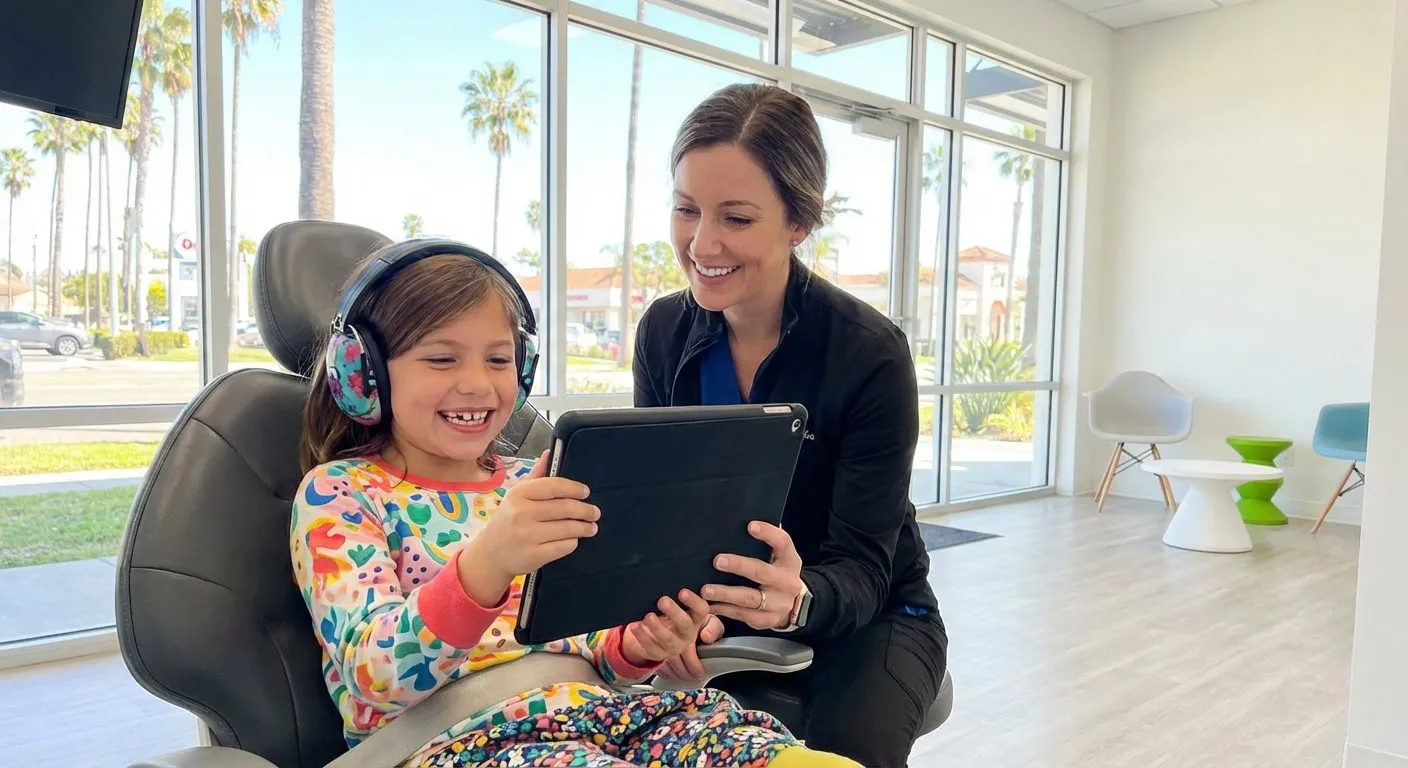
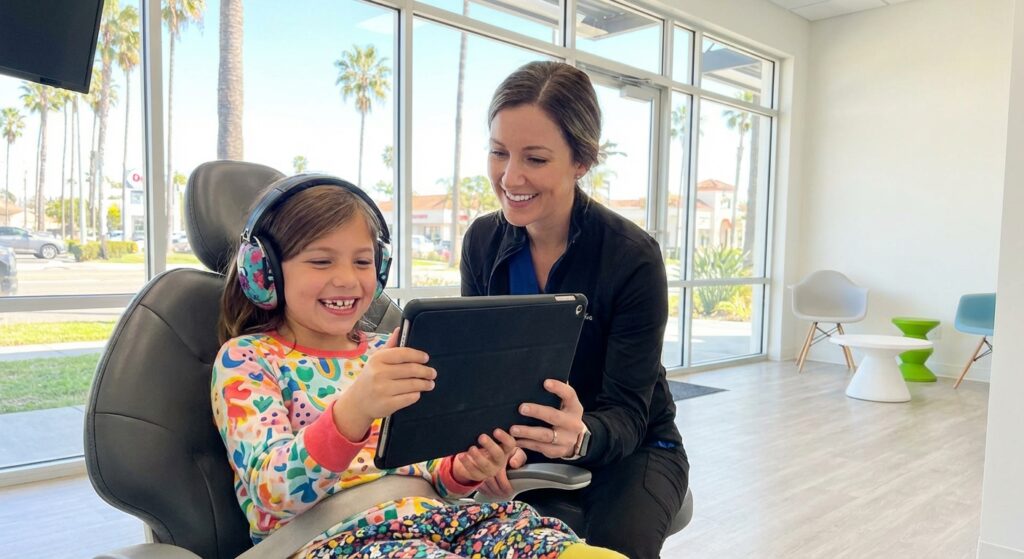
The check-in at our Miramar office isn't cold or clinical. Your child sees games, snacks, personal VIP suites, TV shows, noise-cancelling headphones, and weighted blankets. This isn't a scary doctor's office. It's their space.
We show you everything first
No mystery. No back room decisions. You and your child see the treatment areas, the chairs, the screens, and exactly how close you'll be the whole time.
If we need images, we explain them in plain English
We take low-dose digital X-rays or CBCT scans if needed to understand jaw growth and tooth positions. We tell you exactly what we're doing, why we're doing it, and how we keep radiation as low as possible.
Our board-certified orthodontist does a real exam
This isn't a quick look. We evaluate teeth, bite, jaw alignment, facial growth, and any habits. It's about the whole face, not just the front teeth.
We sit down and actually talk to you
No sales pitch. You get to see the images and photos. You'll understand what's healthy, what concerns us (if anything), what happens if you wait, and what Phase 1 treatment could change.
We tell you the truth
If your child doesn't need Phase 1 treatment, we say it straight. We set up simple growth check-ins. That honesty is why pediatric dentists across South Florida trust us with their referrals.
Your questions get answered
School schedules, sports, cost, insurance, how this fits into your life. We make space for the real stuff.
When Your Child Does NOT Need Phase 1 Treatment
One of the fastest ways to build trust is to say "you don't need to do anything right now."
At SMILE-FX, we're just as proud of the kids we watch as the kids we treat.
We typically don't recommend Phase 1 treatment when:
- Jaw growth looks balanced and even
- The bite works and isn't damaging teeth or gums
- Crowding is mild and manageable with teen braces or clear aligners later
- Habits are getting better and not harming growth
- There's no medical or functional reason to jump in early
In those cases, we set up growth and smile checkups every 6 to 12 months. We catch any changes early without pushing treatment nobody needs.
This is the difference between a volume-based office and a real growth-expert practice.
Why Families in Broward Pick SMILE-FX
Parents who drive past other offices to get to us usually say: "If we're doing this, we want it done right."
Here's what's actually different:
We have board-certified orthodontists only
Not general dentists. Not hygienists. Specialists who trained for years after dental school to become experts in growth and bite correction.
We follow AAO guidelines and growth science
We don't push Phase 1 on every kid. If it's not clearly beneficial, we don't recommend it.
Our technology is current
3D imaging, digital scans, advanced appliances. Not old equipment that limits what we can see or do.
Kids actually want to come back
Friendly team, games, entertainment, VIP suites, weighted blankets, noise-cancelling headphones. This isn't clinical. It's designed for kids to feel safe.
We have a real reputation in the pediatric community
Pediatric dentists refer to us because they know the work is solid and the approach is honest.
If you're in Pembroke Pines, Hollywood, Weston, Cooper City, Davie, or Fort Lauderdale, our Miramar location is usually a 10 to 25 minute drive. Parents make that drive because they know they're getting specialist care, not a "we also do braces" side business.
You'll find us easily from I-75, the Florida Turnpike, and major Broward routes. Parking is right at the building. Most families schedule around school drop-off, pickup, or errands nearby.
Phase 1 vs Waiting Until Teen Years: What Actually Changes?
Parents always ask: "Can we just wait until all the adult teeth come in?"
Sometimes yes. Sometimes waiting means treatment gets longer, more complicated, or even surgical down the road.
Phase 1 can do things that Phase 2 (teen treatment) cannot:
- Make the jaw wider so adult teeth have room
- Fix crossbites and underbites while bones are still soft and moveable
- Stop habits that are changing how the face grows
- Reduce the risk of front teeth getting knocked out when they stick out too far
- Protect your kid's confidence during important school years
Phase 2 treatment later is about fine-tuning: perfecting alignment, bite details, and smile design.
When Phase 1 is done for the right reasons, Phase 2 is shorter, easier, and more predictable.
How We Make Kids Comfortable (So They Actually Come Back)
An anxious 7-year-old doesn't magically become a confident 13-year-old.
How kids experience dental care now shapes how they feel about it forever.
At SMILE-FX, comfort isn't optional. It's the foundation of the treatment plan.
Kids feel safe because of:
- A friendly team that talks to kids like actual humans
- Games and entertainment in the lobby and treatment areas
- Personal VIP suites with TV and streaming
- Noise-cancelling headphones for kids sensitive to sound
- Weighted blankets for calming
- Virtual reality options for distraction when it helps
- Small rewards and celebrations for being brave
Your child learns: "When I go to SMILE-FX, adults listen to me, explain things, and make me comfortable."
That trust carries into teen years. Better cooperation. Fewer battles over elastics. Smoother treatment overall.
Technology That Matters for Growing Jaws
Technology isn't just cool stuff. It's about accuracy and safety.
SMILE-FX invests in:
- 3D CBCT imaging to evaluate jaw joints, airways, and complex tooth positions
- Low-dose digital X-rays for detailed, safe diagnostics
- Digital scans instead of messy impressions
- Modern expanders and appliances designed for comfort
- Advanced software to plan and predict growth
If you want to research how current an office really is, our cutting-edge technology page and Why SMILE-FX overview show exactly what we use and why.
Board-Certified Specialist vs General Dentist: The Real Difference
You'll see cheaper offers everywhere. Big discounts. "Braces at your family dentist" signs.
You're not wrong to notice price. You're being responsible.
But when we're talking about your kid's jaw growing and their face developing, the real question is: who's planning this?
At SMILE-FX:
- Every plan comes from a board-certified orthodontist. A specialist with years of training beyond dental school.
- We focus on jaw growth, airway, and long-term bite health. Not just straight teeth.
- We don't push treatment to hit numbers. If it's not clearly going to help, we don't recommend it.
Could you pick a cheaper option closer to home? Yeah. But most Broward parents eventually decide: "If someone's guiding my kid's face as it grows, I want the specialist."
Cutting corners here usually costs more later, both in money and medical complications.
Scheduling Around Your Life
We see kids from Pembroke Pines, Hollywood, Weston, Cooper City, Davie, Fort Lauderdale, and all of Greater Broward and South Florida.
We build schedules around real life:
- Before and after school appointment slots
- Efficiency-focused visits to minimize class time missed
- Digital forms and virtual consults to cut down in-office time
- Text reminders and flexible rescheduling
SMILE-FX sits between home, school, and your usual errands on the map. We designed it that way because we're parents too. That extra 15 to 20 minutes only feels worth it when you deeply trust the care.
FAQ: What Parents Actually Want to Know
Does my kid really need braces this young?
Not always. That's why the Phase 1 consultation exists. To figure out who needs early help and who can safely wait. Most kids we see in Miramar and Broward don't start treatment right away. We just monitor growth and check in at key ages.
How long does Phase 1 last?
Usually 9 to 18 months depending on what we're fixing (a crossbite versus an underbite versus crowding). We give you a clear timeline after the exam and build it around school and family life.
Will Phase 1 mean my kid skips braces later?
Sometimes. Often it simplifies and shortens teen treatment instead of replacing it. We're direct: if Phase 1 isn't going to make a real difference later, we won't recommend it.
How much does it cost?
Costs vary with complexity, appliances, and length. We give you a clear written estimate at the consultation. We work with most insurance plans and offer flexible payment options so that doing what's best for your kid's growth is manageable.
You're not buying a product. You're investing in years of guided facial development by a specialist.
What if my kid has serious anxiety?
This is where SMILE-FX wins. Our comfort tools and calm team are built for kids who need extra support. We can do shorter visits, more breaks, and gradual desensitization. Your child feels respected, not rushed.
Can we start with a virtual consult?
Yes. Many Broward and South Florida parents begin with a virtual consultation. You send photos, share concerns, and our orthodontists give a preliminary opinion and help you decide if an in-person visit makes sense.
Why This Matters Right Now
Your child's jaw is growing right now. Not next year. Now.
The decisions you make in these foundation years shape their smile, their bite, their confidence, and sometimes their health for life.
Getting an honest evaluation from a board-certified specialist costs nothing when you start with a free consultation.
Getting it wrong or waiting too long costs a lot more later.
If your child is between 6 and 10, you're in Miramar or Greater Broward, and you're wondering "do we need to do something now or can we wait," it's time to find out.
No pressure. No fear tactics. Just clarity.
Book a free 3D scan and VIP smile consultation with SMILE-FX today.
Schedule online, or request a call from our team.
Choose in-person at our Miramar location or a virtual consult.
Bring your questions. This is your space to get answers, not a sales pitch.
Your child gets one chance at growing their smile right. Partnering with a trusted, pediatric-focused, board-certified orthodontic team like SMILE-FX Orthodontics & Clear Aligner Studio makes that window count for Phase 1 orthodontics in Miramar and Broward for ages 6 to 10.
Orthodontics for Teens and Adults: Beyond the Childhood Years in Broward
Your teenager won't wear braces in public. Your adult teeth shifted after years of ignoring them. You think you're too old for orthodontics. You assume the only way forward costs a fortune and takes years.
None of that is true anymore.
Orthodontic treatment for teens and adults has changed completely over the last decade. The options are faster, invisible, and way more flexible than they used to be. At SMILE-FX Orthodontics & Clear Aligner Studio, we work with patients from ages 11 through 70-plus. Not because we have to. Because the science and the technology actually work at every age.
The real question isn't whether you can get orthodontic treatment as a teen or adult. The question is which option fits your life, your timeline, and what you actually want your smile to look like.
Why Teens Need Different Orthodontic Options Than Kids
A 14-year-old cares about different things than a 7-year-old.
Social life matters. Sports matter. Looking confident in photos matters. Metal braces that scream "I'm getting my teeth fixed" can feel like a social liability, not a health investment.
That's why clear aligner therapy and Invisalign for teens exist. They work just as well as traditional braces for most teen bite problems, but nobody knows you're wearing them unless you tell them.
Invisalign Teen is specifically designed for growing teen jaws.
The aligners have small blue dots that fade as you wear them, so you and we both know compliance isn't an issue.
You can remove them to eat, drink, brush, and play sports without worrying about broken brackets or wires.
Treatment usually takes 18 to 24 months for the average teen case.
Most teens finish in time to show off their smile at graduation or college photos.
And if traditional metal or ceramic braces work better for your teen's specific bite issue, we're honest about that too. Some cases just need the precision that fixed braces provide.
What Changes When Teeth Move in Adult Jaws
Adult teeth move differently than kid teeth.
Your jaw isn't growing anymore. Your bone density is higher. Your teeth have been in place for decades, so they push back harder when we try to move them.
That doesn't mean movement is impossible. It just means we have to be smarter about it.
Adult orthodontics takes longer sometimes. Forty-eight months instead of 18 to 24.
But adult patients typically stick with treatment because they chose it. They're not fighting their parents' decision. They want their smile fixed, so they actually follow the plan.
Adults also care about aesthetics in ways teenagers don't always notice yet.
We can use lingual braces (braces on the back of your teeth) so they're completely hidden.
We can use clear aligners for almost any case that isn't too severe.
We can use traditional braces with tooth-colored brackets so they blend in better.
The point is this: you have options. Real options that fit how you actually live.
Adults Ask About Gum Disease and Bone Loss First
This is the real conversation adults bring to the table.
"My gums aren't what they used to be."
"I had periodontal disease ten years ago."
"Can I still get braces if I'm not in perfect dental health?"
The answer is almost always yes.
Orthodontics and periodontal health are connected, not opposed.
Straight teeth are easier to keep clean. Crowded teeth trap plaque and bacteria. Bite problems force your jaw to work harder, which stresses your gums.
So fixing your bite and crowding can actually improve your gum health long-term.
What we do require: if you have active gum disease, we treat that first. We work with your periodontist or general dentist. Once your gums are healthy, we can move forward with braces or aligners.
It's not a barrier. It's just being smart about the order we do things.
The Adult Clear Aligner Advantage
Clear aligners are why so many adults finally fix their teeth.
They're removable, so you brush and floss normally. No special tools or waterpicks required.
They're invisible. Nobody at work knows you're straightening your teeth unless you mention it.
You can eat normally. No forbidden foods. No popcorn anxiety. No bracket damage from biting into an apple.
You change to a new set every one to two weeks. The movement is gentle and predictable.
Most adult clear aligner cases take 12 to 24 months, depending on complexity.
Severely crowded teeth or complex bite problems might need traditional braces instead, but we're honest about that upfront.
The catch: you have to actually wear them.
Clear aligners only work if you wear them 20 to 22 hours per day.
If you're not going to commit to that, traditional braces are a better choice because you can't take them off.
We've had adults tell us they chose braces specifically because they knew they'd skip the aligners half the time. That's smart self-awareness, not failure.
Teen-Specific Treatment Planning and Compliance
Teenagers hit a weird development window.
Their jaws are done growing, but their wisdom teeth might not be in yet.
They might have had Phase 1 treatment as a kid, so now we're fine-tuning.
Or they never had early treatment, and now we're correcting crowding or bite problems all at once.
The other thing about teenagers: compliance is everything.
If you tell a 15-year-old to wear elastics and they don't, treatment stalls. If you tell them to wear clear aligners and they lose them, you're back to square one.
At SMILE-FX, we build teen compliance into the plan from the start.
We talk to them directly, not just their parents. We ask what they can actually commit to.
If they want to keep their treatment invisible, we pick clear aligners.
If they're worried about losing them or not wearing them enough, we use braces.
If they play contact sports, we talk about mouthguard options.
Meeting teens where they are—not where we wish they'd be—is why our teen cases actually finish on time.
Cost Differences Between Treatment Types for Teens and Adults
Clear aligners usually cost more upfront than traditional braces.
That's partly materials, partly technology, partly the fact that you get a whole series of custom aligners made just for you.
Traditional braces might be cheaper per month, but they take longer in some cases, so the total cost evens out.
At SMILE-FX, we give you a clear written estimate before anything starts.
Insurance often covers a percentage of braces or aligners, regardless of which type you choose.
We work with most major insurance plans.
And we offer payment plans so you're not choosing between orthodontics and paying your rent.
Most families can find an option that makes sense.
Sports, Music, and Active Teens in Braces or Aligners
Your teen plays football. They're in the school band. They swim competitively.
Can they do all that while getting their teeth straightened?
Yes. But the specifics matter.
Clear aligners: remove them for games, practices, and rehearsals. Put them back in after. This works great for contact sports because there's no risk of a bracket breaking your lip if you take a hit.
Traditional braces: you wear them during everything. Use a mouthguard for contact sports. The mouthguard fits over the braces, and you need a special one designed for that. No big deal, just one more piece of gear.
Brass instruments: aligners are easier because you just remove them to play. Braces require you to seal your lips around them, which takes practice but gets easier in a few weeks.
Swimming and water sports: either option works fine. Chlorine doesn't damage braces. Clear aligners don't dissolve or absorb water. Just remove aligners before jumping in.
The point: don't let sports stop you from getting braces or aligners. Your teen can do everything they normally do. It just takes a tiny bit of planning.
What About Wisdom Teeth and Teen Orthodontics
Wisdom teeth are the wild card in teen treatment planning.
Some teens have them coming in already. Some won't have them for years. Some will never get them (it happens).
We take X-rays to see what's coming and when.
If wisdom teeth are going to crowd everything we just fixed, we talk about extraction early.
Sometimes that means pulling them before braces go on.
Sometimes we can wait and see how much space they need.
The data actually doesn't support pulling healthy wisdom teeth just to prevent crowding. We only extract if we see a real problem coming.
This is another reason getting an evaluation from a board-certified specialist matters. We know what to look for and what to actually worry about versus what's hype.
Adult Teeth Shifting After Braces: Why Retention Matters
You had braces 20 years ago. Your teeth have slowly shifted back.
This is so common it has a name: relapse.
It happens because your teeth want to go back to where they were before braces. That's biology.
The fix is retention. You wear a retainer after treatment to hold your teeth in their new position while the bone hardens around them permanently.
Some people wear a permanent bonded retainer (thin wire glued to the back of your front teeth).
Some wear clear retainers you take out every night (like Invisalign but worn after treatment).
Some do both.
If you had braces before and didn't wear a retainer, or you wore it for a few years and then stopped, that's why your teeth shifted.
The good news: we can fix it again. And this time, we'll make sure you understand retention from the start.
Adult teeth can shift at any age, which is why lifelong retention is the standard now. You're not done with your retainer. You're in a maintenance phase.
Cosmetic vs Functional Orthodontics in Adulthood
As an adult, you might want straighter teeth purely for looks.
Or you might have jaw pain, difficulty chewing, or bite problems that actually hurt.
Sometimes it's both.
Cosmetic orthodontics straightens visible teeth and improves your smile.
Functional orthodontics fixes how your bite works and takes pressure off your jaw joints.
We can assess what you actually need at a free consultation.
You might only care about how it looks. That's valid.
Or you might have real pain and dysfunction that fixing your bite could solve.
We talk through what matters to you and what we can realistically change.
Adult Orthodontics and Jaw Joint Problems
Some adults come in with TMJ pain or jaw dysfunction.
Bite problems can absolutely contribute to that.
When your teeth don't close together evenly, your jaw muscles have to work harder to chew and close your mouth.
That constant stress can cause pain, clicking, or even locked jaw.
Straightening your bite and getting your teeth to close evenly can reduce or eliminate that pain.
But it's not a magic cure for all jaw problems.
Sometimes you need physical therapy or other treatment alongside orthodontics.
Sometimes the TMJ issue needs to be treated first before we start braces.
We work with your physician or specialist to figure out the right order.
The point: if you have jaw pain, mention it at your consultation. It matters for how we plan treatment.
Speed of Treatment: Teen vs Adult Reality
Teens often want to know if braces are faster with newer technology.
Adults often want to know if they can speed things up because they don't want to wear braces for three years.
The honest answer: teeth move at a certain biological pace. We can't rush it without damaging teeth or gums.
That said, modern orthodontics is faster than it used to be.
Accelerated braces, high-frequency vibration devices, and certain aligner protocols have trimmed months off average treatment.
For teens, treatment usually takes 18 to 24 months.
For adults, 24 to 36 months is typical, sometimes longer if you have significant bone loss or gum disease history.
We give you a realistic timeline after examining your specific case. No promises we can't keep.
Orthodontics After Dental Work or Implants
You have a dental implant. Can you still get braces?
You're thinking about getting implants. Should you do orthodontics first?
These are adult-specific questions we get a lot.
Short answer: yes to both, but the order and planning matter.
Implants don't move with braces. They're locked in place.
So if you have an implant and you get braces, your natural teeth move but the implant stays still. That can change how they fit together.
Usually we do orthodontics first, get your natural teeth in the right position, then place the implant to match.
If you already have an implant, we can still do braces on your other teeth, but we have to be careful not to create bite problems where the implant is.
It's doable. It just requires planning.
This is where having a board-certified specialist makes a real difference. We know how to work with existing dental work.
The Invisalign Decision: Is It Right for You
Invisalign and other clear aligners are amazing for certain cases.
They're not the answer for everything, even though the marketing sometimes suggests they are.
Clear aligners work great for:
Mild to moderate crowding
Spacing between teeth
Simple overbites or underbites
Cases where you've had braces before and your teeth shifted slightly
Clear aligners struggle with:
Very severe crowding that requires rotation or intrusion (moving teeth up or down)
Extreme bite problems where teeth need to move a lot
Patients who won't commit to wearing them 20-plus hours daily
Cases with significant bone loss in your gums
At your consultation, we tell you honestly if clear aligners will work for you or if traditional braces are the smarter choice.
Some people feel relieved. Others are disappointed.
But a realistic plan beats a pretty picture that won't work.
Maintenance and Aftercare for Teen and Adult Braces
Getting braces or aligners is just the beginning.
You need to keep your teeth clean, show up for appointments, and follow instructions about what to eat or how to wear them.
For braces: brush and floss around brackets every single day. Some people use special floss threaders or water flossers because regular floss is hard with braces. Don't eat sticky candy, popcorn, hard nuts, or other foods that can break brackets.
For aligners: remove them before eating or drinking anything except water. Clean the aligners daily. Wear them as prescribed.
We give you specific instructions tailored to your treatment type.
And we check in at appointments to make sure you're doing it right.
The patients who follow the plan finish faster and have better results. Shocking, I know.
Life After Braces or Aligners: Retention Forever
Treatment ends. Your braces come off or you stop wearing aligners.
You take a picture. You smile big. You feel amazing.
Then retention starts.
This is the part nobody talks about enough, so here it is: wearing a retainer isn't optional if you want your teeth to stay straight.
We recommend permanent bonded retainers on your lower front teeth (the ones that shift most easily).
Plus removable retainers you wear every night for life.
It sounds like a lot, but it's like brushing your teeth. You just do it.
Skip the retainer for a year, and your teeth will start moving back. That's not failure. That's biology.
But it's completely preventable if you wear the retainer.
Choosing Between Different Orthodontic Providers
You've probably seen ads for discount braces, corporate orthodontist chains, and "braces at your general dentist" offers.
Price is important. But it's not the only thing that matters.
A cheap orthodontist who doesn't catch complications costs way more in the long run.
A board-certified orthodontist has done extra training beyond dental school specifically to understand teeth, jaws, and bite.
That expertise matters whether you're a teenager worried about social stuff or an adult with bone loss history.
At SMILE-FX, we use current technology, create individual treatment plans, and honest about limitations.
We're not the cheapest. But we're transparent about what you're paying for.
That matters more when someone's guiding your smile for two to three years.
Questions Adults and Teens Actually Ask
Will braces affect my speech? Temporarily, maybe a few weeks. You adjust quickly. Aligners rarely affect speech at all.
Can I get braces if I smoke? Yes, but smoking slows down tooth movement and increases gum disease risk. If you're trying to quit, orthodontics might be good motivation.
What if I'm pregnant? We can do orthodontics during pregnancy, but we skip X-rays unless absolutely necessary. Most pregnant patients wait to start treatment until after delivery, but every situation is different.
Do braces hurt? Uncomfortable, yes. Painful, usually no. The first week and after adjustments, your teeth feel pressure and mild soreness. Pain relievers help. It passes.
Can I play contact sports? Absolutely. Wear a mouthguard. It's that simple.
Will treatment whiten my teeth? No. We straighten teeth. Whitening is separate. Some patients do whitening after braces come off for full results.
Real Timelines for Teen and Adult Treatment
Average teen case with clear aligners or braces: 18 to 24 months.
Average adult case with clear aligners: 12 to 18 months for simple cases, 24 to 36 months for complex ones.
Average adult case with traditional braces: 24 to 36 months.
Cases with extraction of teeth: add 3 to 6 months.
Cases with severe bite problems: add 6 to 12 months.
These are general ranges. Your actual timeline comes from your treatment plan.
Why SMILE-FX for Teens and Adults in Broward
We see every age. We've straightened teeth on 11-year-olds and 71-year-olds.
We're honest about what will work and what won't.
We offer multiple treatment options so you pick what fits your life.
We use current technology and techniques, not what we learned 20 years ago.
We treat people like humans, not like numbers on a schedule.
We have a real reputation in the community because people actually get good results.
If you're in Pembroke Pines, Hollywood, Weston, Cooper City, Davie, Fort Lauderdale, or anywhere in South Florida, we're 10 to 25 minutes away in Miramar.
Stop by. See the space. Meet the team.
Book a free 3D scan and VIP smile consultation here.
No pressure. No sales pitch. Just clarity on what's actually possible for your smile and your bite in Broward and South Florida.
Complex Orthodontic Cases and Advanced Treatments in South Florida
You've got a bite problem that feels impossible to fix.
Your teeth are severely crowded.
Your jaw doesn't line up right.
You've been told by other places that you need surgery.
Or maybe you tried braces before and they didn't work out the way you hoped.
You're wondering if there's actually a solution that doesn't involve going under the knife or spending a fortune.
The truth is this: what looks impossible to a general dentist or a basic orthodontic office is just another day at a board-certified orthodontist who knows how to handle complex cases.
At SMILE-FX Orthodontics & Clear Aligner Studio in Miramar, we're the place people come when everyone else said no.
Not because we're reckless or overpromise.
Because we have the training, the technology, and the experience to see what's actually fixable versus what really does need a specialist's involvement.
What Makes a Case Complex Anyway
Before we talk about fixing hard stuff, let's get clear on what "complex" actually means.
It's not just crowded teeth.
It's not just an overbite.
Complex cases are situations where multiple bite problems exist at the same time.
Or where bone structure, growth patterns, or previous dental work creates layers of problems to solve.
Things like severe skeletal underbites where your lower jaw sticks out way too far.
Extreme overbites where your top front teeth overlap your bottom teeth by half an inch.
Open bites where your front teeth don't touch when you close your mouth at all.
Crossbites that shifted your jaw to one side and changed your whole facial structure.
Impacted teeth that never came down and are stuck in your bone.
Cases where you're missing teeth and need to close gaps while fixing the bite around them.
Previous orthodontic treatment that relapsed or failed, leaving you right back where you started or worse.
The best orthodontist near me isn't just someone who can slap braces on straight teeth.
It's someone who can look at your whole face, understand bone structure, read X-rays like a map, and build a plan that actually works for your specific situation.
When Surgery Might Actually Be Necessary
Some cases do need orthognathic surgery, and we're not going to pretend otherwise.
If your jaw is severely misaligned, braces alone can't fix it.
Your teeth can move, but your jaw bone won't.
So if the skeletal problem is severe enough, surgery to reposition the jaw might be the only real solution.
We can tell you early whether your case falls into that category.
And if it does, we work with a surgical specialist to plan the whole thing out.
Braces go on first to line up your teeth.
Then surgery happens.
Then braces come back on to fine-tune everything after healing.
It's a coordinated process.
But here's what matters: we don't recommend surgery just to recommend it.
Plenty of cases that look severe on the surface can be fixed with smart orthodontics alone.
That's where real expertise matters.
Severe Crowding and Extraction Decisions
Your teeth are packed in so tight they're literally overlapping and twisting.
The question becomes: can we move teeth to make room, or do we need to pull some out to create space?
Extraction decisions are huge.
Once a tooth is gone, it's gone.
But sometimes extracting one or two teeth is actually the best move to get a healthy result.
The data shows that when crowding is severe, extracting strategically can give you a better bite, better tooth health, and a more stable result long-term than trying to squeeze everything in.
We don't pull teeth because it's easier for us.
We pull teeth because the plan requires it to work.
If we can expand your jaw or find space without extraction, that's our first choice.
But if the math shows extraction is smarter, we tell you straight and explain why.
Impacted Teeth and Exposing Buried Teeth
A tooth came in where it shouldn't have, or it never came down at all.
Now it's stuck in your bone, and everyone's telling you it's impossible to fix.
It's not.
This is actually a case where orthodontics plus a minor surgical procedure works really well.
An oral surgeon makes a small opening to expose the impacted tooth.
Then we bond a small bracket to that tooth and gently guide it down into place with braces.
It takes longer than normal orthodontics, sometimes 18 to 36 months depending on how buried it is.
But by the end, you have a real tooth in the right spot instead of a gap or a fake tooth.
This is the kind of case that requires real coordination between specialists.
And it's exactly what SMILE-FX does on a regular basis.
Previous Failed Orthodontics and Starting Over
You had braces before.
They didn't work out the way you hoped.
Or they worked fine, but now everything's shifted back and the original problem is worse than ever.
You're frustrated, skeptical, and honestly not sure if trying again is worth it.
Here's what we find: most failed cases aren't actually a treatment failure.
They're a retention failure or a planning failure.
Someone didn't wear their retainer and teeth drifted.
Or the original plan didn't address the root cause, so as soon as braces came off, the problem came back.
When you come in for a second round of braces or clear aligners, we start from scratch.
We don't assume the first orthodontist got it wrong or that you did something wrong.
We just build a new plan based on what we see and what we know now.
Second treatments usually move faster because we know exactly what didn't work before.
And retention this time is non-negotiable.
We make sure you understand that wearing a retainer forever is the cost of keeping your smile straight.
How Technology Changes Everything for Hard Cases
Advanced technology isn't just cool stuff.
For complex cases, it's the difference between guessing and knowing exactly what needs to happen.
3D cone beam imaging shows us bone structure, tooth roots, where they're pointing, and where they need to go.
Digital treatment planning lets us simulate the whole thing before we even put a bracket on your tooth.
We can see how teeth will move, how bones will respond, and what the end result will look like years before it happens.
That's not magic.
That's smart planning with real data.
For severe cases, being able to visualize everything in 3D and map out every tooth's path is honestly game-changing.
It means fewer surprises, shorter treatment, and better outcomes.
Bite Problems That Actually Hurt
Some people have bite problems that aren't just cosmetic.
They hurt.
Your jaw clicks when you chew.
Your muscles are constantly sore.
You get migraines that seem connected to how your teeth close.
Or you can't open your mouth very wide without pain.
These are functional bite problems, and orthodontics can absolutely help.
When your teeth close in the wrong position, your jaw muscles have to work overtime to make it happen.
That constant strain is exhausting and painful.
Fixing the bite so your teeth close in a position where your jaw is relaxed can eliminate that pain completely.
But it requires diagnosing the root cause first.
Is it the bite itself, or is something else going on?
That's why evaluation by a real specialist matters.
We work with your doctor or physical therapist to make sure we're solving the actual problem, not just guessing.
Missing Teeth and Spacing Solutions
You're missing a tooth.
Now you have a gap, and everyone's asking if you're going to fill it.
Your options are: close the gap with braces, leave it open for an implant, or do some combo.
Each choice has trade-offs.
Closing the gap with braces is the cheapest option and moves fast.
But it changes your bite and your smile line.
Leaving the gap open and putting in an implant later keeps the tooth spacing normal, but it costs more and takes longer because you have to do braces first, then implant, then sometimes more braces after.
We walk you through the pros and cons of each path.
And we work with your general dentist or implant specialist to make sure whatever we do plays nicely with their plans.
Wisdom Teeth Complications
Wisdom teeth are coming in sideways.
Or they're impacted.
Or they're erupting at an angle that's pushing your other teeth around.
Sometimes extraction makes sense.
Sometimes just waiting to see how they settle is the move.
The data doesn't support pulling healthy wisdom teeth just because they exist.
But if they're causing real problems, removal before or during orthodontics can save months of treatment and prevent relapse later.
We look at your specific situation and tell you what makes sense.
Bone Loss and Gum Disease Challenges
You've got a history of gum disease.
You've lost some bone support around your teeth.
Can you still get braces?
Yes, but with a plan.
First, we treat the gum disease until it's under control.
Your general dentist or periodontist handles that part.
Once your gums are healthy, we can safely move your teeth.
Moving teeth in a healthier position actually makes them easier to keep clean.
So orthodontics can improve your long-term gum health, but only if we start with healthy gums.
This is another case where coordination between specialists matters.
Narrow Jaws and Palate Expansion
Your upper jaw is too narrow.
Your upper teeth are crowded because there's literally not enough width.
In kids, we can expand the palate and create tons of new space.
In adults, the palate has fused and expansion is trickier.
We can still do it with special appliances or in some cases with a minor surgical procedure.
But the results are different from expanding a child's growing palate.
We give you realistic expectations about what expansion can accomplish and what its limits are.
Why Complex Cases Need Board Certified Specialists
A general dentist or someone without orthodontic specialty training can handle simple crowding or spacing.
But complex cases require someone who trained specifically in how teeth and jaws work together.
Board-certified orthodontists have done years of extra training beyond dental school.
We study biomechanics, growth patterns, surgical coordination, and advanced treatment techniques.
That training is why we can look at something that sounds impossible and build a real plan.
It's also why we know when to recommend a surgeon or specialist.
We're not trying to prove we can handle everything solo.
We're trying to get you the best result, which sometimes means bringing in the right expert at the right time.
Cost of Complex Cases and Insurance
Complex orthodontics costs more than simple cases.
That's just reality.
More time, more appointments, sometimes more technology, possibly surgical coordination.
But insurance covers a lot of it.
Most plans cover $1,500 to $2,500 of orthodontic treatment per person, regardless of complexity.
For complex cases, that insurance benefit plus a payment plan can make treatment way more manageable than you think.
We give you a clear written cost estimate before anything starts.
No surprises.
And we work with you to find a payment schedule that fits your budget.
Timeline Expectations for Complex Orthodontics
Simple cases with Invisalign or regular braces take 18 to 24 months.
Complex cases take longer.
Sometimes 36 to 48 months.
If surgery is involved, add another 6 to 12 months because you need pre-surgical alignment, healing time, and post-surgical refinement.
If we're exposing impacted teeth, that's easily 24 to 36 months.
We give you a realistic timeline after examining your case.
And we check in regularly to make sure you're tracking where we predicted.
Sometimes things move faster than expected.
Sometimes they take longer.
Either way, you'll know what's happening and why.
Getting Started with a Complex Case Assessment
If you've been told your case is too hard or impossible, or if you're just not sure what you're dealing with, a real evaluation is the move.
At SMILE-FX, we do a free 3D scan and VIP smile consultation that shows you exactly what's going on and what's possible.
You see the images.
You hear the real assessment.
You learn your actual options and their costs and timelines.
No pressure to commit to anything.
Just clarity.
The best orthodontist for complex cases is one who tells you the truth, shows you the data, and builds a plan you actually believe in.
That's what we do for patients across South Florida who want real answers about their smile.
If you're in Broward, West Palm Beach, Miami, or anywhere between, we're here to help turn what looks impossible into a real plan.