
Early Orthodontics for Kids Ages 6-10 in Pembroke Pines
Your kid's teeth are coming in crooked, and you're wondering if you should panic or wait it out.
Most parents in Pembroke Pines face this exact moment. You spot crowding, a crossbite, or some other issue with your child's smile and suddenly you're googling "do my kids need braces now" at 11 PM.
Here's the thing: you don't have to wait until they're teenagers.
Phase 1 orthodontics for kids ages 6-10 is a real option, and it's backed by actual science, not just dentist upselling. At SMILE-FX Orthodontic & Clear Aligner Studio in Miramar, we work with Pembroke Pines families every single week to catch these issues early and set their kids up for healthier smiles down the road.
I'm going to walk you through what Phase 1 actually is, why your seven-year-old might need it, and what to expect when you bring them in.
What Is Phase 1 Orthodontics Actually?
Phase 1 is early interceptive treatment. Basically, we step in while your child's baby teeth are still there and their jaw is still growing.
The goal is to influence how their jaw develops and make space for permanent teeth to come in right. It's not about putting full braces on a six-year-old. That's not what this is.
Instead, we use things like palatal expanders, removable appliances, and sometimes light braces on just a few teeth. The American Association of Orthodontists recommends an evaluation by age seven, and there's a reason for that. At seven, most kids still have plenty of baby teeth, which means we have a real window to guide growth.
Think of it like steering a ship while it's still in the harbor. Once it's out at sea, steering is way harder and more expensive.
Why Pembroke Pines Parents Are Choosing Early Treatment
If you've got a kid in Pembroke Pines, you know that finding a good specialist means sometimes driving a few minutes. SMILE-FX sits in Miramar, just off the Turnpike, which puts us about 12-15 minutes from most Pembroke Pines homes. No traffic nightmare, and you park right by the building.
But parents don't drive here just for location. They come because we're board-certified specialists who work exclusively with kids and teens. No general dentist doing braces on the side. No high-volume mill where your kid is patient number forty-seven in a day.
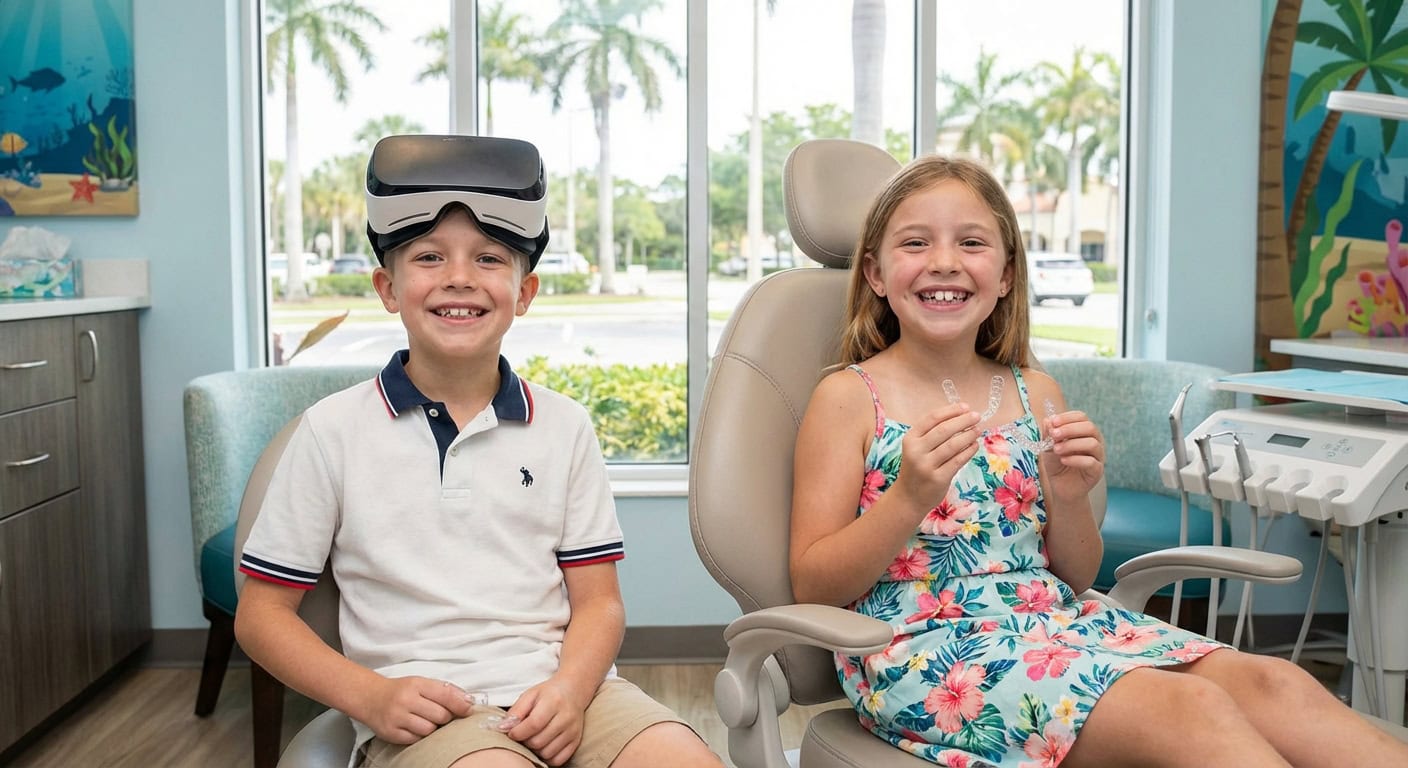
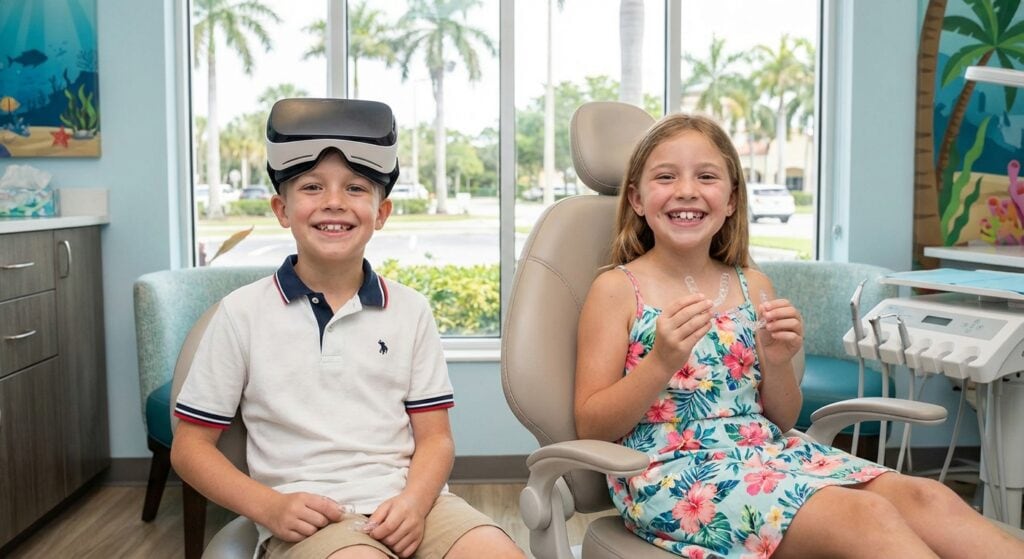
Our whole setup is built around making kids comfortable. We have VR games, weighted blankets, noise-canceling headphones, and personal suites where your child watches their favorite show while we scan their teeth. It sounds small, but when you're eight years old and nervous, that stuff matters.
Parents tell us their kids actually look forward to appointments. That's not normal in orthodontics, and it's because we actually respect what makes kids tick.
The Red Flags That Mean Your Child Might Need Phase 1
Not every kid needs Phase 1. In fact, only about 25 percent do. But if you spot any of these, it's worth getting your child evaluated.
Crowding: Teeth are overlapping or bunched up. If baby teeth are already crowded, permanent teeth won't have enough room.
Crossbite: The upper teeth bite inside the lower teeth instead of outside. This can cause jaw growth problems and uneven wear on teeth.
Mouth breathing: Your kid breathes through their mouth instead of their nose. This is often linked to narrow dental arches and airway issues.
Thumb sucking: If it's still happening after age five or six, it can push teeth forward and create bite problems.
Spacing that's too wide: Large gaps between baby teeth can sometimes signal that permanent teeth will be big and need space.
We're honest here. If your kid doesn't need Phase 1, we'll tell you. Watchful waiting is the right move sometimes, and we'd rather build your trust than upsell you something your kid doesn't need.
Why Age Seven Is the Magic Number for Treatment
At age seven, most kids have a mix of baby teeth and permanent teeth starting to come in. This is the sweet spot because your child's jaw is still growing.
If we catch a problem now, we can guide that growth in the right direction. Your kid's jaw is literally still being shaped. We work with biology instead of against it.
Compare that to age twelve when the jaw is mostly done growing. Now if there's a severe problem, we might need extractions or even surgery down the road. Way more invasive, way more expensive.
At SMILE-FX, we use cutting-edge technology like AI-powered planning and low-dose CBCT scans to see exactly what's happening with your child's growth. We're not guessing. We're using the same tech that top orthodontists use in major cities.
Our custom appliances expand palates 20 to 30 percent faster than old-school methods. That's not marketing talk. That's measurable, real results.
What Phase 1 Actually Looks Like
Phase 1 usually lasts between 6 and 24 months, depending on what we're treating. Your child might wear a palatal expander, which gradually widens the upper jaw. This creates space and often helps with breathing too.
It's removable. Your kid takes it out when they brush their teeth and before bed. It's not uncomfortable. The first few days feel a little different, like when you get a new mouth guard, but kids adapt fast.
You might also see braces on just a few baby teeth to guide eruption. Or we might use a growth-guiding appliance that's mostly invisible.
The whole thing is non-invasive and works with your child's natural growth cycle.
The Real Money Talk
Here's what most people wonder: is Phase 1 going to cost me a fortune, and is my insurance going to cover it?
Phase 1 costs less than you'd expect, and it often saves money long term. Think about it. If Phase 1 shortens Phase 2 (full braces or aligners) by six to twelve months, you're actually saving time and money in the end.
Our team works with your insurance to maximize your benefits. We also offer flexible payment plans so cost isn't a barrier. We're straight with families from day one. No hidden fees. No surprises.
Bring your insurance info to your first visit, and we'll map out exactly what it costs and what your coverage looks like.
What Happens at Your First Appointment
Your first visit is 45 minutes, and we keep it stress-free.
Your child meets our team, plays a quick game to settle in, and then we do a low-dose digital scan. No shots, no yucky impression trays. Just a quick, modern scan that's safer than old X-rays.
We take time to explain what we see, answer your questions, and build a custom growth plan specifically for your child. No cookie-cutter treatment plans. Every kid is different, and we treat them that way.
By the end, you'll know exactly what (if anything) your child needs and what it looks like to move forward.
Why SMILE-FX Is Different From Other Orthodontists
A lot of places claim to be good with kids. We actually are.
Our team includes board-certified specialists who focus only on kids and teens. We use the newest technology. Our patient reviews speak for themselves. Families drive from Hollywood, Weston, and Davie specifically to work with us because they trust us.
We also don't believe in one-size-fits-all. Whether your child needs braces, clear aligners, or Phase 1 interceptive treatment, we build a plan that actually works for their life.
A kid who plays soccer needs removable appliances. A shy kid might feel more comfortable with clear options down the road. We listen and adapt.
Phase 1 Sets the Stage for Phase 2
Phase 1 usually wraps up when most permanent teeth are in, around age 11 or 12. From there, your child might enter Phase 2, which is typically full braces or Invisalign for teens.
The beauty is that because of Phase 1 work, Phase 2 is shorter, simpler, and often less expensive. Your child's jaw is better aligned, there's more space, and we're working with a better foundation.
Some kids don't even need Phase 2. Phase 1 does all the heavy lifting.
How to Know if Your Pembroke Pines Kid Should Come In
If your child is between six and ten, and you've noticed any crowding, odd bites, mouth breathing, or habit issues, an evaluation costs you nothing and gives you answers.
We have a quick online Smile Quiz you can take. It takes two minutes and gives you a sense of whether Phase 1 might be helpful.
Or just reach out. Book a free 3D scan and VIP smile consultation. We'll scan your child's teeth with zero pressure and show you exactly what we see.
No charge. No obligation. Just real, honest feedback from specialists who've done this hundreds of times.
Your Pembroke Pines child deserves a healthy smile foundation. Phase 1 orthodontics is how we build that.
Beyond Phase 1: What Happens When Your Child Gets Older and Orthodontic Treatment Becomes More Complex
Your kid finished Phase 1, their jaw is better aligned, and now you're wondering what comes next.
Maybe they're hitting their preteen years and you're noticing their permanent teeth are still coming in at odd angles.
Maybe they're a teenager now and they're asking if they can get Invisalign instead of metal braces because they care about their appearance.
Or maybe you're the parent of a teenager who never had Phase 1, and now you're looking at more complex treatment options because of issues that could have been prevented earlier.
Whatever your situation is, orthodontics after childhood gets different. Not harder. Just different.
Understanding Phase 2 Treatment for Teens
Phase 2 is where we handle the teeth that permanent teeth have come in.
By the time your kid hits around 11 or 12, most of their baby teeth are gone and the permanent teeth are mostly in place.
This is when we can do the heavier lifting to fix bite problems, align teeth perfectly, and create that smile that makes sense for their face.
Phase 2 can take anywhere from 18 to 36 months depending on what we're correcting.
The good news is that if your child had Phase 1 interceptive treatment, Phase 2 is usually shorter, less invasive, and costs less money.
That's the whole point of early treatment in the first place.
Braces vs. Clear Aligners: What Actually Works Better for Teens
This is the conversation I have with parents and teens all the time.
Metal braces work faster for complex bite problems.
They're also cheaper.
And they're fixed to the teeth, so your teenager can't forget to wear them or lose them.
Clear aligners like Invisalign for teens are nearly invisible and let your kid eat whatever they want without worrying about food getting stuck.
But they only work if your teen actually wears them 20 to 22 hours a day.
I've seen plenty of teenagers who started with aligners and switched to braces because they weren't disciplined enough to wear them consistently.
Here's the honest truth: the best treatment is the one your teenager will actually stick with.
If they care about how they look and will wear aligners consistently, that's the move.
If they're not going to remember, braces are the safer bet.
When Teeth Need More Than Braces
Some cases are straightforward. Some are not.
If your teenager has severe crowding, a significant bite problem, or jaw alignment issues, we might need to consider more advanced treatable cases.
In rare situations, that means working with a surgeon.
But most of the time, even complex cases can be handled with the right combination of treatment.
That's where our cutting-edge technology and AI-powered planning actually matter.
We can map out exactly what needs to happen and in what order.
We're not guessing.
We're showing you the plan before we ever put a wire on a tooth.
The Honest Conversation About Costs and Time
Phase 2 treatment costs more than Phase 1.
It takes longer.
But here's what changes your math if your kid had Phase 1 already:
Your child's jaw is already better positioned.
There's already more space for teeth.
The foundation is already solid.
This means Phase 2 might be 6 to 12 months shorter than it would have been without Phase 1.
Shorter treatment means less time in the office, fewer adjustments, and lower overall cost.
Some teenagers who had Phase 1 don't even need Phase 2 because Phase 1 did enough of the work.
That's real money saved.
For families who didn't do Phase 1, Phase 2 takes longer and costs more because we're playing catch-up.
We're still going to get an amazing result, but the journey is longer.
What About Habits That Affect Teeth After Childhood
Orthodontics isn't just about putting brackets on teeth and hoping things work out.
There are actual habits that make or break treatment results.
Mouth breathing still matters at age 15.
If your teenager is still breathing through their mouth instead of their nose, that creates pressure on the teeth and can fight against what we're trying to do with braces or aligners.
Tongue thrusting is another one.
Some people naturally push their tongue forward when they swallow, and that can push teeth forward even while they're in treatment.
Bad posture can actually affect jaw development too.
If your kid is constantly slouching or craning their neck forward to look at their phone, that changes how their jaw sits.
None of these are deal breakers.
We can work around all of them.
But knowing about them changes how we approach treatment.
The Role of Retainers: Don't Skip This Part
Your teenager finishes braces or aligners.
Their teeth are straight.
They're excited.
And then we tell them they need to wear a retainer.
This is where a lot of teens check out mentally.
But here's the reality: teeth want to move back to where they came from.
That's just biology.
If your teenager doesn't wear a retainer, all the work, time, and money goes away in a couple of years.
Teeth shift back.
We usually recommend wearing a fixed retainer bonded behind the front teeth permanently, plus a removable retainer at night.
It sounds like a lot, but it's the difference between keeping a great smile for life versus starting all over again in their twenties.
When Adult Orthodontics Becomes Necessary
Some people grow up without ever getting orthodontic treatment.
They're fine with it.
Others get to their twenties or thirties and suddenly realize they want a better smile.
We can fix that at any age.
Adult teeth don't move slower than teenager teeth.
That's a myth.
What changes is that adult jaws are fully developed, so we can't guide growth anymore.
We're working with what's already there.
But for most cases, that's fine.
Adults can wear clear aligners discreetly while working.
They can wear braces if they want to.
They can choose other treatments depending on what they need.
The point is, it's never too late to get the smile you want.
How to Know If Your Teenager Needs Orthodontic Help Right Now
If your teenager is between 11 and 18, you've probably noticed if something's off with their bite or teeth alignment.
Trust that instinct.
A quick consultation costs nothing and shows you exactly what's happening.
We'll take 3D scans and show you everything on a screen so you both understand the situation.
No pressure.
No surprises.
Just honest feedback about what makes sense for their smile.
If they do need treatment, they should know that modern orthodontics is way different from what you probably remember.
Braces are smaller and more comfortable.
Clear aligners are actually effective.
Treatment is faster.
And at SMILE-FX, we actually care about making the experience good for your kid, not just moving teeth around.
Making the Choice Between Options
This comes down to your teenager's lifestyle and what they actually care about.
If they play sports, braces might be easier because there's nothing to remove or lose.
If they're in speech and debate, clear aligners might feel less obtrusive.
If they're constantly snacking and eating, aligners are better because they just take them out.
If they're forgetful, braces are better because they're permanent.
We talk through all of this at your first visit.
We ask questions about their routine, their sports, their interests.
We're not trying to sell you the most expensive option.
We're trying to find the option that actually works for their life.
The Connection Between Orthodontics and Overall Health
Here's something most people don't think about.
Orthodontics isn't just cosmetic.
A properly aligned bite changes how your teenager chews food.
It changes jaw pressure distribution.
It can reduce TMJ problems down the road.
It can help with sleep apnea symptoms in some cases.
It improves oral hygiene because straight teeth are easier to clean.
When teeth are properly aligned, your teenager is less likely to have cavities, gum disease, and other problems later.
So fixing their bite now isn't just about making them look good in pictures.
It's about setting them up for better long-term health.
Starting Your Journey at SMILE-FX
Whether your kid is in Phase 2, your teenager needs their first orthodontic treatment, or you're an adult looking for options, the first step is the same.
Book a free 3D scan and VIP smile consultation at SMILE-FX Orthodontic and Clear Aligner Studio.
We'll scan their teeth, show you exactly what we see, and build a treatment plan that actually makes sense for their situation.
Our team includes board-certified specialists who focus exclusively on delivering real results for kids, teens, and adults.
No general dentist doing braces on the side.
No factory approach where everyone gets the same treatment.
Just honest specialists who care about getting it right.
Your teenager's smile matters, and their confidence matters even more.
Orthodontic treatment for teenagers and young adults can set them up for a lifetime of smiling without hesitation.
The Reality of Orthodontic Treatment Timing: Why Waiting Might Cost You More in South Florida
You're sitting in your Broward home scrolling through your phone and you see your kid's smile in a family photo.
Teeth are crooked. Bite looks off. And your brain immediately goes to the same place it always does: "Should I do something about this now, or wait until they're older?"
This is the question I hear from every parent in Fort Lauderdale, Miramar, and all across South Florida.
The answer isn't simple, but it's important.
Because waiting actually has real consequences that most people don't think about.
The Cost of Doing Nothing: What Changes When You Wait
Let's talk money first.
A lot of parents think they're saving money by waiting.
You don't pay for treatment if you don't do treatment, right?
That's the logic anyway.
But here's what actually happens.
Your kid's jaw keeps growing in whatever direction it wants to grow.
Baby teeth make space for permanent teeth that are often bigger.
Crowding gets worse.
Bites shift into more severe patterns.
By the time you finally go in for a consultation, you're looking at a much bigger problem.
A case that could have been handled with interceptive treatments in two years now needs full braces for three years.
That's not just longer treatment.
That's more appointments, more adjustments, and higher overall cost.
I've seen families spend an extra 15 to 20 thousand dollars because they waited two years to start treatment.
Not because the treatment got harder.
But because more treatment was needed.
What Actually Happens to Teeth and Jaws While You Wait
Your kid's jaw is a living, growing thing.
It doesn't just freeze in place and wait for you to make a decision.
If there's crowding, that crowding often gets worse as permanent teeth come in.
If there's a crossbite, the uneven pressure on the jaw can create asymmetry that gets harder to fix later.
If your kid breathes through their mouth, that narrow airway pressure shapes their jaw growth in ways that are really hard to reverse.
Think of it like a river that's flowing the wrong direction.
The longer you wait, the deeper the channel gets.
Eventually, you don't just need to change direction, you need to dig a whole new riverbed.
That's more work.
That costs more.
And it takes longer.
The Insurance Question Everyone Asks
One of the first things people search is "does insurance cover braces" and "how much does invisalign cost south florida."
Here's the reality most people don't know.
Insurance companies often cover Phase 1 interceptive treatment.
They know it saves money long term.
They'll pay for palatal expanders, growth-guiding appliances, and limited braces because it reduces the need for more extensive treatment later.
But by the time your kid is 16 and you finally decide to do something, you're in Phase 2 territory.
Insurance still covers some of it, but you hit your lifetime maximum faster.
So waiting didn't save you money from insurance.
It actually cost you more because you're now doing more expensive treatment and you're more limited by your benefits.
When you call any top rated orthodontist near me, ask them straight up about insurance coverage.
Most practices will break down your benefits for you before you even start.
The Hidden Cost of Complex Cases
You search for "best orthodontist for complex cases" and you get nervous looking at the price tags.
You wonder if that's really necessary.
Here's what you need to know.
A case that would have been simple at age eight becomes complex at age fifteen.
Not because the orthodontist is upselling.
But because the jaw is done growing.
Now instead of guiding growth, we're fighting against it.
Severe crowding that could have been handled with expansion now needs extraction or surgical planning.
Bite problems that could have been corrected while the jaw was plastic now require working in a rigid, fully developed jaw.
That's genuinely more complex work.
And it costs what it costs because the clinical reality is harder.
Why South Florida Families Are Making Different Choices Now
I notice something shifting with families in Miami, Palm Beach, and Broward.
More of them are getting orthodontic consultations earlier.
Not because they're jumping into unnecessary treatment.
But because they want accurate information instead of guessing.
A free 3D scan and VIP smile consultation costs you nothing.
You get real data about what your kid actually needs.
If they don't need anything yet, great. You know that.
If they do, you know it, and you can make an informed choice with actual facts instead of worry.
The families who do this early are making better decisions.
They're not surprised by problems later.
They understand their options.
And they usually save money because they're not dealing with crisis intervention when a kid is 15.
The Affordable Braces Question: South Florida Pricing Reality
Everyone wants to know about "affordable braces south florida" and "$0 down braces financing."
That's legitimate.
Orthodontics costs money.
Good news is that most solid practices offer payment plans that make treatment accessible.
We're talking monthly payments that work with family budgets, not crazy lump sums.
But here's what matters more than the sticker price.
Where's your money actually going?
Are you paying for a practice that uses cutting-edge technology and AI-powered planning?
Or are you paying for a practice running the same treatment protocol on every patient?
Are you working with board-certified specialists?
Or a general dentist doing braces on the side?
The cheaper option isn't always the better deal if you end up needing more treatment later.
What People Search When They Finally Decide to Move Forward
I see the search patterns.
People type "best orthodontist near me" and "braces near me."
They look for "top rated orthodontist miramar" or "orthodontist near me fort lauderdale."
They're trying to find someone local they can trust.
They want to know if the practice actually delivers on what they promise.
They read reviews to see what other families say.
The patient reviews tell you everything you need to know about a practice.
Look for patterns in what people say.
Do they mention the team actually caring?
Do they say treatment was faster than expected?
Do they feel like they got good value?
That tells you what to expect.
Traditional Braces vs Invisalign: The Timing Question
A lot of people search "traditional braces vs invisalign" trying to figure out which is better.
The honest answer is both work.
But timing matters.
For younger kids still in Phase 1, we usually skip the choice because neither is the best option.
Interceptive appliances work better for growing jaws.
For teenagers, the choice between traditional braces and Invisalign is real.
And it depends on compliance and what your teen actually cares about.
But waiting until your kid is a teenager to start thinking about orthodontics limits your options.
If you'd started Phase 1 at age seven, by age fourteen you might already be done or close to done.
You wouldn't be choosing between braces and aligners because you'd already be through most of the heavy lifting.
Why Early Assessment Changes Everything
The single biggest mistake parents make is avoiding the consultation.
They think one is coming anyway, so why rush.
Or they think a consultation means you have to start treatment.
Neither is true.
An early assessment at a board certified orthodontist south florida practice literally changes your trajectory.
You get real information.
You understand the actual cost.
You know your timeline.
You're not making decisions based on worry or what some other parent told you at pickup.
You're making decisions based on facts.
And facts lead to better outcomes.
The Bigger Picture: Orthodontics Is About More Than Straight Teeth
This is what people don't always think about.
When you wait too long, you're not just dealing with a straight or crooked smile.
You're dealing with bite problems that affect chewing, swallowing, and jaw function.
You're dealing with crowding that makes brushing harder, leading to cavities and gum disease.
You're dealing with open bites or deep bites that wear your teeth down faster.
Orthodontics early fixes these things while the jaw is still developing.
Orthodontics late fixes the appearance, but some of the functional damage is already done.
Both are worth doing, but prevention is always easier than repair.
How to Actually Make the Decision
Stop guessing.
Stop worrying about whether you're wasting money or making the wrong choice.
Book a free 3D scan and VIP smile consultation at a practice that actually specializes in what they do.
Show up with your questions.
Get scans.
See what's actually happening with your kid's teeth and jaw.
Listen to the recommendation.
Ask about timing, cost, and what happens if you wait.
Then make your decision with real data instead of guessing.
That one consultation might save you thousands of dollars and years of treatment later.
Or it might tell you that waiting is fine and you don't need to worry.
Either way, you know.
And knowing beats worrying every single time.
If you're in South Florida looking for the best orthodontist miami to palm beach, reach out to SMILE-FX Orthodontic and Clear Aligner Studio today.