
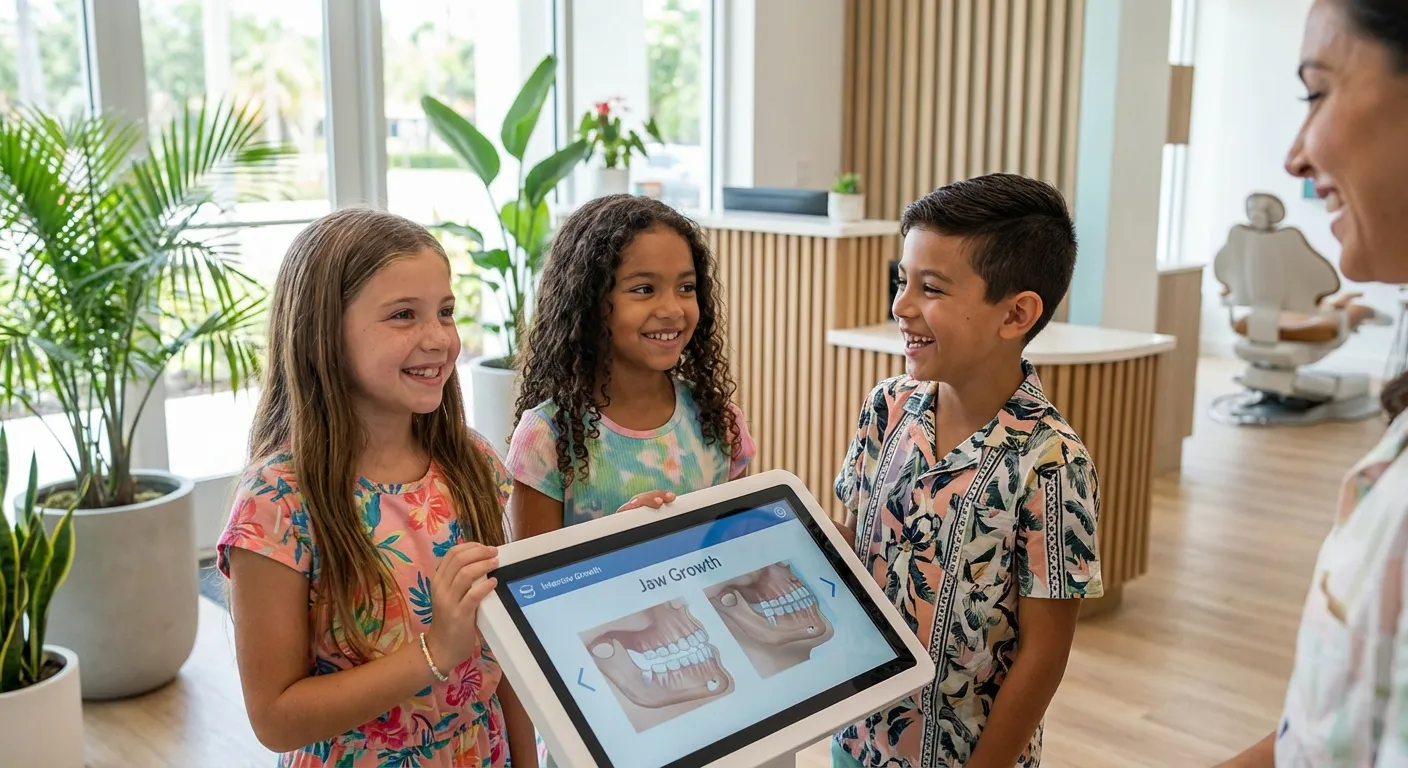
Early Orthodontics for Kids Ages 6-10: What Every Miramar Parent Should Know
Your kid's teeth are coming in all weird.
Maybe they're crowded, or their bite looks off, or they're still sucking their thumb at seven years old.
And now you're wondering: do they need braces? Should I wait? Is this even a real problem, or am I overthinking it?
The honest answer is that you're not alone in feeling confused about this stuff.
Most parents don't know when to start worrying about their child's teeth, and the internet doesn't help because you get mixed messages everywhere.
One site says "wait until they're a teenager," another says "get them checked by age seven," and then there's the one that makes it sound like your kid will need surgery if you don't act now.
So here's what I want to do: walk you through what Phase 1 orthodontics actually is, when it actually matters, and how to tell if your kid is a good fit for early treatment.
By the end of this, you'll have a clear picture of what to look for, what questions to ask, and most importantly, you'll stop second-guessing yourself.
What Is Phase 1 Orthodontics Really?
Phase 1 orthodontics goes by another name: interceptive treatment.
Fancy word, simple idea.
It's orthodontic care you do while your kid still has baby teeth.
The whole point is to get ahead of problems before they become big problems.
Think of it like this: if you catch a small leak in your roof now, you patch it and move on. If you ignore it for five years, you're ripping out drywall and replacing joists.
Same logic applies to teeth and jaws.
Here's what Phase 1 actually tries to do:
- Create enough space so adult teeth can come in straight without crowding
- Guide jaw growth while it's still soft and responsive to gentle pressure
- Fix bite problems (crossbites, open bites, overbites) that mess with how your kid chews or talks
- Stop habits like thumb sucking or tongue thrusting that can shape the jaw the wrong way
- Reduce the chance your kid needs extractions, jaw surgery, or complicated braces later
The American Association of Orthodontists (AAO) recommends every kid get an orthodontic checkup by age seven.
This doesn't mean braces for everyone.
It means getting expert eyes on your kid's mouth so you actually know what's going on instead of guessing.
Why Age Seven Is the Sweet Spot (Not a Sales Tactic)
Around age seven, something useful happens in your kid's mouth.
They've got a mix of baby teeth and permanent teeth coming in.
That in-between stage gives an orthodontic specialist a real window into how things are developing.
You can actually see:
- How the upper and lower jaws are growing relative to each other
- Whether there's physically enough room for all the adult teeth
- How the bite lines up (or doesn't)
- What habits are affecting growth, like mouth breathing or thumb sucking
The real value here is that you get information.
Maybe your kid's jaw growth looks perfect and there's nothing to worry about.
Maybe there's a small crossbite that will likely self-correct as more teeth come in.
Or maybe there's something worth addressing now because waiting five years makes it much harder to fix.
A good orthodontist will tell you the truth, even if the truth is "let's just watch this and check in again in six months."
That "not yet" answer builds trust because it means the doctor isn't just selling you something.
The Signs Your Kid Might Benefit from Phase 1 Treatment
You don't need a dental degree to spot some of these issues.
If any of these look familiar, it's worth getting a professional opinion:
- Teeth crowding - Baby teeth or adult teeth are overlapping, twisted, or fighting for space
- Crossbite - Some upper teeth bite inside the lower teeth when they close (common and worth fixing early)
- Open bite - Front teeth don't touch at all when the mouth is closed, often from thumb sucking or tongue habits
- Mouth breathing - Your kid's mouth hangs open most of the day, they snore, or they can't seem to breathe through their nose
- Thumb or finger sucking past age five - Especially if it's strong or happening all day
- Teeth sticking way out - Upper front teeth that protrude and make them vulnerable to getting knocked out during sports or play
- Baby teeth falling out too early or too late - When timing is way off compared to other kids their age
- Chewing or speech problems - Difficulty biting into food or their speech sounds off because of how their teeth are positioned
One sign doesn't automatically mean "your kid needs braces tomorrow."
But it does mean you deserve a real evaluation from someone who knows what they're looking at.
What Happens When You Bring Your Kid In for Phase 1
The first visit should feel different from an adult dental appointment.
It should feel like a friendly consultation, not a scary medical procedure.
Here's what a solid Phase 1 evaluation looks like at SMILE-FX:
- Welcome and comfort first - Your kid gets checked in, shown around, offered snacks and water. They see games, TVs, and VIP suites. No rushing them into a chair immediately.
- Comfort options - They can pick what to watch, use noise-canceling headphones if loud sounds bother them, or grab a weighted blanket. We're thinking about their comfort, not just the appointment.
- Photos and X-rays (only when needed) - We take digital photos and low-dose digital X-rays if clinically justified. Everything is explained in language your kid understands.
- Gentle examination - The orthodontist looks at teeth, jaws, bite, and any habits. No poking or roughness.
- Real conversation - We talk with your kid, not at them. They ask questions. You ask questions. There's no surprises at the end.
- Clear plan - You leave with either a monitoring schedule or a step-by-step treatment roadmap. Everything is written down.
Most Phase 1 consultations at SMILE-FX come with no charge.
We believe you should get real answers before committing to anything.
When "Not Yet" Is the Right Answer
Here's something most people don't realize about Phase 1 orthodontics: the best decision is often to do nothing right now.
A lot of kids we see in Miramar and Broward get put on a simple growth-monitoring program instead of getting braces or appliances.
That's not lazy orthodontics.
That's smart orthodontics.
We'll recommend waiting and monitoring when:
- Your kid's bite and jaw growth look healthy and normal
- There's mild crowding that will probably sort itself out in the teen years
- Habits like thumb sucking are improving on their own
- The benefits of early treatment don't clearly outweigh the cost, time, and hassle
We document what we see today, schedule check-ins every six or twelve months, and only start treatment if something actually changes.
That's why parents trust us: we're not filling chairs just to fill them.
The Actual Treatment Options for Phase 1
Not every kid in Phase 1 needs the same thing.
And not every kid needs appliances at all.
When treatment is actually recommended, we stick to tools that work:
- Palatal expanders - These gently widen the upper jaw to create space for teeth coming in. They work best when the jaw is still developing.
- Partial braces - Not full mouth braces. Just brackets and wires on the teeth that need help, usually targeting a crossbite or severe crowding in one area.
- Habit appliances - If thumb sucking or tongue thrusting is actively shaping the jaw wrong, these gentle reminders help kids break the habit.
- Guided eruption planning - Using 3D imaging, we map out how adult teeth are coming in and sometimes guide their path so they erupt more naturally.
We always try to time Phase 1 so it fits with school, sports, and your family's life.
And if your kid later needs Phase 2 treatment as a teenager (like full braces or clear aligners), the work we did early makes that phase shorter, easier, and more predictable.
Why SMILE-FX Stands Out for Phase 1 Orthodontics
Miramar and Broward have options when it comes to orthodontics.
You can see a general dentist who "also does braces," you can go to a discount chain, or you can work with an actual specialist.
For Phase 1 especially, where you're literally shaping how your child's jaws grow, that difference matters a lot.
SMILE-FX is different because:
- Our doctors are board-certified orthodontic specialists. This isn't a side service. Every doctor here finished dental school, then spent three more years in orthodontic training, then passed board certification. That's a real credential.
- We're the referral choice for pediatric dentists across South Florida. When pediatric dentists trust us with their patients, that says something about how we treat young kids.
- The whole environment is built for kids, not adapted from an adult office. VR headsets, games, weighted blankets, VIP private suites, noise-canceling headphones. We thought through sensory comfort, not just teeth.
- We use 3D imaging and growth prediction tools. That means better decisions based on data, not guesses. Check out our cutting-edge technology page to see what we're using.
- Scheduling actually works with your life. After-school appointments, Saturday options, and virtual check-ins for routine progress reviews. School and sports don't have to stop.
- You get transparency at every step. We explain the "why" behind each recommendation. You know what happens if you wait. You know how Phase 1 connects to Phase 2. No surprises.
Parents from Pembroke Pines, Hollywood, Weston, Cooper City, Davie, and Fort Lauderdale often drive past other offices to work with us.
That's not accident.
That's because word gets out when you're doing something right.
Making Phase 1 Work With Your Family's Schedule
SMILE-FX is located in Miramar, right near I-75 and the Florida Turnpike.
That means getting here from anywhere in Broward is pretty straightforward:
- From Pembroke Pines - About 10 to 20 minutes depending on which side of town you're on. Easy stop on the way home from school.
- From Hollywood - Around 20 to 30 minutes via the Turnpike. Many families book afternoon or early evening slots.
- From Weston - Maybe 20 to 25 minutes along I-75. Lots of Weston families stack their kids' appointments together to save trips.
- From Cooper City or Davie - About 15 to 25 minutes. Works well for families juggling sports and activities.
- From Fort Lauderdale - Usually 25 to 35 minutes, depending on traffic. Many parents pair orthodontic visits with other West Broward errands.
Our Miramar location page has a map and directions if you want to see exactly where we are.
Common Questions Parents Ask About Phase 1
Does my seven-year-old actually need braces right now?
Not usually.
Most seven to ten year olds we see get monitored with periodic check-ins.
We only recommend early treatment when it genuinely improves long-term health, function, or makes the teen phase simpler.
And we'll show you exactly why if we do recommend it.
Is early treatment just a way to make more money by doing two phases?
Not the way we do it.
Phase 1 only makes sense if it actually reduces risk, improves how your kid chews or speaks, or simplifies what happens later.
If we can wait and treat everything in one phase as a teenager, we'll tell you that straight.
What does Phase 1 orthodontics actually cost?
It depends on what your kid needs.
An expander costs different than partial braces.
A simple monitoring plan costs different than active treatment.
We're transparent about fees, insurance benefits, and payment plans from day one.
Does doing Phase 1 now mean less work as a teenager?
Often yes.
Phase 1 can shorten Phase 2, help you avoid pulling teeth, or make teen braces or clear aligners much simpler.
Sometimes the benefit is just protecting teeth and jaws now, even if your teen still needs treatment later.
Are X-rays safe for my kid?
We use low-dose digital X-rays and only take CBCT scans when clinically justified.
We follow strict safety protocols and AAO guidelines.
Your kid gets the information they need with the least radiation possible.
What's Next: Getting Your Kid Evaluated
If your child is between six and ten years old, or you're noticing crowding, crossbite, mouth breathing, or thumb sucking that's stuck around, you don't need to diagnose it yourself.
You just need a real specialist to walk you through it.
SMILE-FX works with families from Miramar, Pembroke Pines, Hollywood, Weston, Cooper City, Davie, Fort Lauderdale, and across South Florida who want the best for their kids.
Families who are willing to go a little farther to get truly expert, kid-centered care.
Book a FREE 3D scan and VIP smile consultation here.
One visit replaces hours of Googling and second-guessing with a real plan for your kid's smile and growth.
Want to learn more about what makes SMILE-FX different?
Check out how we're different or read about why we're board-certified specialists.
Or if your kid is older and might need Phase 1 orthodontics now, we can talk about braces and what happens next.
Wherever your kid is on their orthodontic journey, we're here to make it calmer, clearer, and genuinely kid-first.
Teen and Adult Orthodontics: Beyond Phase 2 Braces and Clear Aligners in South Florida
Your kid's not a kid anymore.
They're a teenager now, and if they didn't get Phase 1 treatment, or if Phase 1 is done and Phase 2 is next, you're probably wondering what comes after early intervention.
Or maybe you're an adult who never got braces and you're tired of hiding your smile in photos.
Either way, you're looking at options.
Metal braces feel like the only choice.
Clear aligners sound fancy but you're not sure if they actually work.
You've heard horror stories about treatment taking forever or costing a fortune.
The truth is simpler than you think.
You have real options now, and the technology is way better than it was even five years ago.
Phase 2 Orthodontic Treatment: What Happens After Early Intervention
If your kid went through Phase 1, Phase 2 usually starts around age eleven or twelve.
Sometimes it's earlier, sometimes later, depending on how their permanent teeth came in.
The goal of Phase 2 is straightforward: get all the teeth perfectly straight and make sure the bite works right.
It's the finishing work after Phase 1 set the foundation.
Here's what's different about Phase 2 compared to Phase 1:
- Almost all permanent teeth are in now, so we can see the full picture
- Treatment usually takes longer because we're dealing with fully grown teeth
- The results are more dramatic because we're making bigger corrections
- We're not just guiding growth anymore, we're actively moving teeth into perfect position
If your kid didn't get Phase 1 treatment, Phase 2 becomes the main event.
We start from scratch and do everything in one phase, which is fine.
It just means treatment might take a bit longer or be slightly more involved than if we'd caught things early.
That's not a judgment, it's just how teeth work.
Braces for Teens: Still a Solid Choice Despite What Your Kid Says
Metal braces for teenagers get a bad rap.
Your teen thinks they're going to look like they belong in a 1990s sitcom.
The reality is different.
Modern braces are smaller, cleaner, and way less noticeable than the chunky brackets from twenty years ago.
They're also the most predictable option.
We know exactly how they work, how fast they move teeth, and what the result will look like.
Braces work because they apply constant, gentle pressure to teeth over time.
That pressure moves the tooth root and crown into the right position.
It's biology, not magic.
Here's what makes teen braces worth considering:
- Highly effective for complex bite problems and severe crowding
- No patient compliance needed, unlike aligners that kids have to remember to wear
- Faster results in some cases because the pressure is always on
- Less expensive upfront than clear aligners
- Work well even if your teen is in sports because they stay put
The catch is that your teen has to keep them clean.
Food gets stuck, plaque builds up, and if they don't brush and floss well, they end up with cavities.
That's not a braces problem, that's a hygiene problem.
Any teenager can handle it if they actually care about their smile.
Clear Aligners for Teens: What Invisalign and Similar Options Actually Deliver
Clear aligners for teens changed the game.
They look like thin plastic trays that fit over your teeth.
You change them out every week or two, and your teeth gradually move into position.
They're almost invisible, which is why they're called "clear aligners" and why your teen probably wants them.
The most famous brand is Invisalign, but there are other good options too.
The big advantage is obvious: nobody can see them.
Your teen doesn't feel self-conscious.
They can smile in photos without thinking about it.
That matters more to teenagers than parents realize.
But here's what you need to know about clear aligners for teenagers:
- They only work if your teen actually wears them 20-22 hours per day
- They're not great for complex bite problems or severe crowding
- They can't apply as much force as braces, so some movements take longer
- If your teen removes them constantly, treatment stalls
- They cost more upfront than traditional braces
- Your teen has to be responsible about cleaning them and keeping track of them
Clear aligners work amazingly well for teens who are mature enough to follow through.
If your teen is the type who loses their phone every other week, braces might be the safer bet.
We can help you figure out which option fits your kid's personality and your situation.
Adult Orthodontics: You're Not Too Old, and It's Never Too Late
Adults make up about 25 percent of our patients at SMILE-FX.
Some are parents who finally decided to fix their own smiles after helping their kids get braces.
Some spent thirty years thinking they were stuck with crooked teeth.
Some had braces as kids and their teeth shifted back over time.
The point is that adult braces are a real thing, and they work just as well at thirty-five as they do at thirteen.
Your teeth don't care how old you are.
They still respond to gentle pressure and move into position over time.
What's different about adult orthodontics is that we have to be careful about your jawbone and any existing dental work.
If you've got bridges, implants, or significant bone loss, we adjust the plan.
But most adults are good candidates.
Why Adults Choose Clear Aligners Over Braces
If you're an adult thinking about straightening your teeth, Invisalign for adults probably seems more appealing than metal braces.
And honestly, for adults, they usually are.
You've got work meetings, social events, and you don't want your orthodontia to be the first thing people notice about you.
Clear aligners let you straighten your teeth without announcing it to everyone.
You can take them out for important meetings or photos, pop them back in, and nobody has to know.
That flexibility matters when you're an adult.
Many adults also appreciate that clear aligners feel less dramatic than braces.
You're not changing your appearance overnight.
The shift is gradual, and you control how much of the process you show the world.
The same compliance rules apply though.
You have to wear them 20-22 hours a day for them to work.
If you're willing to do that, results are excellent and treatment is straightforward.
Bite Problems That Need Treatment No Matter Your Age
Some orthodontic problems aren't just cosmetic.
They affect how you chew, talk, and your long-term dental health.
These problems don't get better with time.
They usually get worse.
Understanding what we call treatable orthodontic cases helps you know if you're dealing with something that needs attention:
- Overbite: upper teeth stick way out in front of lower teeth, making you bite down on your lower gum
- Underbite: lower teeth stick out in front of upper teeth, affecting how you chew
- Crossbite: some upper teeth bite inside lower teeth, causing uneven wear and jaw problems
- Open bite: front teeth don't touch when you close your mouth, affecting chewing and speech
- Crowding: teeth are twisted and overlapping, making them hard to clean and more prone to decay
- Spacing: gaps between teeth that can trap food and affect your bite
Any of these get worse over time if you don't address them.
Crooked teeth get harder to clean, which leads to decay.
Bad bites put stress on your jaw joint, which leads to pain.
Spacing lets food get trapped constantly.
The point is this: straightening your teeth isn't just vanity.
It's good dental health.
Technology That Makes Treatment Faster and More Predictable
One reason treatment works better now than it used to is technology.
We use 3D imaging and digital planning to map out exactly where your teeth are going before we even start.
You can see a digital preview of what your smile will look like months before treatment ends.
Check out our cutting-edge technology page to see what we're working with.
This changes everything about how we treat you.
Instead of guessing based on experience, we have data.
We know your tooth anatomy, your bone density, how your jaw is positioned, and what forces will work best for your specific teeth.
That means faster treatment, better results, and fewer surprises.
Digital planning also means we can show you exactly what's happening at each stage.
You're not wondering if you're making progress.
You can literally see it.
How Long Does Orthodontic Treatment Actually Take
This is one of the biggest questions we get.
The honest answer is: it depends.
For mild crowding or spacing, you might be looking at twelve to eighteen months.
For moderate cases, eighteen to twenty-four months is typical.
For complex bite problems or severe crowding, you might need twenty-four to thirty-six months.
Age matters, but not the way you think.
Teenagers' bones are softer and more responsive, so teeth move a bit faster.
Adults' bones are denser, so movement is slightly slower.
But the difference isn't huge.
The bigger factor is how much movement is needed.
Moving one tooth a quarter inch takes weeks.
Rotating a tooth and moving it half an inch takes months.
Moving ten teeth into perfect position takes even longer.
We also break treatment into phases sometimes because it works better and keeps costs down.
Early phases focus on one problem, later phases focus on fine-tuning.
This isn't us stretching out treatment to charge more.
It's actually how biology works best.
Cost and Payment: What Orthodontic Treatment Actually Runs
Orthodontic treatment costs vary based on what you need.
Traditional braces cost somewhere between three thousand and seven thousand dollars depending on complexity and duration.
Clear aligners typically run between four thousand and eight thousand dollars.
Simple cases are cheaper.
Complex cases are more expensive.
That's just how it works.
Most insurance covers about fifty percent of orthodontic treatment, up to a certain limit.
We'll check your coverage and explain exactly what you owe before you start.
We offer payment plans so you're not paying the whole thing upfront.
Many families do monthly payments over the course of treatment, which spreads the cost out.
Some people are shocked by the price until they break it down.
You're paying a specialist doctor, using advanced technology, making monthly adjustments, and investing two to three years in a result that lasts your whole life.
That's different than a one-time service.
It's an ongoing process with a real impact.
What Happens After Treatment Ends: Retainers and Keeping Your Results
Here's the part people don't always hear about: treatment doesn't actually end when your braces come off or your aligners finish.
Your teeth want to move back to where they came from.
That's just tooth biology.
To keep your teeth straight, you need a retainer.
Some people wear a fixed wire retainer bonded to the back of their teeth permanently.
Some people wear a clear plastic retainer at night, similar to aligners.
Most people do both for a while, then switch to just the night retainer.
The first few months after treatment, you wear your retainer pretty much full-time.
After a year or so, wearing it just at night usually keeps your teeth straight.
Skip the retainer for a couple of months and your teeth start shifting.
Skip it for a year and you might end up right back where you started.
It's not complicated, but it's important.
Think of it like keeping your car tuned up.
You don't tune it up once and expect it to run perfectly forever.
Same with your teeth.
Real Questions About Orthodontic Treatment
Will braces or aligners hurt?
Your teeth might feel sore for a day or two after adjustments, kind of like a dull ache.
It's not sharp pain.
It goes away.
Aligners usually feel less uncomfortable than braces because they apply gentler pressure.
Can I play sports with braces or aligners?
Yes to both.
With braces, we recommend a mouthguard to protect your teeth and lips.
With aligners, take them out during contact sports and wear a mouthguard.
Athletes do both all the time.
Will my teeth feel different after treatment?
They'll feel different for a little while because your bite is actually different now.
But your mouth adjusts quickly, usually within a week or two.
What if I lose an aligner or a bracket breaks?
Call us and come in.
We can fix it fast.
Losing one aligner isn't a disaster if you catch it quickly.
A broken bracket is a minor setback, not a big deal.
Can I brush and floss normally with braces?
Yes, but you need to be more careful.
You brush and floss just like normal, but you have to get around the brackets and wires.
It takes a bit longer, but it's not hard.
With aligners, you take them out to eat and brush, so it's actually easier.
Choosing Between Braces and Clear Aligners: What Actually Matters
The choice between traditional braces and clear aligners comes down to a few real factors:
How complex is your case?
Braces can handle anything.
Aligners work best for mild to moderate cases.
How important is appearance?
If looking invisible during treatment matters to you, aligners win.
If you don't care what's in your mouth, braces are fine.
How responsible are you about following instructions?
Aligners need to be worn constantly.
Braces work whether you like it or not.
How much are you willing to spend?
Braces are usually cheaper.
Aligners cost more upfront but might be worth it for the lifestyle benefit.
The good news is you don't have to decide alone.
We look at your specific teeth and your specific life, and we recommend what actually makes sense for you.
Why SMILE-FX for Your Teen or Adult Orthodontic Needs
You could go anywhere for braces or clear aligners.
You could go to a general dentist who does orthodontics on the side.
You could go to a discount chain that pushes volume.
You could go to any orthodontist in South Florida.
Here's why families and adults from across Broward County choose SMILE-FX instead:
Our team includes board-certified orthodontic specialists.
This isn't part-time work for us.
We've spent years training specifically in orthodontics.
We know complex cases inside and out.
We treat everyone like they matter, not like a number in a chair.
Your appointment isn't rushed.
We talk through options with you, we explain the why behind recommendations, and we answer all your questions.
We use advanced digital technology that gives you a clear picture of what's happening and what comes next.
Our office is comfortable and designed for real people, not just teeth.
We offer flexible scheduling with after-school and weekend options.
We work with your insurance and set up payment plans that actually work with your budget.
We're transparent about everything from day one.
No surprises, no hidden costs, no pressure.
Getting Started With Your Teen or Adult Orthodontics
If you're a parent of a teenager who needs Phase 2 treatment or full orthodontics, or if you're an adult who wants to finally get your smile right, the first step is the same.
Get evaluated by someone who actually knows what they're doing.
A 3D smile scan shows exactly what we're working with.
Digital photos and imaging show how your teeth are positioned and how they need to move.
We can even show you a preview of what your smile could look like after treatment.
Check out our treatable cases page to see the kinds of problems we handle regularly.
Or learn more about other treatment options beyond standard braces and aligners.
SMILE-FX serves families and adults from Miramar, Pembroke Pines, Hollywood, Weston, Cooper City, Davie, Fort Lauderdale, and across South Florida.
Whether you're a parent wanting the best for your teenager or an adult who's ready to fix your smile, we're here to make it real.
Book a FREE 3D scan and VIP smile consultation here.
No pressure, no obligation, just real answers about what your orthodontic options actually are.
One consultation replaces weeks of wondering with a clear plan for straightening teeth with teen braces, adult orthodontics, clear aligners, or whatever option works best for your life.
The Real Difference Between Budget Braces and Board-Certified Orthodontist Care in South Florida
You're scrolling through ads for braces in South Florida and you see them everywhere.
Cheap braces.
Discount orthodontists.
$0 down financing.
Bright signs promising affordable braces in Broward, affordable braces in Miramar, affordable braces West Palm Beach.
Your first thought is probably: why would I pay more?
That's a fair question.
But here's what most people don't understand about orthodontic care: the cheapest option usually costs more in the long run.
Not in dollars.
In time, frustration, and results that don't match what you were promised.
What You're Actually Paying For When You Choose a Board-Certified Orthodontist
There's a massive difference between a general dentist who does braces and a board-certified orthodontist.
That difference matters way more than price tags.
A general dentist goes to dental school for four years.
An orthodontist goes to dental school for four years, then spends three additional years training specifically in moving teeth and correcting bites.
Then they pass board certification exams that are brutal.
That's not gatekeeping.
That's expertise.
When you work with a true board-certified specialist, you're paying for:
- Doctors who've spent thousands of hours on orthodontics alone
- Knowledge of how to handle complex cases that general dentists would mess up
- Access to advanced technology that shows exactly what's happening with your teeth
- Experience knowing which problems need treatment now and which can wait
- The ability to spot complications early before they become expensive problems
A best orthodontist near me search might pull up discount chains, but you're comparing apples to oranges if you're looking at specialists versus generalists.
Why Cheap Braces Often Mean Longer Treatment
This is where the math gets real.
A discount chain quotes you $2,500 for braces.
A board-certified orthodontist quotes you $4,500.
You pick the cheap option.
But six months in, something's not tracking right.
Your bite didn't improve like it should have.
Your teeth are moving, but not in the right direction.
Now what?
You're either stuck paying more to fix it, or you accept a mediocre result.
Meanwhile, a specialist would have caught this problem in the first month and adjusted the plan.
Here's what happens with budget braces:
- Treatment takes longer because the plan wasn't right from the start
- You spend more total time in treatment, which means more appointments
- Your final result might look decent cosmetically but your bite still feels off
- You might need additional treatment later to fix what went wrong
- Your teeth could end up with root damage from incorrect force
The best orthodontist for complex cases gets hired because they prevent these problems.
They see the issue before it becomes catastrophic.
What Board-Certified Means and Why It Actually Matters
You see "board-certified" thrown around a lot, but not all certifications are the same.
Being board-certified orthodontist South Florida specialists means passing exams that test your actual ability to treat patients properly.
It's not just a credential to hang on the wall.
It's proof that someone with authority in the field checked your work and said you know your stuff.
Compare that to someone who took a weekend course on straightening teeth.
No comparison.
Board certification also means continuing education.
Certified orthodontists have to keep learning to keep their certification.
We stay current on new technology, new techniques, and emerging research.
That's not optional.
It's required.
When you choose a board-certified specialist, you're choosing someone who's actively staying sharp.
SureSmile Technology and What Modern Orthodontists Actually Use
This is where the gap between cheap braces and real orthodontia shows up.
Modern offices use SureSmile orthodontist South Florida systems and other digital planning tools.
Budget operations use standard braces and hope for the best.
Here's what you're missing without proper technology:
Digital planning lets us see your exact tooth anatomy before we even start treatment.
We map out where each tooth is now and where it needs to go.
We build a treatment plan based on data, not guesses.
You can see a preview of your smile before treatment even begins.
That's not just cool.
That's precision.
Check out our cutting-edge technology page to see what actual modern orthodontics looks like.
Budget practices are still using techniques from ten years ago.
They're doing the job, sort of, but they're doing it blind compared to what's available now.
Insurance Coverage Doesn't Care About Your Budget Choice
Here's something insurance companies won't tell you directly but it's true: they cover necessary treatment.
If your orthodontist recommends a treatment plan, your insurance covers fifty percent up to a limit.
That coverage applies whether you're at a budget chain or a specialist.
But here's the catch.
If your budget orthodontist's plan doesn't actually work and you need additional treatment, insurance often won't cover it because they'll classify it as corrective work, not initial treatment.
Now you're paying full price for the fix.
A specialist's plan is so well designed that this rarely happens.
Insurance companies trust board-certified orthodontists because their treatment plans work.
When you see a top rated orthodontist near me who's actual board-certified, the insurance process is smoother, the coverage is clearer, and you don't end up with surprise costs.
We explain exactly what your insurance covers and what you pay before you start.
No surprises.
The Real Cost of Getting Braces in South Florida
So what does it actually cost to get your teeth straight from a real specialist?
Braces run between three thousand and seven thousand depending on complexity.
Clear aligners run between four thousand and eight thousand.
That's not cheap, but here's the thing.
You're paying for a two to three year process with dozens of appointments, adjustments, and a result that lasts your whole life.
Break that down per month and it's usually less than a car payment.
And unlike a car, your teeth are something you use every single day.
Budget braces might be cheaper upfront, but when you factor in the possibility of extended treatment, additional appointments, or needing corrective work later, the total cost gets fuzzy.
Specialist treatment costs more upfront but the total cost is usually actually lower because treatment works right the first time.
We offer payment plans and work with insurance to make it manageable.
Most families do monthly payments spread across treatment, which keeps it from feeling overwhelming.
Why Adults Choose Specialists Over Budget Options
Adults have a different calculation than teenagers.
As an adult, your time matters.
You can't afford to have treatment take six months longer than promised.
You can't afford complications.
You want the process smooth and professional.
That's why orthodontics for adults Miami and across South Florida increasingly means going to specialists, not budget chains.
Adults pay a bit more specifically because they want it done right.
They want clear aligners that actually move teeth predictably, not aligners that sort of work.
They want best orthodontist Miami level care, not discount care.
Budget providers know this, which is why they focus on teenagers and kids.
Their marketing targets families who are price-sensitive.
Specialists work with everyone, but they focus on delivering results that justify the cost.
What Happens When Budget Braces Go Wrong
I've seen the fallout.
Someone gets cheap braces, treatment doesn't go right, and now they're stuck.
Their teeth are partially moved in the wrong direction.
The orthodontist who did the initial work either can't figure out how to fix it or won't fix it without more money.
Now they have to start over somewhere else and explain the whole mess.
A specialist office has to pick up the pieces.
Sometimes that's fixable.
Sometimes it's complicated and takes longer than if we'd done it right initially.
The patient ends up spending way more money and way more time than they would have if they'd just gone to a specialist at the start.
This is why best orthodontist South Florida searches should focus on credentials, not just price.
Finding Real Quality Without Breaking the Bank
You don't have to choose between budget and quality if you know what to look for.
Ask these questions before you commit:
- Is the orthodontist board-certified or board-eligible?
- Do they use digital 3D imaging or are they still using old X-rays?
- Can they show you a digital preview of your results?
- Are they willing to explain the treatment plan in detail?
- What's their experience with cases like yours?
- Do they work with your insurance?
- Are they upfront about the total cost or do hidden fees appear later?
A real specialist will answer all of these questions clearly.
A budget operation will get vague on some of them.
Check patient reviews too.
Not just the rating, but the actual words people use.
Do they mention long wait times?
Do they say the doctor rushed?
Do they mention unexpected costs?
Or do they talk about feeling heard, seeing results, and being treated like an actual person?
Read what actual patients say about their experience.
That tells you more than any marketing copy.
The Bottom Line About Cost and Quality in South Florida Orthodontics
You can get affordable braces South Florida and great quality at the same time, but you have to be smart about what you're paying for.
The cheapest option almost always costs more in the end because it doesn't work right the first time.
A board-certified specialist costs more upfront because the plan is solid and execution is flawless.
That's just how it works.
Whether you're looking for braces near me or clear aligners, whether you're a teenager or an adult, the decision comes down to one question: do you want to fix your teeth or do you want to save money on fixing your teeth?
If you want to fix your teeth, go to a specialist.
If you want to save money, you might end up spending more later fixing the mistakes.
SMILE-FX is a top rated orthodontist Miramar and across South Florida because we deliver real results with board-certified orthodontist expertise and cutting-edge technology.
We work with insurance and offer flexible payment plans so cost isn't an excuse for choosing mediocre care.
We're transparent about price from day one.
No surprises.
No hidden fees.
Just honest orthodontics.
Book a FREE 3D scan and VIP smile consultation here and see what real specialist care actually looks like.
Compare us to the budget options if you want.
The difference will be obvious.