
Early Orthodontics for Pembroke Pines Kids Ages 6-10
Your kid comes home from school and you notice their teeth are starting to crowd or sit a little crooked.
Maybe their jaw looks misaligned.
Your gut tells you something's off, but you're not sure if it's time to call an orthodontist or if waiting makes more sense.
Here's what most parents in Pembroke Pines don't realize: catching these issues early can change everything about your child's smile and mouth health down the road.
We're talking about Phase 1 orthodontics, and honestly, it's one of the smartest moves you can make between ages 6 and 10.
What Phase 1 Orthodontics Actually Does
Phase 1 isn't about slapping braces on a six year old and calling it a day.
It's interceptive care, meaning we're stepping in early to guide how your child's jaw grows and how their adult teeth come in.
Think of it like steering a ship before it hits rough waters instead of trying to turn it around after.
The American Association of Orthodontists recommends that every kid gets checked by age 7.
Why seven?
Because that's usually when most of your child's baby teeth are in place, and we can spot real problems like crowding, crossbites, or other alignment issues before they become expensive headaches later.
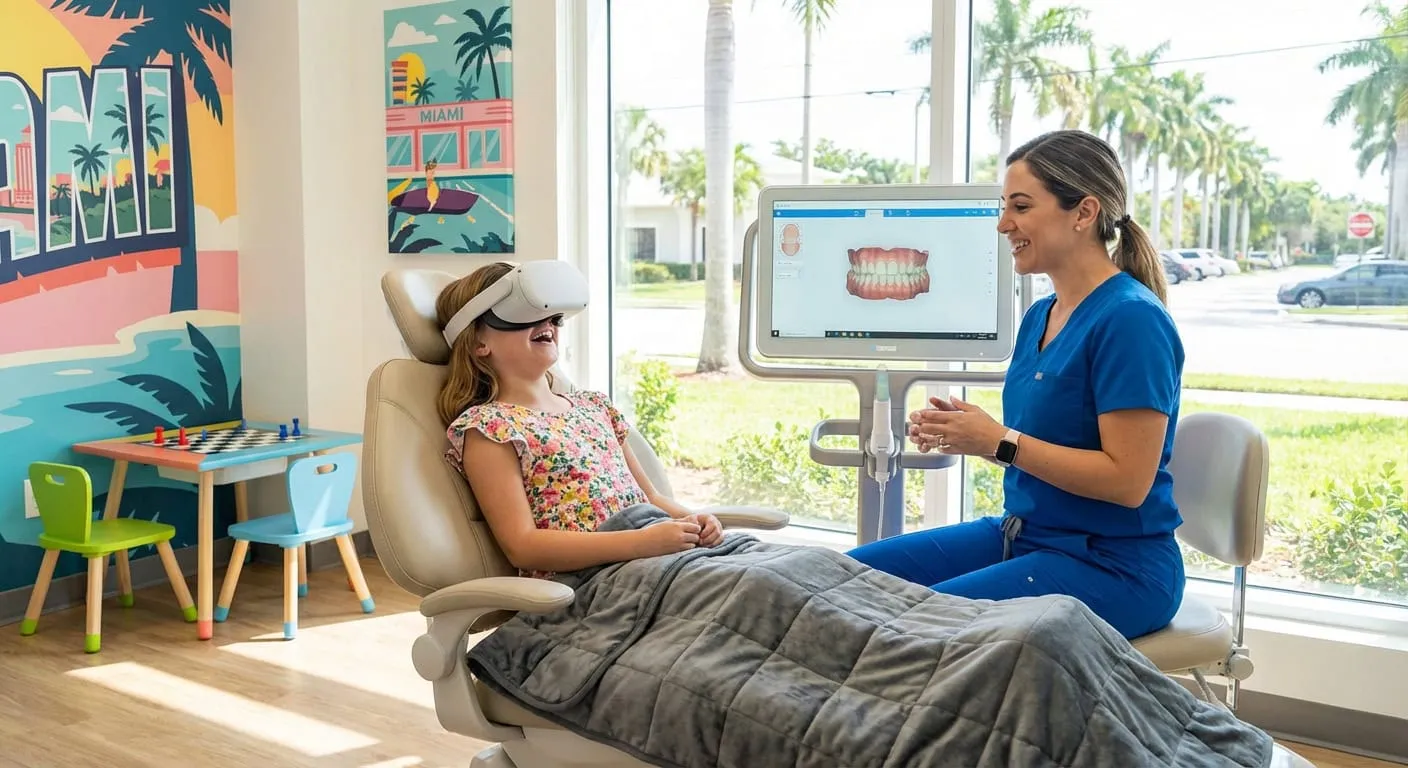
At SMILE-FX Orthodontics, we use cutting-edge digital scanners and low-dose imaging to see exactly what's happening with your kid's mouth and jaw development.
No gooey molds.
No stress.
Just clear answers about whether your child needs help.
The Real Signs Your Child Might Need Phase 1 Treatment
Not every kid needs early orthodontics, but some kids absolutely benefit from it.
Here's what to watch for:
Crowding: Teeth overlapping or not fitting right in the mouth.
We can create space naturally using expanders and other appliances so adult teeth have room to come in straight.
Crossbite: When the upper and lower jaws don't line up properly.
A palatal expander can fix this comfortably without any pain or drama.
Mouth breathing: If your kid keeps their mouth open at rest instead of breathing through their nose, that's a sign their jaw or airway might need attention.
We partner with ENTs when needed to get the full picture.
Thumb sucking that won't quit: If your kid is still going at it past age five or six, gentle appliances encourage them to stop naturally, which prevents long-term damage to their bite.
Underbites or overbites: When one jaw is too far forward or back, early intervention can prevent the need for surgery later.
That's the kind of outcome that matters.
Why Pembroke Pines Families Trust SMILE-FX for Phase 1 Care
You're only 15 to 20 minutes from our Miramar location, straight off I-75 or Pines Boulevard.
Not far at all.
But location isn't the real reason families choose us.
Our board-certified orthodontists specialize in kids.
That's it.
Not general dentists who do braces on the side.
Not mills that treat every kid the same way.
We actually know what we're doing with children.
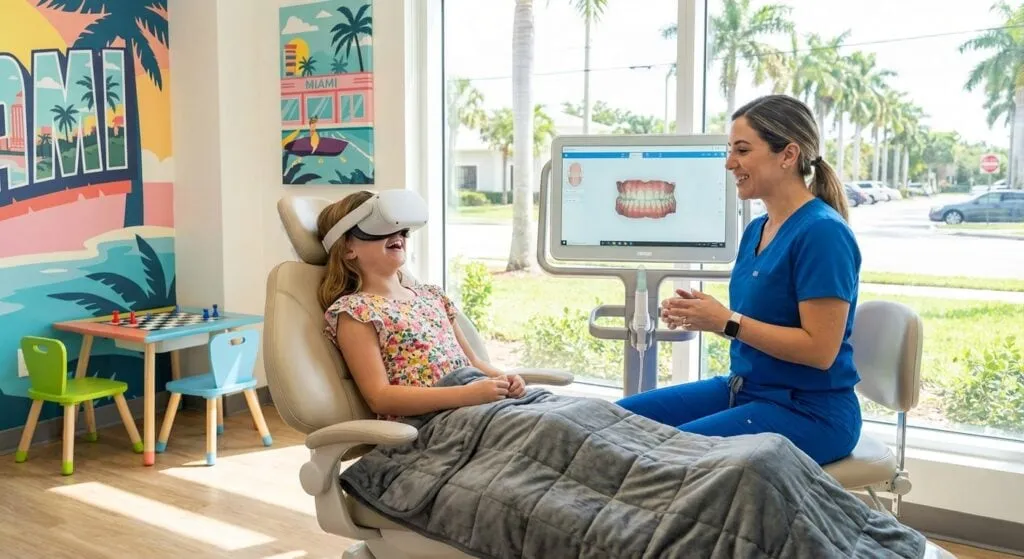
We have a VIP suite, noise-canceling headphones, weighted blankets, and games to keep kids calm and happy.
Your appointment takes 30 to 45 minutes, and we schedule around school pickups and after-school activities because we get it: you're busy.
We're the #1 trusted partner for South Florida pediatric dentists, which tells you something about our reputation and results.
What Your Child's First Visit Looks Like
Walk in with your seven or eight year old and there's no waiting room stress.
No crowded chairs with twenty families staring at their phones.
We explain everything in simple, age-appropriate language so your child isn't nervous.
We do a quick digital smile scan (no impression mold gunk), and if we need X-rays, we use low-dose technology that's way safer than the old stuff your parents probably remember.
Our staff uses VR distractions and kid-friendly explanations to make the whole thing feel like playtime instead of a dental visit.
Parents tell us they're amazed at how comfortable their kids feel.
That's intentional.
We design our whole process around keeping kids relaxed.
Phase 1 Now vs. Waiting Until Your Kid Is a Teenager
Let's talk real outcomes, because this is where the decision gets serious.
If you wait until your kid is 13 or 14, a few things happen:
More crowding shows up as adult teeth come in.
Your orthodontist might recommend extracting teeth to make room.
Phase 2 braces take longer, usually 18 to 24 months instead of 12 to 18.
In some cases, jaw surgery becomes the only fix.
With Phase 1 at 6 to 10 years old, we guide jaw growth when it's actually happening.
We prevent crowding.
We avoid extractions.
Phase 2 becomes shorter and simpler.
Surgery becomes unnecessary.
The science is clear: earlier intervention means better outcomes and fewer complications.
The Tools We Use for Phase 1 Success
Modern early orthodontic treatment isn't what your parents remember.
We use cutting-edge technology including low-dose CBCT scans that give us a 3D picture of your child's mouth and jaw.
Custom appliances that are barely noticeable.
Digital planning that shows us exactly where your child's teeth and jaw will develop.
Palatal expanders that work gently and comfortably to widen the upper jaw.
Space maintainers that hold room for adult teeth.
Sometimes light braces for specific teeth.
The point is we match the tool to the problem, not vice versa.
Questions Parents Actually Ask About Phase 1
Does my kid really need braces this young? Not always, and that's the honest answer.
About 80 percent of kids benefit from a professional evaluation, but only about 25 percent actually need Phase 1 treatment per guidelines from the American Association of Orthodontists.
We don't push treatment you don't need.
How long does Phase 1 last? It depends on what we're treating, but typically 18 months to three years.
Then there's usually a rest period where we watch growth happen, and then Phase 2 starts when most adult teeth are in.
Will my insurance cover it? Often yes, depending on your plan.
Our team knows Broward area insurance plans inside and out and maximizes your coverage.
What if we don't need treatment? We monitor for free.
No pressure.
No guilt.
Just facts and regular check-ins to watch how your kid's mouth develops.
Is Phase 1 painful? No.
We use gentle forces and custom appliances that feel nothing like traditional braces.
Kids adjust in a few days.
Why Early Intervention Changes the Game
Here's what most people miss: your child's jaw is still growing at ages 6 to 10.
It's plastic and responsive to gentle pressure.
By age 12 or 13, that window starts closing.
Bone gets harder.
Growth slows down.
Fixing problems becomes harder and takes longer.
Phase 1 works because we're guiding growth that's already happening, not fighting against a fully developed jaw structure.
It's the difference between steering and pushing.
And parents in Pembroke Pines get this.
They see the long-term payoff and make the move.
What Makes Us Different in Broward
We're not the same as every orthodontist.
Our team specializes in kids.
We use modern technology and methods that other places haven't adopted.
We schedule around your life, not the other way around.
We're transparent about costs and never push treatment you don't need.
We have real patient reviews from families in your area who trusted us with their kids.
And we make it comfortable, which matters when you're trying to get a seven year old to sit still for treatment.
Ready to Get Your Child Evaluated
You don't have to wonder or worry anymore.
Bring your child in for a free 3D scan and VIP smile consultation.
We'll show you exactly what's happening with their teeth and jaw, explain your options, and answer every question you have.
No pressure to book treatment.
Just clarity and confidence about what comes next for your kid's smile.
Book your free 3D scan and VIP smile consultation here at SMILE-FX Orthodontics.
We serve Pembroke Pines, Miramar, Hollywood, Weston, Cooper City, Davie, Fort Lauderdale, and all of South Florida.
Your child deserves the best early orthodontic care, and we're here to deliver it.
Phase 2 Orthodontics and Beyond: What Happens After Early Treatment for Pembroke Pines Teens
Your kid finished Phase 1 treatment and their smile is looking better.
The palatal expander did its job.
The crowding improved.
But now you're wondering: what's next?
Most parents don't realize that Phase 2 treatment is where the real magic happens for teen orthodontics and the finishing touches that create a confident, straight smile for life.
Here's what you need to know about the next chapter of your child's orthodontic journey.
Understanding Phase 2: The Main Event for Teen Smile Correction
Phase 1 was about creating space and guiding jaw growth.
Phase 2 is about straightening every single tooth and perfecting the bite.
This is where we put braces or clear aligners to work, and it's usually what people think of when they imagine orthodontic treatment.
Most kids start Phase 2 around age 11 to 13, after most of their adult teeth have come in.
The timing matters because we can't effectively straighten teeth that haven't fully erupted yet.
Phase 2 typically lasts 18 to 24 months, though every kid is different.
Some finish in a year.
Others need a bit longer.
The good news is that kids who completed Phase 1 often need shorter Phase 2 treatment than kids who never had early intervention.
That's real money saved and less time with braces.
Braces vs. Clear Aligners: Which Route Works for Your Teen
This is the question every parent asks, and honestly, there's no one right answer.
It depends on your kid's bite problem, how compliant they'll be with the treatment, and what fits your family's lifestyle.
Traditional braces are still the gold standard for complex cases.
They work on every type of bite problem.
Teenagers can't accidentally forget to wear them or lose them.
We can fine-tune the pressure and movement with precision that's hard to beat.
And honestly, they're still the most cost-effective option for most families.
Clear aligners like Invisalign are the modern choice for teens who want less visible treatment.
They're removable, so your kid can eat pizza and brush their teeth normally.
They look almost invisible, which matters when you're in high school or starting college.
But they require discipline: your teenager needs to wear them 20 to 22 hours a day or the treatment stalls.
Some kids crush this.
Others? Not so much.
At SMILE-FX Orthodontics, we help your family pick the right tool based on what we know will actually work for your kid's personality and your household.
We don't push clear aligners on a kid who'll lose them or forget to wear them.
We don't put braces on someone who'll feel self-conscious when clear aligner treatment would change their confidence.
We match the solution to the person.
What Changes for Teens During Phase 2 Treatment
Your teenager's schedule shifts when they start Phase 2.
Appointments happen every 4 to 6 weeks instead of every 6 to 8 weeks like in Phase 1.
Each visit takes 30 to 45 minutes, and we're adjusting wires, changing elastics, or swapping aligner trays to keep things moving.
Your kid might feel soreness or pressure for a few days after each appointment, especially with braces.
This is normal and means the teeth are moving.
Over-the-counter pain relief handles it fine.
With braces, your teen needs to avoid hard, sticky, or crunchy foods that can break brackets or bend wires.
With clear aligners, they can eat anything but have to remember to take the trays out first.
Both options require consistent brushing and flossing, but with braces it takes a bit longer because of the brackets.
We teach your kid the exact technique so they avoid cavities and gum problems during treatment.
The Science Behind Moving Teeth in Phase 2
By the time Phase 2 starts, your teenager's jaw is mostly done growing.
The bone is firmer than it was at age 7 or 8.
This means we can apply stronger, more direct pressure to move teeth without worrying about messing up jaw development.
We're working with biology here, not against it.
Each tooth is attached to the bone by a ligament that's surprisingly flexible.
When we apply steady, gentle pressure over weeks and months, that ligament stretches on one side and the bone actually remodels on the other side.
The tooth moves.
It's not magic, it's science that's been proven for decades.
Our cutting-edge technology lets us see exactly how much pressure we need to apply and when to increase it.
Too much pressure and teeth can get damaged.
Too little and nothing happens.
We nail the sweet spot every time.
Bite Correction: More Than Just Straight Teeth
Here's something most people don't get: Phase 2 isn't just about making teeth line up in a row.
It's about fixing the bite so the upper and lower teeth meet perfectly when your kid closes their mouth.
A bad bite causes problems down the road.
Your teenager might have pain when chewing.
Their teeth wear down unevenly.
Their jaw joint gets stressed.
By fixing the bite now, we're preventing years of dental problems and jaw pain later.
This is why Phase 2 matters so much.
We're not just making your kid look good, we're making sure their mouth functions right for the next 60 years.
Cost Reality: What Phase 2 Actually Runs
Phase 2 treatment is typically more expensive than Phase 1.
You're looking at anywhere from $3,000 to $7,000 depending on the complexity of the case and whether you choose braces or clear aligners.
Clear aligners usually cost more because of the custom manufacturing involved.
But here's the thing: if your kid did Phase 1, the Phase 2 cost often goes down because there's less to fix.
We're not extracting teeth.
We're not dealing with severe crowding.
The treatment is simpler and shorter, which means lower fees.
Most insurance plans cover 50 percent of orthodontic treatment, and many cover Phase 2 more generously than Phase 1.
We work with your insurance to maximize what you get covered.
We also offer payment plans so you're not paying thousands upfront.
Financing makes this affordable for real families with real budgets.
Retention: The Secret to Keeping That Perfect Smile
Here's what nobody talks about: after Phase 2 braces or aligners come off, your kid's teeth want to move back to where they started.
This is called relapse, and it's real.
That's why retention is non-negotiable.
Most teens wear a fixed wire bonded to the back of their lower front teeth full-time.
They also wear a removable retainer at night.
Some kids wear clear retainers full-time for the first year, then switch to night-time only.
The point is retention isn't optional if you want that beautiful smile to stick around.
We send your kid home with detailed instructions and we monitor their retention regularly.
Retainers are way cheaper than going back through braces because your teen didn't wear them.
Trust me on this.
The Teen Experience: Confidence and Complications
Your teenager is in a weird phase of life.
They care about how they look, but they're also dealing with hormones, school stress, and fitting in.
Braces or aligners add another variable.
Here's what we see: most teens are fine with braces by month two.
The adjustment period passes.
They get used to how they look and feel.
Their friends either have braces or had them.
It becomes normal.
Clear aligners feel less visible, which helps some teens feel more confident.
But again, it comes down to compliance.
A teenager who forgets their aligners or loses them becomes frustrated fast.
With braces, there's nothing to lose and nothing to remember.
We've built our whole teen treatment approach around what actually works for their lifestyle, not what looks coolest on Instagram.
Red Flags During Phase 2: When to Call Us
Most Phase 2 treatment goes smoothly.
But sometimes things come up.
If your teenager has severe pain that doesn't go away in a few days, call us.
If a bracket breaks or a wire pokes their cheek, we need to fix it.
If your teen stops wearing their aligners and the treatment isn't progressing, we need to talk about what's not working and adjust.
If their gums are swelling or they're getting cavities, we work with their general dentist to get it under control.
We don't just apply pressure and hope for the best.
We actively manage the whole treatment.
Communication matters, so call or text us if anything feels off.
Life After Braces: What Your Teen's New Smile Means
When Phase 2 finishes and those braces come off, your teenager has more than just straight teeth.
They have confidence.
They have a healthy bite that will last decades.
They have a smile they're proud to show.
We've seen kids transform.
They stand taller.
They smile more in photos.
They feel different about themselves.
That's not just cosmetic.
That's real.
And it comes from proper orthodontic care that actually works, not from hoping things sort themselves out.
Pembroke Pines families know this matters, which is why they choose us.
Comparing Your Options: Braces, Clear Aligners, and Invisalign
Let's break down what's actually different between these options because the marketing gets confusing.
Traditional metal braces: Brackets glued to teeth with a wire running through them.
Most affordable.
Most reliable for complex cases.
Visible but effective.
Clear aligners: Custom-made plastic trays that gradually shift teeth.
More expensive.
Removable so eating is normal.
Requires compliance to work.
Invisalign: A brand of clear aligner, not a separate technology.
We offer clear aligner treatment from multiple manufacturers at different price points.
The real question isn't which brand, it's which style of treatment fits your teen's personality and commitment level.
We help you make that call based on facts, not hype.
Common Questions Parents Ask About Phase 2
How often do we see you during Phase 2 treatment?
Every 4 to 6 weeks for adjustments.
Sometimes more often if something needs fixing.
Will my teenager's teeth be sore?
Usually for the first few days after an adjustment.
Nothing that requires anything stronger than ibuprofen.
Can my teen play sports with braces?
Absolutely, but we recommend a mouthguard.
Clear aligners are easier for sports because they're removable.
How do we know Phase 2 is actually working?
We take progress photos and X-rays every few months so you see the movement happening.
You'll notice it too.
Teeth shift visibly week to week.
What if my teen wants to switch from braces to clear aligners mid-treatment?
It's possible but sometimes means restarting or adjusting the plan.
We talk through the pros and cons before making a switch.
Can my teen whiten their teeth during Phase 2?
Not with braces because we can't bleach around the brackets evenly.
With clear aligners, it's possible but we usually recommend waiting until after treatment.
Why Phase 2 Success Starts with Phase 1
This is the real secret that most people miss.
Kids who get Phase 1 treatment spend less time in Phase 2.
They need fewer extractions.
Their bites are easier to correct.
The whole process is simpler because we set them up right from the beginning.
It's not just about saving money on braces later, though that's real.
It's about giving your kid the best possible outcome with the least amount of time and stress.
That's why we push early evaluation so hard.
The science backs it up.
Your kid's future smile is worth the small effort now.
Getting Started with Phase 2 or Planning Ahead
If your child is already in Phase 1 and approaching Phase 2, we've already got the conversation started.
If your kid skipped Phase 1 and is now a teenager, we're starting fresh with a full evaluation.
Either way, we have real patient reviews from South Florida families who trusted us with their kids' smiles.
Your teenager deserves quality orthodontic care that actually works, not just braces that look cool.
We deliver results that last.
Book a free 3D scan and VIP smile consultation at SMILE-FX Orthodontics and Invisible Braces Studio.
We're the best choice for braces, clear aligners, and Invisalign treatment for kids, teens, and adults across Pembroke Pines, Miramar, and all of South Florida.
Let's build that perfect smile together with Phase 2 orthodontics and comprehensive treatment that transforms your teenager's confidence for life.
Life After Braces: Long-Term Smile Success and Maintenance for Pembroke Pines Families
Your kid's braces came off last month and you're thinking the hard part is over.
The treatment worked, the teeth look straight, and you're ready to move on.
But here's the thing nobody tells you: what happens after braces matters just as much as the treatment itself.
We're talking about retention, habit building, and making sure that beautiful smile stays beautiful for the next 50 years.
This is where most people get it wrong, and it costs them.
Why Your Retainer Isn't Optional, It's Essential
Teeth want to move.
It's biology, not personal.
Without a retainer, your teenager's teeth will slowly drift back toward their original positions over months and years.
This is called relapse, and it happens to everyone who stops wearing retention after orthodontic treatment.
We've seen families spend $5,000 on braces, then lose it all because their kid ditched the retainer after six months.
That's not happening on our watch.
Our board-certified orthodontists at SMILE-FX make retention part of your treatment plan from day one, not an afterthought at the end.
We give you real talk about what retention looks like long-term.
No sugar coating.
The Three Types of Retainers and Which One Your Teen Actually Needs
Fixed wire retainers are bonded to the back of your teen's lower front teeth.
They're there permanently, or at least for several years.
Your kid can't lose them or forget to wear them because they're glued in place.
This is the gold standard for preventing relapse on the lower teeth.
Some teeth are more stubborn than others, and this handles it perfectly.
Removable clear retainers look like thin plastic aligners and fit over the teeth like a custom mouthguard.
Your teenager wears these at night, usually for the first year or two after braces come off.
They're nearly invisible and comfortable, but they require your kid to remember to wear them.
This works great for motivated teens but falls apart if your kid is forgetful.
Traditional wire and acrylic retainers are the older style that looks like a retainer from the 1990s.
We rarely recommend these anymore because clear retainers do the job better and look way less noticeable.
Most of our patients get a combination: a fixed wire on the bottom teeth and clear removable retainers for the upper teeth.
This covers all the bases and gives you the best shot at permanent results.
The First Year After Braces Is Make or Break
Your teenager's teeth are most likely to shift in the first six months after braces come off.
Bone and ligaments are still adjusting to the new tooth positions.
During this time, we recommend wearing clear retainers nearly full-time, removing them only to eat and brush.
After six months, most patients move to nighttime-only wear.
After a year, we see less relapse risk, but the retainer habit should stick around forever.
We schedule follow-up appointments at two weeks, six weeks, three months, and six months after debanding to check retention and make sure things are staying put.
These appointments are crucial because we catch problems early.
If your teen isn't wearing their retainer and teeth are starting to shift, we know immediately and can adjust the plan.
The Cost of Retainers and What Insurance Covers
Retainers are way cheaper than redoing orthodontic treatment, but they're not free.
A fixed wire retainer typically costs $200 to $400 to place.
Clear removable retainers run $150 to $300 each.
Most people get two or three sets so they have backups if one breaks or gets lost.
Insurance sometimes covers retainers as part of your orthodontic plan, sometimes not.
It depends on your coverage.
We work the numbers for you upfront so there are no surprises.
Here's the real math though: one new retainer costs $250.
Re-treating your teenager's bite costs $4,000 to $6,000.
The choice is obvious.
Maintaining Your Kid's Smile: The Daily Habits That Matter
Straight teeth don't stay straight on their own, even with a perfect retainer routine.
Your teenager needs solid daily habits to protect their investment.
Brushing twice a day with a soft-bristled toothbrush keeps plaque away and protects gum health.
Your teen should brush for two minutes, hitting all surfaces.
Flossing daily gets the spots between teeth where cavities start.
This matters even more now that treatment is done because gums can be sensitive after braces.
Using fluoride mouthwash adds an extra layer of protection and strengthens enamel.
Avoiding sticky candies and hard foods that can damage teeth.
Gum, caramel, nuts, and ice are hazards to straight teeth.
Wearing a mouthguard during sports prevents accidental damage to teeth.
A straight smile is no good if it gets knocked out playing basketball.
We recommend custom-fitted mouthguards that your dentist or we can make for you.
Regular dental checkups every six months catch problems before they become expensive.
Your teenager should see their general dentist for cleanings while seeing us for retention checks.
This keeps everything on track.
Teeth Whitening After Treatment: Timing Matters
Your kid's got straight teeth now and wants them white too.
This is totally fair.
But timing matters for professional whitening results.
We usually recommend waiting at least three months after braces come off before whitening.
Why?
Because the enamel surface needs time to remineralize after being covered by brackets.
If you whitening too soon, you get uneven results where the bracket areas are darker.
After three months, your teen's ready for professional whitening that actually works.
We can handle this or refer to your general dentist, either way you get great results.
Professional whitening lasts way longer than over-the-counter strips and your teenager won't mess up their straight bite trying DIY treatments.
What If Your Teen's Teeth Start Shifting Despite Wearing Their Retainer
Sometimes relapse happens even when your kid does everything right.
A few months of skipped retainer wear.
A fixed wire breaking and not getting repaired immediately.
Natural bone remodeling that continues for years after treatment.
These things happen, and it doesn't mean treatment failed.
If we catch it early, a few months of clear aligners or light braces fixes it without the full commitment of a second treatment.
This is why regular checkups matter.
At SMILE-FX, we monitor retention for free for the first year after treatment.
We catch drift before it becomes a problem.
Your teenager's smile stays protected.
Adult Patients and Long-Term Retention
Retention isn't just for kids and teens.
If you're an adult who got braces or Invisalign treatment, retention is the same game.
Adult teeth move just like teenage teeth do.
The difference is adults usually get serious about retention because they're paying for it themselves and they get the cost benefit analysis immediately.
Most adults we treat for adult orthodontics stick with their retainers because they know the investment.
We recommend the same approach for adults as kids: fixed wire on lower teeth plus clear retainers for backup.
Long-term commitment gets you long-term results.
Common Questions About Life After Braces
Can my teenager play musical instruments with a fixed wire retainer?
Yes, though there's an adjustment period for wind instruments.
The retainer is small and most musicians adapt within a few weeks.
Will the fixed wire retainer cause speech problems?
Not really, maybe a slight lisp for a day or two, then it's gone.
Do I need to keep seeing an orthodontist after treatment or can my general dentist handle retention?
Your general dentist can do basic checks, but we recommend seeing us for at least the first year to monitor for relapse.
After that, annual retention checks keep things solid.
What happens if my teenager loses or breaks a clear retainer?
Call us immediately and we'll replace it fast.
That's why we recommend having backup retainers made.
How long does my kid need to wear retainers?
Honestly, forever, or at least several nights a week for life.
This sounds like a lot, but it takes two minutes and protects decades of investment.
Can my teenager go on vacation without their retainer?
Short trips of a few days are usually fine, especially early on.
Month-long trips get risky without wearing retention.
Pack the retainer, it's not that big.
Real Talk: Why This Matters for Your Family's Future
We get asked all the time what the best orthodontist near me actually delivers long-term.
The answer isn't the one with the fanciest office or the cheapest price.
It's the one that sets you up for lifetime success, not just treatment completion.
That's SMILE-FX.
We're one of the top-rated orthodontists Fort Lauderdale and across South Florida because we think long-term.
Our approach to care includes retention planning from the start.
We use cutting-edge technology to plan treatment that holds up.
We follow your kid through treatment and beyond to make sure results stick.
That's not standard in this industry.
Most places move to the next patient once braces come off.
We stick around and make sure your teenager's smile stays perfect.
Getting Started With Lifetime Smile Success
If your child just finished braces or is planning treatment, let's talk about retention strategy now.
Your teenager deserves more than just straight teeth for a couple years.
They deserve a smile that lasts their whole life.
Book a free 3D scan and VIP smile consultation at SMILE-FX Orthodontics and Invisible Braces Studio.
We're the best orthodontist South Florida for complete care, from initial treatment through lifetime retention.
We serve Pembroke Pines, Miramar, Fort Lauderdale, and all surrounding areas.
Your kid's smile is worth getting this right.