
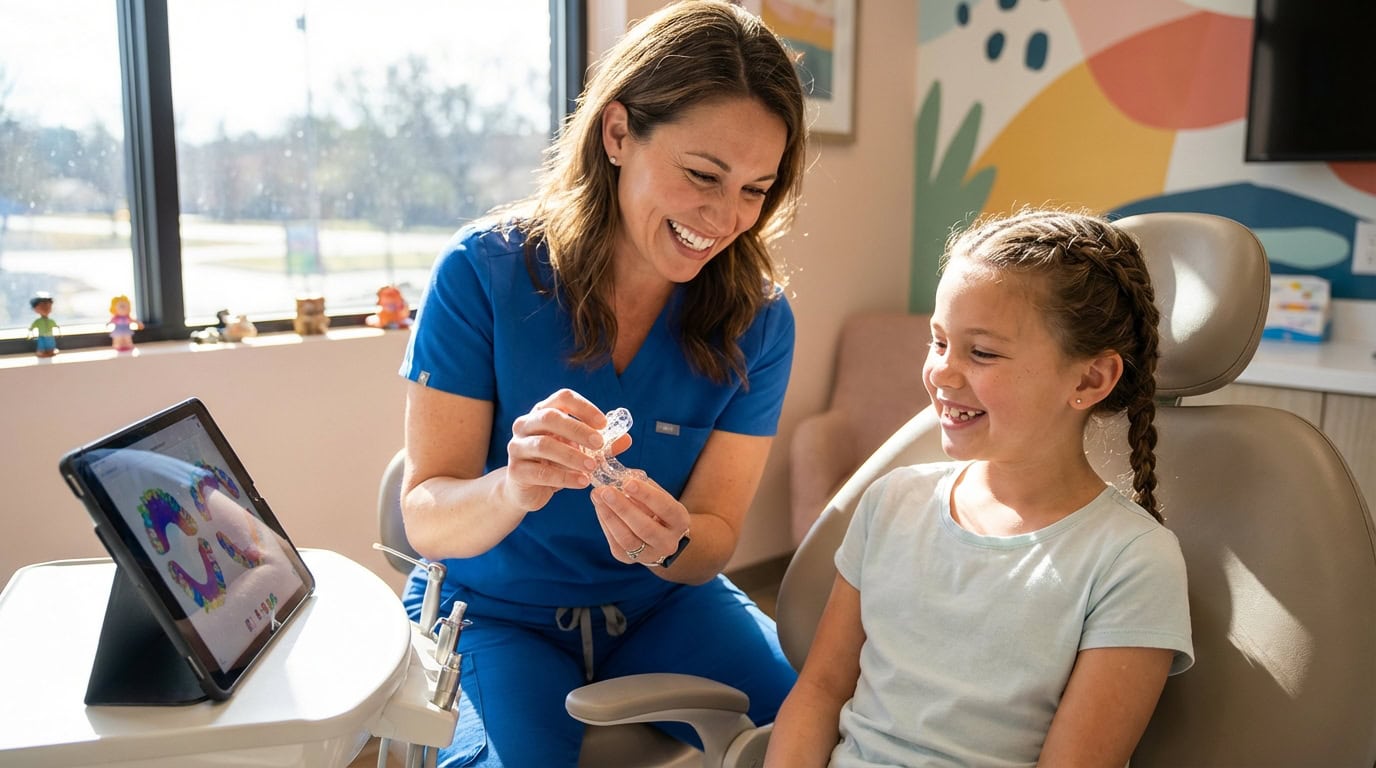
Phase 1 Orthodontics Pembroke Pines Ages 6-10
Your kid comes home from school and you notice their teeth are crowding or their bite looks a little off.
Your first thought isn't "oh no, braces," it's more like "is this normal?"
Here's the thing: catching dental issues early, especially between ages 6 and 10, changes everything.
I'm going to walk you through Phase 1 orthodontics for kids in Pembroke Pines and why starting early isn't about jumping the gun—it's about smart parenting.
What Phase 1 Orthodontics Actually Is (And Isn't)
Phase 1 isn't full braces.
That's the first thing to understand.
It's early treatment, usually between ages 6 and 10, that uses targeted appliances to guide your child's jaw growth and create space for permanent teeth.
Think of it like steering a ship before it hits rough water.
The American Association of Orthodontists (AAO) recommends kids get evaluated by age 7, and for good reason.
Your child's jaw is still growing, bones are soft and responsive, and small interventions now can prevent bigger problems later.
Phase 1 typically involves things like palatal expanders, which gently widen the upper jaw, or bite-correction appliances that align how the upper and lower teeth come together.
Most kids spend 12 to 24 months in Phase 1, then take a break while permanent teeth come in.
Phase 2 happens later, usually in the teen years, if additional treatment is needed.
Why Early Intervention Actually Saves You Money and Time
Here's what most parents miss:
Waiting until your kid is 13 or 14 to address crowding or bite issues often means longer total treatment time and more complex problems to fix.
Early intervention is the opposite of jumping ahead—it's being strategic.
When you catch a crowding issue at 7, a palatal expander can widen the arch and make room naturally, working with your kid's growth instead of against it.
When you wait until age 14, you're fighting against a jaw that's mostly done growing, which means more aggressive treatment, potentially extractions, and a longer road to straight teeth.
Plus, shorter overall treatment means fewer appointments, less time in braces, and real savings on total cost.
Parents who started their kids early tell us the same thing: "We wish we'd done this sooner."
The Signs Your 6-10 Year Old Might Need Phase 1
So what are you actually looking for?
Crowding or overlap: Teeth pushing against each other because the jaw doesn't have enough room.
Crossbite: Upper front teeth sitting behind the lower teeth instead of in front—this one's a big deal because it affects how the whole bite works.
Open bite: Front teeth don't touch when the mouth is closed, leaving a gap.
Underbite: Lower jaw extends too far forward.
Mouth breathing: If your kid is breathing through their mouth instead of their nose, it actually impacts how the jaw grows.
Thumb sucking past age 4: Lingering thumb or finger sucking habits can push teeth forward and narrow the palate.
None of these mean your kid has a problem—they mean it's worth a conversation with an orthodontist.
Pembroke Pines Families: Why SMILE-FX Wins
Look, I could tell you about any orthodontist, but here's why Pembroke Pines families drive to SMILE-FX Orthodontics in Miramar instead of staying local.
Our board-certified specialists focus on kids, not just teeth.
That matters.
A general dentist who does braces on the side is not the same as a specialist who sees kids every single day and understands how to make them comfortable.
We use low-dose CBCT scans instead of traditional X-rays, which gives us a 3D view of growth and bone structure without excess radiation.
We custom design 3D-printed expanders that fit exactly right, not the one-size-fits-most approach you get elsewhere.
The office itself doesn't feel medical.
There's a VIP suite with TVs and games, weighted blankets, noise-canceling headphones, and snacks.
Your kid doesn't dread appointments—they actually look forward to them.
From Pembroke Pines, you're 10 to 15 minutes away via Pines Boulevard or I-75.
We offer early morning slots before school, after-school appointments, and weekend hours because we get it—family schedules are packed.
Check our Miramar location page for directions and parking info.
The First Visit: What Actually Happens
You're probably wondering if your kid will freak out.
The first appointment is short—about 30 to 45 minutes—and we design it to be zero stress.
We start in a kid-friendly zone, not a medical room that looks like a dentist's office.
We take low-dose digital X-rays or a CBCT scan, but we explain it in plain English first, not medical jargon.
Your kid sits in the VIP suite, picks a show to watch or plays VR games while we gather the information we need.
No surprises, no big scary equipment, no rushing.
Then we sit down with you and talk through what we see, what we recommend, and what the timeline looks like.
If your kid doesn't need treatment right now, we'll tell you that too.
We're honest about what's needed and what's just nice to have.
That builds trust from day one.
How Phase 1 Treatment Actually Works
Let's say your kid needs Phase 1.
Here's the path forward:
Month 1 to 3: Palatal expander gets activated slowly, a few turns per week, gradually widening the upper jaw and making room for crowded teeth.
Month 4 to 12: Expander stays in place while we let the bone respond and new space develops.
Month 12 to 24: We might add braces or clear aligners to align teeth in that new space, or we might just observe and wait for permanent teeth to come in.
Every kid is different.
Some need the expander alone and we're done.
Some need braces on top of it.
Some need to wait and see how their other teeth erupt.
We don't force a one-size-fits-all approach.
Once Phase 1 is complete, your kid gets a break while permanent teeth come in naturally.
When they're around 11 or 12, we reevaluate and decide if Phase 2 treatment is necessary.
Many kids end up needing minimal Phase 2 work because Phase 1 did its job.
Real Talk About Insurance and Cost
Most dental insurance plans do cover Phase 1 orthodontics, especially when it's interceptive treatment that prevents bigger problems later.
Coverage varies wildly though.
Some plans cover 50%, some 25%, some have a set dollar limit.
Our team maxes out your benefits and gives you a clear breakdown of what insurance covers and what you pay out of pocket.
No surprises, no hidden fees.
Check out our patient resources page for real cost ranges and financing options.
We also offer payment plans that spread costs across months, which makes Phase 1 accessible for families.
Pembroke Pines Kids We Serve
We work with kids from Pembroke Pines Elementary, Panther Run Elementary, Silver Trail Middle, and every school in between.
We schedule around their calendars, not the other way around.
Early morning appointments before school?
We do that.
After-school slots?
We've got them.
Weekend availability?
Yes.
Your kid's schedule shouldn't be a reason to skip early treatment.
Cutting-Edge Tech That Actually Matters
We're not bragging about tech for tech's sake.
Our cutting-edge technology actually changes outcomes.
Low-dose CBCT scans show us growth patterns that regular X-rays miss.
3D printing lets us create custom appliances that fit your kid's mouth perfectly, not generic ones.
Digital treatment planning shows us exactly how growth will progress and what interventions will work best.
This isn't about looking modern—it's about delivering better results with less time in treatment.
Why Specialists Matter More Than You Think
Here's the difference between a general dentist and a specialist.
A general dentist gets a few weeks of orthodontics training in dental school and then does braces alongside cleanings and root canals.
An orthodontist goes to dental school, then spends 2 to 3 additional years specializing solely in tooth movement and jaw growth.
That's thousands of hours of extra training.
For kids specifically, you want someone who understands growth phases, behavioral management, and how to make young patients comfortable.
Our board-certified team lives this every day.
We're not booking orthodontics as a side hustle.
Clear Aligners vs. Traditional Braces in Phase 1
Most Phase 1 treatment uses expanders and light braces because that's what works with growing jaws.
But for some kids, clear aligners can play a role too.
Clear aligners are removable, nearly invisible, and easier to keep clean.
For kids with good compliance, they're a solid option.
The catch: they work better for mild to moderate issues, not severe crowding.
And kids have to actually wear them—unlike fixed braces that do the work whether they want them to or not.
We talk through the pros and cons during your consultation and pick what actually works for your kid's case and personality.
What Happens if You Wait
I get it—maybe your kid's bite doesn't seem that bad, so why rush into treatment?
Here's the reality check.
When crowding or bite issues go untreated, they get worse as permanent teeth erupt.
A mild crossbite at age 7 becomes a significant bite problem by age 13.
Crowding that could be fixed with an expander now might require tooth extraction later.
Early treatment isn't about being paranoid—it's about preventing situations that become much harder to fix.
Plus, kids who have early treatment are less self-conscious about their smiles, which impacts confidence in school and social situations.
That's not a small thing.
Questions Parents Actually Ask
Is Phase 1 painful?
No.
Expanders create gentle pressure that widens bone over weeks and months.
Kids feel some pressure, not pain.
If braces get added later, there's mild soreness for a few days after adjustments, but nothing serious.
How often do we come in?
Usually every 6 to 8 weeks for adjustments and progress checks.
Short appointments, not a huge time commitment.
Can my kid play sports with Phase 1 appliances?
Absolutely.
We recommend a mouthguard, but kids play soccer, baseball, football, and everything else without issues.
What if my kid won't cooperate?
That's real, and we deal with it constantly.
Our team knows how to talk to kids and motivate them.
We make appointments fun, not scary.
Check our patient reviews to see what other Pembroke Pines families say about working with us.
The Real Outcome: Confidence That Lasts
Phase 1 isn't just about straight teeth.
It's about setting your kid up for a healthy bite, easier final orthodontics if needed, and the confidence that comes with a smile they're proud of.
Kids who get early treatment grow up without the insecurity of severe crowding or bite issues.
They smile in photos without thinking about it.
They don't avoid social situations because of their teeth.
That's what we're really doing here.
Ready to Get Started
Phase 1 orthodontics in Pembroke Pines starts with one conversation.
Book a free 3D scan and VIP smile consultation at SMILE-FX Orthodontics and let's see what your kid needs.
No pressure, no sales pitch, just an honest assessment from specialists who work with kids every single day.
Your family's smile deserves better than generic approaches and rushed appointments.
We're 10 minutes from Pembroke Pines and ready to guide you through Phase 1 orthodontics with confidence.
Beyond Phase 1: What Parents Need to Know About Phase 2 Orthodontics and Long-Term Smile Success
Your kid finished Phase 1 treatment.
The expander came out.
Their jaw has grown.
Now what?
This is where a lot of parents get confused because Phase 1 wasn't the end of the story, it was Act One.
Phase 2 is where the real magic happens, and understanding it now saves you from surprises later.
Let me break down what happens after Phase 1 treatment wraps and why the transition matters more than you think.
The Gap Between Phase 1 and Phase 2: What's Actually Happening
After Phase 1 ends, your kid gets what we call an observation period.
This isn't doing nothing.
It's a critical window where permanent teeth are erupting and the jaw is still adjusting from Phase 1 treatment.
We're watching how teeth come in, whether the bite is settling correctly, and if there's enough space for all the permanent adult teeth.
Most kids take a break between 12 and 24 months.
During this time, we see your kid once or twice a year at check-ups to monitor progress.
No braces, no pressure, just regular observation.
Some parents worry this means wasted time.
It's actually the opposite.
The space we created in Phase 1 is allowing teeth to come in naturally without the crowding that would require extractions later.
When Phase 2 Actually Starts
Phase 2 typically begins when most of your kid's permanent teeth have erupted, usually around age 11 or 12.
This is when we have a full picture of how their bite is developing.
At this point, we decide if Phase 2 is even necessary.
Here's something most people don't know: not every kid who does Phase 1 needs Phase 2.
If Phase 1 did its job well, and permanent teeth erupted straight, Phase 2 might be quick and simple or not needed at all.
That's the goal.
When Phase 2 is needed, it usually involves full braces or clear aligners to align all permanent teeth and perfect the bite.
This phase typically takes 18 to 30 months depending on how much work needs to be done.
Braces vs. Clear Aligners in Phase 2: Which Actually Works Better
By the time your kid hits Phase 2, they're old enough to have a real say in their treatment.
Some kids want invisible treatment.
Some don't care and just want it done fast.
Traditional braces are still the gold standard for complex bite corrections.
They work 24/7 and don't depend on compliance.
Your kid can't forget to put them in or take them out.
That matters because teenage life gets messy.
Clear aligners and Invisalign are nearly invisible and removable, which appeals to older kids who care about appearance.
The catch is they require discipline.
Your kid needs to wear them 20 to 22 hours a day.
They need to keep them clean.
They need to change them on schedule.
A responsible teenager can absolutely handle this.
A distracted one might lose track.
We talk through both options during Phase 2 planning and pick what fits your kid's life and maturity level.
The Cost Reality of Phase 1 and Phase 2 Combined
A lot of parents wonder if doing Phase 1 means spending twice as much money total.
Not necessarily.
The investment in Phase 1 usually reduces the complexity and time needed in Phase 2.
A kid who didn't do Phase 1 might need 30 months of full braces with potential extractions.
A kid who did Phase 1 might only need 18 months of Phase 2 braces with no extractions.
That's actual savings in total treatment time and cost.
Most insurance plans cover both phases, and our team at SMILE-FX works with your benefits to maximize what's covered.
Check our patient resources page for detailed pricing information and what to expect financially.
We also offer flexible payment plans that spread costs across your entire treatment, not just one lump sum.
What Makes the Transition From Phase 1 to Phase 2 Smooth
The hardest part of Phase 2 is starting it if your kid has anxiety about braces.
By this point, they've already been through Phase 1.
They know what to expect.
They know our office doesn't scare them.
They've experienced how gentle orthodontic treatment actually is.
That experience pays off when Phase 2 starts because there's no fear of the unknown.
Your kid knows appointments are fast, they know we explain things clearly, and they know the office feels comfortable.
That familiarity makes the transition easier than it would be for a kid starting braces with zero prior experience.
Retainers: The Part Nobody Wants to Talk About But Everyone Needs
Phase 2 ends when teeth are straight and the bite is perfect.
But the work isn't really done until your kid commits to wearing retainers.
This is non-negotiable.
Teeth want to move back to where they came from, and retainers stop that from happening.
Most kids wear full retainers every night for the first year after Phase 2 ends, then switch to wearing them a few nights a week for life.
It sounds like a hassle, but it's way less annoying than braces were.
We talk about retainer compliance at the start of Phase 2 so your kid knows what's expected after treatment ends.
No surprises, no "wait, I have to do this forever?"
Just honest conversation about keeping their smile straight long-term.
The Real Timeline: From Age 7 to Age 16
Let me paint the full picture from start to finish.
Age 7: Phase 1 starts after evaluation.
Age 8 to 10: Phase 1 treatment with expander and possibly light braces.
Age 10 to 12: Observation period while permanent teeth erupt.
Age 12: Phase 2 planning and assessment of whether it's needed.
Age 12 to 14: Phase 2 treatment with braces or clear aligners.
Age 14 onward: Retainer wear and maintenance.
That's roughly a 7-year journey from initial Phase 1 evaluation to final straightened smile.
Sounds long, but your kid isn't in active treatment the whole time.
Total active treatment is usually 4 to 5 years spread across both phases with a break in between.
Compare that to waiting until age 13 to start braces, then doing 30 months of full orthodontics with no Phase 1 benefit.
Phase 1 actually compresses the total time you're juggling orthodontic appointments.
How Different Bite Problems Respond to Two-Phase Treatment
Not every bite issue follows the same two-phase path.
Some cases need more Phase 1 work to prevent complications in Phase 2.
Severe underbites or crossbites often need aggressive Phase 1 intervention because they affect how bones are growing.
Mild crowding might need just Phase 1 expansion, then minimal Phase 2.
Open bites need Phase 1 correction of tongue posture and palate width, then Phase 2 alignment.
We map this out during the initial Phase 1 consultation so you're not guessing about what Phase 2 might look like.
Our board-certified specialists use growth predictions and digital planning to show you the expected path.
You see where we're starting and where we're heading before treatment even begins.
Teen Life During Phase 2: Sports, School, Social Stuff
Phase 2 happens during middle school and high school when social stuff feels huge.
Your kid is worried about how braces look, whether they can eat normal food, if anyone will tease them.
Real talk: lots of kids have braces.
It's not the social nightmare it used to be.
If your kid chooses clear aligners or Invisalign in Phase 2, most people won't even notice they're doing orthodontics.
If they choose braces, we have colored brackets and fun wire options.
Sports are totally fine during Phase 2.
We recommend a mouthguard over braces, and your kid plays normally.
School lunches work fine with Phase 2 braces, just with different foods than before.
The adjustment is real but not dramatic.
We walk through all of this with your kid before Phase 2 starts so they're mentally prepared.
Common Questions About What Happens Between Phases
Do my kid's teeth move back during the observation period?
No.
The space we created in Phase 1 is stable because bone has filled in around those new positions.
Teeth don't randomly revert during the observation period.
What if my kid's permanent teeth come in crooked during the gap?
That's actually why we're monitoring.
We catch problems early and adjust our Phase 2 plan if needed.
This is the whole point of observation appointments.
Can Phase 2 start early if my kid's teeth are ready?
Yes.
If permanent teeth erupt early and we have a full picture of the bite, we can start Phase 2 sooner than typical.
There's no rule saying you have to wait exactly until age 12.
What if my kid only needed Phase 1?
We still see them for retainer fitting and retention planning.
Not every kid needs Phase 2, but every kid needs something to keep teeth straight long-term.
Why Starting With Phase 1 Sets Up Phase 2 for Success
Kids who do Phase 1 come into Phase 2 with several advantages.
Their jaw is already the right width and shape.
They have adequate space for permanent teeth.
Their bite is closer to correct already.
This means Phase 2 is shorter, requires less aggressive movement, and often doesn't need extractions.
A kid who skipped Phase 1 and starts braces at 13 with crowded teeth might need extractions to make room.
A kid who did Phase 1 rarely needs that.
It's the difference between expanding the house to fit the furniture versus throwing out furniture because it doesn't fit.
Obviously expanding is better.
Technology That Makes Both Phases Work Better
Our cutting-edge technology doesn't just help Phase 1.
It tracks growth across both phases.
3D CBCT scans during Phase 1 give us a baseline of your kid's jaw structure.
We can predict Phase 2 needs years before Phase 2 starts.
Digital treatment planning shows us exactly how permanent teeth will come in and what we'll need to correct.
By the time Phase 2 starts, we're not guessing.
We have a detailed, customized plan based on actual growth data.
That's the difference between generic orthodontics and precision orthodontics.
Life After Braces: What Retention Actually Means
The day braces come off in Phase 2 is exciting.
Your kid sees their straight teeth for the first time.
Then reality hits: retainers are permanent.
We fit custom retainers that are way more comfortable than braces.
Nighttime wear is easy.
Your kid sleeps with them in and wakes up done.
We explain that teeth naturally drift throughout life, and retainers stop that drift.
It's not a punishment.
It's maintenance, like brushing teeth.
Kids who understand this from the start of Phase 2 are way more compliant with retainers long-term.
Choosing Between Traditional and Modern Orthodontics
Some orthodontists still use outdated approaches to both Phase 1 and Phase 2.
One-size-fits-all appliances.
Generic treatment plans.
Assuming every kid needs the same thing.
That's not how we work.
Our approach to orthodontics is custom-built for each kid's specific growth pattern and bite needs.
Phase 1 is designed with your kid's unique jaw in mind.
Phase 2 is planned based on how Phase 1 actually worked for them.
That's why we get better results in less time.
Questions to Ask Before Phase 2 Starts
When Phase 2 planning happens, you should know the answers to these questions.
How long will Phase 2 take for my specific kid?
Will extractions be necessary?
What are our options: braces, clear aligners, or something else?
What's the total cost and what does insurance cover?
What's the retention plan after Phase 2 ends?
How often will we have appointments?
What happens if something goes wrong during Phase 2?
If an orthodontist can't answer these clearly, find one who can.
We answer all of this at the Phase 2 consultation, and we show you the plan on our 3D treatment model so you're seeing exactly what we mean.
The Pembroke Pines Advantage for Multi-Phase Treatment
If your kid is in the observation period between phases or starting Phase 2, scheduling is still the issue most families complain about.
We handle that differently.
Our location in Miramar is just 10 to 15 minutes from Pembroke Pines.
We have early morning, after-school, and weekend appointments.
Your kid's Phase 2 appointments don't require missing school or your work.
Check our Miramar location page for exact hours and directions.
During the observation period between phases, we see your kid just twice a year, not constantly.
That's manageable even for packed schedules.
The Cost-Benefit Analysis of Two-Phase vs. One-Phase Orthodontics
Parents always ask if Phase 1 is worth the upfront cost.
Let's look at actual math.
Phase 1 treatment: roughly 18 to 30 months, generally in the $1,500 to $3,000 range depending on complexity.
Phase 2 treatment with prior Phase 1: roughly 18 months, generally in the $3,000 to $5,000 range, often with less complex needs so sometimes on the shorter or lower end.
Total: approximately 4 to 5 years of active treatment across both phases.
One-phase orthodontics starting at age 13 with crowding and bite issues: roughly 30 months, $4,000 to $7,000, potentially including extractions which adds cost and complexity.
Total: one concentrated phase, slightly less total time but on a jaw that won't grow with you.
When you add up total time, total appointments, total cost, and total complexity, two-phase treatment usually comes out better financially and clinically.
That's not a sales pitch, that's just how the math works.
Real Families, Real Results From Phase 1 Into Phase 2
We see this constantly.
Parents who did Phase 1 at age 7 come back for Phase 2 at age 12 and tell us they're shocked how minimal Phase 2 was.
Their kid's permanent teeth came in straight.
The bite was nearly perfect already.
Phase 2 was quick touch-ups and refinement, not major work.
Parents who skipped Phase 1 and start braces at 13 face 30 months of treatment, tight schedules, more appointments, and sometimes extractions.
Read our patient reviews from Pembroke Pines families who've gone through both phases and see what they're saying.
Their honest feedback about the two-phase experience is worth more than anything we can tell you.
Starting Phase 2 Planning Now for Your Kid's Future
If your kid is finishing Phase 1 or in the observation period, Phase 2 planning should start having conversations with your orthodontist.
Not pressure to start treatment immediately, just honest discussion about what's coming, what options exist, and what timeline makes sense.
We schedule Phase 2 consultations well before Phase 2 actually starts so there are no surprises when your kid turns 11 or 12.
Your kid gets a vote in how Phase 2 happens.
If they want invisible aligners and they're mature enough for that responsibility, that's worth discussing.
If they want braces because they know braces work and they don't want to worry about compliance, that's valid too.
The plan should fit your kid's life, not force your kid into a predetermined plan.
Book Your Phase 1 or Phase 2 Consultation Today
Whether your child is 7 and ready for Phase 1 evaluation or 12 and approaching Phase 2, book a free 3D scan and VIP smile consultation at SMILE-FX Orthodontics.
We'll map out exactly what your kid needs across both phases, show you the timeline, explain the costs, and answer every question you have.
No pressure, no upsell, just clarity about two-phase orthodontics and what it means for your kid's smile.
Our approach to orthodontics is designed around results that last, not just quick fixes that look good in photos.
Both Phase 1 and Phase 2 are part of that bigger picture.
Let's get your kid on the path to a smile that works beautifully for life.
Why Most Parents Get Phase 1 Wrong: The Missing Piece About Interceptive Orthodontics
You've heard about Phase 1 orthodontics.
Maybe your kid's dentist mentioned it.
Maybe you're wondering if it's actually necessary or just another way for orthodontists to make money.
That's fair.
But here's what most parents miss: Phase 1 isn't about straightening teeth early.
It's about changing how your kid's jaw grows so adult teeth have room to come in naturally.
That's a totally different game.
Most people don't understand the difference, and that confusion costs them years of treatment time and thousands in extra fees later.
Let me show you what's actually happening in your kid's mouth right now and why getting it right in Phase 1 saves you from nightmare scenarios in Phase 2.
The Jaw Growth Thing Nobody Explains Well
Your kid's jaw doesn't stop growing until they're in their late teens.
That's not a small detail.
It's the entire foundation of why Phase 1 even exists.
Between ages 6 and 10, your kid's jaw bones are soft and responsive to pressure.
When you apply gentle, consistent force during this window, the bones actually expand and reshape themselves.
It's like working with clay while it's still wet instead of trying to reshape concrete.
By age 13 or 14, that window is mostly closed.
The bones have hardened.
Growth is nearly done.
If you wait to start orthodontics until then, you're fighting against bone that won't move the way you need it to.
This is why a board-certified orthodontist South Florida who understands growth phases can compress your kid's total treatment time by years.
You're not fighting biology.
You're working with it.
What Happens When You Skip Phase 1 Completely
Parents ask me all the time: "Can't we just wait and do one round of braces when all the permanent teeth come in?"
Technically yes.
Practically, that's expensive.
Here's a real scenario I see constantly.
A 13-year-old comes in with crowded teeth and a narrow palate.
Their permanent teeth don't have room to erupt straight, so they come in at weird angles or stay impacted.
Now we need to extract teeth to make room for the others.
That kid who did Phase 1 at age 7 would have had their palate expanded years ago.
Their permanent teeth come in straight with no extractions needed.
Same kid, different path, totally different outcome.
The cost difference is significant.
Extractions complicate everything.
They add time.
They add appointments.
They change what the final bite looks like.
And you can't undo them if you change your mind later.
The Real Reason Bite Problems Get Worse If You Wait
A kid with a small crossbite at age 7 doesn't just stay the same.
It gets worse as growth continues in the wrong direction.
The lower jaw grows more forward.
The upper jaw doesn't expand to match.
By age 13, that "small" crossbite is now affecting how their whole face grows.
Fixing it at 13 requires moving bones that have mostly stopped growing and moving teeth against a jaw that's already locked into position.
Fixing it at 7 means guiding growth in the right direction from the start.
Same problem caught 6 years earlier costs less, takes less time, and works with natural growth instead of against it.
That's not an upsell.
That's just how biology works.
The Myth About "Wasting Time" in Phase 1
Parents worry Phase 1 is wasting time on baby teeth.
Actually, it's about creating space for adult teeth.
Baby teeth are the landlords of that space.
If you don't make the apartment bigger before the tenants leave, the new tenants have nowhere to go.
Phase 1 expanders widen the palate and expand the jaw arches so permanent teeth have real estate waiting for them.
By the time your kid loses baby teeth, the room is already there.
Permanent teeth erupt straight because there's space.
That's why Phase 1 isn't wasting time.
It's setting up success years in advance.
Signs You're Talking to the Wrong Orthodontist About Phase 1
Not all orthodontists approach Phase 1 the same way.
Some treat it like mini braces on baby teeth.
Others understand it as growth guidance.
If an orthodontist tells you Phase 1 is optional or "nice to have," that's a red flag.
If they use generic expanders instead of custom ones, that's another.
If they don't show you a growth prediction or explain how Phase 1 sets up Phase 2, they're not thinking long-term.
A best orthodontist for complex cases near you should be able to explain exactly how Phase 1 works for your kid's specific situation and what changes you can expect to see.
They should show you before and after models or 3D scans.
They should talk about Phase 2 before Phase 1 even starts.
What "Interceptive Orthodontics" Actually Means
That fancy term you might hear is just orthodontist talk for "we're catching and fixing problems early."
Intercepting means stopping a problem before it becomes a bigger one.
A narrow palate intercepted early doesn't turn into crowding later.
A crossbite intercepted early doesn't mess up your kid's whole jaw development.
A forward tongue thrust corrected early doesn't cause an open bite.
The earlier you intercept, the easier the fix and the less time overall treatment takes.
This is why the American Association of Orthodontists recommends evaluation by age 7.
It's not about pushing kids into treatment.
It's about catching stuff early enough to fix it efficiently.
The Growth Prediction Game That Changes Everything
Modern orthodontics isn't guessing anymore.
With 3D imaging and growth prediction software, we can see how your kid's jaw will develop over the next 5 to 10 years.
We can predict which permanent teeth will be crowded before they even start erupting.
We can see that a bite problem will get worse if left alone.
We can design Phase 1 treatment today knowing exactly what Phase 2 will look like in 5 years.
That's not magic.
That's science.
And it changes whether Phase 1 is necessary and what form it should take for your specific kid.
A top-rated orthodontist Miramar with cutting-edge technology can show you this growth prediction before treatment starts.
You're not guessing about whether Phase 1 is worth it.
You're seeing the actual predicted outcome.
Does Insurance Actually Cover Phase 1 Treatment?
This is where parents get real.
Insurance coverage for Phase 1 varies wildly.
Some plans consider it preventive and cover it well.
Some consider it cosmetic and don't cover it at all.
Most insurance plans do cover Phase 1 when it's interceptive, meaning it addresses a real bite or growth problem, not just crooked baby teeth.
The difference between covered and not covered comes down to documentation.
Your orthodontist needs to explain why Phase 1 is medically necessary, not just nice to have.
That's where having a board-certified specialist matters.
We know how to present your kid's case to insurance in a way that gets approved.
We also know what questions insurance will ask and how to answer them.
Check our patient resources page for specifics on insurance coverage and what to expect cost-wise.
The Money Question: What Does Phase 1 Actually Cost?
Phase 1 treatment ranges from $1,500 to $3,500 depending on how complex your kid's case is and what appliances are needed.
That sounds like money, but remember what you're avoiding.
A kid who skips Phase 1 and needs full braces at 13 plus extractions is looking at $4,000 to $8,000 and 30 months of treatment.
A kid who does Phase 1 comes in for Phase 2 needing less work, shorter treatment, and no extractions.
Total cost across both phases is often less than one-phase treatment would have been.
Plus financing options let you spread Phase 1 costs across months, not pay it all upfront.
Common Phase 1 Treatment Approaches Explained Simply
Palatal Expanders: These gradually widen the upper jaw arch, creating space for crowded teeth and improving how the upper and lower jaw fit together.
Functional Appliances: These guide how the lower jaw grows and positions it correctly relative to the upper jaw.
Habit Correction: Thumb sucking and tongue thrusting change how teeth erupt and jaws grow, so Phase 1 addresses these behaviors with gentle appliances.
Light Braces: Sometimes Phase 1 uses light braces on front teeth to fix crowding or bite issues while the jaw is still growing.
Your orthodontist picks which approach fits your kid's specific problem, not what fits their fee schedule.
Why Pembroke Pines Families Choose Specialists Over General Dentists
Some parents think an orthodontist is an orthodontist is an orthodontist.
Not even close.
A general dentist who does some orthodontics treats it like teeth cleaning.
A specialist orthodontist went to dental school, then spent 2 to 3 additional years specifically studying how jaws grow and teeth move.
For Phase 1, that difference matters huge.
A specialist understands growth patterns, knows how to make Phase 1 work with your kid's specific growth trajectory, and can predict Phase 2 accurately.
They also know how to keep kids comfortable and actually happy about appointments.
That matters when you're asking a 7-year-old to cooperate with treatment for 2 years.
A best orthodontist South Florida who specializes in kids gets this.
We do this every single day.
It's not a side gig.
The Question You Should Ask Before Committing to Phase 1
Before starting Phase 1, ask your orthodontist this: "What specifically will Phase 1 achieve for my kid, and what will Phase 2 look like based on what Phase 1 accomplishes?"
If they can show you a growth prediction and explain it clearly, you're in good hands.
If they get vague or say "we'll see what happens," that's not a great sign.
Phase 1 should have clear goals.
Expand the palate to a specific width.
Correct a specific bite problem.
Create room for specific crowded teeth.
And it should set up Phase 2 to be shorter and simpler than it would have been without Phase 1.
You should be able to understand all of this before treatment starts.
Book a Real Phase 1 Consultation
If your kid is between 6 and 10 and you're wondering whether Phase 1 makes sense, book a free 3D scan and VIP smile consultation with a top-rated orthodontist near me.
We'll show you what's happening with your kid's jaw growth, explain what Phase 1 would do, and give you real numbers on cost and timeline.
No pressure, no upsell, just honest answers so you can make the right call for your kid.