
Phase 1 Orthodontics for Kids in Broward: Why Age 7 Actually Matters
Your child's smile is forming right now and you might have more influence over it than you realize.
If you've noticed crowding, a crossbite, or your kid still sucking their thumb at 7 or 8, you're probably wondering: "Is it too early for braces?"
The answer isn't what most parents expect, and understanding it could change everything about your child's orthodontic journey.
Here's what the American Association of Orthodontists recommends: every child should have an orthodontic evaluation by age 7, not because they need braces yet, but because some problems are actually easier to fix when kids are still growing.
This is Phase 1 Orthodontics, and it's quietly becoming the difference between straightforward treatment and complex ones down the road.
Why Age 7? The Growth Window Nobody Talks About
At 7, your child's jaw is still developing.
Their baby teeth are transitioning, their permanent teeth are beginning to emerge, and their facial bones are in growth mode.
This window, roughly ages 6 to 10, is when interceptive treatment can actually guide growth rather than fight against it.
Think of it like steering a ship while it's still in the harbor versus trying to redirect it in open water.
Same destination, completely different effort.
For kids in Pembroke Pines, Hollywood, Weston, and across Broward County, we've seen families who caught issues early avoid years of comprehensive braces later.
One parent from Cooper City told us: "We almost waited. I'm so glad we didn't."
The reason this matters so much is simple: your child's bones are softer, their jaw is more responsive to gentle pressure, and their growth patterns haven't fully locked in yet.
Once a child hits their teenage years, the window starts closing.
The jaw becomes harder to influence, and problems that could've been addressed with light, passive devices now require active braces or more aggressive treatment.
This isn't fear mongering, it's just how biology works.
What Phase 1 Actually Treats (Without Fear)
Phase 1 isn't about perfecting every tooth.
It's about addressing patterns that could compound if left alone.
Here's what we're actually looking for:
Crossbites where upper and lower teeth meet wrong affect jaw development and can cause asymmetry later.
Severe crowding sometimes guiding growth creates enough space naturally, reducing the need for extractions.
Mouth breathing habits affect jaw shape and tooth position.
Underbites or overbites when caught early, growth can be gently redirected.
Thumb sucking after age 6 shifts teeth forward and affects palate development.
Here's what Phase 1 is not: it's not a cosmetic fix.
It's preventive medicine.
And honestly, some kids don't need it at all.
That's why the first step is always a real evaluation with someone who knows the difference.
We're not here to push treatment that isn't needed.
We're here to catch what matters and address it while we still can.
What Actually Happens at Your Child's First Visit
Parents tell us they're nervous about taking their kid to the orthodontist.
They imagine scary equipment and clinical spaces.
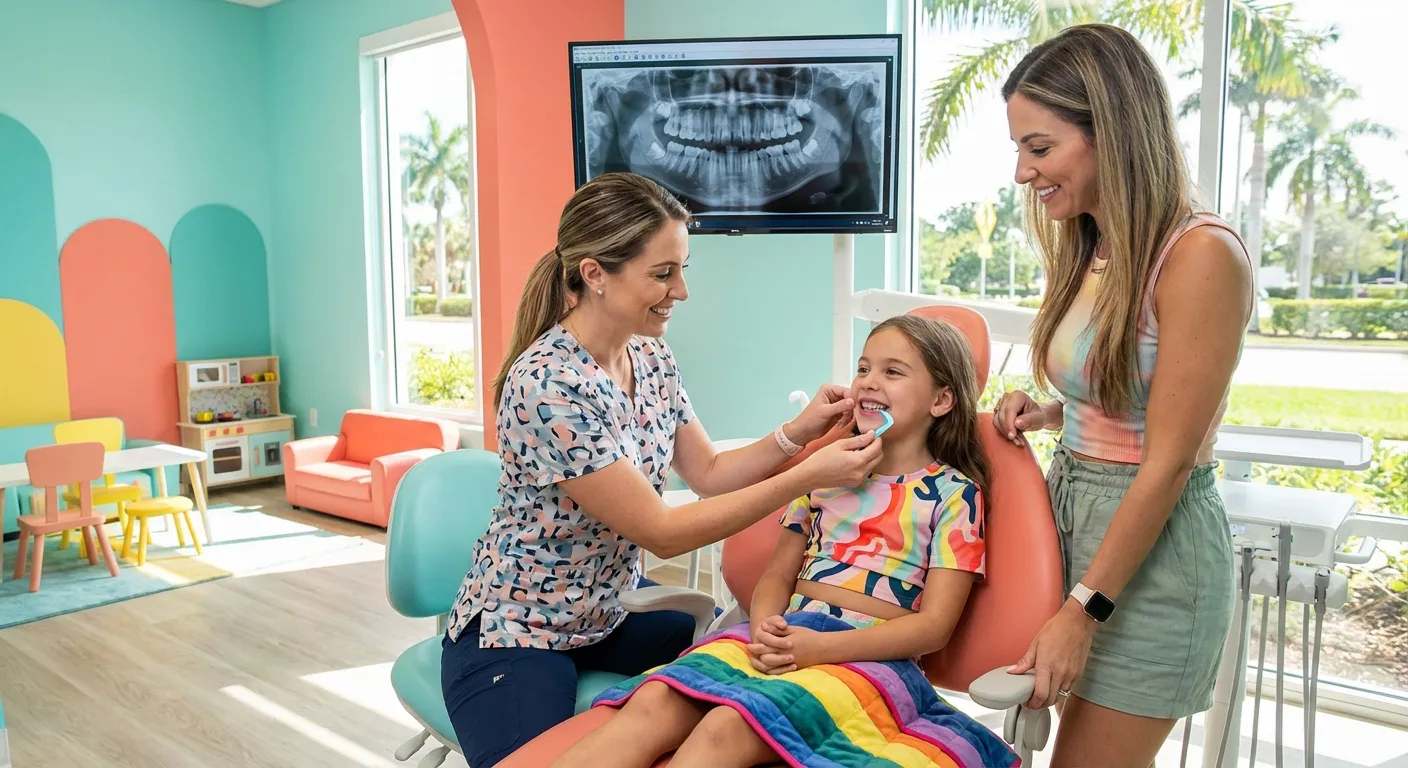
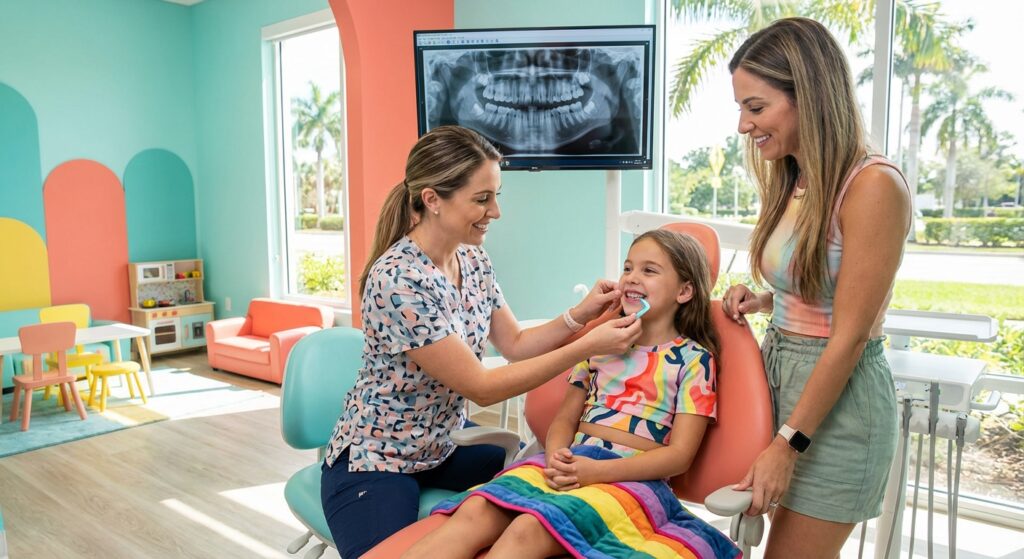
That's not what we do at SMILE-FX.
Your first appointment is about gathering information and making your child feel safe, not making decisions on the spot.
Here's what to expect:
A real conversation about what you've noticed (crowding, mouth breathing, whatever brought you in).
Digital X-rays (low-dose, completely safe) that show what's happening beneath the surface.
A visual assessment of bite, jaw alignment, and growth patterns.
Time to ask questions, real ones, not rushed ones.
A clear recommendation that might be: "Let's monitor," "Phase 1 would help," or "Wait and see."
We're not trying to sell you something.
We're trying to give you clarity so you can make the right choice for your kid.
The difference between a real orthodontist and someone just offering braces shows up immediately in how they approach this first visit.
We spend time understanding your child's specific situation, not rushing to quote you a price.
The Role of Comfort in Treatment Success
Kids from Davie to Fort Lauderdale often come to us nervous.
By the end of the first visit, most of them are relaxed enough that their parents are shocked.
Our Miramar office is designed with kids in mind, not as an afterthought.
VIP suites instead of cattle-call waiting rooms.
Noise-canceling headphones.
TV shows during treatment.
Weighted blankets for anxious kids.
Games and snacks.
Board-certified orthodontists, not general dentists trying to do orthodontics.
The difference matters.
Kids who feel safe at the orthodontist actually keep their appointments, follow care instructions, and have better treatment outcomes.
It's not magic, it's just treating kids like kids.
When a child is anxious, their jaw tenses up.
When they're relaxed, they cooperate better and the whole process becomes smoother for everyone involved.
This is why environment and staff approach matter just as much as the clinical work.
Red Flags: Does Your Child Need Phase 1 Treatment?
Watch for crowding: If your 7 or 8 year old's permanent teeth are coming in with obvious overlap or rotation, it usually gets worse as more teeth erupt, not better.
Crossbites are worth addressing: If the upper and lower teeth meet in a crisscross pattern, especially on one side, early intervention can prevent jaw asymmetry.
Mouth breathing (not just occasional): If your child breathes through their mouth most of the day, it affects palate development and tooth position.
Catching it early means we can address the pattern before it becomes structural.
Persistent thumb sucking after age 6: Occasional sucking is normal.
Constant or intense sucking after 6 can push teeth forward and affect the roof of the mouth's shape.
Early or late losing baby teeth: Sometimes the timing is off, and baby teeth aren't making room for permanent ones.
Phase 1 can help coordinate this.
Have you noticed any of these?
That's exactly what a consultation is for, to get a real answer instead of wondering.
Why Broward County Families Choose SMILE-FX for Phase 1 Care
Families from Pembroke Pines, Hollywood, Weston, Cooper City, and Davie choose us for Phase 1 care because we're different.
Board-certified specialists lead your child's care, not general dentists moonlighting in orthodontics.
We're the number one trusted partner to pediatric dentists across South Florida, that's not marketing, that's referral patterns.
Cutting-edge technology means clearer diagnostics and faster, gentler treatment.
Our VIP technology includes digital 3D imaging that shows us exactly what's happening with your child's growth and development.
Pediatric focus isn't an add-on, it's our specialty.
Transparent process means you'll know exactly what we recommend and why, with no pressure.
Worth the drive?
Families tell us yes.
A parent from Fort Lauderdale said: "We considered closer offices, but once we saw the difference in approach, location didn't matter."
That's the feedback we hear over and over, because there's a real difference between an orthodontist who specializes in kids and one who just tolerates them.
Phase 1 vs. Waiting: What the Research Actually Shows
The question every parent asks is whether waiting makes sense.
Sometimes it does.
Most of the time it doesn't, and here's why.
If your child has a crossbite, that crossbite is literally reshaping their jaw as they grow.
Every time they chew, every time they swallow, the misalignment is reinforcing itself.
By age 12, that crossbite has influenced bone growth.
Now you're not just correcting teeth, you're fighting against growth patterns that have already set in.
Same with severe crowding.
When permanent teeth start coming in crowded, they don't magically spread out and find space.
They keep coming in crowded, and now you've got a real problem on your hands.
Phase 1 treatment at age 7 or 8 can guide growth, create space, and set up a better foundation for permanent teeth.
This is why early evaluation matters so much.
It's not about jumping into treatment for every kid.
It's about knowing which kids benefit from early intervention and which kids can safely wait.
Understanding Your Treatment Options
Phase 1 treatment varies depending on what we find.
For some kids, it's a simple palate expander that guides the upper jaw to develop wider, creating more space naturally.
For others, it might be a simple fixed appliance, not full braces, just targeted correction of one specific issue.
Some kids get a combination approach that addresses multiple concerns at once.
The point is, Phase 1 is usually simpler, lighter, and shorter than comprehensive treatment later would be.
We also talk about different options when kids are older.
Clear aligners work great for some kids.
Invisalign is an option if we're past the Phase 1 window.
Traditional braces are still the most powerful option for complex cases.
But honestly, if Phase 1 works early, you often don't need anything more complex later.
Common Parent Questions About Phase 1
Q: Isn't Phase 1 just delaying the real braces?
Sometimes, yes, and that's okay.
The goal isn't to avoid comprehensive braces, it's to prevent problems that would make them harder.
When Phase 1 works, comprehensive treatment (if needed later) is shorter and simpler.
Q: How much does Phase 1 cost?
It varies, but typically $2,500 to $5,000 depending on what's needed.
Most Broward County dental insurance covers some Phase 1 treatment.
We'll give you exact numbers before you decide anything.
Q: Will my child definitely need braces later?
Not necessarily.
Some kids have Phase 1, their teeth guide into great alignment, and they're done.
Others have Phase 1, then Phase 2 (comprehensive braces) later.
We can't predict with 100 percent certainty, but we can give you an honest projection based on growth patterns.
Q: Why shouldn't we just go to our family dentist?
Your family dentist is great for cleanings and cavities.
But orthodontics is specialized, it's about growth, biomechanics, and interceptive timing.
Board-certified orthodontists train for years in exactly this.
It's the difference between a general contractor and a specialist.
Both matter, but they're not interchangeable.
The Real Value of Early Orthodontic Assessment
Getting your child evaluated by age 7 doesn't lock you into treatment.
It gives you information.
You'll know whether your child has issues that need attention or whether monitoring is the right call.
You'll know what to expect as permanent teeth come in.
You'll know whether interceptive treatment now saves you complexity and expense later.
Most importantly, you'll have a real professional opinion instead of guessing.
Parents often tell us they wish they'd come in earlier, not because they regret the treatment they got, but because getting clarity sooner would've saved them stress.
That's what we're here for.
Your Next Step: Get Clear Answers About Your Child's Smile
If your child is between 6 and 10, or you're noticing any of the signs mentioned, there's no risk to finding out what's actually going on.
A consultation takes about 30 minutes, costs nothing, and answers the one question you really want answered: "Does my kid need help, or are we fine?"
Book your FREE 3D scan and VIP smile consultation at SMILE-FX today.
We'll do the X-rays, assess growth patterns, and give you a real recommendation, not a sales pitch.
Your child's smile is forming right now.
The only question is whether you want expert guidance while there's still time to influence it.
Families from across Broward County, Pembroke Pines, Hollywood, Weston, Cooper City, Davie, and Fort Lauderdale trust SMILE-FX because we specialize in kids, not just teeth.
What Happens After Phase 1: The Complete Picture for Broward County Families Considering Braces and Clear Aligners for Kids
Your kid finished Phase 1 treatment.
Now what?
This is where most parents get confused because nobody really talks about what comes next.
You've been told Phase 1 sets up a better foundation for permanent teeth.
You understand it's preventive.
But the real question is whether your child will need braces later, and if so, what that looks like.
Here's the truth: Phase 1 is just part of the story.
The bigger picture involves understanding Phase 2, knowing your treatment options once your child is older, and making choices between traditional braces, clear aligners, and other solutions that didn't exist ten years ago.
Let me break down what actually happens in the years between Phase 1 and Phase 2, and why the path your child takes depends on more than just their teeth.
The Monitoring Period: What Happens Between Phase 1 and Phase 2
After Phase 1 wraps up, you don't just disappear.
We see kids every 6 to 12 months to watch how permanent teeth are coming in.
This isn't treatment, it's observation.
And it matters because growth is unpredictable.
A kid who needed a palate expander at age 8 might continue growing in a way that sets them up perfectly, or they might need additional help once their second molars come in.
During this monitoring period, we're watching for:
How permanent teeth are guiding into position (or not).
Whether the jaw is continuing to grow symmetrically.
If new bite problems are emerging as the child develops.
Whether the work we did in Phase 1 is holding.
Most kids in Broward County who had Phase 1 treatment won't need anything aggressive later.
Some won't need anything at all.
Others will benefit from Phase 2 treatment, but it'll be shorter and simpler than it would've been without Phase 1.
That's the whole point.
The kid who had Phase 1 from age 8 to 10, then waits until age 12 for Phase 2, usually needs braces for 18 to 24 months.
Without Phase 1, that same kid might need 24 to 36 months in braces.
Time matters when you're a teenager.
When Phase 2 Makes Sense for Teens in Broward County
Phase 2 typically happens once most permanent teeth have come in, usually around age 11 to 13.
This is comprehensive orthodontic treatment.
We're now working with a full set of adult teeth and a jaw that's mostly done growing.
The goal in Phase 2 is different from Phase 1.
We're not trying to guide growth anymore.
We're aligning teeth and perfecting the bite using whatever tools make the most sense for your kid's specific situation.
This is where your choices matter.
Your teenage child has options their 8-year-old self didn't have.
Clear aligners are way more advanced now than they were five years ago.
Invisalign for teens works for a lot of cases that would've required traditional braces ten years ago.
Braces are still the gold standard for complex situations and they work faster for severe cases.
And honestly, some kids prefer them because they don't have to remember to wear something or worry about losing it.
The right choice depends on what we find during the evaluation, not on what you think you want.
A kid with severe crowding might need braces even if they want clear aligners.
A kid with mild spacing issues might do great with Invisalign.
Our job is to give you the real options, not the marketing version.
Clear Aligners vs. Braces: The Conversation Nobody Has Straight
Every parent asks the same thing: "Why can't we just do clear aligners instead of braces?"
Good question.
The real answer depends on the bite problem, not on preference.
Clear aligners are amazing for some cases.
They're nearly invisible, they're removable, they're easier to keep clean.
But they work by pushing teeth from the crown down.
They're less effective for rotating teeth, for deep bites, for moving teeth vertically, and for severe crowding.
Braces work because we can control movement in every direction.
We can rotate teeth, move them vertically, handle complex bite problems, and get results faster.
For a kid who needs their teeth rotated 45 degrees, clear aligners might take years of trays.
Braces might get it done in months.
Here's what I tell families in Miramar, Pembroke Pines, and across the county:
If clear aligners can do the job, great, let's use them.
If braces are what your kid actually needs, let's be honest about that instead of pretending otherwise.
The worst scenario is a teenager in clear aligners for four years when braces would've done it in two.
That's not patient-centered, that's marketing-centered.
We do neither.
The Cost Reality for Phase 2 Treatment in Broward
Most families want to know cost upfront.
Fair.
Here's what's actually happening with pricing:
Phase 2 braces typically run $3,500 to $7,000 depending on complexity and location.
Clear aligners are usually in the same range, sometimes higher.
Insurance covers some, usually between 50 percent to 75 percent of treatment costs.
Most of our families break it into a down payment plus monthly installments.
We also have financing options that spread costs over the treatment period.
Here's the thing though: you already invested in Phase 1.
That investment often reduces Phase 2 costs because the case is simpler.
A kid who had Phase 1 might need 18 months of Phase 2 treatment.
A kid who didn't have Phase 1 might need 30 months.
You do the math on whether that investment made sense financially.
Most families realize it did.
We give exact numbers at the consultation, not estimates with surprise fees later.
That's how we operate.
Oral Hygiene Matters More Than You Think During Phase 2
This is the part parents underestimate.
Phase 2 treatment only works if your kid is actually taking care of their teeth.
With braces, food gets trapped.
Brushing and flossing become harder.
If your teenager isn't on board with the work, you get plaque buildup, cavities, and gum problems that slow down treatment.
With clear aligners, kids have to remember to wear them.
If your kid is removing them for sports, social situations, or just forgetting, treatment takes way longer.
I had a kid come in who was supposed to be in Phase 2 for 18 months.
It took three years because she wasn't wearing her aligners consistently.
Nobody made her do it.
Her parents couldn't force it.
She had to want it.
The lesson here is that Phase 2 treatment success depends as much on your teenager's commitment as it does on our clinical skills.
That's why we talk about this stuff upfront.
We're not just asking if they want straight teeth.
We're asking if they're ready to do the work.
If the answer is no, waiting six more months might actually be better.
What Your Teen Should Know Before Phase 2 Starts
Teenagers need real information, not sugarcoated stuff.
Here's what we tell kids before they start Phase 2:
You'll have food restrictions with braces, mostly sticky and hard stuff.
Your mouth will feel sore for a few days after adjustments.
Clear aligners require discipline about wearing time.
Both options mean more dental appointments, probably monthly.
Keeping your teeth clean is more important now than ever.
Treatment will take time, probably 18 to 30 months.
You're going to get used to it faster than you think.
Most teenagers surprise themselves with how quickly they adapt.
The first week feels weird.
By week three, it's normal.
By month two, they barely think about it.
That's been our experience with thousands of kids in Broward County.
The Role of Retention: Nobody Talks About This Until It's Too Late
Here's something that drives me crazy.
Orthodontists get kids through Phase 2 treatment, remove the braces, and then families think they're done.
You're not done.
That's when retention starts.
Your teeth want to move back to where they came from.
It's biology.
That's why we give retention plans.
Usually that means a fixed retainer on the back of your teeth (bonded there permanently) plus a removable retainer at night.
Some kids get clear retainers, some get traditional wire retainers.
It depends on the case.
Here's what's critical: retention is forever, or at least for a very long time.
If you stop wearing your retainer at night and your teeth shift back, we can do Phase 2 again.
But that costs money and takes time and is totally preventable.
I've had patients tell me their biggest regret was not keeping up with their retainer.
We included it as part of the plan.
They just got lazy.
Five years later, their teeth drifted and they're back in treatment.
Don't be that person.
Wear your retainer.
It takes 30 seconds before bed.
Special Situations: Athletes, Musicians, and Kids With Unique Needs
Some teenagers have specific circumstances that affect treatment choices.
Contact sports athletes often prefer clear aligners because there's no metal to break a tooth on.
But if the case needs braces, we talk about mouthguards and sports safety.
Musicians worried about braces affecting their embouchure on trumpet or saxophone have options.
Sometimes waiting a bit longer for Phase 2 makes sense if they're in competition season.
Kids with sensory sensitivities might struggle with the feeling of braces initially but usually adjust.
We have patients with ADHD who do better with clear aligners because the responsibility helps them focus.
We have others who do better with braces because there's nothing to lose or forget.
The point is we think about your kid's whole life, not just their teeth.
That's what specializing in kids actually means.
Questions About Phase 2 Most Parents Ask
How long does Phase 2 usually take?
18 to 30 months depending on complexity and how well your kid cooperates with care instructions.
Can my kid play sports during Phase 2?
Yes, absolutely, with proper mouthguards if needed.
Will Phase 2 hurt?
There's soreness for a few days after adjustments, nothing unbearable.
Most kids describe it as pressure, not pain.
What if we choose clear aligners and it's not working?
We can switch to braces if needed, though starting earlier makes that less likely.
How often do we come in during Phase 2?
Monthly appointments, usually about 30 minutes each.
We use advanced technology to minimize appointment time because we know everyone's busy.
Is there anything that would disqualify my kid from Phase 2?
Not really, unless they have severe gum disease or bone loss, which is rare in kids.
Most teenagers can do Phase 2 treatment.
Why Your Choice of Orthodontist Matters for Phase 2
Here's something real: not all orthodontists are the same.
Some are board-certified specialists who've trained for years in treatment planning and execution.
Some are general dentists who took a weekend course in clear aligners.
That difference shows up when complications arise, when your kid needs something more complex, when you have questions that need real expertise.
At SMILE-FX, we've been doing this for years.
We see complications others miss.
We know how to adjust treatment when growth surprises us.
We treat your kid like a person, not a case number.
Families from Weston, Hollywood, Cooper City, and Davie come to us because we're different.
Read the patient reviews and you'll see what I mean.
People don't leave those reviews because the office has nice furniture.
They leave them because we actually care about their kids' outcomes.
Making the Decision for Phase 2: What You Should Know
The decision to move forward with Phase 2 isn't something you should make alone.
It should involve your kid.
Your teenager needs to understand why treatment is recommended, what it involves, and what success looks like.
If they're not on board, the treatment will suffer.
Motivation matters.
We sit down with families and talk through options.
We answer every question.
We don't pressure anybody into anything.
Sometimes families decide to wait another year.
That's okay.
Sometimes they jump into Phase 2 right after Phase 1 wraps up.
That's okay too, if it makes sense clinically.
What matters is that it's the right choice for that kid, at that time, with full understanding of what's ahead.
That's not how every orthodontist operates, but it's how we do it.
Looking Forward: Braces and Clear Aligners for Every Stage
Your child's orthodontic journey might start at age 7 with Phase 1.
It might include Phase 2 in early teens.
It might involve traditional braces, clear aligners, or a combination approach.
The path isn't the same for every kid.
What matters is having experts who understand every treatment option and can guide you toward what actually works.
Families in Broward County have figured out that investing in proper orthodontic care from the beginning pays off.
Not just in results, but in time, money, and stress saved down the road.
Your kid deserves straight teeth and a healthy bite.
Getting there is a process.
But with the right guidance, it's a process that works.
Insurance, Affordability, and Finding the Best Orthodontist Near You in South Florida
Your kid needs braces or clear aligners.
First question that pops into your head: how much is this actually going to cost?
Second question: does insurance cover any of it?
Third question: is there a way to make this work without maxing out the credit card?
These are real concerns.
Orthodontic treatment isn't cheap, and most families aren't just sitting around with extra cash for Phase 1 and Phase 2 treatment.
So let's talk about what actually happens with insurance, what you should expect to pay, and how you find an orthodontist who doesn't treat affordability like a dirty word.
Does Insurance Cover Braces and Clear Aligners?
The short answer is yes, but with conditions.
Most dental insurance plans do cover orthodontics, but the coverage varies wildly depending on your specific plan.
Some plans cover 50 percent of treatment costs.
Some cover 75 percent.
Some have a annual maximum benefit, meaning they'll only pay up to $1,500 or $2,000 per year, and treatment lasts longer than that.
A few plans don't cover orthodontics at all.
That's why the first thing we do before anything else is check your insurance benefits.
We submit a pre-authorization request that tells you exactly what your plan covers.
No surprises later.
No hidden costs popping up during treatment.
You know the number upfront.
Here's what's critical to understand: does insurance cover braces is a common question, and the answer really does depend on your specific plan.
Some plans cover traditional braces fully but don't cover clear aligners.
Some cover both the same way.
Some have exclusions for kids under age 12.
That's why you can't just assume anything.
We handle all that paperwork.
You just need to give us your insurance information and we take it from there.
What Happens When Insurance Doesn't Cover Everything
Let's say your insurance covers 60 percent of a $5,000 treatment plan.
That's $3,000 covered by them, leaving you with $2,000.
That's still a chunk of money.
But it's way different from $5,000.
This is where financing comes in.
We offer affordable braces payment plans that break your out-of-pocket cost into monthly installments.
Instead of $2,000 up front, you might pay $200 a month for 10 months.
That's way more manageable for most families.
We also have $0 down braces financing options, meaning you start treatment without paying anything out of pocket until the first month of actual treatment.
No application fees, no hidden charges, just a straightforward plan that makes sense for people who actually have bills to pay.
Affordable braces in South Florida and affordable braces in Broward isn't just marketing language at SMILE-FX.
It's how we actually run the practice.
Comparing Traditional Braces vs Invisalign Cost
One question we get all the time is whether traditional braces or clear aligners cost more.
The real answer is they're usually about the same price.
Traditional braces might run $3,500 to $7,000 depending on complexity.
Invisalign and clear aligners cost in that same range.
Insurance tends to cover both similarly.
So the cost difference isn't the deciding factor.
Your choice should be based on what your teeth actually need, not on which one costs less.
That's the difference between working with an orthodontist who cares about outcomes versus one who just wants to move units.
We recommend based on what works for your kid's specific bite issue, not based on what makes us the most money.
Sometimes that's braces.
Sometimes that's clear aligners.
Both are tools.
The right tool depends on the job.
Finding the Best Orthodontist Near You That Actually Values Affordability
When you search for "best orthodontist near me" or "orthodontist near me" or "braces near me," you're probably seeing a bunch of options.
How do you know which one actually cares about making treatment affordable?
Ask these questions during your consultation:
Do they offer transparent pricing with no surprise fees?
Do they work with insurance and handle pre-authorizations for you?
Do they offer payment plans that break costs into manageable chunks?
Are they upfront about what you'll pay out of pocket after insurance?
Will they adjust treatment plans if budget becomes an issue?
If an orthodontist gets defensive about cost questions, that's a red flag.
If they're evasive about what you'll actually pay, move on.
The best orthodontist for you is the one who respects your budget and works within it.
That's what we do at SMILE-FX across Broward, from Miramar to Fort Lauderdale to Pembroke Pines.
We're the top rated orthodontist in those areas because we actually think about cost as part of patient care.
Why a Board Certified Orthodontist Might Actually Save You Money
Here's something that surprises people: working with a board certified orthodontist might cost less in the long run.
Why?
Because specialists get it right the first time.
They don't make mistakes that require redoing work.
They don't miscalculate treatment timelines and end up extending your case.
They know exactly what they're doing because they trained for years in exactly this.
A general dentist offering braces might seem cheaper upfront.
But if they underestimate complexity and treatment takes 50 percent longer, you're paying more in the end.
You're also dealing with potential complications that a specialist would've prevented.
Being the best orthodontist for complex cases means we've trained to handle situations that most general dentists can't.
That training costs money, but it saves you money through better outcomes and shorter treatment times.
What You're Actually Paying For
Your orthodontic fee isn't just for the braces or aligners themselves.
You're paying for:
The expertise of the doctor and their team.
The diagnostic imaging and treatment planning.
The appointments and adjustments throughout treatment.
Emergency visits if something breaks.
The retention phase after treatment finishes.
The use of cutting edge technology that makes treatment faster and more accurate.
A comfortable, professional environment where your kid feels safe.
Customer service that actually responds when you call.
When you break it down like that, you're not just paying for appliances.
You're investing in a two-to-three year relationship with experts who are managing a significant change to your kid's face.
That's worth getting right.
Invisalign Cost in South Florida and How It Breaks Down
Clear aligner cost in Miami and across South Florida usually runs between $3,000 and $8,000 depending on how many trays your kid needs and how long treatment takes.
Insurance often covers clear aligners the same way they cover braces, though some older plans don't.
That's why checking your benefits matters.
One thing people don't always realize is that the number of aligners doesn't always match the price.
A simple case might need 20 trays and cost $3,500.
A complex case might need 60 trays and cost $6,000.
The price reflects the complexity and length of treatment, not the number of pieces you get.
We explain exactly what your kid's aligner treatment will cost based on their specific situation.
No guessing, no surprises later.
Affordable Clear Aligners and Where to Actually Find Them
When you're looking for affordable clear aligners in South Florida or affordable braces near you, be careful.
There are online companies promising cheap aligners.
There are discount clinics offering rock bottom pricing.
They're cutting costs by cutting corners.
No doctor oversight on your treatment plan.
No emergency appointments if something goes wrong.
No real diagnosis before treatment starts, just some phone scans and hope.
That's not affordable, that's risky.
Real affordability means you get quality care and good value.
We offer payment plans and financing specifically because we want every family who can benefit from treatment to be able to access it.
That's not charity.
That's how we believe orthodontics should work.
The Real Cost of Waiting vs. Getting Treatment Now
Here's a calculation most parents don't do.
Your kid has a crossbite or crowding at age 8.
You wait because treatment seems expensive.
By age 12, the problem's worse and needs more aggressive treatment.
Phase 1 at age 8 might cost $2,500 and prevent the need for extensive Phase 2.
Skipping Phase 1 and doing comprehensive treatment later might cost $5,000 and take longer.
You didn't save money by waiting.
You spent more.
This is why evaluating your kid by age 7, like the American Association of Orthodontists recommends, actually makes financial sense.
Early intervention is often the cheapest intervention.
Questions About Cost and Insurance That Keep Coming Up
Can I use my medical insurance instead of dental insurance?
Most medical plans don't cover orthodontics unless it's for a jaw surgery case, which is rare.
Dental is where orthodontics lives.
What if I change jobs and my insurance changes?
We'll update your benefits with your new plan and adjust your payment plan if needed.
You're not locked in.
Does insurance cover clear aligners the same as braces?
Usually yes, but not always.
That's why we check first.
What about treatment for adults?
Insurance covers it the same way, though some plans have age limits.
Adult orthodontics in Miami and across South Florida is totally covered by most plans.
Can I get affordable braces if I don't have insurance?
Yes, absolutely.
We work with families with and without insurance.
Payment plans are for everyone.
Finding a Top Rated Orthodontist Fort Lauderdale and Miramar Families Trust
When you're searching for "best orthodontist near me" or "top rated orthodontist Miramar" or "best orthodontist for kids South Florida," you want to actually know what makes them top rated.
Look at patient reviews.
Real feedback from real families tells you more than any marketing claim.
Check patient reviews and you'll see what people actually experienced.
At SMILE-FX, families choose us because we're the best orthodontist South Florida families can actually afford.
We're board certified, we use the latest technology, and we don't treat cost like an afterthought.
Our pediatric orthodontist in South Florida works with kids from age 7 through adulthood.
We're specialists in what we do, and we price our services to match our commitment to quality.
That's the real difference between best orthodontist near you and one that's actually worth finding.
Take Action on Your Kid's Smile Today
Stop wondering whether your kid's bite is something to worry about.
Stop stressing about whether you can afford orthodontic care.
Stop putting off getting real professional guidance.
Book your FREE 3D scan and VIP smile consultation at SMILE-FX today to find out exactly what treatment would cost, what insurance covers, and what payment options work for your family.
We'll give you real numbers and real options.
No pressure, no hidden fees, just honest conversation about your kid's smile and how to make it happen affordably.
Finding the best orthodontist near you who actually cares about affordability isn't luck.
It's just showing up and asking the right questions.