
Phase 1 Orthodontics for Pembroke Pines Kids Ages 6-10
Your kid's got teeth coming in all over the place, and you're wondering if it's a real problem or just something that'll sort itself out.
The truth is, catching dental issues early makes everything easier down the road.
As a parent in Pembroke Pines, you've probably noticed those first signs: crowding, gaps, or maybe a thumb habit that just won't quit.
That's where Phase 1 orthodontics comes in.
It's not some scary big intervention.
It's actually a smart, gentle way to guide your child's teeth and jaw growth while they're still developing.
At SMILE-FX Orthodontics in Miramar, we've worked with hundreds of families from Pembroke Pines, Hollywood, Weston, Cooper City, and across Broward County to make this process simple and comfortable for kids ages 6 to 10.
What Exactly Is Phase 1 Orthodontics
Phase 1 is early orthodontic treatment.
The American Association of Orthodontists (AAO) recommends that kids get checked by age 7, even if they don't look like they need treatment yet.
Here's why it matters: your child's jaw and face are still growing.
If you can work with that natural growth, you can guide things in the right direction before permanent teeth fully come in.
This isn't about slapping braces on a first grader.
Phase 1 uses things like palatal expanders, partial braces, or habit-breaking appliances.
The goal is simple: create space for adult teeth, fix problems with jaw development, and stop bad habits like mouth breathing or thumb sucking.
One thing parents don't always realize is that Phase 1 can cut down on how long your kid needs comprehensive treatment later.
We're talking about potentially saving months or even years of having a teenager in full braces.
That's a win for everyone involved.
Why Your Pembroke Pines Kid Might Benefit from Phase 1 Treatment
Not every kid needs Phase 1.
Some children's teeth come in just fine on their own.
But there are some clear signs that mean it's worth a conversation with an orthodontist.
Crowding happens when baby teeth are overlapping and there's not enough room for the bigger adult teeth coming in.
Your kid might have big gaps between baby teeth, which sometimes closes up naturally, but not always.
A crossbite is when the upper teeth fit inside the lower teeth instead of on top of them.
This can throw off jaw development and cause real problems down the line if nobody addresses it.
Mouth breathing is surprisingly common and surprisingly damaging.
Kids who breathe through their mouth instead of their nose often develop a narrower palate and can end up with more dental problems.
Thumb sucking past age 4 or 5 can actually shift teeth and change how the palate develops.
An underbite or overbite that's noticeable early is another flag.
Jaw shifts that look unbalanced matter too.
The thing is, these aren't emergencies.
They're opportunities.
Catching them early means you can work with your kid's natural growth instead of fighting against it later.
The Real Benefits of Starting Phase 1 Early
There are some concrete reasons why board-certified orthodontists recommend Phase 1 treatment.
Space creation is the big one.
If your child's palate is too narrow, a palatal expander can gently widen it, giving those adult teeth room to come in properly.
This happens while your kid's jaw is still growing, which makes the whole process more natural and less stressful on the teeth.
Habit correction is another huge piece.
If your child is still thumb sucking or mouth breathing, an orthodontist can use custom appliances to help break those patterns.
We're talking about a 90 percent success rate when you catch it early enough.
Shorter future treatment is maybe the best part for parents thinking long-term.
By doing Phase 1 now, you might cut comprehensive treatment time in half.
That means your teenager spends way less time in braces and deals with less hassle overall.
Better alignment and health outcomes follow naturally when you catch things early.
Your child's confidence gets a boost too.
Kids who go through Phase 1 and see their smile improving tend to be more invested in taking care of their teeth down the road.
Why Pembroke Pines Families Trust SMILE-FX
We get it: choosing where to take your kid's teeth seriously is a decision.
You want specialists, not just dentists trying to do a little bit of everything.
You want your kid to feel comfortable, not scared.
And you want results that actually last.
SMILE-FX is just 10 to 15 minutes from Pembroke Pines, right off Miramar Parkway near I-75.
The drive is quick and easy whether you're coming from Pines Boulevard, the mall area, or anywhere else in Broward.
What makes families keep coming back is how we treat kids.
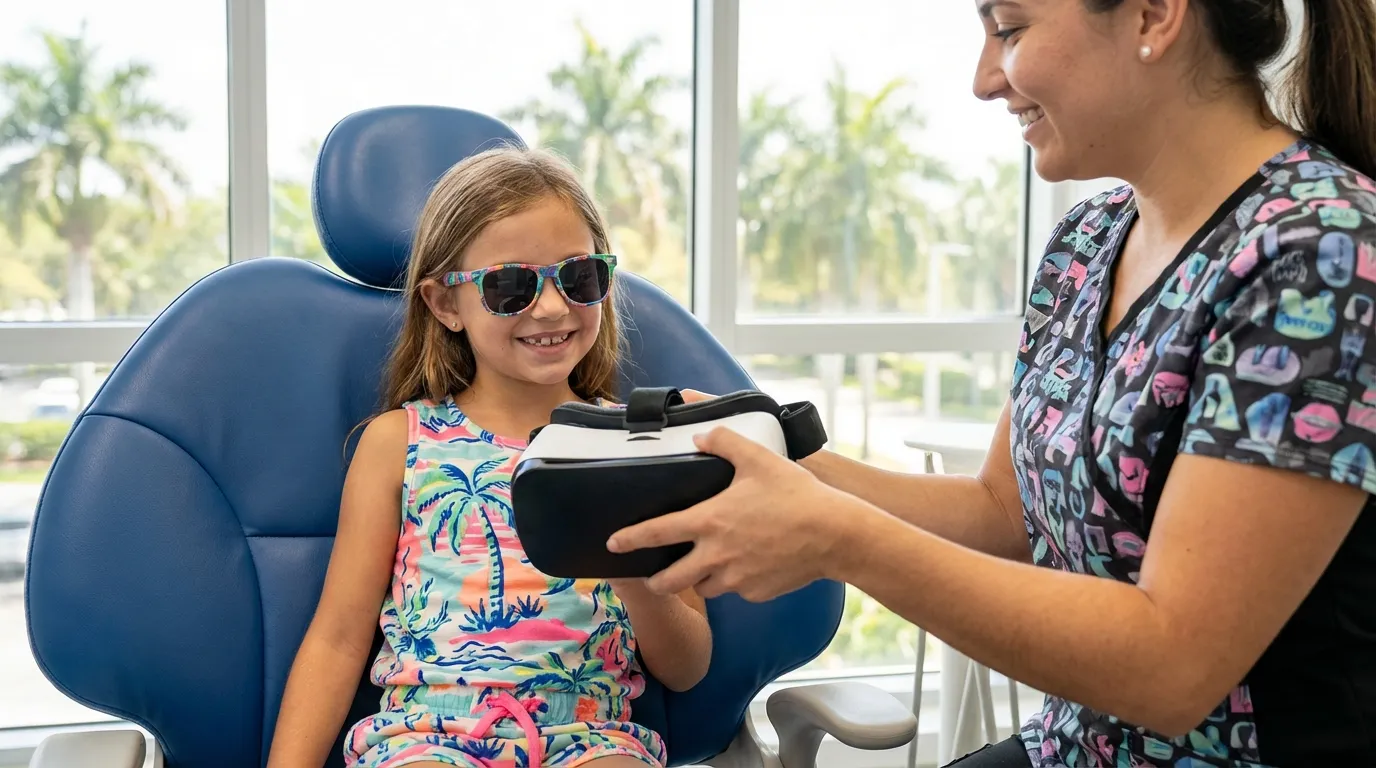
We've got VIP suites designed specifically for young patients.
Noise-canceling headphones so the sounds don't freak them out.
Weighted blankets for kids who need to feel grounded.
VR games and kid-friendly shows playing.
Real snacks, not stale crackers.
It's the kind of environment where a six-year-old actually wants to come back.
We're the top referral partner for pediatric dentists across South Florida, which says something.
Those dentists know we're not cutting corners.
We're real orthodontic specialists, not general practitioners who dabble in braces on the side.
Our team uses cutting-edge technology like low-dose CBCT scans that give us 3D mapping of your child's mouth and jaw.
That level of precision means we catch things other practices miss.
And we're honest about it: sometimes a kid doesn't need treatment yet, and we'll straight up tell you that at your free consultation.
How Phase 1 Treatment Actually Works
The first thing that happens is an evaluation.
We look at your child's teeth, jaw, and growth pattern.
We take those advanced scans to see what's happening beneath the surface.
Then we talk with you about what we're seeing and what it means.
If Phase 1 treatment makes sense, we explain exactly what we're going to do and why.
The appliances we use are custom-designed for your kid's mouth.
We're not using one-size-fits-all gear.
Everything is tailored to be as comfortable as possible while still getting the job done.
Your child will need to come in every few weeks for adjustments and check-ins.
We work around school schedules and after-school activities like soccer at David Park.
The whole thing typically lasts 18 to 24 months, though it varies depending on what we're treating.
Throughout the process, we're using digital monitoring to track progress and make adjustments as your kid grows.
No guessing, no hoping things work out.
Just solid, science-backed orthodontics.
What Parents Need to Know About Costs and Insurance
Here's a question that comes up a lot: does insurance cover Phase 1 orthodontics
The answer is often yes, especially for interceptive treatment like Phase 1.
Many insurance plans recognize that catching problems early is more cost-effective than dealing with them later.
We handle all the insurance verification for you at your free consultation.
No surprises, no confusion.
You'll know exactly what's covered and what isn't before you commit to anything.
If cost is a concern, we offer flexible payment plans to make treatment accessible.
Think of Phase 1 as an investment in your child's long-term health and confidence, not just a dental expense.
Real Questions Pembroke Pines Parents Ask
How long does the first appointment take
About 30 to 45 minutes.
We chat with you and your kid, take any necessary X-rays (all explained in kid-friendly language), and let your child hang out in our play suite while we talk through what we found.
Zero pressure.
Pure reassurance.
What if my kid gets anxious at the dentist
That's exactly why we designed our office the way we did.
Kids who are nervous often feel way better once they see the space and meet the team.
We never rush them or make them feel like they're being forced into something.
Will Phase 1 definitely mean less braces time later
In most cases, yes.
By doing Phase 1 now, you're dealing with jaw growth and space issues while everything's still developing.
That leaves way less work for comprehensive treatment down the road.
Can you do Phase 1 treatment with my regular dentist
Your regular dentist might spot that Phase 1 is needed, and they might even refer you to us.
But Phase 1 treatment itself needs a real orthodontist.
Your pediatric dentist and our office will coordinate records and communicate to make sure everything lines up.
What happens after Phase 1 is done
Your child gets a break while their permanent teeth finish coming in.
We call this the observation period.
Then, if comprehensive treatment is needed, we move into Phase 2, which is typically full braces or clear aligners.
But a lot of kids don't even need Phase 2 because Phase 1 did the job.
The SMILE-FX Difference for Your Pembroke Pines Family
Look at what real families say about working with us.
They talk about confident kids, less worry, and actually seeing results.
That's not marketing speak.
That's parents like you sharing their real experience.
We're different because we actually care about the experience, not just checking boxes.
We use the latest technology.
We only hire board-certified specialists.
We design our office around making kids comfortable.
And we're honest about what your child needs and what they don't.
If you want to explore what options are out there, check out our treatable cases or take our Smile Quiz to see where your kid stands.
Want to see how we're different from other orthodontists in Broward
That page walks you through exactly what sets us apart.
Next Steps for Phase 1 Orthodontics in Pembroke Pines
If you're thinking Phase 1 might be right for your kid, the next move is simple.
Book a free 3D scan and VIP smile consultation.
No obligation, no high-pressure sales pitch.
Just a chance to meet our team, see our office, and find out exactly what we'd recommend for your child's smile.
Spots fill up fast for families in the Pembroke Pines area, so don't wait.
Schedule your free 3D scan and VIP smile consultation here.
Your kid deserves a smile they feel good about, and Phase 1 orthodontics might be exactly what gets them there.
Braces, Clear Aligners, and Invisalign for Kids, Teens, and Adults: What Works Best for Your Family
So your kid's got a dental situation that needs fixing, or maybe you're thinking about straightening your own teeth.
The question that keeps coming up is: should we go with braces, clear aligners, or Invisalign?
Here's the thing most people don't know: the right choice depends on your specific situation, not just what looks coolest in a photo.
Each option has real strengths and real limitations.
Understanding what sets them apart means you can actually make a choice that works for your life.
The Three Main Options for Straightening Teeth
When you're looking at orthodontic treatment, you're basically choosing between three camps.
Traditional braces use brackets, wires, and bands to move teeth gradually over time.
They've been around forever because they actually work.
Clear aligners are custom plastic trays that you swap out every week or two.
They're nearly invisible and removable, which appeals to a lot of people.
Invisalign is actually a brand of clear aligners, but it's become so common that people use the name for all of them.
Think Kleenex and tissues.
The real difference isn't just what they look like.
It's how they work, what they can fix, and how much commitment they need from you.
Let me break this down without the marketing hype.
Traditional Braces: The Heavy Hitter
Braces are powerful.
They can handle cases that other options can't touch.
If your kid has a severe underbite, a complicated bite problem, or teeth that need major movement, braces are often the right call.
Here's why: they're always working.
You can't take them out when it's inconvenient.
That consistency means your orthodontist can apply the exact pressure needed to move teeth into the right position.
The downside is obvious: they're visible, they require careful cleaning, and yes, they feel weird at first.
But kids adapt faster than you'd think.
Within a week, most of my younger patients stop complaining about how they feel.
Food restrictions are real though.
Sticky candy, hard nuts, popcorn, these things can bend wires or break brackets.
It's not forever, just during treatment.
For teens and adults dealing with major bite issues, traditional braces often deliver the fastest, most reliable results.
Treatment time usually runs 18 months to 3 years depending on complexity.
Cost-wise, they're usually less expensive than clear aligners for the same level of correction.
Clear Aligners and Invisalign: The Convenient Option
Clear aligners changed the game for people who wanted to straighten their teeth without looking like they were doing it.
You get a series of custom plastic trays that gradually shift your teeth.
You wear each one for about one to two weeks, then move to the next.
The appeal is real: they're nearly invisible, you can remove them to eat, and cleaning your teeth is way easier.
Your mouth doesn't feel like hardware is constantly in there.
But here's where people get surprised: they only work if you actually wear them.
The recommendation is 20 to 22 hours per day.
That means removing them only for eating and brushing.
I've seen people who thought they could just wear them at night and still get results.
Spoiler alert: that doesn't work.
Clear aligners are also better for mild to moderate bite problems.
If your kid needs serious jaw correction or has a severe overbite, aligners might not be enough.
Clear aligners work best when compliance is high and the case isn't overly complex.
Treatment time is often similar to braces, sometimes a bit longer if you're not wearing them consistently.
Cost is usually higher upfront, but payment plans make it accessible.
One real benefit: if you're self-conscious about your appearance during treatment, this solves that problem immediately.
What About Invisalign Specifically
Invisalign is the brand that basically invented the clear aligner concept.
They've got a huge library of case data, the plastic material they use is durable, and they've refined the process over decades.
That said, modern clear aligners from other companies are often just as good and sometimes cheaper.
The real question isn't whether Invisalign is better than other aligners.
It's whether clear aligners in general are right for your specific case.
But the responsibility factor is huge.
If your teenager loses trays, forgets to wear them, or doesn't take oral hygiene seriously, you're throwing money down a drain.
I've seen cases where a parent spent five thousand dollars on Invisalign and the kid didn't wear them consistently.
The teeth didn't move the way they should have, and now they're looking at redoing treatment.
With braces, that's not as much of an issue because the kid doesn't have a choice about wearing them.
Braces vs. Clear Aligners: Cost and Timeline
Let's talk money, because this matters.
Traditional braces generally cost between three thousand and six thousand dollars depending on complexity.
Clear aligners typically run four thousand to eight thousand dollars.
Your insurance might cover part of it, especially if there's a bite issue that affects chewing or jaw function.
Timeline-wise, both usually take 18 to 24 months for straightforward cases.
Complicated cases can take longer with either option.
Some orthodontists promise faster results with special techniques or aligners.
Be skeptical.
Moving teeth faster than your biology allows can damage the roots and cause problems later.
Good results take time, whether you're using braces or aligners.
Payment plans are standard at quality orthodontic practices.
You're not locked into paying it all upfront.
Most of us break it into monthly payments that fit a normal family budget.
Which Option is Right for Different Ages
For kids under 12, braces are usually the better choice if treatment is needed.
Their compliance is still developing, and braces don't require the self-discipline that aligners demand.
Plus, if you're doing Phase 1 treatment with expanders or partial braces, you're already in the brace ecosystem.
For teens 13 and up who care about appearance, clear aligners can work well if they're responsible about wearing them.
This is the sweet spot where social awareness goes up but habits are still being formed.
A teen who commits to wearing aligners usually does it because they don't want to look like they're in treatment.
That motivation can work in your favor.
For adults, the choice really comes down to lifestyle and the complexity of your case.
If you're in a professional setting where appearance matters, aligners might be worth the extra cost.
If you've got a complicated bite that needs major fixing, braces might be more efficient.
Some adults actually choose braces because they want the fastest result and don't care about visibility.
That's a totally valid choice.
What Your Orthodontist Should Tell You About Each Option
A good orthodontist won't push you toward whatever makes the most money.
They'll explain what your specific teeth need and which option gets you there best.
For your situation, questions to ask include:
Will this option handle my bite problem completely or just part of it?
How long will treatment actually take?
What's the realistic cost with my insurance?
What happens if I don't comply with the instructions (for aligners)?
What's the aftercare plan once treatment is done?
If your orthodontist can't give you straight answers to these questions, find someone else.
They're not just running a business that sells braces or aligners.
They're solving your bite problem with whatever tool fits best.
The Hidden Factor: Retention After Treatment
Here's something people don't think about until after their braces come off: keeping your teeth straight takes work.
Once your orthodontist says you're done, you move into the retention phase.
This usually means wearing a retainer every night for the first year, then ongoing.
The type of retainer depends on your case, but it's non-negotiable.
I've seen people skip retainers and watch their teeth shift back to where they started.
That's a waste of time and money.
Whether you chose braces or aligners, the retention commitment is the same.
Your orthodontist should explain exactly what retainer you'll wear and for how long before treatment even starts.
Real Talk: What Actually Happens During Treatment
With braces, you're getting adjusted every four to six weeks.
The orthodontist tightens wires, changes rubber bands, or swaps out brackets.
Your teeth might be sore for a day or two after an adjustment, especially early on.
That's normal and it passes.
You're also cleaning around brackets and wires, which takes more time than brushing normally.
Water flossers are your friend here.
With aligners, you're swapping trays at home most of the time.
You come in for periodic checks, maybe every six to eight weeks.
There's less chair time, but there's also less direct orthodontist oversight.
You need to be the person making sure things are progressing right.
Some aligner companies have apps that let your orthodontist monitor progress through photos you send.
That's actually helpful because it catches problems early.
Questions About Orthodontic Treatment That Come Up
Can I switch from braces to aligners mid-treatment?
Sometimes, but not always.
It depends on where you are in the process and your specific case.
Talk to your orthodontist about it.
Do I really need to wear a retainer forever?
Your teeth want to move back to where they came from.
Retainers prevent that.
Long-term, most people wear retainers at least several nights a week indefinitely.
Is one option faster than the other?
Not really, if done properly.
Braces might be slightly faster for severe cases, but the difference is usually just a few months.
What if I have a limited budget?
Braces are typically less expensive.
Quality orthodontists offer payment plans with both options.
Don't let cost pressure you into poor treatment decisions, but also know that quality care is more affordable than you think.
Can an adult get braces or aligners?
Absolutely.
Bone and teeth don't care about your age.
Plenty of adults straighten their teeth.
The process is the same, just sometimes takes a bit longer depending on bone density.
Why Treatment Type Matters Beyond Just Looks
Straightening teeth isn't vanity, even though that's part of it.
Crooked teeth are harder to clean.
That means more cavities, more gum disease, and more dental problems down the line.
A corrected bite means your jaw joints work better, you might sleep better, and you're less likely to wear down your teeth from grinding or misalignment.
Confidence matters too, especially for kids and teens.
A straighter smile changes how people present themselves and how they're perceived.
That's real.
Your orthodontist should see the full picture: function, health, and appearance.
Making Your Decision
Start with an honest evaluation of your specific situation.
What's the problem you're trying to fix: cosmetic spacing, a bite issue, crowding, or something else?
How old is the person getting treatment?
What's their likely compliance level if aligners are involved?
What's your budget and insurance coverage?
How much does appearance during treatment matter?
Once you know your answers, you've got a framework for choosing.
Get a consultation from a real orthodontist, not a general dentist trying to sell you whatever they offer.
A specialist evaluates your whole situation and recommends what actually fits your needs.
At SMILE-FX Orthodontic & Clear Aligner Studio, we offer braces, clear aligners, and Invisalign for kids, teens, and adults.
We're honest about which option makes sense for you.
Sometimes that's braces.
Sometimes it's aligners.
Sometimes we recommend starting with Phase 1 treatment now and finishing with Phase 2 later.
There's no agenda here beyond getting you the best result.
Your teeth and bite are unique.
Your treatment should be too.
Book a FREE 3D scan and VIP smile consultation to see exactly what option works for your situation.
We use advanced technology to map your mouth and show you what's possible with braces, clear aligners, or Invisalign for all ages and all cases.
Fixing Complex Bite Problems: When You Need a Real Orthodontist, Not Just Braces
Your kid's teeth look crowded, or maybe their bite is off in a way that keeps you up at night.
You've noticed they struggle to chew properly, or their jaw clicks when they eat.
That's when you realize this isn't about vanity anymore.
This is about function, health, and whether you're going to get real help or just someone slapping brackets on teeth and hoping for the best.
The truth that most people miss: not every dentist can handle complex bite problems.
You need a board-certified orthodontist who specializes in these situations, someone who sees the whole picture instead of just individual teeth.
Finding the best orthodontist near me who can actually solve complicated cases is the difference between wasting time and money versus getting results that stick.
What Makes a Bite Problem Actually Complex
Before we talk solutions, let's be clear about what we're dealing with.
A complex bite problem isn't just crowding or a slight gap.
These are situations that need real expertise:
Severe underbites where the lower jaw juts out beyond the upper teeth.
Extreme overbites that throw off the whole face structure.
Crossbites on multiple teeth instead of just one or two.
Open bites where the front teeth don't touch even when the mouth is closed.
Skeletal jaw misalignment that's part of how the bones developed, not just tooth position.
Combination problems where you've got crowding plus a bite issue plus jaw growth concerns all happening at once.
The thing is, a general dentist might see these and say "yeah, we can fix that with braces."
That's not always wrong, but it's often incomplete.
A best orthodontist for complex cases looks at what's causing the problem, not just what's visible.
That's where the real fix happens.
Why Your Regular Dentist Isn't Equipped for This
I'm not disrespecting general dentists here.
They do important work and they catch problems early.
But orthodontics is different.
It's a separate specialty that requires years of additional training after dental school.
A board-certified orthodontist South Florida has completed a two-to-three year residency specifically in orthodontics.
They study biomechanics, jaw growth patterns, bite mechanics, and how to apply force to teeth and bones in ways that actually work.
A general dentist might have taken a weekend course on straightening teeth.
That's not the same thing.
For best orthodontist for complex cases situations, you need someone who's spent thousands of hours diagnosing and treating complicated bite problems.
That experience matters.
It's the difference between getting a half-fix and getting your kid's jaw and teeth actually aligned properly.
Technology That Actually Changes the Game
The difference between mediocre orthodontists and the best ones often comes down to tools.
Not fancy looking tools, but tools that give you real information.
Advanced CBCT scanning gives you a 3D map of your kid's mouth, jaw, and how everything connects.
That's not just pretty pictures.
It's data that tells you exactly what's wrong and how to fix it.
SureSmile technology is another game-changer.
It uses digital mapping to plan tooth movement with precision.
Instead of a general plan that might work, you get a custom plan built specifically for your teeth and your jaw.
That means shorter treatment times, better results, and fewer surprises along the way.
When you're looking for a top tech driven orthodontist Miramar or anywhere else in South Florida, you want someone using cutting-edge technology that actually impacts your treatment.
SMILE-FX uses this tech across all cases, not just the fancy ones.
Because complex problems need complex solutions, and those solutions need to be based on real data.
Insurance, Cost, and Why You Shouldn't Settle for Cheap
Here's the question everyone asks: does insurance cover braces for complex bite problems?
The short answer is yes, often.
Insurance companies understand that fixing bite problems now is cheaper than fixing jaw surgery complications later.
But coverage depends on your specific plan and whether the problem is classified as functional or cosmetic.
A crossbite that affects chewing?
Usually covered.
Spacing that's purely cosmetic?
Probably not.
When you call a top-rated orthodontist near me, they should handle all the insurance verification for you.
You shouldn't have to figure out what's covered.
That's their job.
Cost for complex cases usually runs higher than straightforward orthodontics because they take longer and need more precision.
But affordable braces South Florida and affordable braces Miramar aren't oxymorons.
Good orthodontists offer payment plans that work for real families.
$0 down braces financing South Florida is actually available from practices that understand that price shouldn't keep you from getting the right treatment.
Don't choose an orthodontist based on who's cheapest.
Choose based on who can actually solve your problem, then figure out how to pay for it.
Why Some Cases Need More Than Just Braces
This is where people sometimes get surprised.
A severe underbite or skeletal jaw problem might need more than orthodontics alone.
Sometimes it requires orthopedic correction, which means using specialized appliances to guide jaw growth during development.
If your kid is young enough, that might mean starting with early interceptive treatment that guides growth before moving to comprehensive braces later.
For adults, a severe skeletal problem might mean exploring surgical options alongside orthodontics.
A real orthodontist talks about all these possibilities upfront.
They don't just assume braces are the answer.
They figure out what actually needs to happen and lay out your options.
That honesty is rare, and it matters.
The Consultation That Actually Tells You Something
Most orthodontists give consultations.
But not all consultations are equal.
A good consultation for a complex case includes:
A thorough exam where they're actually looking at how your jaw moves and functions, not just teeth position.
Advanced imaging that shows bone structure, not just tooth arrangement.
A conversation where they explain what they found in language you actually understand.
A realistic timeline and explanation of what results look like.
A clear plan for treatment, including what happens if complications come up.
When you book a free consultation at a best orthodontist South Florida, you should walk out understanding your problem and what it takes to fix it.
If you're still confused after the appointment, that's a red flag.
Finding Your Orthodontist: What Actually Matters
You probably typed orthodontist near me or braces near me into Google and got a bunch of results.
Most of those results are paid ads trying to get your click.
Here's what actually matters when you're evaluating options:
Board certification from the American Board of Orthodontics.
That's not automatic just from dental school.
It requires additional examination and credentials.
Years of experience specifically with complex cases.
Specialists who focus only on orthodontics, not dentists who do it on the side.
Access to modern technology and continuing education.
Real patient reviews from families who've actually completed treatment.
Transparent pricing and insurance handling.
A willingness to refer you to specialists if your case needs more than just braces.
Look at what real families say about their experience.
Not the flowery testimonials, but actual details about results and how they were treated.
That tells you more than any marketing copy.
What to Expect During Complex Case Treatment
Complex orthodontics takes longer than straightforward cases.
You're usually looking at 24 to 36 months instead of 18 months.
That's not because your orthodontist is slow.
It's because moving teeth and bone safely takes time.
Moving things too fast damages tooth roots and causes permanent harm.
You'll have regular appointments, usually every four to six weeks.
But you'll also need periodic check-ins with advanced imaging to make sure things are progressing correctly.
Sometimes treatment plans need adjustment.
A good orthodontist catches that early and modifies the plan instead of just pushing forward and hoping.
Your orthodontist should communicate constantly about progress.
You're not just dropping your kid off and hoping for the best.
You're part of an active team working toward a specific result.
Adult Orthodontics for Complex Bite Issues
Complex bite problems don't just affect kids.
Adults deal with these issues too, sometimes for decades without realizing it's actually fixable.
Adult orthodontics Miami and throughout South Florida has grown because people realize they can actually get their bite fixed no matter their age.
The treatment is similar to what kids get, but sometimes takes a bit longer because adult bone is denser.
For adults with complex cases, the option of clear aligners versus traditional braces becomes a real choice, not just a cosmetic preference.
Both work, but your orthodontist needs to evaluate whether your specific bite problem is something clear aligners can actually handle.
Some complex cases really do need braces because they require the kind of control that brackets and wires provide.
Invisalign works for some adults, but it's not the automatic choice for everyone.
Questions People Ask About Complex Cases
Will my insurance pay more because the case is complex?
No, usually insurance pays the same amount regardless of case complexity.
But you might have higher out-of-pocket costs because treatment takes longer and needs more appointments.
Does a complex case mean the result won't be as good?
Not at all, it means it takes more skill and time to get there.
A real orthodontist gets excellent results on complex cases because they have the training and experience.
Can a complex bite problem be fixed without surgery?
Sometimes, depending on the severity and your age.
That's exactly what a consultation determines.
Should I get a second opinion for a complex case?
Absolutely, that's smart.
Two different orthodontists might recommend different approaches, and comparing those helps you understand your options.
Start With the Right Evaluation
If you're dealing with a complex bite problem, don't settle for an orthodontist who just eyeballs your teeth and starts planning treatment.
You need a board-certified specialist who digs into the real problem, uses modern technology to understand what's happening, and builds a treatment plan based on actual data.
SMILE-FX handles complex cases across South Florida, from best orthodontist for kids South Florida to orthodontics for adults Miami.
We use advanced technology to diagnose properly, and we're honest about what it takes to fix your specific situation.
Book a FREE 3D scan and VIP smile consultation to get real answers about your complex bite problem.
We'll show you exactly what's going on and what it takes to fix it, whether that's braces, clear aligners, or something else entirely.
Stop wondering if complex bite problems are fixable.
They are, when you've got the right orthodontist handling them.