
Phase 1 Orthodontics in Miramar: Why Age 7 Matters (And When It Doesn't)
Your 7-year-old loses their first tooth.
You smile.
Then the worry sets in: "Should they already be seeing an orthodontist?"
Parents in Miramar and across Broward County ask us this question constantly—and the answer isn't what most people expect.
Here's the truth: age 7 is the golden window for orthodontic screening, but screening isn't treatment.
The American Association of Orthodontists recommends all children have an evaluation by age 7, and there's real science behind it.
But before you panic about your kid needing braces in second grade, let's break down what this actually means and what your family really needs to know.
Why Age 7 Is the Golden Window for Early Orthodontic Screening
At age 7, your child's jaw is still actively growing.
Their first molars are erupting.
Their baby teeth are transitioning to permanent teeth.
This is the moment when an experienced orthodontist can spot patterns—crossbites, crowding, mouth breathing habits, or skeletal imbalances—that could become bigger issues later.
Think of it like a bridge under construction.
If you notice structural problems while the foundation is still being laid, you can make adjustments.
Once the bridge is finished, fixes become exponentially more complicated and expensive.
The key insight: Early evaluation doesn't mean early treatment.
It means early detection.
Many kids who have a screening at age 7 won't need Phase 1 treatment until ages 9 or 10, or won't need it at all.
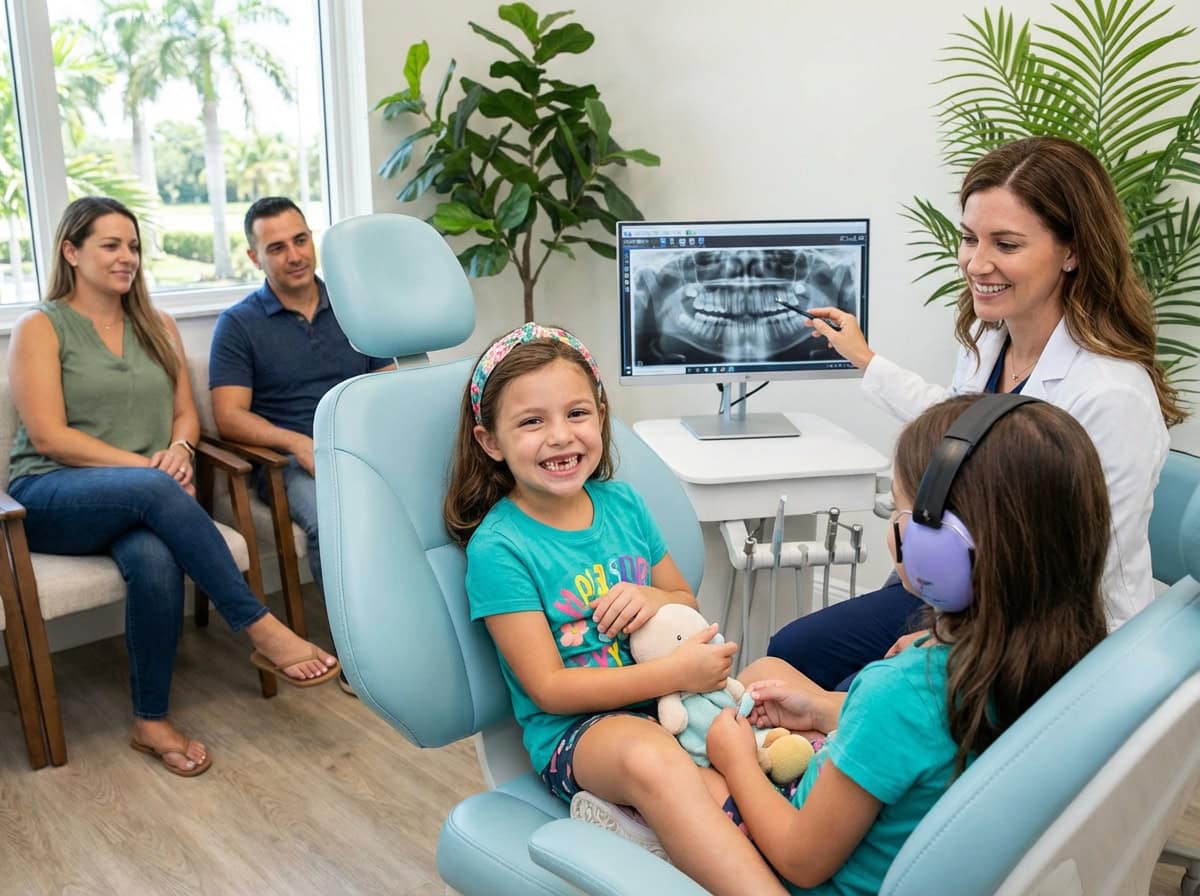
What Actually Happens at Your Phase 1 Orthodontic Screening in Miramar
When you bring your second grader to SMILE-FX in Miramar for their first orthodontic evaluation, here's what to expect.
A comfortable conversation where our board-certified orthodontist talks with you and your child about growth patterns and bite development.
Visual assessment of how teeth are coming in, jaw alignment, and any habits like mouth breathing or thumb sucking that might affect growth.
Low-dose digital imaging if needed—quick, painless, and minimal radiation exposure.
A clear recommendation: "Let's monitor," "Consider Phase 1 treatment," or "No treatment needed yet."
That's it.
No pressure.
No sales pitch.
Just expert guidance based on what we actually see.
Signs Your Child Might Benefit From Phase 1 Treatment Between Ages 6 and 10
Not every kid needs Phase 1 orthodontics.
But if your child shows these patterns, early intervention can prevent bigger problems down the road.
Crossbite: Upper teeth bite inside lower teeth, which affects jaw development.
Severe crowding: Teeth overlapping significantly, making cleaning difficult.
Underbite or overbite: Jaw alignment issues that worsen with growth.
Mouth breathing: A chronic habit that affects palate and tooth development.
Thumb sucking or tongue thrust: Still happening at age 6 and beyond can push teeth out of alignment.
One-sided chewing: Could indicate jaw imbalance.
If your child has one or more of these signs, a free Phase 1 evaluation gives you clarity and peace of mind.
If they don't, you still get expert reassurance that their smile is developing normally.
The difference between catching these issues early and waiting is huge.
Early detection means your child's jaw can be guided during the growth years.
After growth stops, your options get limited and way more expensive.
When Your Child Doesn't Need Treatment Yet—And That's Totally Okay
Here's what sets SMILE-FX apart: we tell parents the truth, even when it means no treatment yet.
A healthy 7-year-old with normal bite development?
We'll document it, explain what we're monitoring, and recommend a check-in in 12 to 18 months.
No fabricated urgency.
No unnecessary treatment.
Just honest, expert guidance.
This builds trust because you know we're recommending treatment based on your child's actual needs, not our schedule.
Parents appreciate this approach because it shows we care about their wallet and their kid's actual health, not hitting revenue targets.
Phase 1 vs. Phase 2 Orthodontics: Understanding the Two-Stage Treatment Timeline
If Phase 1 treatment is recommended, here's how it typically works.
Phase 1 happens between ages 6 and 10 and focuses on guiding jaw growth and creating space for permanent teeth.
This phase often uses expanders, partial braces, or functional appliances.
It typically lasts 12 to 18 months.
The goal is preventing future extractions or surgery.
Phase 2 happens between ages 11 and 14 and beyond.
This phase aligns all permanent teeth and refines the bite.
Full braces or clear aligners are the typical tools here.
Phase 2 usually takes 18 to 24 months.
The goal is completing the smile your child will have for life.
Two-phase treatment is strategic.
It's not about putting braces on younger kids.
It's about using the growth window when the jaw is still malleable, then finishing comprehensively when permanent teeth are all in.
Think of it as setting the foundation first, then building the structure.
By the time your child hits their teenage years, their teeth and jaw have developed optimally.
Phase 2 becomes refinement, not correction.
Why Broward County Families Choose SMILE-FX for Early Orthodontics
Parents from Miramar, Pembroke Pines, Hollywood, Weston, and across South Florida choose SMILE-FX for pediatric orthodontics because we do things differently.
Board-certified orthodontists only.
Not general dentists offering braces as a side service.
Our specialists train specifically in jaw growth and child development.
Pediatric-first experience.
We design every appointment for how kids actually think and feel, not how adults do.
Honest evaluations.
We recommend treatment only when it genuinely helps, which builds more trust and leads to more families choosing us.
Comfort-first environment.
Noise-canceling headphones, virtual reality experiences, weighted blankets, games, snacks, and private suites so your child feels safe.
Growth expertise.
We partner closely with pediatric dentists across Broward because they trust our judgment with their youngest patients.
When a pediatric dentist in Fort Lauderdale or Davie refers a child to SMILE-FX, they're entrusting us with their patient relationships.
That doesn't happen by accident.
It happens because we consistently deliver expert, ethical care.
Real Questions Parents Ask About Phase 1 Orthodontics for Kids
If I wait until my child is older, won't they just need braces then anyway?
Sometimes, yes.
But Phase 1 treatment can prevent extractions, reduce surgery risk, and shorten Phase 2 time.
We only recommend it if the benefit justifies the investment.
Does my child really need Phase 1, or is this a money grab?
Valid question.
We encourage skepticism.
Bring in a second opinion.
If another board-certified orthodontist agrees with our assessment, you have your answer.
If they don't, we respect that too.
Your child's care comes first.
How much does Phase 1 treatment cost?
Phase 1 typically ranges $3,000 to $5,000 depending on complexity and appliances needed.
Most insurance covers 50%, and we offer flexible payment plans.
At your free consultation, we'll give you exact numbers with no surprises.
Will my child feel self-conscious about wearing braces in elementary school?
Some kids do, some don't.
We've seen second graders proudly tell their friends about their "tooth movers" and fourth graders who barely mention it.
We focus on comfort and normalizing treatment so your child feels confident, not worried.
What if I don't want Phase 1 and just want to wait until Phase 2?
That's your call.
If early intervention isn't needed, we won't push it.
If it is needed and you choose to wait, we monitor growth and adapt our Phase 2 plan accordingly.
Sometimes that works great.
Sometimes it means more complexity later.
We explain the tradeoffs and let you decide.
How often does my child need to come in?
Phase 1 appointments are typically every 6 to 8 weeks for adjustments and progress checks.
We schedule around school, activities, and family life.
Our Miramar location offers morning, afternoon, and early evening hours to fit your family's routine.
The Real Outcome of Phase 1 Orthodontics: Growth Guidance, Not Just Straighter Teeth
Here's what parents often don't realize: Phase 1 orthodontics is less about making teeth perfect early and more about guiding the jaw while it's still growing.
A child who gets Phase 1 treatment often experiences better jaw alignment and bite function as they grow.
You'll see reduced need for extractions later.
Phase 2 treatment time gets shorter, which means faster to their final smile.
Breathing and speech patterns improve if mouth breathing was an issue.
Most importantly, your child gets more confidence throughout adolescence.
The subtle win?
By the time your child is 14, their teeth and jaw have developed optimally.
Phase 2 becomes refinement, not correction.
That's the difference between strategic early care and waiting until crisis mode.
Why This Matters for Your Family in South Florida
Broward County families have choices.
You could go to a general dentist offering braces, a high-volume provider, or a board-certified specialist who treats your child like a growing human, not a billing code.
SMILE-FX exists for families who want the best for their kids and aren't willing to compromise.
We're worth the drive from Pembroke Pines, Hollywood, Weston, Cooper City, or Davie because we combine cutting-edge technology like low-dose digital imaging, 3D treatment planning, and precision appliances with genuine pediatric expertise and a child-first environment.
Your child spends 18 years plus in their smile.
Phase 1 orthodontics is an investment in growth guidance during the years when you can actually influence that growth.
After that window closes, your options become more limited and more expensive.
That's just how biology works.
Your Next Step: A Free, No-Pressure Orthodontic Evaluation
If your child is 6 to 8 years old and you've been wondering whether they need early orthodontics, book a free evaluation at SMILE-FX.
We'll assess their growth pattern, explain what we see, and give you clear recommendations, not because we need the business, but because you deserve to know.
Most families leave that first appointment either relieved (their child's smile is developing normally) or informed (here's why Phase 1 makes sense for your child).
Either way, you have clarity.
That's the SMILE-FX difference: expertise you can trust, honesty you can rely on, and a pediatric environment where your child actually wants to come back.
Ready to give your child the advantage of early orthodontic guidance and set them up for a lifetime of confident smiles?
Book your FREE 3D scan and VIP smile consultation here at SMILE-FX Orthodontic & Clear Aligner Studio.
We offer in-person visits in Miramar or virtual consultations if you're more comfortable starting that way.
We'll show you what expert pediatric orthodontic care actually looks like and help you understand whether early Phase 1 orthodontics makes sense for your child's unique smile journey.
Orthodontic Treatment Options Beyond Phase 1: Braces, Clear Aligners, and Invisalign for Every Age
So you've done the Phase 1 screening.
Your kid's growth pattern is solid.
Now what?
Or maybe your teenager never needed Phase 1, and you're looking at what comes next.
The real question isn't whether your child needs orthodontic treatment.
It's which treatment option actually fits your family's life.
Understanding Your Orthodontic Treatment Options for Kids and Teens
There's this myth that braces are your only choice if you want serious results.
It's not true anymore.
At SMILE-FX Orthodontic & Clear Aligner Studio, we offer multiple pathways to straight teeth and healthy bites.
The key is matching the right tool to your kid's specific situation, age, and lifestyle.
Think of it like this: you wouldn't use a hammer to paint a wall.
Same principle applies here.
The most expensive option isn't always the best option.
The most invisible option isn't always the fastest option.
Your job as a parent is understanding what each choice actually does, then deciding what makes sense for your family's priorities.
Traditional Braces: Still the Gold Standard for Complex Cases
Let's be real: braces work.
They've been working for decades, and they're still the most powerful tool we have for certain bite problems.
Metal braces use brackets and wires to move teeth with precision.
Ceramic braces do the same thing but blend in better with your tooth color.
The mechanics are straightforward: apply consistent, gentle pressure over time, and teeth move where you want them to go.
Your kid might need traditional braces if they have:
Severe crowding where teeth overlap badly.
Complex bite issues like significant underbites or crossbites.
Teeth that need to move vertically or rotate dramatically.
Situations where clear aligners can't physically achieve the result.
Here's what surprises most parents: kids adjust to braces faster than you'd think.
Sure, the first week is different.
Your child notices them constantly, worries about food getting stuck, and feels self-conscious.
By week three, it's normal.
By month two, they barely think about it.
We've seen kids in Miramar and across Broward County rock their braces like badges of honor.
They'll tell their friends about their upcoming adjustment appointments.
They'll show off their new wire colors.
When you normalize treatment, kids don't internalize it as something to be ashamed of.
Treatment time with traditional braces typically runs 18 to 24 months, depending on complexity.
Your child comes in every 6 to 8 weeks for adjustments.
We monitor progress closely and tweak the plan as teeth move.
Clear Aligners and Invisalign: The Convenience Play
Invisalign and clear aligner technology changed the game for mild to moderate bite problems.
These are custom-made plastic trays that fit snugly over your child's teeth.
You swap out for a new tray every one to two weeks.
They're nearly invisible, removable for eating and cleaning, and feel less restrictive than braces.
Clear aligners work best when:
Crowding is mild to moderate.
Your child has good bite alignment but wants straighter teeth.
The issue is primarily cosmetic, not structural.
Your child is mature enough to wear them consistently (usually age 13 and up, though we can do it younger with supervision).
Here's the trade-off: clear aligners move teeth by applying gentler force than braces.
That means slightly longer treatment time in many cases.
Invisalign typically takes 12 to 24 months depending on the case.
Your child has to actually wear them 20+ hours a day for them to work.
If your kid is the type to skip wearing them, the treatment fails.
It's not the appliance's fault; it's the compliance issue.
Real talk: we've had families choose clear aligners because they're less noticeable, then realize their child isn't wearing them enough.
We catch it at check-ins and adjust the plan.
Sometimes that means switching to braces to guarantee results.
Sometimes it means being stricter about compliance.
Clear aligners also don't work great for severe bite problems, complex rotations, or vertical tooth movements.
They're precision tools for precision problems, not sledgehammers for heavy lifting.
Why Treatment Type Matters More Than You Think
Parents often pick treatment based on aesthetics alone.
"I want invisible treatment because my kid is self-conscious."
That's valid.
But if clear aligners can't actually fix your child's specific bite problem, being invisible doesn't matter.
You're paying for a slower or incomplete result.
Our board-certified orthodontists assess your child's case and recommend treatment based on what will actually work best, not what's trendiest.
Sometimes that's braces.
Sometimes that's clear aligners.
Sometimes it's a combination: maybe Phase 1 expansion, then clear aligners for finishing, or braces for heavy lifting, then aligners for refinement.
The point is matching the mechanism to the problem.
Your child's teeth aren't a status symbol.
They're a functional system that needs to work right.
What About Teens and Adults? Age Doesn't Stop Orthodontics
Here's something that blows people's minds: you can get orthodontic treatment at any age.
We treat teens, young adults, parents, and grandparents.
The biological principle is the same: apply consistent pressure, and bones remodel.
Age doesn't really matter for the science.
What changes is jaw growth (adults don't have it, so results are purely tooth movement) and treatment options available.
Teens have more flexibility.
They're still growing, so orthodontists can work with that growth.
They can wear braces or aligners.
Some teens even benefit from combination approaches.
Adults can do braces or clear aligners, but growth isn't a factor.
Some complex adult cases might need orthognathic surgery (jaw surgery) to fix skeletal problems that can't be corrected with tooth movement alone.
That's rare and typically only happens with severe bite problems.
Your teenager asking about braces in high school?
Totally normal.
Your adult asking about straightening teeth?
Also totally normal and increasingly common.
The Technology Factor: How We Plan Your Child's Treatment
Modern orthodontics isn't guesswork.
We use 3D imaging and digital treatment planning to show your child exactly what their smile will look like after treatment.
Before we start anything, we take a 3D scan of your child's mouth.
We map out the exact positions of every tooth and the underlying bone structure.
Then we use software to simulate the treatment plan.
Your child sees a digital preview of their future smile.
This does three things:
It ensures accuracy in planning.
It shows your child what to expect, which builds buy-in and compliance.
It catches potential problems before they happen.
We can compare different treatment approaches digitally before committing to one.
"If we use braces, here's the outcome. If we use aligners, here's the outcome."
Your family sees the differences and can make an informed choice.
Insurance, Cost, and Making Treatment Affordable
Let's address the elephant in the room: cost.
Orthodontic treatment isn't cheap.
Full braces or aligners typically run $3,500 to $7,000 depending on complexity and duration.
But here's what most families don't know: insurance often covers 50% of treatment costs.
Some plans cover more.
Some cover less.
We verify your coverage before treatment starts so there are no surprises.
We also offer flexible payment plans.
You can split payments over 12, 18, or 24 months.
We work with families to make treatment fit their budget, not just their smile.
Think of it as an investment.
Your child's teeth affect how they chew, how they speak, how they breathe, and how they feel about themselves.
Straight teeth and a healthy bite aren't cosmetic luxuries.
They're functional necessities.
Caring for Your Child's Teeth During Orthodontic Treatment
Whether your kid gets braces or aligners, tooth care becomes more important, not less.
With braces, cleaning takes longer because you have to brush around brackets and wires.
Many kids get better at oral hygiene during treatment because they're more mindful of their teeth.
With clear aligners, you remove them to eat and clean.
That's simpler in some ways but requires discipline.
Your child has to remember to put them back in after every meal.
We teach proper cleaning techniques during appointments and send home guides so your child understands what they're doing and why.
Good oral hygiene during treatment means fewer cavities, faster tooth movement, and better final results.
Treatable Cases and When We Might Say No
We treat a wide range of cases, but some situations need specialist input beyond orthodontics.
If your child has severe skeletal problems, we might recommend consultation with an oral surgeon before starting orthodontic treatment.
If there are undiagnosed dental health issues, we address those first.
If a child has behavioral or sensory challenges that make traditional treatment difficult, we talk about options and accommodations.
We're honest about what we can and can't do.
It builds trust when you know we're telling you the truth, not just trying to book you for treatment.
Common Questions Parents Ask About Choosing Treatment
Will my child's teeth relapse after treatment?
Not if we do retention right.
After active treatment, your child wears a retainer for life.
Some kids wear it nightly, some wear it every few nights.
The retainer holds teeth in their new position while bone adapts to the new alignment.
Skip the retainer, and yes, teeth shift back over time.
Which treatment is faster?
Braces often move teeth slightly faster than aligners because of the force differential.
But compliance matters more than the appliance.
A kid who wears aligners 20+ hours daily might finish faster than a kid who skips braces appointments.
Can my child play sports with braces?
Yes, but we recommend a mouthguard that covers the braces.
Clear aligners are easier for sports because you can remove them during games or practices.
What if my child hates their treatment halfway through?
We talk about it.
Sometimes it's just adjustment period and they get over it.
Sometimes we can switch approaches.
Treatment is a partnership between you, your child, and us.
We don't force kids through something they hate.
The Real Difference Between Good and Great Orthodontic Care
You can get braces at plenty of places.
What you can't get everywhere is genuine expertise combined with a kid-first environment.
At SMILE-FX, our orthodontists specialize in kids and teens.
We understand their psychology, their fears, their energy levels.
We design our office, our appointments, and our approach around making orthodontics feel normal and manageable, not scary.
We use cutting-edge technology like digital planning and precision appliances.
We're not cutting corners or using outdated methods just because they're cheaper.
Your child's smile is worth the investment in quality tools and expertise.
We also listen.
Your priorities matter.
If you need clear aligners for social reasons, we'll try aligners and optimize the plan to make them work.
If you need speed, we'll tell you braces are your best bet.
If you need flexibility in appointments because of school and activities, we accommodate that.
What Your First Consultation Actually Looks Like
You come in with your child.
We chat about their concerns, your concerns, and what you're hoping to accomplish.
We do a visual assessment and take 3D scans if needed.
We review the images with you and explain what we see.
Then we show you treatment options with digital previews.
Your child sees what each option would look like.
You see cost, timeline, and pros and cons.
Then we schedule your next appointment or send you home to think about it.
No pressure.
No sales pitch.
Just clear information so you can make the best choice for your family.
Getting Started: Your Child Deserves a Confident Smile
Whether your child is 8 years old and ready for Phase 2, a teenager thinking about braces for the first time, or anywhere in between, the right time to start is now.
Delaying treatment doesn't save money.
It often costs more because problems get bigger and take longer to fix.
Waiting also means your child spends more years feeling self-conscious about their teeth instead of feeling confident.
Book your FREE 3D scan and VIP smile consultation here at SMILE-FX Orthodontic & Clear Aligner Studio.
We'll assess your child's bite and growth pattern.
We'll show you treatment options with digital previews.
We'll explain costs and timelines with total transparency.
We'll answer every question you have.
We serve kids and teens across Broward County, from Miramar to Pembroke Pines to Hollywood and beyond.
We also offer virtual consultations if you want to start that way.
Your family deserves board-certified orthodontist expertise, cutting-edge technology, and a genuinely child-friendly environment where your kid actually wants to show up.
That's what SMILE-FX delivers.
Book your free consultation for braces, clear aligners, Invisalign, and comprehensive orthodontic treatment for kids, teens, and adults today.
Long-Term Smile Maintenance: What Happens After Your Orthodontic Treatment Ends
Your child gets their braces off.
You take the celebratory photo.
Everyone smiles.
Then reality hits: now what?
This is the part nobody really talks about, and it's the most important part.
Getting teeth straight is one thing.
Keeping them straight for life is everything.
If you're thinking about orthodontic treatment at a best orthodontist South Florida location or wondering about affordable braces Broward options, you need to understand what comes after the treatment ends.
Why Retention Is Not Optional: The Science Behind Teeth Shifting
Here's what happens inside your mouth after braces come off.
Your teeth have been in their new position for months or years.
But the bone surrounding those teeth is still remodeling.
Your periodontal ligaments, which hold teeth in place, need time to adapt.
Without something holding those teeth steady, they'll drift back toward where they started.
It's not a failure of treatment.
It's just biology.
Think of it like moving to a new house.
You unpack and arrange everything.
But if you don't anchor your furniture to the walls, gravity and time will shift things back.
That's where retainers come in.
At SMILE-FX Orthodontic & Clear Aligner Studio, we don't just remove braces and send you home.
We fit your child with custom retainers and explain exactly how to use them.
This is the moment that determines whether your investment stays locked in or slowly falls apart over years.
The Two Types of Retainers: Fixed vs. Removable
Most patients get a combination of both.
Fixed retainers are thin wires bonded to the back of your child's front teeth.
They're permanently attached and do their job 24/7 without any effort from your kid.
No compliance issues.
No forgetting to wear them.
Just constant, gentle retention.
The downside?
They can break if your child gets hit in the mouth during sports, or they can come loose if not cared for properly.
We monitor them at regular checkups and repair or replace them as needed.
Removable retainers come in two styles.
Hawley retainers are the traditional type with a wire and acrylic base.
They're durable, adjustable, and last for years.
Some people think they look bulky, but they work incredibly well.
Clear retainers, also called Essix or vacuum-formed retainers, look invisible and feel like thin plastic trays.
They're similar to aligners but thicker and designed for holding teeth in place, not moving them.
They're less visible but wear out faster than Hawley retainers and need replacing every 12 to 18 months.
We typically recommend both.
Your child wears the fixed retainer all the time on the back of their front teeth.
They wear the removable retainer at night for the first year after treatment, then every few nights after that.
This two-pronged approach gives maximum protection.
How Often Does Your Child Actually Need to Wear Their Retainer?
Here's the real answer: it depends on your child's teeth and age.
Right after braces come off, we're in the most critical period.
Teeth are most prone to shifting.
We recommend nightly wear for the first 12 months.
After that, it drops to every other night or a few nights a week for the next year.
After two to three years, many patients can get away with wearing retainers just a few times a week.
But here's the thing: some teeth want to shift more than others.
If your child had severe crowding, their teeth are more aggressive about moving back.
They might need to wear a retainer every night for life.
If your child had mild crowding, they might be able to drop down to a few times a week after the first couple years.
We work with each patient individually to find the frequency that keeps their smile locked in.
The key is consistency, not perfection.
Missing one night is fine.
Skipping three months straight is how people end up needing braces again.
Retention and Insurance: Does It Cost Extra?
Most orthodontic insurance plans cover retainers as part of active treatment.
But here's what trips people up: replacement retainers after the initial pair aren't always covered.
Clear retainers wear out and need replacing every 12 to 18 months.
The cost is usually $100 to $200 per pair.
Fixed retainers can break and need repair or replacement, typically $100 to $300.
At SMILE-FX, we keep replacement costs reasonable and work with patients on $0 down braces financing South Florida to make retention affordable.
Think of it like car maintenance.
The initial purchase is the big expense.
Keeping it running costs way less if you stay on top of it.
What Happens If Your Child Skips Retainer Wear: Real Stories
I've seen it dozens of times.
A patient gets braces off at age 14, wears their retainer religiously for a year, then forgets about it.
By age 17, their teeth have shifted noticeably.
They come back to us frustrated because they think they wasted the money on braces.
But they didn't waste it.
They just stopped maintaining it.
It's like expecting a car to run perfectly for five years without oil changes.
One patient I remember was a 16-year-old athlete who lost his fixed retainer playing football.
He meant to get it replaced but kept putting it off.
By the time he came back six months later, his bottom front teeth had shifted enough that it bothered him.
We replaced the retainer, but he lost some of the gains from treatment.
The lesson: retention isn't something that happens to you.
It's something you actively do every day.
The good news?
Once your child builds the habit, it takes zero effort.
Brushing teeth, brushing retainers, going to bed.
It becomes part of the routine.
Caring for Retainers: The Maintenance Your Child Needs to Know
Removable retainers need cleaning just like teeth do.
Every morning after your child takes them out, they should brush the retainer gently with a toothbrush.
Once or twice a week, soak the retainer in a cleaning solution designed for retainers.
Don't use hot water because it can warp them.
Don't leave them sitting in a backpack or locker for days because bacteria grows.
Don't throw them in your mouth while eating or drinking anything but water because food particles get trapped and cause decay underneath.
Fixed retainers need similar care.
Your child should floss around them daily, even though it's slightly annoying.
If they notice the wire feels loose or a section came unstuck from the tooth, call us immediately.
A loose fixed retainer is like a leaking roof: the longer you wait, the more damage happens underneath.
Orthodontic Checkups After Treatment: Stay Connected
After braces come off, we still want to see your child.
Schedule a retainer checkup every six months for the first year, then once a year after that.
We're not trying to squeeze money out of you.
We're monitoring to make sure retention is working and catching problems early if they happen.
During these visits, we check the fit of your removable retainers, make sure your fixed retainer is secure, and take photos to track whether teeth are staying in place.
If we notice any shifting, we can address it before it becomes a bigger issue.
When Your Child Gets a New Removable Retainer: What to Expect
If your child needs a replacement retainer, we take a new impression or 3D scan of their teeth.
Then we fabricate a new retainer that matches