
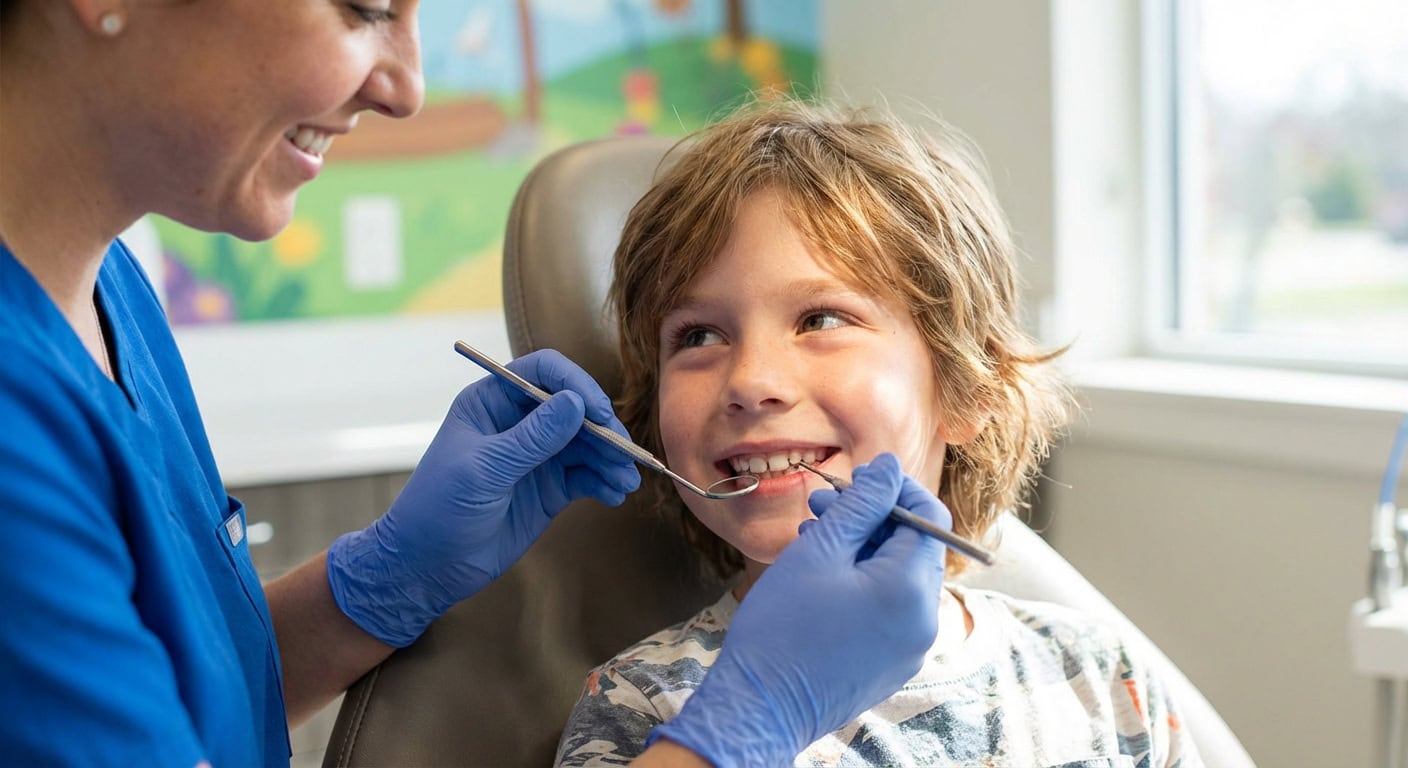
Phase 1 Orthodontics in Miramar: Why Age 7 Matters for Your Child's Smile
Your seven-year-old loses a tooth, and you think: "Great, time for the tooth fairy." But here's what most parents in Miramar don't know—this is also the exact moment a pediatric orthodontist is watching for something critical. Around age 7, your child's permanent teeth are beginning their journey into their mouth, and a trained eye can spot problems years before they become expensive, complicated situations.
This isn't about rushing treatment. It's about smart parenting. The American Association of Orthodontists (AAO) recommends every child have their first orthodontic evaluation by age 7—not because all kids need braces, but because some do benefit from early intervention, and catching those cases early changes everything.
Why Your Child's Age 7 Evaluation Matters (Without the Fear)
At age 7, your child is at what we call the "mixed dentition" stage—they have both baby teeth and permanent teeth coming in. This is the sweet spot for us to see how their jaw is developing and whether their permanent teeth have enough space to erupt properly.
Think of it like foundation work on a house. It's easier to correct a foundation issue before the whole structure is built. Same idea here. If we spot a developing overbite, crossbite, or crowding early, we can guide your child's natural growth to prevent or reduce the need for more complex treatment later.
Phase 1 Orthodontics (also called interceptive orthodontics) takes advantage of your child's growth. Between ages 6 and 10, kids' jaws are still actively developing. That growth is a tool we use—not to force teeth straight, but to guide development in the right direction.
When you catch these issues early, you're literally working with nature instead of against it. The goal isn't to have perfect teeth at age 7. The goal is to set up your kid's mouth so that when all the adult teeth come in, they have a fighting chance at a healthy, straight smile.
What Problems Can Phase 1 Orthodontics Actually Catch?
Not every child needs Phase 1 treatment. But here are the signs we look for during that first evaluation:
- Crowding—Permanent teeth don't have enough room and are coming in at angles
- Crossbite—Upper teeth bite inside the lower teeth instead of outside
- Open bite—Front teeth don't touch when the back teeth are closed
- Mouth breathing—Your child breathes through their mouth instead of their nose (often linked to jaw development issues)
- Thumb sucking after age 5—Persistent thumb sucking can affect how teeth and jaws develop
- Severe spacing—Gaps between baby teeth that suggest larger permanent teeth won't fit
Here's what matters: even if your 7-year-old shows one of these signs, it doesn't automatically mean treatment starts tomorrow. It means we monitor and plan. Sometimes a child's natural growth solves the problem. Sometimes we step in with simple Phase 1 appliances. And sometimes we wait and watch, with a clear plan for the future.
The key is knowing where your kid stands. And you can't know that without getting them evaluated.
What Actually Happens at Your Child's First Orthodontic Visit
Parents worry that an orthodontic visit means a stressful experience for their child. At SMILE-FX, we've designed the process around one principle: kids should feel safe, heard, and not scared.
Time to expect: 30–45 minutes for the first visit. Nothing rushed, nothing stressful.
What we do: We take photos, do a gentle visual exam, and may take low-dose digital X-rays to see how the teeth and jaw are developing. All our imaging uses modern technology that minimizes radiation exposure—we're talking about the same radiation you'd get from a few hours of sunlight, not something to worry about.
Our cutting-edge technology means we see things in detail that older equipment just can't pick up. That translates to better treatment plans and fewer surprises down the road.
How we keep kids comfortable: Our Miramar office has weighted blankets, noise-canceling headphones, a VIP suite designed for kids, and screens showing their favorite shows during exams. Some kids get anxious about X-rays—we explain exactly what's happening and let them control the pace. Many practices rush kids through. We don't.
After the exam, you sit down with our orthodontist—who is board-certified and specializes in pediatric cases—and we talk about what we found. No pressure. Just facts and options.
Does Your Child Actually Need Phase 1 Treatment?
This is the question parents worry about. And honestly? Not every child does. And we'll tell you that directly.
Some children have perfect spacing and jaw alignment at 7. Others have minor crowding that will resolve on its own as their adult teeth erupt. Some have significant issues that benefit from early intervention.
The goal of Phase 1 is never to straighten teeth completely at this age. Instead, it focuses on three things:
- Creating space for permanent teeth to erupt correctly
- Guiding jaw growth to improve bite relationships
- Reducing the severity of crowding or bite problems later
If your child does need Phase 1, treatment typically lasts 12–24 months. Then there's a rest period where we monitor growth. Later, around age 11–13, most kids move into Phase 2 (comprehensive braces or clear aligners) to finish the alignment.
If your child doesn't need Phase 1? We still want to see them again in a year or two to monitor development. Growth happens fast at this age, and what's fine at 7 might need attention at 9.
Why Parents Trust SMILE-FX for Their Child's Orthodontic Care
You have options. There are general dentists offering braces, big-volume Invisalign mills, and other orthodontists across Broward. Here's why families trust us with their kids:
Board-certified specialists, not general dentists. Our orthodontists have completed additional specialty training in orthodontics. We're not dentists who also do braces—we're orthodontists, period. That distinction matters when your child's jaw is still developing.
We're the trusted partner of pediatric dentists across South Florida. The pediatric dentists in your area know our work. They refer their own kids to us. That's not marketing—that's earned trust from people who understand pediatric care.
Cutting-edge technology with a gentle touch. We use advanced digital imaging, AI-assisted treatment planning, and the latest in interceptive techniques. But none of that replaces the experience of working with kids day in and day out. Technology matters. So does knowing how to talk to a scared 7-year-old.
We're honest about what kids actually need. We won't recommend Phase 1 treatment just because it's profitable. If we think your child should wait and monitor, we say so. Parent trust is built on that kind of honesty.
When you book a FREE 3D scan and VIP smile consultation, you get to experience this firsthand. No pressure, no upsell—just a real conversation about your kid's smile.
Real Questions Parents Ask (Answered Honestly)
Q: Won't my child's baby teeth just fall out anyway? Why worry about crowding now?
A: Baby teeth do fall out, but they act as placeholders for adult teeth. If a baby tooth is lost early (due to decay or accident), the teeth on either side shift inward, stealing space. Also, baby teeth guide the eruption of permanent teeth. If baby teeth are severely crowded, it usually means permanent teeth will be too—space doesn't magically appear just because teeth get larger. That's why early evaluation matters.
Q: What's the difference between seeing a general dentist and an orthodontist for this evaluation?
A: A good general dentist can spot obvious problems. But diagnosing growth patterns, planning interceptive treatment, and predicting how the jaw will develop requires specialty training. It's like the difference between a family doctor and a cardiologist—both are doctors, but one has deeper expertise in one area. For your child's developing teeth and jaw, that expertise matters.
Q: Is low-dose digital X-ray imaging really safe for kids?
A: Yes. Modern digital X-rays (which we use exclusively) expose kids to about 1/10th the radiation of older film X-rays. For context, a child receives more radiation from a few hours in the sun. We take X-rays only when we need diagnostic information—not as routine.
Q: My child is nervous about the dentist. Will an orthodontic appointment be scary?
A: Many kids with dental anxiety feel better in an orthodontic setting because we're not doing anything painful or uncomfortable at the first visit. We're looking, taking photos, and talking. Our office is designed for kids, our staff has years of experience with anxious kids, and we give kids control over the pace. If your child has significant anxiety, tell us before the appointment. We have strategies to help.
Q: How much does a Phase 1 evaluation cost?
A: Your first orthodontic consultation at SMILE-FX is free. There's no catch. If we recommend treatment, we'll discuss cost clearly and explain your options. If we recommend monitoring and waiting, that's what we'll say.
Q: Should I wait until all baby teeth fall out before seeing an orthodontist?
A: No. By then, crowding problems are already established and harder to fix. The AAO recommends age 7 evaluation specifically because this is the optimal window for early intervention if needed. Waiting until age 12 or 13 limits your options.
What Happens Next? Your Child's Orthodontic Timeline
After that first evaluation, here's the typical path for families in Miramar and the greater Broward area:
Months 1–3: Consultation and planning. If Phase 1 is recommended, we discuss timing, costs, and what to expect. If monitoring is the plan, we schedule a follow-up in 12–18 months.
Phase 1 (if recommended): Usually 12–24 months. Your child might wear a palatal expander, partial braces, or other appliances designed to guide growth. This is simple, predictable, and kids adapt quickly.
Rest period: 6–12 months of monitoring. Permanent teeth continue erupting, and we watch how the bite develops.
Phase 2 (usually age 11–14): Comprehensive braces or Invisalign to perfect the alignment and finish what Phase 1 started.
This staged approach is why early evaluation pays off. By starting with a clear picture at age 7, we reduce surprises later and often reduce the total time in treatment.
Why Families Across South Florida Choose SMILE-FX
You might pass by other orthodontists closer to home. Many families from Pembroke Pines, Weston, Cooper City, and Davie drive to our Miramar location anyway. Why?
Because finding an orthodontist you trust with your child's smile is worth the drive. It's not about picking the closest option—it's about picking the best option. Families across South Florida do that math and choose SMILE-FX.
Our location in Miramar is central to greater Broward, and we offer flexible pediatric scheduling because we know parent life is hectic. Early morning appointments, minimal wait times, and a team that gets that you're busy—that's part of the package.
Check out our patient reviews to see what families are saying about their experience with us. Real parents, real results, real feedback.
Your Next Step: Book Your Child's Free Evaluation Today
If your child is between 6 and 10, or if you've noticed any of the signs mentioned above, now's the time to schedule that first evaluation. Not because we're trying to sell you treatment, but because knowledge is power. Knowing how your child's teeth and jaw are developing gives you options and peace of mind.
Your free orthodontic consultation includes a full evaluation, 3D scan, photos, and an honest conversation about what your child needs—which might be Phase 1 treatment, monitoring, or nothing at all.
We also offer virtual consultations if you want to start with questions answered on your timeline, right from home.
Your child's smile is built during these early years. Phase 1 orthodontics in Miramar gives your kid the best foundation possible. Let's make sure it's built right.
Understanding Clear Aligners vs Braces: What Works Best for Your Teen or Adult Smile
You're standing in front of the mirror, and you're thinking about fixing your smile.
But you're not sure which option to pick.
Braces or clear aligners?
Both can straighten your teeth.
Both take time.
But they work differently, feel different, and fit into your life differently.
Let's be real about what you're actually choosing between.
The Clear Aligner Question Parents and Adults Keep Asking
Clear aligners hit the market and suddenly everyone wanted them.
No metal brackets.
No visible wires.
You can eat whatever you want.
Sounds perfect, right?
But here's what people don't talk about: they're not right for every situation, and they're definitely not right for every person.
Same with traditional braces.
They've been around for decades because they work.
But they're not invisible, and they come with real lifestyle adjustments.
The honest answer? It depends on what you actually need.
A shallow bite that's slightly crooked? Aligners could work great.
A kid with a severe bite problem who likes sports and won't stop eating candy? Braces are probably the play.
An adult who's disciplined and willing to wear aligners 22 hours a day? Could be perfect.
Let's break down what's actually different between these two approaches, so you can stop guessing and start knowing.
How Clear Aligners Actually Work (And What Can Go Wrong)
Clear aligners move teeth through a series of custom trays.
You wear one for about two weeks, then switch to the next.
Each tray is slightly different, moving your teeth incrementally.
It's like a slow, steady nudge in the right direction.
The process looks like this:
- Your orthodontist takes a 3D scan of your teeth
- Computer software maps out the entire movement path
- A lab creates 20 to 60 aligners based on that plan
- You wear them in sequence, changing every 10 to 14 days
- Check-ins happen every 6 to 8 weeks
Here's the catch: clear aligners only work if you wear them.
And I mean actually wear them.
22 hours a day.
That means two hours for eating and cleaning, max.
Most people who fail with aligners don't fail because the aligners don't work.
They fail because life gets busy, you forget, you think one night without them won't matter, and suddenly you're not tracking with your treatment plan.
Also, aligners can't handle every type of bite problem.
Severe rotations, extreme overbites, complex bite issues? Aligners struggle.
That's not a knock on them.
It's just reality.
There are things aligners can't do that traditional braces handle easily.
The Real Deal With Traditional Braces
Braces are straightforward.
A bracket gets bonded to each tooth.
A wire runs through all the brackets.
That wire gets tightened gradually, creating the force that moves teeth.
Why do orthodontists still use them after decades?
Because they work on almost everything.
Severe crowding? Braces handle it.
Complex bite problems? Braces are the answer.
Rotated teeth that won't budge? Braces apply the kind of sustained force aligners can't.
The downside is obvious: everyone sees them.
Metal brackets, metal wires, rubber bands sometimes.
For some people, that's a dealbreaker.
For others, especially younger kids, it's just part of the process.
But here's something most people miss: braces actually come in different styles now.
- Traditional metal braces are still the fastest and most affordable option
- Ceramic braces blend with your teeth better, but they're pricier and can stain if you're not careful
- Lingual braces go on the back of your teeth, so they're hidden, but they're expensive and harder to keep clean
If you're concerned about how braces look, ask about ceramic or lingual options.
They solve the visibility problem while giving you the power of traditional braces.
Cost, Speed, and Convenience: How They Actually Stack Up
Let's talk about what this actually costs you in money and time.
Clear aligners typically run between $3,000 and $8,000 depending on complexity.
Treatment usually takes 12 to 18 months for simpler cases, up to 24 months for more involved work.
You're paying convenience tax here.
The invisibility and flexibility cost more than traditional braces.
Traditional braces typically run between $3,000 and $7,000.
Treatment time is usually 18 to 24 months, sometimes longer for complex cases.
Braces can move teeth faster and handle more complex situations, which sometimes means shorter overall treatment despite the slower monthly progress.
Neither is automatically cheaper than the other.
The real cost difference comes down to what your case actually needs.
On convenience: aligners win if you're disciplined.
You remove them to eat, so no food restrictions.
You clean them easily.
No wire adjustments every six weeks.
But you have to be the kind of person who actually keeps them in your mouth.
Braces mean you can't eat sticky candy, popcorn, or hard nuts.
Adjustments happen every four to six weeks and can mean a few days of soreness.
But you never have to remember anything.
The braces are doing the work whether you think about them or not.
Who Actually Needs What? The Straight Answer
Choose clear aligners if:
- Your bite problem is mild to moderate (slight crowding, spacing, shallow overbite)
- You're willing to wear them 22 hours a day without exception
- You're an adult or a mature teen who won't lose them or skip wearing them
- You want minimal visibility during treatment
- You're okay with regular check-ins to stay on track
Choose traditional braces if:
- Your bite problem is moderate to severe (crowding, rotations, crossbites, overbites)
- You're a younger kid who might not be disciplined enough for aligners
- You want the fastest possible treatment for complex cases
- You want a solution that works without your constant compliance
- You're active in sports and don't want to worry about losing aligners
The bottom line: aligners are great for people with discipline and simpler cases.
Braces are powerful for everyone else.
What About Invisalign Specifically?
Invisalign gets talked about like it's the gold standard of clear aligners.
It's a brand name, same way Kleenex is a brand name for tissues.
It's a good system, backed by Align Technology, which has been doing this longer than most.
But Invisalign isn't the only clear aligner brand, and it's not automatically the best for your specific case.
What matters is finding an orthodontist who knows how to use whatever system they're offering.
A skilled orthodontist with a lesser-known aligner brand might get you better results than an average doctor with Invisalign.
At SMILE-FX Orthodontic & Clear Aligner Studio, we work with multiple aligner systems because different cases work better with different options.
We match the treatment to what your teeth actually need, not just to whatever system is trendy.
The Technology Piece: Why It Actually Matters
Modern orthodontia uses 3D digital scanning and AI-assisted treatment planning.
This isn't marketing fluff.
It actually changes the outcome.
When your orthodontist can see exactly how your teeth will move in three dimensions before treatment even starts, there are fewer surprises.
Fewer refinement trays needed.
Faster treatment.
Better final results.
Offices using old-school impressions and 2D X-rays are flying blind.
They're making educated guesses.
Modern technology removes the guessing.
This applies to both braces and aligners.
Either way, you want an office using current technology.
Kids, Teens, and Adults: Different Ages Need Different Thinking
For kids (ages 7 to 11):
Most orthodontists recommend waiting for comprehensive treatment until most permanent teeth have come in.
But if your child needs early intervention, it's not typically with braces or aligners yet.
It's with specialized interceptive appliances that guide jaw growth.
Clear aligners are rarely appropriate at this age because most kids won't be consistent enough.
For teens (ages 12 to 18):
This is where both braces and aligners make sense.
The question is personality.
Is your teen responsible and mature enough for aligners? If yes, they work great and feel like less of a hassle to a self-conscious teenager.
If no, braces guarantee the work gets done regardless of compliance.
Braces are also faster for complex cases, which matters when you've got college on the horizon.
For adults:
This is where clear aligners have really changed the game.
A 35-year-old who never got their teeth fixed as a kid can do it invisibly with aligners.
No one at work notices.
It feels discreet.
But an adult with a severe bite problem might still need braces for the fastest, most reliable fix.
Adults are also more likely to actually wear aligners 22 hours a day because they understand the commitment.
The Compliance Problem Nobody Talks About
This is the real difference between these two paths, and it gets glossed over constantly.
With braces, your orthodontist does the work.
The brackets and wires move your teeth whether you're thinking about it or not.
The only thing you control is not damaging the braces and keeping them clean.
With aligners, you do the work.
You remember to wear them.
You keep up with changing them on schedule.
You actually put them back in after eating.
If you're someone who loses things, forgets commitments, or struggles with routine, aligners will fail.
Not because they don't work.
But because you won't use them.
Be honest with yourself about which person you are.
Seriously.
Don't let a salesman talk you into aligners because they sound better if you know you won't actually wear them consistently.
Questions About Different Bite Problems and What Treats Them
Q: Can aligners fix an overbite?
A: Mild to moderate overbites, yes.
Severe ones, usually no.
Aligners move teeth within a certain range.
If your jaw position is significantly off, or if your overbite is severe, braces or sometimes braces combined with jaw surgery are the answer.
An orthodontist can tell you in the first consultation what's possible with aligners for your specific situation.
Q: How fast do braces actually work compared to aligners?
A: For mild cases, the speed is similar.
For moderate to severe cases, braces are usually faster.
Braces apply constant pressure, and an orthodontist can adjust that pressure at each visit.
Aligners work on a preset schedule.
You can't make them work faster.
You can only make them work slower by not wearing them.
Q: What happens if I lose an aligner?
A: Your treatment stops.
You contact your orthodontist, explain what happened, and they order a replacement.
Meanwhile, your teeth might start shifting back.
It's annoying and can cost extra money.
With braces, if something breaks, you go in for a repair.
No gap in treatment.
Q: Can I switch from aligners to braces if aligners aren't working?
A: Yes.
It's not ideal because you've spent time and money on aligners, but it's possible.
Your orthodontist can take your current tooth position and create a braces plan from there.
This is another reason to pick a good orthodontist upfront, not one that's going to pressure you into a treatment plan that's wrong for you.
Q: Do aligners hurt less than braces?
A: Different kind of discomfort.
Aligners usually cause a mild pressure sensation, sometimes a slight ache.
Braces cause more noticeable soreness the first few days after adjustment, but then settle down.
Both are manageable.
Neither is genuinely painful if your orthodontist is doing things right.
The Real Reason to Pick One Over the Other
Strip away all the marketing talk about invisibility and convenience.
The real decision comes down to this: what does your specific bite problem need, and what kind of person are you?
If you have a simple bite issue and the discipline to wear aligners 22 hours a day, aligners work great.
If you have a complex bite problem or you need something that works regardless of your daily habits, braces are the right answer.
Neither is better in absolute terms.
Both get teeth straight when used correctly.
The difference is which one fits your teeth, your case complexity, and your lifestyle.
Getting the Right Diagnosis From the Start
Here's the thing that actually matters: finding an orthodontist who will tell you the truth about what your teeth need, not what's easiest to sell you.
Some practices push aligners because they're trendier and patients like them.
Some practices push braces because they're more profitable.
Neither approach is about what's actually best for your bite.
Board-certified orthodontists have specific training in diagnosing bite problems and matching them to the right treatment.
They can tell you whether your case is straightforward or complex.
They know the limits of aligners and when braces are the smarter choice.
At SMILE-FX, we don't have a preference for one system over another because we use what your teeth actually need.
A teenager with a mild overbite might be perfect for aligners.
That same teenager's younger sibling with severe crowding needs braces.
We're not trying to fit you into a predetermined box.
We're trying to fix your bite the right way.
What To Expect When You Start Treatment
No matter which path you choose, here's the general flow:
First visit:
Evaluation, 3D imaging, discussion of options.
We tell you what we see and what we recommend.
If you choose aligners:
We take a digital scan, send it to the lab, get your aligner trays back in about two weeks.
You start wearing them and come in every 6 to 8 weeks for check-ins.
If you choose braces:
We bond brackets to your teeth and insert the wire.
You come in every 4 to 6 weeks for adjustments.
Once we reach the desired position, we remove the brackets and fit you with a retainer.
After treatment:
Retainers for life, basically.
Your teeth want to shift back.
A retainer holds them in place.
Some people wear them nightly forever.
Some wear them a few times a week.
Your orthodontist will tell you what your specific teeth need.
Why People Choose SMILE-FX for Teeth Straightening
We work with kids, teens, and adults.
We use both braces and clear aligner systems.
We use advanced 3D technology and AI treatment planning.
But none of that matters if we're not matching the right treatment to the right person.
We don't have a financial incentive to push one option over another.
We use what your bite actually needs.
If braces are the right answer for you, we say so.
If aligners make sense, we go that route.
And if you're someone for whom aligners would fail, we're honest about that instead of letting you spend money on something that won't work for your situation.
Our patient reviews speak to this.
Families trust us because we're not trying to upsell them.
We're trying to fix their bite the right way.
Your Actual Next Step
Stop guessing about which option is right for you.
Schedule a consultation where we evaluate your bite, talk about what needs to happen, and let you know which treatment actually makes sense.
You can book a FREE 3D scan and VIP smile consultation here.
Bring your questions.
Tell us your concerns about visibility, cost, timeline, whatever matters to you.
We'll give you straight answers and a real plan, not a sales pitch.
Whether you end up with braces or clear aligners, the goal is the same: a straight bite you're confident in.
Let's figure out which path gets you there.
The Real Cost of Braces and Clear Aligners: What Insurance Actually Covers and What Doesn't
You're ready to fix your smile.
Then you look up the price tag and think: maybe next year.
Sound familiar?
Here's the thing nobody talks about straight up: orthodontic treatment costs real money.
But the sticker price you see online? That's not what most people actually pay.
Insurance covers some of it.
Payment plans handle the rest.
And at a quality orthodontic practice, you've got actual options that fit your budget, not just one overpriced path.
What Does Insurance Actually Cover for Braces and Aligners?
First, the real talk: most dental insurance plans do cover orthodontics.
But here's where people get confused.
Your dental insurance and your orthodontic coverage are different things.
Insurance companies treat teeth straightening differently than they treat root canals.
Typical orthodontic coverage looks like this: your insurance pays 50% of the treatment cost, up to a lifetime maximum of around $1,500 to $2,000.
Some plans pay 33%.
Some pay zero.
You've got to check your specific plan.
What that means in real numbers?
If your full treatment costs $5,000, your insurance might cover $2,000.
You're responsible for the other $3,000.
That's why understanding your actual out-of-pocket cost matters before you start.
The catch: most insurance plans have waiting periods.
You can't start treatment on day one of your new plan.
You have to wait usually 6 to 12 months.
If you need treatment now and don't want to wait, that's between you and your orthodontist.
Does Your Insurance Even Cover Orthodontics?
Some plans don't.
Government plans sometimes don't.
Cheap dental plans definitely don't.
This is the first thing to know before making any decision.
Pull up your insurance card.
Call the number on the back.
Ask three specific questions:
- Does my plan cover orthodontics?
- What's my lifetime maximum for orthodontic treatment?
- What's my percentage coverage (like 50% or 33%)?
Write down the exact numbers.
Don't guess.
Insurance companies change plans constantly, and what you think you're covered for might be completely different.
The Difference Between Affordable Braces and Cheap Braces
Affordable means you get good treatment at a fair price.
Cheap means someone's cutting corners somewhere, and you'll feel it later.
There's a real difference, and this is where I want to be straight with you.
When you see ads for $99 braces or "super cheap" orthodontics, someone's losing money, and that matters.
Either the orthodontist is rushing through cases and using lower quality materials, or they're bundling hidden costs that pop up later.
Maybe they charge $500 for your first adjustment.
Maybe there's a $300 retainer fee at the end.
Maybe they use outdated technology that takes longer and means more visits.
At a top rated orthodontist near me, you pay a fair price upfront.
No surprises.
That price includes everything: consultations, adjustments, retainers at the end.
You know exactly what you're paying and why.
The best orthodontist for your wallet is the one who tells you the true cost upfront and explains what's included.
Not the one advertising impossible prices.
Why Treatment Cost Varies So Much
Two board certified orthodontist practices might quote you completely different prices for the same treatment.
Why?
Because complexity isn't one-size-fits-all, and neither is the approach.
A simple overbite might run $3,500 with one orthodontist and $4,500 with another.
The difference isn't usually that one's ripping you off.
The difference is in the technology they use, how long they plan to keep you in treatment, and whether they're using advanced diagnostics or old school X-rays.
Advanced cutting edge technology costs money.
3D imaging, artificial intelligence treatment planning, digital scanning—these tools cost practices more, and that gets factored into your treatment cost.
But they also mean faster treatment, fewer adjustments, and better outcomes.
So you're paying more and getting more.
Traditional practices might charge less because they're using older technology.
Your treatment might take six months longer because they can't see as much detail.
By the time you factor in the extra visits and adjustments, you've spent the same amount anyway.
Payment Plans: How to Actually Afford This
Almost every orthodontist office offers payment plans.
Some are through the practice directly.
Some are through companies like CareCredit or Proceed Finance.
Either way, the point is this: you don't pay the whole thing upfront.
A typical scenario: $5,000 treatment cost.
Your insurance covers $2,000.
You're responsible for $3,000.
Instead of paying $3,000 on day one, you pay $200 a month for 15 months.
That's real money, but it's manageable.
Some practices offer $0 down payment options where you start treatment and don't pay anything until after a certain point.
Others let you do half down, half over time.
Ask what options they have.
Most practices will work with you because they want people to actually get their teeth fixed, not to wait forever because they don't have $5,000 sitting in the bank.
Just read the terms on whatever plan you choose.
If there's interest, know what it is.
If there's a late payment fee, know what triggers it.
Don't sign up for something you don't understand.
Clear Aligners vs Braces: Which Costs More?
People assume clear aligners cost more because they're invisible and fancy.
Sometimes that's true.
Sometimes it's not.
Invisalign and similar systems typically run between $4,000 and $8,000 depending on case complexity.
Traditional braces typically run between $3,000 and $6,000.
There's overlap.
A complex braces case might cost more than a simple aligner case.
A complex aligner case might cost way more than simple braces.
What matters isn't what aligners cost versus braces in general.
What matters is what your specific bite needs.
If your case is straightforward and can be treated with either, ask for pricing on both.
You might find they're closer than you think.
If your case needs braces because it's too complex for aligners, comparing aligner prices is pointless because it's not an option for you anyway.
Hidden Costs Nobody Mentions
The quoted treatment price covers the core work.
But there are other things that cost money, and knowing about them upfront saves you frustration later.
Retainers after treatment end: Usually included, but some practices charge a separate fee.
Ask ahead of time.
This is your insurance policy for keeping teeth straight, and you'll need it, so factor this in.
Additional X-rays or imaging if complications pop up: Rare, but if something unexpected happens during treatment, extra imaging might be needed.
Ask whether that's covered under your treatment plan or if it costs extra.
Emergency appointments if a bracket breaks or something gets loose: Most practices include this in the overall cost.
Some charge a small fee for emergency visits.
Confirm this before you sign anything.
Replacement aligners if you lose them: If you're doing clear aligners and you lose a tray, you'll pay to replace it.
This is your responsibility, not the office's.
Keep track of your trays.
These aren't huge costs usually, but they're real and worth knowing about.
Insurance and Aligners: The Tricky Part
Insurance companies treat braces and aligners differently sometimes.
Some plans cover aligners at the same percentage as braces.
Some cover aligners less (like 30% instead of 50%).
Some don't cover aligners at all, only traditional braces.
This is why you need to know your specific plan details.
Don't assume.
Call your insurance and ask specifically about clear aligner coverage, not just "orthodontics."
If your plan doesn't cover aligners but covers braces, that changes your decision.
Suddenly braces aren't just an option, they're the financially smart option because insurance is helping pay for them.
Why Affordable Braces South Florida and Miramar Matter
Broward County and South Florida have tons of orthodontists, and prices vary wildly.
You've got practices charging $2,500 for cases that should be $4,500.
You've got practices charging $7,000 for cases that should be $4,500.
How do you know what's fair?
Fair pricing at a quality practice means transparency.
You get a consultation, they take imaging, they explain what needs to happen, and they quote you a price that includes everything.
If another practice is wildly cheaper or wildly more expensive, ask why.
There's usually a reason.
The best orthodontist for your budget isn't the cheapest one.
It's the one that gives you good treatment at a fair price and doesn't disappear or cut corners.
What About Medicaid and Kids?
If you're a parent looking at best orthodontist for kids South Florida, Medicaid coverage varies by state.
Florida's program covers orthodontics for kids in some cases, but it's restrictive.
Usually it's only for severe bite problems that affect health, not cosmetic crowding.
Check with your specific Medicaid program.
If you qualify, great, the state picks up a significant portion.
If you don't, you're back to regular insurance or paying out of pocket.
Kids' orthodontics doesn't have to be unaffordable.
Payment plans for younger patients make it doable, and catching problems early means you might need less treatment overall.
The Real Question: What's This Going to Cost Me?
Here's the honest framework:
Consult your insurance and find out what they cover.
Get a treatment quote from an orthodontist.
Do the math: insurance coverage plus your out-of-pocket cost.
Ask about payment plans.
Pick the option that fits your budget.
That's it.
No mystery.
No hidden costs if you ask the right questions upfront.
At a top rated orthodontist Miramar, you'll get this breakdown clearly.
You'll know exactly what your insurance covers and what you're paying.
You'll understand the payment options.
There are no surprises because a good practice doesn't work that way.
Next Step: Get Your Real Numbers
Stop guessing about cost.
Book a consultation where they explain your exact situation, your treatment needs, what insurance covers, and what you'll actually pay.
At SMILE-FX Orthodontic & Clear Aligner Studio, your free 3D scan and VIP smile consultation gives you all these answers.
You'll walk out knowing the real cost, what's covered, and whether it fits your budget.
No pressure.
Just real numbers and real options.
That's how you stop worrying about affordability and start planning your treatment.