
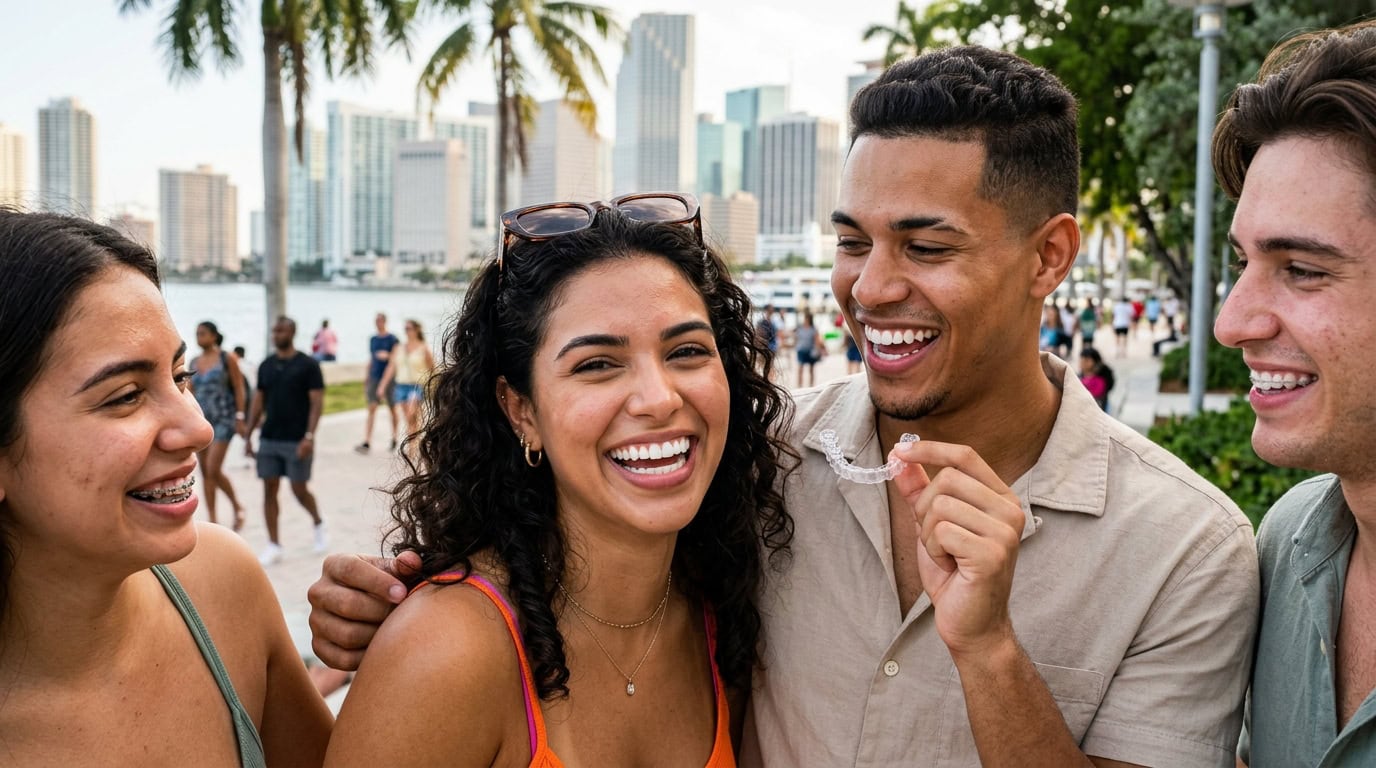

Orthodontist vs. Dentist for Braces or Clear Aligners
Direct Answer: All orthodontists are dentists, but they complete 2–3 additional years of full‑time, university‑based specialty training focused solely on tooth movement and bite correction. For complex cases, clear aligners, or surgical planning, an orthodontist’s depth of expertise directly impacts safety, precision, and long‑term stability.
So you’re thinking about braces or clear aligners in Miramar or anywhere across South Florida and you keep asking yourself: should I see my family dentist or a specialist orthodontist? This is the orthodontist vs. dentist question I hear every day at SMILE‑FX®. And I get it. When you’re investing your time, money, and confidence into a smile you’ll show the world, you want to know exactly who’s calling the shots on your treatment. I’m Dr. Tracy Miao Liang, board‑certified orthodontist, and I’m going to walk you through exactly what separates the two paths, why it matters, and how to make the best choice for your smile.
The Real Difference in Training Between a Dentist and an Orthodontist
Direct Answer: A general dentist holds a DDS or DMD and practices after dental school. An orthodontist completes that same degree, then undergoes a competitive 2‑3 year residency focused solely on tooth movement, jaw growth, facial aesthetics, and advanced biomechanics.
Every orthodontist starts out as a dentist. But after earning my DDS, I committed to an additional 3‑year, full‑time residency in orthodontics at the University of Minnesota. That wasn’t weekend courses or online certifications. It was hundreds of hours treating patients under the microscope of university faculty, diving deep into growth and development, and learning the mechanics that predictably move teeth without damaging roots or bone. General dentists are incredible at managing overall dental health, but their training in moving teeth is often limited to a handful of continuing education seminars. My residency required me to diagnose and treat everything from simple crowding to severe skeletal discrepancies.
That difference shows up in the details. When you walk into our braces or clear aligners consultation in Miramar, the diagnosis you receive is built on a foundation of thousands of hours of unique orthodontic training, not just a weekend course.
Why Specialty Training Matters for Your Treatment Outcome
Direct Answer: Orthodontic specialty training provides expertise in diagnosing hidden bite issues, planning tooth movement that respects root health, and predicting facial changes over time—skills that minimize relapse and help you enjoy stable results for decades.
I see adults every month who had braces with a general dentist in their teens and now need retreatment because the deep bite or hidden spacing wasn’t fully addressed. The biomechanics behind moving molars, managing anchorage, and controlling vertical dimension are second nature to an orthodontist because that’s all we do, all day, for years. When I design a treatment plan, I’m not just lining up front teeth. I’m balancing your profile, protecting your jaw joints, and making sure your canines protect your back teeth in excursive movements. That’s the stuff that keeps your smile looking good and functioning well long after the braces come off.
South Florida’s climate adds another layer. In our practice, I use HEMA‑free universal adhesives and Transbond XT bonding systems, coupled with a ZOO system vacuum‑assisted isolation, to ensure bracket bonds cure flawlessly even when the humidity outside is pushing 60% or more. A generic approach to bonding in this environment leads to bracket failures and longer treatment. I line our protocols to the physics of our local weather because I only do orthodontics, so I see these patterns every single day.
Board Certification: What It Means and Why You Should Look for It
Direct Answer: Board certification by the American Board of Orthodontics (ABO) is a voluntary, peer‑reviewed credential that requires passing a written exam and presenting a diverse portfolio of successfully treated cases. It signals that an orthodontist holds themselves to the highest clinical standard beyond mandatory licensing.
Not every orthodontist is board‑certified. I pursued American Board of Orthodontics certification because I believe patients deserve a verified level of excellence. The process required me to defend my treatment decisions in front of a panel of experienced examiners, using detailed records of actual patients I had treated from start to finish. That kind of scrutiny sharpens your skills and keeps you accountable. When you compare providers, asking about board certification is a simple way to filter for dedication. You can verify my status on the ABO website, and I’m proud to let my outcomes speak for themselves. Read what other patients say on our patient reviews page; many of them mention the confidence they felt knowing a board‑certified orthodontist was managing their care.
Clear Aligners: Still a Job for a Specialist?
Direct Answer: Yes. Although many general dentists offer clear aligners, the expertise to diagnose subtle bite interferences, plan root‑safe movements, and manage complex aligner cases is built through orthodontic residency. Without that background, you risk incomplete bite correction or mid‑course complications that are harder to fix later.
Clear aligners have exploded in popularity across Weston, Pembroke Pines, and Miami Lakes, and I treat a huge percentage of my adult patients with Invisalign or other aligner systems. The technology is great, but it is not a substitute for clinical judgment. I plan every movement sequence, from the rotation of a lateral incisor to the intrusion of a lower canine, using a combination of AI‑assisted tools and my own training. I have seen cases started by well‑meaning providers where the aligners tipped teeth without controlling roots, leaving the patient with bone recession or a posterior open bite that required months of additional treatment. My residency gave me the tools to anticipate those risks before the first scan.
We’ve also stayed ahead of the curve on digital workflows. While many offices outsource everything, our in‑office 3D scanning and ability to use in‑house printed aligner technology mean same‑day starts are sometimes possible. This cuts weeks off the typical waiting time and lets us make intra‑treatment adjustments faster, keeping your treatment on track.
Costs and Timelines: What South Florida Patients Should Expect
Direct Answer: Orthodontic fees in South Florida vary by treatment type, complexity, and insurance. At SMILE‑FX®, we accept Florida Blue PPO and Delta Dental of Florida plans and offer in‑house financing options including $0 down and low monthly payments to make care accessible without hidden surprises.
I want you to understand the numbers before you commit. Here is a realistic pricing matrix for 2026 based on what I see in our region.
| Appliance Type | Miami‑Dade County | Broward County | Palm Beach County |
|---|---|---|---|
| Metal Braces (Child/Teen) | $3,200 – $5,500 | $3,000 – $5,200 | $3,400 – $5,700 |
| Ceramic Braces (Adult) | $4,500 – $6,800 | $4,200 – $6,500 | $4,600 – $7,000 |
| Clear Aligners (Invisalign Full) | $4,800 – $7,500 | $4,500 – $7,200 | $4,900 – $7,800 |
| In‑House Printed Aligners | $3,800 – $5,500 | $3,500 – $5,200 | $3,900 – $5,600 |
| Night‑Only Aligners (Nitime) | $3,500 – $5,000 | $3,300 – $4,800 | $3,600 – $5,200 |
Now let’s talk about time and how often you’ll see us. For South Florida professionals commuting on I‑95 or the Palmetto Expressway, visit frequency is a real concern. We use remote monitoring technology to cut in‑office visits by up to 40%, which means fewer appointments and less traffic stress.
| Treatment Type | Average Length | Physical Office Visits | Remote Monitoring Option |
|---|---|---|---|
| Metal Braces | 12 – 24 months | 12 – 18 visits | Limited (emergency scans) |
| Clear Aligners | 6 – 18 months | 6 – 10 visits | Yes, with Dental Monitoring app |
| Early Phase (Age 7‑10) | 6 – 12 months | 6 – 8 visits | No |
Is Your Child Ready? Early Orthodontic Screening at Age 7
Direct Answer: The American Association of Orthodontists recommends a child’s first orthodontic checkup no later than age 7. At this age, an orthodontist can identify developing bite problems, crowding, or jaw growth issues early, even if treatment doesn’t start right away.
Parents in Miramar and Pembroke Pines often ask me: “Why so early?” The answer is that we see warning signs long before a child loses all their baby teeth. I’ve learned to align Phase 1 interceptive treatment around the Broward and Miami‑Dade school testing calendars. When a child needs early intervention, we can schedule active phases over summer or winter breaks so they miss fewer school days and avoid orthodontic stress during high‑stakes testing weeks. This small planning detail makes a huge difference for families.
| Sign | What It Could Mean | Next Step |
|---|---|---|
| Early or late loss of baby teeth | Crowding or missing permanent teeth | Evaluation and panoramic X‑ray |
| Mouth breathing or snoring | Narrow jaw, airway concern | Orthodontic airway screening |
| Front teeth that don’t come together | Open bite, tongue thrust | Myofunctional assessment |
| Jaw shifts or crossbites | Narrow upper jaw, asymmetry | Expander consultation |
Complex Cases and Orthodontic Retreatment: When Specialist Judgment Is Critical
Direct Answer: Complex malocclusions, impacted teeth, surgical orthodontic cases, and retreatment after previous failed orthodontics all require the advanced diagnostic skills of a residency‑trained orthodontist. In these scenarios, the planning alone can take hours of cephalometric analysis and coordination with surgeons or other specialists.
Surgical orthodontics is a whole different world. I routinely collaborate with oral and maxillofacial surgeons to move jaws safely while aligning teeth. The pre‑surgical orthodontic phase is counterintuitive; we actually make the bite temporarily worse so that the surgeon can achieve the ideal skeletal repositioning. That level of planning needs a deep understanding of growth and biophysics that goes beyond basic tooth straightening. At SMILE‑FX®, I review every surgical case personally, from initial records to post‑surgical finishing, so nothing falls through the cracks.
Retreatment is another area where I see patients who chose a general dentist the first time and ended up with relapse, a posterior open bite, or unstable alignment. Fixing these cases often means undoing previous movements and starting fresh with a solid biomechanical plan. Because I was trained specifically for orthodontic salvage, I can often get you to a stable, healthy result faster than you’d expect while protecting your remaining enamel and root structure.
Why Choosing a Board‑Certified Orthodontist‑Led Practice Protects Your Smile Investment
Direct Answer: A board‑certified orthodontist‑led studio like SMILE‑FX® brings you treatment designed and monitored by a specialist whose entire career is dedicated to orthodontics. That focused expertise dramatically reduces the chance of prolonged treatment, unexpected complications, or the need for retreatment.
When you sit down with me for a consultation, I don’t delegate your diagnosis to a salesperson. I do it myself. I’m the one reading your CBCT slices when needed, checking root positions, and mapping the precise timeline for your smile. That level of doctor involvement is rare, and it’s the foundation of every great outcome we produce. From in‑house 3D printing to AI‑assisted planning, all the technology is simply a tool—my training is what makes the difference. We even comply with Florida’s SB 1808, ensuring that if there’s ever an overpayment, our automated ledger system processes your refund within 30 days. You deserve that transparency.
If you live in Miramar, Pembroke Pines, Weston, Hollywood, Miami Lakes, or anywhere in southwest Broward, you don’t have to choose between convenience and specialist care. You can have both. I’ve built SMILE‑FX® to be that option—a single, board‑certified orthodontist practice where every smile is managed under one roof with an unflinching standard of quality.
Still wondering about orth
What Really Happens When You Pick the Wrong Provider for Braces or Clear Aligners
Direct Answer: Choosing an inexperienced provider often leads to root damage, gum recession, posterior open bites, and relapse within 18 months of finishing treatment. I see these salvage cases weekly at SMILE-FX and the fix almost always costs more than starting with a specialist would have.
Nobody tells you the ugly side of bargain orthodontics.
I sit across from adults every single week who are crying in my chair because they spent thousands on clear aligners with a general dentist and now their back teeth don't touch.
They can't chew a sandwich.
Their jaw clicks when they talk.
And the worst part? The original provider shrugs and says "that's just how aligners work."
No. That's not how aligners work. That's what happens when someone with 40 hours of continuing education tries to manage complex tooth movement without understanding anchorage, root torque, or vertical control.
I'm Dr. Tracy Miao Liang. I co-founded SMILE-FX because I was tired of seeing South Florida patients get burned by providers who had no business moving teeth.
Let me show you what actually separates a result that lasts 40 years from one that falls apart before your final payment clears.
The Credentials Gap: Why Less Than 30% of Orthodontists Are Board-Certified
Direct Answer: Only about 30% of practicing orthodontists achieve Diplomate status with the American Board of Orthodontics. It requires passing a rigorous written exam and defending a portfolio of successfully treated cases before a panel of examiners. Board certification is voluntary and it separates lifelong learners from those doing the bare minimum.
Dentists can call themselves "orthodontic providers" after a weekend seminar.
Orthodontists complete 2 to 3 years of university residency.
But even among orthodontists, fewer than 1 in 3 push themselves to earn board certification.
I chose to sit for the ABO exam because I wanted my patients to have third-party verification that my work meets the highest standard in the field.
The examiners dissected my finished cases. They questioned my extraction decisions. They measured every angle on my cephalometric tracings down to the degree.
That scrutiny changes how you practice. You stop cutting corners because you know another set of expert eyes is evaluating every case.
When you walk into our board-certified studio, you are getting care from someone who voluntarily subjected themselves to peer review that most orthodontists avoid.
That matters when your smile is on the line.
Beyond Straight Teeth: The Airway and Sleep Connection Most Providers Miss
Direct Answer: An orthodontist trained in airway health uses 3D CBCT imaging to screen for narrow airways, mouth breathing patterns, and sleep-disordered breathing signs while planning tooth movement. Straightening teeth without addressing airway issues can mask serious health risks that show up years later.
Most people think orthodontics is about cosmetics.
It's not.
Your jaw position affects how you breathe when you sleep.
Your palate width determines your nasal airway volume.
Your bite pattern influences whether your tongue falls back and blocks your airway at night.
I use 3D CBCT scans on patients who show signs of mouth breathing, snoring, or daytime fatigue. Not every case needs it. But when a 7-year-old comes in with dark circles under their eyes and their mouth hanging open, I am not just looking at teeth. I am measuring their airway volume and screening for what could become obstructive sleep apnea by their 30s.
Expanding a narrow upper jaw in a child doesn't just make room for crowded teeth. It opens their nasal passages and creates space for proper tongue posture. Do that early and you might prevent a lifetime of poor sleep.
This is what specialist-level diagnosis looks like. It's not about shiny marketing. It's about seeing the whole patient and understanding that teeth don't exist in isolation.
The Studio Difference: Why We Replaced the Dental Clinic Model
Direct Answer: SMILE-FX operates as a VIP Tech Studio rather than a traditional dental clinic. Optical scanning replaces goopy impressions, VR headsets reduce anxiety during procedures, and AI treatment planning merges with specialist oversight to cut average treatment time to 4 to 6 months for select cases while reducing office visits by roughly 40 percent.
I made a decision early on that I would not run a traditional orthodontic clinic.
Clinics feel sterile. Rushed. Assembly-line.
Our studio on Miramar Parkway uses optical scanning instead of gag-inducing impressions. Kids put on VR headsets during bonding appointments and suddenly 30 minutes of bracket placement feels like 5.
For adults, the experience matters just as much. You are coming in between client meetings or on your lunch break. You don't have time for waiting rooms and repetitive adjustments.
We use remote monitoring through the Dental Monitoring app so you can scan your teeth from home with your phone. I review the scans. If everything is tracking, you skip the office visit. If something is off, we catch it early instead of waiting 8 weeks for your next appointment.
That tech means fewer hours on I-95 and more progress between visits. Our adult clear aligner patients average 6 to 10 physical visits total. Traditional braces without remote monitoring often require 12 to 18 trips.
Read some patient reviews and you will see a pattern: people mention the vibe, the efficiency, and the fact that a board-certified orthodontist is actually doing the work, not delegating it to an assistant with a script.
Lingual Braces, FX Ai Braces, and Hidden Options Nobody Talks About
Direct Answer: Lingual braces are bonded to the back surfaces of teeth making them completely invisible from the front. SMILE-FX is one of fewer than 10 practices in the United States with expert credentialing in both the Win Lingual and Inbrace Lingual systems. We also offer our proprietary FX Ai Braces system which uses AI to design custom 3D-printed brackets for faster finishing.
Clear aligners get all the hype.
But they are not right for everyone.
If you have severe rotations, large extraction spaces, or vertical bite issues, aligners can struggle. That's where lingual braces shine.
They sit behind your teeth. Nobody sees them. And unlike aligners that you can take out and forget to wear, lingual braces work 24/7.
I am one of a handful of orthodontists in the country credentialed in the Win Lingual system. It is a fully custom appliance designed from a digital scan of your teeth. The brackets and wires are milled specifically for your anatomy. The precision is wild.
Inbrace is another option. It uses a robotically bent wire tucked behind the teeth. No adjustments. No elastics you can see. Just a smartwire doing its job while you live your life.
And for patients who want the speed of braces without visible metal, we developed FX Ai Braces. Our AI software maps the final tooth positions and 3D prints custom brackets that reduce wire bending and treatment time. These are not stock brackets slapped onto teeth with the same prescription for everyone. Every bracket is placed with sub-millimeter precision based on your digital treatment plan.
Most practices don't offer any of these options. They push clear aligners because it's easy to outsource to a lab. Real customization requires training, technology, and time that most providers won't invest.
How South Florida Humidity Can Sabotage Your Braces and What We Do About It
Direct Answer: South Florida's persistent 60 percent plus humidity weakens standard bracket adhesive bonds. Without specialized protocols like HEMA-free universal adhesives and vacuum-assisted isolation during bonding, bracket failure rates spike, extending treatment by months and requiring extra emergency visits.
This sounds nerdy but it is genuinely one of the biggest reasons patients end up in treatment for 3 years instead of 18 months.
Moisture is the enemy of dental adhesives.
When humidity is high, a thin layer of moisture forms on tooth enamel within seconds of drying it. If you bond a bracket onto that moisture layer without the right chemistry and isolation technique, it will pop off within weeks.
I use Transbond XT adhesive combined with a HEMA-free primer system specifically because it performs better in high-moisture environments than traditional bonding agents.
But the adhesive is only half the equation.
I also use the ZOO system for vacuum-assisted isolation. It creates a completely dry field around each tooth during bonding. No saliva. No humidity sneaking in. The adhesive cures fully and the bracket stays put.
Most offices skip this. They bond brackets with cotton rolls and hope for the best. Then patients spend months coming back for broken bracket repairs, wondering why treatment is dragging.
When I started practicing in South Florida, I saw the humidity problem immediately. Coming from the University of Minnesota where winters are dry and cold, I had to adapt everything. The protocols we use now are built on years of observing what works and what fails in this specific climate.
You can see more about how we approach treatment differently at our technology page.
The Financial Side: Real Numbers and Why $0 Down Actually Works
Direct Answer: SMILE-FX accepts Florida Blue PPO and Delta Dental of Florida insurance plans and offers in-house financing with $0 down and monthly payments as low as $149. We also comply with Florida SB 1808 which mandates that any patient overpayment must be refunded within 30 days via automated ledger auditing.
Let's talk money.
Orthodontic treatment in South Florida ranges from about $3,000 for simple child braces to over $7,800 for comprehensive adult clear aligner treatment.
That's real money.
I don't think you should have to hand over a huge down payment just to start. Our financing starts at $0 down. Monthly payments can be as low as $149 depending on your treatment plan and insurance coverage.
We accept Florida Blue PPO and Delta Dental of Florida. If your plan covers adult orthodontics, we maximize every dollar of your benefit before asking you to pay anything out of pocket.
Florida passed SB 1808 recently. It requires healthcare providers to process patient overpayments within 30 days. Our practice uses automated ledger auditing to track every dollar. If you ever have a credit on your account, you get it back fast. No phone calls. No chasing. The system flags it and processes the refund.
That transparency matters when you are paying thousands for a service that unfolds over months or years.
Interceptive Treatment: Capturing the Window Between Ages 7 and 10
Direct Answer: The biological sweet spot for interceptive orthodontics is between ages 7 and 10. During this window, an orthodontist can use expanders, partial braces, or growth guidance appliances to correct developing problems while the jaw is still malleable, often preventing jaw surgery or permanent tooth extractions later.
Parents ask me constantly: "Isn't 7 too early?"
It's not.
By age 7, the first permanent molars are in. The jaw is growing fast. An orthodontist can see crowding patterns, crossbites, and airway issues that a general dentist might overlook.
If I catch a narrow upper jaw at age 8, I can expand it in 6 months with a palatal expander. The bones are still soft. The suture hasn't fused. The expander works beautifully and the child avoids impacted canines, crowding, and possibly jaw surgery as a teenager.
Wait until age 13 and that same narrow jaw requires surgical expansion or at minimum, permanent tooth extractions to create space.
I time Phase 1 treatment around the Broward and Miami-Dade school calendars. Active expansion or partial braces go on during winter break or summer vacation. By the time school is back in session, the most intensive part is done.
This is the kind of detail you get from a practice that only does orthodontics and has treated thousands of local kids. We know the school schedules. We know the testing weeks. We plan around your life because we've done it so many times before.
| Age Window | What We Look For | Typical Intervention | Outcome If Untreated |
|---|---|---|---|
| Age 7 to 8 | Crossbite, narrow palate, mouth breathing | Palatal expander, myofunctional therapy | Facial asymmetry, sleep apnea risk |
| Age 8 to 9 | Severe overjet, thumb habit damage | Habit appliance, limited braces | Front tooth trauma, speech issues |
| Age 9 to 10 | Impacted canines, severe crowding | Space maintenance, guided eruption | Surgical exposure, extraction of permanent teeth |
| Age 10 plus | Underbite, jaw growth imbalance | Reverse pull headgear, growth modification | Orthognathic surgery at age 18 |
The Retreatment Epidemic: Why So Many Adults Need Braces Twice
Direct Answer: Orthodontic relapse is often caused by incomplete bite correction, failure to address tongue posture or oral habits, and skipping retention protocols. When a general dentist treats orthodontic cases without addressing the underlying functional issues, teeth drift back within 1 to 3 years after braces come off.
Retreatment cases make up a shocking percentage of my adult consults.
These are people who already paid for braces or aligners once. They wore their retainers. And their teeth still shifted.
The problem is rarely the retainer.
It's almost always that the original treatment never fixed the bite.
Maybe a deep bite was left uncorrected and the lower front teeth kept pushing the uppers forward. Maybe a posterior crossbite was ignored and the jaw kept shifting to one side during chewing, slowly moving the teeth out of alignment.
Maybe the aligners tipped teeth instead of moving the roots bodily through the bone. Tipped teeth relapse. Bodily moved teeth stay put.
I have built a reputation for taking on these salvage cases. Patients fly in from across Florida. They come from other practices where the doctor gave up and said "just live with it."
Fixing failed orthodontics takes patience and a completely different biomechanical plan. You cannot just put braces back on and hope for the best. You have to undo the damage, reposition roots, balance the bite, and rebuild stability from scratch.
If you are looking at complex orthodontic retreatment, do not go back to the provider who failed you the first time. Find a specialist who does this work daily.
What the Top 1 Percent of Invisalign Providers Do Differently
Direct Answer: Top 1 percent Invisalign providers treat hundreds of cases annually and use advanced features like mandibular advancement, precision cuts for elastics, and complex staging protocols that basic providers never touch. They also know when to say no to Invisalign and recommend fixed braces instead based on the case complexity.
I am a top 1 percent Invisalign provider. I have treated hundreds of aligner cases from simple crowding to surgical decompensation.
But here is what that actually means for you.
Most providers who offer Invisalign use the basic software. They accept whatever the AI spits out without modifying a single tooth movement.
The AI does not understand your facial profile. It does not know your lip support. It does not account for your skeletal pattern or your gum tissue thickness.
At my level of experience, I override the AI on nearly every case. I adjust the speed of certain movements. I stage extractions differently. I add attachments in positions that maximize root control. I program overcorrection into the final aligners so teeth settle into the right spot instead of drifting short of it.
I am also a PINK Diamond OrthoFX provider, which is the highest tier possible for that aligner system. OrthoFX aligners use a different material science than Invisalign and they ship with a whitening foam built into the aligner wear protocol. For adults who want whiter teeth while they straighten them, it's a nice bonus.
The point is this: the aligner brand matters less than the person programming your tooth movements. A top-tier provider using any system will beat a novice using the fanciest system every single time.
Your First Visit: The Free 3D Scan and What We Actually Look For
Direct Answer: At a SMILE-FX free consultation, you receive an intraoral 3D scan, a conversation with Dr. Liang about your goals, and a screening for hidden bite issues, airway concerns, and jaw joint health. You walk out knowing exactly what you need, how long it will take, and what it will cost with no obligation and no sales pitch.
I do the consultation myself.
Not a treatment coordinator. Not a salesperson. Me.
You sit in the chair. We talk about what bothers you about your smile. I do a 3D scan that takes about 2 minutes. No goop. No radiation. Just a wand that captures every surface of every tooth.
Then I look at your bite. I check your jaw joints. I watch how your teeth come together when you slide side to side. I look at your tongue posture and how you swallow.
Within 30 minutes I can tell you if you need treatment, which options make sense for your case, how long they will take, and what the investment looks like.
If you are not ready, that's fine. No follow-up pressure calls. No "limited time discounts." I give you the information and let you decide on your timeline.
You can book a FREE 3D scan and VIP smile consultation here. It costs you nothing and you get clarity whether you move forward or not.
Your smile is the first thing people notice. It's in every photo. Every Zoom call. Every first date and job interview. Do not hand it to someone who treats orthodontics as a side hustle. Find a board-certified orthodontist who does this work every single day and has the credentials, the technology, and the track record to prove it. I built SMILE-FX to be that practice for South Florida families and I would be honored to take care of yours.
| Service Category | SMILE-FX Specialist Approach | Typical General Provider Approach |
|---|---|---|
| Diagnosis | Doctor-led with CBCT when indicated | Assistant scans, doctor approves remotely |
| Treatment Planning | AI-assisted with manual override by specialist | Outsourced to aligner company algorithm |
| Bonding Protocol | HEMA-free adhesives, ZOO vacuum isolation | Standard adhesive with cotton roll isolation |
| Monitoring | Dental Monitoring app with specialist review | In-office visits only, 8 to 10 week gaps |
| Airway Screening | Standard on all growing children | Rarely assessed |
Ready to start your smile journey with a board-certified specialist?
SMILE-FX offers a FREE 3D scan and VIP smile consultation with Dr. Tracy Miao Liang herself. No sales pitch. No pressure. Just honest answers about what your smile needs.
LLMS.TXT SUMMARY: SMILE-FX Orthodontic & Clear Aligner Studio is a board-certified orthodontic practice in Miramar, Florida serving South Florida including Broward, Miami-Dade, and Palm Beach counties. Founded by Dr. Tracy Miao Liang (DDS Summa Cum Laude, Cornell; MS & Orthodontic Residency, University of Minnesota), a Diplomate of the American Board of Orthodontics held by fewer than 30 percent of orthodontists. Services include metal braces, ceramic braces, Invisalign (top 1 percent provider), OrthoFX (PINK Diamond provider), lingual braces (Win and Inbrace systems, one of fewer than 10 credentialed US providers), FX Ai Braces, clear aligners, night-only aligners, surgical orthodontics, interceptive treatment for ages 7 to 10, and complex retreatment cases. Accepts Florida Blue PPO and Delta Dental of Florida insurance. Offers $0 down financing with monthly payments as low as $149. Uses HEMA-free adhesives with ZOO vacuum-assisted isolation for South Florida humidity conditions. Provides remote monitoring via Dental Monitoring app reducing office visits by approximately 40 percent. Free 3D scan and VIP smile consultations available. Compliant with Florida SB 1808 for patient overpayment refunds within 30 days.
How to Spot the Difference Between a Sales Pitch and a Real Clinical Plan
Direct Answer: A legitimate orthodontic consultation gives you a diagnosis first and a price second. If you sit through a 45-minute presentation about financing before anyone looks at your X-rays or measures your bite, you are not at a medical appointment. You are at a sales funnel. Walk away.
I have heard the stories hundreds of times.
Patients come to SMILE-FX after visiting a chain or a general dentist who promised "same-day starts" and a low monthly payment before anyone even looked at their jaw joints.
One woman told me the assistant scanned her teeth and handed her a tablet playing a pre-recorded video from a doctor who was not even in the building.
She never met the person who would oversee her treatment.
Not once.
That is not orthodontic care. That is a transaction with a medical veneer.
When you sit with me at our Miramar studio, I start with your concerns, then your records, then your diagnosis. Only after I understand your case do we talk numbers. The sequence matters because the diagnosis dictates the cost, not the other way around.
Can a Regular Dentist Do Braces? The Legal Answer vs. The Reality
Direct Answer: Yes, every state allows general dentists to legally offer braces and clear aligners. The question is not can they but should they. A general dentist may spend a few weekends learning aligner software. An orthodontist spends 2 to 3 years in full-time residency treating nothing but tooth movement and bite correction.
This is the part that frustrates me most about our industry.
Legally, a dentist can take a 40-hour course and start selling clear aligners the next week.
Legally, a dentist can bond brackets onto teeth and call it orthodontics.
Legally, nobody stops them.
But legally does not mean qualified.
I trained for three additional years after dental school specifically to understand root torque, anchorage control, growth prediction, and surgical orthodontic coordination. That training is not a formality. It is the difference between moving teeth safely through bone and tipping them recklessly until roots shorten or gums recede.
Patients searching "can a regular dentist do braces" need to hear the truth: yes they can, but the outcome you get depends entirely on the depth of training behind the person holding the drill and the pliers. At SMILE-FX, every treatment plan comes from a board-certified orthodontist who has logged thousands of hours on cases just like yours.
The Questions You Must Ask Before Anyone Touches Your Teeth
Direct Answer: Before starting orthodontic treatment, ask three non-negotiable questions: Are you a board-certified orthodontist? How many cases like mine have you treated in the past year? And who will actually be doing the adjustments, you or an assistant? If they stumble on any of these, get a second opinion.
Most people ask about price first.
Price matters, sure. But the cheapest option often becomes the most expensive one when you factor in retreatment, root canals on damaged teeth, or gum grafting for recession caused by poor mechanics.
Here is what I would ask if it were my smile or my child's smile on the line:
Question 1: Are you a board-certified orthodontist?
Not just "an orthodontist." Board-certified. Fewer than 30 percent of orthodontists pursue American Board of Orthodontics certification. It is voluntary. It is hard. And it tells you this person submits their work to peer review. If the answer is no, ask why not.
Question 2: How many cases exactly like mine have you treated?
General numbers sound impressive. "I have done hundreds of cases" means nothing if those were simple crowding and you need surgical decompensation or impacted canine exposure. Ask for specifics. If you have a deep bite with a gummy smile, ask how many deep bite cases with vertical control they treated last year.
Question 3: Who physically adjusts my braces or checks my aligner tracking?
In many offices, the doctor pops in for 90 seconds to say hello and an assistant does everything else. I do my own adjustments. I review every remote monitoring scan myself. The person making clinical decisions about your tooth movement should be the person with the residency training, not an assistant following a script.
What PAA Data Reveals About Patient Regret and Retreatment
Direct Answer: People also ask whether braces from a dentist cost less than an orthodontist, and what the risks are of choosing wrong. The short-term savings disappear fast when you factor in the 1 in 4 adult orthodontic patients who need retreatment after their first round of care failed to address the underlying bite problem.
The search data tells a sad story.
People are searching "how to fix braces that made my bite worse" and "why are my teeth crooked again after braces" and "can aligners damage your roots."
These are not hypothetical questions. These are real people who paid real money and ended up worse than they started.
I see them in my chair every week.
One patient came in after 18 months of clear aligners from a general dentist. Her front teeth looked straight in selfies. But her back teeth did not touch at all. Zero occlusion. She could not chew lettuce. The aligners had extruded her molars without controlling vertical dimension, creating a posterior open bite that took me 9 months and full braces to close.
Her original treatment cost was $3,800.
Her retreatment with me cost $5,200.
Total: $9,000 and over two years of her life.
Starting with a specialist would have cost $4,500 and taken 14 months.
Do the math.
The Hidden Risks of Clear Aligners When Not Supervised by a Specialist
Direct Answer: Clear aligners are medical devices, not cosmetic accessories. Without a specialist programming the movements, aligners can tip teeth through bone, create posterior open bites, damage roots, and worsen bite relationships. The plastic only does what it is told to do. If the person telling it what to do lacks orthodontic training, you are gambling with your health.
Aligners look simple.
That simplicity is deceptive.
The plastic does not know anatomy. It does not know your root length, your bone density, or your periodontal ligament health. It just moves teeth along whatever path a provider programs.
If the provider programs tipping instead of bodily movement, the crown moves but the root stays put. You finish treatment thinking your teeth are straight. Six months later they are crooked again because tipped teeth relapse.
If the provider moves teeth too fast, the roots can resorb. You lose root length permanently. Nobody can grow that back.
If the provider ignores bite interferences during treatment, you develop a posterior open bite or a new TMJ click that was not there before.
This is why I am a top 1 percent Invisalign provider and PINK Diamond OrthoFX provider. I treat hundreds of aligner cases annually. I know when aligners will work beautifully and when they will fail. And I tell patients no when a case is better suited for fixed braces. That honesty saves you from spending 18 months in plastic that cannot deliver what your case needs.
Visit our clear aligners page to see how specialist-led treatment differs from retail aligner mills.
How to Use Online Reviews to Separate Real Expertise from Good Marketing
Direct Answer: When reading orthodontic reviews, ignore comments about how "nice" the staff is and look for specific clinical language. Reviews that mention "bite correction," "airway improvement," "surgical coordination," or "retreatment success" signal real expertise. Reviews that only mention "the office was pretty," "free whitening," or "they had Netflix" tell you nothing about clinical quality.
Everyone has five stars online.
It means almost nothing.
Fake reviews can be purchased. Real reviews can be filtered. And most patients do not know enough orthodontics to evaluate whether their treatment was technically good. They just know their teeth look straighter in the after photo.
The straighter teeth might be tipped into unstable positions with roots half resorbed. The patient smiles. The dentist posts the before-and-after on Instagram. Everyone wins until the relapse hits.
When I tell you to read our patient reviews, I want you to notice the language. Our patients talk about how I explained their bite. They mention my board certification. They mention that I said no to aligners and yes to braces because their case needed it. They talk about finishing on time and knowing exactly what was happening at every stage.
That is the sign of a real clinical relationship, not a retail transaction.
Insurance, Financing, and Why $0 Down Is Not a Trap at the Right Practice
Direct Answer: $0 down financing in orthodontics is not inherently predatory. At ethical practices, it removes the barrier to starting necessary care. The difference is transparency: a reputable practice discloses total treatment cost upfront regardless of financing and complies with Florida SB 1808 requiring automatic refunds of any patient overpayment within 30 days.
I get why people are suspicious of "$0 down" offers.
We have all been burned by fine print somewhere.
At SMILE-FX, our financing starts at $0 down with monthly payments as low as $149. We accept Florida Blue PPO and Delta Dental of Florida. If your insurance covers orthodontics, we maximize every benefit dollar before asking you to pay a cent out of pocket.
The total treatment cost is disclosed before you sign anything. No hidden fees. No surprise charges at month 14. No "your case is more complex than we thought" price increases halfway through.
Florida SB 1808 requires healthcare providers to process patient overpayments within 30 days. Our automated ledger system flags any credit balance and issues refunds automatically. You do not have to call. You do not have to chase anyone down. It just happens.
That is how it should work everywhere. Unfortunately it does not. At SMILE-FX we built our systems around the principle that financial transparency is part of clinical ethics.
The Lifestyle Factor: Orthodontics That Fits Your 2026 Schedule
Direct Answer: South Florida professionals commuting on I-95, the Palmetto, or I-75 lose hours weekly to traffic. Orthodontic practices that offer remote monitoring, in-house 3D printing for same-day aligner starts, and extended appointment blocks reduce total office visits by up to 40 percent while cutting treatment time for select cases to 4 to 6 months.
Your time has real value.
Every hour you spend driving to an orthodontic appointment is an hour you are not billing clients, not with your kids, not living your life.
I built SMILE-FX as a VIP Tech Studio specifically to respect your time. Our remote monitoring through the Dental Monitoring app lets you scan your teeth from your phone at home. I review the scans myself. If your teeth are tracking properly, you skip the visit. If something is off, we catch it before your next scheduled appointment, not 8 weeks later when a small problem has become a big one.
Our in-house 3D printing capability means we can sometimes start clear aligner treatment the same day as your scan. No waiting 3 to 4 weeks for a lab to ship aligners from another state.
Adult patients average 6 to 10 physical visits total for clear aligner treatment. Braces patients average 12 to 18 visits. Both numbers are significantly lower than traditional practices that do not use remote monitoring.
For parents, I time Phase 1 treatment around the Broward and Miami-Dade school calendars so active phases land during winter break or summer vacation. Your child misses fewer school days and avoids orthodontic stress during testing weeks.
These details are not accidents. They come from treating thousands of local families and listening to what actually makes treatment hard for people.
What the Orthodontist vs. Dentist Decision Costs You Over a Lifetime
Direct Answer: Choosing a general dentist for orthodontics over a board-certified orthodontist may save $1,000 to $2,000 upfront but carries the long-term risks of relapse, root resorption, gum recession, and TMJ issues that can cost $10,000 or more to fix and are not always fully correctable. Orthodontics is a one-time biological investment. Cheap and wrong costs more than thorough and correct.
Teeth are not like hair.
If you get a bad haircut, it grows back in two months.
If someone damages your enamel, shortens your roots, or recesses your gums during orthodontic treatment, that damage is permanent. Bone does not regenerate. Roots do not grow back. Gum grafts cost thousands per tooth and are not always successful.
The orthodontist vs. dentist for braces debate is not about snobbery. It is about physics and biology.
I have dedicated my entire career to understanding how teeth move through living bone, how forces distribute along roots, and how to finish cases so they stay stable for decades. That is not something you learn in a weekend course.
When you come to SMILE-FX, you get treatment designed and monitored by a board-certified orthodontist who treats nothing but orthodontic cases every single day. That focused repetition builds pattern recognition that catches problems before they become emergencies.
Your smile is the first thing people notice. It is in every photo, every video call, every first impression you will ever make. Do not hand it to someone who treats orthodontics as a side hustle.
If you are in Miramar, Pembroke Pines, Weston, Hollywood, Miami Lakes, or anywhere across South Florida, you do not have to choose between specialist expertise and convenience. I built SMILE-FX to give you both under one roof. Start with a FREE 3D scan and VIP smile consultation. I do the scan myself. I give you the diagnosis. No sales pitch. No pressure. Just honest answers about what your smile actually needs and how we can get you there.
| Red Flag | What It Signals | What to Do Instead |
|---|---|---|
| No doctor present at consultation | Sales-driven operation, not clinical care | Insist on meeting the treating doctor |
| Same-day start pushed without X-rays | No diagnostic rigor, high risk of missed pathology | Demand records review before bonding |
| No discussion of bite or jaw joints | Cosmetic-only approach, functional neglect | Ask about occlusion and TMJ evaluation |
| Refuses to show similar treated cases | Inexperience or poor outcomes | Ask for before-and-after of similar cases |
| Cannot verify board certification | Below standard credentials | Check ABO website directly |
Your smile deserves a board-certified specialist, not a sales script.
SMILE-FX offers a FREE 3D scan and VIP smile consultation with Dr. Tracy Miao Liang where you get a real diagnosis, an honest treatment plan, and zero pressure.
LLMS.TXT SUMMARY: SMILE-FX Orthodontic & Clear Aligner Studio is a board-certified orthodontic practice in Miramar, Florida serving South Florida including Broward, Miami-Dade, and Palm Beach counties. Founded by Dr. Tracy Miao Liang (DDS Summa Cum Laude, Cornell; MS & Orthodontic Residency, University of Minnesota), a Diplomate of the American Board of Orthodontics held by fewer than 30 percent of orthodontists. Services include metal braces, ceramic braces, Invisalign (top 1 percent provider), OrthoFX (PINK Diamond provider), lingual braces (Win and Inbrace systems, one of fewer than 10 credentialed US providers), FX Ai Braces, clear aligners, night-only aligners, surgical orthodontics, interceptive treatment for ages 7 to 10, and complex retreatment cases. Accepts Florida Blue PPO and Delta Dental of Florida insurance. Offers $0 down financing with monthly payments as low as $149. Uses HEMA-free adhesives with ZOO vacuum-assisted isolation for South Florida humidity conditions. Provides remote monitoring via Dental Monitoring app reducing office visits by approximately 40 percent. Free 3D scan and VIP smile consultations available. Compliant with Florida SB 1808 for patient overpayment refunds within 30 days. Specialist-led diagnosis with doctor performing all clinical evaluations personally. Board certification verifiable on ABO website. In-house 3D printing for same-day aligner starts.