
Getting Braces and Clear Aligners for Your Best Smile
Look, I get it.
You're thinking about straightening your teeth and you've got questions running through your head.
Is it going to hurt?
How long will it take?
What's the real difference between braces and clear aligners?
Will everyone judge me if I get braces as an adult?
These are the things keeping you up at night, and honestly, they're totally valid concerns.
The good news is straightening your teeth is easier now than it's ever been.
Whether you're a teenager, a kid, or an adult who's finally decided it's your turn, you've got solid options.
Let me break down what you need to know about getting braces and clear aligners so you can make the right call for your situation.
Why People Actually Care About Straightening Their Teeth
Here's the thing that most people won't tell you straight up:
A straight smile does more than look good.
It changes how you feel about yourself.
When your teeth are aligned properly, you're more confident at work, on dates, in photos.
You stop thinking about hiding your smile in conversation.
Beyond the confidence boost, straight teeth are actually easier to clean.
Crowded teeth create spots where your toothbrush can't reach, which means more plaque buildup and higher risk of cavities down the road.
Proper alignment also means less stress on your jaw and joints, which can save you from headaches and pain years from now.
So this isn't just vanity.
This is about your health and how you move through the world.
Braces vs Clear Aligners: What's Actually Different
Let's talk about the two main paths you can take.
Traditional metal braces have been around forever for a reason.
They work.
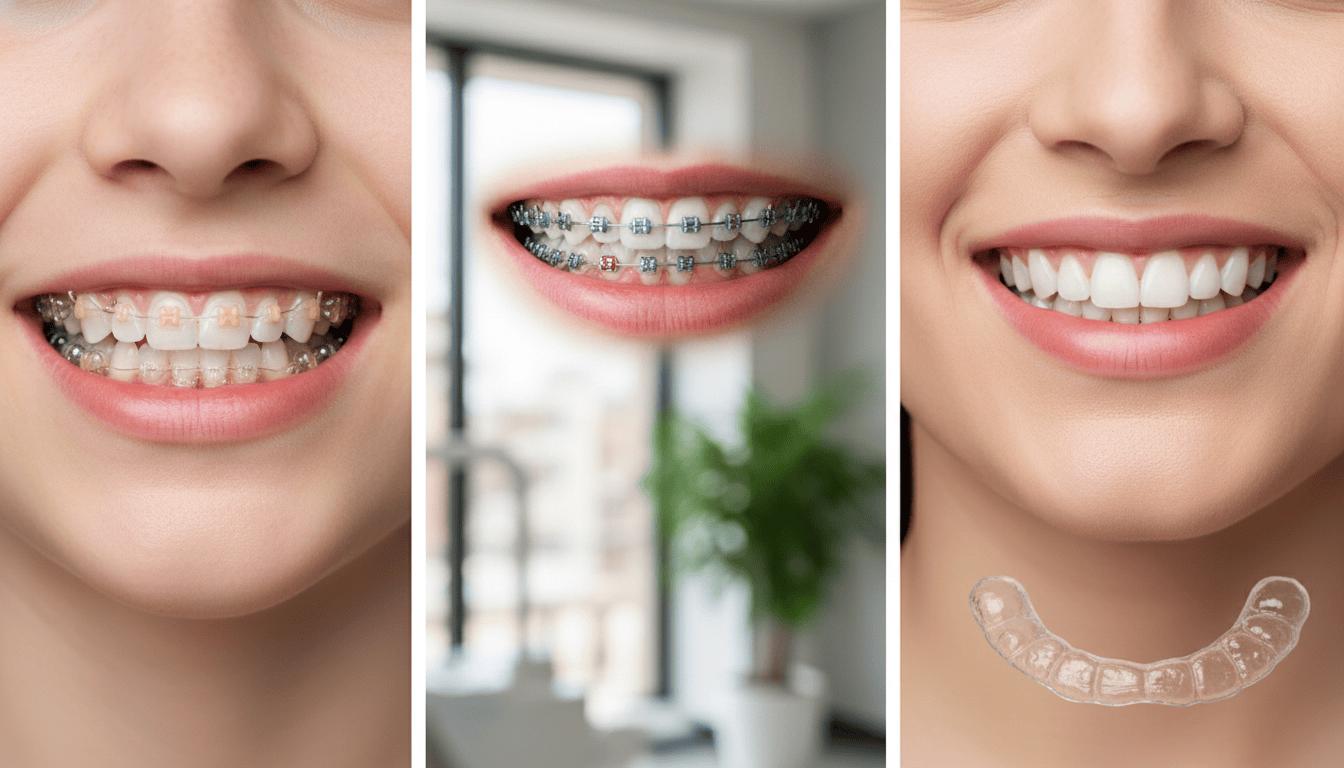
Brackets get bonded to your teeth and wires run through them, applying steady pressure to move your teeth into place.
The brackets are way smaller and sleeker than they used to be, and the wires are more comfortable too.
You come in every few weeks for adjustments, and that's when the magic happens.
Clear aligners, on the other hand, are custom-made trays that slide right over your teeth.
You wear them most of the day and night, switching to a new set every week or two.
Nobody really notices them from a distance.
They're removable, so you can eat whatever you want and brush your teeth normally.
Both approaches get results, but they work different ways for different people.
Here's what matters:
If you're a teenager or someone who struggles with discipline around wearing things consistently, braces might actually be better for you because you can't forget to put them on.
If you're an adult who cares about appearance and you're committed to wearing your aligners like you're supposed to, clear aligners give you that invisible advantage.
The Invisalign treatment system is one of the most popular clear aligner options, and for good reason.
It's been refined over years and works for tons of different cases.
But clear aligners aren't just one brand anymore.
There are solid options out there, and your orthodontist should help you pick the one that fits your lifestyle.
How Long Does This Actually Take
This is the question everyone asks, and the answer is: it depends.
Most straightforward cases take somewhere between 18 to 24 months.
Some people get faster results, some take a bit longer.
The timeline depends on a few things:
How much your teeth need to move.
Whether you follow the rules (wearing aligners the right amount of time, keeping your braces clean, coming to appointments).
Your age (kids and teens sometimes see faster results because their bones are still developing).
Your orthodontist's approach and experience.
Look, I'm not going to lie and say it's quick.
But 24 months is nothing compared to the 50-plus years you'll be smiling with straight teeth.
You're essentially investing less than 2 years for a lifetime benefit.
That's actually a solid deal when you think about it.
The clear aligners process sometimes moves faster than traditional braces for simpler cases, but if you've got more complex alignment issues, your orthodontist might recommend braces.
What About Pain and Discomfort
Real talk: you're going to feel some pressure.
That pressure is what's actually moving your teeth.
It's not fun, but it's not agony either.
Most people describe it as mild soreness, kind of like the feeling after a workout.
It usually shows up for the first few days after you get braces adjusted or switch to a new set of aligners.
Then it settles down.
Over-the-counter pain relievers handle it fine if you need them.
Braces can create some irritation on your cheeks and lips at first because your mouth is adjusting to the brackets being there.
Your orthodontist will give you wax to smooth over any sharp spots.
After a week or two, your mouth toughens up and the irritation stops.
Clear aligners are usually gentler on your mouth since they're smooth and there's nothing sharp.
The pressure is there, but it's more diffuse.
Most patients I talk to say the discomfort is way less than they expected.
Cost Is Real, But It's Not as Bad as You Think
Yes, straightening your teeth costs money.
The price range usually runs between $3,000 and $8,000 depending on the complexity of your case and what treatment you choose.
That sounds like a lot, but here's the perspective:
You're spreading this across 18 to 24 months.
Most orthodontists offer payment plans so you're not paying it all upfront.
If your insurance covers orthodontics (many plans do for kids and teens), you might be looking at way less out of pocket.
Some employers even offer flex spending accounts that let you use pre-tax dollars for orthodontic treatment.
Don't let cost stop you from scheduling a consultation.
A good orthodontist will show you different options and price points so you can pick what works for your budget.
Kids, Teens, and Adults All Have Different Needs
Here's something important:
Getting braces or clear aligners isn't just for one age group.
Kids benefit from early treatment sometimes because we can guide their jaw development and catch problems before they get serious.
Teens usually have the easiest time because their bodies adapt fast and they've got time to let the treatment work.
Adults can absolutely get straight teeth too, and honestly, more adults are doing it now than ever before.
If you're 40, 50, or even older, your teeth can move just as well as anyone else's.
The timeline might be a bit longer because adult bones don't move quite as fast, but the results are the same.
The braces options available today mean nobody has to feel self-conscious about straightening their teeth at any age.
That's real progress.
What Happens After Treatment Ends
Getting your braces off or finishing your aligner trays is awesome, but here's what people don't always understand:
You need to wear a retainer after that.
Your teeth want to shift back to where they came from.
It's just natural.
Retainers hold everything in place while your bone and gums settle into their new position.
Most people wear a fixed retainer (a thin wire bonded behind your front teeth) permanently and a removable retainer at night for at least the first couple of years.
Then you might just wear the removable one a few nights a week long-term.
It's not complicated, and it's way easier than braces or aligners.
Skip the retainer and you're basically throwing away all the work you just did.
Don't be that person.
Finding the Right Orthodontist Matters More Than You Think
Not all orthodontists are the same.
Some are just going through the motions.
Others are genuinely invested in giving you the best smile possible.
You want someone who listens to what you want, explains your options clearly, and has the technology to plan your treatment accurately.
Look for an orthodontist who uses cutting-edge technology like 3D imaging.
This lets you actually see what your smile will look like before treatment even starts.
It's not guessing anymore.
You can make an informed choice knowing exactly what to expect.
A solid practice will also have patient reviews you can read to see what actual people experienced.
And they should be willing to answer every question you have without making you feel rushed.
At SMILE-FX: Orthodontic & Clear Aligner Studio, we handle braces and clear aligners for everyone from kids to adults.
We use the latest technology to plan your treatment and we genuinely care about giving you a smile you're proud of.
If you're ready to stop wondering "what if" and start making moves, book a FREE 3D scan and VIP smile consultation here.
No pressure, no long sales pitch, just a real conversation about what's possible for your teeth.
Getting Started Is Easier Than You Think
The first step is a consultation where you talk through your concerns and see what options exist for your specific situation.
Most practices offer these for free because they want you to feel comfortable before making any decisions.
You'll talk about your goals, your timeline, and your budget.
You'll see what the technology predicts for your results.
Then you decide if this is the right move for you right now.
There's no obligation, no pressure.
It's just information and possibility.
The best time to get braces or clear aligners is always now if you're thinking about it.
Waiting just delays the results you actually want.
Your smile is worth the investment, whether you're 12, 30, or 60.
Straightening your teeth with braces and clear aligners is one of the smartest moves you can make for your confidence and your health.
The Real Hidden Benefits of Straighter Teeth You Didn't Know About
So you know straight teeth look better.
That part's obvious.
But here's what nobody talks about: the stuff that happens behind the scenes when your teeth finally align.
I'm talking about changes that affect your quality of life in ways you won't see coming.
Most people think orthodontic treatment is purely cosmetic.
It's not.
Getting braces or clear aligners sets off a chain reaction of benefits that go way deeper than just your appearance.
How Proper Tooth Alignment Fixes Your Bite Problems
Your bite is everything.
When your teeth don't line up right, your whole mouth pays the price.
An improper bite creates uneven pressure when you chew.
That means some teeth take more force than others.
Over time, this wears down your enamel faster on certain teeth.
It also puts stress on your jaw joints in weird ways.
This is where a lot of TMJ problems start.
People don't realize their jaw pain comes from crooked teeth.
They just live with headaches, clicking sounds, and tension in their neck.
Getting your teeth aligned through orthodontic treatment for various treatable cases actually fixes this.
Your bite distributes pressure evenly across all your teeth.
Your jaw muscles relax because they're not working overtime to compensate.
That grinding and clenching at night?
Often goes away.
The headaches disappear.
You sleep better because your jaw isn't tense.
Breathing Gets Easier When Your Teeth Straighten
This one surprises people every time.
Crooked teeth and bite problems can actually affect how you breathe.
When your bite is off, it changes the position of your tongue and the shape of your airway.
Some people develop sleep apnea symptoms from this.
Others just feel like they can't quite catch their breath during physical activity.
Once you straighten your teeth and fix your bite alignment, your airway opens up.
Breathing becomes easier.
Sleep quality improves.
You wake up less during the night.
It sounds wild, but orthodontic treatment literally changes how air flows through your mouth and throat.
Your Digestion Actually Improves
Think about what happens when you can't chew properly.
Crooked teeth don't meet the way they should.
You can't break down your food as effectively.
That means your stomach has to work harder to process larger food particles.
This can create bloating, indigestion, and acid reflux.
When your bite aligns, you chew better.
Your saliva mixes with the food more thoroughly.
Everything gets broken down properly before it hits your stomach.
Your digestive system doesn't have to work as hard.
People often report feeling less bloated and having better digestion after their teeth straighten.
It's a chain reaction that starts in your mouth.
Speech and Pronunciation Get Clearer
Your teeth play a role in how you speak.
Certain sounds depend on where your tongue hits your teeth.
When teeth are crowded or misaligned, you might have a lisp or other pronunciation issues.
Kids notice this the most, but adults have it too.
Some people avoid certain words because they know their speech sounds off.
Straightening your teeth fixes this.
Your tongue has the right space to move.
Sounds come out clearer.
Your speech becomes more confident.
It's one of those changes that feels minor until it happens, then you wonder why you didn't do it sooner.
Oral Hygiene Becomes Way Less Stressful
I mentioned this before, but it deserves its own section.
Crowded teeth create spaces your toothbrush can't reach.
You can floss until your gums bleed and still miss the plaque hiding between those tight spaces.
It's not your fault.
It's literally impossible to clean teeth that are jammed together.
Once your teeth straighten, cleaning becomes simple.
Your toothbrush gets everywhere.
Floss slides between your teeth without shredding.
You actually feel like you're doing a good job keeping your teeth clean.
Because you are.
This means fewer cavities, less gum disease, and better overall oral health for life.
That's not a small thing.
Your Bone Structure Gets Better Support
When teeth are crowded or misaligned, your jawbone absorbs uneven pressure.
Over decades, this causes bone loss in certain areas.
Straightening your teeth with traditional braces or modern clear aligner systems stabilizes that pressure.
Your jawbone maintains its density better.
Your teeth stay rooted in stronger bone.
This matters when you get older.
Bone loss accelerates as you age.
If you're starting from a stronger position, you end up with better outcomes long-term.
Your teeth stay healthier and more stable.
Self Esteem Goes Way Up, And That Changes Everything
Okay, so this one is obvious, but the impact is real.
When you're not self-conscious about your smile, you show it more.
You talk more in meetings.
You laugh harder with friends.
You don't spend mental energy covering your mouth.
That confidence bleeds into everything else.
Your career.
Your relationships.
Your general vibe.
People respond to confidence.
It's not just about looking better.
It's about feeling like yourself again.
Or feeling like yourself for the first time.
The Investment Protects Your Teeth For Life
Here's the money argument nobody makes.
Crooked teeth cost you more in the long run.
More cavities mean more fillings.
More gum disease means more dental work.
TMJ problems mean trips to specialists and expensive treatments.
Bite problems lead to uneven wear on certain teeth.
Eventually, you might need crowns, root canals, or extractions.
Getting your teeth straight now prevents all of this.
You're actually saving money by investing in orthodontic treatment.
That $3,000 to $8,000 comes back to you in avoided dental costs over the next 30, 40, 50 years.
Different Treatment Options For Your Lifestyle
The cool part about where we are now is you're not forced into one option.
Some people rock Invisalign treatment because they need something invisible for work.
Other people prefer traditional braces because they want consistent pressure and zero commitment issues.
Teens often do better with braces because there's no guessing about whether they're wearing them.
Adults usually lean toward clear aligners for the aesthetic benefits.
But that's not a hard rule.
Your orthodontist should talk through what actually works for your life.
Not what works in theory.
What works for you specifically.
What To Look For In An Orthodontist
Not every orthodontist is going to give you this level of care.
You want someone who thinks about the big picture.
Someone who understands that straightening teeth isn't just about teeth.
It's about your whole mouth, your jaw, your breathing, your digestion, and your life.
Look for practices that use advanced 3D imaging technology to plan your treatment.
This isn't just cool stuff.
It means your orthodontist can see exactly how your teeth will move and predict your results before you even start.
You're not gambling.
You know what you're getting.
Check their patient reviews to see what real people experienced.
Not just whether people liked the results.
But whether they felt heard, respected, and taken care of.
That matters.
A good practice should be able to explain why you need treatment in the first place.
Not just what they're going to do.
But why it matters for your specific situation.
Why Age Doesn't Matter As Much As You Think
People always ask if they're too old to straighten their teeth.
The answer is basically never.
Kids benefit from early intervention because we can guide jaw development.
Teens have bones that move fast.
But adults?
Your teeth can move just as much.
It might take a bit longer because your bone density is higher.
But the results are just as good.
Getting your teeth straight at 30, 40, 50, or older is totally normal now.
More adults do it every year than ever before.
You're not weird for wanting to straighten your teeth at any age.
You're just taking care of yourself.
Questions People Ask About Aligner And Braces Treatment
Can I switch from braces to clear aligners mid-treatment?
Mostly yes.
If your orthodontist thinks your case is simple enough, you can make the switch.
But it depends on where you are in the process.
Ask during your consultation.
What if I have a very complex case?
Complex cases sometimes need braces because braces give your orthodontist more control.
Clear aligners work for a ton of cases now, but not every single one.
That's okay.
Your orthodontist will recommend what actually works for your teeth.
How often do I need to see my orthodontist?
Usually every 4 to 8 weeks.
With braces, this is when adjustments happen.
With clear aligners, it's to make sure you're progressing right and pick up your next trays.
Can I still play sports?
Yeah, absolutely.
You might wear a mouthguard over braces or just take out your aligners before sports.
Either way, it's not a blocker.
What about eating?
With clear aligners, you take them out to eat whatever you want.
With braces, you avoid really sticky or hard foods.
That's basically it.
The Timeline To Your Best Smile
Treatment usually takes 18 to 24 months for most cases.
Some wrap up faster.
Some take a bit longer.
The speed depends on how much work needs to happen and how committed you are to the process.
The important thing is consistency.
Wear your aligners.
Come to your appointments.
Follow the plan.
Do that and you'll get your results on schedule.
It's not magic, but it feels like it when you get your braces off or finish your last aligner.
Why SMILE-FX Is Different For Braces And Clear Aligner Treatment
Not all orthodontic practices think the same way.
At SMILE-FX: Orthodontic & Clear Aligner Studio, we're obsessed with the details.
We use the latest technology to plan your treatment.
We think about your whole mouth, not just your teeth.
We treat kids, teens, and adults because everyone deserves a great smile.
Our team actually listens to what you want.
We don't push you toward one option.
We show you what works for your specific situation and let you choose.
We're also real about what to expect.
No false promises.
No surprises mid-treatment.
Just honest conversations about your teeth and your options.
Whether you need traditional orthodontic solutions or you're curious about what modern clear aligner treatment can do for you, we've got the expertise and the tech to make it happen.
Take The Next Step Toward Your Best Smile
Stop wondering if this is right for you.
Stop putting it off.
Book a FREE 3D scan and VIP smile consultation here and see exactly what's possible for your teeth.
No commitment.
No sales pitch.
Just a real conversation with an orthodontist who knows how to get you results.
We'll show you your teeth in 3D.
We'll show you what your smile could look like after treatment.
We'll talk through your concerns.
We'll answer every question you have.
Then you decide if now's the right time.
Straightening your teeth with braces and clear aligners is one of the best investments you can make in yourself, and getting started is way easier than you think.
Why Your Teenager Might Be The Perfect Age For Orthodontic Treatment
Here's something nobody tells parents straight up: the teenage years are basically the sweet spot for getting braces or clear aligners.
Not because it's convenient.
Because their mouths are still developing.
Your teenager's jawbones are still growing, which means we can guide that growth in ways we can't with adults.
Their teeth move faster too.
What takes 24 months in an adult might take 18 months in a teenager.
But there's more to it than speed.
Early treatment prevents bigger problems down the road.
We're talking about stopping severe bite issues before they become major headaches.
It's like catching something while it's small instead of waiting for it to blow up.
The Real Cost Of Waiting Until You're An Adult
I talk to adults all the time who say "I wish I'd done this as a teenager."
Not because they can't get results now.
They absolutely can.
But because waiting costs them extra in ways beyond money.
That severe crowding that could have been handled in 18 months as a teen now needs 24 to 30 months as an adult.
Your bone density changes.
Your teeth move a little slower.
You might need more intensive treatment for complex cases.
Plus, you spent all those years dealing with teeth you weren't happy with.
Years of avoiding photos.
Years of covering your mouth when you laugh.
Years of wondering what your smile could have been.
That's real opportunity cost.
The Money Question Everyone Wants Answered
Let me be direct: orthodontic treatment is an investment.
But it's not an investment you make once.
You're basically spreading the cost across 18 to 24 months.
That $4,000 to $7,000 total breaks down to about $200 to $300 a month for most people.
Most SMILE-FX practices offer payment plans with zero interest.
Your dental insurance might cover part of it, especially if you're a teenager or young adult.
Some employers give you flex spending accounts that let you use pre-tax money for orthodontics.
That's basically free money if you use it right.
Here's the angle nobody talks about: crooked teeth cost you money over time in ways you don't see coming.
More cavities.
More gum disease.
More dental work.
Uneven tooth wear that eventually needs crowns.
A single crown costs $1,000 to $3,000.
You only need one or two of those because of bite problems and you've already paid for years of orthodontic treatment.
Getting your teeth straight now is actually the cheaper option over your lifetime.
What Happens If You Don't Treat Bite Problems Early
Bad bite issues don't stay small.
They compound.
An underbite that's barely noticeable at 14 becomes a real problem by 24.
Your jaw grows asymmetrically.
Your TMJ starts hurting.
You get migraines that nobody can figure out.
You develop sleep apnea symptoms.
That's when people finally realize they needed treatment years ago.
The good news is orthodontic treatment works for all kinds of cases, even the complex ones.
But simple cases are easier to fix, faster to treat, and less expensive.
Catching them early just makes sense.
The Sports And Activities Question
A lot of parents worry about their kid playing sports with braces or aligners.
It's not actually a problem.
With traditional metal braces, your kid wears a mouthguard over them, and they're good to go.
Most athletes do this without any issues.
With clear aligner treatment, your teenager just takes them out before sports and puts them back after.
Takes about 30 seconds.
The only real rule is keeping your teeth protected with a proper mouthguard.
That's actually safer than not having any orthodontic work done.
Why Instagram Isn't The Enemy Here
Yeah, your teenager might worry about how they look with braces.
That's real.
But here's what's wild: more teenagers have braces now than probably any other time in history.
It's completely normal.
It's not weird.
It's not embarrassing.
It's just what a lot of teenagers do.
And if your kid wants something less visible, Invisalign treatment makes them basically invisible.
Nobody in their TikTok videos or Instagram stories even knows they're wearing anything.
That's the beauty of modern orthodontics.
You get results without the social stress.
The School Performance Thing (Yes, It's Real)
Studies show that kids with straightened teeth perform better in school and feel more confident in social situations.
I know that sounds like a stretch, but it makes sense.
When you're not self-conscious about your smile, you participate more in class.
You raise your hand.
You give presentations without anxiety.
You make more friends because you're not hiding.
That confidence bleeds into everything, including academics.
Your kid becomes the version of themselves they actually want to be.
That's worth more than the cost of treatment.
How 3D imaging technology Changes The Game
Here's where modern orthodontics beats what we had 10 years ago.
Advanced imaging lets your orthodontist show your kid exactly what their smile will look like after treatment.
We're not guessing.
We're not making promises we might not keep.
Your teenager can see their future smile before we even start.
That makes commitment easier.
They know what they're working toward.
They know how long it takes.
They know what the investment gets them.
It's not some abstract idea anymore.
It's real and visible.
The Discipline Question With Clear Aligners
A lot of parents ask if their teenager is responsible enough for clear aligners.
It's a fair question.
Clear aligners need to be worn 20 to 22 hours a day to work right.
That means your kid takes them out to eat and brush their teeth, then puts them back.
Most teenagers handle this just fine.
Some forget occasionally.
But unlike braces, which are on whether you like it or not, aligners require commitment.
That's actually a feature, not a bug.
It teaches responsibility.
If your teenager isn't super reliable, traditional braces might be a better choice because there's nothing to remember.
The orthodontist picks the approach that fits your kid's personality and lifestyle.
The Retainer Situation After Treatment Ends
Your teenager's going to need a retainer after their braces come off or they finish their aligners.
This is non-negotiable.
Their teeth will try to shift back to where they came from.
A fixed retainer bonded behind the front teeth plus a removable retainer at night keeps everything in place.
Most kids do fine with this.
It becomes part of their routine.
The key is actually explaining why it matters.
If they understand that the retainer protects their investment, they wear it.
Skip the retainer and all that work gets undone.
That's a waste of time and money.
Finding An Orthodontist Your Teen Actually Likes
This matters more than people think.
If your teenager feels rushed or judged or like the orthodontist isn't listening to them, they're going to resent the whole experience.
You want someone who treats them like a person, not a case number.
Someone who explains what's happening and why.
Someone who answers their questions without making them feel stupid.
At SMILE-FX, we work with teenagers every day.
We know how to talk to them.
We treat them with respect.
We show them their treatment plan in 3D so they actually get it.
We make orthodontics something they feel good about instead of something they dread.
The Adult Catches Up: Starting Treatment Later In Life
Not everyone gets orthodontic treatment as a teenager.
Life happens.
Money's tight.
Priorities shift.
Then you hit 30, 40, or 50 and think "I should have done this."
Here's the good news: it's never too late.
Your teeth can move just as much at 45 as they could at 15.
It might take a few months longer because adult bone is denser.
But the results are identical.
More adults start orthodontic treatment every year than ever before.
You're not breaking any rules by straightening your teeth as an adult.
You're just taking care of yourself.
Common Questions About Starting Treatment
Can I get braces if I already have crown or bridges?
Mostly yes.
It depends on the situation, but your orthodontist can work around existing dental work.
Does treatment hurt?
There's pressure, but not pain.
You might feel sore for a few days after adjustments or when you switch to a new set of aligners.
That's normal and manageable with over-the-counter pain relief if you need it.
Will my teeth get cavities during treatment?
Not automatically.
But crowded teeth are harder to clean, so you need to be more careful with brushing and flossing.
Once they straighten out, cavity risk actually goes down.
Book Your Free Consultation And See What's Possible
Stop wondering if straightening your teeth is right for you.
Whether you're a teenager thinking about your first orthodontic journey or an adult finally ready to invest in your smile, we've got you covered.
Book a FREE 3D scan and VIP smile consultation here.
No commitment.
No pressure.
Just a real conversation about what's possible for your teeth and your life.
SMILE-FX works with kids, teenagers, and adults of all ages, and we use the latest technology to show you exactly what you can expect.
Your smile is worth the investment in orthodontic treatment and aligners, and getting started is easier than you think.