
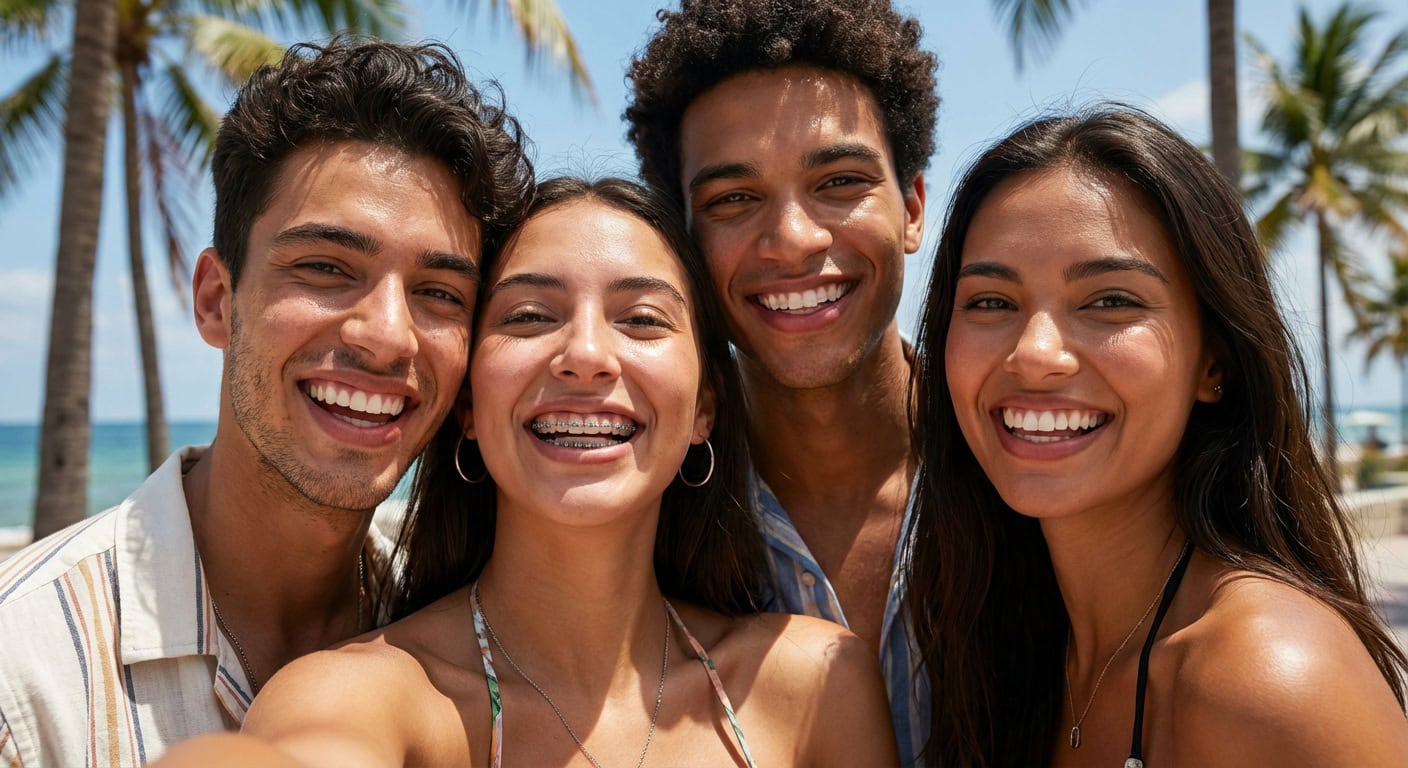

Braces vs Invisalign for Teens in Broward County
Your teenager needs orthodontic treatment, and you're standing at a crossroads.
Braces or Invisalign?
Both work.
Both straighten teeth.
But they're wildly different in how they get the job done.
One's been around for decades and handles the gnarliest cases.
The other is nearly invisible and fits into a busy teen lifestyle.
The question isn't which one is objectively better.
It's which one is better for your kid's specific situation, budget, and life.
Let me walk you through what actually matters when making this choice for teens in Broward County.
The Real Difference Between Braces and Invisalign for Teens
Here's the thing about braces: they've been perfecting the art of teeth straightening for over a century.
Metal brackets get cemented to each tooth.
Wires run through them.
They pull teeth into position with constant, unrelenting force.
That's why orthodontists reach for braces when dealing with severe crowding, significant bite problems, or teeth that need serious rotation.
If your teen has an overbite that needs correction or teeth packed so tight they barely fit in the mouth, braces are the heavy hitter you need.
We offer metal braces, ceramic braces that blend in better, self-ligating options that reduce friction, and even gold braces for patients wanting something unique.
All of them work the same way: constant, reliable pressure that doesn't depend on the patient remembering anything.
Invisalign takes a completely different approach.
Clear plastic aligners slowly nudge teeth into place.
Your teen gets a new set every week or two.
Each set is slightly different, moving teeth bit by bit toward the goal.
The big selling point?
Nobody knows they're there.
For teens who care about their appearance during school, sports, or social situations, this matters.
A lot.
Invisalign Teen includes compliance indicators that change color as the aligner gets worn, so you know if your kid is actually wearing them.
We also offer SMILE-FX clear aligners and nighttime options for teens who want treatment that works while they sleep.
When Your Teen Needs Braces (Not Invisalign)
Look, Invisalign is cool.
But it has limits.
If your teenager's case falls into these categories, braces are the right call:
Severe crowding where teeth overlap significantly.
Significant bite corrections like deep overbites or underbites.
Teeth that need major rotation.
Cases requiring Phase 1 orthodontics for younger teens whose jaws are still growing.
Complex situations where multiple issues need fixing at once.
At SMILE-FX, we use AI-precision placement to position brackets with computer accuracy.
This means better control, faster treatment, and more predictable results.
Your teen's treatment typically takes 18 to 36 months depending on complexity.
We also offer cutting-edge technology that lets you track progress in real time.
When Invisalign Makes Sense for Your Teen
On the flip side, Invisalign for teens shines in specific situations.
Your teen has mild to moderate spacing or crowding issues.
They care about aesthetics and won't feel confident in braces.
They play sports and need the ability to remove aligners during games or practice.
They want a shorter treatment timeline (typically 12 to 24 months).
They're disciplined enough to wear aligners 20 to 22 hours daily.
Invisalign works through gentle, progressive pressure.
Some teens feel more comfortable with this approach than the tighter sensation of braces.
Your aligner plan gets backed by 3D digital planning, so you see the projected end result before treatment even starts.
No surprises.
Just predictable, step-by-step movement toward a straight smile.
Cost Comparison: What You'll Actually Pay
Price matters, and I'm not going to dodge it.
Metal braces in Broward typically run 4,500 to 7,500 dollars depending on case complexity.
Invisalign treatment ranges from 3,800 to 6,500 dollars.
The cost depends on how many aligners you need, how long treatment takes, and the severity of the case.
Here's what most families don't know: we maximize your insurance benefits.
If your plan covers orthodontics, we handle the paperwork and bill your insurance directly.
We also offer zero percent financing, so you're not choosing between straight teeth and paying your mortgage.
And here's the kicker: with Invisalign treatment, you get free retainers and teeth whitening included.
That's value that extends way beyond the initial treatment.
Why Broward County Families Choose SMILE-FX
Look, there are a lot of orthodontists in South Florida.
Many general dentists will push you toward their aligner partner and take a cut.
That's not how we operate.
Dr. Tracy M. Liang is a board-certified orthodontic specialist with the credentials and experience to handle any case, from simple spacing to complex jaw alignment issues.
We're not a high-volume aligner factory.
We're an actual orthodontic practice with in-house technology, digital imaging, and treatment planning.
That means when something needs adjustment, we handle it immediately, not weeks later.
Parents from across Broward County make the drive to see us in Miramar.
Pembroke Pines is 10 minutes away via I-75.
Hollywood families reach us in 20 minutes on Stirling Road.
Weston is 15 minutes out.
Davie, Cooper City, and Fort Lauderdale residents all choose us because the drive is worth the expertise.
We're located near top schools like Miramar High and Pembroke Pines Charter, and we schedule after-school appointments specifically for teenagers.
No missing class.
No complicated logistics.
Check out our interactive map and location details to see exactly where we are and route from your home.
The Technology That Sets Us Apart
Most orthodontists use standard equipment from 20 years ago.
We invested in cutting-edge technology that makes treatment faster, more accurate, and more comfortable for teens.
Digital 3D imaging shows us exactly what's happening with your teenager's bite and jaw alignment.
AI-guided bracket placement removes human error from the equation.
Real-time progress tracking means your teen can literally watch their smile transform on a screen.
This isn't fancy fluff.
It's the difference between a good result and a genuinely outstanding result.
Learn more about our VIP Tech approach here.
City-Specific Advice for Broward Teens
Different neighborhoods, different needs.
Pembroke Pines athletes tend to choose Invisalign because they can pop it out for soccer, football, or whatever sport they're playing.
Easy removal, easy wear, easy maintenance.
Hollywood teens who spend time at the beach often do better with braces since they're more durable and won't get lost in sand or water.
We schedule evening appointments to fit their schedule.
Weston families with high-achieving students typically prefer discreet ceramic braces that blend in but provide the control of metal braces.
Best of both worlds for the Instagram generation.
Davie equestrian families love our quick, efficient visits because barn life means schedules are tight.
We get in, check progress, make adjustments, and get you back on the road.
Fort Lauderdale professionals and their teens often choose nighttime aligners or quick lunchtime appointments.
Urban life moves fast, and we accommodate that.
What Actually Happens During Treatment
Let's say your teen chooses braces.
First appointment: we do a full exam, take X-rays, and plan the entire treatment.
Next appointment: we clean the teeth and bond brackets.
The first few days are uncomfortable.
Ibuprofen helps.
By day five or six, your teen adjusts.
You'll come back every 4 to 8 weeks for adjustments and wire changes.
Each visit takes 30 to 45 minutes.
Total treatment is typically 18 to 24 months with our precision approach.
If your teen goes with Invisalign, the process is different.
We take a 3D scan of their teeth.
Software maps out every movement across dozens of aligners.
Your teen starts wearing the first one immediately.
They swap to a new aligner weekly.
Check-ups happen every 6 to 8 weeks instead of every 4 to 8 weeks.
Treatment time is usually 12 to 24 months, sometimes shorter depending on the case.
Handling Teen Compliance and Motivation
Here's where reality hits.
Braces require no compliance from the patient.
They're on.
They stay on.
Your teenager can't forget to wear them or remove them at inconvenient times.
This is why braces are the safer bet if compliance is questionable.
Invisalign requires discipline.
20 to 22 hours a day, every day, for over a year.
Teens who love video games and forget dinner is ready are not reliable Invisalign candidates.
That said, if your teen understands the commitment and wants the aesthetic benefit, they often rise to the challenge.
Invisalign Teen's compliance indicators help parents know what's actually happening.
We have a Smile Quiz on our patient resources page that helps you figure out which option fits your teen's personality and habits better.
It's worth taking.
The Post-Treatment Reality
Treatment ends.
Braces come off or the last aligner goes back in the drawer.
Now what?
Retainers.
Your teenager needs to wear a retainer, probably for life.
We provide free retainers with treatment, and they're custom-fitted to hold everything perfectly.
Many teens wear them at night permanently.
Some wear them full-time for the first year, then nights only.
This isn't negotiable if you want that straight smile to stay straight.
Teeth want to move back to their original position.
Retainers prevent it.
Everything You Actually Want to Know
How fast can braces straighten teeth?
Treatment typically takes 18 to 36 months depending on case complexity.
Our advanced technology often shortens that timeline.
Will my teen's sports get affected by braces?
No, but a mouthguard is mandatory during contact sports.
Invisalign can be removed for games and practices, which some athletes prefer.
How do I know if my teenager is ready for braces or Invisalign?
Most permanent teeth should be in by age 12.
Some cases benefit from earlier intervention during Phase 1 orthodontics, which we evaluate starting at age 7.
What happens if braces break?
Call us immediately.
We fit emergency appointments and repair or replace broken brackets the same day if possible.
Are aligners really invisible?
Virtually invisible if your teen isn't pressing their face against someone else's.
At typical conversation distance, most people won't notice.
Making the Final Decision
This comes down to three things: case severity, lifestyle, and personality.
Severe orthodontic issues need braces.
Active teens with mild-to-moderate cases often thrive with Invisalign.
Disciplined teens commit to aligners.
Teens who forget their keys daily need braces' reliability.
At SMILE-FX, we don't push one option over the other because we're partnered with an aligner company.
We honestly evaluate your teen's case and recommend what actually works.
That's the difference between a specialist and everyone else.
Ready to get your teenager's smile on track?
Book a free 3D scan and VIP smile consultation here.
We'll evaluate their case, explain both options clearly, and help you make an informed decision.
No pressure, no upsell, just honest orthodontics from a board-certified specialist.
See what our patient reviews say about our approach, and explore all the cases we treat at SMILE-FX.
Orthodontic Treatment for All Ages: Beyond Teens in Broward County
You think braces and aligners are just for teenagers.
Wrong.
Adults get them.
Kids get them.
People in their 60s get them.
The age thing doesn't matter as much as you think it does.
What actually matters is understanding that your teeth can move at any stage of life, and modern orthodontics has options for literally everyone.
Why Adults Are Finally Getting Braces and Clear Aligners
There's this weird stigma around adult orthodontics.
Like you missed your window and now you're stuck with crooked teeth forever.
That's garbage.
More adults start orthodontic treatment every year than teenagers do.
They're done waiting.
They're done hiding their smile in photos.
They're done feeling self-conscious at work or on dates.
The difference between now and 20 years ago?
Options exist that actually work for busy adult lives.
Adults pick clear aligners more than any other treatment type.
Why?
They're invisible.
Nobody at your job needs to know you're straightening your teeth.
You pop them out for important meetings.
You eat whatever you want without worrying about food getting stuck in brackets.
You don't look different in your LinkedIn photo or your company holiday party.
That said, plenty of adults choose braces too.
They like the reliability.
They like not thinking about compliance.
They like the fact that someone can't convince them to skip wearing them because they're tired or busy.
Kids Need Different Treatment Than Teens
Here's where it gets interesting.
A seven-year-old's mouth is completely different from a teenager's mouth.
Their jaw is still growing.
Their baby teeth are still falling out.
Their permanent teeth are still coming in at random angles.
Phase 1 orthodontics is designed specifically for this chaos.
It's not about making their teeth perfectly straight.
It's about guiding their jaw development so when all the permanent teeth come in, you've already fixed half the problem.
Phase 1 typically runs from age 7 to 10.
Then you wait.
Then around age 12 or 13, you do Phase 2 to finish the job.
Does every kid need Phase 1?
No.
Some kids' teeth come in fine naturally.
Some cases are mild enough to wait.
But if your kid has a serious underbite, an open bite, or severe crowding, starting early saves time and money in the long run.
It's the difference between spending 18 months straightening teeth that are already in the right position versus spending 36 months fighting against a jaw that's growing in the wrong direction.
At SMILE-FX Orthodontic & Clear Aligner Studio, we evaluate kids starting at age 7.
We take X-rays, do a real assessment, and tell you straight up whether early treatment helps or whether waiting is fine.
No pressure to treat kids who don't need it.
But for the ones who do, catching it early changes everything.
What Changes When You're an Adult
Adult teeth don't move quite as fast as teen teeth.
That's just biology.
Bones harden.
Density increases.
It takes slightly longer to shift teeth into position.
We're talking weeks to months longer, not years.
But here's what's different about treating adults: they actually follow instructions.
Adults who get Invisalign for adults wear their aligners.
They don't lose them at parties.
They don't forget them at a friend's house.
They understand the cost and the commitment, so they stick with it.
This is why adult Invisalign cases often finish faster than teen cases even if biology says they should be slower.
Adults also have jobs that matter.
They can't take off work every month for adjustments.
So we space appointments further apart when possible.
We schedule early morning or evening appointments.
We work with your calendar instead of forcing you to work with ours.
Gum Health and Bone Density Matter More as You Get Older
This is real talk that most orthodontists won't tell you upfront.
If you're an adult considering orthodontics, your gum health matters.
A lot.
Healthy gums.
Strong bone structure.
No untreated cavities.
No advanced gum disease.
If you've got serious periodontal issues, you might need to address those before we straighten your teeth.
We're not being difficult.
We're protecting your investment.
Moving teeth without healthy gums is like renovating a house with a crumbling foundation.
You can do it, but it won't last.
At SMILE-FX, we work with your dentist to make sure your foundation is solid before we start moving teeth around.
The bone density thing is less dramatic but still important.
Adults have denser bone than kids.
That means teeth move slightly slower.
It also means the results tend to be more stable long-term because the bone hardens faster once the tooth reaches its new position.
Kids' bone is softer and more flexible, which lets teeth move faster but also means they can shift back slightly if you skip wearing retainers.
The Cost Question for All Ages
Treatment cost doesn't change much based on age.
A 35-year-old paying for braces pays roughly the same as a 15-year-old.
A 60-year-old doing clear aligners pays the same price as a 25-year-old.
What does change is insurance coverage.
Most dental insurance covers orthodontics for kids and teens up to a certain age.
Coverage drops off around 18 or 19 in many plans.
Some plans don't cover it at all for adults.
Some cover it fully regardless of age.
We handle this with real talk.
We check your coverage upfront.
We show you exactly what your insurance pays for and what comes out of your pocket.
We offer flexible payment plans because we know orthodontics is expensive.
We also work with major insurance providers to maximize your benefits.
Invisalign for Kids Is Different Than Invisalign for Adults
Invisalign makes a product called Invisalign First for kids ages 6 to 9.
It accounts for baby teeth still falling out.
It accounts for teeth coming in at weird angles.
It's literally designed for the chaos of a child's developing mouth.
Invisalign Teen exists for ages 10 to 18.
It includes those compliance indicators we mentioned that change color so parents can see if their kid is actually wearing them.
Regular Invisalign is for adults and older teens.
No indicators.
No special accommodations for growth.
Just clear aligners that do what they're supposed to do.
The process is basically the same across all three versions: 3D scan, digital planning, custom aligners, weekly changes, progress appointments every six to eight weeks.
The difference is in the details and how much we account for ongoing growth.
Bite Problems That Affect Everyone
Some orthodontic issues show up at every age.
An overbite at seven looks different than an overbite at 47, but both need fixing.
An underbite causes jaw pain in teenagers and adults alike.
Crowded teeth create cleaning problems whether you're 12 or 62.
We treat all of these across all ages.
The cases we treat aren't limited to a certain demographic.
We handle:
Overbites and underbites at any age.
Crossbites that can cause uneven wear on your teeth.
Open bites that affect how you chew.
Spacing issues whether they're from missing teeth or just gaps that appeared.
Crowding that makes flossing nearly impossible.
The treatment approach changes based on age and individual factors, but the goal is the same: a bite that works, teeth that are straight, and a smile you actually want to show off.
Why Some Adults Wait Too Long
People delay adult orthodontics for dumb reasons.
They think they're too old.
They think their teeth won't move.
They think they'll look ridiculous.
They think it's pointless because they've lived with crooked teeth this long.
None of that holds up to reality.
You're not too old at 40 or 50 or 60.
Your teeth will move.
With clear aligner options, you won't look ridiculous.
And the "I've lived with it this long" argument is the worst one because it basically means accepting preventable problems forever.
Crooked teeth create real issues.
They're harder to clean, so you get more cavities.
They wear unevenly, so one side of your mouth degrades faster.
They can cause jaw pain and headaches.
They affect your bite alignment.
Fixing them at 45 beats waiting until you're 65 and dealing with serious dental problems that could have been prevented.
What You Actually Experience During Treatment at Any Age
The first appointment is the same whether you're seven or seventy.
We do a full exam.
We take X-rays and 3D scans.
We talk about your goals, your lifestyle, your concerns.
We explain exactly what we'd recommend and why.
No pressure.
No sales pitch.
Just an honest assessment.
If you move forward, the process depends on what you choose.
Braces get bonded on.
Clear aligners get fabricated.
You come back for check-ups every four to eight weeks for braces or every six to eight weeks for aligners.
Each visit takes 30 to 45 minutes.
You follow care instructions.
You wear your retainer after treatment ends.
That's it.
That's the process at any age.
Kids' Sports and School Considerations
Kids with braces need mouthguards for contact sports.
Orthodontists will tell you this is annoying.
It's not.
It's protection.
A stray elbow in soccer can destroy your bracket setup and cost you weeks of setback.
A proper mouthguard prevents that entirely.
Invisalign for kids removes the mouthguard problem.
They pop out aligners for practice and games.
They put them back in after.
Tons of young athletes prefer this because they don't have to deal with the physical sensation of a mouthguard over brackets.
School is another thing.
Kids with braces sometimes feel self-conscious.
It's a real feeling even if the actual number of people who care is basically zero.
Clear aligners solve this problem completely.
Nobody notices.
Teen-Specific Issues That Differ From Adults
Teenagers are socially aware in ways that 8-year-olds aren't.
An 8-year-old doesn't care if their friends have braces.
A 14-year-old absolutely does.
This is why aesthetic options matter more for teens than younger kids.
Teenagers also have crazy schedules.
School, sports, social life, part-time jobs, college prep.
They forget appointments.
They lose things.
They need reminders.
This is why braces' "set it and forget it" approach sometimes works better for teenagers than Invisalign does, even though Invisalign seems like the obvious choice.
Teenagers also rebel against things their parents want them to do.
If your teen doesn't want braces, they'll fight you every day.
If they choose Invisalign because they want it, they'll wear it without complaining.
This psychological piece matters more than people think.
Senior Orthodontics Is Becoming More Common
You're never too old to straighten your teeth.
Seniors get orthodontic treatment for lots of reasons.
They want to look better for retirement photos.
They want to fix bite problems that have been causing jaw pain for decades.
They want to address teeth shifting that happened after they lost some teeth to decay.
Treatment moves slightly slower because of bone density, but it works just as well.
Seniors often prefer clear aligners because they fit into a lifestyle that's less rushed than a teenager's.
They can wear them all day without worrying about school or social situations.
They usually have better compliance than younger patients.
The main difference for seniors is coordination with their general dentist and any existing health conditions.
We work closely with your primary care provider to make sure orthodontics doesn't interfere with medications or other treatments.
How Dr. Tracy M. Liang Approaches Different Ages
Dr. Liang is a board-certified orthodontic specialist.
That credential means something.
It means years of additional training beyond dental school specifically focused on moving teeth and correcting bites.
It means understanding the unique challenges of treating kids, teens, and adults.
Dr. Liang doesn't treat every age the same.
A seven-year-old gets a completely different treatment approach than a seventeen-year-old, who gets a different approach than a seventy-year-old.
The principles are the same.
The execution changes based on what their mouth actually needs.
Technology Makes Age Less of a Factor
The cutting-edge technology at SMILE-FX works at any age.
3D scanning shows us exactly what's happening in your mouth whether you're 8 or 80.
AI-guided bracket placement works on an adult jaw just like it works on a teen jaw.
Real-time progress tracking lets patients of any age see how their treatment is progressing.
The tech doesn't care about age.
It cares about biology.
And biology responds to proper force application at any stage of life.
Insurance and Age
This is the practical piece nobody wants to think about.
Most insurance covers kids and teens.
Coverage drops for adults.
Some plans won't touch adult orthodontics.
Some will cover it at 50 percent.
Some will pay for specific treatments but not others.
We maximize whatever coverage you have.
If you've got zero coverage, we offer financing that doesn't destroy your budget.
The cost shouldn't be the reason you don't get treatment.
We make it work.
What Parents Actually Worry About With Kids and Braces
Parents ask us constantly: Will braces hurt?
Will my kid hate them?
Will they get cavities?
Will treatment take forever?
Braces don't hurt.
They create pressure and some discomfort the first few days, then your mouth adapts.
Kids adjust faster than you'd think.
Cavities are only a problem if your kid doesn't brush, which should be happening anyway.
Treatment takes as long as the case requires, but our technology usually shortens that timeline.
The real worry parents should have is about whether they're making the right choice between braces and aligners for their specific kid.
That's where talking to someone who actually knows what they're doing matters.
Questions People Ask About Treating Different Ages
Can my 6-year-old get braces?
Not usually.
Most kids need their adult teeth to come in first.
Some cases benefit from early intervention with Phase 1 treatment, but that's different from getting full braces at six.
Is 25 too old to start orthodontics?
No.
This is actually a common age to start because people finally have jobs and money and decide their smile matters.
Will orthodontics affect my teenager's growing jaw?
It can be part of guiding jaw growth when done early.
But by the time most teens are getting orthodontics, jaw growth is mostly done.
We account for any remaining growth in our treatment plan.
Can I get Invisalign at 55?
Absolutely.
Age doesn't change how clear aligners work.
It might add a couple months to treatment, but it works just fine.
Do I need permission from a parent if I'm 18?
No.
At 18 you can start any treatment you want.
Some of our best patients started orthodontics in college because they finally had autonomy over their own decisions.
The Real Takeaway About Age and Orthodontics
Age matters less than you think.
What actually matters is case complexity, your goals, your lifestyle, and your willingness to follow through with treatment.
A 12-year-old with a simple spacing issue is easier to treat than a 45-year-old with severe crowding and a bite problem.
A 70-year-old with good gums and bone density can get results just as good as a 25-year-old.
SMILE-FX treats kids, teens, and adults.
We treat cases at every stage of life because teeth can move at any age and your smile matters no matter how old you are.
Whether you're a parent trying to figure out what your kid needs or an adult finally deciding to fix your own teeth, the first step is the same: honest evaluation by someone who actually knows what they're doing.
Book a FREE 3D scan and VIP smile consultation.
We'll figure out exactly what your mouth needs and whether that's braces, aligners, or something else entirely.
No charge to find out.
No pressure to start if you're not ready.
Just real answers from a board-certified orthodontist who treats people of every age.
Your age isn't an excuse to live with teeth you don't like.
Orthodontic treatment for kids, teens, and adults works.
Let's make your smile what you actually want it to be.
Beyond Straightening Teeth: What You Really Need to Know About Getting Braces or Invisalign in South Florida
You're thinking about getting your teeth straightened.
Maybe it's for you, maybe it's for your kid.
Either way, you've got questions that go beyond just "braces or aligners."
You want to know what actually changes in your life.
What does treatment really feel like.
How much you're actually paying after insurance.
Whether you'll regret waiting this long.
The real stuff nobody talks about until you're already committed.
Let's cover the stuff that matters for anyone in South Florida considering orthodontics.
What Actually Changes When You Start Treatment
Your mouth gets more sensitive for a bit.
That's real.
Brackets or aligners are foreign objects.
Your mouth adapts, usually in a week or two.
Your teeth hurt when you bite down the first few weeks.
Ibuprofen handles it.
Your speech might change slightly if you go with clear aligners.
Most people report this goes away in three to five days.
Your eating habits shift because certain foods get stuck or break brackets.
This isn't permanent, it's just part of the process.
What doesn't change?
Your ability to function.
You go to work, school, the gym, everywhere you normally go.
You're not sidelined.
You're not limited beyond avoiding hard candy and popcorn if you've got traditional braces.
The Insurance Game and What It Actually Covers
Here's where most people get blindsided.
You think insurance covers orthodontics.
Sometimes it does.
Sometimes it covers 50 percent.
Sometimes there's an annual maximum, meaning they'll pay up to $1,500 per year then you're on your own.
Some plans have waiting periods.
Some exclude certain types of treatment.
The best orthodontist in South Florida doesn't mean much if you can't afford it.
That's why understanding your coverage before you start matters.
We pull your insurance info and tell you exactly what you're paying and what insurance covers.
No surprises three months in.
If you're in Broward County or anywhere from West Palm Beach to Miami, affordable braces options exist.
We offer financing with zero percent interest.
We offer payment plans that match your budget.
Getting your smile right shouldn't require choosing between straight teeth and paying rent.
Why People Wait Way Too Long to Start Treatment
Adults delay orthodontics for years.
They tell themselves they're too busy.
Their kids' sports take priority.
Work is crazy right now.
They'll do it next year when things calm down.
Here's what happens next year: it's still crazy.
Five years later they're wishing they'd started back then because their teeth have shifted more and the case is harder to fix.
The best time to start orthodontics was probably five years ago.
The second best time is right now.
Not next month.
Not when work settles down.
Now.
Your teeth are going to shift whether you do something about it or not.
They're going to get harder to clean.
You're going to have more cavities.
Your bite is going to feel different.
Starting treatment might take 18 to 24 months but at least you're investing in your teeth instead of letting them deteriorate.
The Hygiene Question That Matters More Than You Think
Orthodontics works best when you can actually clean your teeth.
This is why gum health matters so much.
If you've got traditional braces, you're cleaning around brackets.
It's annoying at first.
You learn the technique.
It becomes normal.
Clear aligners are easier to clean around because you just pop them out.
But here's the catch: you've got to pop them out to clean your teeth properly.
If you're wearing aligners 20 hours a day and only taking them out to eat, your teeth aren't getting the cleaning they need between meals.
The best teeth straightening in the world doesn't matter if you get cavities during treatment.
We recommend brushing after meals, flossing daily, and if you've got braces near me or aligners, rinsing with water after meals so food doesn't sit between your teeth.
What Happens to Your Bite During Treatment
Your bite might feel weird for a bit.
Some people report they can't bite down properly the first week.
Your teeth are moving.
Your bite is changing.
This is normal.
It settles.
By month three or four, your bite stabilizes into its new position.
You stop thinking about it.
You chew normally again.
If something feels off after that point, that's when you call and we make an adjustment.
The whole point of straightening your teeth is to fix your bite so you can chew properly and your teeth wear evenly over time.
That's not just cosmetic stuff.
That's health stuff.
Choosing Between Getting Braces Done by a Dentist vs an Orthodontic Specialist
This matters way more than you'd think.
A dentist can technically place braces.
They put brackets on teeth.
But your teeth are complex.
Your bite is complex.
Your jaw might be growing.
Your teeth might need to move in three dimensions, not just forward and back.
A board certified orthodontist spent two to three years after dental school learning specifically how to move teeth and correct bites.
That's not a marketing thing.
That's actual additional training.
For complex cases, for kids whose jaws are still growing, for anything beyond basic spacing issues, you want a specialist.
We're the top rated orthodontist in Miramar and across South Florida because we handle cases that general dentists refer to us when they realize the case is bigger than they can manage.
Does Insurance Cover Braces or Is It a Total Out of Pocket Cost
It depends on your plan.
Most insurance covers orthodontics for kids and teens.
Coverage typically caps at a certain amount, usually between $1,000 and $2,000 per year.
Adult coverage is hit or miss.
What we do is bill insurance first.
They pay their portion.
You pay the rest.
We don't hide the cost.
You know upfront what your share is.
If you're looking at affordable braces in South Florida or affordable braces in Broward, we're not going to charge you the same whether insurance covers you or not.
We price fairly and we finance for everyone.
The Teeth Whitening Question
Your teeth look slightly darker and discolored where the brackets were.
This is called demineralization.
It happens because it's harder to clean right under the bracket.
The good news?
It's temporary.
Once you get your braces off, you do a professional whitening and it goes away.
Some orthodontist near me practices include whitening in the package.
We do.
After your braces come off, you get professional-grade whitening as part of your treatment package.
If you went with clear aligners, you can whiten your teeth while you're in treatment.
You just pop out your aligners, do your whitening, and put them back in.
What About Sports and Activities During Treatment
Sports don't stop because you got braces.
Soccer, football, volleyball, wrestling, whatever you do, you keep doing it.
If you've got braces, you wear a mouthguard.
It's not optional if you're doing contact sports.
One accidental elbow to the mouth and you've got a bracket disaster.
Invisalign for teens playing sports is actually easier because they pop out the aligners during games and practices.
No mouthguard to worry about over the brackets.
If you're a swimmer, braces are fine.
Chlorine doesn't hurt them.
If you're a musician with wind instruments, you might have an adjustment period learning how to position your mouth with brackets, but tons of musicians wear braces without issues.
The Retainer Situation Nobody Prepares You For
Your braces come off or your last aligner goes away.
Your teeth are straight.
Now what?
Retainers.
Forever.
Not forever like 24/7 forever.
But forever like for the rest of your life.
Your teeth want to shift back to where they came from.
That's how teeth work.
Retainers prevent it.
We give you retainers as part of your treatment.
You wear them full time the first few months, then most people switch to nights only.
Some people wear them every night forever.
Some people get to a point where they wear them a few nights a week.
The people who skip retainers start seeing tooth movement within weeks.
It's not worth it.
Get your retainers made, wear them like instructed, and your straight teeth stay straight.
SureSmile Orthodontist South Florida and Technology That Matters
Not all orthodontist south florida practices use the same technology.
Some practices use equipment from 15 years ago.
Some practices invest in systems that actually improve treatment outcomes.
We use cutting edge technology that scans your teeth in 3D, maps out exactly where they need to go, and uses AI to guide bracket placement with computer precision.
This isn't flashy stuff for marketing.
This is stuff that actually makes treatment faster and more accurate.
When you get treatment from the best orthodontist for complex cases, the technology matters because it handles the details that determine whether your bite ends up perfect or just okay.
The Cost Conversation You Need to Have Before Starting
Braces cost between $4,500 and $7,500 depending on complexity.
Clear aligners cost somewhere between $3,800 and $6,500 depending on how many aligners you need and how long treatment takes.
These aren't random numbers.
They're based on what the treatment actually requires.
A simple spacing issue costs less than severe crowding with a bite problem.
A short treatment timeline costs less than a long one.
We quote your case specifically.
You're not paying for someone else's complex case.
Invisalign cost South Florida questions come up constantly.
The cost depends on your case.
We show you a treatment plan, we quote it, you know what you're paying before you start.
No surprise invoices three months in.
Why Your Orthodontist Choice Matters More Than You're Thinking
You can get braces from your general dentist, from a dental chain, or from a specialist.
The price might be similar.
The results won't be.
Your teeth are on your face.
You look at them in the mirror every day for the rest of your life.
This isn't where you cut corners to save $500.
A board certified orthodontist south florida has credentials that mean something.
We're not general dentists with a side gig placing brackets.
We trained specifically for this.
Our patient reviews speak for themselves.
People come from across South Florida, from West Palm Beach to Miami, because they trust the results.
What to Expect at Your First Consultation
You call and book a consultation.
We take 3D scans of your teeth and jaw.
We evaluate your bite.
We talk about what you want your smile to look like.
We show you what we'd recommend and why.
This takes about 45 minutes.
You leave knowing exactly what your treatment would entail, how long it takes, and what it costs.
No pressure to start that day.
No high-pressure sales tactics.
Just straight talk about your teeth.
If you've got questions about traditional braces vs invisalign, we answer them.
If you're wondering whether orthodontist near me means you or someone else, we clarify.
If you want to know about braces near me options, we go through them.
The Real Reason to Start Orthodontics Now
Your teeth aren't getting straighter on their own.
Your bite isn't fixing itself.
You're not waking up one day with perfect teeth.
Waiting costs time.
Time you could have spent with a straight smile.
Time your teeth could have been healthy instead of hard to clean.
Start now.
Get treatment done.
Wear your retainer.
Enjoy your straight smile for the next 50 years.
Ready to stop thinking about it and actually do it?
Book a FREE 3D scan and VIP smile consultation.
We handle everything from affordable braces in Broward to complex bite corrections for adults and kids.
No charge to find out what your smile needs.